REVIEW 4 major objections 5 minor 1 cited by
First-principles prediction into robust high-performance photovoltaic double perovskites A$_{2}$SiI$_{6}$ (A = K, Rb, Cs)
T0 review · 4 major / 5 minor · reviewed 2026-08-14 · deepseek-v4-flash
Pith's one-line read First-principles calculations predict that three silicon-based double perovskites—K$_2$SiI$_6$, Rb$_2$SiI$_6$ and Cs$_2$SiI$_6$—are direct-gap, lead-free solar absorbers.
desk verdict A genuine first-principles screen of a new Si-based double-perovskite family, but the abstract oversells the band gaps and the stability test omits the obvious competing phases. read the letter →
The pith
A machine-rendered reading of the paper's core claim, the machinery that carries it, and where it could break.
The reading
What carries the argument
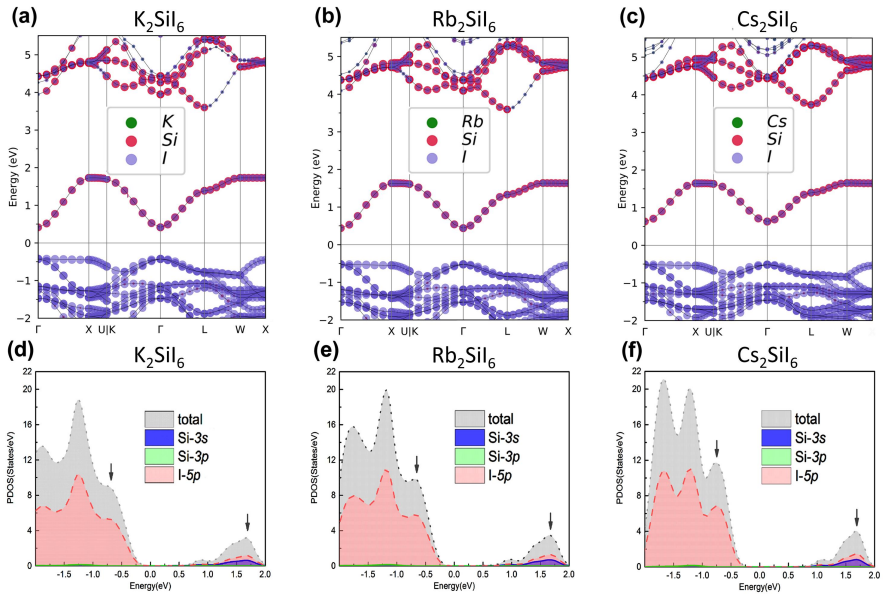
The central object is the vacancy-ordered double-perovskite structure in space group $Fm\bar{3}m$, formula A$_2$BX$_6$, in which half the B-site octahedra are empty and the remaining [BX$_6$]$^{2-}$ octahedra are isolated, with A cations occupying the voids between them. The argument is carried by the electronic structure of the [SiI$_6$]$^{2-}$ unit: Si-$3s$ and I-$5p$ states hybridize into a wide, isolated lower conduction band and I-$5p$-dominated valence bands, and the A-site cation sets the lattice size that tunes the gap. The calculations use a screened hybrid density functional plus spin-orbit corrections for band gaps, effective masses, and optical spectra, and they use parity and transition dipole moments at the zone centre to identify which band-to-band transitions are optically allowed. Stability is established from decomposition enthalpies, elastic constants, and finite-temperature molecular-dynamics trajectories.
What would settle it
Synthesize K$_2$SiI$_6$ or Rb$_2$SiI$_6$ and measure the crystal structure, band gap, and optical absorption. If X-ray diffraction shows a structure other than $Fm\bar{3}m$, if the measured gap is far outside the predicted 0.7–1.2 eV range, or if the strong absorption onset is far from the predicted 1.57–1.73 eV allowed transition, the central prediction fails.
Extended reading notes
Core claim
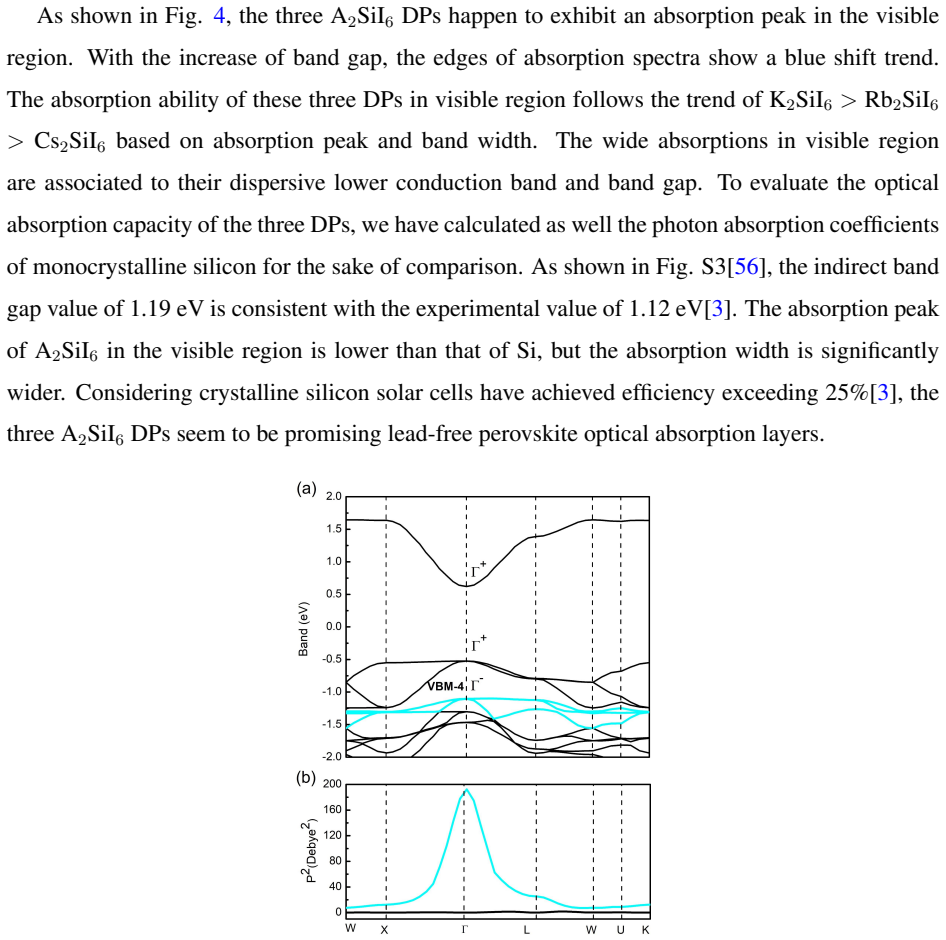
The central claim is that A$_2$SiI$_6$ (A = K, Rb, Cs) form a previously unstudied class of inorganic double perovskites with photovoltaic-grade electronic structure. All three are direct-gap semiconductors, with hybrid-functional gaps of 0.84 eV (K), 0.96 eV (Rb) and 1.15 eV (Cs), and the gap rises with A-site cation size and with halogen electronegativity across the wider A$_2$SiX$_6$ series. The lower conduction band is an isolated, dispersive band built from Si-$3s$ and I-$5p$ states, giving electron effective masses of 0.17–0.23 $m_0$ while holes are heavier, which the authors read as making these materials n-type-oriented absorbers. A parity analysis at the zone centre shows the direct transition between the valence-band maximum and the conduction-band minimum is dipole-forbidden, so the optical absorption is carried by an allowed transition from a lower valence band, with dipole-allowed gaps of 1.57–1.73 eV. Positive decomposition enthalpies (41–76 meV per atom), elastic constants satisfying the cubic stability criteria, and 400 K molecular-dynamics stability for K$_2$SiI$_6$ and Rb$_2$SiI$_6$ underpin the stability claim.
Load-bearing premise
The predictions assume the compounds crystallize in the cubic vacancy-ordered double-perovskite structure and that their only relevant decomposition is into ASiI$_3$ plus AI$_3$; no competing crystal structures or other decomposition products are tested.
Editorial extensions
If this is right
- If K$_2$SiI$_6$ and Rb$_2$SiI$_6$ can be synthesized, they are concrete lead-free, silicon-based candidates for perovskite solar-cell absorbers.
- The predicted gaps fall in the 0.9–1.2 eV rear-cell window used for perovskite-perovskite tandem devices, and K$_2$SiI$_6$'s allowed optical transition at 1.57 eV sits close to the single-junction detailed-balance optimum.
- The small electron effective masses imply fast electron transport, so devices built from these absorbers should be designed to collect electrons preferentially.
- Cs$_2$SiI$_6$'s predicted dynamic instability at 300–400 K means experimental effort should concentrate on the potassium and rubidium members.
- A successful synthesis of any member would give experimenters a benchmark for the hybrid-functional prediction and open the wider A$_2$SiX$_6$ family to compositional tuning.
Reading between the lines
- Because the predictions are benchmarked against other vacancy-ordered double perovskites rather than against any measured silicon double perovskite, the absolute band gaps carry a calibration uncertainty that a single optical measurement would resolve.
- The parity-forbidden direct edge implies the nominal band gap is not the absorption onset: devices would absorb through the allowed transition at 1.57–1.73 eV, so sub-gap absorption and defect behaviour deserve direct study.
- The monotonic gap trends across cation and halogen suggest that alloying, for example K/Rb mixing or I/Br mixing, could tune the gap across the 0.8–1.2 eV range, possibly even stabilizing the cesium member.
- The effective-mass asymmetry points toward n-type transport, but the paper does not compute dopability or defect levels, so the actual carrier polarity in a working device could differ.
Signed reviews
Editorial analysis
A structured set of objections, weighed in public.
Referee Report
Summary. The paper uses first-principles DFT (PBE/PBEsol for structure, HSE06 for electronic and optical properties) to predict that the vacancy-ordered double perovskites A2SiI6 (A = K, Rb, Cs) have direct band gaps of 0.84–1.15 eV, small electron effective masses, visible-region absorption, and favorable thermodynamic and dynamic stability, and it proposes them as lead-free, earth-abundant absorber candidates for perovskite solar cells. The manuscript also reports elastic constants, decomposition enthalpies against a single product set, 400 K molecular dynamics for K and Rb, Bader/Mulliken charges, and a parity analysis showing that the fundamental direct gap is dipole-forbidden with allowed optical transitions at 1.57–1.73 eV. The central claim is that K2SiI6 and Rb2SiI6, in particular, are synthesizable and promising photovoltaic absorbers.
Significance. If the stability and optical-gap claims survive scrutiny, the paper would identify two lead-free, earth-abundant vacancy-ordered double perovskites with allowed optical gaps (1.57–1.73 eV) in a useful range, small electron effective masses (0.17–0.23 m0), and visible absorption; the explicit parity analysis is a useful caution against screening on fundamental gaps alone. The manuscript is genuinely predictive rather than fitted: no parameters are tuned to target properties, HSE06 and the Shockley–Queisser limit are adopted from standard external benchmarks, and the band gaps, masses, and absorption spectra are computed. However, the significance is conditional on two load-bearing issues: the thermodynamic stability is tested only against a nonstandard decomposition product set, and the abstract's headline band-gap range misrepresents the optically relevant gaps. The paper also transparently reports that Cs2SiI6 is dynamically unstable, which narrows the family-level stability claim but is a point in favor of the authors' honesty.
major comments (4)
- [Abstract and §III (band gaps)] The headline 'suitable band gaps of 0.84–1.15 eV' in the Abstract, and the screening discussion in §III that 'we here have screened three candidates,' report the fundamental direct band gaps, but the manuscript itself shows these transitions are parity-forbidden (Fig. 5 and the text 'the direct transition from VBM to CBM is forbidden'). The dipole-allowed optical transitions are 1.57 eV (K2SiI6), 1.63 eV (Rb2SiI6), and 1.73 eV (Cs2SiI6). Since the Shockley–Queisser analysis, the 'wide photon absorption in the visible range' claim, and the comparison to MAPbI3 all depend on the optically allowed gap, the Abstract and the screening rationale must be rephrased around the allowed gaps; the current text overstates how close these materials are to the 0.9–1.5 eV ideal range.
- [§III, Eq. (4) and Table III] The thermodynamic stability test is defined only as ΔH = E(ASiI3) + E(AI3) − E(A2SiI6) in Eq. (4). This competing product set is nonstandard and appears to involve a redox decomposition (Si(IV) to Si(II), I(−I) to triiodide), rather than the oxidation-state-preserving binaries 2AI + SiI4. SiI4 is a known stable molecular solid and KI, RbI, and CsI are very stable ionic crystals, so the natural decomposition channel is 2AI + SiI4. The positive ΔH values in Table III (41–76 meV/atom) therefore do not establish stability with respect to known phases, and the 'robust high-temperature stability' claim collapses if the 2AI + SiI4 channel is exothermic. The authors should compute ΔH for 2AI + SiI4 (and preferably other competing products) before claiming synthesizability.
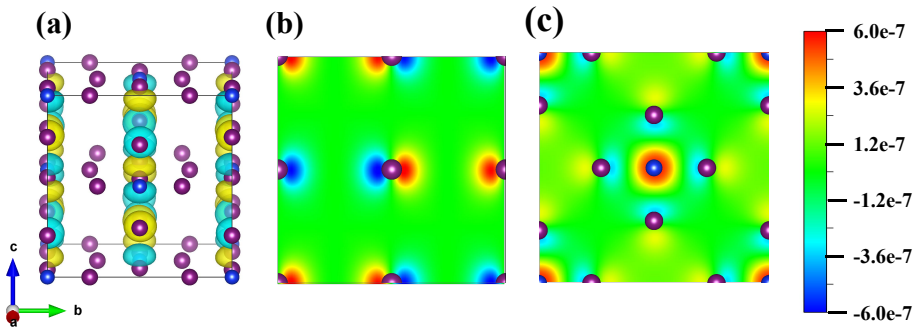
- [Abstract, §III, and §IV (family-level stability)] The Abstract's 'good stability at high temperature' is not supported for the whole A2SiI6 family: §III reports that Cs2SiI6 is dynamically unstable at both 400 K and 300 K (Fig. S4), leaving only K2SiI6 and Rb2SiI6 dynamically stable (Fig. 6). The Conclusion partially acknowledges this, but the Abstract and the opening of the Conclusion ('These three DPs exhibit excellent ... stable properties') do not. The claims should be restricted to the two stable members, and the Si–I covalency analysis (Table S2) should be presented as a prediction for why Cs2SiI6 fails rather than as a minor exception.
- [§III (structural assumption)] The entire prediction is predicated on the assumption that these compounds crystallize in the vacancy-ordered Fm3m double-perovskite structure (Fig. 1(a)). No search over competing polymorphs or alternative ordered vacancy arrangements is reported, and the only decomposition channel tested is Eq. (4). If the true ground-state structure of K2SiI6 or Rb2SiI6 is not the assumed Fm3m prototype, the computed electronic, optical, and stability properties do not apply. The authors should either scan plausible competing structures or explicitly state this limitation as a caveat on the 'first-principles prediction' claim.
minor comments (5)
- [Abstract] The first sentence is ungrammatical: 'Despite the exceeding 23% photovoltaic efficiency achieved in organic-inorganic hybrid perovskite solar cells obtaining' should be rephrased, and 'the stable materials with desirable band gap are rare and are highly desired' can be tightened.
- [§III (dielectric function)] In the paragraph introducing ε(ω), the phrase 'where ε1(ω) and ε2(ω) are the real and imaginary parts in several' is incomplete; it should state 'respectively' or otherwise finish the definition.
- [Table III] The column header 'mental Si I' should read 'elemental Si I', and the layout of the Bader and Mulliken charge columns is confusing because the elemental labels are repeated without clear separation between the two charge analyses.
- [References] Reference [3] (Battaglia et al.) lists a title that appears to belong to reference [4] (Stranks et al.); the citation titles should be checked against the actual sources. Reference [41] is cited as a supplemental-material pointer but appears in the main reference list and should be formatted as such.
- [Throughout (typos)] There are several typographical errors: 'DPS' should be 'DPs' in the Conclusion, 'PCSs' should be 'PSCs', and in the Introduction 'some of which a portion of materials' is awkwardly phrased.
Circularity Check
No significant circularity: the electronic, optical, and stability quantities are computed from standard first-principles methods with external benchmarks, not fitted to the target properties.
full rationale
The paper's central predictions (band gaps, effective masses, absorption spectra, elastic constants, decomposition enthalpies) are obtained by direct HSE06/PBEsol calculations and standard post-processing formulas, with no parameter fitted to the claimed target properties. The HSE06 functional choice is justified by agreement with experimental band gaps of chemically related compounds (Cs2SnI6, Cs2TiI6), which is an external benchmark rather than a self-referential input. The decomposition enthalpy in Eq. (4) compares against ASiI3 + AI3; whether this is the correct competing phase set is a thermodynamic completeness concern, not a circularity, since the target stability is not defined in terms of its own predicted properties. Likewise, the observation that Rb2SiI6 has the largest decomposition enthalpy and largest Bader/Mulliken charge transfer on I is a consistency argument, not a derivation of stability from the stability claim. There are no load-bearing self-citations, no fitted inputs renamed as predictions, and no uniqueness theorem imported from the authors' prior work. The weaker assumption about assuming the Fm3m vacancy-ordered double perovskite structure without polymorph screening is an unverified premise and a correctness risk, but it does not make the derivation circular: the prediction follows from the assumed structure and standard physics, not from the target result being encoded in the input. Overall, the derivation chain is self-contained against external benchmarks, and no step reduces by construction to its own output.
Assumptions & free parameters
assumptions (4)
- domain assumption A2SiI6 compounds form the cubic vacancy-ordered double perovskite structure (Fm3m) without competing polymorphs.
- domain assumption HSE06 hybrid functional gives accurate band gaps for Si-based double perovskites, extrapolated from agreement on Cs2SnI6 and Cs2TiI6.
- domain assumption The thermodynamic stability is judged against the single decomposition reaction A2SiI6 -> ASiI3 + AI3 (Eq. 4).
- domain assumption The Shockley-Queisser limit defines the ideal band gap range of 0.9-1.5 eV for photovoltaic absorbers.
Cite this review
Pith. "Pith review of First-principles prediction into robust high-performance photovoltaic double perovskites A$_{2}$SiI$_{6}$ (A = K, Rb, Cs)." pith.science (2026). https://pith.science/paper/TLK4OLEO
@misc{pith2026190802187,
  author       = {Pith},
  title        = {Pith review of: First-principles prediction into robust high-performance photovoltaic double perovskites A$_2$SiI$_6$ (A = K, Rb, Cs)},
  year         = {2026},
  howpublished = {\url{https://pith.science/paper/TLK4OLEO}},
  note         = {Machine review of arXiv:1908.02187}
}
abstract
Despite the exceeding 23\% photovoltaic efficiency achieved in organic-inorganic hybrid perovskite solar cells obtaining, the stable materials with desirable band gap are rare and are highly desired. With the aid of first-principles calculations, we predict a new promising family of nontoxic inorganic double perovskites (DPs), namely, silicon (Si)-based halides A$_{2}$SiI$_{6}$ (A = K, Rb, Cs; X = Cl, Br, I). This family containing the earth-abundant Si could be applied for perovskite solar cells (PSCs). Particularly A$_{2}$SiI$_{6}$ exhibits superb physical traits, including suitable band gaps of 0.84-1.15 eV, dispersive lower conduction bands, small carrier effective masses, wide photon absorption in the visible range. Importantly, the good stability at high temperature renders them as promising optical absorbers for solar cells.
Figures

Figures from the paper (3 more)


Forward citations
Cited by 1 Pith paper
-
Unveiling the Optoelectronic Potential of Vacancy-Ordered Double Perovskites: A Computational Deep Dive
A computational screen of Rb2BX6 perovskites (B=Si,Ge,Sn,Pt; X=Cl,Br,I) finds a 0.56 to 6.12 eV bandgap range and identifies Rb2SnI6 as the most promising solar absorber.
Reference graph
Works this paper leans on
- [1]
-
[2]
H.-S. Kim, A. Hagfeldt and N.-G. Park, Morphological and Compositional Progress in Halide Per- ovskite Solar Cells, Chem. Commun. 2019, 55, 1192
work page 2019
-
[3]
C. Battaglia, A. Cuevas and S. De Wolf, High-Efficiency Crystalline Silicon Solar Cells: Status and Perspectives. Electron-Hole Diffusion Lengths Exceeding 1 Micrometer in an Organometal Trihalide Perovskite Absorber, Energy Environ. Sci. 2016, 9, 1552
work page 2016
-
[4]
S. D. Stranks, G. E. Eperon, G. Grancini, C. Menelaou, M. J. P. Alcocer, T. Leijtens, L. M. Herz, A. Petrozza and H. J. Snaith, Electron-Hole Diffusion Lengths Exceeding 1 Micrometer in an Organometal Trihalide Perovskite Absorber, Science 2013, 342, 341
work page 2013
-
[5]
J. M. Frost, K. T. Butler, F. Brivio, C. H. Hendon, M. van Schilfgaarde and A. Walsh, Atomistic Origins of High-Performance in Hybrid Halide Perovskite Solar Cells, Nano Lett. 2014, 14, 2584
work page 2014
- [6]
-
[7]
W.-J. Yin, T. Shi and Y . Yan, Unusual Defect Physics in CH3NH3PbI3 Perovskite Solar Cell Absorber, Appl. Phys. Lett. 2014, 104, 063903
work page 2014
-
[8]
A. Buin, P. Pietsch, J. Xu, O. V oznyy, A. H. Ip, R. Comin and E. H. Sargent, Materials Processing Routes to Trap-Free Halide Perovskites, Nano Lett. 2014, 14, 6281
work page 2014
Show all 56 references
-
[9]
D’Innocenzo, A
V . D’Innocenzo, A. R. Srimath Kandada, M. De Bastiani, M. Gandini and A. Petrozza, Tuning the Light Emission Properties by Band Gap Engineering in Hybrid Lead Halide Perovskite, J. Am. Chem. Soc. 2014, 136, 17730
2014
-
[10]
Filippetti and A
A. Filippetti and A. Mattoni, A. Hybrid Perovskites for Photovoltaics: Insights from First Principles, Phys. Rev. B 2014, 89, 125203. 13
2014
-
[11]
W. S. Yang, B.-W. Park, E. H. Jung, N. J. Jeon, Y . C. Kim, D. U. Lee, S. S. Shin, J. Seo, E. K. Kim, J. H. Noh and S. I. Seok, Iodide Management in Formamidinium-Lead-Halide-Based Perovskite Layers for Efficient Solar Cells, Science 2017, 356, 1376
2017
-
[12]
Saliba, T
M. Saliba, T. Matsui, J.-Y . Seo, K. Domanski, J.-P. Correa-Baena, M. K. Nazeeruddin, S. M. Za- keeruddin, W. Tress, A. Abate, A. Hagfeldt and M. Gr ¨atzel, Cesium-Containing Triple Cation Per- ovskite Solar Cells: Improved Stability, Reproducibility and High Efficiency, Energy...
2016
-
[13]
Hsiao, T
Y .-C. Hsiao, T. Wu, M. Li, Q. Liu, W. Qin and B. Hu, Fundamental Physics behind High-Efficiency Organo-Metal Halide Perovskite Solar Cells, J. Mater. Chem. A 2015, 3, 15372
2015
-
[14]
Zhang, G
W. Zhang, G. E. Eperon and H. J. Snaith, Metal Halide Perovskites for Energy Applications, Nat. Energy 2016, 1, 16048
2016
-
[15]
Zhang, W
F. Zhang, W. Shi, J. Luo, N. Pellet, C. Yi, X. Li, X. Zhao, T. J. S. Dennis, X. Li, S. Wang, Y . Xiao, S. M. Zakeeruddin, D. Bi and M. Gr ¨atzel, Isomer-Pure Bis-PCBM-Assisted Crystal Engineering of Perovskite Solar Cells Showing Excellent Efficiency and Stability, Adv. Mater. ...
2017
-
[16]
X. Li, D. Bi, C. Yi, J.-D. D´ucoppet, J. Luo, S. M. Zakeeruddin, A. Hagfeldt and M. Gr¨atzel, A Vacuum Flash-Assisted Solution Process for High-Efficiency Large-Area Perovskite Solar Cells, Science 2016, 353, 58-62
2016
-
[17]
G. P. Nagabhushana, R. Shivaramaiah and A. Navrotsky, Direct Calorimetric Verification of Ther- modynamic Instability of Lead Halide Hybrid Perovskites, Proc. Natl. Acad. Sci. USA 2016, 113, 7717
2016
-
[18]
Conings, J
B. Conings, J. Drijkoningen, N. Gauquelin, A. Babayigit, J. D’Haen, L. D’Olieslaeger, A. Ethirajan, J. Verbeeck, J. Manca, E. Mosconi, F. D. Angelis and H.-G. Boyen, Intrinsic Thermal Instability of Methylammonium Lead Trihalide Perovskite, Adv. Energy Mater. 2015,5, 1500477
2015
-
[19]
B. Li, Y . Li, C. Zheng, D. Gao and W. Huang, Advancements in the Stability of Perovskite Solar Cells: Degradation Mechanisms and Improvement Approaches, RSC Adv. 2016, 6, 38079
2016
-
[20]
Z. Shi, J. Guo, Y . Chen, Q. Li, Y . Pan, H. Zhang, Y . Xia and W. Huang, Lead-Free Organic-Inorganic Hybrid Perovskites for Photovoltaic Applications: Recent Advances and Perspectives, Adv. Mater. 2017, 29, 1605005
2017
-
[21]
W. J. Nimens, S. J. Lefave, L. Flannery, J. Ogle, D.-M. Smilgies, M. T. Kieber-Emmons and L. Whittaker-Brooks, Understanding Hydrogen Bonding Interactions in Crosslinked Methylammonium Lead Iodide Crystals: Towards Reducing Moisture and Light Degradation Pathways, Angew. Chem....
2019
-
[22]
G. Niu, X. Guo and L. Wang, Review of Recent Progress in Chemical Stability of Perovskite Solar Cells, J. Mater. Chem. A 2015, 3, 8970-8980
2015
-
[23]
L. Chu, W. Ahmad, W. Liu, J. Yang, R. Zhang, Y . Sun, J. Yang and X. Li, Lead-Free Halide Double Perovskite Materials: A New Superstar Toward Green and Stable Optoelectronic Applications, Nano- Micro Lett. 2019, 11, 16
2019
-
[24]
V olonakis, M
G. V olonakis, M. R. Filip, A. A. Haghighirad, N. Sakai, B. Wenger, H. J. Snaith and F. Giustino, Lead-Free Halide Double Perovskites via Heterovalent Substitution of Noble Metals, J. Phys. Chem. Lett. 2016, 7, 1254
2016
-
[25]
Zhao, J.-H
X.-G. Zhao, J.-H. Yang, Y . Fu, D. Yang, Q. Xu, L. Yu, S.-H. Wei and L. Zhang, Design of Lead-Free Inorganic Halide Perovskites for Solar Cells via Cation-Transmutation, J. Am. Chem. Soc. 2017,139, 2630
2017
-
[26]
Greul, M
E. Greul, M. L. Petrus, A. Binek, P. Docampo and T. Bein, Highly Stable, Phase Pure Cs 2AgBiBr6 Double Perovskite Thin Films for Optoelectronic Applications, J. Mater. Chem. A 2017, 5, 19972
2017
-
[27]
A. H. Slavney, T. Hu, A. M. Lindenberg and H. I. Karunadasa, A Bismuth-Halide Double Perovskite with Long Carrier Recombination Lifetime for Photovoltaic Applications, J. Am. Chem. Soc. 2016, 138, 2138
2016
-
[28]
A. E. Maughan, A. M. Ganose, M. M. Bordelon, E. M. Miller, D. O. Scanlon and J. R. Neilson, Defect Tolerance to Intolerance in the Vacancy-Ordered Double Perovskite Semiconductors Cs2SnI6 andCs2TeI6, J. Am. Chem. Soc. 2016, 138, 8453
2016
-
[29]
B. Lee, C. C. Stoumpos, N. Zhou, F. Hao, C. Malliakas, C.-Y . Yeh, T. J. Marks, M. G. Kanatzidis and R. P. H. Chang, Air-Stable Molecular Semiconducting Iodosalts for Solar Cell Applications: Cs2SnI6 as a Hole Conductor, J. Am. Chem. Soc. 2014, 136, 15379
2014
-
[30]
M.-G. Ju, M. Chen, Y . Zhou, H. F. Garces, J. Dai, L. Ma, N. P. Padture and X. C. Zeng, Earth-Abundant Nontoxic Titanium (IV)-Based Vacancy-Ordered Double Perovskite Halides with Tunable 1.0 to 1.8 eV Bandgaps for Photovoltaic Applications, ACS Energy Lett. 2018, 3, 297
2018
-
[31]
Kresse and J
G. Kresse and J. Furthm ¨uller, Efficient Iterative Schemes for Ab Initio Total-Energy Calculations Using a Plane-Wave Basis Set, Phys. Rev. B 1996,54, 11169
1996
-
[32]
P. E. Bl ¨ochl, Projector Augmented-Wave Method, Phys. Rev. B 1994,50, 17953
1994
-
[33]
J. P. Perdew and Y . Wang, Accurate and Simple Analytic Representation of the Electron-Gas Correla- tion Energy, Phys. Rev. B 1992,45, 13244. 15
1992
-
[34]
J. P. Perdew, K. Burke and Y . Wang, Generalized Gradient Approximation for the Exchange- Correlation Hole of a Many-Electron System, Phys. Rev. B 1996, 54, 16533
1996
-
[35]
J. P. Perdew, A. Ruzsinszky, G. I. Csonka, O. A. Vydrov, G. E. Scuseria, L. A. Constantin, X. Zhou and K. Burke, Restoring the Density-Gradient Expansion for Exchange in Solids and Surfaces, Phys. Rev. Lett. 2008, 100, 136406
2008
-
[36]
J. Heyd, G. E. Scuseria and M. Ernzerhof, Hybrid Functionals Based on a Screened Coulomb Poten- tial, J. Chem. Phys. 2003, 118, 8207
2003
-
[37]
H. J. Monkhorst and J. D. Pack, Special Points for Brillouin-Zone Integrations, Phys. Rev. B 1976, 13, 5188-5192
1976
-
[38]
V . Wang, N. Xu, J. C. Liu, G. Tang and W.-T. Geng, V ASPKIT: A Pre- and Post-Processing Program for V ASP Code, arXiv:1908.08269 [cond-mat]
1908 arXiv
-
[39]
Maintz, V
S. Maintz, V . L. Deringer, A. L. Tchougr ´eeff and R. Dronskowski, LOBSTER: A Tool to Extract Chemical Bonding from Plane-Wave Based DFT: Tool to Extract Chemical Bonding, J. Comput. Chem. 2016, 37, 1030
2016
-
[40]
Poglitsch and D
A. Poglitsch and D. Weber, Dynamic Disorder in Methylammoniumtrihalogenoplumbates (II) Ob- served by Millimeter-wave Spectroscopy, J. Chem. Phys. 1987,87, 6373
1987
-
[41]
See Supplemental Material at http://link.aps.org/supplemental/10.1103/PhysRevX.XXXXX for opti- mized lattice constants, local density of states, wave function distributions of VBM and CBM related to Cs 2SiI6, optical absorption spectra of Si, simulated MD potential energy of C...
-
[42]
Y . Cai, W. Xie, H. Ding, Y . Chen, K. Thirumal, L. H. Wong, N. Mathews, S. G. Mhaisalkar, M. Sher- burne and M. Asta, Computational Study of Halide Perovskite-Derived A2BX6 Inorganic Compounds: Chemical Trends in Electronic Structure and Structural Stability, Chem. Mater. 201...
2017
-
[43]
M.-G. Ju, J. Dai, L. Ma and X. C. Zeng, Perovskite Chalcogenides with Optimal Bandgap and Desired Optical Absorption for Photovoltaic Devices, Adv. Energy Mater. 2017,7, 1700216
2017
-
[44]
Pauling, Cornell university press Ithaca, NY ., 1960, 260, 3175
L. Pauling, Cornell university press Ithaca, NY ., 1960, 260, 3175. The Nature of the Chemical Bond
1960
-
[45]
Zhang, Q
S. Zhang, Q. Wang, Y . Kawazoe and P. Jena, Three-Dimensional Metallic Boron Nitride, J. Am. Chem. Soc. 2013, 135, 18216
2013
-
[46]
Shockley and H
W. Shockley and H. J. Queisser, Detailed Balance Limit of Efficiency of P-n Junction Solar Cells, J. Appl. Phys. 1961, 32, 510. 16
1961
-
[47]
G. E. Eperon, T. Leijtens, K. A. Bush, R. Prasanna, T. Green, J. T.-W. Wang, D. P. McMeekin, G. V olonakis, R. L. Milot, R. May, A. Palmstrom, D. J. Slotcavage, R. A. Belisle, J. B. Patel, E. S. Parrott, R. J. Sutton, W. Ma, F. Moghadam, B. Conings, A. Babayigit, H.-G. Boyen, ...
2016
-
[48]
Sun, Q.-S
P.-P. Sun, Q.-S. Li, L.-N. Yang and Z.-S. Li, Theoretical Insights into a Potential Lead-Free Hybrid Perovskite: Substituting Pb2+ with Ge2+, Nanoscale 2016, 8, 1503
2016
-
[49]
Gajdo ˇs, K
M. Gajdo ˇs, K. Hummer, G. Kresse, J. Furthm ¨uller and F. Bechstedt, Linear Optical Properties in the Projector-Augmented Wave Methodology, Phys. Rev. B 2006,73, 045112
2006
-
[50]
Mouhat and F.-X
F. Mouhat and F.-X. Coudert, Necessary and Sufficient Elastic Stability Conditions in Various Crystal Systems, Phys. Rev. B 2014, 90, 224104
2014
-
[51]
Ertural, S
C. Ertural, S. Steinberg and R. Dronskowski, Development of a Robust Tool to Extract Mulliken and L¨owdin Charges from Plane Waves and Its Application to Solid-State Materials, RSC Adv. 2019, 9, 29821
2019
-
[52]
W. Tang, E. Sanville and G. Henkelman, A Grid-Based Bader Analysis Algorithm without Lattice Bias, J. Phys.: Condens. Matter 2009, 21, 084204
2009
-
[53]
B. Lee, A. Krenselewski, S. I. Baik, D. N. Seidman and R. P. H. Chang, Solution Processing of Air-Stable Molecular Semiconducting Iodosalts, Cs2SnI6xBrx′, for Potential Solar Cell Applications, Sustain, Energy Fuels 2017, 1, 710-724
2017
-
[54]
W. Zhu, G. Xin, Y . Wang, X. Min, T. Yao, W. Xu, M. Fang, S. Shi, J. Shi and J. Lian, Tunable Optical Properties and Stability of Lead Free All Inorganic Perovskites (Cs 2SnIxCl6−x), J. Mater. Chem. A 2018, 6, 2577
2018
-
[55]
C. N. Savory, A. Walsh and D. O. Scanlon, Can Pb-Free Halide Double Perovskites Support High- Efficiency Solar Cells? ACS Energy Lett. 2016, 1, 949
2016
-
[56]
V . L. Deringer, A. L. Tchougr´eeff and R. Dronskowski, Crystal Orbital Hamilton Population (COHP) Analysis as Projected from Plane-Wave Basis Sets, J. Phys. Chem. A 2011, 115, 5461. 17
2011
Reviewed August 14, 2026 · model on record in the stance chip above.
Discussion (0). Continue with ORCID to comment.