REVIEW 4 major objections 5 minor 1 cited by
Re-evaluation of Logical Specification in Behavioural Verification
T0 review · 4 major / 5 minor · reviewed 2026-08-07 · deepseek-v4-flash
Pith's one-line read Temporal-logic solver beats classic theorem provers by 100x
desk verdict The benchmark suite is thoughtfully constructed, but the missing encoding mapping makes the headline speedup claim unverifiable as it stands. read the letter →
The pith
A machine-rendered reading of the paper's core claim, the machinery that carries it, and where it could break.
The reading
What carries the argument
The load-bearing object is the catalogue of eight logical problem families, P1 through P8, generated algorithmically to isolate specific structural factors: uniform or Poisson-distributed clause lengths, atom-to-clause ratios from one half to five times the clause count, fixed versus varied clause lengths, extreme clause-length groupings, liveness/safety ratios from 90:10 to 10:90, implication-based model-property verification, and logical-square relations (contrary, subcontrary, and subalternated) between formulas. Each family is a set of task formulas with controlled statistical parameters, intended to mimic behavioural-model specifications and to expose how each solver's runtime reacts to those parameters. The comparison methodology—three solvers, three runs per task, a 300-second timeout, and averaged time measurements—carries the empirical argument.
What would settle it
Run InKreSAT, Prover9, and SPASS on formulas extracted from real behavioural models (e.g., workflow or microservice contracts) rather than random generation, and compare runtimes; if InKreSAT does not remain consistently faster by at least an order of magnitude, or if formulas of typical size exceed the 1–2 second interactive threshold, the paper's central claim fails.
Extended reading notes
Core claim
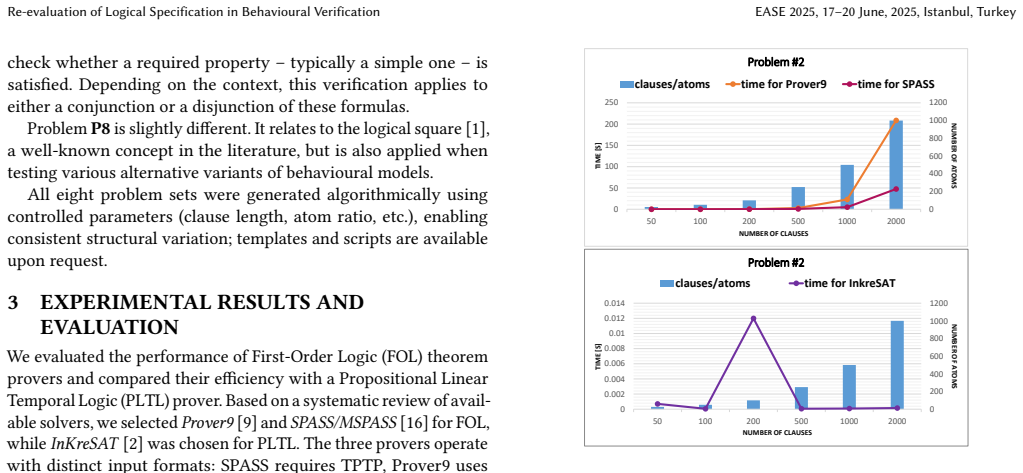
The paper's central claim is Claim 2: InKreSAT consistently outperforms the FOL provers, offering near-instant validation via efficient heuristics and incremental solving. On the eight generated problem families, InKreSAT's average times fall in the microsecond-to-millisecond range, whereas Prover9 and SPASS often require seconds and occasionally reach the 300-second timeout. Prover9 tends to win on shorter formulas and SPASS on longer ones, but both are far slower than the PLTL solver. The paper also reports that clause length, atom-to-clause ratio, liveness/safety ratio, and Poisson-distributed lengths all change solver behaviour, with InKreSAT showing occasional spikes but never losing its overall advantage. These findings extend prior replication work with a structured, behavioural-model-specific benchmark suite.
Load-bearing premise
The load-bearing premise is that the hand-generated random formulas in P1–P8 capture how real behavioural-model specifications are actually structured; if real specifications differ in clause length, atom ratio, or liveness/safety mix, the measured speed advantage may not carry over to practice.
Editorial extensions
If this is right
- InKreSAT can validate short-to-medium behavioural-model formulas in microseconds to milliseconds, making on-the-fly checks in AI-driven IDEs feasible.
- For formulas up to a few hundred clauses, Prover9 can meet a 1–2 second interactive budget, while SPASS remains the better FOL choice for longer formulas.
- Formula structure, not just size, drives solver performance: clause length, atom-to-clause ratio, and liveness/safety mix all change runtimes.
- Poisson-distributed clause lengths generally reduce runtimes but introduce occasional sharp slowdowns for InKreSAT, indicating that adaptive heuristics are needed.
- The 1890-task benchmark suite provides a reusable reproducibility corpus for future solver comparisons in behavioural verification.
Reading between the lines
- If real specifications resemble the P1–P3 families, the paper's results imply a PLTL solver could shrink verification feedback from seconds to milliseconds in IDEs; testing on a real curated corpus would confirm this.
- The P3 constraint that every atom appears at least once becomes unsatisfiable for the largest atom-to-clause ratios, so some P3 measurements may reflect degenerate formulas; regenerating P3 without that constraint is a natural robustness check.
- The paper reports runtime but not accuracy of satisfiability outcomes; a natural next step is checking whether InKreSAT's speed advantage holds when answers are verified against a ground truth.
- The observed irregularities in InKreSAT suggest that a portfolio approach—using the PLTL solver by default but switching to SPASS on formula structures known to trigger spikes—could give even more stable interactive verification.
Editorial analysis
A structured set of objections, weighed in public.
Referee Report
Summary. The paper reports an empirical replication and extension study comparing two first-order logic theorem provers (Prover9 and SPASS) with the PLTL solver InKreSAT on eight algorithmically generated formula families (P1-P8). Each formula is measured three times; time and memory are recorded, with a 300-second timeout. The central claims are that InKreSAT consistently outperforms the FOL provers, on average by roughly a factor of one hundred, and that such performance makes automated reasoning practical for IDE and CI/CD integration. The paper also claims to confirm earlier results and identifies performance irregularities that motivate adaptive heuristics.
Significance. If the comparison were shown to be fair and the measurements reproducible, the paper would provide useful evidence for solver selection in behavioural-model verification and would extend prior benchmarking work to PLTL versus FOL tools. The eight-problem catalogue is a reasonable attempt to vary clause length, atom ratio, liveness/safety balance, and logical structure, and the paper reports direct measurements rather than fitted or inferred results. However, several load-bearing details of the experimental design and reporting are missing, so the significance of the quantitative claims cannot currently be assessed.
major comments (4)
- [Section 3, Claim 2, Table 1] The central speedup claim is not evaluable because the paper does not state the encoding or decision problem used for each solver. Section 3 says the three provers use different input formats (TPTP, LADR, InTohyLo), and InKreSAT is a PLTL satisfiability prover while Prover9 and SPASS are FOL theorem provers, but it never specifies how a generated temporal formula is translated into each formalism or whether the FOL tools were asked the satisfiability of a translated formula or the validity of a theorem. Without an equivalence argument or a shared benchmark encoding, the microseconds-versus-seconds gap in Table 1 may reflect a mismatch of logic and decision procedure rather than solver efficiency; Claim 2 and the '100 times superior' statement are therefore unsupported as reported.
- [Section 2.1, Problem P7] P7 defines the disjunctive model as G1≡F1∨F2∨F3 and the conjunctive model as G2≡F1∨F2∨F3; both definitions are identical, so the comparison between disjunction- and conjunction-connected models described in Section 3 is not implemented. The cases c) and d) collapse into a) and b), and any conclusion about conjunction-connected formulas (e.g., Prover9 frequently timing out when models are conjunction-connected) lacks a corresponding experimental object. Unless the second definition is a typographical error for F1∧F2∧F3, the P7 results cannot support those statements.
- [Section 3, Figures 6-7, Claim 2] The paper claims InKreSAT consistently outperforms both FOL provers 'across all formulae' and that 'all results remain fully acceptable', yet no InKreSAT results are reported for P7 or P8: Figure 6 shows only Prover9 and SPASS for P7, Figure 7 shows only Prover9 and SPASS for P8, and Table 1 covers only P1-P6. The stated universal claim is therefore unsupported for two of the eight problem families; the paper needs either to report those measurements or to restrict the claim to P1-P6.
- [Section 2.1, Table 1, Section 5] The quantitative summary is not reproducible from the reported data. Each formula was measured three times, but no variance, raw values, or timeout counts are given; it is unclear how 300-second timeouts enter the averages. The 210-task total in Section 5 is not derivable from the problem catalogue (e.g., P3 as described has 6 formula sizes × 4 atom ratios = 24 tasks and P8 has 5 formula sizes × 6 cases = 30 tasks), and the aggregate averages 0.0787/0.3622 and 0.000648/0.002997 in Table 1 do not match any straightforward mean of the displayed rows. The 'one hundred times superior' statement is therefore not supported by the table as presented, and the promised dataset and scripts are only 'available upon request' (Section 2.2) rather than included.
minor comments (5)
- [Section 2.1, Problem P3] The generation rule for P3 is underspecified: with atom-to-clause ratios of 2-5 and clause lengths capped at 10, the 'every atom appears at least once' requirement imposes an average-length constraint that is not stated; the manuscript should describe the sampling procedure or the check used to enforce coverage.
- [Section 2.2, Problem P8] The logical-square basis is cited inconsistently: the P8 problem header refers to [4, Tab. 4], while Section 2.2 says the logical square is 'a well-known concept in the literature' and cites [1]; please align the citations and state explicitly what P8 adds over the earlier work in [5].
- [Figure 6, Table 1] Axis and caption typos ('NUMMBER', 'NUBER') should be corrected; Table 1's mention of green marking is not visible in the manuscript, and the phrase 'when both extreme columns are rejected' needs a precise definition before the reported averages can be interpreted.
- [Section 3, Problem P8] The sentence 'SPASS solved all instances, occasionally exceeding memory limits' is self-contradictory; if memory was exceeded the run did not solve the instance, so the statement should be rephrased and memory-limit events reported separately.
- [Section 3, Claim 1] The statement that Prover9 achieves superior execution times for shorter formulae 'particularly those comprising 200-500 clauses' conflicts with Table 1 at 500 clauses, where SPASS is faster for P1-P4 and P6; please qualify this claim by problem family or by clause-count range.
Circularity Check
No circularity: the reported speedups are direct measurements from Table 1; the authors' self-citations are motivational or consistency checks, not load-bearing inputs.
full rationale
The paper is an empirical benchmark study, not a derivation. It defines eight synthetic problem families (P1-P8), runs Prover9, SPASS, and InKreSAT on them with a 300-second timeout, and reports the measured average times in Table 1 and the figures. The headline claims (Claim 1 and Claim 2 in Section 3) are direct summaries of those measured times, so they cannot reduce by construction to their own inputs: there is no fitted parameter later renamed as a prediction, no equation whose output is identical to its input, and no uniqueness theorem imported from the authors' prior work. The self-citations ([3], [4], [5], and [7] share the first author) are used to motivate the problem design and to note consistency with prior measurements, but the benchmark data and Table 1 stand independently; even if those prior papers were removed, the reported times would be unchanged. The statement that the Problem 8 results 'confirm the experiments [5]' is an empirical consistency check, not a premise on which the central claim depends. The skeptical concern that the three solvers consume different input formats (TPTP, LADR, InTohyLo) and that no encoding-equivalence check is shown is a missing-support or correctness-risk issue about whether the comparison is apples-to-apples; it is not an instance of circularity under the definitions, because no claim is true by construction. Therefore the circularity score is 0.
Assumptions & free parameters
free parameters (5)
- Clause length sets per problem =
P1/P3: {2,3,4,6,8,10}; P5: {1,5,10,20}; P4: {2,3,4,5}
- Atom-to-clause ratio =
0.5 for P1,P2,P4-P8; 2-5 for P3
- Poisson lambda for clause length =
3.5
- Liveness-to-safety clause ratio =
50:50 default; P6 uses 90:10 through 10:90
- Timeout threshold =
300 seconds
assumptions (4)
- domain assumption The synthetic formulas in P1-P8 are representative of behavioural model specifications.
- domain assumption Three repeated runs with averaged wall-clock time give a stable measure of solver performance.
- domain assumption The test harness described only by reference [14] correctly measures time and memory.
- domain assumption Performance on randomly generated formulas transfers to real-time verification in CI/CD and IDE contexts.
Cite this review
Pith. "Pith review of Re-evaluation of Logical Specification in Behavioural Verification." pith.science (2026). https://pith.science/paper/TLZRSMXD
@misc{pith2026250517979,
  author       = {Pith},
  title        = {Pith review of: Re-evaluation of Logical Specification in Behavioural Verification},
  year         = {2026},
  howpublished = {\url{https://pith.science/paper/TLZRSMXD}},
  note         = {Machine review of arXiv:2505.17979}
}
read the original abstract
This study empirically validates automated logical specification methods for behavioural models, focusing on their robustness, scalability, and reproducibility. By the systematic reproduction and extension of prior results, we confirm key trends, while identifying performance irregularities that suggest the need for adaptive heuristics in automated reasoning. Our findings highlight that theorem provers exhibit varying efficiency across problem structures, with implications for real-time verification in CI/CD pipelines and AI-driven IDEs supporting on-the-fly validation. Addressing these inefficiencies through self-optimising solvers could enhance the stability of automated reasoning, particularly in safety-critical software verification.
Figures


Figures from the paper (4 more)


Forward citations
Cited by 1 Pith paper
-
Logic Mining from Process Logs: Towards Automated Specification and Verification
A pipeline that mines process trees from event logs, translates them into PLTL specifications via fixed patterns, and validates satisfiability and requirements with automated provers.
Reference graph
Works this paper leans on
-
[1]
Lorenz Demey. 2015. Interactively Illustrating the Context-Sensitivity of Aris- totelian Diagrams. In Modeling and Using Context (Lecture Notes in Artificial Intelligence, Vol. 9405), Henning Christiansen, Isidora Stojanovic, and George A. Papadopoulos (Eds.). Springer International Publishing, 331–345
work page 2015
-
[2]
Mark Kaminski and Tobias Tebbi. 2013. InKreSAT: Modal Reasoning via Incremen- tal Reduction to SAT. In 24th International Conference on Automated Deduction (CADE 2013), Lake Placid, New York, 9–14 June 2013 (Lecture Notes in Computer Science, Vol. 7898), Maria Paola Bonacina (Ed.). Springer, 436–442
work page 2013
-
[3]
Radosław Klimek. 2018. Exploration of Human Activities Using Message Stream- ing Brokers and Automated Logical Reasoning for Ambient-assisted Services. IEEE Access 6 (2018), 27127–27155. doi:10.1109/ACCESS.2018.2834532
arXiv 2018
-
[4]
Radosław Klimek. 2019. Pattern-based and Composition-driven Automatic Generation of Logical Specifications for Workflow-oriented Software Models. Journal of Logical and Algebraic Methods in Programming 104 (2019), 201–226. doi:10.1016/j.jlamp.2019.02.005
-
[5]
Radoslaw Klimek. 2024. Logical square-driven and state-oriented generation of behavioural models. In Proceedings of the 39th IEEE/ACM International Conference on Automated Software Engineering Workshops (Sacramento, CA, USA) (ASEW ’24). Association for Computing Machinery, New York, NY, USA, 72–81. doi:10. 1145/3691621.3694936
arXiv 2024
-
[6]
Radosław Klimek and Piotr Szwed. 2013. Verification of ArchiMate process specifications based on deductive temporal reasoning. In Proceedings of Federated Conference on Computer Science and Information Systems (FedCSIS 2013), 8–11 September 2013, Kraków, Poland. IEEE Xplore Digital Library, 1131–1138
work page 2013
-
[7]
Radoslaw Klimek and Julia Witek. 2024. Automatic Generation of Logical Specifi- cations for Behavioural Models. InProceedings of the 39th IEEE/ACM International Conference on Automated Software Engineering Workshops (Sacramento, CA, USA) (ASEW’24). Association for Computing Machinery, New York, NY, USA, 1–7. doi:10.1145/3695750.3695822
arXiv 2024
-
[8]
Zohar Manna and Amir Pnueli. 1992. The Temporal Logic of Reactive and Concur- rent Systems – Specification . Springer-Verlag New York, Inc
work page 1992
Show all 16 references
-
[9]
William McCune. 2019. Website for solver Prover9. https://www.cs.unm.edu/ ~mccune/prover9/ accessed on 5-Aug-2020
2019
-
[10]
David Mitchell, Bart Selman, and Hector Levesque. 1992. Hard and easy dis- tributions of SAT problems. In Proceedings of the Tenth National Conference on Artificial Intelligence (San Jose, California) (AAAI’92). AAAI Press, 459–465
1992
-
[11]
Francis Jeffry Pelletier. 1986. Seventy-five problems for testing automatic theorem provers. Journal of Automated Reasoning 2 (1986), 191–216
1986
-
[12]
Schaefer
Thomas J. Schaefer. 1978. The Complexity of Satisfiability Problems. In Proceed- ings of the 10-th Annual ACM Symposium on Theory of Computing (San Diego, California, USA) (STOC ’78). Association for Computing Machinery, 216–226. doi:10.1145/800133.804350
1978
-
[13]
Mitchell, and Hector J
Bart Selman, David G. Mitchell, and Hector J. Levesque. 1996. Generating Hard Satisfiability Problems. Artificial Intelligence 81, 1–2 (March 1996), 17–29. doi:10. 1016/0004-3702(95)00045-3
1996
-
[14]
Jakub Semczyszyn. 2021. Performance analysis of selected theorem provers for the first order logic, Engineering diploma thesis, supervisor: Radoslaw Klimek, AGH University of Krakow
2021
-
[15]
Geoff Sutcliffe. 2017. The TPTP Problem Library and Associated Infrastructure. Journal of Automated Reasoning 59 (2017), 438–502
2017
-
[16]
Christoph Weidenbach, Dilyana Dimova, Arnaud Fietzke, Rohit Kumar, Martin Suda, and Patrick Wischnewski. 2009. SPASS Version 3.5. In 22nd International Conference on Automated Deduction, (CADE 2009) Montreal, Canada, August 2– 7, 2009 (Lecture Notes in Computer Science, Vol. 5...
2009 doi
Reviewed August 7, 2026 · model on record in the stance chip above.
Discussion (0). Continue with ORCID to comment.