REVIEW 4 major objections 7 minor 46 references
Dynamical Nucleon-Pion System via Basis Light-Front Quantization
T0 review · 4 major / 7 minor · reviewed 2026-08-14 · deepseek-v4-flash
Pith's one-line read The paper applies Basis Light-Front Quantization to a chiral nucleon-pion model, diagonalizes the mass-squared matrix, and obtains the proton's mass, wave function, and parton distribution function.
desk verdict A credible proof-of-principle for BLFQ in the nucleon-pion sector, but the overclaim that the proton mass is an output, plus the unverified two-sector truncation, makes the central claim conditional. read the letter →
The pith
A machine-rendered reading of the paper's core claim, the machinery that carries it, and where it could break.
The reading
What carries the argument
The central object is the mass-squared operator $H_{LC} = P^+P^- - (P^\perp)^2$ represented in a light-front basis: discretized plane waves in $x^-$ and two-dimensional harmonic-oscillator (2DHO) states in the transverse plane, with a 2DHO basis strength $b$. A Lipkin-Lawson term $H_{CM}$ is added to separate and remove spurious center-of-mass excitations. The vector that carries the calculation is the light-front wave function, the eigenvector of this matrix; being boost-invariant, it directly yields the PDF $f(x_N)$.
What would settle it
Run the same FSDR-tuned diagonalization after adding the nucleon-plus-two-pion Fock sector while keeping the model-space size and the fitting procedure unchanged; if the ground-state PDF or the charge radius after re-fitting the basis strength moves by more than the convergence trend between the second-largest and largest model spaces, the two-sector truncation premise is false.
Extended reading notes
Core claim
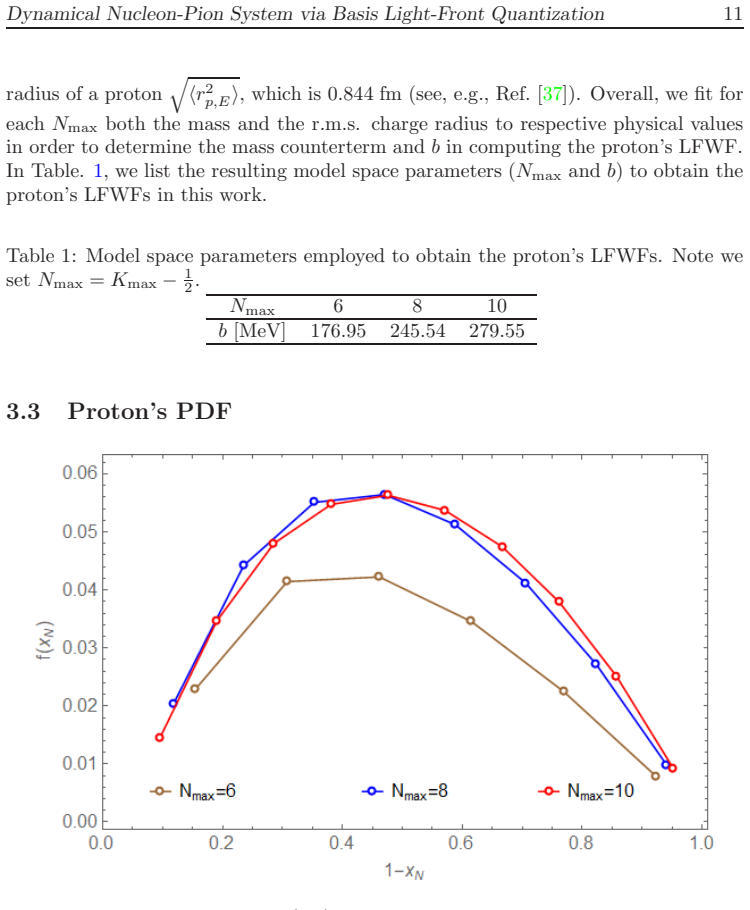
The central claim, on the paper's own terms, is that this is the first non-perturbative, ab initio treatment of the chiral nucleon-pion model with BLFQ. Solving the mass-squared eigenvalue problem $H|\Psi\rangle = M^2|\Psi\rangle$ in a two-Fock-sector basis yields the proton mass (after renormalization), a boost-invariant light-front wave function, and a parton distribution function. The paper finds that the ground state sits below the $N\pi$ continuum threshold of 1075 MeV, that the excited states behave as scattering states whose level density grows with $N_{\max}$, and that the PDF satisfies normalization and momentum sum rules and appears to converge with increasing model space. The bare-nucleon probability in the proton falls from 0.83 to 0.62 as $N_{\max}$ goes from 6 to 10.
Load-bearing premise
Everything reported rests on the assumption that truncating the Fock space to one bare nucleon and one nucleon-plus-pion state, with the pion interaction kept only at single-emission/absorption order, is enough to describe the proton's ground state; if the omitted nucleon-plus-two-pion sector or higher-order couplings would materially shift the wave function and PDF, the results are not yet converged predictions.
Editorial extensions
If this is right
- The same diagonalization can be used to compute other proton observables from the wave function, such as transverse-momentum distributions and elastic form factors, without new dynamical input.
- The two-Fock-sector spectrum already contains scattering states above the nucleon-pion threshold, so the framework can be extended to study nucleon-pion scattering and resonances.
- If higher Fock sectors are added, the Fock-sector-dependent renormalization procedure gives a systematic route to test convergence of the proton's structure.
- The PDF's peak at $x_N \approx 0.55$ implies that in this model the pion carries roughly 45% of the proton's longitudinal momentum.
Reading between the lines
- Because the ground-state mass is inserted by the counterterm rather than predicted, the quantitative claims to scrutinize are the shape of the PDF and its apparent convergence, not the 938 MeV eigenvalue.
- Folding pion quark distributions into the constituent-pion contribution would produce a concrete prediction for the proton's up- and down-antiquark flavor asymmetry, comparable with existing Drell-Yan data.
- Applying the identical two-sector Hamiltonian to the neutron and comparing the resulting electromagnetic form factors with data would test whether the pion-cloud picture transfers beyond the proton.
- The next decisive computation is the nucleon-plus-two-pion sector: if the PDF and charge radius shift materially after re-fitting the basis strength, the two-sector truncation is not yet a controlled approximation.
Signed reviews
Editorial analysis
A structured set of objections, weighed in public.
Referee Report
Summary. The manuscript applies Basis Light-Front Quantization (BLFQ) to a chiral nucleon-pion Lagrangian, truncating the interaction at single-pion emission/absorption order and the Fock space to the |N> and |Nπ> sectors. Working with a basis of discretized longitudinal momentum and two-dimensional harmonic oscillator transverse modes, the authors construct the mass-squared matrix, add a Lipkin-Lawson term to control spurious center-of-mass motion, and diagonalize it. The proton mass and charge radius are used as inputs to fix the bare nucleon mass via Fock-sector-dependent renormalization and the basis strength b; the outputs are a low-lying mass spectrum, a boost-invariant light-front wave function, and the proton's longitudinal momentum distribution f(x_N). The reported PDF peaks near x_π ≈ 0.45, and the bare-nucleon probability decreases from 0.83 to 0.62 as Nmax increases from 6 to 10.
Significance. If the truncations were controlled, this would be a useful proof-of-principle demonstration that BLFQ can handle a theory with coupled fermion-boson Fock sectors, producing a bound state plus scattering states and a boost-invariant light-front wave function suitable for computing PDFs. The authors verify normalization and the momentum sum rule for each model space and correctly exploit the exact center-of-mass factorization of the 2DHO basis. However, the calculation does not yet establish the 'ab initio' claim: two central observables (the proton mass and its charge radius) are inputs, and the Fock-space truncation is explicitly unverified. The main value is as a methodology benchmark, not as a quantitative prediction for the proton.
major comments (4)
- [Abstract, §3 (FSDR paragraph)] The abstract claims that solving the eigenvalue problem yields the proton's mass, but §3 explains that the bare nucleon mass is tuned iteratively until the ground-state eigenvalue matches 938 MeV. The proton mass is therefore an input of the calculation, not an output. This should be stated explicitly in the abstract and conclusions, otherwise the central claim is circular.
- [§2.3.4, §3.3, §4] The truncation to |N>+|Nπ> with interactions kept through O(1/f) is the load-bearing approximation, and it is not controlled. The paper itself defers the convergence proof (§3.1: 'We will save the proof for the future work') and states that larger Fock space is necessary to verify real convergence (§4). The numerical trend in the single-nucleon probability f(x_N=1) drops from 0.83 to 0.62 across Nmax=6, 8, 10 (§3.3), a substantial drift, so the PDF and the spectrum cannot yet be regarded as robust predictions of the chiral model. Please provide at least an estimate of the omitted |Nππ> sector and O(1/f^2) contributions, or substantially qualify the 'ab initio' characterization.
- [§3.2, Table 1] The basis strength b is fixed separately for each Nmax by fitting the proton's r.m.s. charge radius to the experimental value, with b varying from 176.95 to 279.55 MeV. Because b controls the transverse resolution, the apparent convergence of the PDF in Fig. 2 is partly a consequence of this per-Nmax tuning. The predictive content of the LFWF and PDF should be characterized by showing how they vary with b, or by treating b as part of a systematic uncertainty.
- [§3.1, Fig. 1] The claimed convergence of the mass spectrum is only qualitative: the figure shows six states with no extrapolation, no quantified uncertainty, and no independent Kmax dependence (Kmax is tied to Nmax throughout). Without a convergence criterion, statements like 'seem to converge' are insufficient to support the conclusion that the lowest eigenvalues are stable. Please provide numerical tables with convergence indicators or define a quantitative measure.
minor comments (7)
- [§2.3.5] 'ultravilot' is a typo for 'ultraviolet'.
- [§2.2] 'Legrendre' should be 'Legendre'.
- [§2.3.4] The heading 'T runcation' should be 'Truncation'.
- [§3.2, Fig. 2 caption] The text says the x-axis is rescaled as 1 - x_N, but the caption writes '1 - x_N = x_π'; please clarify the axis label to avoid confusion.
- [§4] 'FDSR' appears once in the conclusions; elsewhere the abbreviation is 'FSDR'.
- [§2.6, §3.2] The text refers to the r.m.s. charge radius but does not give the formula used to compute ⟨r^2⟩ from the LFWF; please add the definition.
- [§3.1, Table 1] Since Kmax = Nmax + 1/2, the smallest longitudinal momentum fraction is 1/Kmax; a brief statement of the resulting longitudinal resolution would aid the reader.
Circularity Check
The headline proton mass is an input: the bare nucleon mass is tuned until the ground state hits 938 MeV, so the abstract's 'obtain the proton's mass' is a fitted value relabeled as a prediction; LFWF/PDF remain nontrivial outputs.
-
fitted input called prediction
[Sec. 3, first paragraph (FSDR procedure), around Eq. (44)]
"We numerically diagonalize the matrix of the modified mass-squared operator H [Eq. (38)], in which process the bare nucleon mass is tuned in the matrix elements within the single nucleon sector. This process is iterative and continues until the square-root of the eigenvalue of the ground state (identified as the physical proton) matches the mass of the physical proton (taken as 938 MeV in this work)."
The abstract claims the proton's mass is obtained by solving the eigenvalue problem, but the mass is actually imposed: the bare nucleon mass in the single-nucleon sector is iteratively adjusted so that the ground-state eigenvalue of Eq. (44) equals the physical proton mass, which is an input (938 MeV). Thus the reported proton mass is not a prediction of the calculation but a fitted parameter renamed as an output. The wave function and PDF are still non-trivial outputs of the truncated model, so the circularity is partial and confined to the mass claim presented in the abstract and Sec. 3.1.
full rationale
The central derivation chain is: construct H_LC from the chiral Lagrangian, truncate to |N>+|N pi>, diagonalize H, and read off mass, LFWF, PDF. The mass step is circular in presentation: Sec. 3 states that the bare nucleon mass is tuned until the ground state matches 938 MeV, so the 'obtained' proton mass is an input imposed via the FSDR counterterm, not an independent eigenvalue prediction. This is the pattern of a fitted input called a prediction. The basis strength b is also fitted to the proton charge radius (0.844 fm) before computing the LFWF and PDF; that is parameter calibration rather than circularity by itself, since the radius is not presented as a predicted output and the PDF is not mathematically forced by the two fitted constants. The PDF and the relative/excited spectrum do carry independent content within the truncated model. However, the paper explicitly defers the convergence proof ('We will save the proof for the future work') and notes larger Fock space is needed to verify real convergence, so the robustness of the non-trivial outputs rests on an unverified truncation; that is a correctness/convergence risk, not a circularity. No load-bearing self-citation or imported uniqueness theorem is present: BLFQ and FSDR citations are methodology references, and the chiral model is attributed to Miller. Overall, one central claimed result (the proton mass) reduces by construction to its input, while the other claimed results remain non-trivial; hence the partial-circularity score of 6.
Assumptions & free parameters
free parameters (2)
- Bare nucleon mass (mass counterterm via FSDR) =
Not given; adjusted so ground state equals 938 MeV for each Nmax
- Basis strength b =
176.95 MeV (Nmax=6), 245.54 MeV (Nmax=8), 279.55 MeV (Nmax=10)
assumptions (5)
- domain assumption The chiral Lagrangian of Eq. (4) is an adequate model of the physical proton's pion cloud.
- ad hoc to paper The two-Fock-sector truncation and O(1/f) interaction truncation are sufficient for the qualitative result.
- domain assumption Miller's chiral transformation and the constraint solution in Eq. (6) correctly resolve the light-front nucleon-field constraint equation.
- domain assumption The 2DHO basis with Nmax truncation exactly factorizes intrinsic and center-of-mass components of the LFWF.
- ad hoc to paper Fock-sector-dependent renormalization with a mass counterterm only in the single-nucleon sector is valid for this model.
Cite this review
Pith. "Pith review of Dynamical Nucleon-Pion System via Basis Light-Front Quantization." pith.science (2026). https://pith.science/paper/TM74BOWC
@misc{pith2026190802237,
  author       = {Pith},
  title        = {Pith review of: Dynamical Nucleon-Pion System via Basis Light-Front Quantization},
  year         = {2026},
  howpublished = {\url{https://pith.science/paper/TM74BOWC}},
  note         = {Machine review of arXiv:1908.02237}
}
read the original abstract
We present the first application of the Basis Light-Front Quantization method to study a simple chiral model of the nucleon-pion system via an ab initio, non-perturbative, Hamiltonian approach. As a test problem, we consider the physical proton as the relativistic bound state of the nucleon-pion system. Based on the chiral model of the nucleon-pion system, we construct the mass-squared matrix of the system within our light-front basis representation. We obtain the proton's mass and the corresponding light-front wave function by solving the eigenvalue problem of the mass-squared matrix. With the resulting boost-invariant light-front wave function, we also compute the proton's parton distribution function.
Figures

Reference graph
Works this paper leans on
-
[1]
O. Hen, G. A. Miller, E. Piasetzky and L. B. Weinstein, Rev. Mod. Ph ys. 89, no. 4, 045002 (2017)
work page 2017
-
[2]
J. J. Aubert et al. [European Muon Collaboration], Phys. Lett. 123B, 275 (1983)
work page 1983
-
[3]
H. Cheng and T. Wu, Expanding Protons: Scattering at High Energies (MIT Press, Cambridge, 1987)
work page 1987
-
[4]
J. P. Vary, H. Honkanen, Jun Li, P. Maris, S. J. Brodsky, A. Har indranath, G. F. de Teramond, P. Sternberg, E. G. Ng and C. Yang, Phys. Rev. C 81, 035205 (2010)
work page 2010
-
[5]
H. Honkanen, P. Maris, J. P. Vary and S. J. Brodsky, Phys. Rev . Lett. 106, 061603 (2011). 14 Weijie Du, Yang Li, Xingbo Zhao and James P. Vary
work page 2011
-
[6]
X. Zhao, H. Honkanen, P. Maris, J. P. Vary and S. J. Brodsky, P hys. Lett. B 737, 65 (2014)
work page 2014
- [7]
-
[8]
J. P. Vary, L. Adhikari, G. Chen, S. Jia, M. Li, Y. Li, P. Maris, W. Qia n, J. R. Spence, S. Tang, K. Tuchin, A. Yu and X. Zhao, Few Body Syst. 59, no. 4, 56 (2018)
work page 2018
Show all 46 references
-
[9]
Y. Li, P. Maris, X. Zhao and J. P. Vary, Phys. Lett. B 758, 118 (2016)
2016
-
[10]
Y. Li, P. Maris and J. P. Vary, Phys. Rev. D 96, no. 1, 016022 (2017)
2017
-
[11]
S. Tang, Y. Li, P. Maris and J. P. Vary, Phys. Rev. D 98, no. 11, 114038 (2018)
2018
-
[12]
M. Li, Y. Li, P. Maris and J. P. Vary, Phys. Rev. D 98, no. 3, 034024 (2018)
2018
-
[13]
Jia and J
S. Jia and J. P. Vary, Phys. Rev. C 99, no. 3, 035206 (2019)
2019
-
[14]
J. Lan, C. Mondal, S. Jia, X. Zhao and J. P. Vary, Phys. Rev. Le tt. 122, no. 17, 172001 (2019)
2019
-
[15]
X. Zhao, A. Ilderton, P. Maris and J. P. Vary, Phys. Rev. D 88, 065014 (2013)
2013
-
[16]
X. Zhao, A. Ilderton, P. Maris and J. P. Vary, Phys. Lett. B 726, 856 (2013)
2013
-
[17]
G. Chen, X. Zhao, Y. Li, K. Tuchin and J. P. Vary, Phys. Rev. D 95, no. 9, 096012 (2017)
2017
-
[18]
G. A. Miller, Phys. Rev. C 56, 2789 (1997)
1997
-
[19]
G. A. Miller, Prog. Part. Nucl. Phys. 45, 83 (2000)
2000
-
[20]
Harindranath, Saha Institute of Nuclear Physics, 2005 (un published)
A. Harindranath, Saha Institute of Nuclear Physics, 2005 (un published)
2005
-
[21]
N. A. Tsirova, V. A. Karmanov and J.-F. Mathiot, Phys. Atom. N ucl. 73, 1952 (2010)
2010
-
[22]
Mathiot and N
J.-F. Mathiot and N. A. Tsirova, Phys. Atom. Nucl. 76, 1387 (2013)
2013
-
[23]
C. R. Ji, W. Melnitchouk and A. W. Thomas, Phys. Rev. D 80, 054018 (2009)
2009
-
[24]
C. R. Ji, W. Melnitchouk and A. W. Thomas, Phys. Rev. D 88, no. 7, 076005 (2013)
2013
-
[25]
Chang and F
P. Chang and F. G¨ ursey, Phys. Rev. 164, 1752 (1967)
1967
-
[26]
S. J. Brodsky, H. C. Pauli and S. S. Pinsky, Phys. Rept. 301, 299 (1998)
1998
-
[27]
Maris, P
P. Maris, P. Wiecki, Y. Li, X. Zhao and J. P. Vary, Acta Phys. Polo n. Supp. 6, 321 (2013)
2013
-
[28]
Hornbostel, S
K. Hornbostel, S. J. Brodsky and H. C. Pauli, Phys. Rev. D 41, 3814 (1990)
1990
-
[29]
B. R. Barrett, P. Navratil and J. P. Vary, Prog. Part. Nucl. P hys. 69, 131 (2013). Dynamical Nucleon-Pion System via Basis Light-Front Quantization 15
2013
-
[30]
M. A. Caprio, P. Maris and J. P. Vary, Phys. Rev. C 86, 034312 (2012)
2012
-
[31]
H. J. Lipkin, Phys. Rev. 109, 2071 (1958)
1958
-
[32]
D. H. Gloeckner and R. D. Lawson, Phys. Lett. 53B, 313 (1974)
1974
-
[33]
J. R. Hiller and S. J. Brodsky, Phys. Rev. D 59, 016006 (1999)
1999
-
[34]
V. A. Karmanov, J.-F. Mathiot and A. V. Smirnov, Phys. Rev. D 77, 085028 (2008)
2008
-
[35]
V. A. Karmanov, J.-F. Mathiot and A. V. Smirnov, Phys. Rev. D 82, 056010 (2010)
2010
-
[36]
V. A. Karmanov, J.-F. Mathiot and A. V. Smirnov, Phys. Rev. D 86, 085006 (2012)
2012
-
[37]
J. M. Alarc´ on, D. W. Higinbotham, C. Weiss and Z. Ye, Phys. Rev . C 99, no. 4, 044303 (2019)
2019
-
[38]
C. A. Aidala et al. [SeaQuest Collaboration], arXiv:1706.09990 [physics.ins-det]
-
[39]
R. S. Towell et al. [NuSea Collaboration], Phys. Rev. D 64, 052002 (2001)
2001
-
[40]
E. A. Hawker et al. [NuSea Collaboration], Phys. Rev. Lett. 80, 3715 (1998)
1998
- [41]
-
[42]
D. R. Entem and R. Machleidt, Phys. Rev. C 68, 041001 (2003)
2003
-
[43]
Epelbaum, H
E. Epelbaum, H. W. Hammer and U. G. Meissner, Rev. Mod. Phys. 81, 1773 (2009)
2009
-
[44]
Y. Li, V. A. Karmanov, P. Maris and J. P. Vary, Few Body Syst. 56, no. 6-9, 495 (2015)
2015
-
[45]
Y. Li, V. A. Karmanov, P. Maris and J. P. Vary, Phys. Lett. B 748, 278 (2015)
2015
-
[46]
J. P. Vary, R. Basili, W. Du, M. Lockner, P. Maris, D. Oryspayev , S. Pal, S. Sarker, H. M. Aktulga, E. Ng, M. Shao and C. Yang, Proceedings of the Inter- national Conference ‘Nuclear Theory in the Supercomputing Era-2 016’ (NTSE- 2016), Khabarovsk, Russia, September 19-23, 20...
2016 arXiv
Reviewed August 14, 2026 · model on record in the stance chip above.
Discussion (0). Continue with ORCID to comment.