REVIEW 4 major objections 6 minor 40 references
A trade-off between hydrodynamic performance and morphological bias limits the evolution of symmetric lattice animal wings
T0 review · 4 major / 6 minor · reviewed 2026-08-12 · deepseek-v4-flash
Pith's one-line read This paper argues that the diversity of insect wing shapes is partly a statistical consequence: sparse, bristled morphologies are far more numerous than compact ones, so evolution is biased toward them, and the same physical setup selects…
desk verdict Careful, high-throughput settling experiments that convincingly show evolved shapes do not converge; the proposed entropy-fitness mechanism is a plausible post-hoc story that needs a control before it carries the title. read the letter →
The pith
A machine-rendered reading of the paper's core claim, the machinery that carries it, and where it could break.
The reading
What carries the argument
The load-bearing object is the free-fitness function $F = f/f_0 + \kappa S/S_0$ from evolutionary statistical mechanics: it adds a morphological-entropy term to the usual fitness, with an 'evolutionary temperature' $\kappa$ set to 1. The paper feeds this function with an empirically fitted linear entropy relation $S = 9.5 - 13.3Q$, where $Q$ is the compactness (isoperimetric quotient) of a lattice animal. This construct converts the abstract idea of 'many ways to be sparse' into a quantitative rate term: because low-$Q$ shapes are abundant, their entropy is high, and the free fitness rises faster when evolution moves toward them, which is exactly the direction in which the measured adaptation is faster.
What would settle it
Compute the exact entropy $S(Q)$ by enumerating all connected polyominoes of area 23 and counting how many share each compactness value; if $\ln \Omega$ is not well described by a straight line, the $S = 9.5 - 13.3Q$ fit is an artifact. Alternatively, rerun the genetic algorithm with a different mutation rate (which changes $\kappa$) and check whether the max-to-min adaptation-rate ratio changes as predicted by the free-fitness model; if the ratio is unchanged, the entropy term is not doing the work attributed to it.
Extended reading notes
Core claim
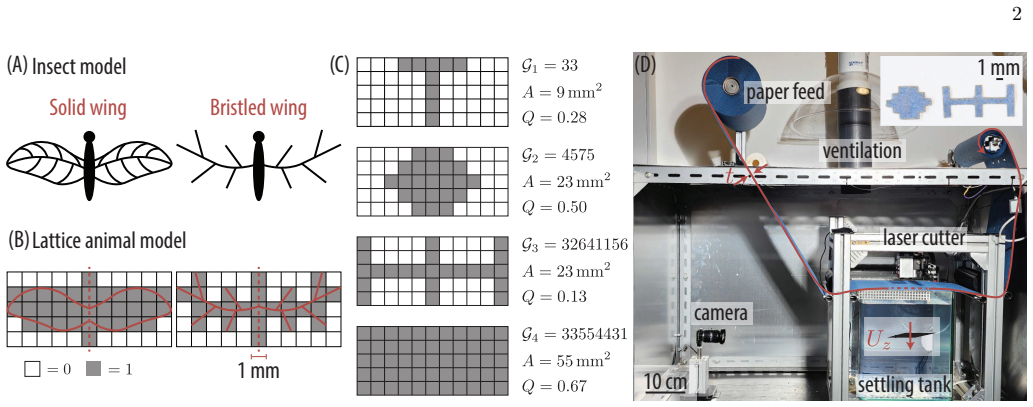
The central claim, stated on the paper's own terms, is that morphological entropy biases adaptation in a physically realized evolving system. The drag coefficient $C_D$ of a settling lattice animal decreases with compactness $Q$, and sparse geometries with low $Q$ are vastly more numerous than compact ones among the 7,325 connected polyominoes of area 23 mm². When a genetic algorithm selects for maximum $C_D$, it moves quickly into these abundant low-$Q$ states; when selection is reversed toward minimum $C_D$, it must climb toward rare high-$Q$ states, and the rate of adaptation is at least 50% slower. The paper accounts for this hysteresis with a free fitness $F = f/f_0 + \kappa S/S_0$, where entropy $S$ is measured from the number of morphologies sharing a given compactness, and finds $S = 9.5 - 13.3Q$ for this shape space. The authors therefore propose that the non-convergence of artificial evolution experiments—and, speculatively, of insect wing shapes in nature—is partly a consequence of the uneven distribution of morphologies, not solely of fitness differences.
Load-bearing premise
The argument rests on the free-fitness equation $F = f/f_0 + \kappa S/S_0$ with $\kappa$ fixed at 1 and on the fitted linear entropy relation $S = 9.5 - 13.3Q$; if the true evolutionary temperature differs from 1 or the entropy is not linear in compactness, the proposed explanation for the directional hysteresis loses support.
Editorial extensions
If this is right
- Repeated artificial evolution experiments on identical tasks will not produce the same optimal shapes; the paper observes this directly.
- Evolution toward high-drag (sparse) shapes is at least 50% faster than evolution toward low-drag (compact) shapes at matched fitness gains.
- The free-fitness model with the entropy term explains the rate hysteresis: the abundant low-$Q$ states accelerate the forward direction and slow the reverse.
- The authors suggest this fitness-entropy competition may partly explain why real insect wings do not converge on a single optimal morphology.
Reading between the lines
- Editorial inference: The observed rate asymmetry is entangled with the starting point of each evolutionary run (the max-$C_D$ run starts at a compact shape, the min-$C_D$ run at a sparse shape), so a cleaner test of the free-fitness model would start both runs from the same morphology or from several different initial states.
- Editorial inference: If the entropy-bias mechanism is general, then any discrete design space with a skewed distribution of forms should show similar directional hysteresis, which could be tested with a computational genetic algorithm on other combinatorial objects.
- Editorial inference: The paper sets $\kappa = 1$ for simplicity; varying the mutation rate or the experimental noise should change the effective evolutionary temperature, and one could predictably tune the rate asymmetry—a testable extension the authors do not perform.
Signed reviews
Editorial analysis
A structured set of objections, weighed in public.
Referee Report
Summary. The paper reports a large automated experimental study of the settling dynamics of symmetric polyomino shapes, with the goal of understanding how morphology and evolutionary dynamics interact. The authors measure drag coefficients for 31 shapes (1,692 experiments) and then run genetic-algorithm 'evolution' experiments (50,086 experiments) selecting for either high or low drag at fixed area. They observe that repeated evolutionary runs do not converge to identical shapes and that adaptation toward high drag appears faster than adaptation toward low drag. They propose a 'free fitness' model, F = f/f0 + κS/S0, in which the morphological entropy S of the space of possible shapes biases evolution, and they argue this provides experimental support for the idea that competition between fitness and morphological entropy limits convergence in insect wing evolution.
Significance. If the central claim is established, the paper would be a valuable experimental demonstration of an entropic contribution to evolutionary dynamics in a physical system, with implications for understanding the diversity of biological wing shapes. The raw experimental effort is substantial and careful: 21-59 repeats per shape, a reference shape to control for drift, Chauvenet rejection of outliers, and consistency checks against Willmarth's disk data. The paper also ships reproducible code and a clear automated setup, which are strengths. However, the explanatory link between the observed rate asymmetry and morphological entropy is not yet convincingly demonstrated, for reasons detailed in the major comments.
major comments (4)
- [Supplemental 'Genetic algorithm and breeding function' and Fig. S2] The central entropy argument in 'Free fitness dictates the rate of evolution' identifies S = ln Ω(Q) with the logarithm of the static count of all 7,325 polyominoes at compactness Q (Fig. 3 and Fig. 5 inset). This identification is only valid if the genetic algorithm samples morphologies in proportion to Ω(Q). The described breeding operator is not Q-neutral: when two sparse parents are recombined, they have few overlapping cells, so the random filling step can generate many low-Q offspring; when two compact parents are recombined, the overlap constraint strongly restricts offspring to remain compact. The effective multiplicity experienced by the GA is therefore likely biased toward low Q relative to the brute-force enumeration. The paper provides no control experiment, e.g., neutral evolution with selection turned off and the same breeding and mutation operators, to show that the GA's stationary distribution over Q matches the static enumeration. Without such a control, Eq. (4) is not justified as an explanation of the observed rate asymmetry.
- [Fig. 4 and Figs. S7-S9] The claim that adaptation toward high drag is 'at least 50% slower' in the reverse direction rests on only three evolutionary repeats per direction, and no statistical significance is reported. Given the measurement variability (σ_Uz/Uz ≈ 0.11) and the substantial run-to-run variation visible in the supplementary figures, the observed rate difference may not be statistically robust. The paper should report the rates (e.g., mean change in CD per generation) with confidence intervals, and ideally run more independent repeats, before using this asymmetry as the central empirical basis for the free-fitness model.
- [Eq. (4) and the paragraph 'Free fitness dictates the rate of evolution'] The free-fitness model is post hoc: κ is set to 1 'for simplicity' without justification or sensitivity analysis, and the entropy-compactness relation S = 9.5 − 13.3Q is fitted to the static enumeration but the model is not quantitatively compared to the evolutionary data beyond a qualitative statement about which direction is faster. The model makes a specific prediction for the ratio of adaptation rates, but this prediction is not derived or tested. To be convincing, the paper should either fit κ to the data, show that the qualitative conclusion is robust over a plausible range of κ, or test a quantitative prediction of the model against the measured trajectories.
- [Methods 'Morphological optimization' and Fig. 4] The two genetic-algorithm runs start from opposite ends of the compactness spectrum: the max-CD run starts from the compact G2 (Q = 0.50), and the min-CD run starts from the sparse G3 (Q = 0.13). The observed rate asymmetry is therefore entangled with the starting position. Even if the GA samples proportionally to the static count, the local density of states near a compact starting point is much lower than near a sparse one, which alone could produce the rate difference. A cleaner test would start both selective directions from the same or multiple starting values of Q, or at least include max-CD runs starting from a sparse shape and min-CD runs starting from a compact shape. As reported, the experiment does not isolate the proposed morphological-bias mechanism from a simple starting-position effect.
minor comments (6)
- [Introduction] There is a typo: 'the the implications' should be 'the implications'.
- [Methods 'Settling experiment'] There are typographical errors: 'Raspberri Pi' should be 'Raspberry Pi', and 'aqcuisition' in the flowtrace description should be 'acquisition'.
- [Fig. 4 captions and body text] The terms 'insert' and 'inset' are used inconsistently; the small panels showing compactness evolution should be 'insets' throughout.
- [Methods 'Morphology'] The genome representation is described only briefly, and the statement that 'a numerically large genome indicates a large area or a sparse morphology' is not generally true for the binary-to-decimal mapping (e.g., a sparse shape with a single high-order bit can have a large decimal value). A formal definition of row/column ordering would help the reader.
- [Main text, first paragraph of 'Morphological optimization'] The reference to 'Fig. S2' after mentioning the oval wing appears to be a cross-reference error; Fig. S2 shows the breeding function, not example lattice animals. The intended figure is likely Fig. S4.
- [Abstract and Discussion] The phrasing 'provides experimental support for the idea that the lack of convergence in insect wing shape may partly reflect the competition between fitness and entropy' overstates what is shown, since the experiments involve paper shapes settling in water rather than insect wings, and the discussion itself later uses 'we speculate.' Consider softening the abstract to match the discussion.
Circularity Check
No significant circularity: the entropy term is computed from an independent static enumeration and the fitness from separate settling experiments; the free-fitness model is explicitly interpretive.
full rationale
The paper's empirical chain is self-contained rather than circular. Drag coefficients are measured from terminal velocities via Eq. (2); compactness Q is a geometric definition (Eq. (3)); the entropy S = 9.5 - 13.3Q is a fit to the number of distinct lattice animals binned by Q, obtained from a brute-force enumeration of 7,325 polyominoes (Fig. 3 and Fig. 5 inset), which is independent of the genetic algorithm outcomes. The drag-compactness correlation (Fig. 2 and Fig. S6) comes from separate settling experiments. Eq. (4) introduces the free fitness F with kappa = 1 stated as a simplification ('For simplicity, we set κ = 1'); it is not fitted to the evolution data and is used only to give a qualitative, post hoc account of the observed rate asymmetry and lack of convergence. The paper explicitly labels the extension to insect wings as speculation ('We speculate that...'). The only self-citations ([25], describing the ASAP apparatus, and [40], the code repository) are not load-bearing for the central mechanism. Concerns about the choice of kappa, the unverified neutrality of the GA breeding operator, and the asymmetric starting compactness are robustness or design limitations, not definitional circularity; no equation or fitted parameter is renamed as a prediction by construction.
Assumptions & free parameters
free parameters (4)
- Evolutionary temperature κ =
1
- Entropy line intercept and slope =
9.5, -13.3
- Drag-compactness decay coefficient =
0.55
- GA population size and mutation probability =
N=10, p=0.20
assumptions (4)
- domain assumption The 2D lattice animal model with a fixed body column captures relevant insect wing morphology
- domain assumption Free-fall settling in water is a valid physical model of parachuting flight
- ad hoc to paper The free-fitness function F always increases and governs evolutionary dynamics
- standard math Sampson's solution to Stokes' equation estimates pore flow speed
Cite this review
Pith. "Pith review of A trade-off between hydrodynamic performance and morphological bias limits the evolution of symmetric lattice animal wings." pith.science (2026). https://pith.science/paper/TMLM3IRP
@misc{pith2026241109456,
  author       = {Pith},
  title        = {Pith review of: A trade-off between hydrodynamic performance and morphological bias limits the evolution of symmetric lattice animal wings},
  year         = {2026},
  howpublished = {\url{https://pith.science/paper/TMLM3IRP}},
  note         = {Machine review of arXiv:2411.09456}
}
abstract
Bristled and membranous insect wings have co-evolved despite apparently serving the same functionality. We emulate flight physics using an automated free-fall experiment to better understand how and why several distinct wing forms may have developed. Biomimetic two-dimensional lattice animals were laser cut from a continuous sheet of paper, and their descent in a settling tank was tracked using a camera. Data from 31 generic symmetric polyominos (1,692 experiments) reveal that morphology impacts the drag coefficient $C_D$ and hence flight efficiency. Some polyominos rapidly sediment while others remain suspended for longer. Positioning the search for an optimal shape within an evolutionary context, we relinquished control of the automated setup to a genetic algorithm. Hereditary information passes between generations in proportion to fitness and is augmented by rare mutations. High-performing morphologies are observed, but {experimental repeats do} not re-evolve the same shapes. Adaptation rates also differ if the selective pressure is reversed from suspension to sedimentation. Our data (50,086 experiments) reveal several physical sources of indeterminism in the simulated natural selection process, including fluid flow variability and morphological entropy. This provides experimental support for the idea that the lack of convergence in insect wing shape may partly reflect the competition between fitness and entropy, making it nearly impossible to achieve unique optimal forms.
Figures


Figures from the paper (2 more)


Reference graph
Works this paper leans on
-
[1]
G. V. Lauder, Form and function: structural analysis in evolutionary morphology, Paleobiology 7, 430 (1981)
work page 1981
-
[2]
D. L. Stern, The genetic causes of convergent evolution, Nature Reviews Genetics 14, 751 (2013)
work page 2013
-
[3]
M. K. Salcedo, J. Hoffmann, S. Donoughe, and L. Ma- hadevan, Computational analysis of size, shape and structure of insect wings, Biology Open 8, bio040774 (2019)
work page 2019
-
[4]
Sun, Colloquium: Miniature insect flight, Reviews of Modern Physics 95, 041001 (2023)
M. Sun, Colloquium: Miniature insect flight, Reviews of Modern Physics 95, 041001 (2023)
work page 2023
- [5]
-
[6]
Y. Luna Lin, M. Pezzulla, and P. M. Reis, Fluid– structure interactions of bristled wings: the trade-off be- tween weight and drag, Journal of the Royal Society In- terface 20, 20230266 (2023)
work page 2023
-
[7]
F. O’Callaghan, A. Sarig, G. Ribak, and F.-O. Lehmann, Efficiency and aerodynamic performance of bristled in- sect wings depending on reynolds number in flapping flight, Fluids 7, 75 (2022)
work page 2022
-
[8]
A. A. Polilov, Small is beautiful: features of the smallest insects and limits to miniaturization, Annual review of entomology 60, 103 (2015)
work page 2015
Show all 40 references
-
[9]
M. P. Ford, V. T. Kasoju, M. G. Gaddam, and A. San- thanakrishnan, Aerodynamic effects of varying solid sur- face area of bristled wings performing clap and fling, Bioinspiration & Biomimetics 14, 046003 (2019)
2019
-
[10]
R. J. Wootton, Functional morphology of insect wings, Annual Review of Entomology 37, 113 (1992)
1992
-
[11]
S. H. Lee, M. Lee, and D. Kim, Optimal configuration of a two-dimensional bristled wing, Journal of Fluid Me- chanics 888, A23 (2020)
2020
-
[12]
S. H. Lee and D. Kim, Aerodynamics of a translating comb-like plate inspired by a fairyfly wing, Physics of fluids 29 (2017)
2017
-
[13]
Kolomenskiy, S
D. Kolomenskiy, S. Farisenkov, T. Engels, N. Lapina, P. Petrov, F.-O. Lehmann, R. Onishi, H. Liu, and A. Po- 8 lilov, Aerodynamic performance of a bristled wing of a very small insect: Dynamically scaled model experiments and computational fluid dynamics simulations using a re...
2020
-
[14]
M. Lee, S. H. Lee, and D. Kim, Stabilized motion of a freely falling bristled disk, Physics of Fluids 32 (2020)
2020
-
[15]
Ramananarivo, T
S. Ramananarivo, T. Mitchel, and L. Ristroph, Improv- ing the propulsion speed of a heaving wing through artifi- cial evolution of shape, Proceedings of the Royal Society A 475, 20180375 (2019)
2019
-
[16]
Eloy, On the best design for undulatory swimming, Journal of Fluid Mechanics 717, 48 (2013)
C. Eloy, On the best design for undulatory swimming, Journal of Fluid Mechanics 717, 48 (2013)
2013
-
[17]
J. C. Spall, Introduction to stochastic search and opti- mization: estimation, simulation, and control(John Wi- ley & Sons, 2005)
2005
-
[18]
R. C. Read, Contributions to the cell growth problem, Canadian Journal of Mathematics 14, 1 (1962)
1962
-
[19]
S. W. Golomb, Polyominoes: puzzles, patterns, problems, and packings, Vol. 16 (Princeton University Press, 1996)
1996
-
[20]
Schubnel, A
T. Schubnel, A. Mazurier, A. Nel, P. Grandcolas, L. Desutter-Grandcolas, F. Legendre, and R. Garrouste, Flat does not mean 2d: Using x-ray microtomography to study insect wings in 3d as a model for comparative stud- ies, Methods in Ecology and Evolution 14, 2036 (2023)
2023
-
[21]
List and R
R. List and R. S. Schemenauer, Free-fall behavior of pla- nar snow crystals, conical graupel and small hail, Journal of Atmospheric Sciences 28, 110 (1971)
1971
-
[22]
Jayaweera, An equivalent disc for calculating the ter- minal velocities of plate-like ice crystals, Journal of At- mospheric Sciences 29, 596 (1972)
K. Jayaweera, An equivalent disc for calculating the ter- minal velocities of plate-like ice crystals, Journal of At- mospheric Sciences 29, 596 (1972)
1972
-
[23]
Bagheri and C
G. Bagheri and C. Bonadonna, On the drag of freely falling non-spherical particles, Powder Technology 301, 526 (2016)
2016
-
[24]
Howison, J
T. Howison, J. Hughes, and F. Iida, Large-scale auto- mated investigation of free-falling paper shapes via iter- ative physical experimentation, Nature Machine Intelli- gence 2, 68 (2020)
2020
-
[25]
M. D. Biviano and K. H. Jensen, Settling aerodynamics is a driver of symmetry in deciduous tree leaves (2024), arXiv:2409.05514
2024 arXiv
-
[26]
L. B. Esteban, J. Shrimpton, and B. Ganapathisubra- mani, Study of the circularity effect on drag of disk-like particles, International Journal of Multiphase Flow 110, 189 (2019)
2019
-
[27]
Tinklenberg, M
A. Tinklenberg, M. Guala, and F. Coletti, Thin disks falling in air, Journal of Fluid Mechanics 962, A3 (2023)
2023
-
[28]
J. R. Taylor, An introduction to error analysis(Univer- sity Science Books, 1997)
1997
-
[29]
Gilpin, V
W. Gilpin, V. N. Prakash, and M. Prakash, Flowtrace: simple visualization of coherent structures in biological fluid flows, Journal of experimental biology 220, 3411 (2017)
2017
-
[30]
Walker, J
M. Walker, J. U. Hammel, F. Wilde, T. Hoehfurtner, S. Humphries, and R. Schuech, Estimation of sinking velocity using free-falling dynamically scaled models: Foraminifera as a test case, Journal of Experimental Bi- ology 224, jeb230961 (2021)
2021
-
[31]
Zastawny, G
M. Zastawny, G. Mallouppas, F. Zhao, and B. Van Wachem, Derivation of drag and lift force and torque coefficients for non-spherical particles in flows, International Journal of Multiphase Flow 39, 227 (2012)
2012
-
[32]
W. W. Willmarth, N. E. Hawk, and R. L. Harvey, Steady and unsteady motions and wakes of freely falling disks, (1964)
1964
-
[33]
Cummins, M
C. Cummins, M. Seale, A. Macente, D. Certini, E. Mas- tropaolo, I. M. Viola, and N. Nakayama, A separated vortex ring underlies the flight of the dandelion, Nature 562, 414 (2018)
2018
-
[34]
Cheer and M
A. Cheer and M. Koehl, Paddles and rakes: fluid flow through bristled appendages of small organisms, Journal of Theoretical Biology 129, 17 (1987)
1987
-
[35]
Jaffar-Bandjee, T
M. Jaffar-Bandjee, T. Steinmann, G. Krijnen, and J. Casas, Leakiness and flow capture ratio of insect pecti- nate antennae, Journal of the Royal Society Interface 17, 20190779 (2020)
2020
-
[36]
Iwasa, Free fitness that always increases in evolution, Journal of Theoretical Biology 135, 265 (1988)
Y. Iwasa, Free fitness that always increases in evolution, Journal of Theoretical Biology 135, 265 (1988)
1988
-
[37]
Sella and A
G. Sella and A. E. Hirsh, The application of statistical physics to evolutionary biology, Proceedings of the Na- tional Academy of Sciences 102, 9541 (2005)
2005
-
[38]
Manrubia, J
S. Manrubia, J. A. Cuesta, J. Aguirre, S. E. Ahnert, L. Altenberg, A. V. Cano, P. Catal´ an, R. Diaz-Uriarte, S. F. Elena, J. A. Garc ´ ıa-Mart ´ ın,et al., From genotypes to organisms: State-of-the-art and perspectives of a cor- nerstone in evolutionary dynamics, Physics of L...
2021
-
[39]
Lawrence, Handbook of genetic algorithms, Van Nos- trand Reinhold (1991)
D. Lawrence, Handbook of genetic algorithms, Van Nos- trand Reinhold (1991)
1991
-
[40]
S. F. Arnbjerg-Nielsen, M. D. Biviano, A. Cazaubiel, A. Carlson, and K. H. Jensen, GitHub repository: A trade-off between hydrodynamic performance and mor- phological bias limits the evolution of symmetric lattice animal wings. 1 SUPPLEMENT AR Y MA TERIALS Experimental setup T...
Reviewed August 12, 2026 · model on record in the stance chip above.
Discussion (0). Continue with ORCID to comment.