REVIEW 2 cited by
Unmute the Patch Tokens: Rethinking Probing in Multi-Label Audio Classification
T0 review · reviewed 2026-08-04 · deepseek-v4-flash
Pith's one-line read A binarized prototypical probing method that pools per-class evidence from patch tokens substantially outperforms [cls]-token and attentive probes on multi-label audio classification benchmarks.
The pith
A machine-rendered reading of the paper's core claim, the machinery that carries it, and where it could break.
The reading
Their new method, binarized prototypical probing, keeps a small set of prototype vectors per class, binarizes them to +1/-1, scores every patch token against each prototype, and max-pools the scores. The resulting per-class evidence vector is then sent to a linear classifier. It is simple, uses few parameters, and in the benchmark it usually beats both the [cls] token and attention-based pooling, especially when multiple sounds overlap.
The main caveats: prototype methods were given a different hyperparameter search range, which weakens the fairness of the comparison, and the 'competitive with fine-tuning' claim is measured against fine-tuning numbers quoted from other papers, not run in the same setup. Still, the benchmark is large, the gains are consistent, and the idea is easy to test.
Extended reading notes
Core claim
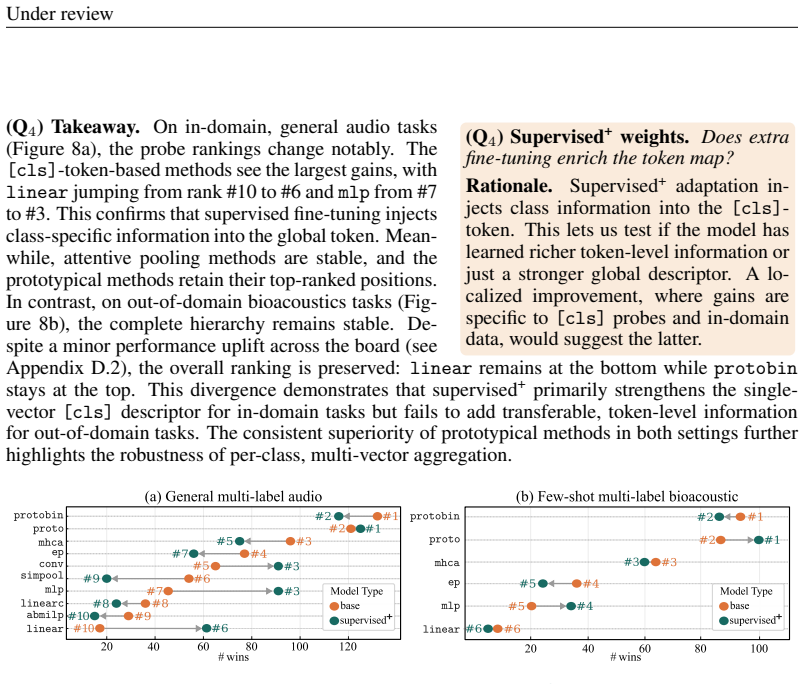
The underperformance of probing in (multi-label) audio stems not from the frozen embeddings themselves, but from an information bottleneck in pooling methods (Section 5, Conclusion). The empirical support is that protobin wins most pairwise comparisons, with an average improvement of +14.41%p mAP over linear on general audio (Q1 Takeaway, Section 4.2).
Load-bearing premise
The claim that protobin's superiority is due to the pooling architecture assumes that the hyperparameter search was fair. In Appendix D.4 the authors gave prototypical probes a learning-rate search range of 2e-3 to 8e-2, while all other pooling methods were searched over 1e-4 to 7e-3, an adjustment made after preliminary experiments. If this difference in tuning budget, rather than per-class multi-vector aggregation, drives the gains, the central 'pooling bottleneck' conclusion is not established.
Editorial analysis
A structured set of objections, weighed in public.
Assumptions & free parameters
free parameters (2)
- J, number of prototypes per class =
20 (10 for as20k)
- Learning-rate search range for prototypical methods =
[2e-3, 8e-2] vs [1e-4, 7e-3] for other probes
assumptions (4)
- domain assumption Six ViT-base spectrogram encoders (A-MAE, ASiT, Dasheng, BEATs, EAT, SSLAM) represent the space of audio SSL models.
- domain assumption Reported fine-tuning numbers from each backbone paper are comparable baselines.
- domain assumption Caching embeddings without on-the-fly augmentations does not disadvantage any probe family.
- standard math The straight-through estimator is a valid way to train through the sign function.
Cite this review
Pith. "Pith review of Unmute the Patch Tokens: Rethinking Probing in Multi-Label Audio Classification." pith.science (2026). https://pith.science/paper/TNERJ53S
@misc{pith2026250924901,
  author       = {Pith},
  title        = {Pith review of: Unmute the Patch Tokens: Rethinking Probing in Multi-Label Audio Classification},
  year         = {2026},
  howpublished = {\url{https://pith.science/paper/TNERJ53S}},
  note         = {Machine review of arXiv:2509.24901}
}
abstract
Although probing frozen models has become a standard evaluation paradigm, self-supervised learning in audio defaults to fine-tuning when pursuing state-of-the-art on AudioSet. A key reason is that global pooling creates an information bottleneck causing linear probes to misrepresent the embedding quality: The $\texttt{cls}$-token discards crucial token information about dispersed, localized events in audio. This weakness is rooted in the mismatch between the pretraining objective (globally) and the downstream task (localized). Across a comprehensive benchmark of 13 datasets and 6 spectrogram-based encoders, we investigate the global pooling bottleneck. We introduce binarized prototypical probes: a lightweight and simple pooling method that learns prototypes to perform class-wise information aggregation. Despite its simplicity, our method notably outperforms linear and attentive probing. Our work establishes probing as a competitive and efficient paradigm for evaluating audio SSL models, challenging the reliance on costly fine-tuning.
Figures


Figures from the paper (5 more)


Forward citations
Cited by 2 Pith papers
-
AudioMosaic: Contrastive Masked Audio Representation Learning
AudioMosaic learns general-purpose audio representations through contrastive pre-training with structured spectrogram masking, reaching state-of-the-art results on standard benchmarks and improving audio-language tasks.
-
BAT: Better Audio Transformer Guided by Convex Gated Probing
CGP probing—layer-gating plus prototypes—closes much of the gap between frozen and fine-tuned audio SSL evaluation, and guides a re-engineered audio transformer (BAT) that improves on the authors' reproduced baselines.
Reference graph
Works this paper leans on
-
[2]
URLhttps://arxiv.org/abs/2106.08254. 11 Under review Adrien Bardes, Quentin Garrido, Jean Ponce, Michael Rabbat, Yann LeCun, Mahmoud Assran, and Nicolas Ballas. Revisiting feature prediction for learning visual representations from video. In arXiv preprint arXiv:2404.08471,
-
[5]
FSD50K: An Open Dataset of Human-Labeled Sound Events.arXiv:2010.00475,
Eduardo Fonseca, Xavier Favory, Jordi Pons, Frederic Font, and Xavier Serra. FSD50K: An Open Dataset of Human-Labeled Sound Events.arXiv:2010.00475,
arXiv 2010
-
[6]
doi: 10.48550/arXiv.2010. 00475. Jort F. Gemmeke, Daniel P. W. Ellis, Dylan Freedman, Aren Jansen, Wade Lawrence, R. Channing Moore, Manoj Plakal, and Marvin Ritter. Audio Set: An ontology and human-labeled dataset for audio events. In2017 IEEE International Conference on Acoustics, Speech and Signal Processing (ICASSP),
-
[7]
The jump in performance fromJ= 1,J= 5andJ= 10is notable on all datasets, though the impact varies on the task (multi-class vs
Sensitivity to number of prototypes.Our results show a clear trend across backbones and pro- totypical probes: performance is highly sensitive toJat lower values and begins to saturate asJ increases. The jump in performance fromJ= 1,J= 5andJ= 10is notable on all datasets, though the impact varies on the task (multi-class vs. multi-label) and the dataset’s...
2017
-
[9]
Xian Li, Nian Shao, and Xiaofei Li
URL https://arxiv.org/abs/2202.10054. Xian Li, Nian Shao, and Xiaofei Li. Self-supervised audio teacher-student transformer for both clip-level and frame-level tasks.IEEE/ACM Transactions on Audio, Speech, and Language Pro- cessing,
-
[12]
Bill Psomas, Ioannis Kakogeorgiou, Konstantinos Karantzalos, and Yannis Avrithis
URLhttps://arxiv.org/abs/2412.03215. Bill Psomas, Ioannis Kakogeorgiou, Konstantinos Karantzalos, and Yannis Avrithis. Keep it sim- pool: Who said supervised transformers suffer from attention deficit? InIEEE/CVF International Conference on Computer Vision (ICCV),
-
[13]
Attention, please! revisiting attentive probing for masked image modeling.arXiv:2506.10178,
13 Under review Bill Psomas, Dionysis Christopoulos, Eirini Baltzi, Ioannis Kakogeorgiou, Tilemachos Aravanis, Nikos Komodakis, Konstantinos Karantzalos, Yannis Avrithis, and Giorgos Tolias. Attention, please! revisiting attentive probing for masked image modeling.arXiv:2506.10178,
-
[14]
Can masked autoencoders also listen to birds?arXiv:2504.12880, 2025a
Lukas Rauch, René Heinrich, Ilyass Moummad, Alexis Joly, Bernhard Sick, and Christoph Scholz. Can masked autoencoders also listen to birds?arXiv:2504.12880, 2025a. Lukas Rauch, Raphael Schwinger, Moritz Wirth, René Heinrich, Denis Huseljic, Marek Herde, Jonas Lange, Stefan Kahl, Bernhard Sick, Sven Tomforde, and Christoph Scholz. BirdSet: A Large-Scale Da...
Show all 16 references
-
[16]
Speech Commands: A Dataset for Limited-V ocabulary Speech Recognition
Pete Warden. Speech Commands: A Dataset for Limited-V ocabulary Speech Recognition. arXiv:1804.03209,
-
[17]
14 Under review A DETAILEDBENCHMARKRESULTS This appendix provides supplementary material to the benchmark evaluation presented in the main paper. Our full benchmark spans 5 general multi-label datasets, 7 few-shot bioacoustic datasets, and 2 multi-class control tasks across 6 ...
1918
-
[19]
up," "down,
‡ 1,600–400 505 sc2(Warden, 2018)84,848 9,982 4,890 1210 AudioSet(Gemmeke et al., 2017).as2mis a large-scale dataset used to pretrain general-purpose audio models and built from a vast collection of YouTube videos. It features a comprehensive ontology of over 500 sound classes...
2018
-
[1998]
Schuller, Christian J
Joseph Turian, Jordie Shier, Humair Raj Khan, Bhiksha Raj, Björn W. Schuller, Christian J. Stein- metz, Colin Malloy, George Tzanetakis, Gissel Velarde, Kirk McNally, Max Henry, Nicolas Pinto, Camille Noufi, Christian Clough, Dorien Herremans, Eduardo Fonseca, Jesse Engel, Jus...
-
[2018]
Johnson, Wolfgang Lorenz, Michael Taenzer, Stylianos Mimilakis, Sascha Grollmisch, Jakob Abeßer, and Hanna Lukashevich
David S. Johnson, Wolfgang Lorenz, Michael Taenzer, Stylianos Mimilakis, Sascha Grollmisch, Jakob Abeßer, and Hanna Lukashevich. DESED-FL and URBAN-FL: Federated Learning Datasets for Sound Event Detection.arXiv:2102.08833,
-
[2023]
Leonardo Pepino, Pablo Riera, and Luciana Ferrer
URLhttps://openreview.net/forum?id=azCKuYyS74. Leonardo Pepino, Pablo Riera, and Luciana Ferrer. EnCodecMAE: leveraging neural codecs for universal audio representation learning. InInterspeech 2025,
2025
-
[2024]
Estimating or Propagating Gradients Through Stochastic Neurons for Conditional Computation.arXiv:1308.3432,
Yoshua Bengio, Nicholas Léonard, and Aaron Courville. Estimating or Propagating Gradients Through Stochastic Neurons for Conditional Computation.arXiv:1308.3432,
-
[2025]
Scaling up masked audio encoder learning for general audio classification.arXiv:2406.06992,
Heinrich Dinkel, Zhiyong Yan, Yongqing Wang, Junbo Zhang, Yujun Wang, and Bin Wang. Scaling up masked audio encoder learning for general audio classification.arXiv:2406.06992,
Reviewed August 4, 2026 · model on record in the stance chip above.
Discussion (0). Sign in to comment.