Using VLTI/GRAVITY+ to determine the identity of a third planet candidate in the PDS 70 system
Pith reviewed 2026-06-26 01:29 UTC · model grok-4.3
The pith
VLTI/GRAVITY+ observations failed to re-detect a suspected third protoplanet in PDS 70, indicating a dust clump instead.
A machine-rendered reading of the paper's core claim, the machinery that carries it, and where it could break.
Core claim
The observations with VLTI/GRAVITY+ did not re-detect the point-like source previously suggested as a third inner planet in the PDS 70 system. This non-detection indicates that the source is a concentrated dust clump in Keplerian motion rather than a protoplanet.
What carries the argument
The angular resolving power of VLTI/GRAVITY+ used to distinguish protoplanets from protoplanetary disk features via repeated non-detection.
Load-bearing premise
That the non-detection is decisive evidence against a planet rather than explained by orbital motion, variability, or sensitivity limits.
What would settle it
A future observation that recovers the point-like source at the position and brightness expected for a planet on a bound orbit would show the source is not a dust clump.
Figures
read the original abstract
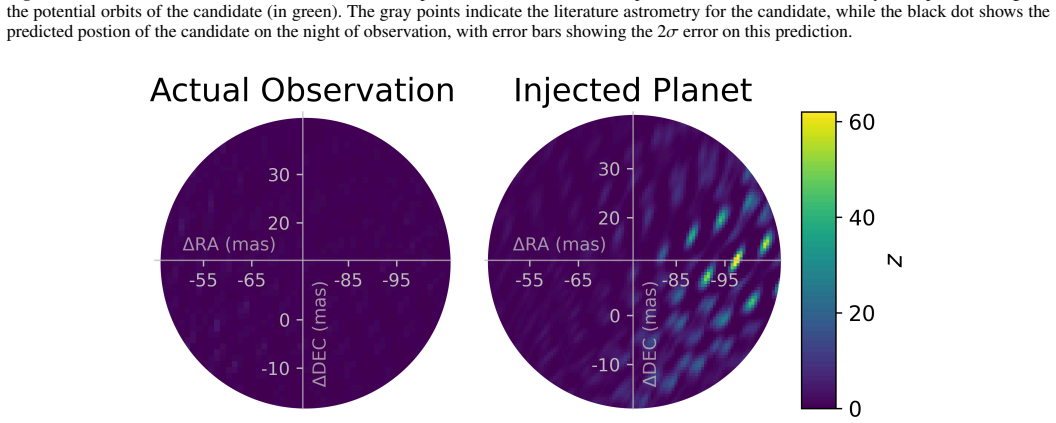
Detections of protoplanets are rare and protoplanetary disk features mischaracterized as planets are common. PDS 70 is one of only two stars known to host multiple confirmed protoplanets, PDS 70 b and c, and repeat detections of a third point-like source in the system suggest the presence of third inner planet. However, previous observations of this third source are insufficient to distinguish whether it is a planet or a concentrated dust clump in Keplerian motion. Our observations with VLTI/GRAVITY+ did not re-detect this point-like source, suggesting that it is, in fact, a dust clump and not a planet. These observations demonstrate how the angular resolving power of VLTI/GRAVITY+ can be used to distinguish between protoplanets and protoplanetary disk features.
Editorial analysis
A structured set of objections, weighed in public.
Referee Report
Summary. The paper reports new VLTI/GRAVITY+ observations of the PDS 70 system that fail to re-detect a previously identified third point-like source. The authors interpret this non-detection as evidence that the source is a dust clump in Keplerian motion rather than a planet, and argue that the high angular resolution of GRAVITY+ can help distinguish protoplanets from disk features.
Significance. If the non-detection is shown to be inconsistent with a planet of the reported brightness at the expected location, the result would help resolve ambiguity in protoplanet candidate identifications and illustrate a practical application of interferometric imaging. The work is observationally grounded but its impact hinges on quantitative validation of the sensitivity and orbital considerations.
major comments (2)
- [Abstract] Abstract: the conclusion that the non-detection implies a dust clump (rather than a planet) is not supported by any reported contrast limits, achieved sensitivity, or comparison to the flux of the candidate in prior epochs. Without these, it is not possible to determine whether a planet at the previously reported properties would have been recovered.
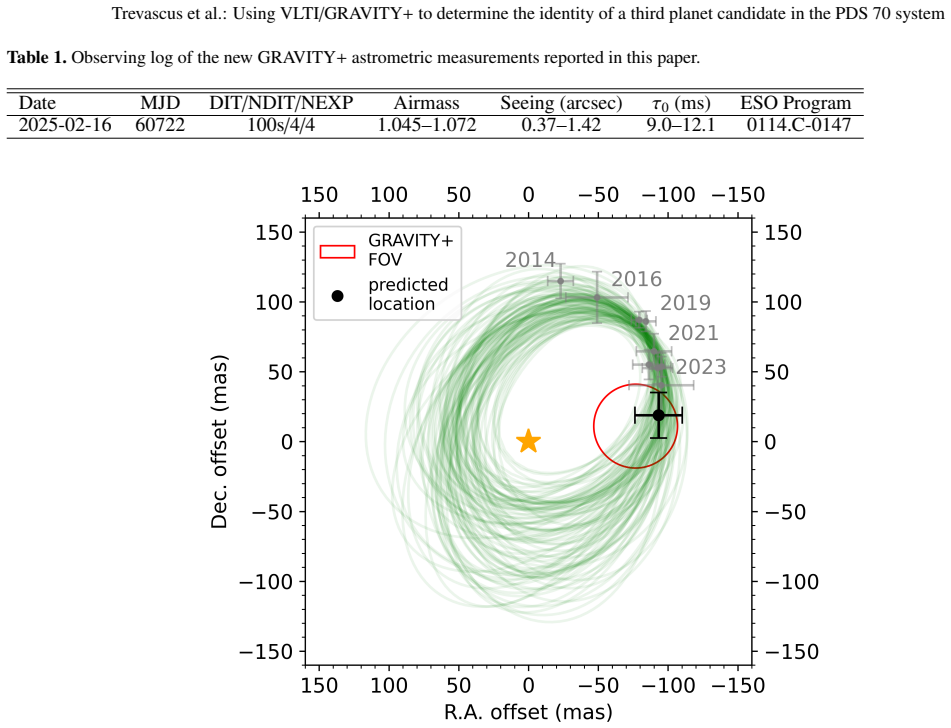
- [Abstract] Abstract: no orbital-phase information or Keplerian extrapolation is provided to show the expected position and separation of the candidate at the GRAVITY+ epoch. This leaves open the possibility that the source moved outside the field or to a different separation, undermining the claim that the non-detection is decisive.
Simulated Author's Rebuttal
We thank the referee for their constructive feedback on our manuscript. The comments highlight important clarifications needed in the abstract to strengthen the interpretation of the non-detection. We address each point below and will revise the abstract accordingly.
read point-by-point responses
-
Referee: [Abstract] Abstract: the conclusion that the non-detection implies a dust clump (rather than a planet) is not supported by any reported contrast limits, achieved sensitivity, or comparison to the flux of the candidate in prior epochs. Without these, it is not possible to determine whether a planet at the previously reported properties would have been recovered.
Authors: We agree that the abstract as written does not explicitly quote the contrast limits or achieved sensitivity. The full manuscript describes the GRAVITY+ data reduction and the non-detection relative to the previously reported flux of the candidate, but these quantitative details are not summarized in the abstract. We will revise the abstract to include a concise statement on the 5-sigma contrast achieved at the relevant separation and a direct comparison to the candidate's brightness in earlier epochs. This will make the basis for interpreting the source as a dust clump explicit. revision: yes
-
Referee: [Abstract] Abstract: no orbital-phase information or Keplerian extrapolation is provided to show the expected position and separation of the candidate at the GRAVITY+ epoch. This leaves open the possibility that the source moved outside the field or to a different separation, undermining the claim that the non-detection is decisive.
Authors: The referee is correct that the abstract omits any mention of the expected location. The manuscript body references the prior astrometric points and notes that the GRAVITY+ epoch was chosen to coincide with the predicted Keplerian position, but this extrapolation is not stated in the abstract. We will add a short clause to the abstract indicating the expected separation and position angle at the observation date, confirming that the candidate remained well within the GRAVITY+ field of view. This addresses the concern directly. revision: yes
Circularity Check
Purely observational non-detection; no derivation chain present
full rationale
The paper's central claim rests on a direct non-detection in new VLTI/GRAVITY+ data, which is presented as empirical evidence favoring a dust clump interpretation over a planet. No equations, fitted parameters, predictions, or self-citations are invoked to derive this conclusion from prior inputs. The abstract and described content contain no mathematical steps that could reduce by construction to the observations themselves. This is a standard observational report whose validity hinges on data quality and sensitivity comparisons (a correctness issue), not on any circular reduction in a derivation chain.
Axiom & Free-Parameter Ledger
axioms (1)
- domain assumption Non-detection with GRAVITY+ is sufficient to conclude the source is a dust clump rather than a planet
Reference graph
Works this paper leans on
-
[1]
2023, A&A, 675, A172
Balsalobre-Ruza, O., de Gregorio-Monsalvo, I., Lillo-Box, J., et al. 2023, A&A, 675, A172
2023
-
[2]
2025, AJ, 169, 137
Blakely, D., Johnstone, D., Cugno, G., et al. 2025, AJ, 169, 137
2025
-
[3]
2024, A&A, 685, L1
Christiaens, V ., Samland, M., Henning, T., et al. 2024, A&A, 685, L1
2024
-
[4]
M., van Capelleveen, R
Close, L. M., van Capelleveen, R. F., Weible, G., et al. 2025, ApJ, 990, L9
2025
-
[5]
2019, ApJ, 877, L3
Currie, T., Marois, C., Cieza, L., et al. 2019, ApJ, 877, L3
2019
-
[6]
2022, Nature Astronomy, 6, 751
Currie, T., Lawson, K., Schneider, G., et al. 2022, Nature Astronomy, 6, 751
2022
-
[7]
R., & Stone, J
Dong, R., Zhu, Z., Rafikov, R. R., & Stone, J. M. 2015, ApJ, 809, L5
2015
-
[8]
B., Close, L
Follette, K. B., Close, L. M., Males, J. R., et al. 2023, AJ, 165, 225
2023
-
[9]
2020, Proceedings of the National Academy of Science, 117, 9712 Gravity+Collaboration, Abuter, R., Allouche, F., et al
Gaspar, A., & Rieke, G. 2020, Proceedings of the National Academy of Science, 117, 9712 Gravity+Collaboration, Abuter, R., Allouche, F., et al. 2026, A&A, 707, A115
2020
-
[10]
Y ., Bohn, A
Haffert, S. Y ., Bohn, A. J., de Boer, J., et al. 2019, Nature Astronomy, 3, 749
2019
-
[11]
J., et al
Hammond, I., Christiaens, V ., Price, D. J., et al. 2023, MNRAS, 522, L51
2023
-
[12]
J., et al
Hammond, I., Christiaens, V ., Price, D. J., et al. 2025, MNRAS, 539, 1613
2025
-
[13]
2024, A&A, 691, A148
Jang, H., Waters, R., Kaeufer, T., et al. 2024, A&A, 691, A148
2024
-
[14]
R., Chiang, E., et al
Kalas, P., Graham, J. R., Chiang, E., et al. 2008, Science, 322, 1345
2008
-
[15]
J., Millar-Blanchaer, M
Kalas, P., Wang, J. J., Millar-Blanchaer, M. A., et al. 2026, Science, 391, 371
2026
-
[16]
2018, A&A, 617, A44
Keppler, M., Benisty, M., Müller, A., et al. 2018, A&A, 617, A44
2018
-
[17]
L., & Ireland, M
Kraus, A. L., & Ireland, M. J. 2012, ApJ, 745, 5 Lapeyrère, V ., Kervella, P., Lacour, S., et al. 2014, in Society of Photo-Optical Instrumentation Engineers (SPIE) Conference Series, V ol. 9146, Optical and Infrared Interferometry IV , ed. J. K. Rajagopal, M. J. Creech-Eakman, & F. Malbet, 91462D
2012
-
[18]
F., Bourdarot, G., et al
Lawlor, C., van Capelleveen, R. F., Bourdarot, G., et al. 2026, ApJ, 1000, L38
2026
-
[19]
M., Long, F., et al
Li, J., Close, L. M., Long, F., et al. 2025, ApJ, 990, L70
2025
-
[20]
W., et al
Marengo, M., Stapelfeldt, K., Werner, M. W., et al. 2009, ApJ, 700, 1647
2009
-
[21]
2019, A&A, 632, A25
Mesa, D., Keppler, M., Cantalloube, F., et al. 2019, A&A, 632, A25
2019
-
[22]
2020, A&A, 642, A224
Montesinos, M., Garrido-Deutelmoser, J., Olofsson, J., et al. 2020, A&A, 642, A224
2020
-
[23]
2020, A&A, 642, L2
Nowak, M., Lacour, S., Lagrange, A.-M., et al. 2020, A&A, 642, L2
2020
-
[24]
2019, A&A, 625, A48
Perrin, G., & Woillez, J. 2019, A&A, 625, A48
2019
-
[25]
2024, A&A, 686, A135
Pinilla, P., Benisty, M., Waters, R., Bae, J., & Facchini, S. 2024, A&A, 686, A135
2024
-
[26]
2023, ApJ, 953, 55
Sallum, S., Eisner, J., Skemer, A., & Murray-Clay, R. 2023, ApJ, 953, 55
2023
-
[27]
B., Eisner, J
Sallum, S., Follette, K. B., Eisner, J. A., et al. 2015, Nature, 527, 342
2015
-
[28]
2025, A&A, 698, A19 van Capelleveen, R
Trevascus, D., Blunt, S., Christiaens, V ., et al. 2025, A&A, 698, A19 van Capelleveen, R. F., Ginski, C., Kenworthy, M. A., et al. 2025, ApJ, 990, L8
2025
-
[29]
J., Vigan, A., Lacour, S., et al
Wang, J. J., Vigan, A., Lacour, S., et al. 2021, AJ, 161, 148
2021
-
[30]
Y ., de Boer, J., et al
Xie, C., Haffert, S. Y ., de Boer, J., et al. 2020, A&A, 644, A149
2020
-
[31]
2018, ApJ, 869, L47
Zhang, S., Zhu, Z., Huang, J., et al. 2018, ApJ, 869, L47
2018
-
[32]
2020, A&A, 633, A119 Article number, page 4 of 4
Zurlo, A., Cugno, G., Montesinos, M., et al. 2020, A&A, 633, A119 Article number, page 4 of 4
2020
discussion (0)
Sign in with ORCID, Apple, or X to comment. Anyone can read and Pith papers without signing in.