REVIEW 5 minor 48 references
Permutahedra, Lusztig varieties, degenerations, and subdivisions
T0 review · 0 major / 5 minor · reviewed 2026-07-12 · grok-4.5
Pith's one-line read Lusztig varieties degenerate to unions of Richardson varieties, subdividing the permutahedron into Bruhat-interval polytopes that are regular in types A, B and C.
desk verdict Solid geometric unification of three known results via a non-Gröbner degeneration, plus a general subdivision theorem and explicit regularity in ABC. read the letter →
The pith
A machine-rendered reading of the paper's core claim, the machinery that carries it, and where it could break.
The reading
What carries the argument
The double-Schubert degeneration of Proposition 2.4, intersected fibrewise with a general translate of the diagonal Schubert variety, produces a flat family whose special fibre is the desired union of Richardson varieties; Duistermaat–Heckman measures then convert the geometric degeneration into a polyhedral subdivision of the moment polytope.
What would settle it
Exhibit a Coxeter element c and a regular-semisimple t for which the intersection of the double-Schubert special fibre with (t,1)Ω_e fails to be equidimensional or Cohen–Macaulay, or compute the height function of Definition 5.6 on a type-A permutahedron and check that a lifted facet lies strictly below a neighbouring facet.
Extended reading notes
Core claim
For t general in the torus there is an embedded flat T-equivariant degeneration of the Lusztig variety Y_w(t) to the reduced union of all Richardson varieties X^{u w^{-1}}_u with u w^{-1} length-additive; when w is a Coxeter element this specialises to a finest Bruhat-interval subdivision of the W-permutahedron that is regular in types A, B and C.
Load-bearing premise
Flatness of the restricted family at the special fibre rests on Kleiman transversality (characteristic zero) together with the Cohen–Macaulay property of the special fibre of the double-Schubert family; if either fails, the class formulae and the polytope subdivision do not follow.
Signed reviews
Editorial analysis
A structured set of objections, weighed in public.
Referee Report
Summary. The paper constructs an embedded T-equivariant flat degeneration of a regular semisimple Lusztig variety Y_w(t) inside G/B to the reduced union of Richardson varieties X^{u w^{-1}}_u over length-additive products uw^{-1} (Theorem A / Theorem 2.10). The construction intersects a known flat family of double Schubert varieties (Proposition 2.4) with a transverse translate (t,1)Ω_e and projects; flatness is verified by K-class equality (Proposition 2.1) using transversality and Cohen–Macaulayness of the special fibre. Specialising to Coxeter elements yields a finest Bruhat-interval subdivision of the W-permutahedron (Theorem C / Theorem 4.4). A general result (Theorem 3.1) shows that any T-equivariant embedded semitoric degeneration of a projective toric variety produces a polyhedral subdivision of the moment polytope via Duistermaat–Heckman measures and Zariski’s main theorem. Explicit height functions (rightmost subexpressions / lattice-path weights) prove the subdivisions are regular in types A, B and C.
Significance. The work unifies and extends cohomology-class formulae of Anderson–Tymoczko, Harada–Horiguchi–Masuda–Park and Kim by a single geometric degeneration, while supplying a non-Gröbner source of Bruhat-interval subdivisions of Coxeter permutahedra. Theorem 3.1 is of independent interest: it removes the Gröbner hypothesis from the classical Sturmfels correspondence between toric degenerations and polytope subdivisions. The regularity proofs give concrete maximal cones in the positive flag Dressian (at least 2^{n-2} in type A) and an explicit height function that realises them. The arguments rely only on standard tools (flatness, equivariant K-theory, moment maps) and previously established properties of double Schubert varieties; no free parameters or circular definitions appear.
minor comments (5)
- [Abstract / §1.1] In the abstract and introduction the degeneration is said to give a “subdivision”, while Theorem 1.1 (quoted from HHMP) only claims a dissection; the upgrade to a genuine subdivision is proved only later in Theorem 3.1. A one-sentence forward pointer would avoid temporary confusion.
- [§2, Proposition 2.1] Proposition 2.1 asserts that equal A_*-classes plus reduced equidimensional fibres imply flatness; the short proof is correct but could cite the precise reference (e.g., the relevant lemma in [KM05] or [AK10]) for readers less familiar with the Hilbert-polynomial argument.
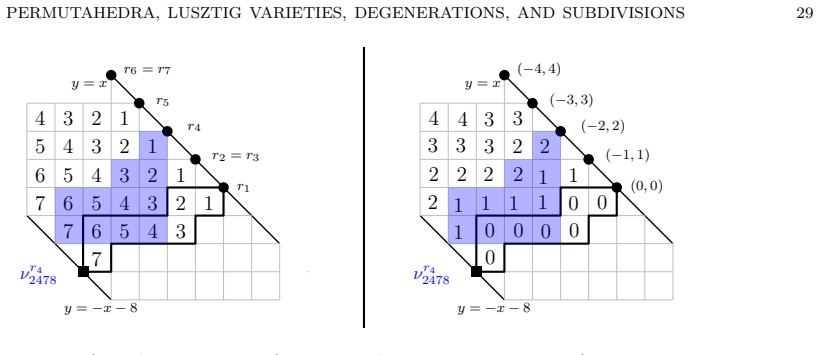
- [§5.3] The lattice-path description of the height function (Proposition 5.18 and Figures 2–4) is clear, yet the dependence of the sequence of corners r_i on the excedance set of c is stated only after the figures; moving the definition of r_i earlier would help the reader follow the weight calculation.
- [§2.4] Conjecture 2.14 on the K-class is left open outside the Coxeter case; a brief remark on whether the same Möbius function can be read off from the totally nonnegative flag variety (already mentioned in Remark 2.16) would clarify the expected next step.
- [Throughout] A few typographical inconsistencies appear: “Gröbner” vs. “Gr"obner”, and the occasional missing space before a citation. These are purely cosmetic.
Circularity Check
No significant circularity; all load-bearing steps are independent derivations from external citations, standard tools (flatness/K-theory/DH measures/Zariski), or direct combinatorial verification of height functions.
full rationale
The central degeneration (Thm 2.10/A) is obtained by fiberwise intersection of the external double-Schubert family of Prop 2.4 ([UG25], non-overlapping authors) with (t,1)Ω_e, followed by projection; flatness at 0/1 follows from Prop 2.1 via K-class equality (transversality by Kleiman + CM of the special fibre already established in the citation) and is not defined in terms of the target classes or polytopes. The general subdivision theorem (Thm 3.1) is proved from scratch via Duistermaat–Heckman measures, GIT quotients, and Zariski’s main theorem (Cor 2.3), without assuming the conclusion. For Coxeter elements the Bruhat-interval subdivision (Thm 4.4/C) is then immediate from the degeneration + Thm 3.1 + Lem 4.3. Regularity in types A/B/C is verified directly: the height functions h_c (Def 5.6/6.1) are defined combinatorially from rightmost subexpressions/weights of lattice paths, then shown to satisfy the external coplanarity + local-folding criteria of Thm 5.3 ([DLRS10]) by explicit incline calculations (Props 5.11/5.13/5.21 and Lem 5.20). The only self-citation ([Knu09] for the Möbius formula on the union) is used solely for the optional K-class refinement and is not load-bearing for the degeneration, cohomology formulae, or polytope subdivision. No quantity is fitted, redefined in terms of the output, or forced by an author-unique uniqueness theorem; the paper is self-contained against its external benchmarks.
Assumptions & free parameters
assumptions (4)
- standard math Kleiman transversality (char 0) guarantees that (t,1)Ω_e ∩ Ω_w is transverse for general t∈T
- standard math Zariski’s main theorem (and its corollary on connectedness of fibres of proper maps with connected general fibre)
- domain assumption The special fibre of the double-Schubert family of Proposition 2.4 is reduced and Cohen–Macaulay
- standard math Duistermaat–Heckman measure of a projective toric variety is Lebesgue measure on its moment polytope
invented entities (1)
-
height function h_c on vertices of the permutahedron (via rightmost subexpressions / lattice-path weights)
independent evidence
Cite this review
Pith. "Pith review of Permutahedra, Lusztig varieties, degenerations, and subdivisions." pith.science (2026). https://pith.science/paper/TNMN77YL
@misc{pith2026260702701,
  author       = {Pith},
  title        = {Pith review of: Permutahedra, Lusztig varieties, degenerations, and subdivisions},
  year         = {2026},
  howpublished = {\url{https://pith.science/paper/TNMN77YL}},
  note         = {Machine review of arXiv:2607.02701}
}
abstract
We present an embedded (in $G/B$) degeneration of Lusztig varieties (which generalize type $A$ Hessenberg varieties) to certain unions of Richardson varieties, giving a simultaneous reproof (and extension) of results of Anderson--Tymoczko, Harada--Horiguchi--Masuda--Park, and Kim. Although torus-equivariant, the degeneration is not Gr\"obner. In the case that the Lusztig variety is the permutahedral toric variety, this degeneration provides a subdivision of the permutahedron into Bruhat interval polytopes, and we prove a more general result showing equivariant degenerations of projective toric varieties produce subdivisions of the moment polytope (as was shown in the Gr\"obner case by Sturmfels). A Gr\"obner degeneration would result in a {\em regular} subdivision, and despite our degeneration not being Gr\"obner we show in types $A,B,C$ that our subdivisions of the permutahedron are indeed regular.
Figures


Figures from the paper (2 more)
Reference graph
Works this paper leans on
-
[1]
Positive configuration space
Nima Arkani-Hamed, Thomas Lam, and Marcus Spradlin. Positive configuration space. Comm. Math. Phys. , 384(2):909--954, 2021
2021
-
[2]
Complete moduli spaces of branchvarieties
Valery Alexeev and Allen Knutson. Complete moduli spaces of branchvarieties. Journal f \"u r die Reine und Angewandte Mathematik , 2010(639), 2010
2010
-
[3]
Schubert polynomials and classes of H essenberg varieties
Dave Anderson and Julianna Tymoczko. Schubert polynomials and classes of H essenberg varieties. Journal of Algebra , 323, 2010
2010
-
[4]
On computing the number of linear extensions of a tree
Mike D Atkinson. On computing the number of linear extensions of a tree. Order , 7(1):23--25, 1990
1990
-
[5]
Combinatorics of C oxeter groups , volume 231 of Graduate Texts in Mathematics
Anders Bj\"orner and Francesco Brenti. Combinatorics of C oxeter groups , volume 231 of Graduate Texts in Mathematics . Springer, New York, 2005
2005
-
[6]
Persistent subdivisions of C oxeter permutahedra
Timothy Blanton, Jes\' u s De Loera, and Melissa Sherman-Bennett. Persistent subdivisions of C oxeter permutahedra. arXiv:2606.28680 , 2026
arXiv 2026
-
[7]
Polyhedral and tropical geometry of flag positroids
Jonathan Boretsky, Christopher Eur, and Lauren Williams. Polyhedral and tropical geometry of flag positroids. Algebra Number Theory , 18(7):1333--1374, 2024
2024
-
[8]
I. N. Bernstein, I. M. Gel ' fand, and S. I. Gel ' fand. Schubert cells and the cohomology of a flag space. Funkcional. Anal. i Prilo zen. , 7(1):64--65, 1973
1973
Show all 48 references
-
[9]
The C oxeter flag variety, 2026
Nantel Bergeron, Lucas Gagnon, Hunter Spink, and Vasu Tewari. The C oxeter flag variety, 2026
2026
-
[10]
Geometry of regular semisimple L usztig varieties
Patrick Brosnan, Jaehyun Hong, and Donggun Lee. Geometry of regular semisimple L usztig varieties. Preprint, arXiv:2504.15868 , 2025
2025
-
[11]
The M irkovi \'c -- V ilonen basis and D uistermaat-- H eckman measures
Pierre Baumann, Joel Kamnitzer, and Allen Knutson. The M irkovi \'c -- V ilonen basis and D uistermaat-- H eckman measures. Acta Mathematica , 227(1):1--101, 2021
2021
-
[12]
Affine M irkovi\'c- V ilonen polytopes
Pierre Baumann, Joel Kamnitzer, and Peter Tingley. Affine M irkovi\'c- V ilonen polytopes. Publ. Math. Inst. Hautes \'Etudes Sci. , 120:113--205, 2014
2014
-
[13]
Totally nonnegative tropical flags and the totally nonnegative flag D ressian
Jonathan Boretsky. Totally nonnegative tropical flags and the totally nonnegative flag D ressian. arXiv:2208.09128 , 2023. preprint
2023 arXiv
-
[14]
Action d’un tore dans une variet \'e projective
M Brion and C Procesi. Action d’un tore dans une variet \'e projective. O perator A lgebras, U nitary R epresentations, E nveloping A lgebras, and I nvariant T heory. E nglish translation at https://translations.thosgood.net/PiM-92-1990-509.pdf. Progress in Mathematics , 93, 1990
1990
-
[15]
Bruhat order of C oxeter groups and shellability
Anders Bj\"orner and Michelle Wachs. Bruhat order of C oxeter groups and shellability. Adv. in Math. , 43(1):87--100, 1982
1982
-
[16]
Variation of geometric invariant theory quotients
Igor V Dolgachev and Yi Hu. Variation of geometric invariant theory quotients. Publications Math \'e matiques de l'Institut des Hautes \'E tudes Scientifiques , 87(1):5--51, 1998
1998
-
[17]
De Loera, J
J. De Loera, J. Rambau, and F. Santos. Triangulations: Structures for algorithms and applications . Algorithms and Computation in Mathematics. Springer Berlin Heidelberg, 2010
2010
-
[18]
Equivariant intersection theory (with an appendix by A ngelo V istoli: The C how ring of M_2 )
Dan Edidin and William Graham. Equivariant intersection theory (with an appendix by A ngelo V istoli: The C how ring of M_2 ). Inventiones Mathematicae , 131(3):595--634, 1998
1998
-
[19]
Intersection theory , volume 2
William Fulton. Intersection theory , volume 2. Springer Science & Business Media, 2013
2013
-
[20]
Karp, and Thomas Lam
Pavel Galashin, Steven N. Karp, and Thomas Lam. Regularity theorem for totally nonnegative flag varieties. J. Amer. Math. Soc. , 35(2):513--579, 2022
2022
-
[21]
Symplectic fibrations and multiplicity diagrams
Victor Guillemin, Eugene Lerman, and Shlomo Sternberg. Symplectic fibrations and multiplicity diagrams . Cambridge University Press, 1996
1996
-
[22]
Gruber and Sergej S
Peter M. Gruber and Sergej S. Ryškov. Facet-to-facet implies face-to-face. European Journal of Combinatorics , 10(1):83--84, 1989
1989
-
[23]
Megumi Harada, Andr\'e Henriques, and Tara S. Holm. Computation of generalized equivariant cohomologies of K ac- M oody flag varieties. Adv. Math. , 197(1):198--221, 2005
2005
-
[24]
The volume polynomial of regular semisimple H essenberg varieties and the G elfand-- Z etlin polytope
Megumi Harada, Tatsuya Horiguchi, Mikiya Masuda, and Seonjeong Park. The volume polynomial of regular semisimple H essenberg varieties and the G elfand-- Z etlin polytope. Proceedings of the Steklov Institute of Mathematics , 305, 2019
2019
-
[25]
Rota's conjecture and positivity of algebraic cycles in permutohedral varieties
June Huh. Rota's conjecture and positivity of algebraic cycles in permutohedral varieties . PhD thesis, University of Michigan, 2014
2014
-
[26]
Generalized permutahedra and positive flag D ressians
Michael Joswig, Georg Loho, Dante Luber, and Jorge Alberto Olarte. Generalized permutahedra and positive flag D ressians. Int. Math. Res. Not. IMRN , (19):16748--16777, 2023
2023
-
[27]
M. M. Kapranov. Chow quotients of G rassmannians. I . In I. M . G el ' fand S eminar , volume 16, Part 2 of Adv. Soviet Math. , pages 29--110. Amer. Math. Soc., Providence, RI, 1993
1993
-
[28]
Homology class of a D eligne- L usztig variety and its analogues
Dongkwan Kim. Homology class of a D eligne- L usztig variety and its analogues. Int. Math. Res. Not. IMRN , (4):1246--1280, 2020
2020
-
[29]
Gr \"o bner geometry of S chubert polynomials
Allen Knutson and Ezra Miller. Gr \"o bner geometry of S chubert polynomials. Annals of Mathematics , pages 1245--1318, 2005
2005
-
[30]
Frobenius splitting and M \"obius inversion
Allen Knutson. Frobenius splitting and M \"obius inversion. arXiv:0902.1930 , 2009
1930 arXiv
-
[31]
Decompositions of normal algebraic varieties determined by an action of a one-dimensional torus
Jerzy Konarski. Decompositions of normal algebraic varieties determined by an action of a one-dimensional torus. Bull. Acad. Polon. Sci. S\'er. Sci. Math. Astronom. Phys. , 26(4):295--300, 1978
1978
-
[32]
The full K ostant- T oda hierarchy on the positive flag variety
Yuji Kodama and Lauren Williams. The full K ostant- T oda hierarchy on the positive flag variety. Comm. Math. Phys. , 335(1):247--283, 2015
2015
-
[33]
The HHMP decomposition of the permutohedron and degenerations of torus orbits in flag varieties
Carl Lian. The HHMP decomposition of the permutohedron and degenerations of torus orbits in flag varieties . International Mathematics Research Notices , 09 2024
2024
-
[34]
The geometry and combinatorics of some H essenberg varieties related to the permutohedral variety
Jan-Li Lin. The geometry and combinatorics of some H essenberg varieties related to the permutohedral variety. The Electronic Journal of Combinatorics , pages P3--17, 2024
2024
-
[35]
New moduli spaces of pointed curves and pencils of flat connections
Andrey Losev and Yuri Manin. New moduli spaces of pointed curves and pencils of flat connections. Michigan Mathematical Journal , 48(1):443--472, 2000
2000
-
[36]
Williams
Tomasz ukowski, Matteo Parisi, and Lauren K. Williams. The positive tropical G rassmannian, the hypersimplex, and the m=2 amplituhedron. Int. Math. Res. Not. IMRN , (19):16778--16836, 2023
2023
-
[37]
G. Lusztig. On the reflection representation of a finite C hevalley group. In Representation theory of L ie groups , pages 325--337. Cambridge Univ. Press, Cambridge, 1979
1979
-
[38]
Towards a mathematical definition of C oulomb branches of 3-dimensional N=4 gauge theories, I
Hiraku Nakajima. Towards a mathematical definition of C oulomb branches of 3-dimensional N=4 gauge theories, I . Adv. Theor. Math. Phys. , 20(3):595--669, 2016
2016
-
[39]
Richard P. Stanley. Enumerative combinatorics. V ol. 1 , volume 49 of Cambridge Studies in Advanced Mathematics . Cambridge University Press, Cambridge, 1997. With a foreword by Gian-Carlo Rota, Corrected reprint of the 1986 original
1997
-
[40]
Folding by automorphisms
John Stembridge. Folding by automorphisms. https://dept.math.lsa.umich.edu/\
-
[41]
Gr \"o bner bases of toric varieties
Bernd Sturmfels. Gr \"o bner bases of toric varieties. Tohoku Mathematical Journal, Second Series , 43(2):249--261, 1991
1991
-
[42]
Williams
David Speyer and Lauren K. Williams. The positive D ressian equals the positive tropical G rassmannian. Trans. Amer. Math. Soc. Ser. B , 8:330--353, 2021
2021
-
[43]
Examples of non- K\"a hler H amiltonian torus actions
Susan Tolman. Examples of non- K\"a hler H amiltonian torus actions. Inventiones mathematicae , 131(2):299--310, 1998
1998
-
[44]
Tsukerman and L
E. Tsukerman and L. Williams. Bruhat interval polytopes. Adv. Math. , 285:766--810, 2015
2015
-
[45]
A degeneration of the brick variety and a mixed subdivision of the associahedron into cubes
Gabe Udell and Raj Gandhi. A degeneration of the brick variety and a mixed subdivision of the associahedron into cubes. Preprint , 2025
2025
-
[46]
Schubert induction
Ravi Vakil. Schubert induction. Ann. of Math. (2) , 164(2):489--512, 2006
2006
-
[47]
Goresky- M ac P herson calculus for the affine flag varieties
Zhiwei Yun. Goresky- M ac P herson calculus for the affine flag varieties. Canad. J. Math. , 62(2):473--480, 2010
2010
-
[48]
Degenerations of toric ideals and toric varieties
Chun-Gang Zhu. Degenerations of toric ideals and toric varieties. Journal of Mathematical Analysis and Applications , 386(2):613--618, 2012
2012
Reviewed July 12, 2026 · model on record in the stance chip above.
Discussion (0). Continue with ORCID to comment.