REVIEW 1 major objections 2 minor 52 references
Efficient Energy-Constrained Semi-Device-Independent QRNG with an Integrated Heterodyne Receiver
T0 review · 1 major / 2 minor · reviewed 2026-06-26 · grok-4.3
Pith's one-line read A four-state coherent-state constellation measured by heterodyne detection certifies 0.223 bits of randomness per shot under photon-number constraints.
desk verdict The paper gives an experimental semi-DI QRNG demo with an integrated heterodyne receiver that reaches 0.223 bits per shot, but the SDP relaxation tightness is not shown. read the letter →
The pith
A machine-rendered reading of the paper's core claim, the machinery that carries it, and where it could break.
The reading
What carries the argument
Photon-number-constrained semi-device-independent QRNG protocol, in which a bound on the mean photon number of the prepared states is combined with heterodyne detection outcomes and semidefinite relaxation to compute lower bounds on extractable Shannon entropy.
What would settle it
An experiment that records the heterodyne statistics of the four-state constellation while enforcing the stated photon-number bound and finds that the resulting semidefinite program returns an entropy lower bound materially below 0.223 bits per measurement.
Extended reading notes
Core claim
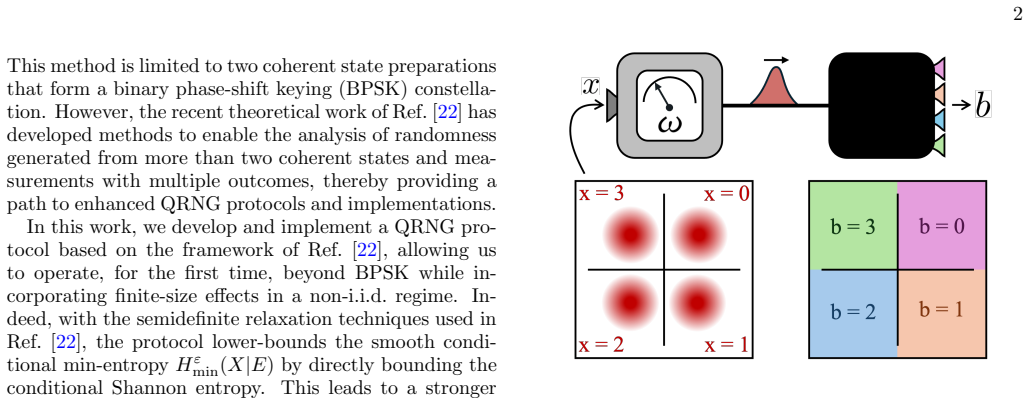
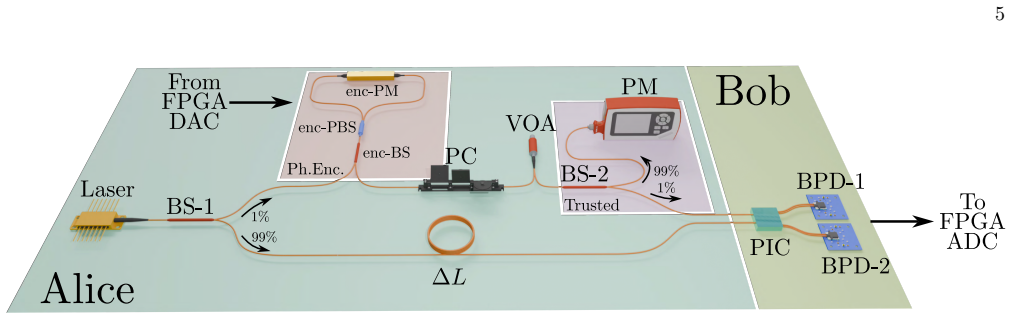
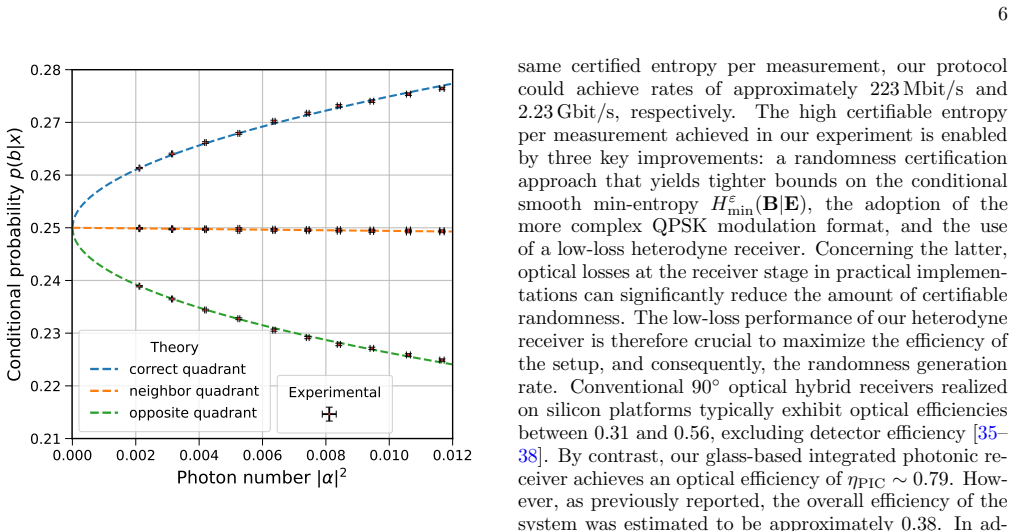
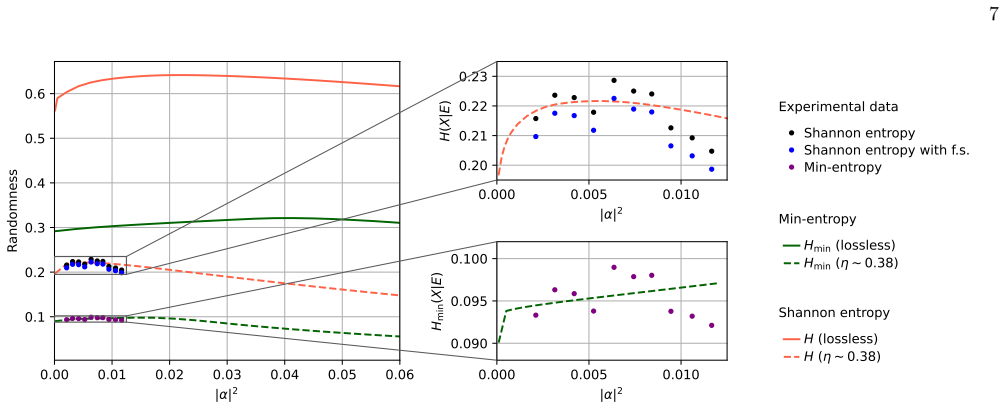
We realize the protocol using a four-state coherent-state constellation symmetrically distributed in phase space and measured by heterodyne detection, certifying 0.223 bit per measurement, which is the highest value reported to date for a continuous-variable semi-device-independent QRNG. The implementation combines a low-loss integrated photonic heterodyne receiver with a simple transmitter assembled from commercial components, providing a practical and high-speed architecture for semi-device-independent randomness generation.
Load-bearing premise
The photon-number constraints on the source states are sufficient, when combined with semidefinite relaxation techniques, to compute tight lower bounds on the certifiable Shannon entropy.
Editorial extensions
If this is right
- Finite-size randomness can be certified without assuming independent and identically distributed rounds by combining the bounds with entropy accumulation.
- The photon-number constraint is experimentally verifiable and therefore practical for photonic hardware.
- The integrated heterodyne receiver and commercial transmitter together form a high-speed, low-loss architecture suitable for real-world deployment.
- The achieved rate of 0.223 bits per measurement exceeds all previously reported values for continuous-variable semi-device-independent QRNGs.
Reading between the lines
- The same photon-number bounding approach could be applied to other continuous-variable protocols to obtain device-independent-style security with modest assumptions.
- Integration of the receiver on a photonic chip suggests a path toward compact, mass-producible QRNG modules.
- Relaxing the four-state constellation to higher-order modulations might increase the certified rate while preserving the same constraint framework.
Signed reviews
Editorial analysis
A structured set of objections, weighed in public.
Referee Report
Summary. The manuscript experimentally realizes a continuous-variable semi-device-independent QRNG protocol using a four-state coherent-state constellation symmetrically placed in phase space, measured via an integrated low-loss heterodyne receiver. It certifies 0.223 bits of randomness per measurement—the highest reported for this class—by imposing experimentally verifiable photon-number constraints, computing lower bounds on conditional Shannon entropy via semidefinite relaxation, and applying entropy accumulation to obtain finite-size guarantees without an i.i.d. assumption.
Significance. If the reported entropy bounds are tight, the result would establish a practical, high-rate architecture for semi-DI randomness generation that combines commercial transmitter components with integrated photonic detection, while relaxing the need for full device characterization. The combination of photon-number constraints with SDP relaxation and entropy accumulation is a methodological strength that could generalize to other photonic QRNG implementations.
major comments (1)
- [Abstract/methods] Abstract and methods: the central claim of 0.223 bit/measurement rests on the semidefinite relaxation producing a sufficiently tight lower bound on the conditional Shannon entropy given only the photon-number constraint and the four-state constellation. No duality-gap bound, comparison against an exact SDP or numerical optimization on the same constraint set, and no sensitivity analysis under small violations of the photon-number assumption are provided; if the relaxation gap is non-negligible the certified value would be overestimated.
minor comments (2)
- The description of the integrated heterodyne receiver would benefit from explicit loss figures, bandwidth, and how the photon-number constraint is experimentally bounded (e.g., mean photon number or support).
- Clarify the precise SDP formulation (objective, constraints, and relaxation hierarchy) used to obtain the entropy lower bound; a supplementary file with the solver input would improve reproducibility.
Simulated Author's Rebuttal
We thank the referee for the careful reading and constructive feedback. We address the single major comment below.
read point-by-point responses
-
Referee: [Abstract/methods] Abstract and methods: the central claim of 0.223 bit/measurement rests on the semidefinite relaxation producing a sufficiently tight lower bound on the conditional Shannon entropy given only the photon-number constraint and the four-state constellation. No duality-gap bound, comparison against an exact SDP or numerical optimization on the same constraint set, and no sensitivity analysis under small violations of the photon-number assumption are provided; if the relaxation gap is non-negligible the certified value would be overestimated.
Authors: We agree that the manuscript does not supply a duality-gap certificate, a direct comparison to an exact solver or finer discretization, or a sensitivity study for photon-number violations. These omissions leave open the possibility that the reported lower bound on conditional entropy is not tight. In the revised manuscript we will add (i) a numerical comparison of the current SDP relaxation against a discretized convex optimization over the same constraint set and (ii) a first-order sensitivity analysis showing the change in the certified entropy when the photon-number bound is relaxed by a few percent. If the gap remains negligible, the 0.223 bit/measurement figure will be retained with the new supporting data; otherwise the certified value will be adjusted downward. revision: yes
Circularity Check
No circularity: SDP-based entropy lower bounds are independent of the certified quantity
full rationale
The paper's central claim is an experimental certification of 0.223 bits/measurement obtained by feeding measured heterodyne statistics (under an experimentally assessed photon-number constraint) into a semidefinite relaxation that produces a lower bound on conditional Shannon entropy, followed by entropy accumulation. This chain does not reduce any quantity to a fitted parameter by construction, nor does it rely on a self-citation whose content is itself the target result. The SDP relaxation is a standard numerical method whose output is not definitionally identical to the input data; any gap between the relaxation and the true minimum is a question of bound tightness rather than circularity. No self-definitional, fitted-input, or uniqueness-imported steps appear in the derivation.
Assumptions & free parameters
Cite this review
Pith. "Pith review of Efficient Energy-Constrained Semi-Device-Independent QRNG with an Integrated Heterodyne Receiver." pith.science (2026). https://pith.science/paper/TNOOLCKY
@misc{pith2026260623231,
  author       = {Pith},
  title        = {Pith review of: Efficient Energy-Constrained Semi-Device-Independent QRNG with an Integrated Heterodyne Receiver},
  year         = {2026},
  howpublished = {\url{https://pith.science/paper/TNOOLCKY}},
  note         = {Machine review of arXiv:2606.23231}
}
read the original abstract
Semi-device-independent QRNG frameworks represent a particularly attractive approach, combining strong security guarantees with high randomness generation rates while relying only on reduced and practical physical assumptions. A recently proposed approach based on photon-number constraints is particularly suited to photonic implementations, where these assumptions can be easily assessed experimentally. Here, we experimentally demonstrate a quantum random number generator within this framework, enabling the direct computation of lower bounds on the certifiable Shannon entropy via semidefinite relaxation techniques. When combined with entropy accumulation methods, this approach enables finite-size randomness certification without assuming independent and identically distributed rounds. We realize the protocol using a four-state coherent-state constellation symmetrically distributed in phase space and measured by heterodyne detection, certifying 0.223 bit per measurement, which is the highest value reported to date for a continuous-variable semi-device-independent QRNG. The implementation combines a low-loss integrated photonic heterodyne receiver with a simple transmitter assembled from commercial components, providing a practical and high-speed architecture for semi-device-independent randomness generation.
Figures
Figures from the paper (1 more)
Reference graph
Works this paper leans on
-
[1]
dimension×DV polarization – – 0.03 23·10 −6
-
[2]
overlap×DV time-bin 0.22 – 50 11
-
[3]
overlap×DV on-off keying 0.33 – 50 16.5
-
[4]
overlap×DV on-off keying 0.0061 – 1 0.006
-
[5]
overlap✓DV time-bin – 1.299 ‡ 0.526 0.683 ∗
-
[6]
energy×DV time-bin 0.23 – 10 2.3 ∗
-
[7]
energy✓DV on-off keying – 0.1 12.5 1.25
-
[8]
energy×CV BPSK 0.09 – 1250 113
Show all 52 references
-
[9]
energy×CV ternary coherent states 0.0117 – 100 1.165
-
[10]
Comparative analysis of Semi-DI QRNG implementations with untrusted source and measurement
energy✓CV BPSK – 0.12 (0.18 ∗) 1250 145.5 This work energy✓CV QPSK 0.10 0.22 ‡ 250 55.6 TABLE I. Comparative analysis of Semi-DI QRNG implementations with untrusted source and measurement. The com- parison includes the underlying protocol assumptions, such as the bound on the ...
2023
-
[11]
Ac´ ın and L
A. Ac´ ın and L. Masanes, Certified randomness in quan- tum physics, Nature540, 213 (2016)
2016
-
[12]
Y.-Q. Nie, L. Huang, Y. Liu, F. Payne, J. Zhang, and J.-W. Pan, The generation of 68 gbps quantum random number by measuring laser phase fluctuations, Review of Scientific Instruments86, 063105 (2015)
2015
-
[13]
Bruynsteen, T
C. Bruynsteen, T. Gehring, C. Lupo, J. Bauwelinck, and X. Yin, 100-gbit/s integrated quantum random number generator based on vacuum fluctuations, PRX Quantum 4, 010330 (2023)
2023
-
[14]
Pironio, A
S. Pironio, A. Ac´ ın, S. Massar, A. B. de la Giroday, D. N. Matsukevich, P. Maunz, S. Olmschenk, D. Hayes, L. Luo, T. A. Manning, and C. Monroe, Random numbers certi- fied by bell’s theorem, Nature464, 1021 (2010)
2010
-
[15]
Bierhorst, E
P. Bierhorst, E. Knill, S. Glancy, Y. Zhang, A. Mink, S. Jordan, A. Rommal, Y.-K. Liu, B. Christensen, S. W. Nam, M. J. Stevens, and L. K. Shalm, Experimentally generated randomness certified by the impossibility of superluminal signals, Nature556, 223 (2018)
2018
-
[16]
Y. Liu, Q. Zhao, M.-H. Li, J.-Y. Guan, Y. Zhang, B. Bai, W. Zhang, W.-Z. Liu, C. Wu, X. Yuan, H. Li, W. J. Munro, Z. Wang, L. You, J. Zhang, X. Ma, J. Fan, Q. Zhang, and J.-W. Pan, Device-independent quantum random-number generation, Nature562, 548 (2018)
2018
-
[17]
M.-H. Li, X. Zhang, W.-Z. Liu, S.-R. Zhao, B. Bai, Y. Liu, Q. Zhao, Y. Peng, J. Zhang, Y. Zhang, W. Munro, X. Ma, Q. Zhang, J. Fan, and J.-W. Pan, Experimental Realization of Device-Independent Quantum Random- ness Expansion, Physical Review Letters126, 050503 (2021)
2021
-
[18]
Liu, M.-H
W.-Z. Liu, M.-H. Li, S. Ragy, S.-R. Zhao, B. Bai, Y. Liu, P. J. Brown, J. Zhang, R. Colbeck, J. Fan, Q. Zhang, and J.-W. Pan, Device-independent randomness expan- sion against quantum side information, Nature Physics 17, 448 (2021)
2021
-
[19]
J. B. Brask, N. Brunner, J. Pauwels, D. Rusca, and A. Tavakoli, Quantum correlations in prepare-and- measure scenarios and their semi-device-independent ap- plications (2026), arXiv:2603.23604 [quant-ph]
2026
-
[20]
Z. Cao, H. Zhou, and X. Ma, Loss-tolerant measurement- device-independent quantum random number genera- tion, New Journal of Physics17, 125011 (2015)
2015
-
[21]
Avesani, D
M. Avesani, D. G. Marangon, G. Vallone, and P. Villoresi, Source-device-independent heterodyne- based quantum random number generator at 17 gbps, Nature Communications9, 5365 (2018)
2018
-
[22]
P. R. Smith, D. G. Marangon, M. Lucamarini, Z. L. Yuan, and A. J. Shields, Simple source device- independent continuous-variable quantum random num- ber generator, Phys. Rev. A99, 062326 (2019)
2019
-
[23]
J. B. Brask, A. Martin, W. Esposito, R. Houlmann, J. Bowles, H. Zbinden, and N. Brunner, Megahertz- rate semi-device-independent quantum random number generators based on unambiguous state discrimination, Phys. Rev. Appl.7, 054018 (2017)
2017
-
[24]
Avesani, H
M. Avesani, H. Tebyanian, P. Villoresi, and G. Val- lone, Semi-device-independent heterodyne-based quan- tum random-number generator, Phys. Rev. Appl.15, 034034 (2021)
2021
-
[25]
Li, Z.-Q
H.-W. Li, Z.-Q. Yin, Y.-C. Wu, X.-B. Zou, S. Wang, W. Chen, G.-C. Guo, and Z.-F. Han, Semi-device- independent random-number expansion without entan- glement, Phys. Rev. A84, 034301 (2011)
2011
-
[26]
H.-W. Li, M. Paw lowski, Z.-Q. Yin, G.-C. Guo, and Z.-F. Han, Semi-device-independent randomness certification usingn→1 quantum random access codes, Phys. Rev. A85, 052308 (2012)
2012
-
[27]
Pauwels, S
J. Pauwels, S. Pironio, E. Woodhead, and A. Tavakoli, Almost qudits in the prepare-and-measure scenario, Phys. Rev. Lett.129, 250504 (2022)
2022
-
[28]
Tebyanian, M
H. Tebyanian, M. Zahidy, M. Avesani, A. Stanco, P. Vil- loresi, and G. Vallone, Semi-device independent ran- domness generation based on quantum state’s indistin- guishability, Quantum Science and Technology6, 045026 (2021)
2021
-
[29]
Van Himbeeck, E
T. Van Himbeeck, E. Woodhead, N. J. Cerf, R. Garc´ ıa- Patr´ on, and S. Pironio, Semi-device-independent frame- work based on natural physical assumptions, Quantum 1, 33 (2017)
2017
-
[30]
T. V. Himbeeck and S. Pironio, Correlations and ran- domness generation based on energy constraints (2019), arXiv:1905.09117 [quant-ph]
2019 arXiv
-
[31]
Rusca, H
D. Rusca, H. Tebyanian, A. Martin, and H. Zbinden, Fast self-testing quantum random number generator based on homodyne detection, Applied Physics Letters116, 264004 (2020)
2020
-
[32]
Roch i Carceller, J
C. Roch i Carceller, J. Pauwels, S. Pironio, and A. Tavakoli, Prepare-and-measure scenarios with photon- number constraints, Phys. Rev. Lett.135, 140802 (2025)
2025
-
[33]
A. Peri, G. Gualandi, T. Bertapelle, M. Sabatini, G. Cor- rielli, Y. Pi´ etri, D. G. Marangon, G. Vallone, P. Villoresi, R. Osellame, and M. Avesani, High-performance het- erodyne receiver for quantum information processing in a laser-written integrated photonic platform, Adva...
2026 doi
-
[34]
Sabatini, T
M. Sabatini, T. Bertapelle, P. Villoresi, G. Vallone, and M. Avesani, Hybrid encoder for discrete and continu- ous variable qkd, Advanced Quantum Technologies8, 2400522 (2025)
2025
-
[35]
Metger, O
T. Metger, O. Fawzi, D. Sutter, and R. Renner, Gen- eralised entropy accumulation, in2022 IEEE 63rd An- nual Symposium on Foundations of Computer Science (FOCS)(2022) pp. 844–850
2022
-
[36]
Renner,Security of Quantum Key Distribu- tion, Ph.D
R. Renner,Security of Quantum Key Distribu- tion, Ph.D. thesis, ETH Zurich (2005), available at http://arxiv.org/abs/quant-ph/0512258
2005 arXiv
-
[37]
Tavakoli, A
A. Tavakoli, A. Pozas-Kerstjens, P. Brown, and M. Ara´ ujo, Semidefinite programming relaxations for 9 quantum correlations, Rev. Mod. Phys.96, 045006 (2024)
2024
-
[38]
Corrielli, A
G. Corrielli, A. Crespi, and R. Osellame, Femtosecond laser micromachining for integrated quantum photonics, Nanophotonics10, 3789 (2021)
2021
-
[39]
Lunghi, J
T. Lunghi, J. B. Brask, C. C. W. Lim, Q. Lavigne, J. Bowles, A. Martin, H. Zbinden, and N. Brunner, Self- testing quantum random number generator, Phys. Rev. Lett.114, 150501 (2015)
2015
-
[40]
Leone, D
N. Leone, D. Rusca, S. Azzini, G. Fontana, F. Acerbi, A. Gola, A. Tontini, N. Massari, H. Zbinden, and L. Pavesi, An optical chip for self-testing quantum random number generation, APL Photonics5, 101301 (2020)
2020
-
[41]
C. R. i. Carceller, L. N. Faria, Z.-H. Liu, N. Sguerso, U. L. Andersen, J. S. Neergaard-Nielsen, and J. B. Brask, Im- proving semi-device-independent randomness certifica- tion by entropy accumulation, Phys. Rev. A112, 022430 (2025)
2025
-
[42]
Rusca, T
D. Rusca, T. van Himbeeck, A. Martin, J. B. Brask, W. Shi, S. Pironio, N. Brunner, and H. Zbinden, Self- testing quantum random-number generator based on an energy bound, Physical Review A100, 062338 (2019), publisher: American Physical Society
2019
-
[43]
Z. Lu, J. Wu, Y. Zhang, S. Ren, X. Wang, H. Zhou, and Y. Li, Semi-Device-Independent Quantum Random Number Generator Resistant to General Attacks (2026), arXiv:2602.06362 [quant-ph]
2026
-
[44]
Y. Pan, H. Wang, Y. Shao, Y. Pi, Y. Li, B. Liu, W. Huang, and B. Xu, Experimental demonstration of high-rate discrete-modulated continuous-variable quan- tum key distribution system, Optics Letters47, 3307 (2022)
2022
-
[45]
A. A. Hajomer, C. Bruynsteen, I. Derkach, N. Jain, A. Bomhals, S. Bastiaens, U. L. Andersen, X. Yin, and T. Gehring, Continuous-variable quantum key distribu- tion at 10 gbaud using an integrated photonic-electronic receiver, Optica11, 1197 (2024)
2024
-
[46]
Raffaelli, G
F. Raffaelli, G. Ferranti, D. H. Mahler, P. Sibson, J. E. Kennard, A. Santamato, G. Sinclair, D. Bonneau, M. G. Thompson, and J. C. Matthews, A homodyne detector integrated onto a photonic chip for measuring quantum states and generating random numbers, Quantum Sci- ence and T...
2018
-
[47]
Zhang, J
G. Zhang, J. Y. Haw, H. Cai, F. Xu, S. M. Assad, J. F. Fitzsimons, X. Zhou, Y. Zhang, S. Yu, J. Wu, W. Ser, L. C. Kwek, and A. Q. Liu, An integrated silicon pho- tonic chip platform for continuous-variable quantum key distribution, Nature Photonics13, 839 (2019)
2019
-
[48]
Y. Bian, Y. Pan, X. Xu, L. Zhao, Y. Li, W. Huang, L. Zhang, S. Yu, Y. Zhang, and B. Xu, Continuous- variable quantum key distribution over 28.6 km fiber with an integrated silicon photonic receiver chip, Applied Physics Letters124, 174001 (2024)
2024
-
[49]
Brown, H
P. Brown, H. Fawzi, and O. Fawzi, Device-independent lower bounds on the conditional von Neumann entropy, Quantum8, 1445 (2024)
2024
-
[50]
Bancal, L
J.-D. Bancal, L. Sheridan, and V. Scarani, More ran- domness from the same data, New Journal of Physics 16, 033011 (2014). 10 Appendix A: Semidefinite programs to bound the Shannon entropy In this part of the supplementary material, we present the semidefinite progams (SDPs) w...
2014
-
[51]
Primal SDP The Shannon entropy of Bob’s measurement outcomes (H(B|Λ E) in the main text) is lower bounded by [31, 39] H(B|Λ E)≥c m + m−1X i=1 wi ti log 2 inf {zλ i,b,x} (X x px X λ q(λ) X b pλ(b|x) 2zλ i,b,x + (1−t i)(zλ i,b,x)2 +t i(zλ i,b,x)2 ) ,(A1) forc m =P i wi ti log 2,...
-
[52]
Since CVXPY internally constructs and solves both the primal and the dual problems, the dual variables associated with each constraint are directly accessible at optimality
Dual SDP and min-tradeoff function We solve the primal SDP in (C10) using the solver MOSEK with CVXPY in Python. Since CVXPY internally constructs and solves both the primal and the dual problems, the dual variables associated with each constraint are directly accessible at op...
Reviewed June 26, 2026 · model on record in the stance chip above.
Discussion (0). Continue with ORCID to comment.