REVIEW 3 major objections 7 minor 9 references
SCORE-SET: A dataset of GuitarPro files for Music Phrase Generation and Sequence Learning
T0 review · 3 major / 7 minor · reviewed 2026-08-15 · deepseek-v4-flash
Pith's one-line read SCORE-SET converts piano MIDI recordings into Guitar Pro tablature with bends, slides, vibrato, and palm muting, giving sequence models guitar-specific training data.
desk verdict A small but real dataset artifact whose abstract overclaims: random expression injection from metal-song ratios cannot, by itself, support the 'real-world guitar performance' framing. read the letter →
The pith
A machine-rendered reading of the paper's core claim, the machinery that carries it, and where it could break.
The reading
What carries the argument
The load-bearing object is the Guitar Pro tablature file (.gp5): each note is stored as a string-fret combination with articulation flags, so a generated file is a complete performance instruction rather than a bare pitch-duration sequence. The conversion machinery has three components: a MIDI-to-tablature heuristic that fixes the root note and assigns chord tones to consecutive strings while keeping frets low; a quantization step that snaps off-beat notes to the nearest beat and aligns all measures to 4/4; and a random accent-injection step that applies techniques at ratios computed from a manual transcription of metal songs. The .gp5 format and the injection ratios are what carry the claim that the data contains realistic, playable guitar expression.
What would settle it
A fret-span calculation on the exported .gp5 files would test the playability claim: if a substantial share of chord voicings require stretches wider than an average hand, the dataset cannot be said to reflect real-world guitar performance.
Extended reading notes
Core claim
The paper's central claim is that a large, guitar-specific symbolic music dataset can be built by converting piano-oriented MIDI into rhythm guitar tracks and then enriching the tracks with guitar techniques. The conversion maps each MIDI pitch to a string-fret pair using a heuristic that favors lower frets and continuous melodic motion, quantizes durations to a sixteenth-note grid in 4/4, and attaches articulations such as bends, slides, vibrato, palm mutes, hammer-ons, natural harmonics, and dead notes at frequencies measured from manually transcribed metal songs. The result is a set of .gp5 tablature files that preserve note-level expression attributes, which the paper offers as training material for guitar phrase generation and sequence learning.
Load-bearing premise
The load-bearing premise is that randomly injecting guitar techniques at ratios measured from a manually transcribed set of metal songs, combined with a heuristic fret placement, yields tablature that reflects how guitarists actually play.
Editorial extensions
If this is right
- Generative models trained on the dataset have access to articulation labels, so they can learn to place bends, slides, vibrato, and palm mutes in musically plausible positions rather than treating every note as a plain pitch.
- Because outputs are .gp5 files, generated phrases can be loaded into tablature software and listened to directly, making qualitative evaluation much easier than with raw MIDI.
- The reported expression statistics give modelers a numerical prior for how often each technique should appear in generated guitar music.
- The dataset repurposes existing piano-oriented symbolic corpora for the guitar domain, which is useful because guitar-specific symbolic data with technique annotations is scarce.
Reading between the lines
- A direct extension would be to train a sequence model on SCORE-SET and check whether the articulations it generates match the injected ratios from Figure 5; this would test whether the dataset actually teaches expression rather than just note content.
- Because the expression ratios were measured only on metal transcriptions, applying the same injection pipeline to other genres would likely require genre-specific ratio data, suggesting a conditional extension of the dataset design.
- The paper does not include human evaluation of the tablature, so a perceptual study in which guitarists compare random SCORE-SET files to human transcriptions would be the prudent next step before relying on the dataset for performance-aware generation.
Signed reviews
Editorial analysis
A structured set of objections, weighed in public.
Referee Report
Summary. The paper presents SCORE-SET, a dataset of Guitar Pro tablature files (.gp5) created by converting piano MIDI from MAESTRO and GiantMIDI into rhythm guitar parts, then augmenting them with guitar-specific articulations such as bends, slides, vibrato, palm muting, dead notes, hammer-ons, and harmonics. The augmentation uses expression frequencies derived from a manual transcription of modern metal songs, with accents added randomly at those ratios. The authors position the dataset for guitar music generation, sequence modeling, and performance-aware learning, and they provide a statistical overview of the articulation distribution.
Significance. If its realism were established, SCORE-SET would be a useful public resource for symbolic guitar research, with strengths including its release in a standard Guitar Pro format, use of well-known MIDI sources, and reliance on an open-source exporter. However, the paper currently establishes neither that the expression content is representative of real-world guitar playing nor that the musical transformations preserve musical coherence. The central claim depends on undocumented statistics and a random placement model, and no validation against human-written tablature or downstream learning experiments is offered. With careful revision—documenting the transcription, justifying genre transfer, quantifying the octave-shift heuristic, and adding validation—the dataset could become a meaningful contribution.
major comments (3)
- [Section 3 (Statistics); Fig. 5] The paper's central claim in the abstract that the processed dataset 'better reflect[s] the nuances of real-world guitar playing' is not supported by the construction described in Section 3: 'Accents were added to the original dataset at random, following the expression ratios derived from Figure 5.' Random injection makes each technique's occurrence independent of pitch contour, duration, metrical position, chord structure, and phrasing—exactly the contextual cues that determine idiomatic guitar expression and that a performance-aware model must learn. The expression ratios encode only marginal frequencies, not placement. No musical-coherence evaluation or comparison against human-written guitar tablature is provided to close this gap.
- [Section 3, Figure 5] The expression statistics that drive the augmentation come from a manual transcription of 'modern metal songs' that is not described as a method: no song list, number of songs, annotation procedure, or inter-annotator/error assessment is given. The text only states that transcriptions were 'created by ear.' These undocumented ratios are then applied to classical piano MIDI from MAESTRO and GiantMIDI, a genre and instrument mismatch. The paper does not justify why metal-specific expression frequencies transfer to non-metal piano-derived material, so the representativeness claim rests on unverifiable data.
- [Section 2.3 (String and fret)] The playability heuristic can alter the musical content: 'If multiple notes fell on the same string, their pitch was adjusted by adding or subtracting octaves until a playable fret position was found on different strings.' The paper does not quantify how often octave shifts occur, nor does it validate the 'plausible playability' heuristic against any standard (e.g., human transcription or a playability checker). Since octave changes alter the pitch content of the original source, this transformation is load-bearing for the dataset's fidelity and must be measured and discussed.
minor comments (7)
- [Section 1] The first paragraph contains an article error ('curated dataset' should be 'a curated dataset') and a typo ('adapted innto' should be 'adapted into').
- [Section 2.2 (Quantization)] The statement that 'MIDI formats represent time signatures using ticks' is technically inaccurate; time signatures are carried by meta-events, while ticks provide only a resolution for note timing.
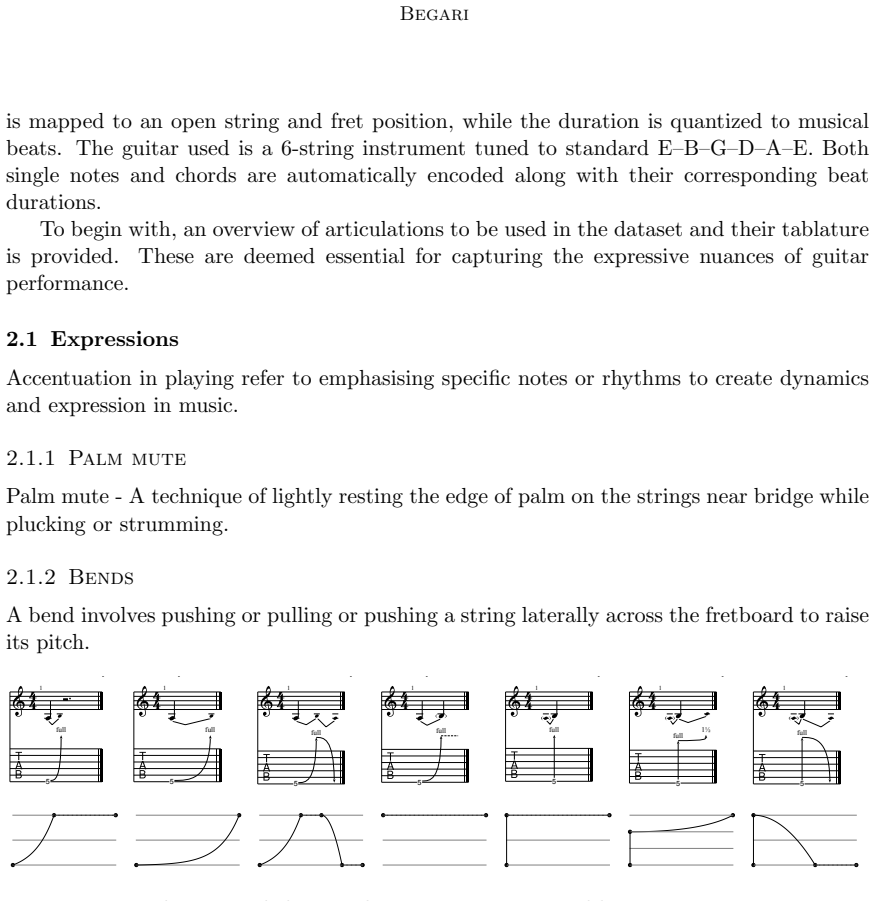
- [Figure 2 caption] The caption reads 'Tremlo types and their pitch variations'; 'Tremlo' should be 'Tremolo'.
- [Figure 5] The figure's axis is labeled 'Count ratio' while the text refers to 'Percentages of techniques'; the log-scale tick labels (10^1 through 10^4) and the precise definition of 'count ratio' should be clarified.
- [Section 3 (Statistics)] The treatment of tremolo is an exception ('applied to an entire beat, which may contain multiple notes') but the figure appears to count TREM_BAR occurrences like other note-level techniques; please state explicitly how tremolo counts are computed and whether the 25.39% accent figure includes tremolo.
- [Section 2 (SCORE-SET Dataset)] The dataset description would benefit from a dataset card giving the number of .gp5 files, total note count, total duration, license, versioning, and whether the conversion script is also released.
- [Section 1 (Introduction)] The claim that 'there remains a lack of large-scale, high-quality resources tailored specifically to the guitar' omits existing Guitar Pro datasets such as DadaGP; please cite and differentiate SCORE-SET from them.
Circularity Check
Dataset construction is transparent: expression ratios are external manual-transcription inputs, not predictions derived from the released data, so no circularity is present.
full rationale
The paper's only load-bearing derivation is the conversion of MAESTRO and GiantMIDI piano MIDI into Guitar Pro tablature, which is a concrete, independent transformation. The expression content is obtained by explicitly disclosed random injection: Section 3 states that 'Accents were added to the original dataset at random, following the expression ratios derived from Figure 5.' Those ratios come from a separate manual transcription of metal songs, not from the released dataset, and the 25.39% accent statistic is reported for that manual transcription, not presented as a measured property of the generated dataset. Thus the dataset's expression distribution is an input to the construction procedure, not a quantity the paper claims to predict or discover. The abstract's phrase 'to better reflect the nuances of real-world guitar playing' is an unvalidated design claim, and concerns about random placement, genre mismatch, or lack of musical coherence are external-validity and correctness risks rather than circularity. There are no load-bearing self-citations and no uniqueness or ansatz arguments imported from prior work. Accordingly, the derivation chain is self-contained and not circular.
Assumptions & free parameters
free parameters (3)
- Expression ratios (BEND_NOTE_1..7, TREM_BAR_1..5, SLIDE_NOTE_1..6, DEAD_NOTE, HAMMER, VIBRATO, HARMONIC, PALM_MUTE) =
unknown (derived from manual transcription)
- Minimum note duration =
sixteenth note
- Time signature and beat alignment =
4/4 time, nearest beat
assumptions (4)
- domain assumption MIDI note pitches can be mapped to playable guitar fretboard positions using the described heuristic.
- ad hoc to paper Randomly adding expressive techniques to the converted MIDI preserves musical coherence.
- domain assumption The manual transcription of metal songs provides representative expression statistics.
- domain assumption Standard guitar tuning (E-B-G-D-A-E) and 4/4 time are appropriate for all source MIDI.
Cite this review
Pith. "Pith review of SCORE-SET: A dataset of GuitarPro files for Music Phrase Generation and Sequence Learning." pith.science (2026). https://pith.science/paper/TNV4NBPV
@misc{pith2026250718723,
  author       = {Pith},
  title        = {Pith review of: SCORE-SET: A dataset of GuitarPro files for Music Phrase Generation and Sequence Learning},
  year         = {2026},
  howpublished = {\url{https://pith.science/paper/TNV4NBPV}},
  note         = {Machine review of arXiv:2507.18723}
}
read the original abstract
A curated dataset of Guitar Pro tablature files (.gp5 format), tailored for tasks involving guitar music generation, sequence modeling, and performance-aware learning is provided. The dataset is derived from MIDI notes in MAESTRO and GiantMIDI which have been adapted into rhythm guitar tracks. These tracks are further processed to include a variety of expression settings typical of guitar performance, such as bends, slides, vibrato, and palm muting, to better reflect the nuances of real-world guitar playing.
Figures


Figures from the paper (3 more)


Reference graph
Works this paper leans on
-
[1]
Sviatoslav Abakumov. Pyguitarpro. https://pyguitarpro.readthedocs.io/en/stable/, 2014. Revision c88d0350
work page 2014
- [2]
-
[3]
Thierry Bertin - Mahieux, Daniel P. W. Ellis, Brian Whitman, and Paul Lamere. The million song dataset. In Anssi Klapuri and Colby Leider, editors, Proceedings of the 12th International Society for Music Information Retrieval Conference, ISMIR 2011, Miami, Florida, USA, October 24-28, 2011 , pages 591--596. University of Miami, 2011. URL http://ismir2011....
work page 2011
-
[4]
Aria-midi: A dataset of piano midi files for symbolic music modeling, 2025
Louis Bradshaw and Simon Colton. Aria-midi: A dataset of piano midi files for symbolic music modeling, 2025. URL https://arxiv.org/abs/2504.15071
arXiv 2025
-
[5]
Jort F. Gemmeke, Daniel P. W. Ellis, Dylan Freedman, Aren Jansen, Wade Lawrence, R. Channing Moore, Manoj Plakal, and Marvin Ritter. Audio set: An ontology and human-labeled dataset for audio events. In 2017 IEEE International Conference on Acoustics, Speech and Signal Processing (ICASSP), pages 776--780, 2017. doi:10.1109/ICASSP.2017.7952261
arXiv 2017
-
[6]
Enabling factorized piano music modeling and generation with the MAESTRO dataset
Curtis Hawthorne, Andriy Stasyuk, Adam Roberts, Ian Simon, Cheng-Zhi Anna Huang, Sander Dieleman, Erich Elsen, Jesse Engel, and Douglas Eck. Enabling factorized piano music modeling and generation with the MAESTRO dataset. In International Conference on Learning Representations, 2019. URL https://openreview.net/forum?id=r1lYRjC9F7
2019
-
[7]
Giantmidi-piano: A large-scale midi dataset for classical piano music, 2022
Qiuqiang Kong, Bochen Li, Jitong Chen, and Yuxuan Wang. Giantmidi-piano: A large-scale midi dataset for classical piano music, 2022. URL https://arxiv.org/abs/2010.07061
arXiv 2022
-
[8]
Js fake chorales: a synthetic dataset of polyphonic music with human annotation, 2022
Omar Peracha. Js fake chorales: a synthetic dataset of polyphonic music with human annotation, 2022. URL https://arxiv.org/abs/2107.10388
arXiv 2022
Show all 9 references
-
[9]
Learning features of music from scratch, 2017
John Thickstun, Zaid Harchaoui, and Sham Kakade. Learning features of music from scratch, 2017. URL https://arxiv.org/abs/1611.09827
2017 arXiv
Reviewed August 15, 2026 · model on record in the stance chip above.
Discussion (0). Continue with ORCID to comment.