REVIEW 3 minor 42 references
Method to study $CP$ violation in $B_s^0\to K_S K^\pm \pi^\mp$ decays
T0 review · 0 major / 3 minor · reviewed 2026-06-28 · grok-4.3
Pith's one-line read A method relates amplitudes across conjugate final states to allow a single tagged time-dependent Dalitz analysis of B_s^0 to K_S K pi decays.
desk verdict This paper sets out a workable method for a simultaneous tagged time-dependent Dalitz fit on the two charge states of Bs to Ks K pi, relating the amplitudes, and shows via pseudoexperiments that decent precision on phi_s^eff is reachable with existing LHCb data. read the letter →
The pith
A machine-rendered reading of the paper's core claim, the machinery that carries it, and where it could break.
The reading
What carries the argument
The relation that ties resonant amplitudes in the two opposite-charge final states together so one fit can be performed on both at once.
What would settle it
Performing the full analysis on the actual LHCb Runs 1-3 dataset and obtaining an uncertainty on φ_s^eff substantially larger than the pseudoexperiment prediction would show the claimed sensitivity does not hold.
Extended reading notes
Core claim
The amplitudes for decays to resonances in the K_S K^+ π^- and K_S K^- π^+ final states can be related to each other, making a single simultaneous tagged time-dependent Dalitz analysis valid; pseudoexperiments then show that this analysis reaches good precision on the weak phase difference φ_s^eff with a dataset matching LHCb Runs 1-3.
Load-bearing premise
The amplitudes for decays to resonances in the two final states can be related to each other so that a single simultaneous tagged time-dependent Dalitz analysis is valid.
Editorial extensions
If this is right
- Good precision on φ_s^eff is reachable with LHCb Runs 1-3 data.
- Sensitivity improves further with data from future LHCb runs.
- The same amplitude-relation technique applies to other multibody decays that have multiple final states.
- The method is already implemented inside the Laura++ Dalitz-plot analysis package.
Reading between the lines
- The approach could be tested on other b to s transition modes where separate analyses of charge states have previously been required.
- If the amplitude relations hold in data, the method may reduce the impact of certain reconstruction efficiencies that differ between the two final states.
- Future high-statistics samples could use the same framework to search for direct CP violation in individual resonant contributions.
Signed reviews
Editorial analysis
A structured set of objections, weighed in public.
Referee Report
Summary. The paper proposes a method for a simultaneous tagged time-dependent Dalitz-plot analysis of B_s^0 → K_S K^+ π^- and B_s^0 → K_S K^- π^+ decays to extract the effective weak phase φ_s^eff between B_s^0 → K_S K*(892)^0 and its charge conjugate, including mixing effects. Amplitudes for resonances in the two final states are related to each other as part of the framework; feasibility is shown via pseudoexperiments, with projected sensitivity to φ_s^eff using LHCb Run 1-3 data (and improvement with future datasets). The method is implemented in the Laura++ package and is intended to be applicable to other multibody decays.
Significance. If the proposed amplitude relations and pseudoexperiment setup hold under realistic conditions, the work enables the first such analysis in this channel, providing a new probe of CP violation in B_s decays that can test the Standard Model and search for new physics. Credit is due for the explicit demonstration of sensitivity via pseudoexperiments and the public implementation in Laura++.
minor comments (3)
- The description of the amplitude relations (in the section outlining the method) should include an explicit statement of which resonance parameters are shared versus allowed to float independently, to clarify the degrees of freedom in the simultaneous fit.
- Pseudoexperiment results (likely in §4 or the results section) report achievable precision on φ_s^eff but do not tabulate the input values used for background fractions, efficiency parametrization, or resonance model assumptions; adding these would strengthen reproducibility.
- The abstract states that the method 'can be applied to other multibody decays,' but the main text does not provide a concrete example or checklist of conditions under which the amplitude relations would generalize; this would aid readers.
Simulated Author's Rebuttal
We thank the referee for their positive assessment of the manuscript, including the significance of the proposed method and the explicit demonstration via pseudoexperiments. The recommendation for minor revision is noted. No specific major comments were provided in the report.
Circularity Check
No significant circularity; method proposal is self-contained
full rationale
The paper proposes a tagged time-dependent Dalitz analysis method for B_s^0 → K_S K^± π^∓ decays, relating amplitudes between the two final states as an explicit part of the framework. Feasibility is shown via pseudoexperiments that incorporate these relations by design. No equations reduce a claimed prediction to a prior fit, no self-citation chain supports a load-bearing uniqueness claim, and the sensitivity result on φ_s^eff is obtained from simulation rather than by construction from input parameters. The derivation chain is independent of the target result.
Assumptions & free parameters
assumptions (1)
- domain assumption Amplitudes for resonances in the two final states can be related by isospin or other standard symmetries
Cite this review
Pith. "Pith review of Method to study $CP$ violation in $B_s^0\to K_S K^\pm \pi^\mp$ decays." pith.science (2026). https://pith.science/paper/TOC3MDJZ
@misc{pith2026260606446,
  author       = {Pith},
  title        = {Pith review of: Method to study $CP$ violation in $B_s^0\to K_S K^\pm \pi^\mp$ decays},
  year         = {2026},
  howpublished = {\url{https://pith.science/paper/TOC3MDJZ}},
  note         = {Machine review of arXiv:2606.06446}
}
abstract
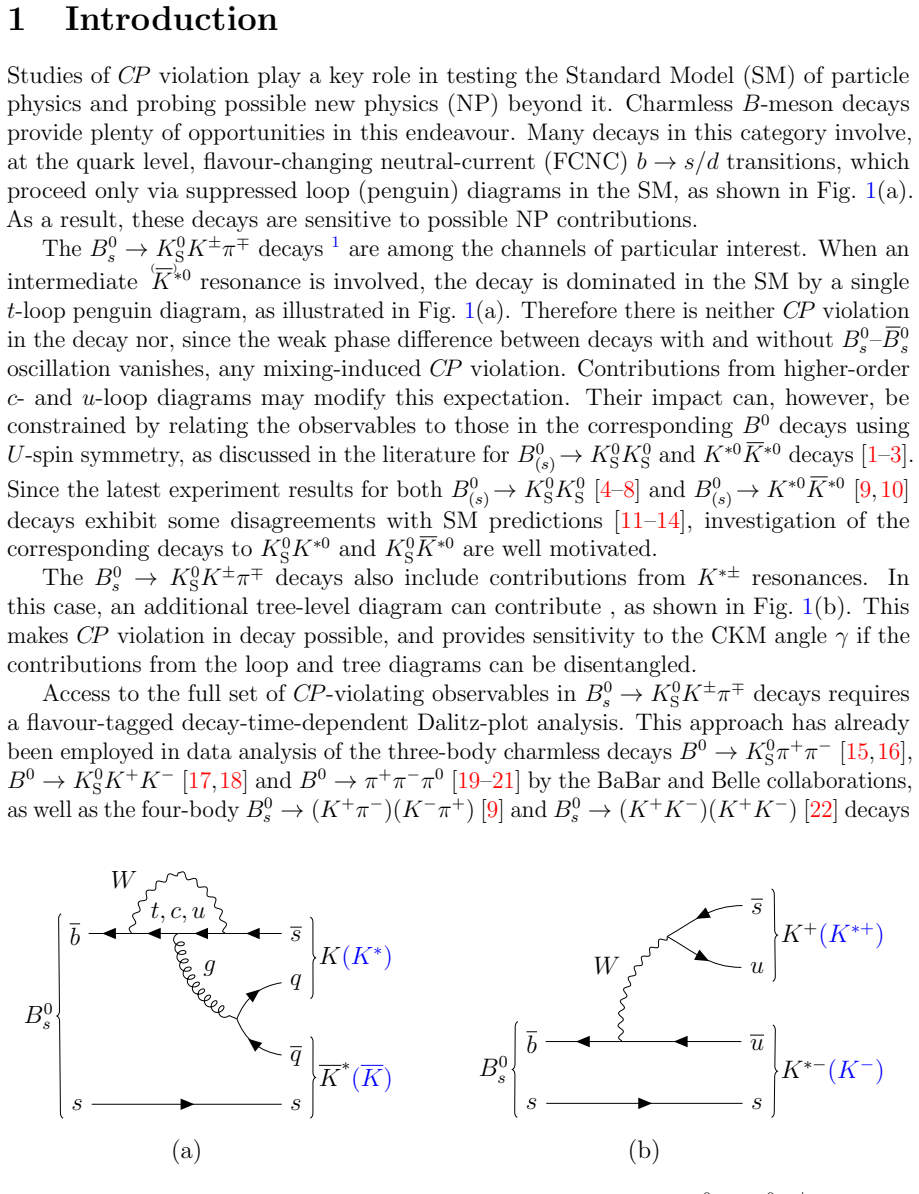
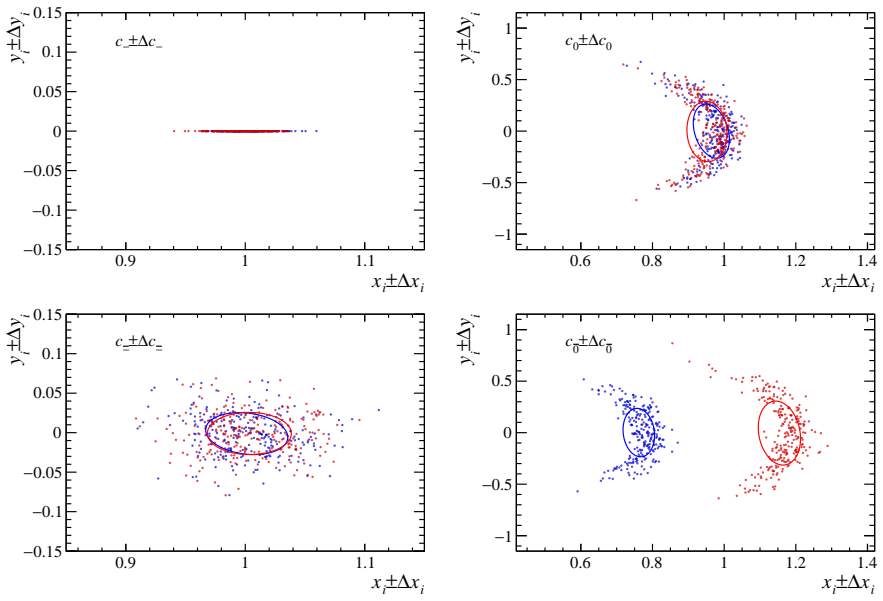
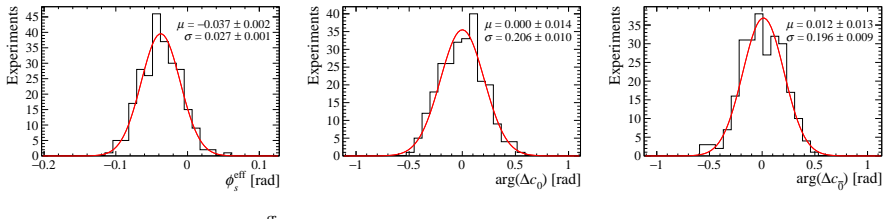
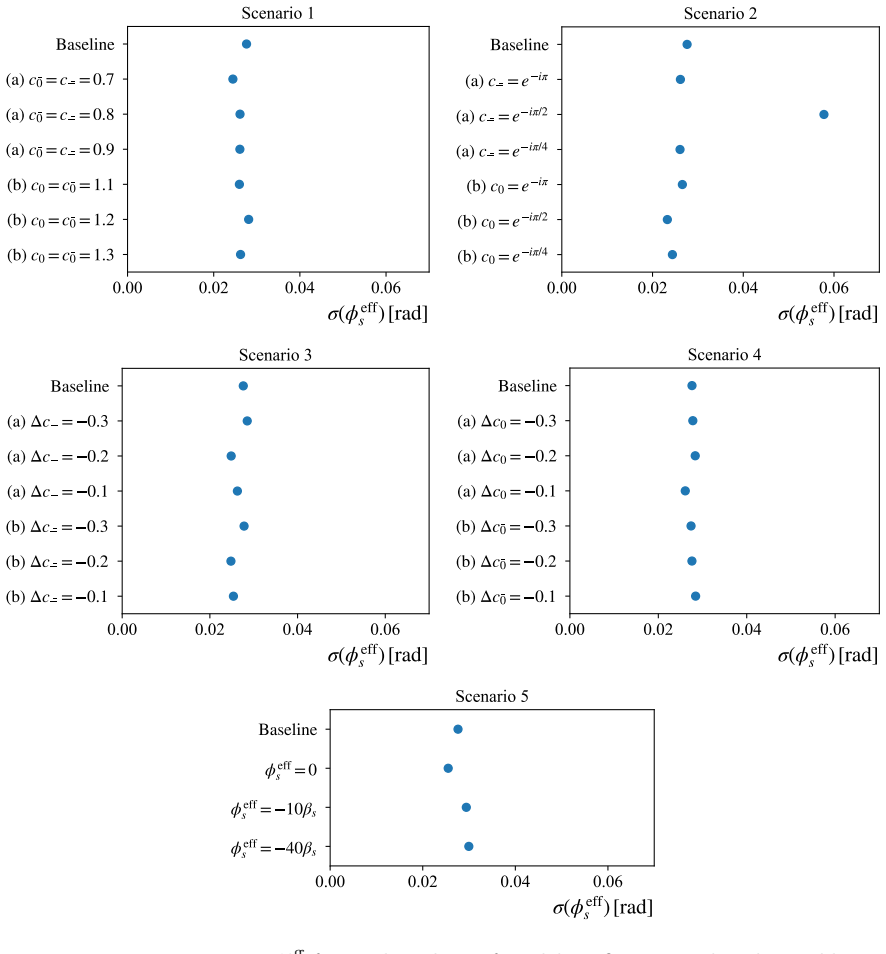
The $B_s^0\to K_S K^\pm \pi^\mp$ decays are of interest to test the Standard Model and search for new sources of $CP$ violation. A full study of these decays requires a tagged decay-time-dependent Dalitz-plot analysis performed simultaneously in the two final states. Such an analysis has never previously been performed. The method to carry out such an analysis, relating the amplitudes for decays to resonances in the two final-states to each other, is set out and its feasibility is demonstrated using pseudoexperiments. The sensitivity to the weak phase difference, $\phi_s^{\rm eff}$, between $B_s^0 \to K_S K^*(892)^0$ decays with and without $B_s^0$-$\bar{B}_s^0$ mixing is studied. Good precision on $\phi_s^{\rm eff}$ is found to be achievable with a dataset corresponding to LHCb Runs 1-3, with further improvement expected with datasets to be collected in future. The method is implemented in the Laura++ Dalitz-plot analysis package, and can be applied to other multibody decays with multiple final states.
Figures
Figures from the paper (1 more)
Reference graph
Works this paper leans on
-
[1]
Exploring B_{d,s}-> KK decays through flavour symmetries and QCD-factorisation
S. Descotes-Genon, J. Matias, and J. Virto,Exploring Bd,s →KK decays through flavour symmetries and QCD-factorisation, Phys. Rev. Lett.97(2006) 061801, arXiv:hep-ph/0603239
work page Pith review arXiv 2006
-
[2]
B_s to K^(*)0 \bar K^(*)0 decays: the golden channels for new physics searches
M. Ciuchini, M. Pierini, and L. Silvestrini, Bs →K (∗)0K (∗)0 : The golden channels for new physics searches, Phys. Rev. Lett.100(2008) 031802,arXiv:hep-ph/0703137
work page Pith review arXiv 2008
-
[3]
Measuring beta_s with Bs -> K0(*) K0bar(*) -- a Reappraisal
B. Bhattacharya, A. Datta, M. Imbeault, and D. London,Measuring βs with Bs → K0(∗) ¯K0(∗) – a reappraisal, Phys. Lett.B717(2012) 403,arXiv:1203.3435
work page Pith review arXiv 2012
-
[4]
Observation of B+ --> K0bar K+ and B0 --> K0 K0bar
BaBar collaboration, B. Aubertet al.,Observation of B+ → ¯K0K+ and B0 →K 0 ¯K0, Phys. Rev. Lett.97(2006) 171805,arXiv:hep-ex/0608036
work page Pith review arXiv 2006
-
[5]
Measurement of Time-Dependent CP-Violating Parameters in B0 -> K0S K0S decays
Belle collaboration, Y. Nakahamaet al.,Measurement of time-dependent C P- violating parameters in B0 →K 0 SK0 S decays, Phys. Rev. Lett.100(2008) 121601, arXiv:0712.4234
work page Pith review arXiv 2008
-
[6]
Belle collaboration, Y.-T. Duhet al.,Measurements of branching fractions and direct C P asymmetries for B→Kπ , B→ππ and B→KK decays, Phys. Rev.D87 (2013) 031103,arXiv:1210.1348
work page Pith review arXiv 2013
-
[7]
Observation of the decay $B_s^0\rightarrow K^0\overline{K}^0$
Belle collaboration, B. Palet al.,Observation of the decay B0 s →K 0K0, Phys. Rev. Lett.116(2016) 161801,arXiv:1512.02145
work page Pith review arXiv 2016
-
[8]
Aaijet al.,Measurement of the branching fraction of the decayB 0 s →K 0 SK0 S, Phys
LHCb collaboration, R. Aaijet al.,Measurement of the branching fraction of the decayB 0 s →K 0 SK0 S, Phys. Rev.D102(2020) 012011,arXiv:2002.08229
Show all 42 references
-
[9]
Aaijet al.,First measurement of the C P-violating phase ϕs dd inB 0 s →(K +π−)(K −π+)decays, JHEP03(2018) 140,arXiv:1712.08683
LHCb collaboration, R. Aaijet al.,First measurement of the C P-violating phase ϕs dd inB 0 s →(K +π−)(K −π+)decays, JHEP03(2018) 140,arXiv:1712.08683
2018 arXiv
-
[10]
Aaijet al.,Measurement of the branching fractions and longitudinal polarisations of B0 (s) →K ∗0K ∗0 decays, Phys
LHCb collaboration, R. Aaijet al.,Measurement of the branching fractions and longitudinal polarisations of B0 (s) →K ∗0K ∗0 decays, Phys. Rev.D113(2026) 092002, arXiv:2512.05102
2026 arXiv
-
[11]
Alguer´ oet al.,A new B-flavour anomaly in Bd,s →K ∗0 ¯K ∗0: anatomy and interpretation, JHEP04(2021) 066,arXiv:2011.07867
M. Alguer´ oet al.,A new B-flavour anomaly in Bd,s →K ∗0 ¯K ∗0: anatomy and interpretation, JHEP04(2021) 066,arXiv:2011.07867
2021
-
[12]
Amhis, Y
Y. Amhis, Y. Grossman, and Y. Nir,The branching fraction of B0 s →K 0K0: three puzzles, JHEP02(2023) 113,arXiv:2212.03874
2023
-
[13]
Biswas, S
A. Biswas, S. Descotes-Genon, J. Matias, and G. Tetlalmatzi-Xolocotzi,A new puzzle in non-leptonic B decays, JHEP06(2023) 108,arXiv:2301.10542
2023
-
[14]
Aleksan and L
R. Aleksan and L. Oliver, Bd,s →K ∗0K ∗0 decays, a serious problem for the Standard Model,arXiv:2312.07198
-
[15]
Aubertet al.,Time-dependent amplitude analysis of B0 → K0 Sπ+π−, Phys
BaBar collaboration, B. Aubertet al.,Time-dependent amplitude analysis of B0 → K0 Sπ+π−, Phys. Rev.D80(2009) 112001,arXiv:0905.3615. 11
2009 arXiv
-
[16]
Dalsenoet al.,Time-dependent Dalitz plot measurement of C P parameters in B0 →K 0 Sπ+π− decays, Phys
Belle collaboration, J. Dalsenoet al.,Time-dependent Dalitz plot measurement of C P parameters in B0 →K 0 Sπ+π− decays, Phys. Rev.D79(2009) 072004, arXiv:0811.3665
2009
-
[17]
Nakahamaet al.,Measurement of C P violating asymmetries in B0 →K +K −K0 S decays with a time-dependent Dalitz approach, Phys
Belle collaboration, Y. Nakahamaet al.,Measurement of C P violating asymmetries in B0 →K +K −K0 S decays with a time-dependent Dalitz approach, Phys. Rev.D82 (2010) 073011,arXiv:1007.3848
2010 arXiv
-
[18]
BaBar collaboration, J. P. Leeset al.,Study of C P violation in Dalitz-plot analyses of B0 →K +K −K0 S, B+ →K +K −K+, and B+ →K 0 SK0 SK+, Phys. Rev.D85(2012) 112010,arXiv:1201.5897
2012 arXiv
-
[19]
BaBar collaboration, J. P. Leeset al.,Measurement of C P-violating asymmetries in B0 → (ρπ)0 decays using a time-dependent Dalitz plot analysis, Phys. Rev.D88 (2013) 012003,arXiv:1304.3503
2013 arXiv
-
[20]
Kusakaet al.,Measurement of C P asymmetries and branching fractions in a time-dependent Dalitz analysis of B0 → (ρπ)0 and a constraint on the quark mixing angleϕ 2, Phys
Belle collaboration, A. Kusakaet al.,Measurement of C P asymmetries and branching fractions in a time-dependent Dalitz analysis of B0 → (ρπ)0 and a constraint on the quark mixing angleϕ 2, Phys. Rev.D77(2008) 072001,arXiv:0710.4974
2008 arXiv
-
[21]
Kusakaet al.,Measurement of C P asymmetry in a time- dependent Dalitz analysis of B0 → (ρπ)0 and a constraint on the CKM angle ϕ2, Phys
Belle collaboration, A. Kusakaet al.,Measurement of C P asymmetry in a time- dependent Dalitz analysis of B0 → (ρπ)0 and a constraint on the CKM angle ϕ2, Phys. Rev. Lett.98(2007) 221602,arXiv:hep-ex/0701015
2007 arXiv
-
[22]
Aaijet al.,Precision measurement of C P violation in the penguin-mediated decay B0 s →ϕϕ , Phys
LHCb collaboration, R. Aaijet al.,Precision measurement of C P violation in the penguin-mediated decay B0 s →ϕϕ , Phys. Rev. Lett.131(2023) 171802, arXiv:2304.06198
2023
-
[23]
Gershon, T
T. Gershon, T. Latham, and R. Silva Coutinho,Probing CP violation in B0 s → K0 Sπ+π− decays, Nucl. Part. Phys. Proc.273-275(2016) 1417,arXiv:1411.2018
2016 arXiv
-
[24]
Aaijet al.,Constraints on the unitarity triangle angle γ from Dalitz plot analysis of B0 →DK +π− decays, Phys
LHCb collaboration, R. Aaijet al.,Constraints on the unitarity triangle angle γ from Dalitz plot analysis of B0 →DK +π− decays, Phys. Rev.D93(2016) 112018, Erratum ibid.D94(2016) 079902,arXiv:1602.03455
2016 arXiv
-
[25]
Aaijet al.,First observation of a doubly charged tetraquark candidate and its neutral partner, Phys
LHCb collaboration, R. Aaijet al.,First observation of a doubly charged tetraquark candidate and its neutral partner, Phys. Rev. Lett.131(2023) 041902, arXiv:2212.02716
2023
-
[26]
Aaijet al.,Amplitude analysis of B0 → D0D+ s π− and B+ →D −D+ s π+ decays, Phys
LHCb collaboration, R. Aaijet al.,Amplitude analysis of B0 → D0D+ s π− and B+ →D −D+ s π+ decays, Phys. Rev.D108(2023) 012017,arXiv:2212.02717
2023
-
[27]
Aaijet al.,Observation of new charmonium or charmo- niumlike states in B+ →D ∗±D∓K+ decays, Phys
LHCb collaboration, R. Aaijet al.,Observation of new charmonium or charmo- niumlike states in B+ →D ∗±D∓K+ decays, Phys. Rev. Lett.133(2024) 131902, arXiv:2406.03156
2024
-
[28]
Aaijet al.,Study of B0 (s) →K 0 Sh+h′− decays with first observa- tion of B0 s →K 0 SK ±π∓ and B0 s →K 0 Sπ+π−, JHEP10(2013) 143, arXiv:1307.7648
LHCb collaboration, R. Aaijet al.,Study of B0 (s) →K 0 Sh+h′− decays with first observa- tion of B0 s →K 0 SK ±π∓ and B0 s →K 0 Sπ+π−, JHEP10(2013) 143, arXiv:1307.7648
2013 arXiv
-
[29]
Aaijet al.,Observation of B0 s →K ∗±K ∓ and evidence of B0 s →K ∗−π+ decays, New J
LHCb collaboration, R. Aaijet al.,Observation of B0 s →K ∗±K ∓ and evidence of B0 s →K ∗−π+ decays, New J. Phys.16(2014) 123001,arXiv:1407.7704. 12
2014 arXiv
-
[30]
Aaijet al.,First observation of the decay B0 s →K 0 SK ∗(892)0, JHEP01(2016) 012,arXiv:1506.08634
LHCb collaboration, R. Aaijet al.,First observation of the decay B0 s →K 0 SK ∗(892)0, JHEP01(2016) 012,arXiv:1506.08634
2016 arXiv
-
[31]
Aaijet al.,Improved branching fraction measure- ments of B0 (s) →K 0 Sh+h′− decays and first observation of B0 s →K 0 SK+K −, arXiv:2603.08621, submitted to JHEP
LHCb collaboration, R. Aaijet al.,Improved branching fraction measure- ments of B0 (s) →K 0 Sh+h′− decays and first observation of B0 s →K 0 SK+K −, arXiv:2603.08621, submitted to JHEP
-
[32]
Aaijet al.,Amplitude analysis of B0 s →K 0 SK ±π∓ decays, JHEP06(2019) 114,arXiv:1902.07955
LHCb collaboration, R. Aaijet al.,Amplitude analysis of B0 s →K 0 SK ±π∓ decays, JHEP06(2019) 114,arXiv:1902.07955
2019 arXiv
-
[33]
Backet al.,Laura ++: A Dalitz plot fitter, Comput
J. Backet al.,Laura ++: A Dalitz plot fitter, Comput. Phys. Commun.231(2018) 198,arXiv:1711.09854
2018 arXiv
-
[34]
K. Anikeevet al., B physics at the Tevatron: Run II and beyond, inWorkshop on B Physics at the Tevatron: Run II and Beyond Batavia, Illinois, September 23-25, 1999, 2001,arXiv:hep-ph/0201071
1999 arXiv
-
[35]
Aaijet al.,Measurement of the C P asymmetry in B0 s–B0 s mixing, Phys
LHCb collaboration, R. Aaijet al.,Measurement of the C P asymmetry in B0 s–B0 s mixing, Phys. Rev. Lett.117(2016) 061803,arXiv:1605.09768
2016 arXiv
-
[36]
Navaset al.,Review of particle physics, Phys
Particle Data Group, S. Navaset al.,Review of particle physics, Phys. Rev.D110 (2024) 030001
2024
-
[37]
Zemach,Three pion decays of unstable particles, Phys
C. Zemach,Three pion decays of unstable particles, Phys. Rev.133(1964) B1201
1964
-
[38]
Zemach,Use of angular momentum tensors, Phys
C. Zemach,Use of angular momentum tensors, Phys. Rev.140(1965) B97
1965
-
[39]
Aaijet al.,The LHCb Upgrade I, JINST19(2024) P05065, arXiv:2305.10515
LHCb collaboration, R. Aaijet al.,The LHCb Upgrade I, JINST19(2024) P05065, arXiv:2305.10515
2024
-
[40]
Aaijet al.,Measurement of C P asymmetries in two-body B0 (s)-meson decays to charged pions and kaons, Phys
LHCb collaboration, R. Aaijet al.,Measurement of C P asymmetries in two-body B0 (s)-meson decays to charged pions and kaons, Phys. Rev.D98(2018) 032004, arXiv:1805.06759
2018 arXiv
-
[41]
Aaijet al.,Improved measurement of CP violation parameters in B0 s →J/ ψK+K − decays in the vicinity of the ϕ(1020)resonance, Phys
LHCb collaboration, R. Aaijet al.,Improved measurement of CP violation parameters in B0 s →J/ ψK+K − decays in the vicinity of the ϕ(1020)resonance, Phys. Rev. Lett. 132(2024) 051802,arXiv:2308.01468
2024
-
[42]
Hayrapetyanet al.,First evidence for mixing-induced C P violation in B0 s →J/ ψϕ(1020)decays in pp collisions at √s = 13 TeV, Phys
CMS collaboration, A. Hayrapetyanet al.,First evidence for mixing-induced C P violation in B0 s →J/ ψϕ(1020)decays in pp collisions at √s = 13 TeV, Phys. Rev. Lett.136(2026) 181801. 13
2026
Reviewed June 28, 2026 · model on record in the stance chip above.
Discussion (0). Continue with ORCID to comment.