REVIEW 2 major objections 4 minor 1 cited by
Nearly Optimal Measurement Scheduling for Partial Tomography of Quantum States
T0 review · 2 major / 4 minor · reviewed 2026-08-14 · deepseek-v4-flash
Pith's one-line read This paper proves that all elements of the fermionic 2-RDM can be estimated with $O(N^2)$ circuits, that this is asymptotically optimal among Clifford-based direct measurement schemes, and that qubit $k$-RDMs need only $O(3^k \log^{k-1}…
desk verdict Useful upper bounds and a genuinely practical fermionic 2-RDM scheme, but the optimality claim is broader than the proof: the lower bound only covers direct measurement in a basis containing each operator, not all Clifford-plus-readout protocols. read the letter →
The pith
A machine-rendered reading of the paper's core claim, the machinery that carries it, and where it could break.
The reading
What carries the argument
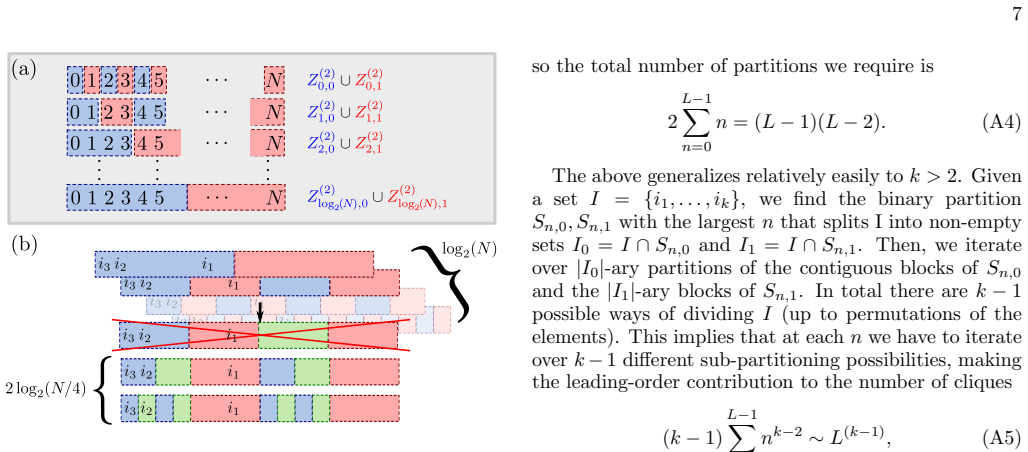
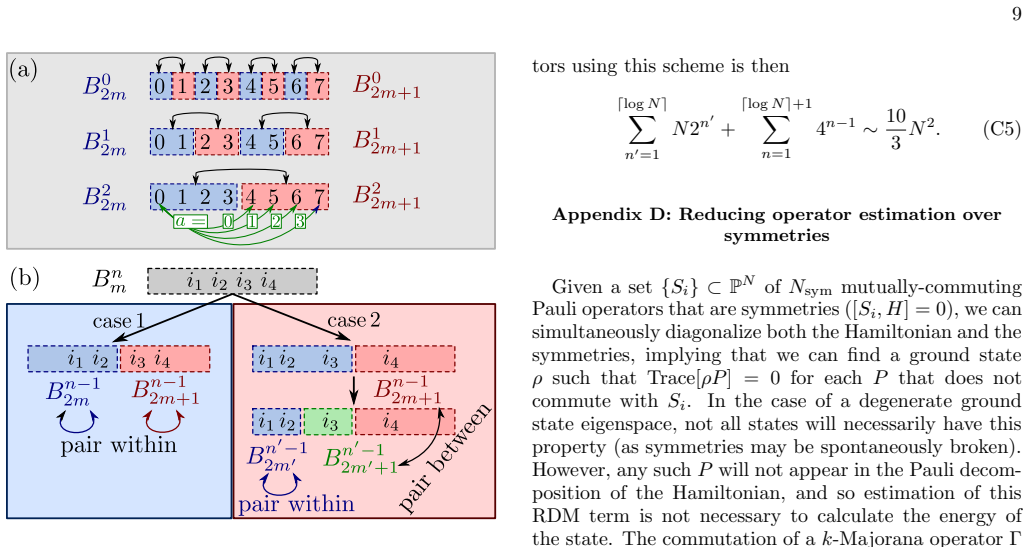
The load-bearing object is the commuting clique: a set of operators that can be estimated from one state preparation because a single measurement basis contains them all. The paper's qubit result is carried by a binary-partition construction that assigns each qubit a Pauli letter so that every tensor product of $k$ Paulis appears in at least one word. The fermionic result is carried by pairings of the $2N$ Majorana operators: each pairing of $N$ disjoint pairs generates a maximal commuting clique of products of $k$ pairs, and a divide-and-conquer iteration over block pairings covers every 4-Majorana operator in $O(N^2)$ cliques. The anti-commuting result is carried by the rotation $e^{\theta P_i P_j}$, which rotates between two anti-commuting Pauli or Majorana operators while leaving the rest of an anti-commuting clique fixed, allowing a linear combination to be compressed into one measurable Pauli operator.
What would settle it
Exhibit a concrete protocol that estimates every element of the fermionic 2-RDM to fixed error with $o(\epsilon^{-2} N^2)$ state preparations—for instance a shadow-style scheme using random Clifford measurements and classical post-processing—or a direct commuting-clique protocol that covers all 4-Majorana operators with fewer than $\frac{4}{3}N^2 - \frac{8}{3}N + 1$ unique circuits; either would break the claimed optimality.
Extended reading notes
Core claim
The central claim is a pair of asymptotic results plus a lower bound. First, any $k$-qubit RDM can be tomographed by assigning each qubit a Pauli letter $X$, $Y$, or $Z$ in a carefully chosen set of words, with only $O(3^k \log^{k-1} N)$ words needed to contain every $k$-local Pauli product. Second, every element of the fermionic 2-RDM can be directly measured using $O(N^2)$ unique commuting cliques of 4-Majorana operators, implemented by a Clifford basis change that permutes Majorana labels in depth $O(N)$; the paper proves a matching lower bound $\Omega(\epsilon^{-2} N^k)$ on the number of state preparations for any Clifford-circuit protocol estimating a fermionic $k$-RDM, making the 2-RDM scheme asymptotically optimal and establishing an exponential separation between qubit and fermionic tomography. Third, a set of mutually anti-commuting Majorana operators can be rotated into a single Pauli operator for readout, so a linear combination of 2-RDM elements can be sampled in $O(N^4/\omega)$ circuits each of depth $O(\omega)$.
Load-bearing premise
The proof of optimality assumes a measurement protocol is a Clifford circuit followed by computational-basis readout, so that each preparation can only estimate expectation values of mutually commuting operators; it does not cover indirect estimation schemes, such as classical shadows, that reconstruct many non-commuting expectation values from random measurements by classical post-processing.
Editorial extensions
If this is right
- For qubit systems, partial tomography of $k$-local correlations becomes practical for large $N$, since the number of circuits grows only polylogarithmically in $N$.
- For fermionic systems, estimating the 2-RDM—and hence energies and gradients in quantum chemistry—drops from a quartic to a quadratic number of circuits, directly reducing the wall-clock cost of variational quantum algorithms.
- The lower bound means no Clifford-circuit direct measurement protocol can beat the $O(N^2)$ fermionic 2-RDM scheme asymptotically; further speedups must come from a different measurement model.
- The $O(N^4/\omega)$ anti-commuting scheme gives near-term devices a tunable trade-off: fewer shots at the price of deeper circuits, or much shallower circuits at the price of more shots.
- When the Hamiltonian has symmetries, the clique count drops further by a factor that depends on the number of symmetries, and the measurement circuits conserve parity, enabling symmetry-verification error mitigation at no extra cost.
Reading between the lines
- Because the lower bound excludes indirect estimation, the paper leaves open whether shadow-style random measurements could estimate the fermionic 2-RDM with fewer than $\Omega(N^2)$ preparations; if they could, the exponential separation would hold for direct scheduling but not for tomography in general.
- The anti-commuting compression technique is not obviously limited to 2-RDM elements: any sparse fermionic operator expressed as a short linear combination of Majorana products could be sampled with the same depth-versus-shots trade-off, which may extend the result beyond chemistry.
- The qubit scheme's polylogarithmic word count suggests a natural randomized variant: sample words from the binary-partition distribution and use median-of-means post-processing, which could turn the deterministic clique cover into a shadow-style estimator with comparable scaling.
- For small molecule sizes, the exact clique counts rather than asymptotics matter; the paper reports implementations of its measurement generation, so a practical benchmark on realistic molecular Hamiltonians would clarify when the $O(N^2)$ regime actually begins.
Signed reviews
Editorial analysis
A structured set of objections, weighed in public.
Referee Report
Summary. The paper addresses the measurement bottleneck in partial tomography of quantum states for variational quantum eigensolvers, focusing on scheduling measurements of k-body reduced density matrices (k-RDMs). For qubit k-RDMs, it constructs a set of Pauli-word measurement circuits via binary/ary partitioning and proves a bound of O(3^k log^{k-1} N) unique circuits. For fermionic k-RDMs, it proves in Theorem 1 a lower bound of Ω(ε^{-2}N^k) state preparations for Clifford circuits followed by computational-basis measurement and gives a construction that directly measures all elements of the fermionic 2-RDM in O(N^2) circuits using Majorana pairings and swap networks. It further presents a method to estimate arbitrary linear combinations of anti-commuting 4-Majorana operators with O(N^4/ω) circuits and circuit depth O(ω), and proves a bound of 2N+1 on the maximum size of anti-commuting Pauli/Majorana cliques. The paper claims asymptotic optimality of the fermionic 2-RDM scheme and an exponential separation between the number of circuits required for qubit versus fermionic RDMs.
Significance. The paper contains useful and partly novel constructions: the qubit k-RDM scheme is an exponential improvement over the earlier O(N^k) direct-measurement approaches, the fermionic 2-RDM construction is explicit, uses only linear connectivity with O(N)-depth circuits, is accompanied by code in OpenFermion, and supports symmetry-verification error mitigation. The anti-commuting linear-combination method provides a practical trade-off between circuit depth and number of measurements. If the lower bound were valid in full generality, the optimality claim would be a significant result. As it stands, the upper-bound scheduling schemes are solid, but the advertised asymptotic optimality and exponential separation are proven only for direct-measurement protocols, which limits the scope of the main claim.
major comments (2)
- [Theorem 1 (Sec. III) / App. H] The proof of Theorem 1 assumes that estimating ⟨Γ_i⟩ requires M_i preparations in a basis containing Γ_i (App. H, first paragraph). This is the direct-measurement model. For a fixed Clifford circuit with computational-basis readout, that is correct. However, the theorem is stated as a lower bound on the number of preparations for any Clifford-plus-computational-basis protocol, and that class includes protocols with classical post-processing (classical shadows being a concrete example) that estimate many non-commuting expectation values from the same random data. The counting bound in App. B lower-bounds the number of direct basis-containing measurements, not the total number of preparations for all estimation strategies. Since Theorem 1 is used to conclude asymptotic optimality of the O(N^2) fermionic 2-RDM scheme and the exponential separation from qubit k-RDMs, this is a load-bearing gap. The theorem should either be restricted to direct-measurement schemes or the proof extended to rule out post-processing estimators.
- [App. G] The proof of the 2N+1 upper bound on anti-commuting cliques has a gap for odd n. The text claims that the union of the even-parity subsets P_⃗b is the set of operators commuting with ∏_{P_i∈S}P_i and therefore has size exactly half of P_N. If the product ∏P_i is proportional to the identity (e.g., S={X,Y,Z} for N=1), its centralizer is all of P_N, so the claimed half-size statement is false and the subsequent counting of the set anticommuting with all elements of S becomes invalid. The theorem itself is true, but the proof needs repair.
minor comments (4)
- [App. H, Eq. (H1)] The variance bound is off by a factor of 4: for a ±1-valued random variable with mean μ, the variance of the sample mean after M_i shots is (1-μ^2)/M_i, not (1-μ^2)/(4M_i). This affects only constants, since the theorem is asymptotic.
- [Sec. V] The conclusion states the fermionic lower bound as Ω(N^{⌈k/2⌉}), which is inconsistent with Theorem 1 and the introduction, both of which state Ω(N^k). This should be corrected.
- [App. C, Eq. (C5)] The expression for the total number of cliques, `∑_{n'=1}^{⌈logN⌉} N^2 n' + ...`, appears to contain a typo: as written the first term would contribute ~N^2 log N rather than ~N^2, and the stated ∼10/3 N^2 scaling would not follow. Please clarify the intended summation.
- [App. F, Eq. (F4)] The last line of Eq. (F4) should read cos(θ)P_j − sin(θ)P_i; as printed it has −sin(θ)P_j, which is inconsistent with the standard rotation between two anti-commuting Pauli operators.
Circularity Check
No circularity found: the measurement constructions and the Majorana counting lower bound are self-contained; the App. H direct-measurement assumption is a scope gap, not a circular reduction.
full rationale
The paper contains no fitted parameters, no self-referential predictions, and no normalization tricks. The qubit k-RDM upper bound is an explicit binary-partition construction (App. A) whose cost count follows directly from the partition scheme, and the fermionic 2-RDM upper bound is an explicit clique-cover construction (App. C) whose O(N^2) count is summed directly from the construction. The lower bound (Theorem 1, App. H) is a counting argument over the Majorana algebra: App. B bounds the size of a commuting clique by (N choose k), App. H shows that a Clifford circuit followed by computational-basis readout is equivalent to measuring a commuting set of Pauli operators, and the variance bound together with the maximally mixed worst-case state supplies the epsilon^{-2} factor. None of these steps assumes the conclusion; the upper-bound construction and the lower-bound counting are independent. Self-citations, such as OpenFermion [31] and symmetry verification [29], are used for implementation or error mitigation rather than to justify the central complexity claims. The App. H proof does contain a scope gap: the step requiring M_i measurements 'in a basis containing Gamma_i' excludes randomized Clifford protocols with classical post-processing such as classical shadows, so the advertised optimality may be broader than proven. That is a correctness and scope concern, not circularity, because the proof's counting does not reduce to the theorem's statement by definition.
Assumptions & free parameters
free parameters (1)
- ω =
user-chosen, 1 ≤ ω ≤ N
assumptions (4)
- standard math Pauli operators either commute or anti-commute; products of Majorana operators are Pauli operators under Jordan-Wigner or Bravyi-Kitaev encodings
- domain assumption Allowed measurement protocols are Clifford circuits followed by computational-basis readout, with ancillas initialized in |0⟩; indirect or adaptive measurements are not considered
- domain assumption Symmetry operators used for error mitigation are Pauli words that commute with the Hamiltonian
- domain assumption N-representability constraints on fermionic RDMs do not reduce worst-case variance; the worst-case state is the maximally mixed state
Cite this review
Pith. "Pith review of Nearly Optimal Measurement Scheduling for Partial Tomography of Quantum States." pith.science (2026). https://pith.science/paper/TON35CVU
@misc{pith2026190805628,
  author       = {Pith},
  title        = {Pith review of: Nearly Optimal Measurement Scheduling for Partial Tomography of Quantum States},
  year         = {2026},
  howpublished = {\url{https://pith.science/paper/TON35CVU}},
  note         = {Machine review of arXiv:1908.05628}
}
abstract
Many applications of quantum simulation require to prepare and then characterize quantum states by performing an efficient partial tomography to estimate observables corresponding to $k$-body reduced density matrices ($k$-RDMs). For instance, variational algorithms for the quantum simulation of chemistry usually require that one measure the fermionic 2-RDM. While such marginals provide a tractable description of quantum states from which many important properties can be computed, their determination often requires a prohibitively large number of circuit repetitions. Here we describe a method by which all elements of $k$-body qubit RDMs acting on $N$ qubits can be directly measured with a number of circuits scaling as ${\cal O}(3^{k} \log^{k-1}\! N)$, an exponential improvement in $N$ over prior art. Next, we show that if one is able to implement a linear depth circuit on a linear array prior to measurement, then one can directly measure all elements of the fermionic 2-RDM using only ${\cal O}(N^2)$ circuits. We prove that this result is asymptotically optimal, thus establishing an exponential separation between the number of circuits required to directly measure all elements of qubit versus fermion RDMs. We further demonstrate a technique to estimate the expectation value of any linear combination of fermionic 2-RDM elements using ${\cal O}(N^4 / \omega)$ circuits, each with only ${\cal O}(\omega)$ gates on a linear array where $\omega \leq N$ is a free parameter. We expect these results will improve the viability of many proposals for near-term quantum simulation.
Figures

Forward citations
Cited by 1 Pith paper
-
Measurement reduction in variational quantum algorithms
Unitary partitioning can always group molecular electronic-structure Hamiltonian terms into O(N^3) anticommuting sets, reducing the VQE term count by a factor linear in the number of orbitals.
Reference graph
Works this paper leans on
-
[1]
A variational eigenvalue solver on a photonic quantum processor,
Alberto Peruzzo, Jarrod McClean, Peter Shadbolt, Man- Hong Yung, Xiao-Qi Zhou, Peter J Love, Al´ an Aspuru- Guzik, and Jeremy L O’Brien, “A variational eigenvalue solver on a photonic quantum processor,” Nat. Commun. 5, 4213 (2014)
work page 2014
- [2]
-
[3]
Scal- able quantum simulation of molecular energies,
P J J O’Malley, Ryan Babbush, I D Kivlichan, Jonathan Romero, J R McClean, Rami Barends, Julian Kelly, Pe- dram Roushan, Andrew Tranter, Nan Ding, et al., “Scal- able quantum simulation of molecular energies,” Phys. Rev. X 6, 031007 (2016)
work page 2016
-
[4]
Strategies for quantum computing molecular en- ergies using the unitary coupled cluster ansatz,
Jonathan Romero, Ryan Babbush, Jarrod R McClean, Cornelius Hempel, Peter J Love, and Al´ an Aspuru- Guzik, “Strategies for quantum computing molecular en- ergies using the unitary coupled cluster ansatz,” Quan- tum Sci. Technol. 4, 014008 (2018)
work page 2018
-
[5]
Hybrid quantum-classical hierarchy for mitigation of decoherence and determination of excited states,
Jarrod R. McClean, Mollie E. Kimchi-Schwartz, Jonathan Carter, and Wibe A. de Jong, “Hybrid quantum-classical hierarchy for mitigation of decoherence and determination of excited states,” Phys. Rev. A 95, 042308 (2017)
2017
-
[6]
Digital quantum simulation of molecular vibrations
Sam McArdle, Alex Mayorov, Xiao Shan, Simon Ben- jamin, and Xiao Yuan, “Quantum computation of molec- ular vibrations,” arXiv:1811.04069 (2018)
work page Pith review arXiv 2018
-
[7]
Calculating energy derivatives for quantum chemistry on a quantum computer
T E O’Brien, B Senjean, R Sagastizabal, X Bonet- Monroig, A Dutkiewicz, F Buda, L DiCarlo, and L Viss- cher, “Calculating energy derivatives for quantum chem- istry on a quantum computer,” arXiv:1905.03742 (2019)
work page Pith review arXiv 2019
-
[8]
compatible Pauli heuristic single rotations O(N 4) N 1 O(1) linear yes no
Show all 46 references
-
[9]
Computation of molecular spectra on a quantum processor with an error-resilient algorithm,
J I Colless, V V Ramasesh, D Dahlen, M S Blok, M E Kimchi-Schwartz, J R McClean, J Carter, WA De Jong, and I Siddiqi, “Computation of molecular spectra on a quantum processor with an error-resilient algorithm,” Phys. Rev. X 8, 011021 (2018)
2018
-
[10]
Quantum Chemistry Calculations on a Trapped-Ion Quantum Simulator,
Cornelius Hempel, Christine Maier, Jonathan Romero, Jarrod McClean, Thomas Monz, Heng Shen, Petar Jurcevic, Ben Lanyon, Peter Love, Ryan Babbush, Alan Aspuru-Guzik, Rainer Blatt, and Christian Roos, “Quantum Chemistry Calculations on a Trapped-Ion Quantum Simulator,” Physical ...
2018
-
[11]
Ground-state energy esti- mation of the water molecule on a trapped ion quantum computer,
Yunseong Nam, Jwo-Sy Chen, Neal C. Pisenti, Ken- neth Wright, Conor Delaney, Dmitri Maslov, Kenneth R. Brown, Stewart Allen, Jason M. Amini, Joel Apisdorf, Kristin M. Beck, Aleksey Blinov, Vandiver Chaplin, Mika Chmielewski, Coleman Collins, Shantanu Debnath, Andrew M. Ducore,...
2019 arXiv
-
[12]
Progress towards practical quantum variational algorithms,
Dave Wecker, Matthew B Hastings, and Matthias Troyer, “Progress towards practical quantum variational algorithms,” Phys. Rev. A 92, 042303 (2015). 6
2015
-
[13]
n-representability constraints single rotations O(N 4) N 1 O(1) linear no no
-
[14]
The theory of variational hy- brid quantum-classical algorithms,
Jarrod R McClean, Jonathan Romero, Ryan Babbush, and Al´ an Aspuru-Guzik, “The theory of variational hy- brid quantum-classical algorithms,” New J. Phys. 18, 023023 (2016)
2016
-
[15]
Molecu- lar properties from variational reduced-density-matrix theory with three-particle n-representability conditions,
Gergely Gidofalvi and David A. Mazziotti, “Molecu- lar properties from variational reduced-density-matrix theory with three-particle n-representability conditions,” The Journal of Chemical Physics 126, 024105 (2007), https://doi.org/10.1063/1.2423008
2007 doi
-
[16]
In- creasing the representation accuracy of quantum simu- lations of chemistry without extra quantum resources,
Tyler Takeshita, Nicholas C. Rubin, Zhang Jiang, Eun- seok Lee, Ryan Babbush, and Jarrod R. McClean, “In- creasing the representation accuracy of quantum simu- lations of chemistry without extra quantum resources,” arXiv:1902.10679 (2019)
2019 arXiv
-
[17]
James Sethna, Statistical Mechanics: Entropy, Order Parameters, and Complexity (Oxford University Press, 2006)
2006
-
[18]
Quantum overlapping tomog- raphy,
J Cotler and F. Wilczek, “Quantum overlapping tomog- raphy,” arXiv:1908.02754 (2019)
2019 arXiv
-
[19]
compatible Pauli clique cover single rotations O(N 4) N 1 O(N 8−N 12) linear yes no
-
[20]
Hardware-efficient variational quan- tum eigensolver for small molecules and quantum mag- nets,
Abhinav Kandala, Antonio Mezzacapo, Kristan Temme, Maika Takita, Markus Brink, Jerry M Chow, and Jay M Gambetta, “Hardware-efficient variational quan- tum eigensolver for small molecules and quantum mag- nets,” Nature 549, 242 (2017)
2017
-
[21]
Pauli graph coloring stabilizer formalism O(N 3) - - - full no no
comm. Pauli graph coloring stabilizer formalism O(N 3) - - - full no no
-
[22]
Pauli clique cover symplectic subspaces O(N 3) O(N 2/ logN) - O(N 8−N 12) full no no
comm. Pauli clique cover symplectic subspaces O(N 3) O(N 2/ logN) - O(N 8−N 12) full no no
-
[24]
Pauli clique cover Pauli evolutions O(N 3) O(N 2 logN) - O(N 8−N 12) full no no
a-comm. Pauli clique cover Pauli evolutions O(N 3) O(N 2 logN) - O(N 8−N 12) full no no
-
[25]
mean-field partitioning fast feed-forward O(N 4) O(N) O(N) O(N 3) full no no
-
[26]
basis rotation grouping Givens rotations O(N) N 2/4 N/2 O(N 4 log(N)) linear no Num
-
[27]
Pauli clique cover stabilizer formalism O(N 3) O(N 2) - O(N 8−N 12) full yes no
comm. Pauli clique cover stabilizer formalism O(N 3) O(N 2) - O(N 8−N 12) full yes no
-
[28]
comm”. and “a-comm
a-comm. Pauli clique cover Pauli evolutions O(N 3) O(N 3 2 logN) - O(N 8−N 12) full no no here comm. Majorana pairs Majorana swaps O(N 2) N 2/2 N O(N 2) linear yes Par. here a-comm. Majoranas Majorana rotations O(N 4/ω) ω ω/2 O(N 4 ω ) linear no Par. here 2-RDM partition bound...
-
[29]
Application of fermionic marginal constraints to hybrid quantum algorithms,
Nicholas C Rubin, Ryan Babbush, and Jarrod McClean, “Application of fermionic marginal constraints to hybrid quantum algorithms,” New J. Phys. 20, 053020 (2018)
2018
-
[30]
Unbiased re- duced density matrices and electronic properties from full configuration interaction quantum monte carlo,
Catherine Overy, George H. Booth, N. S. Blunt, James J. Shepherd, Deidre Cleland, and Ali Alavi, “Unbiased re- duced density matrices and electronic properties from full configuration interaction quantum monte carlo,” The Journal of Chemical Physics 141, 244117 (2014), https://...
2014 doi
-
[31]
Measure- ment optimization in the variational quantum eigensolver using a minimum clique cover,
V Verteletskyi, T-C Yen, and A Izmaylov, “Measure- ment optimization in the variational quantum eigensolver using a minimum clique cover,” arXiv:1907.03358 (2019)
2019 arXiv
-
[32]
Reducibility among combinatorial prob- lems,
R M Karp, “Reducibility among combinatorial prob- lems,” in Complexity of Computer Computations , edited by R E Miller, J W Thatcher, and J D Bohlinger (Springer, Boston, MA, 1972)
1972
-
[33]
Pauli partitioning with respect to gate sets,
A Jena, S Genin, and M Mosca, “Pauli partitioning with respect to gate sets,” arXiv:1907.07859 (2019)
2019 arXiv
-
[34]
Measur- ing all compatible operators in one series of a single- qubit measurements using unitary transformations,
T-C Yen, V Verteletskyi, and A F Izmaylov, “Measur- ing all compatible operators in one series of a single- qubit measurements using unitary transformations,” arXiv:1907.09386 (2019)
2019 arXiv
-
[35]
Minimizing state preparations in variational quantum eigensolver by partitioning into commuting families,
P Gokhale, O Angiuli, Y Ding, K Gui, T Tomesh, M Suchara, M Martonosi, and F T Chong, “Minimizing state preparations in variational quantum eigensolver by partitioning into commuting families,” arXiv:1907.13623 (2019)
2019 arXiv
-
[36]
Unitary partitioning approach to the measurement problem in the variational quantum eigensolver method,
A F Izmaylov, T-C Yen, R A Lang, and V Vertelet- skyi, “Unitary partitioning approach to the measurement problem in the variational quantum eigensolver method,” arXiv:1907.09040 (2019)
2019 arXiv
-
[37]
Revising measurement process in the variational quantum eigen- solver: Is it possible to reduce the number of separately measured operators?
A F Izmaylov, T-C Yen, and I G Ryabinkin, “Revising measurement process in the variational quantum eigen- solver: Is it possible to reduce the number of separately measured operators?” arXiv:1810.11602 (2018)
2018 arXiv
-
[38]
Efficient and noise re- silient measurements for quantum chemistry on near- term quantum computers,
W J Huggins, J McClean, N Rubin, Z Jiang, N Wiebe, B Whaley, and R Babbush, “Efficient and noise re- silient measurements for quantum chemistry on near- term quantum computers,” arXiv:1907.13117 (2019)
2019 arXiv
-
[39]
Efficient quantum measurement of pauli operators,
O Crawford, B van Straaten, D Wang, T Parks, E Camp- bell, and S Brierley, “Efficient quantum measurement of pauli operators,” ArXiv:1908.06942 (2019)
2019 arXiv
-
[40]
Measurement reduction in variational quan- tum algorithms,
A Zhao, A Tranter, W M Kirby, S F Ung, A Miyake, and P J Love, “Measurement reduction in variational quan- tum algorithms,” ArXiv:1908.08067 (2019)
2019 arXiv
-
[41]
Low-cost error mitigation by symmetry verifi- cation,
X. Bonet-Monroig, R. Sagastizabal, M. Singh, and T. E. O’Brien, “Low-cost error mitigation by symmetry verifi- cation,” Phys. Rev. A 98, 062339 (2018)
2018
-
[42]
Error-mitigated digital quantum simulation,
S McArdle, X Yuan, and S Benjamin, “Error-mitigated digital quantum simulation,” Phys. Rev. Lett 122, 180501 (2019)
2019
-
[43]
OpenFermion: The Electronic Structure Package for Quantum Comput- ers,
Jarrod R McClean, Kevin J Sung, Ian D Kivlichan, Yudong Cao, Chengyu Dai, E Schuyler Fried, Craig Gid- ney, Brendan Gimby, Thomas H¨ aner, Tarini Hardikar, Vojtch Havl´ ıˇ cek, Oscar Higgott, Cupjin Huang, Josh Izaac, Zhang Jiang, Xinle Liu, Sam McArdle, Matthew Neeley, Thomas...
2017 arXiv
-
[44]
Jordan and E
P. Jordan and E. Wigner, Z. Phys. 47, 631 (1928)
1928
-
[45]
A N Haberman, Parallel Neighbor Sort (or the Glory of the Induction Principle) , Tech. Rep. AD-759-248 (Carnegie Mellon University, 1972)
1972
-
[46]
Fermionic quan- tum computation,
Sergey B Bravyi and Alexei Yu Kitaev, “Fermionic quan- tum computation,” Ann. Phys. 298, 210–226 (2002)
2002
-
[47]
The Bravyi-Kitaev transformation for quantum com- putation of electronic structure,
Jacob T Seeley, Martin J Richard, and Peter J Love, “The Bravyi-Kitaev transformation for quantum com- putation of electronic structure,” Journal of Chemical Physics 137, 224109 (2012). Appendix A: Schemes for partial state tomography of qubit k-RDMs In this section, we develo...
2012
Reviewed August 14, 2026 · model on record in the stance chip above.
Discussion (0). Continue with ORCID to comment.