REVIEW 4 major objections 5 minor 3 cited by
WoW-Bench: Evaluating Fine-Grained Acoustic Perception in Audio-Language Models via Marine Mammal Vocalizations
T0 review · 4 major / 5 minor · reviewed 2026-08-05 · deepseek-v4-flash
Pith's one-line read A whale-vocalization benchmark measures whether audio-language models actually hear pitch, duration, and acoustic transitions—and finds them far below human levels.
desk verdict Solid, novel benchmark; the human-model gap is real, but missing artifacts and single-run prompt selection need fixing before the exact numbers are trustworthy. read the letter →
The pith
A machine-rendered reading of the paper's core claim, the machinery that carries it, and where it could break.
The reading
What carries the argument
The central instrument is the benchmark itself: 1,777 multiple-choice items built from marine mammal vocalizations, with Perception tasks (species, vocalization, both) and Cognition tasks organized around the four lower levels of Bloom's taxonomy. The argument-carrying mechanism is the adversarial distractor: each distractor inverts the expected answer pattern (all candidate sounds identical, all different from the reference, or a noise-replaced segment), so a correct answer can only come from attending to the audio. This mechanism separates genuine low-level listening from the classify-first behavior the paper documents.
What would settle it
Take a stratified sample of WoW-Bench Cognition items, have expert bioacousticians label the correct answer directly from the audio without seeing the generated choices, and measure agreement with the GPT-4o-produced ground truth. If expert agreement falls substantially below the measured human-model gap, the claim that models specifically lack low-level audition is weakened because the benchmark's labels, not the models' listening, would be the unreliable link.
Extended reading notes
Core claim
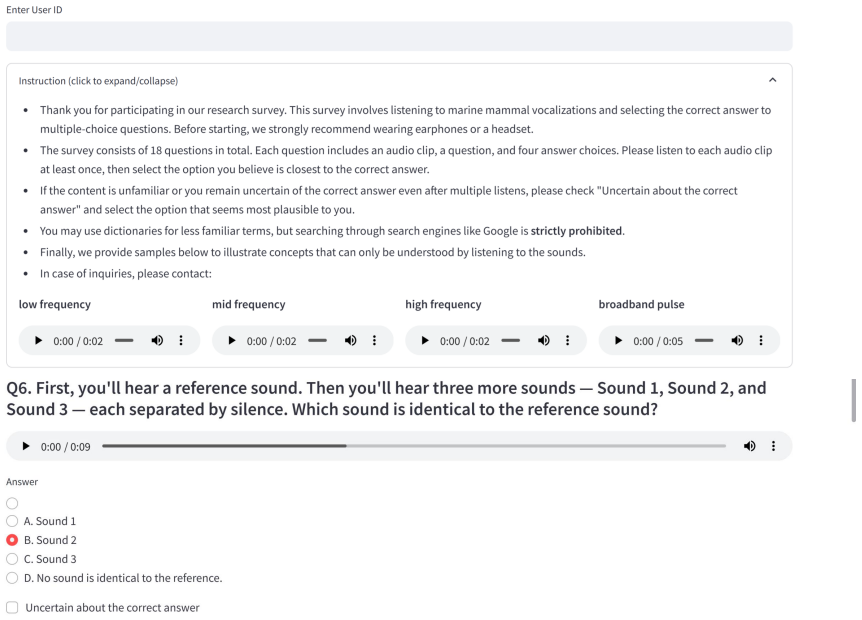
WoW-Bench consists of 1,777 validated zero-shot multiple-choice questions drawn from marine mammal vocalizations. The Perception component asks models to classify species, vocalization type, or both; the Cognition component, organized by Bloom's taxonomy, asks models to remember a reference sound, understand a sound's acoustic description, apply pitch or duration comparisons, and analyze transitions within a clip. Adversarial distractors invert the expected pattern—identical candidate sounds, 'none of the above,' or noise-replaced segments—to test whether models answer by listening. Across ten open and commercial LALMs, the best model (Gemini-2.5-Flash) reaches 45.5% total accuracy, while hu
Load-bearing premise
The benchmark's ground-truth labels are correct and unambiguous: questions were generated by GPT-4o from metadata and spectrograms and then verified by three human annotators, so if those labels contain hallucinated acoustic descriptions or if annotators accepted subtle mislabels, the measured human-model gap could be partly an artifact of the benchmark rather than a true deficit in low-level listening.
Editorial extensions
If this is right
- Cognition accuracy on WoW-Bench is a purer measure of low-level listening than Perception accuracy, because it requires no marine-mammal prior knowledge; it can isolate auditory perception from world knowledge.
- Distractor accuracy is a practical diagnostic: a model that collapses when the expected answer pattern is inverted is relying on priors, not on the acoustic signal.
- No current LALM is reliable for fine-grained acoustic comparisons such as which sound is higher pitched or longest, even though such comparisons are easy for human listeners.
- Performance does not collapse at high sample rates or long durations, suggesting the deficit is perceptual fidelity within the model's nominal operating range, not simply bandwidth limitation.
- Because WoW-Bench is test-only and zero-shot, future improvement must come from better auditory generalization rather than memorizing whale-specific training data.
Reading between the lines
- A natural extension is to build synthetic versions of the Apply tasks from pure tones with known pitch and duration, isolating whether failures come from the novelty of whale sounds or from a more basic inability to compare acoustic dimensions.
- The distractor logic could be exported to other out-of-distribution listening domains—industrial machinery, medical audio, wildlife monitoring—as a general audit of whether a model is listening to the signal or matching expected answer patterns.
- If the low-level bottleneck is genuine, simply scaling audio-text training data at 16 kHz may not close the human-model gap; architectures or pretraining objectives that preserve fine spectral/temporal detail may be required.
- The results set a concrete target: an LALM that reaches expert-human performance on WoW-Bench Cognition (roughly 88% on distractor items in the paper's human study) would be strong evidence of true auditory grounding, because the test was designed so semantic priors cannot produce those answers.
Editorial analysis
A structured set of objections, weighed in public.
Referee Report
Summary. The paper introduces WoW-Bench, a test-only multiple-choice benchmark for evaluating low-level auditory perception in large audio-language models (LALMs). The benchmark is built from the Watkins Marine Mammal Sound Database and consists of a Perception component (species, vocalization, and combined species+vocalization classification) and a Cognition component organized by Bloom's taxonomy (Remember, Understand, Apply-Frequency, Apply-Duration, Analyze-Acoustics, Analyze-Vocalization), together with adversarial distractor variants. The authors evaluate a broad set of open and commercial LALMs, plus human non-expert and expert listeners. The central empirical claim is that current LALMs perform far below human listeners on the Cognition tasks, e.g., the best model, Gemini-2.5-Flash, achieves 45.5% overall and 18.3% on distractor questions, whereas human listeners on the sampled subset reach about 70–77% on Cognition and experts reach substantially higher.
Significance. If the observed human–model gap is accepted, WoW-Bench provides a useful, controlled out-of-distribution probe of low-level auditory perception that is not captured by existing benchmarks such as MMAU, and the distractor manipulations give a concrete way to test whether models are listening rather than relying on linguistic priors. The human baseline is a major strength: it grounds the claim that the Cognition questions are solvable from the audio alone. The finding that distractor performance is low and negatively correlated with non-distractor performance is a specific, falsifiable behavioral signature of shallow auditory grounding. The paper also makes a clear contribution by focusing on a domain underrepresented in standard audio corpora and by drawing attention to perceptual, not just semantic, limitations of LALMs.
major comments (4)
- [§4.1 and Appendix C.2] The best-performing prompt for each model is selected based on 'preliminary validation' with no indication that this validation is performed on a separate split. Since the entire benchmark is test-only and the reported numbers are on the same data, this is effectively test-set prompt selection. This can inflate absolute model scores and makes comparisons across models and tasks difficult to trust. The human–model gap is wide enough that the conclusion likely survives, but the quantitative claims need to be made robust by using a held-out prompt-development split or by reporting all prompt variants and explicitly discussing selection bias.
- [§C.1 and §C.3] All model results come from a single run, and invalid or ambiguous model responses are excluded from accuracy rather than counted as incorrect. Combined with test-set prompt selection, this makes task-level differences (e.g., Gemini-2.5-Flash at 64.4% on Remember but 36.0% on Apply-Frequency) potentially fragile. The authors should report multiple runs with variance or at least quantify the fraction of invalid responses per model, and state how the exclusion affects the reported accuracy. This is needed to support the precision of the benchmark's headline numbers.
- [§3.5 and Appendix B.3] Ground truth for Understand, Apply, and Analyze questions is generated by GPT-4o, partly from spectrograms, and then verified by three annotators. The paper does not report how many generated questions were discarded, how often annotation changed the answer, or the level of annotator agreement. The human baseline is reassuring evidence that the labels are generally grounded in the audio, but for a new benchmark the curation pipeline should be quantified (inter-annotator agreement, discard rates, and examples of reannotation) so that readers can assess label reliability independently.
- [§4.2.5 and Figure 6] The analysis of sampling-rate and duration effects is descriptive and the bins used in Figure 6 are not defined in the text. The claim that performance 'fluctuates' without a sharp threshold would be more convincing with a specification of the binning procedure and, ideally, a simple statistical comparison. This is not central to the main conclusion but affects the paper's treatment of acoustic-range effects.
minor comments (5)
- [Throughout] Typographical issues include 'distactor' for 'distractor' in §4.2.3, 'V ocalization' in several places, and 'lanugage' in the Introduction. These should be fixed in a revised version.
- [Table 2] The table formatting loses column separation in several rows (e.g., the LTU row shows '27.422.8' and '31.95'), which makes the reported numbers hard to parse. Please reformat and verify all entries.
- [Figure 1 and Figure 2] Abbreviations such as UAF, S, V, RAD, BAA in Figure 1 and the legend markers in Figure 2 are not defined in the captions. Define all acronyms and markers directly in the captions for self-containment.
- [Appendix A.1] The keyword-based accuracy analysis is exploratory and may be confounded by answer verbosity and prompt style. The paper should state explicitly that these are descriptive correlations, not causal error analyses, and should avoid overinterpreting small cell counts.
- [Appendix C.4] The human evaluation is based on 108 questions and 10 participants, and Table 7 compares only Gemini-2.5-Flash on this subset. To support the use of the human baseline against full-benchmark model scores, include a per-task model comparison on the subset for at least the main models, or provide the claimed 'closely matched' statistics in detail.
Circularity Check
No significant circularity: the benchmark claims are supported by direct empirical measurement and human baselines, not by derivation from fitted inputs or self-citations.
full rationale
WoW-Bench is an empirical evaluation artifact rather than a derivational chain. The central claim—that state-of-the-art LALMs perform far below human levels on fine-grained low-level listening—is established by direct measurement: Gemini-2.5-Flash scores 45.5% overall while human Cognition accuracy is 70.67% (non-distractor) and 76.67% (distractor), with non-expert listeners alone reaching 62.7% and 65.0% on Cognition. The human baseline directly tests whether the questions are solvable from audio alone: if the GPT-4o-generated labels were not grounded in audible acoustic content, naive listeners could not score well above chance on the same task family. The distractor condition further strengthens the claim, since humans detect 'none match'/'all identical' at high rates while the best model collapses to 18.3% on distractor Cognition, showing the gap is not an artifact of marine-mammal priors or question wording. No fitted parameter is renamed as a prediction, and no result is derived from a self-citation. The paper's own cited prior work (e.g., AudioCaps) is used only as an example dataset and is not load-bearing. The stated limitations—restriction to marine mammal vocalizations and dependence on multiple-choice format—concern external validity and benchmark coverage, not circularity. Potential label noise from LLM-assisted generation is a correctness risk, but it is mitigated by three-annotator verification and by the human-expert baselines, and it does not constitute a circular derivation. Therefore the appropriate score is 0.
Assumptions & free parameters
assumptions (5)
- domain assumption Low-level listening (detection of pitch, duration, timbre) is a separable perceptual ability that can be quantified through multiple-choice audio questions.
- domain assumption Marine mammal vocalizations are sufficiently out-of-distribution for current LALMs that good performance requires low-level listening rather than memorized semantic priors.
- domain assumption The Watkins Marine Mammal Sound Database metadata (species, vocalization type) is accurate and the source recordings are clean enough for the intended comparisons.
- domain assumption LLM-generated question-answer pairs validated by three human annotators have correct ground truth, including for subtle acoustic distinctions.
- domain assumption Spectrogram-based descriptions provided by a vision-language model (GPT-4o) faithfully capture the audio content for Understand and Apply questions.
Cite this review
Pith. "Pith review of WoW-Bench: Evaluating Fine-Grained Acoustic Perception in Audio-Language Models via Marine Mammal Vocalizations." pith.science (2026). https://pith.science/paper/TOQAKMCH
@misc{pith2026250820976,
  author       = {Pith},
  title        = {Pith review of: WoW-Bench: Evaluating Fine-Grained Acoustic Perception in Audio-Language Models via Marine Mammal Vocalizations},
  year         = {2026},
  howpublished = {\url{https://pith.science/paper/TOQAKMCH}},
  note         = {Machine review of arXiv:2508.20976}
}
read the original abstract
Large audio language models (LALMs) extend language understanding into the auditory domain, yet their ability to perform low-level listening, such as pitch and duration detection, remains underexplored. However, low-level listening is critical for real-world, out-of-distribution tasks where models must reason about unfamiliar sounds based on fine-grained acoustic cues. To address this gap, we introduce the World-of-Whale benchmark (WoW-Bench) to evaluate low-level auditory perception and cognition using marine mammal vocalizations. WoW-bench is composed of a Perception benchmark for categorizing novel sounds and a Cognition benchmark, inspired by Bloom's taxonomy, to assess the abilities to remember, understand, apply, and analyze sound events. For the Cognition benchmark, we additionally introduce distractor questions to evaluate whether models are truly solving problems through listening rather than relying on other heuristics. Experiments with state-of-the-art LALMs show performance far below human levels, indicating a need for stronger auditory grounding in LALMs.
Figures


Figures from the paper (4 more)


Forward citations
Cited by 3 Pith papers
-
Comparative Reasoning: Making an Audio Language Model Better at Comparing Emotions
A reasoning-guided ordinal SER framework conditions LALMs on paired speech, trains on semantic and GeMAPS-derived reasoning traces, and applies direct preference optimization to improve comparative emotion prediction ...
-
TW-Sound580K: A Regional Audio-Text Dataset with Verification-Guided Curation for Localized Audio-Language Modeling
TW-Sound580K dataset plus Tai-LALM model with dynamic Dual-ASR arbitration lifts localized Taiwanese audio-language accuracy to 49.1% on the TAU benchmark.
-
A Survey of Large Audio Language Models: Generalization, Trustworthiness, and Outlook
A survey of Large Audio Language Models that establishes a taxonomy of trustworthiness vulnerabilities and proposes a Defense-in-Depth roadmap for audio intelligence.
Reference graph
Works this paper leans on
-
[1]
Lorin W Anderson and David R Krathwohl. 2001. A taxonomy for learning, teaching, and assessing: A revision of Bloom's taxonomy of educational objectives: complete edition. Addison Wesley Longman, Inc
work page 2001
-
[2]
Jinze Bai, Shuai Bai, Yunfei Chu, Zeyu Cui, Kai Dang, Xiaodong Deng, Yang Fan, Wenbin Ge, Yu Han, Fei Huang, et al. 2023. Qwen technical report. arXiv preprint arXiv:2309.16609
arXiv 2023
-
[3]
Rolf Bardeli, Daniel Wolff, Frank Kurth, Martina Koch, K-H Tauchert, and K-H Frommolt. 2010. Detecting bird sounds in a complex acoustic environment and application to bioacoustic monitoring. Pattern Recognition Letters
work page 2010
-
[4]
Benjamin S Bloom, Max D Engelhart, Edward J Furst, Walker H Hill, David R Krathwohl, et al. 1956. Taxonomy of educational objectives: The classification of educational goals. Handbook 1: Cognitive domain. Longman New York
work page 1956
-
[5]
Albert S Bregman. 1994. Auditory scene analysis: The perceptual organization of sound. MIT press
work page 1994
-
[6]
Honglie Chen, Weidi Xie, Andrea Vedaldi, and Andrew Zisserman. 2020. Vggsound: A large-scale audio-visual dataset. In ICASSP
work page 2020
-
[7]
Yunfei Chu, Jin Xu, Qian Yang, Haojie Wei, Xipin Wei, Zhifang Guo, Yichong Leng, Yuanjun Lv, Jinzheng He, Junyang Lin, et al. 2024. Qwen2-audio technical report. arXiv preprint arXiv:2407.10759
arXiv 2024
-
[8]
Yunfei Chu, Jin Xu, Xiaohuan Zhou, Qian Yang, Shiliang Zhang, Zhijie Yan, Chang Zhou, and Jingren Zhou. 2023. Qwen-audio: Advancing universal audio understanding via unified large-scale audio-language models. arXiv preprint arXiv:2311.07919
arXiv 2023
Show all 53 references
-
[9]
Gheorghe Comanici, Eric Bieber, Mike Schaekermann, Ice Pasupat, Noveen Sachdeva, Inderjit Dhillon, Marcel Blistein, Ori Ram, Dan Zhang, Evan Rosen, et al. 2025. Gemini 2.5: Pushing the frontier with advanced reasoning, multimodality, long context, and next generation agentic c...
2025 arXiv
-
[10]
Marco Crocco, Marco Cristani, Andrea Trucco, and Vittorio Murino. 2016. Audio surveillance: A systematic review. ACM Computing Surveys
2016
-
[11]
Soham Deshmukh, Satvik Dixit, Rita Singh, and Bhiksha Raj. 2025 a . Mellow: a small audio language model for reasoning. arXiv preprint arXiv:2503.08540
2025 arXiv
-
[12]
Soham Deshmukh, Benjamin Elizalde, Rita Singh, and Huaming Wang. 2023. Pengi: An audio language model for audio tasks. In NeurIPS
2023
-
[13]
Soham Deshmukh, Shuo Han, Hazim Bukhari, Benjamin Elizalde, Hannes Gamper, Rita Singh, and Bhiksha Raj. 2025 b . Audio entailment: Assessing deductive reasoning for audio understanding. In AAAI
2025
-
[14]
Soham Deshmukh, Shuo Han, Rita Singh, and Bhiksha Raj. 2025 c . Adiff: Explaining audio difference using natural language. In ICLR
2025
-
[15]
Kota Dohi, Keisuke Imoto, Noboru Harada, Daisuke Niizumi, Yuma Koizumi, Tomoya Nishida, Harsh Purohit, Ryo Tanabe, Takashi Endo, Masaaki Yamamoto, and Yohei Kawaguchi. 2022. Description and discussion on dcase 2022 challenge task 2: Unsupervised anomalous sound detection for m...
2022
-
[16]
Konstantinos Drossos, Samuel Lipping, and Tuomas Virtanen. 2020. Clotho: An audio captioning dataset. In ICASSP. IEEE
2020
-
[17]
Eduardo Fonseca, Xavier Favory, Jordi Pons, Frederic Font, and Xavier Serra. 2021. Fsd50k: an open dataset of human-labeled sound events. IEEE TASLP
2021
-
[18]
Jort F Gemmeke, Daniel PW Ellis, Dylan Freedman, Aren Jansen, Wade Lawrence, R Channing Moore, Manoj Plakal, and Marvin Ritter. 2017. Audio set: An ontology and human-labeled dataset for audio events. In ICASSP
2017
-
[19]
Sreyan Ghosh, Zhifeng Kong, Sonal Kumar, S Sakshi, Jaehyeon Kim, Wei Ping, Rafael Valle, Dinesh Manocha, and Bryan Catanzaro. 2025. Audio flamingo 2: An audio-language model with long-audio understanding and expert reasoning abilities. arXiv preprint arXiv:2503.03983
2025 arXiv
-
[20]
Sreyan Ghosh, Sonal Kumar, Ashish Seth, Chandra Kiran Reddy Evuru, Utkarsh Tyagi, S Sakshi, Oriol Nieto, Ramani Duraiswami, and Dinesh Manocha. 2024 a . GAMA : A large audio-language model with advanced audio understanding and complex reasoning abilities. In EMNLP
2024
-
[21]
Sreyan Ghosh, Ashish Seth, Sonal Kumar, Utkarsh Tyagi, Chandra Kiran Reddy Evuru, S Ramaneswaran, S Sakshi, Oriol Nieto, Ramani Duraiswami, and Dinesh Manocha. 2024 b . Compa: Addressing the gap in compositional reasoning in audio-language models. In ICLR
2024
-
[22]
Yuan Gong, Alexander H Liu, Hongyin Luo, Leonid Karlinsky, and James Glass. 2023. Joint audio and speech understanding. In ASRU
2023
-
[23]
Yuan Gong, Hongyin Luo, Alexander H Liu, Leonid Karlinsky, and James R Glass. 2024. Listen, think, and understand. In ICLR
2024
-
[24]
Google DeepMind . 2024. Gemini 2.0 flash. https://deepmind.google/technologies/gemini/flash/
2024
-
[25]
Google Research . 2024. Whistles, songs, boings and biotwangs: Recognizing whale vocalizations with ai. https://research.google/blog/whistles. Accessed: 2025-05-19
2024
-
[26]
Dan Hendrycks, Collin Burns, Steven Basart, Andy Zou, Mantas Mazeika, Dawn Song, and Jacob Steinhardt. 2021. Measuring massive multitask language understanding. In ICLR
2021
-
[27]
Shawn Hershey, Daniel PW Ellis, Eduardo Fonseca, Aren Jansen, Caroline Liu, R Channing Moore, and Manoj Plakal. 2021. The benefit of temporally-strong labels in audio event classification. In ICASSP
2021
-
[28]
Aaron Hurst, Adam Lerer, Adam P Goucher, Adam Perelman, Aditya Ramesh, Aidan Clark, AJ Ostrow, Akila Welihinda, Alan Hayes, Alec Radford, et al. 2024. Gpt-4o system card. arXiv preprint arXiv:2410.21276
2024 arXiv
-
[29]
Md Mohaiminul Islam, Ngan Ho, Xitong Yang, Tushar Nagarajan, Lorenzo Torresani, and Gedas Bertasius. 2024. Video recap: Recursive captioning of hour-long videos. In CVPR
2024
-
[30]
Xuan Ju, Yiming Gao, Zhaoyang Zhang, Ziyang Yuan, Xintao Wang, Ailing Zeng, Yu Xiong, Qiang Xu, and Ying Shan. 2024. Miradata: A large-scale video dataset with long durations and structured captions. In NeurIPS Datasets and Benchmarks
2024
-
[31]
Chris Dongjoo Kim, Byeongchang Kim, Hyunmin Lee, and Gunhee Kim. 2019. Audiocaps: Generating captions for audios in the wild. In NAACL
2019
-
[32]
Yuma Koizumi, Yohei Kawaguchi, Keisuke Imoto, Toshiki Nakamura, Yuki Nikaido, Ryo Tanabe, Harsh Purohit, Kaori Suefusa, Takashi Endo, Masahiro Yasuda, and Noboru Harada. 2020. Description and discussion on dcase2020 challenge task2: Unsupervised anomalous sound detection for m...
2020
-
[33]
Zhifeng Kong, Arushi Goel, Rohan Badlani, Wei Ping, Rafael Valle, and Bryan Catanzaro. 2024. Audio flamingo: A novel audio language model with few-shot learning and dialogue abilities. In ICML
2024
-
[34]
Ziyang Ma, Zhuo Chen, Yuping Wang, Eng Siong Chng, and Xie Chen. 2025. Audio-cot: Exploring chain-of-thought reasoning in large audio language model. arXiv preprint arXiv:2501.07246
2025 arXiv
-
[35]
Brian CJ Moore. 2012. An introduction to the psychology of hearing. Brill
2012
-
[36]
Mor Nahum, Israel Nelken, and Merav Ahissar. 2008. Low-level information and high-level perception: the case of speech in noise. PLoS biology
2008
-
[37]
OpenAI. 2025. https://platform.openai.com/docs/models/gpt-4o-audio-preview Gpt-4o audio preview . 2025
2025
-
[38]
Karol J Piczak. 2015. Esc: Dataset for environmental sound classification. In ACM MM
2015
-
[39]
Lukas Rauch, Raphael Schwinger, Moritz Wirth, Ren \'e Heinrich, Denis Huseljic, Marek Herde, Jonas Lange, Stefan Kahl, Bernhard Sick, Sven Tomforde, and Christoph Scholz. 2025. Birdset: A large-scale dataset for audio classification in avian bioacoustics. In ICLR
2025
-
[40]
David Robinson, Marius Miron, Masato Hagiwara, and Olivier Pietquin. 2025. Nature LM -audio: an audio-language foundation model for bioacoustics. In ICLR
2025
-
[41]
S Sakshi, Utkarsh Tyagi, Sonal Kumar, Ashish Seth, Ramaneswaran Selvakumar, Oriol Nieto, Ramani Duraiswami, Sreyan Ghosh, and Dinesh Manocha. 2025. Mmau: A massive multi-task audio understanding and reasoning benchmark. In ICLR
2025
-
[42]
Laela Sayigh, Mary Ann Daher, Julie Allen, Helen Gordon, Katherine Joyce, Claire Stuhlmann, and Peter Tyack. 2016. The watkins marine mammal sound database: an online, freely accessible resource. In Proceedings of Meetings on Acoustics
2016
-
[43]
Dan Stowell. 2022. Computational bioacoustics with deep learning: a review and roadmap. PeerJ, 10
2022
-
[44]
Changli Tang, Wenyi Yu, Guangzhi Sun, Xianzhao Chen, Tian Tan, Wei Li, Lu Lu, MA Zejun, and Chao Zhang. 2024. Salmonn: Towards generic hearing abilities for large language models. In ICLR
2024
-
[45]
Gemini Team, Petko Georgiev, Ving Ian Lei, Ryan Burnell, Libin Bai, Anmol Gulati, Garrett Tanzer, Damien Vincent, Zhufeng Pan, Shibo Wang, et al. 2024. Gemini 1.5: Unlocking multimodal understanding across millions of tokens of context. arXiv preprint arXiv:2403.05530
2024 arXiv
-
[46]
Bin Wang, Xunlong Zou, Geyu Lin, Shuo Sun, Zhuohan Liu, Wenyu Zhang, Zhengyuan Liu, AiTi Aw, and Nancy F. Chen. 2025. A udio B ench: A universal benchmark for audio large language models. In NAACL
2025
-
[47]
Jason Wei, Xuezhi Wang, Dale Schuurmans, Maarten Bosma, Fei Xia, Ed Chi, Quoc V Le, Denny Zhou, et al. 2022. Chain-of-thought prompting elicits reasoning in large language models. In NeurIPS
2022
-
[48]
Zhifei Xie, Mingbao Lin, Zihang Liu, Pengcheng Wu, Shuicheng Yan, and Chunyan Miao. 2025. Audio-reasoner: Improving reasoning capability in large audio language models. arXiv preprint arXiv:2503.02318
2025
-
[49]
Jin Xu, Zhifang Guo, Jinzheng He, Hangrui Hu, Ting He, Shuai Bai, Keqin Chen, Jialin Wang, Yang Fan, Kai Dang, et al. 2025. Qwen2. 5-omni technical report. arXiv preprint arXiv:2503.20215
2025 arXiv
-
[50]
Qian Yang, Jin Xu, Wenrui Liu, Yunfei Chu, Ziyue Jiang, Xiaohuan Zhou, Yichong Leng, Yuanjun Lv, Zhou Zhao, Chang Zhou, et al. 2024. Air-bench: Benchmarking large audio-language models via generative comprehension. In ACL
2024
-
[51]
Xiang Yue, Yuansheng Ni, Kai Zhang, Tianyu Zheng, Ruoqi Liu, Ge Zhang, Samuel Stevens, Dongfu Jiang, Weiming Ren, Yuxuan Sun, et al. 2024. Mmmu: A massive multi-discipline multimodal understanding and reasoning benchmark for expert agi. In CVPR
2024
-
[52]
online" 'onlinestring :=
ENTRY address archivePrefix author booktitle chapter edition editor eid eprint eprinttype howpublished institution journal key month note number organization pages publisher school series title type volume year doi pubmed url lastchecked label extra.label sort.label short.list...
-
[53]
write newline
" write newline "" before.all 'output.state := FUNCTION n.dashify 't := "" t empty not t #1 #1 substring "-" = t #1 #2 substring "--" = not "--" * t #2 global.max substring 't := t #1 #1 substring "-" = "-" * t #2 global.max substring 't := while if t #1 #1 substring * t #2 gl...
Reviewed August 5, 2026 · model on record in the stance chip above.
Discussion (0). Sign in to comment.