Shear-Induced Structural Convergence but Formation-History-Dependent Yielding in Sequentially Gelled Binary Colloidal Networks
Pith reviewed 2026-06-27 23:09 UTC · model grok-4.3
The pith
Shear drives sequentially gelled binary colloidal networks to structurally similar mixed states, yet their transient yielding responses retain dependence on gelation delay and interspecies attraction strength.
A machine-rendered reading of the paper's core claim, the machinery that carries it, and where it could break.
Core claim
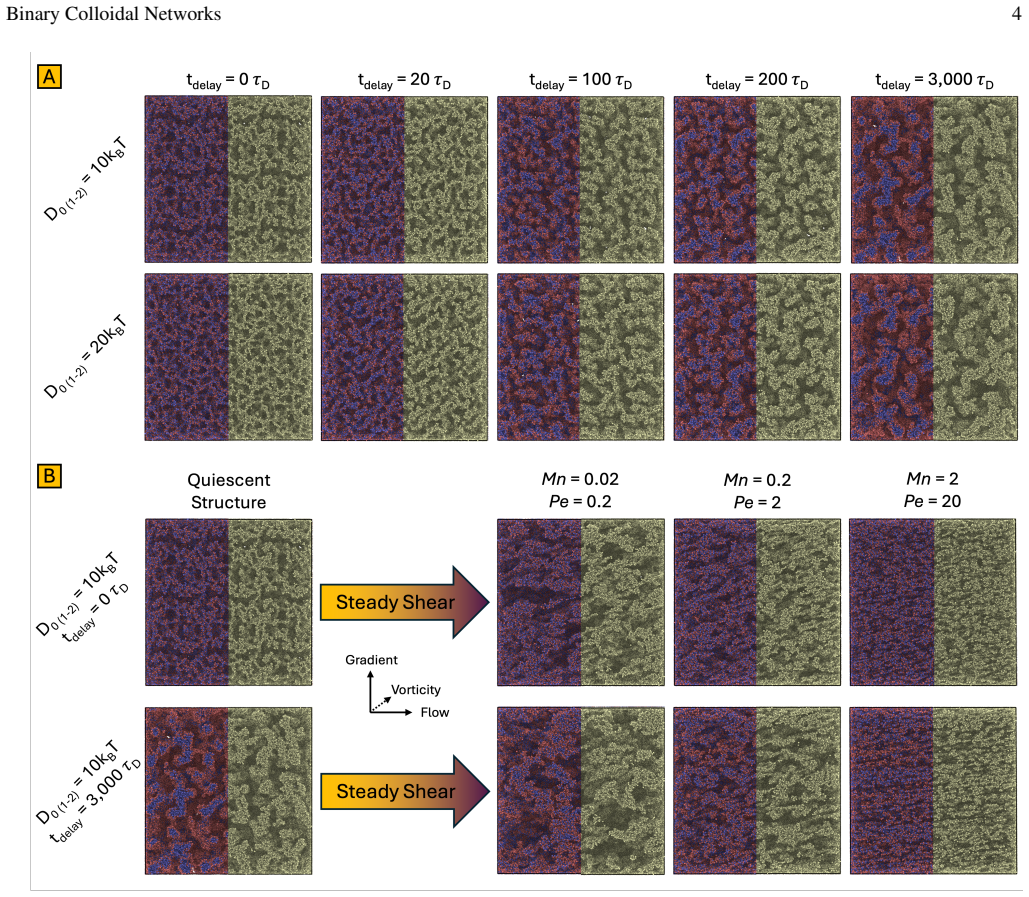
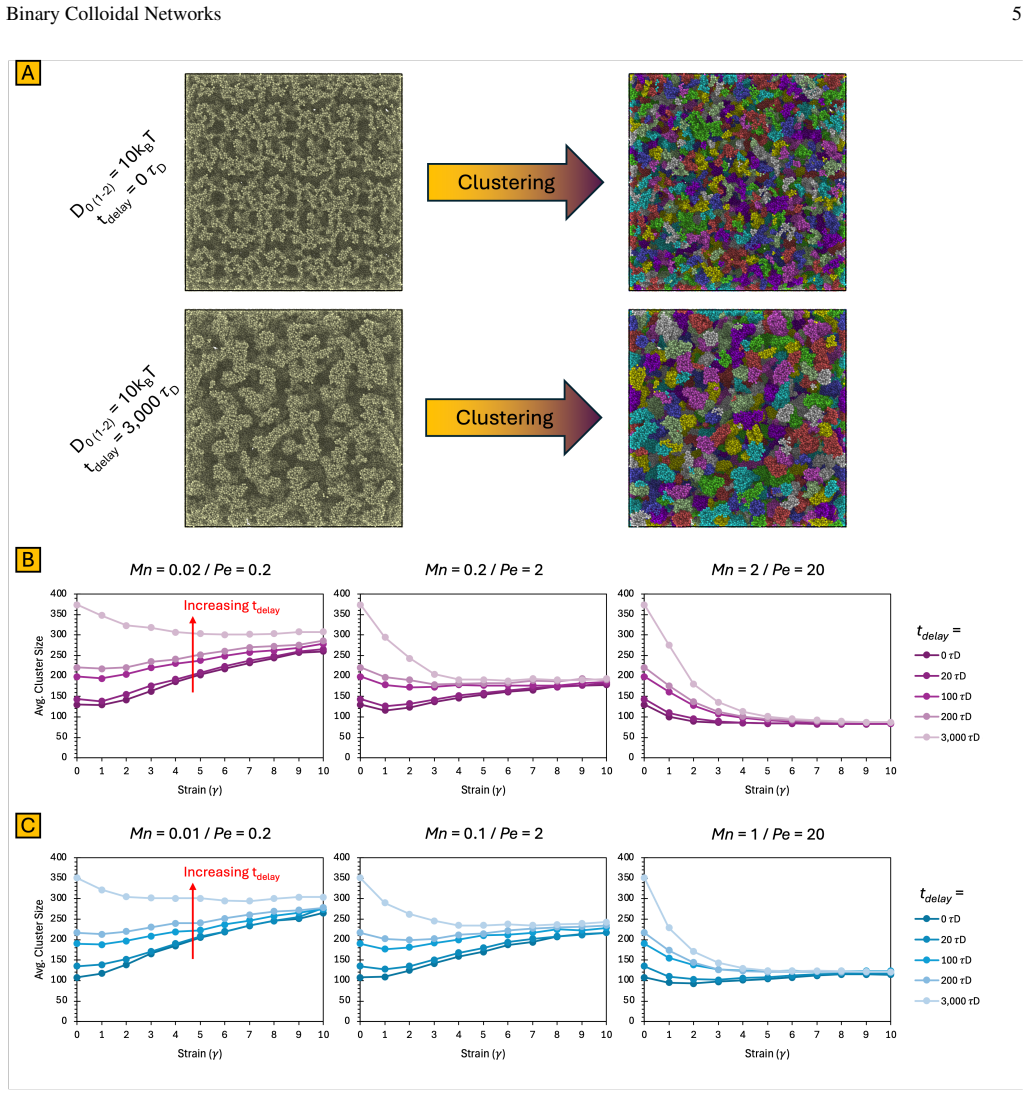
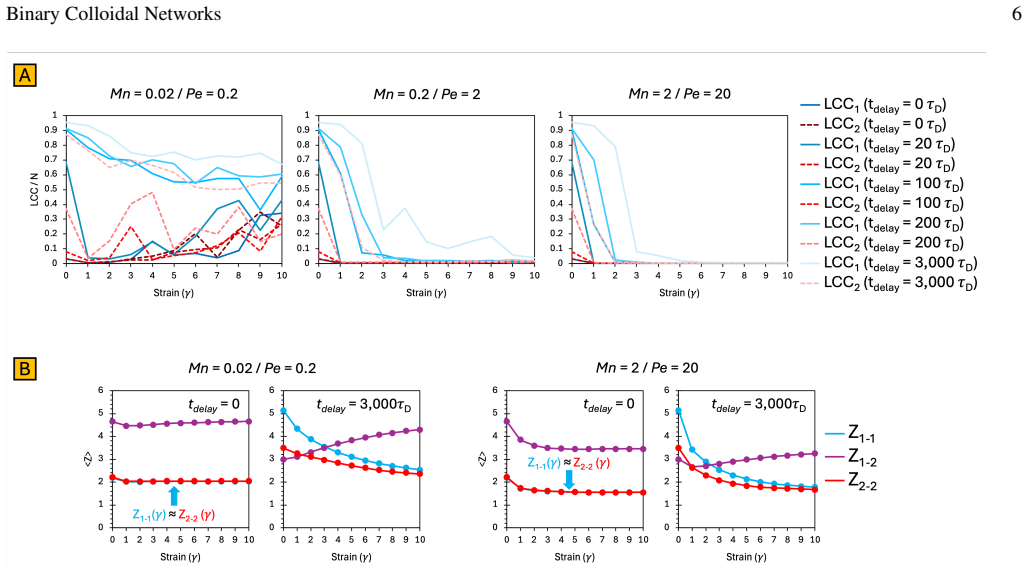
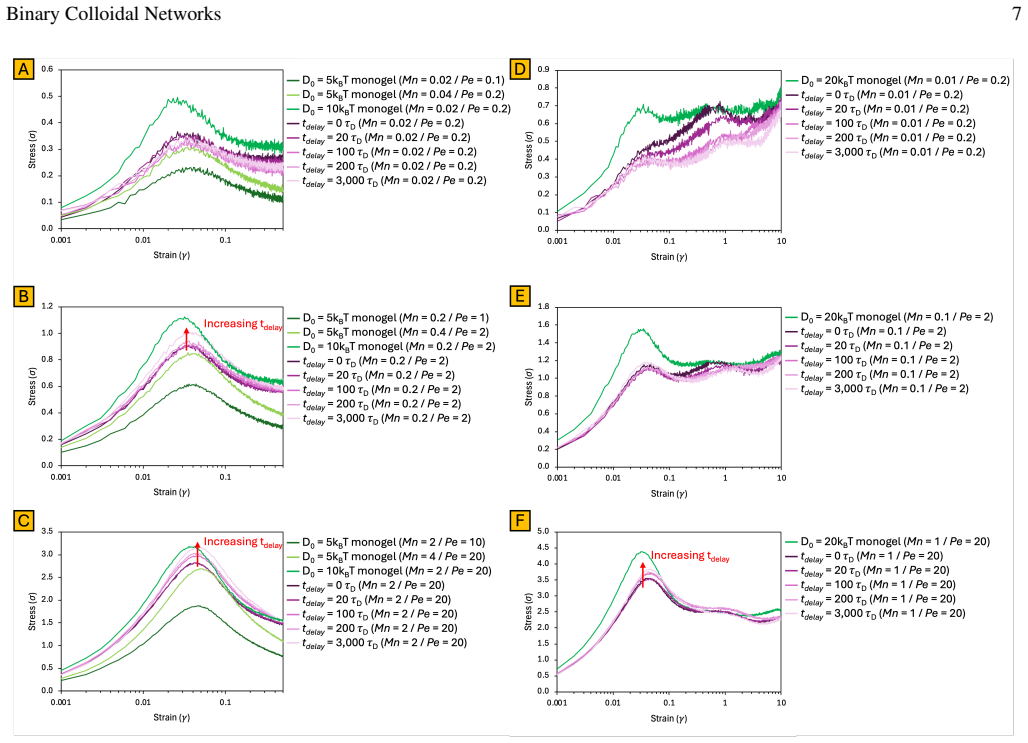
Although varying the gelation delay produces markedly different quiescent morphologies, ranging from well-mixed networks to coarse shell-core structures, steady shear drives the systems toward structurally convergent, mixed states as quantified by cluster, connected-component, and coordination analyses. This structural convergence, however, does not imply rheological equivalence. The transient stress response remains strongly dependent on gelation delay and interspecies attraction strength. For moderate interspecies attractions, increasing delay enhances the stress overshoot, particularly at high shear rates. For stronger interspecies attractions, initially heterogeneous gels exhibit two-ste
What carries the argument
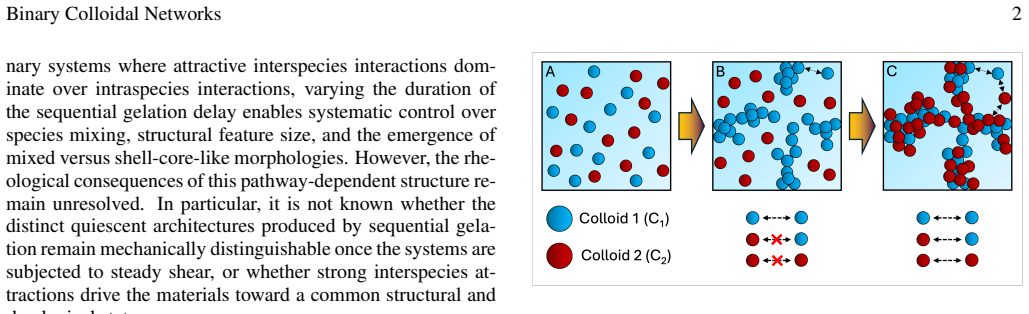
Sequential gelation with tunable delay under dominant interspecies attractions, whose effects on structure and transient stress are tracked through cluster, connected-component, and coordination analyses during applied shear.
If this is right
- Steady shear produces mixed states independent of initial gelation delay according to cluster, connected-component, and coordination metrics.
- The transient stress response during yielding stays dependent on gelation delay and interspecies attraction strength.
- For moderate interspecies attractions, longer gelation delays increase the stress overshoot especially at high shear rates.
- For strong interspecies attractions, initially heterogeneous gels display two-step yielding at low shear rates.
- Rheological memory from the formation pathway persists even after common structural descriptors have converged.
Where Pith is reading between the lines
- Formation history could serve as a control variable for tuning mechanical response in sheared colloidal materials without altering final structure.
- Similar history-dependent yielding after flow may appear in other multicomponent gels or soft networks.
- Varying particle size ratios or adding weak attractions between like species would test whether the reported memory effects generalize beyond the dominant interspecies case.
- The results imply that processing sequences in industrial gelation could leave lasting effects on performance even after subsequent mixing steps.
Load-bearing premise
The particle-based simulation model with its chosen interaction potentials, tunable delay times, and dominant interspecies attractions produces dynamics that are representative of real experimental binary colloidal gels under sequential gelation and shear.
What would settle it
Direct rheometry and microscopy experiments on real binary colloidal gels that show history-independent transient stress responses once structural metrics have converged under shear would falsify the claim of persistent rheological memory.
Figures
read the original abstract
Multicomponent colloidal gels can exhibit mechanical responses that depend not only on interaction strengths but also on the temporal pathway by which their networks form. Here, we use particle-based simulations to investigate the steady-shear deformation of binary colloidal gels assembled by sequential gelation with tunable delay time and dominant interspecies attractions. Although varying the gelation delay produces markedly different quiescent morphologies, ranging from well-mixed networks to coarse shell-core structures, steady shear drives the systems toward structurally convergent, mixed states as quantified by cluster, connected-component, and coordination analyses. This structural convergence, however, does not imply rheological equivalence. The transient stress response remains strongly dependent on gelation delay and interspecies attraction strength. For moderate interspecies attractions, increasing delay enhances the stress overshoot, particularly at high shear rates. For stronger interspecies attractions, initially heterogeneous gels exhibit two-step yielding at low shear rates, indicating distinct deformation and restructuring processes. These results show that sequential gelation can imprint a persistent rheological memory in binary colloidal gels, even when shear substantially erases differences in common structural descriptors.
Editorial analysis
A structured set of objections, weighed in public.
Referee Report
Summary. The manuscript uses particle-based simulations to study binary colloidal gels formed via sequential gelation with tunable delay times under dominant interspecies attractions. It reports that varying delay produces distinct quiescent morphologies (well-mixed networks to coarse shell-core structures), but steady shear drives convergence to mixed states according to cluster, connected-component, and coordination analyses; however, transient stress responses retain strong dependence on gelation delay and attraction strength, including enhanced overshoots at moderate attractions and two-step yielding at stronger attractions and low rates.
Significance. If validated, the results indicate that common structural metrics can converge under shear while rheological memory of formation history persists, which is relevant for designing multicomponent soft materials where processing steps like shearing do not fully erase pathway-dependent mechanics. The controlled simulation approach enables isolation of delay time and attraction effects that are difficult to access experimentally.
major comments (2)
- [Methods] Methods section: No information is supplied on model validation against known colloidal gel benchmarks, system sizes, number of independent realizations, statistical sampling, or error estimation for the reported structural and stress quantities. These details are required to assess whether the observed structural convergence and rheological differences are statistically robust.
- [Results on structural analysis] Structural characterization (cluster/connected-component/coordination analyses): The central claim that shear produces structurally convergent states (while rheology remains history-dependent) rests on these three metrics. Without supplementary checks for residual delay-time dependence in interspecies bond distributions, local packing fractions, or network anisotropy, it remains possible that undetected structural differences, rather than formation history per se, explain the rheological distinctions.
minor comments (1)
- [Abstract] Abstract: States outcomes of the analyses but supplies no information on validation, system sizes, or error bars, which hinders immediate assessment of the claims.
Simulated Author's Rebuttal
We thank the referee for the constructive comments, which help clarify the presentation of our results. We respond to each major comment below and will revise the manuscript accordingly.
read point-by-point responses
-
Referee: [Methods] Methods section: No information is supplied on model validation against known colloidal gel benchmarks, system sizes, number of independent realizations, statistical sampling, or error estimation for the reported structural and stress quantities. These details are required to assess whether the observed structural convergence and rheological differences are statistically robust.
Authors: We agree that these details are necessary to establish statistical robustness. In the revised manuscript we will expand the Methods section to include model validation against standard colloidal gel benchmarks, explicit system sizes (particle numbers), the number of independent realizations per parameter combination, and descriptions of the statistical sampling and error estimation procedures applied to both structural metrics and stress responses. revision: yes
-
Referee: [Results on structural analysis] Structural characterization (cluster/connected-component/coordination analyses): The central claim that shear produces structurally convergent states (while rheology remains history-dependent) rests on these three metrics. Without supplementary checks for residual delay-time dependence in interspecies bond distributions, local packing fractions, or network anisotropy, it remains possible that undetected structural differences, rather than formation history per se, explain the rheological distinctions.
Authors: The three metrics employed are standard for characterizing colloidal gel morphology and directly quantify the mixing and connectivity changes under shear. Nevertheless, to address the possibility of undetected residual differences, we will add supplementary figures and discussion in the revision showing interspecies bond distributions and local packing fractions versus delay time after shear. Network anisotropy is not expected to persist under the steady shear protocol used, but we will include a brief quantitative check for completeness. revision: yes
Circularity Check
No circularity: results are direct simulation outputs
full rationale
The manuscript reports outcomes from particle-based simulations of binary colloidal gels under sequential gelation and steady shear. Structural convergence is quantified via standard post-processing metrics (cluster, connected-component, and coordination analyses) applied to simulation trajectories. No equations, fitted parameters, self-referential definitions, or load-bearing self-citations appear in the abstract or described claims. The transient stress responses and history dependence are presented as direct simulation results rather than derived predictions. The work is self-contained against external benchmarks as a computational study with no reduction of outputs to inputs by construction.
Axiom & Free-Parameter Ledger
Reference graph
Works this paper leans on
-
[1]
Gong, J.P. and Katsuyama, Y. and Kurokawa, T. and Osada, Y. , year =. Double‐Network Hydrogels with Extremely High Mechanical Strength , volume =. Advanced Materials , publisher =. doi:10.1002/adma.200304907 , number =
-
[2]
Zhu, Ruixin and Zhu, Dandan and Zheng, Zhen and Wang, Xinling , year =. Tough double network hydrogels with rapid self-reinforcement and low hysteresis based on highly entangled networks , volume =. Nature Communications , publisher =. doi:10.1038/s41467-024-45485-8 , number =
-
[3]
Sun, Jeong-Yun and Zhao, Xuanhe and Illeperuma, Widusha R. K. and Chaudhuri, Ovijit and Oh, Kyu Hwan and Mooney, David J. and Vlassak, Joost J. and Suo, Zhigang , year =. Highly stretchable and tough hydrogels , volume =. Nature , publisher =. doi:10.1038/nature11409 , number =
-
[4]
Zhao, Xuanhe , year =. Multi-scale multi-mechanism design of tough hydrogels: building dissipation into stretchy networks , volume =. Soft Matter , publisher =. doi:10.1039/c3sm52272e , number =
-
[5]
Multi-component colloidal gels: interplay between structure and mechanical properties , volume =
Ferreiro-Córdova, Claudia and Del Gado, Emanuela and Foffi, Giuseppe and Bouzid, Mehdi , year =. Multi-component colloidal gels: interplay between structure and mechanical properties , volume =. Soft Matter , publisher =. doi:10.1039/c9sm02410g , number =
-
[6]
and Tchuenkam Batoum, Rose and Del Gado, Emanuela , year =
Mugnai, Mauro L. and Tchuenkam Batoum, Rose and Del Gado, Emanuela , year =. Interspecies interactions in dual, fibrous gels enable control of gel structure and rheology , volume =. Proceedings of the National Academy of Sciences , publisher =. doi:10.1073/pnas.2423293122 , number =
-
[7]
and Gouzy, Roland and Coulais, Corentin and Velikov, Krassimir P
Macias-Rodriguez, Braulio A. and Gouzy, Roland and Coulais, Corentin and Velikov, Krassimir P. , year =. Thermoresponsive oil-continuous gels based on double-interpenetrating colloidal-particle networks , volume =. Soft Matter , publisher =. doi:10.1039/d3sm01582c , number =
-
[8]
Grzelczak, Marek and Vermant, Jan and Furst, Eric M. and Liz-Marzán, Luis M. , year =. Directed Self-Assembly of Nanoparticles , volume =. ACS Nano , publisher =. doi:10.1021/nn100869j , number =
-
[9]
Recent Advances in Multicomponent Particle Assembly , volume =
Guo, Dan and Song, Yanlin , year =. Recent Advances in Multicomponent Particle Assembly , volume =. Chemistry – A European Journal , publisher =. doi:10.1002/chem.201800264 , number =
-
[10]
Immink, Jasper N. and Maris, J. J. Erik and Crassous, Jér\^ome J. and Stenhammar, Joakim and Schurtenberger, Peter , year =. Reversible Formation of Thermoresponsive Binary Particle Gels with Tunable Structural and Mechanical Properties , volume =. ACS Nano , publisher =. doi:10.1021/acsnano.8b09139 , number =
-
[11]
and Foffi, Giuseppe and Eiser, Erika , year =
Di Michele, Lorenzo and Varrato, Francesco and Kotar, Jurij and Nathan, Simon H. and Foffi, Giuseppe and Eiser, Erika , year =. Multistep kinetic self-assembly of DNA-coated colloids , volume =. Nature Communications , publisher =. doi:10.1038/ncomms3007 , number =
-
[12]
and van de Laar, Ties and ten Hove, Jan Bart and Kodger, Thomas E
Appel, Jeroen and de Lange, Niek and van der Kooij, Hanne M. and van de Laar, Ties and ten Hove, Jan Bart and Kodger, Thomas E. and Sprakel, Joris , year =. Temperature Controlled Sequential Gelation in Composite Microgel Suspensions , volume =. Particle and Particle Systems Characterization , publisher =. doi:10.1002/ppsc.201500007 , number =
-
[13]
Zia, Roseanna N. and Landrum, Benjamin J. and Russel, William B. , year =. A micro-mechanical study of coarsening and rheology of colloidal gels: Cage building, cage hopping, and Smoluchowski’s ratchet , volume =. Journal of Rheology , publisher =. doi:10.1122/1.4892115 , number =
-
[14]
Pusey, P. N. and Zaccarelli, E. and Valeriani, C. and Sanz, E. and Poon, Wilson C. K. and Cates, Michael E. , year =. Hard spheres: crystallization and glass formation , volume =. Philosophical Transactions of the Royal Society A: Mathematical, Physical and Engineering Sciences , publisher =. doi:10.1098/rsta.2009.0181 , number =
-
[15]
Zaccarelli, E. and Valeriani, C. and Sanz, E. and Poon, W. C. K. and Cates, M. E. and Pusey, P. N. , year =. Crystallization of Hard-Sphere Glasses , volume =. Physical Review Letters , publisher =. doi:10.1103/physrevlett.103.135704 , number =
-
[16]
Henderson, S.I. and Mortensen, T.C. and Underwood, S.M. and van Megen, W. , year =. Effect of particle size distribution on crystallisation and the glass transition of hard sphere colloids , volume =. Physica A: Statistical Mechanics and its Applications , publisher =. doi:10.1016/s0378-4371(96)00153-7 , number =
-
[17]
Rosvall, M. and Axelsson, D. and Bergstrom, C. T. , year =. The map equation , volume =. The European Physical Journal Special Topics , publisher =. doi:10.1140/epjst/e2010-01179-1 , number =
-
[18]
Kheirkhahzadeh, Masoumeh and Lancichinetti, Andrea and Rosvall, Martin , year =. Efficient community detection of network flows for varying Markov times and bipartite networks , volume =. Physical Review E , publisher =. doi:10.1103/physreve.93.032309 , number =
-
[19]
Varga, Zsigmond and Swan, James W. , year =. Large scale anisotropies in sheared colloidal gels , volume =. Journal of Rheology , publisher =. doi:10.1122/1.5003364 , number =
-
[20]
Effect of hydrodynamic interactions on the lifetime of colloidal bonds
Ness, Christopher and Zaccone, Alessio. Effect of hydrodynamic interactions on the lifetime of colloidal bonds. Ind. Eng. Chem. Res
-
[21]
Varga, Zsigmond and Swan, James , year =. Hydrodynamic interactions enhance gelation in dispersions of colloids with short-ranged attraction and long-ranged repulsion , volume =. Soft Matter , publisher =. doi:10.1039/c6sm01285j , number =
-
[22]
Key role of hydrodynamic interactions in colloidal gelation
Furukawa, Akira and Tanaka, Hajime. Key role of hydrodynamic interactions in colloidal gelation. Phys. Rev. Lett
-
[23]
and Jamali, S
Kaltashov, A. and Jamali, S. , title =. 2026 , howpublished =
2026
-
[24]
Structural fingerprints of yielding mechanisms in attractive colloidal gels
Boromand, Arman and Jamali, Safa and Maia, Jo \ a o M. Structural fingerprints of yielding mechanisms in attractive colloidal gels. Soft Matter
-
[25]
Life and death of colloidal bonds control the rate-dependent rheology of gels
Nabizadeh, Mohammad and Jamali, Safa. Life and death of colloidal bonds control the rate-dependent rheology of gels. Nat. Commun
-
[26]
Predicting yielding in attractive colloidal gels
Mangal, Deepak and Nabizadeh, Mohammad and Jamali, Safa. Predicting yielding in attractive colloidal gels. Phys. Rev. E
-
[27]
The hidden hierarchical nature of soft particulate gels
Bantawa, Minaspi and Keshavarz, Bavand and Geri, Michela and Bouzid, Mehdi and Divoux, Thibaut and McKinley, Gareth H and Del Gado, Emanuela. The hidden hierarchical nature of soft particulate gels. Nat. Phys
-
[28]
Topological origins of yielding in short-ranged weakly attractive colloidal gels , volume =
Mangal, Deepak and Nabizadeh, Mohammad and Jamali, Safa , year =. Topological origins of yielding in short-ranged weakly attractive colloidal gels , volume =. The Journal of Chemical Physics , publisher =. doi:10.1063/5.0123096 , number =
-
[29]
Stress localization, stiffening, and yielding in a model colloidal gel , volume =
Colombo, Jader and Del Gado, Emanuela , year =. Stress localization, stiffening, and yielding in a model colloidal gel , volume =. Journal of Rheology , publisher =. doi:10.1122/1.4882021 , number =
-
[30]
Johnson, Lilian C. and Landrum, Benjamin J. and Zia, Roseanna N. , year =. Yield of reversible colloidal gels during flow start-up: release from kinetic arrest , volume =. Soft Matter , publisher =. doi:10.1039/c8sm00109j , number =
-
[31]
Zaccone, Alessio and Wu, Hua and Del Gado, Emanuela , year =. Elasticity of Arrested Short-Ranged Attractive Colloids: Homogeneous and Heterogeneous Glasses , volume =. Physical Review Letters , publisher =. doi:10.1103/physrevlett.103.208301 , number =
-
[32]
and Bi, Dapeng and Ravandi, Babak and Jamali, Safa , year =
Nabizadeh, Mohammad and Nasirian, Farzaneh and Li, Xinzhi and Saraswat, Yug and Waheibi, Rony and Hsiao, Lilian C. and Bi, Dapeng and Ravandi, Babak and Jamali, Safa , year =. Network physics of attractive colloidal gels: Resilience, rigidity, and phase diagram , volume =. Proceedings of the National Academy of Sciences , publisher =. doi:10.1073/pnas.231...
-
[33]
and Chakraborty, Bulbul and Morris, Jeffrey F
Sedes, Omer and Makse, Hernan A. and Chakraborty, Bulbul and Morris, Jeffrey F. , year =. K-core analysis of shear-thickening suspensions , volume =. Physical Review Fluids , publisher =. doi:10.1103/physrevfluids.7.024304 , number =
-
[34]
Network analysis of particles and grains , volume =
Papadopoulos, Lia and Porter, Mason A and Daniels, Karen E and Bassett, Danielle S , year =. Network analysis of particles and grains , volume =. Journal of Complex Networks , publisher =. doi:10.1093/comnet/cny005 , number =
-
[35]
Huang, Yuming and Daniels, Karen E. , year =. Friction and pressure-dependence of force chain communities in granular materials , volume =. Granular Matter , publisher =. doi:10.1007/s10035-016-0681-6 , number =
-
[36]
Bassett, Danielle S. and Owens, Eli T. and Porter, Mason A. and Manning, M. Lisa and Daniels, Karen E. , year =. Extraction of force-chain network architecture in granular materials using community detection , volume =. Soft Matter , publisher =. doi:10.1039/c4sm01821d , number =
-
[37]
and Donley, Gavin J
Smith, Alexander D. and Donley, Gavin J. and Del Gado, Emanuela and Zavala, Victor M. , year =. Topological Data Analysis for Particulate Gels , volume =. ACS Nano , publisher =
-
[38]
Landrum, Benjamin J. and Russel, William B. and Zia, Roseanna N. , year =. Delayed yield in colloidal gels: Creep, flow, and re-entrant solid regimes , volume =. Journal of Rheology , publisher =. doi:10.1122/1.4954640 , number =
-
[39]
Structure and Dynamics of Force Clusters and Networks in Shear Thickening Suspensions , volume =
Nabizadeh, Mohammad and Singh, Abhinendra and Jamali, Safa , year =. Structure and Dynamics of Force Clusters and Networks in Shear Thickening Suspensions , volume =. Physical Review Letters , publisher =. doi:10.1103/physrevlett.129.068001 , number =
-
[40]
Haghighi, Paniz and Nabizadeh, Mohammad and Jamali, Safa , year =. Emergence and evolution of a particulate network during gelation and coarsening of attractive colloids , volume =. Soft Matter , publisher =. doi:10.1039/d5sm00572h , number =
-
[41]
and Padmanabhan, Poornima and Ryu, Brian K
Fenton, Scott M. and Padmanabhan, Poornima and Ryu, Brian K. and Nguyen, Tuan T. D. and Zia, Roseanna N. and Helgeson, Matthew E. , year =. Minimal conditions for solidification and thermal processing of colloidal gels , volume =. Proceedings of the National Academy of Sciences , publisher =. doi:10.1073/pnas.2215922120 , number =
-
[42]
Shear induced tuning and memory effects in colloidal gels of rods and spheres , volume =
Das, Mohan and Petekidis, George , year =. Shear induced tuning and memory effects in colloidal gels of rods and spheres , volume =. The Journal of Chemical Physics , publisher =. doi:10.1063/5.0129709 , number =
-
[43]
Countryman, Albert and Vinutha, H. A. and Ruiz, Fabiola Diaz and Mao, Xiaoming and Del Gado, Emanuela and Chakraborty, Bulbul , year =. Pinch-point singularities in stress–stress correlations reveal rigidity in colloidal gels , volume =. Soft Matter , publisher =. doi:10.1039/d5sm00296f , number =
-
[44]
Vinutha, H. A. and Diaz Ruiz, Fabiola Doraly and Mao, Xiaoming and Chakraborty, Bulbul and Del Gado, Emanuela , year =. Stress–stress correlations reveal force chains in gels , volume =. The Journal of Chemical Physics , publisher =. doi:10.1063/5.0131473 , number =
-
[45]
Zeb and Hsiao, Lilian and Szakasits, Megan and Solomon, Michael J
Rocklin, D. Zeb and Hsiao, Lilian and Szakasits, Megan and Solomon, Michael J. and Mao, Xiaoming , year =. Elasticity of colloidal gels: structural heterogeneity, floppy modes, and rigidity , volume =. Soft Matter , publisher =. doi:10.1039/d0sm00053a , number =
-
[46]
Yielding and resolidification of colloidal gels under constant stress , volume =
Moghimi, Esmaeel and Schofield, Andrew B and Petekidis, George , year =. Yielding and resolidification of colloidal gels under constant stress , volume =. Journal of Physics: Condensed Matter , publisher =. doi:10.1088/1361-648x/abfb8d , number =
-
[47]
Koumakis, N. and Ballesta, P. and Besseling, R. and Poon, W. C. K. and Brady, J. F. and Petekidis, G. , year =. Colloidal gels under shear: Strain rate effects , ISSN =. doi:10.1063/1.4794598 , booktitle =
-
[48]
Koumakis, Nick and Moghimi, Esmaeel and Besseling, Rut and Poon, Wilson C. K. and Brady, John F. and Petekidis, George , year =. Tuning colloidal gels by shear , volume =. Soft Matter , publisher =. doi:10.1039/c5sm00411j , number =
-
[49]
and Kang, Heekyoung and Ahn, Kyung Hyun and Solomon, Michael J
Hsiao, Lilian C. and Kang, Heekyoung and Ahn, Kyung Hyun and Solomon, Michael J. , year =. Role of shear-induced dynamical heterogeneity in the nonlinear rheology of colloidal gels , volume =. Soft Matter , publisher =. doi:10.1039/c4sm01375a , number =
-
[50]
Hsiao, Lilian C. and Newman, Richmond S. and Glotzer, Sharon C. and Solomon, Michael J. , year =. Role of isostaticity and load-bearing microstructure in the elasticity of yielded colloidal gels , volume =. Proceedings of the National Academy of Sciences , publisher =. doi:10.1073/pnas.1206742109 , number =
-
[51]
Jamali, Safa and McKinley, Gareth H. and Armstrong, Robert C. , year =. Microstructural Rearrangements and their Rheological Implications in a Model Thixotropic Elastoviscoplastic Fluid , volume =. Physical Review Letters , publisher =. doi:10.1103/physrevlett.118.048003 , number =
-
[52]
Koumakis, N. and Petekidis, G. , year =. Two step yielding in attractive colloids: transition from gels to attractive glasses , volume =. Soft Matter , publisher =. doi:10.1039/c0sm00957a , number =
-
[53]
and Koumakis, Nick and Petekidis, George , year =
Moghimi, Esmaeel and Jacob, Alan R. and Koumakis, Nick and Petekidis, George , year =. Colloidal gels tuned by oscillatory shear , volume =. Soft Matter , publisher =. doi:10.1039/c6sm02508k , number =
discussion (0)
Sign in with ORCID, Apple, or X to comment. Anyone can read and Pith papers without signing in.