REVIEW 2 major objections 3 minor 52 references
Spin inertia and polarization recovery in quantum dots: Role of pumping strength and resonant spin amplification
T0 review · 2 major / 3 minor · reviewed 2026-08-14 · deepseek-v4-flash
Pith's one-line read Spin inertia theory predicts resonant oscillations in Faraday geometry
desk verdict Solid finite-power spin-inertia extension, but the Faraday RSA prediction rests on an under-justified static Overhauser approximation. read the letter →
The pith
A machine-rendered reading of the paper's core claim, the machinery that carries it, and where it could break.
The reading
What carries the argument
The central object is the Gaussian distribution of static Overhauser fields $\boldsymbol{\Omega}_{N,g}$ with variance $\omega_{n,g}^2$ and anisotropy $\lambda_g$, together with the assumption that the trion Overhauser field is proportional to it via scaling factors $\chi$ and $\lambda_g/\lambda_t$. The pulse action is encoded in the map (6) with $Q$ the probability not to excite a trion and $\Phi$ the detuning-induced spin rotation. These feed into the steady-state Bloch equations (A2), whose central identity is the phase synchronization condition $|\boldsymbol{\Omega}_{L,g}+\boldsymbol{\Omega}_{N,g}|T_R=2\pi k$: it is what turns nuclear-field-tilted precession into the predicted Faraday-geometry resonant spin amplification peaks.
What would settle it
Measure the spin inertia signal of a p-type quantum-dot ensemble as a function of longitudinal field using strong nearly resonant pulses ($Q\approx0$) at zero modulation frequency and with $T_R$ halved to 6.6 ns; if no reproducible peaks appear at fields satisfying $\Omega_{L,g}T_R=2\pi k$, the Faraday-geometry resonant spin amplification prediction fails. A second clear check is the predicted pump-power saturation form: $L(P)/L(P_\pi)$ should follow $\sin^2(\pi\sqrt{P/P_\pi}/2)$ when $\tau_{s,t}\gg\tau_0$ and the saturated form of Eq. (17) when $\tau_{s,t}\ll\tau_0$.
Extended reading notes
Core claim
On the paper's own terms, the central discovery is that the spin inertia signal in a longitudinal magnetic field contains a resonant spin amplification channel generated by transverse Overhauser-field fluctuations. For each dot the relevant phase synchronization condition is $|\boldsymbol{\Omega}_{L,g}+\boldsymbol{\Omega}_{N,g}|T_R=2\pi k$: the spin precesses around the total field, whose direction is tilted away from the $z$ axis by the random nuclear field, so even in Faraday geometry an integer number of full precessions between pump pulses constructively amplifies the polarization. Averaging over the Gaussian distribution of Overhauser fields shifts the resonance condition by $\omega_{n,g}^2/(2\lambda_g^2\Omega_{L,g}^2)$ and leaves peaks at fields satisfying $\Omega_{L,g}T_R=2\pi k$, with visibility controlled by the anisotropy $\lambda_g$ and by pulse strength. A second result is that pumping strength renormalizes the relaxation: the effective spin relaxation time obeys $1/\tau_s^* = 1/\tau_{s,g} + (1-Q^2)\tau_0/[2T_R(\tau_{s,t}+\tau_0)]$, so the pump-power dependence of the signal directly encodes the trion spin relaxation time.
Load-bearing premise
The load-bearing premise is that the Overhauser field felt by the trion is exactly proportional to the ground-state Overhauser field (Eq. 5), which holds only when the trion wavefunction is a product of identical single-carrier wavefunctions; if this proportionality fails, the calculated trion spin relaxation and with it the M-like polarization recovery curve and resonant spin amplification visibility change.
Editorial extensions
If this is right
- Fitting the modulation-frequency dependence of the spin inertia signal at fixed field yields the effective relaxation time $\tau_s^*$, and extrapolating its linear power dependence to zero pump power recovers the intrinsic ground-state spin relaxation time.
- The pump-power dependence of $L(0)$ determines the ratio $\tau_{s,t}/\tau_0$ of trion spin relaxation time to radiative lifetime, a parameter that is otherwise difficult to isolate.
- In p-type dots the polarization recovery curve is M-shaped because trion-state hyperfine relaxation is suppressed by a longitudinal field; increasing pump power turns it V-shaped by saturating the ground-state polarization.
- Resonant spin amplification in Faraday geometry provides an optical route to measure the longitudinal $g$-factor of resident carriers at small magnetic fields.
- Halving the pulse repetition period makes the resonant spin amplification peaks clearly visible even for n-type dots, where the larger $\omega_{n,g}$ normally smears them out.
Reading between the lines
- The same commensurability mechanism may drive nuclear frequency focusing in Faraday geometry, since the resonant spin amplification condition makes the spin response sensitive to the periodicity of the total magnetic field; the paper raises this as a suggestion, not a demonstrated result.
- The anisotropy of the hyperfine interaction could be extracted directly from resonant spin amplification peak amplitudes, because the peaks shrink as $\lambda_g$ grows; the paper shows this dependence but does not propose it as a fitting protocol.
- A testable extension would use the detuning-induced ratio $L(0)/L(\infty)$ as a sample-independent check of dot size, because the proportionality assumption underlying Eq. (5) is exact only for small dots with product wavefunctions.
Signed reviews
Editorial analysis
A structured set of objections, weighed in public.
Referee Report
Summary. The paper develops a theory of the spin inertia effect for resident electrons and holes in singly charged quantum dots, treating pulsed optical pumping with arbitrary pulse area and detuning, a longitudinal external magnetic field, and hyperfine coupling to the nuclear spin bath in both ground and trion states. The authors derive analytic results in the strong-field limit, including an effective spin relaxation time that shortens with pump power, analyze polarization recovery curves for n- and p-type dots, discuss the influence of detuning, and predict resonant spin amplification in Faraday geometry caused by transverse Overhauser-field fluctuations. Parameters are taken from the experiments of Ref. [12], and the analytic results are compared with numerical simulations of the full dynamics.
Significance. If the main claims hold, the paper provides a systematic framework for extracting ground- and trion-state spin relaxation times from spin inertia measurements, explains the V- and M-like polarization recovery curves, and predicts a new Faraday-geometry resonant spin amplification effect that could enable measurement of longitudinal g factors and motivate studies of nuclear frequency focusing in longitudinal geometry. Strengths of the paper include the clearly stated assumptions behind the strong-field analytic results, agreement of those results with numerical simulations, and a numerical method with documented convergence and error estimates. The model uses experimental parameters as inputs rather than fitting the target predictions, which strengthens the predictive character of the claims.
major comments (2)
- [Sec. III D (RSA) and Sec. II after Eq. (2)] The justification for the static Overhauser field approximation is incomplete. The paper states that the nuclear correlation time tau_c ~ 200 ns is much larger than T_R = 13.2 ns and therefore leads to 'no noticeable smearing' of the RSA peaks, but the relevant accumulation time for the stroboscopic RSA signal is the effective spin-memory time, not a single pulse interval. For the p-type parameters used in Fig. 3(b) with Q = 0.7, Eq. (12) gives tau_s* ~ 2.4 microseconds, and for weaker pulses it approaches tau_s,g = 5.2 microseconds; both exceed tau_c by roughly an order of magnitude or more. Over such times each dot samples many independent Overhauser configurations while the RSA steady state is being established, so the phase Omega_eff T_R in Eq. (22) is not stationary on the averaging time and the predicted peaks may be substantially smeared. The authors should either provide a quantitative estimate of the smearing or perform simulations with a finite nuclear correlation time to support the central RSA prediction.
- [Sec. II, Eq. (5)] The proportionality relations between the trion and ground-state Overhauser fields in Eq. (5) are load-bearing for the trion-spin relaxation that controls the M-like PRC in p-type dots and the RSA visibility. The paper correctly observes that these relations are exact only when the trion wavefunction is a product of identical single-carrier wavefunctions, which holds for small quantum dots. Because the quantitative predictions and the extraction strategy rely on the parameters chi and lambda_g/lambda_t, the manuscript should discuss the expected error for realistic dots or include a sensitivity analysis of the main results under plausible deviations from Eq. (5).
minor comments (3)
- [Sec. III C] The derivation of Eqs. (18) and (20) is only sketched with the statement that the equations 'can be solved analytically'; please include the calculation in an appendix or cite a source where it is carried out in detail.
- [Fig. 1(a) caption] The inset uses both Q and P/P_pi on the same horizontal axis via Eq. (14); the caption should state this correspondence explicitly so the reader can interpret the axis correctly.
- [Sec. III D] The criterion omega_n,g ≲ sqrt(2 pi)/T_R for observable RSA peaks is asserted without derivation; please clarify its origin or mark it as an empirical observation supported by the numerical data.
Circularity Check
No significant circularity: the quantitative predictions are obtained by solving stated equations of motion with experimental parameters as inputs, and no predicted quantity is fitted or defined in terms of its target.
full rationale
The paper's derived quantities (Eqs. 11-13 for the effective relaxation time and L(0), Eqs. 18-20 for detuning, and Eqs. 21-23 for Faraday RSA) follow algebraically and numerically from the stated equations of motion (2), (3), pulse relations (6), and Overhauser distribution (4). The parameters in Table I are taken from the independent experiment of Ref. [12]; they are inputs, not the quantities being predicted. The RSA resonance condition (22) is not imposed as a fit but is the phase-synchronization consequence of precession about the total field Omega_L,g + Omega_N,g, and the paper verifies the predicted maxima against numerical solution of the same microscopic equations (Fig. 5). Neither the pump-power shortening of tau_s* nor the PRC shapes are obtained by fitting the target results. The only notable self-citation is to the same group's earlier theory (Ref. [14]) and experiment (Ref. [12]); these are used as comparison and parameter source, not as an unverified uniqueness or existence premise. The static-Overhauser assumption, defended by tau_c >> T_R, is a physical approximation whose quantitative accuracy could be questioned, but the claim is not circular: the predicted RSA peaks are not defined or fitted by that assumption. No step reduces a predicted quantity to its input by construction.
Assumptions & free parameters
free parameters (18)
- omega_n,g (n-type) =
70 MHz
- omega_n,g (p-type) =
16 MHz
- omega_n,t (n-type) =
16 MHz
- omega_n,t (p-type) =
70 MHz
- tau_s,g (n-type) =
500 ns
- tau_s,g (p-type) =
5200 ns
- tau_s,t (n-type) =
10 ns
- tau_s,t (p-type) =
35 ns
- tau_0 (both) =
0.4 ns
- T_R (both) =
13.2 ns
- lambda_g (n-type) =
1
- lambda_g (p-type) =
5
- lambda_t (n-type) =
5
- lambda_t (p-type) =
1
- g_g (n-type) =
-0.61
- g_g (p-type) =
-0.45
- g_t (n-type) =
-0.45
- g_t (p-type) =
-0.4
assumptions (6)
- domain assumption The nuclear spin bath is described semiclassically by a Gaussian distribution of the Overhauser field, Eq. (4).
- domain assumption The Overhauser field is frozen during the pulse train, i.e. its dynamics are neglected.
- domain assumption The trion Overhauser field is proportional to the ground-state Overhauser field through Eq. (5).
- domain assumption Pump pulses act as instantaneous rotations and projections described by Eq. (6).
- domain assumption Only the z component of the trion pseudospin is transferred back to the ground state during radiative recombination.
- domain assumption The thermal equilibrium spin polarization is negligible.
Cite this review
Pith. "Pith review of Spin inertia and polarization recovery in quantum dots: Role of pumping strength and resonant spin amplification." pith.science (2026). https://pith.science/paper/TOQNRIDB
@misc{pith2026190801531,
  author       = {Pith},
  title        = {Pith review of: Spin inertia and polarization recovery in quantum dots: Role of pumping strength and resonant spin amplification},
  year         = {2026},
  howpublished = {\url{https://pith.science/paper/TOQNRIDB}},
  note         = {Machine review of arXiv:1908.01531}
}
read the original abstract
Spin inertia measurements are a novel experimental tool to study long-time spin relaxation processes in semiconductor nanostructures. We develop a theory of the spin inertia effect for resident electrons and holes localized in quantum dots. We consider the spin orientation by short optical pulses with arbitrary pulse area and detuning from the trion resonance. The interaction with an external longitudinal magnetic field and the hyperfine interaction with the nuclear spin bath is considered in both the ground and excited (trion) states of the quantum dots. We analyze how the spin inertia signal depends on the magnetic field (polarization recovery) and on the modulation frequency of the helicity of the pump pulses as well as on their power and detuning. In particular, we elaborate how approaching the saturation limit of the spin polarization influences the measurements. The quantitative description of spin inertia measurements will enable the determination of the parameters of spin dynamics such as the spin relaxation times in the ground and excited states and the parameters of the hyperfine interaction. Finally, we predict the emergence of resonant spin amplification due to the transverse components of the nuclear spin fluctuations, which manifests itself as oscillations of the spin polarization as a function of the longitudinal magnetic field.
Figures


Figures from the paper (4 more)


Reference graph
Works this paper leans on
-
[14]
M. Ikezawa, B. Pal, Y. Masumoto, I. V. Ignatiev, S. Y. Verbin, and I. Y. Gerlovin, Submillisecond electron spin relaxation in InP quantum dots, Phys. Rev. B72, 153302 (2005)
work page 2005
-
[12]
V. S. Zapasskii, Spin-noise spectroscopy: from proof of principle to applications, Adv. Opt. Photon. 5, 131 (2013)
work page 2013
-
[1]
Finite modulation frequency In order to calculate the spin inertia signal defined by Eq. (1) for a finite modulation frequency ωm, we solve the equations of motion (2) and (3) numerically by apply- ing the Dormand-Prince method provided by odeint [46]. The subroutine is part of the Boost C++ library. The numerical calculation of the spin dynamics is perform...
-
[2]
In this limit, the spin inertia signal L tends to 2Sz b/π as follows from Eq
Zero modulation frequency In the limit of zero modulation frequency parts of the calculations can be performed analytically. In this limit, the spin inertia signal L tends to 2Sz b/π as follows from Eq. (1). The analytical integration of Eq. (3) yields the trion spin dynamics. The dynamics of the z component of the trion spin after a pump pulse is given b...
-
[3]
Fig- ure 6 shows a normalized version of Fig
Normalized PRC for n-type QDs Changes in the shape of PRCs are easier to discern when the curves are normalized, e.g., by rescaling them. Fig- ure 6 shows a normalized version of Fig. 2a by plotting the ratio L(Bext)/L(300 mT). The upper panel, corre- sponding to a low modulation frequency, reveals a strong broadening of the dip at small magnetic fields wh...
-
[4]
(20), we perform nu- merical calculations with the corresponding parameters, see Fig
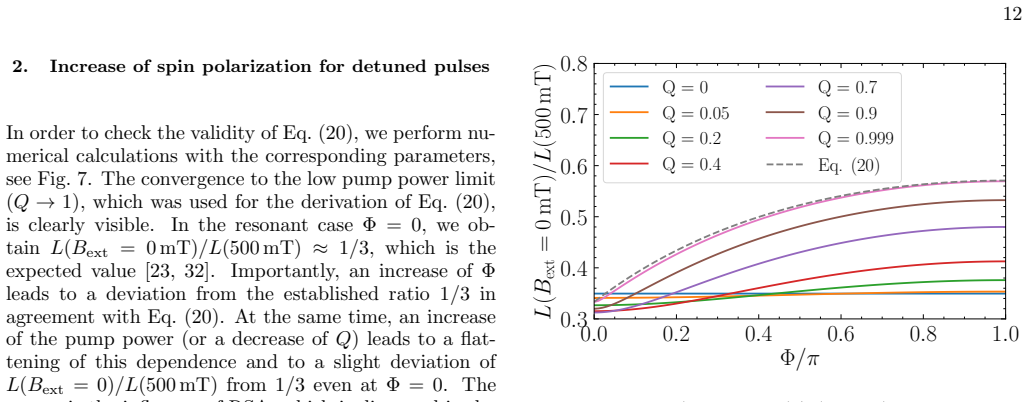
Increase of spin polarization for detuned pulses In order to check the validity of Eq. (20), we perform nu- merical calculations with the corresponding parameters, see Fig. 7. The convergence to the low pump power limit (Q→ 1), which was used for the derivation of Eq. (20), is clearly visible. In the resonant case Φ = 0, we ob- tain L(Bext = 0 mT)/L(500 m...
-
[5]
M. I. Dyakonov, ed., Spin physics in semiconductors (Springer International Publishing AG, 2017)
work page 2017
-
[6]
F. Meier and B. P. Zakharchenya, eds., Optical Orienta- tion (North Holland, Amsterdam, 1984)
work page 1984
Show all 52 references
-
[7]
D. D. Awschalom, J. M. Halbout, S. von Molnar, T. Siegrist, and F. Holtzberg, Dynamic Spin Organiza- tion in Dilute Magnetic Systems, Phys. Rev. Lett. 55, 1128 (1985)
1985
-
[8]
N. I. Zheludev, M. A. Brummell, R. T. Harley, A. Ma- linowski, S. V. Popov, D. E. Ashenford, and B. Lunn, Giant specular inverse Faraday effect in Cd 0.6Mn0.4Te, Solid State Commun. 89, 823 (1994)
1994
-
[9]
V. V. Belykh, E. Evers, D. R. Yakovlev, F. Fobbe, A. Greilich, and M. Bayer, Extended pump-probe Fara- day rotation spectroscopy of the submicrosecond elec- tron spin dynamics in n-type GaAs, Phys. Rev. B 94, 241202(R) (2016)
2016
-
[10]
J. M. Kikkawa and D. D. Awschalom, Resonant Spin Amplification inn-Type GaAs, Phys. Rev. Lett.80, 4313 (1998)
1998
-
[11]
I. A. Yugova, M. M. Glazov, D. R. Yakovlev, A. A. Sokolova, and M. Bayer, Coherent spin dynamics of elec- trons and holes in semiconductor quantum wells and quantum dots under periodical optical excitation: Reso- nant spin amplification versus spin mode locking, Phys. Rev. B 85...
2012
-
[13]
Heisterkamp, E
F. Heisterkamp, E. A. Zhukov, A. Greilich, D. R. Yakovlev, V. L. Korenev, A. Pawlis, and M. Bayer, Lon- gitudinal and transverse spin dynamics of donor-bound electrons in fluorine-doped ZnSe: Spin inertia versus Hanle effect, Phys. Rev. B 91, 235432 (2015)
2015
-
[15]
F. Fras, B. Eble, P. Desfonds, F. Bernardot, C. Testelin, M. Chamarro, A. Miard, and A. Lemaˆ ıtre, Hole-spin ini- tialization and relaxation times in InAs/GaAs quantum dots, Phys. Rev. B 84, 125431 (2011)
2011
-
[16]
E. A. Zhukov, E. Kirstein, D. S. Smirnov, D. R. Yakovlev, M. M. Glazov, D. Reuter, A. D. Wieck, M. Bayer, and A. Greilich, Spin inertia of resident and photoexcited car- riers in singly charged quantum dots, Phys. Rev. B 98, 121304(R) (2018)
2018
-
[17]
M. M. Glazov, Electron & Nuclear Spin Dynamics in Semiconductor Nanostructures (Oxford University Press, 2018)
2018
-
[18]
D. S. Smirnov, E. A. Zhukov, E. Kirstein, D. R. Yakovlev, D. Reuter, A. D. Wieck, M. Bayer, A. Greilich, and M. M. Glazov, Theory of spin inertia in singly charged quantum dots, Phys. Rev. B 98, 125306 (2018)
2018
-
[19]
E. A. Zhukov, D. R. Yakovlev, M. Bayer, G. Karczewski, T. Wojtowicz, and J. Kossut, Spin coherence of two- dimensional electron gas in CdTe/(Cd,Mg)Te quantum wells, Phys. Status Solidi B 243, 878 (2006)
2006
-
[20]
Greilich, A
A. Greilich, A. Pawlis, F. Liu, O. A. Yugov, D. R. Yakovlev, K. Lischka, Y. Yamamoto, and M. Bayer, Spin dephasing of fluorine-bound electrons in ZnSe, Phys. Rev. B 85, 121303(R) (2012)
2012
-
[21]
Dahbashi, J
R. Dahbashi, J. H¨ ubner, F. Berski, K. Pierz, and M. Oestreich, Optical Spin Noise of a Single Hole Spin Localized in an (InGa)As Quantum Dot, Phys. Rev. Lett. 112, 156601 (2014)
2014
-
[22]
S. V. Poltavtsev, I. I. Ryzhov, M. M. Glazov, G. G. Koz- lov, V. S. Zapasskii, A. V. Kavokin, P. G. Lagoudakis, D. S. Smirnov, and E. L. Ivchenko, Spin noise spec- troscopy of a single quantum well microcavity, Phys. Rev. 13 B 89, 081304(R) (2014)
2014
-
[23]
E. L. Ivchenko, Optical Spectroscopy of Semiconductor Nanostructures (Alpha Science, Harrow UK, 2005)
2005
-
[24]
M. M. Glazov, Coherent spin dynamics of electrons and excitons in nanostructures (a review), Phys. Solid State 54, 1 (2012)
2012
-
[25]
I. A. Yugova, M. M. Glazov, E. L. Ivchenko, and A. L. Efros, Pump-probe Faraday rotation and ellipticity in an ensemble of singly charged quantum dots, Phys. Rev. B 80, 104436 (2009)
2009
-
[26]
E. A. Zhukov, D. R. Yakovlev, M. Bayer, M. M. Glazov, E. L. Ivchenko, G. Karczewski, T. Wojtowicz, and J. Kos- sut, Spin coherence of a two-dimensional electron gas induced by resonant excitation of trions and excitons in CdTe/(Cd,Mg)Te quantum wells, Phys. Rev. B 76, 205310 (2007)
2007
-
[27]
I. A. Merkulov, A. L. Efros, and M. Rosen, Electron spin relaxation by nuclei in semiconductor quantum dots, Phys. Rev. B 65, 205309 (2002)
2002
-
[28]
Schulten and P
K. Schulten and P. G. Wolynes, Semiclassical description of electron spin motion in radicals including the effect of electron hopping, The Journal of Chemical Physics 68, 3292 (1978)
1978
-
[29]
Stanek, C
D. Stanek, C. Raas, and G. S. Uhrig, From quantum- mechanical to classical dynamics in the central-spin model, Phys. Rev. B 90, 064301 (2014)
2014
-
[30]
Esser, E
A. Esser, E. Runge, R. Zimmermann, and W. Lang- bein, Photoluminescence and radiative lifetime of trions in GaAs quantum wells, Phys. Rev. B 62, 8232 (2000)
2000
-
[31]
Glasenapp, D
P. Glasenapp, D. S. Smirnov, A. Greilich, J. Hackmann, M. M. Glazov, F. B. Anders, and M. Bayer, Spin noise of electrons and holes in (In,Ga)As quantum dots: Experi- ment and theory, Phys. Rev. B 93, 205429 (2016)
2016
-
[32]
Testelin, F
C. Testelin, F. Bernardot, B. Eble, and M. Chamarro, Hole–spin dephasing time associated with hyperfine in- teraction in quantum dots, Phys. Rev. B 79, 195440 (2009)
2009
-
[33]
Greilich, R
A. Greilich, R. Oulton, E. A. Zhukov, I. A. Yugova, D. R. Yakovlev, M. Bayer, A. Shabaev, A. L. Efros, I. A. Merkulov, V. Stavarache, D. Reuter, and A. Wieck, Optical Control of Spin Coherence in Singly Charged (In, Ga)As/GaAs Quantum Dots, Phys. Rev. Lett. 96, 227401 (2006)
2006
-
[34]
A. V. Kimel, A. Kirilyuk, P. A. Usachev, R. V. Pisarev, A. M. Balbashov, and T. Rasing, Ultrafast non-thermal control of magnetization by instantaneous photomagnetic pulses, Nature 435, 655 (2005)
2005
-
[35]
I. I. Ryzhov, G. G. Kozlov, D. S. Smirnov, M. M. Glazov, Y. P. Efimov, S. A. Eliseev, V. A. Lovtcius, V. V. Petrov, K. V. Kavokin, A. V. Kavokin, and V. S. Zapasskii, Spin noise explores local magnetic fields in a semiconductor, Sci. Rep. 6, 21062 (2016)
2016
-
[36]
M. Y. Petrov, I. V. Ignatiev, S. V. Poltavtsev, A. Greilich, A. Bauschulte, D. R. Yakovlev, and M. Bayer, Effect of thermal annealing on the hyperfine interaction in InAs/GaAs quantum dots, Phys. Rev. B 78, 045315 (2008)
2008
-
[37]
Varwig, A
S. Varwig, A. Schwan, D. Barmscheid, C. M¨ uller, A. Greilich, I. A. Yugova, D. R. Yakovlev, D. Reuter, A. D. Wieck, and M. Bayer, Hole spin precession in a (In,Ga)As quantum dot ensemble: From resonant spin amplification to spin mode locking, Phys. Rev. B 86, 075321 (2012)
2012
-
[38]
E. A. Zhukov, O. A. Yugov, I. A. Yugova, D. R. Yakovlev, G. Karczewski, T. Wojtowicz, J. Kossut, and M. Bayer, Resonant spin amplification of resident elec- trons in CdTe/(Cd,Mg)Te quantum wells subject to tilted magnetic fields, Phys. Rev. B 86, 245314 (2012)
2012
-
[39]
Greilich, A
A. Greilich, A. Shabaev, D. R. Yakovlev, A. L. Efros, I. A. Yugova, D. Reuter, A. D. Wieck, and M. Bayer, Nuclei- Induced Frequency Focusing of Electron Spin Coherence, Science 317, 1896 (2007)
2007
-
[40]
Greilich, S
A. Greilich, S. Spatzek, I. A. Yugova, I. A. Akimov, D. R. Yakovlev, A. L. Efros, D. Reuter, A. D. Wieck, and M. Bayer, Collective single-mode precession of electron spins in an ensemble of singly charged (In,Ga)As/GaAs quantum dots, Phys. Rev. B 79, 201305(R) (2009)
2009
-
[41]
Barnes and S
E. Barnes and S. E. Economou, Electron-Nuclear Dy- namics in a Quantum Dot under Nonunitary Electron Control, Phys. Rev. Lett. 107, 047601 (2011)
2011
-
[42]
M. Y. Petrov and S. V. Yakovlev, Comparison of quantum-mechanical and semiclassical approaches for an analysis of spin dynamics in quantum dots, Journal of Experimental and Theoretical Physics 115, 326 (2012)
2012
-
[43]
M. M. Glazov, I. A. Yugova, and A. L. Efros, Electron spin synchronization induced by optical nuclear magnetic resonance feedback, Phys. Rev. B 85, 041303(R) (2012)
2012
-
[44]
S. E. Economou and E. Barnes, Theory of dynamic nu- clear polarization and feedback in quantum dots, Phys. Rev. B 89, 165301 (2014)
2014
-
[45]
Beugeling, G
W. Beugeling, G. S. Uhrig, and F. B. Anders, Quantum model for mode locking in pulsed semiconductor quan- tum dots, Phys. Rev. B 94, 245308 (2016)
2016
-
[46]
Beugeling, G
W. Beugeling, G. S. Uhrig, and F. B. Anders, Influence of the nuclear Zeeman effect on mode locking in pulsed semiconductor quantum dots, Phys. Rev. B 96, 115303 (2017)
2017
-
[47]
J¨ aschke, A
N. J¨ aschke, A. Fischer, E. Evers, V. V. Belykh, A. Greilich, M. Bayer, and F. B. Anders, Nonequilibrium nuclear spin distribution function in quantum dots sub- ject to periodic pulses, Phys. Rev. B 96, 205419 (2017)
2017
-
[48]
Schering, J
P. Schering, J. H¨ udepohl, G. S. Uhrig, and B. Fauseweh, Nuclear frequency focusing in periodically pulsed semi- conductor quantum dots described by infinite classical central spin models, Phys. Rev. B 98, 024305 (2018)
2018
-
[49]
Kleinjohann, E
I. Kleinjohann, E. Evers, P. Schering, A. Greilich, G. S. Uhrig, M. Bayer, and F. B. Anders, Magnetic field de- pendence of the electron spin revival amplitude in peri- odically pulsed quantum dots, Phys. Rev. B 98, 155318 (2018)
2018
-
[50]
Ahnert and M
K. Ahnert and M. Mulansky, Odeint Solving Ordinary Differential Equations in C++, AIP Conf. Proc. 1389, 1586 (2011)
2011
-
[51]
Greilich, D
A. Greilich, D. R. Yakovlev, A. Shabaev, A. L. Efros, I. A. Yugova, R. Oulton, V. Stavarache, D. Reuter, A. Wieck, and M. Bayer, Mode Locking of Electron Spin Coherences in Quantum Dots, Science 313, 341 (2006)
2006
-
[52]
Shabaev, A
A. Shabaev, A. L. Efros, D. Gammon, and I. A. Merkulov, Optical readout and initialization of an elec- tron spin in a single quantum dot, Phys. Rev. B 68, 201305(R) (2003)
2003
Reviewed August 14, 2026 · model on record in the stance chip above.
Discussion (0). Continue with ORCID to comment.