Giant Planet Atmospheres
Pith reviewed 2026-06-30 02:27 UTC · model grok-4.3
The pith
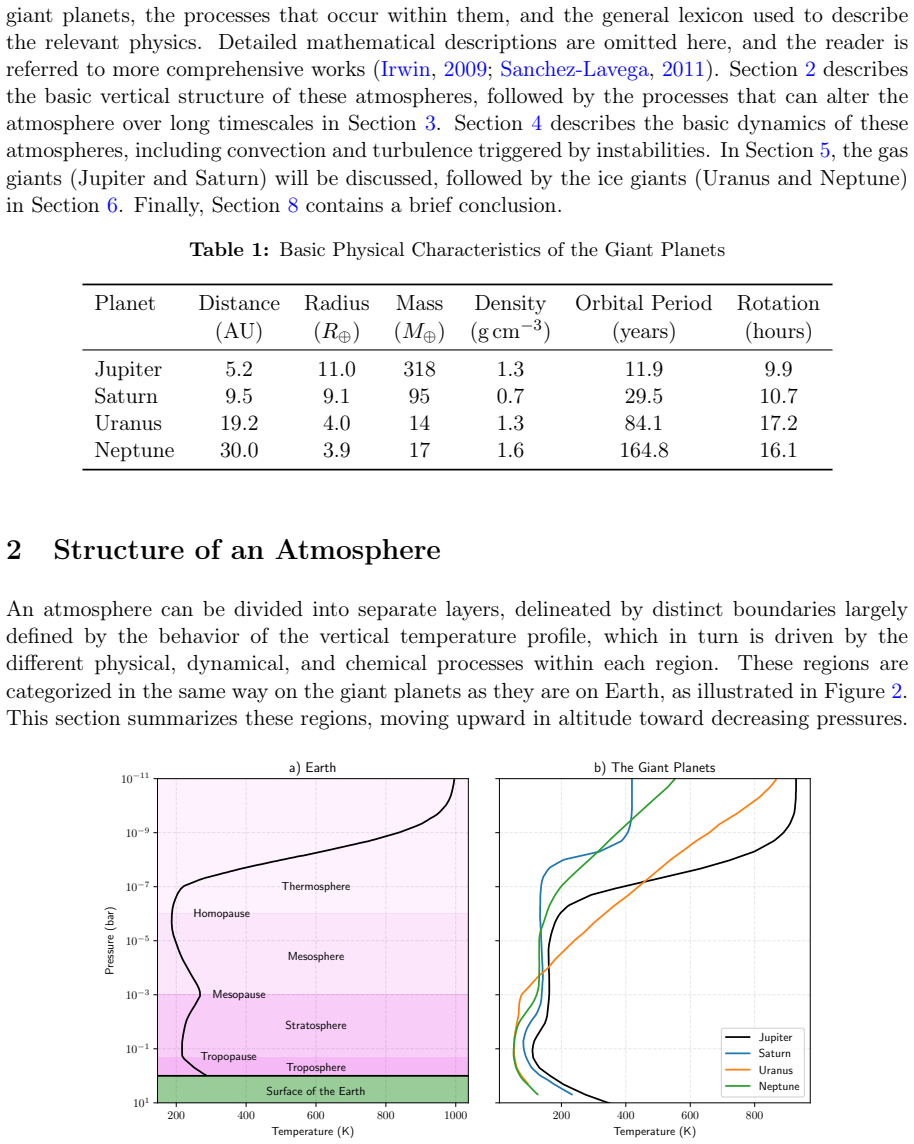
Giant planet atmospheres are divided into layers by temperature gradients, with convection cooling the troposphere, UV heating the stratosphere, and auroral processes energizing the upper atmosphere.
A machine-rendered reading of the paper's core claim, the machinery that carries it, and where it could break.
Core claim
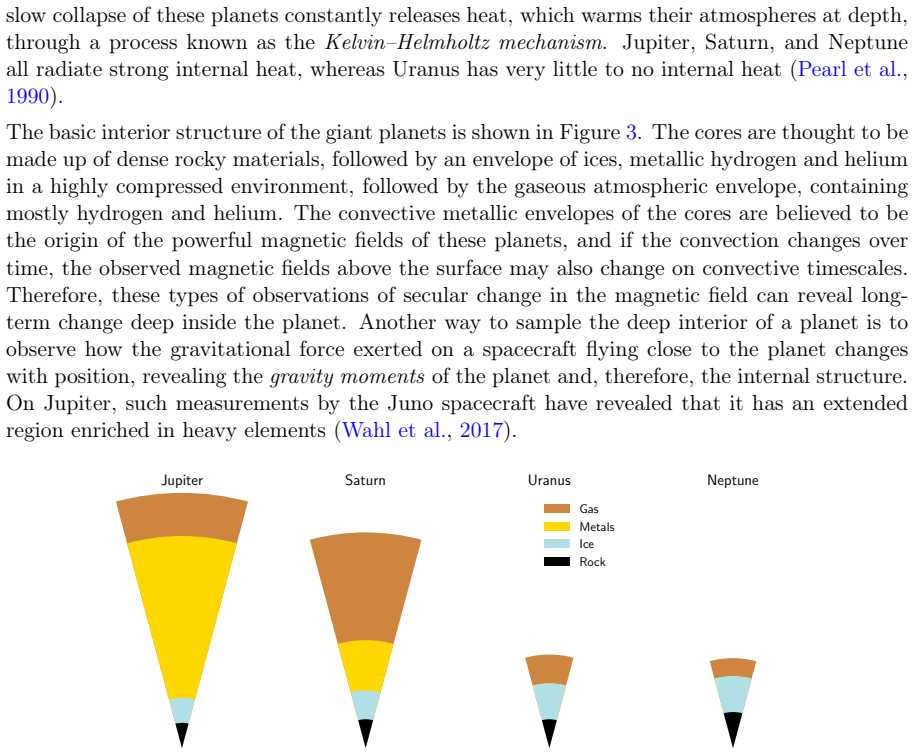
The giant planets have atmospheres dominated by hydrogen and helium that can be divided into the troposphere, where temperatures decrease with altitude as convection carries internal heat upward; the stratosphere, where temperatures increase due to ultraviolet heating and photochemistry; an ill-defined mesosphere; and the upper atmosphere, heated by solar extreme ultraviolet radiation and auroral processes. Internal heat and solar input, combined with rapid rotation, establish global circulation, waves, and instabilities.
What carries the argument
Atmospheric layers defined by temperature gradients and their associated heating mechanisms.
If this is right
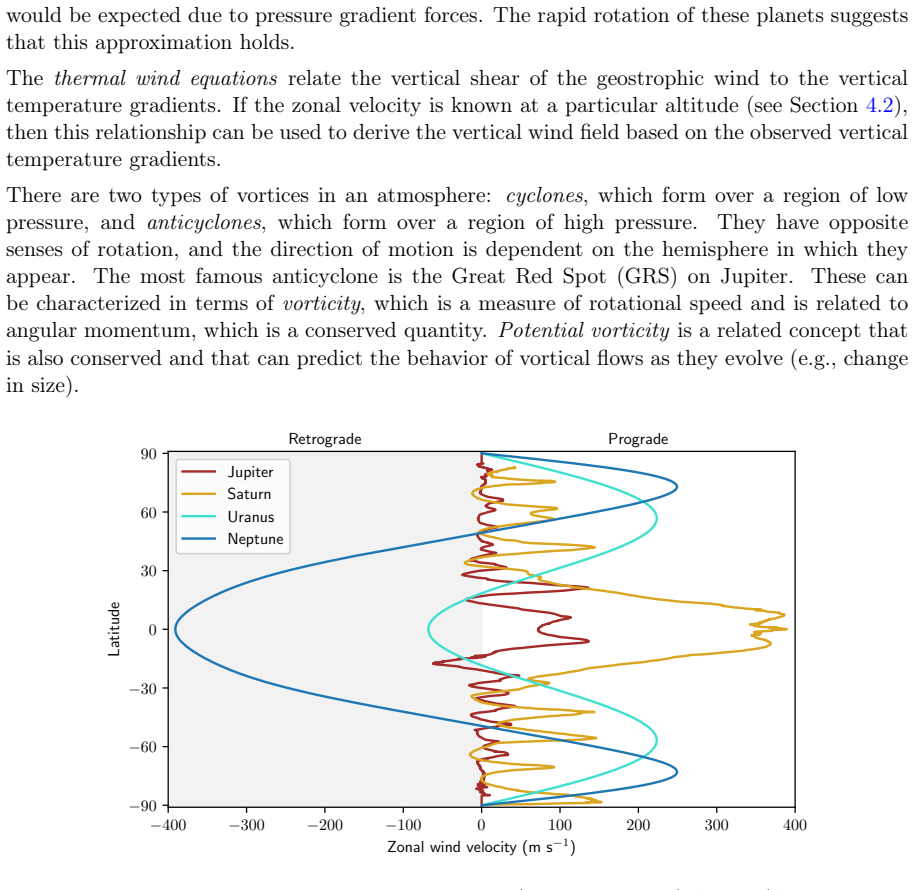
- Energy from internal heat and the Sun plus fast rotation drives global circulation patterns and atmospheric waves.
- Condensation of water and other volatiles produces clouds in the troposphere.
- Ultraviolet-driven photochemistry in the stratosphere generates hydrocarbons.
- Auroral heating connects the upper atmosphere to the planetary magnetosphere and space environment.
Where Pith is reading between the lines
- The same temperature-gradient regimes could be tested on hydrogen-rich exoplanet atmospheres using transmission spectroscopy.
- Improved remote sensing of the mesosphere region might clarify whether it is truly absent or simply hard to observe.
- The lack of a solid surface means vertical mixing and heat transport operate differently than on terrestrial planets.
Load-bearing premise
The description assumes the standard layered division of atmospheres and the established causes of heating in each layer are accurate without presenting new measurements.
What would settle it
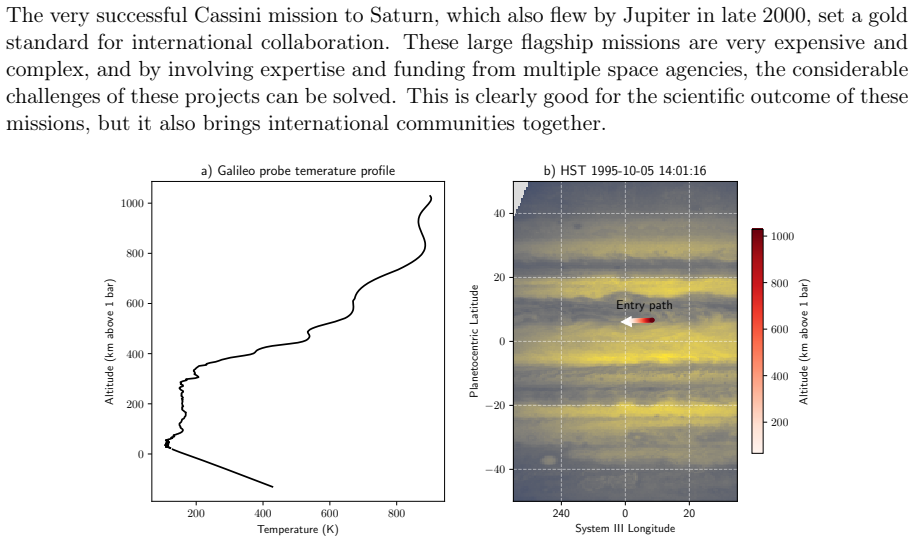
Direct temperature measurements from an entry probe showing temperature increasing with height throughout the troposphere or decreasing throughout the stratosphere would contradict the claimed structure.
Figures
read the original abstract
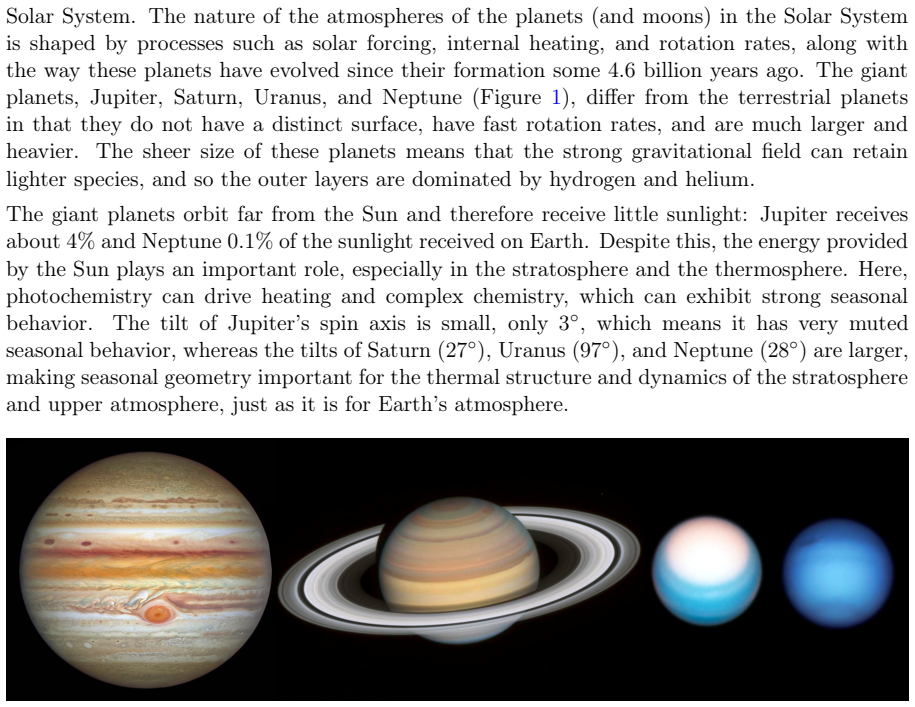
The giant planets, Jupiter, Saturn, Uranus, and Neptune, all have vibrant and dynamic atmospheres. The iconic belt--zone structure of Jupiter, together with the Great Red Spot, is instantly recognizable. Saturn, with its dramatic ring system and more muted atmosphere, is a formidable jewel in the Solar System. In the outer reaches, the pale blue Uranus and Neptune are found, worlds about which ultimately very little is known. The atmospheres of these planets are dominated by hydrogen and helium, and unlike the Earth, they do not have a solid surface. These differences generate inherently different types of atmospheres, but there are also similarities. For example, the condensation of water, which forms the familiar clouds on Earth, also occurs on the giant planets. Broadly speaking, the atmosphere can be divided into different regimes defined by their temperature gradients. In the troposphere, where weather occurs, the temperatures decrease as a function of increasing altitude as convection moves internal heat upward; the rising material expands and cools. Above this region lies the stratosphere, defined by a positive temperature gradient, where hydrocarbons are heated by ultraviolet radiation from the Sun (analogous to ozone heating in the terrestrial stratosphere), which also drives substantial photochemistry. This is followed by a mesosphere that cools as a function of altitude, a region that is ill-defined at the giant planets. Finally, the upper atmosphere connects to the space environment and is heated by both solar extreme ultraviolet light and auroral processes. The giant planets are energized both by internal heat and by solar heating. These energy inputs, along with the fast rotation rates of these planets, drive dynamics by establishing global circulation patterns and generating both waves and instabilities. [...]
Editorial analysis
A structured set of objections, weighed in public.
Referee Report
Summary. The manuscript provides a qualitative overview of the atmospheres of the giant planets (Jupiter, Saturn, Uranus, Neptune), noting their H/He dominance, lack of solid surface, water condensation, and division into atmospheric layers defined by temperature gradients: troposphere (negative lapse rate from convection of internal heat), stratosphere (positive gradient from solar UV heating and photochemistry), mesosphere (cooling with altitude, noted as ill-defined), and upper atmosphere (heated by solar EUV and auroral processes). It briefly mentions dynamics driven by internal/solar energy and rapid rotation.
Significance. If the descriptions hold, the significance is low: the content restates long-established consensus in planetary science without new observations, quantitative models, derivations, data reductions, or falsifiable predictions. No machine-checked proofs, reproducible code, or parameter-free results are present.
minor comments (2)
- [Abstract] Abstract: the provided text ends abruptly with '[...]', leaving the discussion of dynamics and energy inputs incomplete.
- No equations, tables, or figures are referenced or presented, consistent with a purely descriptive summary but limiting any quantitative assessment.
Simulated Author's Rebuttal
We thank the referee for their review. The manuscript is a qualitative overview of established concepts in giant planet atmospheric science, and we address the assessment of its significance below.
read point-by-point responses
-
Referee: If the descriptions hold, the significance is low: the content restates long-established consensus in planetary science without new observations, quantitative models, derivations, data reductions, or falsifiable predictions. No machine-checked proofs, reproducible code, or parameter-free results are present. REFEREE RECOMMENDATION: reject
Authors: We agree that the manuscript synthesizes long-established knowledge on the H/He-dominated atmospheres, temperature-defined layers (troposphere, stratosphere, mesosphere, upper atmosphere), photochemistry, condensation processes, and dynamics driven by internal heat, solar input, and rapid rotation. It contains no new observations, models, or quantitative predictions. The purpose is to provide a concise, accessible description of these features for readers new to the subject, rather than to advance original research. We do not plan to modify the manuscript to include novel content. revision: no
Circularity Check
No significant circularity detected
full rationale
The manuscript is a purely descriptive review summarizing established atmospheric layering (troposphere, stratosphere, mesosphere, thermosphere) and heating mechanisms for the giant planets. No equations, derivations, parameter fits, or quantitative predictions are advanced anywhere in the text. All attributions match long-standing consensus models and do not reduce to any self-referential construction, self-citation load-bearing step, or fitted-input renaming. The argument is therefore self-contained against external benchmarks with no circular steps present.
Axiom & Free-Parameter Ledger
Reference graph
Works this paper leans on
-
[1]
Derived Products for `Temporal variability of the northern infrared Aurora of Jupiter as captured by
Melin, Henrik , date-added =. Derived Products for `Temporal variability of the northern infrared Aurora of Jupiter as captured by. doi:10.5281/zenodo.16535636 , publisher =
-
[2]
Data for Jupiter programme \#3665 [Dataset] , year = 2024, bdsk-url-1 =
Melin, Henrik , date-added =. Data for Jupiter programme \#3665 [Dataset] , year = 2024, bdsk-url-1 =. doi:10.17909/zp4p-0c93 , month = aug, publisher =
-
[3]
doi:10.1016/j.icarus.2015.12.048 , journal =
-
[4]
doi:10.1007/s11214-014-0094-y , journal =
-
[5]
doi:10.1038/s41550-024-02389-3 , journal =
-
[6]
AAS/Division for Planetary Sciences Meeting Abstracts \#55 , date-added =
-
[7]
JWST Calibration Pipeline , url =
Bushouse, Howard and Eisenhamer, Jonathan and Dencheva, Nadia and Davies, James and Greenfield, Perry and Morrison, Jane and Hodge, Phil and Simon, Bernie and Grumm, David and Droettboom, Michael and Slavich, Edward and Sosey, Megan and Pauly, Tyler and Miller, Todd and Jedrzejewski, Robert and Hack, Warren and Davis, David and Crawford, Steven and Law, D...
-
[8]
doi:10.1029/2025JA033868 , eid =
Journal of Geophysical Research (Space Physics) , month = may, number =. doi:10.1029/2025JA033868 , eid =
-
[9]
and Clark, George , date-added =
Gershman, Daniel J. and Clark, George , date-added =. Predictions of Auroral Electron Precipitation and Joule Heating at Uranus , url =. Geophysical Research Letters , keywords =. 2025 , bdsk-url-1 =. doi:https://doi.org/10.1029/2024GL114470 , eprint =
-
[10]
doi:10.1029/2024GL112001 , journal =
-
[11]
doi:10.1038/s41550-025-02492-z , journal =
-
[12]
doi:10.1029/2021JE007169 , eid =
Journal of Geophysical Research (Planets) , keywords =. doi:10.1029/2021JE007169 , eid =
-
[13]
doi:10.1007/s11214-014-0042-x , journal =
-
[14]
doi:10.1029/2021JA030224 , eid =
Journal of Geophysical Research (Space Physics) , keywords =. doi:10.1029/2021JA030224 , eid =
-
[15]
doi:10.1029/2005JE002411 , eid =
Journal of Geophysical Research (Planets) , keywords =. doi:10.1029/2005JE002411 , eid =
-
[16]
doi:10.1016/j.pss.2015.03.008 , eprint =
, keywords =. doi:10.1016/j.pss.2015.03.008 , eprint =
-
[17]
doi:10.1038/s41467-025-58984-z , eid =
Nature Communications , keywords =. doi:10.1038/s41467-025-58984-z , eid =
-
[18]
doi:10.1038/s41550-025-02507-9 , journal =
-
[19]
doi:10.1088/0953-4075/27/23/018 , journal =
-
[20]
M Danko and J. Orsz. Electron Induced Fluorescence Spectra of Methane , url =. WDS'11 Proceedings of Contributed Papers, Part II , date-added =. 2011 , bdsk-url-1 =
2011
-
[21]
doi:10.1002/2015JA021272 , journal =
-
[22]
doi:10.1029/2024GL113751 , journal =
-
[23]
doi:10.1029/2021JE00695410.1002/essoar.10507057.1 , eid =
Journal of Geophysical Research (Planets) , keywords =. doi:10.1029/2021JE00695410.1002/essoar.10507057.1 , eid =
-
[24]
doi:10.1029/GL004i002p00065 , journal =
-
[25]
arXiv , author =:2503.19153 , journal =
doi:10.3847/PSJ/adc09b , eid =. arXiv , author =:2503.19153 , journal =
-
[26]
doi:10.1029/2023JA032122 , eid =
-
[27]
An overview of the NIRSPEC upgrade for the Keck II telescope
Ground-based and Airborne Instrumentation for Astronomy VII , date-added =. doi:10.1117/12.2312266 , editor =. arXiv , author =:1808.06024 , keywords =
work page internal anchor Pith review Pith/arXiv arXiv doi:10.1117/12.2312266
-
[28]
doi:10.1016/j.icarus.2024.116453 , eid =
, keywords =. doi:10.1016/j.icarus.2024.116453 , eid =
-
[29]
arXiv , author =:2402.19069 , journal =
doi:10.1029/2024JA032613 , eid =. arXiv , author =:2402.19069 , journal =
-
[30]
doi:10.1029/2003JE002230 , eid =
Journal of Geophysical Research (Planets) , keywords =. doi:10.1029/2003JE002230 , eid =
-
[31]
doi:10.1051/0004-6361/202348634 , eid =
, keywords =. doi:10.1051/0004-6361/202348634 , eid =
-
[32]
doi:10.1016/j.jqsrt.2007.11.006 , journal =
-
[33]
doi:10.1002/2014JA020514 , journal =
-
[34]
doi:10.1029/2021JA02988610.1002/essoar.10507765.1 , eid =
Journal of Geophysical Research (Space Physics) , keywords =. doi:10.1029/2021JA02988610.1002/essoar.10507765.1 , eid =
-
[35]
doi:10.1029/2009JA014051 , eid =
Journal of Geophysical Research (Space Physics) , keywords =. doi:10.1029/2009JA014051 , eid =
-
[36]
h3ppy: An open-source Python package for modelling and fitting H _3^+ spectra , url =
Henrik Melin , date-added =. h3ppy: An open-source Python package for modelling and fitting H _3^+ spectra , url =. 2025 , bdsk-url-1 =. doi:10.21105/joss.07536 , journal =
-
[37]
doi:10.1029/2006GL027375 , eid =
, keywords =. doi:10.1029/2006GL027375 , eid =
-
[38]
doi:10.1016/j.icarus.2010.06.039 , eprint =
, keywords =. doi:10.1016/j.icarus.2010.06.039 , eprint =
-
[39]
doi:10.1007/s11214-014-0040-z , journal =
-
[40]
doi:10.1038/s41550-019-0743-x , journal =
-
[41]
doi:10.1016/j.icarus.2016.06.023 , journal =
-
[42]
arXiv , author =:2406.08133 , journal =
doi:10.1029/2024JE008299 , eid =. arXiv , author =:2406.08133 , journal =
-
[43]
doi:10.1029/2024JA032723 , eid =
Journal of Geophysical Research (Space Physics) , keywords =. doi:10.1029/2024JA032723 , eid =
-
[44]
arXiv , author =:2211.05253 , journal =
doi:10.1016/j.icarus.2022.115328 , eid =. arXiv , author =:2211.05253 , journal =
-
[45]
doi:10.1016/j.pss.2021.105178 , eid =
, keywords =. doi:10.1016/j.pss.2021.105178 , eid =
-
[46]
doi:10.1029/2024GL111623 , journal =
-
[47]
doi:10.1029/2024JA032891 , journal =
-
[49]
doi:10.1038/323605a0 , journal =
-
[50]
doi:10.1029/JA095iA12p20967 , journal =
-
[51]
doi:10.1126/science.212.4491.239 , journal =
-
[52]
doi:10.1038/280794a0 , journal =
-
[53]
doi:10.1038/ncomms10231 , eid =
Nature Communications , month = dec, pages =. doi:10.1038/ncomms10231 , eid =
-
[54]
arXiv , author =:2410.02468 , journal =
doi:10.1029/2024JE008415 , eid =. arXiv , author =:2410.02468 , journal =
-
[55]
doi:10.1016/j.icarus.2017.12.041 , eprint =
, keywords =. doi:10.1016/j.icarus.2017.12.041 , eprint =
-
[56]
doi:10.1017/9781316227220.013 , editor =
Saturn in the 21st Century , date-added =. doi:10.1017/9781316227220.013 , editor =
-
[57]
Journal of the British Astronomical Association , month = oct, pages =
-
[58]
doi:10.1051/0004-6361/202244200 , eid =
, keywords =. doi:10.1051/0004-6361/202244200 , eid =
-
[59]
doi:10.1098/rspa.1923.0103 , journal =
-
[60]
doi:10.1007/s00159-009-0021-5 , journal =
-
[61]
doi:10.1038/nature05438 , journal =
-
[62]
doi:10.1126/science.247.4946.1061 , journal =
-
[63]
A Hexagon in Saturn's Northern Stratosphere Surrounding the Emerging Summertime Polar Vortex
doi:10.1038/s41467-018-06017-3 , eid =. arXiv , author =:1809.00572 , journal =
work page internal anchor Pith review Pith/arXiv arXiv doi:10.1038/s41467-018-06017-3
-
[64]
doi:10.1126/science.247.4947.1206 , journal =
-
[65]
doi:10.1016/0019-1035(88)90075-9 , journal =
-
[66]
doi:10.1016/j.icarus.2013.11.035 , eprint =
, keywords =. doi:10.1016/j.icarus.2013.11.035 , eprint =
-
[67]
arXiv , author =:2305.06787 , journal =
doi:10.1051/0004-6361/202346621 , eid =. arXiv , author =:2305.06787 , journal =
-
[68]
arXiv , author =:2112.00033 , journal =
doi:10.3847/PSJ/ac5aa4 , eid =. arXiv , author =:2112.00033 , journal =
-
[69]
doi:10.1016/j.icarus.2011.05.028 , journal =
-
[70]
doi:10.1029/JA092iA13p15093 , journal =
-
[71]
arXiv , author =:2111.15494 , journal =
doi:10.1098/rsta.2019.0476 , eid =. arXiv , author =:2111.15494 , journal =
-
[72]
doi:10.1029/JA092iA13p14987 , journal =
-
[73]
doi:10.1006/icar.1998.6000 , journal =
-
[74]
doi:10.1038/nature12131 , journal =
-
[75]
arXiv , author =:2006.11367 , journal =
doi:10.1098/rsta.2019.0477 , eid =. arXiv , author =:2006.11367 , journal =
-
[76]
doi:10.1126/science.233.4759.70 , journal =
-
[77]
doi:10.1029/JA092iA13p15011 , journal =
-
[78]
arXiv , author =:1911.12830 , journal =
doi:10.3847/1538-3881/ab5dc7 , eid =. arXiv , author =:1911.12830 , journal =
-
[79]
doi:10.1098/rsta.2019.0489 , eid =
Philosophical Transactions of the Royal Society of London Series A , month = dec, number =. doi:10.1098/rsta.2019.0489 , eid =
-
[80]
Neptune and Triton , date-added =
-
[81]
Uranus , date-added =
discussion (0)
Sign in with ORCID, Apple, or X to comment. Anyone can read and Pith papers without signing in.