REVIEW 3 major objections 5 minor 80 references
Resource-Efficient Quantum Optimization via Higher-Order Encoding
T0 review · 3 major / 5 minor · reviewed 2026-08-03 · deepseek-v4-flash
Pith's one-line read Higher-order binary encodings of optimization problems use logarithmically fewer qubits than QUBO one-hot encodings, and after compilation to one- and two-qubit gates cut CNOT counts by at least 89.6% across three problem classes.
desk verdict Real per-layer resource savings and a genuinely useful HUBO construction pipeline; the headline '89.6% CNOT reduction' rests on best-of-100 QAOA minima and per-encoding lambda tuning, so treat it as optimistic rather than established. read the letter →
The pith
A machine-rendered reading of the paper's core claim, the machinery that carries it, and where it could break.
The reading
What carries the argument
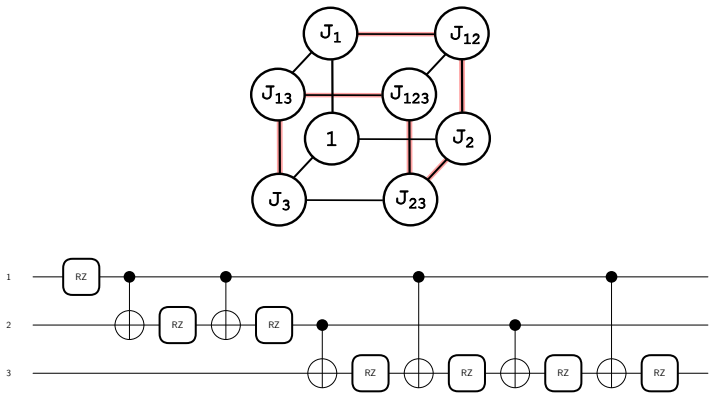
The central object is the value-index bit encoding: each variable i is stored in d = ⌈log2 m⌉ qubits and the projector |v⟩⟨v|_i is expanded as a sum over products of Pauli-Z operators, producing a HUBO Hamiltonian whose interacting terms act on up to 2d qubits. Two constructions carry the argument: the Walsh-Hadamard transform that converts the classical cost coefficients c1(i,v) and c2(i,j,v,w) into the HUBO coefficients J_i,S and J_{ij,S1,S2} in O(n^2 m^6) time for quadratic objectives, and the Gray-code hypercube traversal that compiles all higher-order Z-products of a d-qubit block into a circuit with one CNOT and one RZ per term — the minimal count, replacing the naive 2^d(d−2)+2 CNOTs
What would settle it
Recompute the minimum total CNOTs needed to reach the target approximation ratio using the median (not the best) of the 100 QAOA runs for both encodings, with identical penalty multipliers and identical parameter-optimization budgets; if the median saving for any tested instance falls below 89.6%, the headline savings are an artifact of selection rather than of the encoding.
Extended reading notes
Core claim
For any COP with n variables each taking one of m values, the authors construct a HUBO Hamiltonian whose ground state encodes the optimal solution, using d = ⌈log2 m⌉ qubits per variable. The bitstrings of the d qubits are read as value indices, so the one-hot penalty needed in QUBO disappears. Coefficients of the Pauli-Z expansion are obtained from the classical cost coefficients by a Walsh-Hadamard transform, with polynomial numerical complexity. The cost unitary for QAOA is built from the commuting diagonal terms using a Gray-code parity scheme, so a term acting on t qubits costs one CNOT and one RZ gate after the first, and all terms of a 2d-qubit block are implemented with 2^(2d) − 2 CN
Load-bearing premise
The 89.6–100% total-CNOT savings to reach solution thresholds come from picking the best of 100 independent QAOA runs for each encoding, after tuning penalty multipliers separately for each encoding; if that best-of-100 selection or the penalty tuning favors HUBO, the saving is larger than a fair per-instance comparison would give.
Editorial extensions
If this is right
- Exponential qubit reduction: n·m qubits become n·⌈log2 m⌉, so problems with many values per variable (e.g., gate assignment with many gates) become representable.
- Deterministic per-layer gate savings: compiled per-layer CNOT counts for the tested instances are 68 vs 140 (GAP), 90 vs 132 (MkCS), and 38 vs 120 (IP) for HUBO versus QUBO.
- To reach fixed approximation-ratio thresholds (0.2–0.6), HUBO-QAOA uses 89.6–100% fewer CNOTs and 86.1–100% fewer RZ gates than QUBO-QAOA across all benchmarked sizes.
- At equal QAOA depth HUBO produces better average objective values in all three problems, e.g., 12.1 vs 15.8 minutes walking time for the GAP instance.
- The full cost unitary is implemented with only single- and two-qubit gates, so the method is directly compatible with current device constraints despite higher-order Hamiltonian terms.
Reading between the lines
- The exponential qubit saving is structural and does not depend on QAOA; it should transfer to any algorithm that needs to encode m-valued variables, including quantum annealing or imaginary-time evolution.
- The ≥89.6% CNOT figure combines a deterministic per-layer advantage with an empirical convergence-rate comparison; under a different optimizer or with fixed instead of per-encoding-tuned penalty weights, the total-gate saving could be smaller, though still nonzero.
- A natural stress test is to apply the same construction to problems with inequality constraints involving more than two variables, where QUBO typically requires extra slack variables; HUBO's direct projector penalties may avoid that overhead entirely.
- The Gray-code compilation implies a general rule: any set of Z-terms sharing the same qubit block can be implemented with one CNOT per new subset, so the reported per-layer counts are lower bounds for any Hamiltonian with similar locality.
Editorial analysis
A structured set of objections, weighed in public.
Referee Report
Summary. The paper proposes a systematic HUBO encoding for combinatorial optimization problems with n variables, each taking m values, using d = ceil(log2 m) qubits per variable instead of the n*m qubits of a one-hot QUBO encoding. The authors derive the Pauli expansion of the cost Hamiltonian via a Walsh-Hadamard transform (Eqs. 15-23), implement the diagonal cost unitary with Gray-code parity circuits using only CNOT and RZ gates, and prove O(n^2 m^2) per-layer scaling. They benchmark QUBO-QAOA and HUBO-QAOA on small Gate Assignment, Maximum k-Colorable Subgraph, and Integer Programming instances, reporting qubit counts, per-layer gate counts, and total gates needed to reach target approximation ratios. The central advertised result is that HUBO reduces qubit requirements and cuts total CNOT counts by at least 89.6% after compilation for all tested instances. An open-source package, PyHUBO, is released.
Significance. If the empirical claims hold, the paper offers a practical and broadly applicable alternative to QUBO for QAOA-style optimization: the qubit reduction from n*m to n*log m is clean and deterministic, the Pauli/Hadamard construction is parameter-free, and the Gray-code circuit synthesis is explicit and machine-checkable in principle. The per-layer deterministic gate counts in Table 2 show real, if modest, HUBO advantages (32-68% CNOT reduction for the three concrete instances), and the asymptotic scaling in Appendix C is useful. The 89.6-100% CNOT savings, however, are not a property of the encodings alone: they depend on empirical QAOA convergence, on best-of-100 run selection, and on per-encoding penalty tuning. Since that headline number is the paper's main selling point, its evidential basis needs to be substantially strengthened before the central claim can be accepted.
major comments (3)
- [Appendix D / Figs. 8, 11, 14] The headline 'at least 89.6% CNOT reduction after compilation' is not supported by the deterministic per-layer counts in Table 2, which show only 32-68% reductions. The larger figure comes from the number of layers needed to reach target thresholds, and the protocol in Appendix D states that for these benchmarks the authors 'ran the QAOA algorithm 100 times and picked the QAOA experiment with the lowest layer requirements.' The distribution of required layers is not reported, and the Lagrange multipliers lambda are tuned iteratively per encoding without a fixed protocol. If the two encodings have different run-to-run variance, the minimum over 100 runs can systematically favor one encoding (here HUBO) even when typical performance is similar. Please report medians/quantiles, success probabilities as a function of layers, and use a symmetric, pre-specified lambda-selection rule. Without t
- [Abstract and Sec. 2] The claim that HUBO 'exponentially reduces qubit requirements' is not accurate as stated. QUBO uses n*m qubits and HUBO uses n*ceil(log2 m) qubits, so the ratio is m/ceil(log2 m), which is polynomial in m. The correct statement is that the qubit count is reduced from linear to logarithmic in m. This wording appears in the abstract and is repeated in Sec. 2 and the Conclusion; it should be corrected to avoid overstating the advantage.
- [Sec. 2.3 / Fig. 14] The paper states that QUBO-QAOA was 'not computationally feasible' at the n=5, m=4 IP instance, which is only 20 qubits, while QUBO-QAOA is reportedly run on a 16-qubit reduced instance. This is surprising and unexplained: statevector simulation of 20 qubits is routine in PennyLane. If the largest IP instance is excluded for QUBO, then the percentage savings quoted for IP (94.4-100%) apply only to the smaller instances; the text should state this explicitly and justify the claimed infeasibility.
minor comments (5)
- [Sec. 1.1] The sentence 'without loss of generality, we only consider linear and quadratic COPs' is not literally WLOG; higher-order objectives are simply outside the scope. Please rephrase.
- [Sec. 1.2.2 / Eq. (16)] The binary-to-decimal mapping is ambiguous when values are indexed from 1 to m. Since a d-bit string decodes to 0..2^d-1, the penalty in Eq. (16) may be off by one. Please define the offset explicitly (e.g., value index v = binary + 1 or v = binary).
- [Appendix A] The stated complexity O(n^2 m^6) for computing quadratic HUBO coefficients overstates the cost of the Walsh-Hadamard transform. H^{⊗d} can be applied to a vector of length 2^d in O(d 2^d) time, so the per-pair cost is O(d^2 2^{2d}) = O(m^2 log^2 m), giving O(n^2 m^2 log^2 m) overall. Please correct or clarify the complexity model.
- [Appendix A, Eq. (28)] Typo: 'co + c1' should be 'c0 + c1'.
- [Table 2] Please state explicitly whether the reported QUBO gate counts include the one-hot penalty terms and any constraint penalties. This is important for reproducing the per-layer comparisons.
Circularity Check
No circularity found; HUBO construction is an exact transform of the classical objective and resource counts are explicit, parameter-independent circuit counts.
full rationale
The derivation chain is self-contained. The HUBO coefficients in Eq. (23) are obtained by substituting the Pauli expansion of projectors, Eqs. (18) and (21), into the objective Hamiltonian Eq. (15); no fitted or optimized constant is inserted into this step, and the same coefficients are used to build the circuits. The qubit-count comparison (n×m vs n⌈log2 m⌉) and the per-layer CNOT/RZ counts in Table 2 follow from the explicit encodings and circuit constructions, and the asymptotic scalings in App. C are derived for both encodings from the same worst-case coefficient counts. The Gray-code circuit optimization is attributed to external results [72,74], not to a self-citation, and the only self-reference, the PyHUBO package [31], is a software artifact rather than a load-bearing premise. The concern raised by a skeptic—that the 89.6–100% savings figures rest on 'the QAOA experiment with the lowest layer requirements' (App. D) and per-encoding lambda tuning—is an evidence-quality/statistical-validity issue about the representativeness of best-of-100 selection, not a circular reduction: the resource counts are not equal by construction to a fitted parameter, and the concrete per-layer counts independently support a resource advantage. No circular step is present.
Assumptions & free parameters
free parameters (3)
- Penalty multipliers lambda =
not reported (tuned per instance)
- QAOA variational parameters gamma, beta =
not reported (optimized per instance and layer)
- Target approximation ratios for scaling benchmarks =
0.50 (GAP), 0.20 (MkCS), 0.30 (IP)
assumptions (4)
- domain assumption Polynomial objective of a COP can be written as a sum of linear and quadratic terms (Eq. 1) without loss of generality.
- domain assumption Constraints can be enforced by adding lambda times a violation indicator to the Hamiltonian, with lambda large enough that the ground state is feasible (Eqs. 3-4).
- standard math Walsh-Hadamard expansion of projectors (Eq. 18) and the Gray-code parity circuit of Welch et al. [74] implement exp(i gamma J_T Z_T) using one CNOT per Gray-code edge.
- domain assumption Sampling 10,000 bitstrings gives an approximation ratio within 2% with 99% probability (Hoeffding), and averaging 100 independent QAOA optimizations is representative.
Cite this review
Pith. "Pith review of Resource-Efficient Quantum Optimization via Higher-Order Encoding." pith.science (2026). https://pith.science/paper/TPB2ACKN
@misc{pith2026251117545,
  author       = {Pith},
  title        = {Pith review of: Resource-Efficient Quantum Optimization via Higher-Order Encoding},
  year         = {2026},
  howpublished = {\url{https://pith.science/paper/TPB2ACKN}},
  note         = {Machine review of arXiv:2511.17545}
}
read the original abstract
Quantum approaches to combinatorial optimization problems (COPs) are often limited by the resource demands of Quadratic Unconstrained Binary Optimization (QUBO) encodings, which enlarge circuits through penalty terms and increase qubit and gate counts. We show that Higher-Order Unconstrained Binary Optimization (HUBO) enables a more resource-efficient formulation. Our method systematically constructs HUBO Hamiltonians and, compared to a QUBO formulation in benchmarks on Gate Assignment (GAP), Maximum k-Colorable Subgraph (MkCS), and Integer Programming (IP) problems, significantly reduces qubit requirements and decreases total CNOT gate counts by at least 89.6% for all tested instances. These results highlight HUBO as a practical alternative for quantum optimization on near-term devices. To promote adoption, we release an open-source Python library that automates HUBO model construction, extends beyond the examples presented in this work, and broadens access to resource-efficient quantum optimization.
Figures


Figures from the paper (7 more)


Reference graph
Works this paper leans on
-
[1]
M. Marzec. Portfolio optimization: Applications in quantum computing, 2016. URLhttps: //onlinelibrary.wiley.com/doi/abs/10.1002/9781118593486.ch4
-
[2]
A. Perdomo-Ortiz, N. Dickson, M. Drew-Brook, G. Rose, and A. Aspuru-Guzik. Finding low- energy conformations of lattice protein models by quantum annealing.Scientific Reports, 2(1): 571, August 2012. ISSN 2045-2322. DOI: 10.1038/srep00571. URLhttps://www.nature.com/ articles/srep00571
-
[3]
R. J. Boucherie, A. Braaksma, and H. Tijms.Operations Research. WORLD SCIENTIFIC, 2021. DOI: 10.1142/12343
-
[4]
Crescenzi and V
P. Crescenzi and V. Kann. A compendium of NP optimization problems, 1995. URLhttps: //cs.pwr.edu.pl/zielinski/lectures/om/compendium.pdf
1995
-
[5]
Fu and P
Y. Fu and P. W. Anderson. Application of statistical mechanics to NP-complete problems in combinatorial optimisation.Journal of Physics A: Mathematical and General, 19(9):1605, June
-
[6]
S. Kirkpatrick, Jr. Gelatt, C. D., and M. P. Vecchi. Optimization by simulated annealing.Science, 220(4598):671–680, 1983. DOI: 10.1126/science.220.4598.671
-
[7]
F. Glover, E. TaiUard, and D. de Werra. A user’s guide to tabu search.Annals of Operations Research, 41(1):1–28, March 1993. ISSN 1572-9338. DOI: 10.1007/BF02078647
-
[8]
IBM ILOG CPLEX Optimization Studio, November 2024
IBM CPLEX. IBM ILOG CPLEX Optimization Studio, November 2024. URLhttps://www. ibm.com/products/ilog-cplex-optimization-studio
2024
Show all 80 references
-
[9]
Gurobi optimization, July 2025
Gurobi Optimization. Gurobi optimization, July 2025. URLhttps://www.gurobi.com/
2025
-
[10]
Xu and L
L. Xu and L. Liberti. Relaxations for binary polynomial optimization via signed certificates, 2024. URLhttps://arxiv.org/abs/2405.13447
2024 arXiv
-
[11]
Puchinger, G
J. Puchinger, G. R. Raidl, and U. Pferschy. The Multidimensional Knapsack Problem: Structure and Algorithms.INFORMS Journal on Computing, 22(2):250–265, May 2010. ISSN 1091-9856, 1526-5528. DOI: 10.1287/ijoc.1090.0344
2010
-
[12]
Packebusch and S
T. Packebusch and S. Mertens. Low Autocorrelation Binary Sequences.Journal of Physics A: Mathematical and Theoretical, 49(16):165001, April 2016. ISSN 1751-8113, 1751-8121. DOI: 10.1088/1751-8113/49/16/165001
2016 doi
-
[13]
Danilova, P
M. Danilova, P. Dvurechensky, A. Gasnikov, E. Gorbunov, S. Guminov, D. Kamzolov, and I. Shibaev. Recent Theoretical Advances in Non-Convex Optimization. In Ashkan Nikeghbali, Panos M. Pardalos, Andrei M. Raigorodskii, and Michael Th. Rassias, editors,High-Dimensional Optimizat...
2022 doi
-
[14]
Burer and A
S. Burer and A. N. Letchford. Non-convex mixed-integer nonlinear programming: A survey.Sur- veys in Operations Research and Management Science, 17(2):97–106, July 2012. ISSN 1876-7354. DOI: 10.1016/j.sorms.2012.08.001. URLhttps://www.sciencedirect.com/science/article/ pii/S187...
2012 doi
-
[15]
C. A. Floudas, I. G. Akrotiriankis, S. Caratzoulas, C. A. Meyer, and J. Kallrath. Global op- timization in the 21st century: Advances and challenges.Computers & Chemical Engineering, 20 29(6):1185–1202, May 2004. ISSN 0098-1354. DOI: 10.1016/j.compchemeng.2005.02.006. URL http...
2004 doi
-
[16]
Albash and D
T. Albash and D. A. Lidar. Adiabatic quantum computation.Reviews of Modern Physics, 90(1): 015002, January 2018. ISSN 0034-6861, 1539-0756. DOI: 10.1103/RevModPhys.90.015002
2018 doi
-
[17]
Ebadi, A
S. Ebadi, A. Keesling, M. Cain, T. T. Wang, H. Levine, D. Bluvstein, G. Semeghini, A. Omran, J.-G. Liu, R. Samajdar, X.-Z. Luo, B. Nash, X. Gao, B. Barak, E. Farhi, S. Sachdev, N. Gemelke, L. Zhou, S. Choi, H. Pichler, S.-T. Wang, M. Greiner, V. Vuletić, and M. D. Lukin. Quant...
2022 doi
-
[18]
Farhi, J
E. Farhi, J. Goldstone, and S. Gutmann. A quantum approximate optimization algorithm, 2014. URLhttps://arxiv.org/abs/1411.4028
2014 arXiv
-
[19]
A. Lucas. Ising formulations of many NP problems.Frontiers in Physics, 2, February 2014. ISSN 2296-424X. DOI: 10.3389/fphy.2014.00005
2014
-
[20]
Goswami, R
K. Goswami, R. Mukherjee, H. Ott, and P. Schmelcher. Solving optimization problems with local light shift encoding on Rydberg quantum annealers.Physical Review Research, 6(2):023031, April
-
[21]
C. Lai, C. Blank, P. Schmelcher, and R. Mukherjee. Towards arbitrary qubo optimization: Anal- ysis of classical and quantum-activated feedforward neural networks, 2024
2024
-
[22]
Zaman, K
M. Zaman, K. Tanahashi, and S. Tanaka. Pyqubo: Python library for mapping combinatorial optimization problems to qubo form.IEEE Transactions on Computers, 71(4):838–850, 2022. DOI: 10.1109/TC.2021.3063618
2022
-
[23]
Dominguez, J
F. Dominguez, J. Unger, M. Traube, B. Mant, C. Ertler, and W. Lechner. Encoding-independent optimization problem formulation for quantum computing.Frontiers in Quantum Science and Technology, 2, September 2023. ISSN 2813-2181. DOI: 10.3389/frqst.2023.1229471. URLhttp: //dx.doi...
2023
-
[24]
J. A. Montañez-Barrera, D. Willsch, A. Maldonado-Romo, and K. Michielsen. Unbalanced penal- ization: A new approach to encode inequality constraints of combinatorial problems for quantum optimization algorithms.Quantum Science and Technology, 9(2):025022, April 2024. ISSN 2058-
2024
-
[25]
S. V. Romero, A.-M. Visuri, A. Gomez Cadavid, A. Simen, E. Solano, and N. N. Hegade. Bias-field digitized counterdiabatic quantum algorithm for higher-order binary optimization.Communica- tions Physics, 8(1), August 2025. ISSN 2399-3650. DOI: 10.1038/s42005-025-02270-3. URL ht...
2025 doi
-
[26]
A. Glos, A. Krawiec, and Z. Zimborás. Space-efficient binary optimization for variational quantum computing.npj Quantum Information, 8(1):39, April 2022. ISSN 2056-6387. DOI: 10.1038/s41534- 022-00546-y. URLhttps://www.nature.com/articles/s41534-022-00546-y
2022 doi
-
[27]
S. V. Romero, A. Gomez Cadavid, P. Nikačević, E. Solano, N. N. Hegade, M. A. Lopez-Ruiz, C. Girotto, M. Yamada, P. Kl. Barkoutsos, A. Kaushik, and M. Roetteler. Protein folding with an all-to-all trapped-ion quantum computer, 2025. URLhttps://arxiv.org/abs/2506.07866
2025 arXiv
-
[28]
Yahui, E
C. Yahui, E. Epifanovsky, K. Jansen, A. Kaushik, and S. Kühn. Simulating the flight gate assignment problem on a trapped ion quantum computer, 2023. URLhttps://arxiv.org/abs/ 2309.09686
2023 arXiv
-
[29]
Wintersperger, F
K. Wintersperger, F. Dommert, T. Ehmer, A. Hoursanov, J. Klepsch, W. Mauerer, G. Reuber, T. Strohm, M. Yin, and S. Luber. Neutral atom quantum computing hardware: performance and end-user perspective.EPJ Quantum Technology, 10(1), August 2023. ISSN 2196-0763. DOI: 10.1140/epjq...
2023 doi
-
[30]
Fauseweh
B. Fauseweh. Quantum many-body simulations on digital quantum computers: State-of-the-art and future challenges.Nature Communications, 15(1):2123, March 2024. ISSN 2041-1723. DOI: 10.1038/s41467-024-46402-9
2024 doi
-
[31]
F. Koch. PyHUBO, October 2025. URLhttps://github.com/frederikKoch/PyHUBO. 21
2025
-
[32]
Schrijver.Combinatorial Optimization: Polyhedra and Efficiency, volume B
A. Schrijver.Combinatorial Optimization: Polyhedra and Efficiency, volume B. Journal of Computer and System Sciences - JCSS, 2003. URLhttps://link.springer.com/book/ 9783540443896
2003
-
[33]
T. G. Crainic, M. Gendreau, and A. Frangioni, editors.Combinatorial Optimization and Applica- tions: A Tribute to Bernard Gendron, volume 358 ofInternational Series in Operations Research & Management Science. Springer Nature Switzerland, Cham, 2024. ISBN 978-3-031-57602-7 978...
2024 doi
-
[34]
J. Chen, H. Westerheim, Z. Holmes, I. Luo, T. Nuradha, D. Patel, S. Rethinasamy, K. Wang, and M. M. Wilde. Slack-variable approach for variational quantum semidefinite programming.Physical Review A, 112(2):022607, August 2025. ISSN 2469-9926, 2469-9934. DOI: 10.1103/lwxq-4myj
2025 doi
-
[35]
QuantumbridgeanalyticsI:Atutorialonformulatingand using QUBO models.Annals of Operations Research, 314(1):141–183, July 2022
F.Glover, G.Kochenberger, andY.Du. QuantumbridgeanalyticsI:Atutorialonformulatingand using QUBO models.Annals of Operations Research, 314(1):141–183, July 2022. ISSN 1572-9338. DOI: 10.1007/s10479-022-04634-2
2022 doi
-
[36]
Bouras, M
A. Bouras, M. A. Ghaleb, U. S. Suryahatmaja, and A. M. Salem. The Airport Gate Assignment Problem: A Survey.The Scientific World Journal, 2014:1–27, 2014. ISSN 2356-6140, 1537-744X. DOI: 10.1155/2014/923859. URLhttp://www.hindawi.com/journals/tswj/2014/923859/
2014 doi
-
[38]
Bentert, R
M. Bentert, R. van Bevern, and R. Niedermeier. Inductive $k$-independent graphs and $c$- colorable subgraphs in scheduling: A review.Journal of Scheduling, 22(1):3–20, February 2019. ISSN 1094-6136, 1099-1425. DOI: 10.1007/s10951-018-0595-8
2019 doi
-
[39]
M. M. Halldórsson, J. Y. Halpern, L. (Erran) Li, and V. S. Mirrokni. On spectrum sharing games. InProceedings of the Twenty-Third Annual ACM Symposium on Principles of Distributed Computing, pages 107–114, St. John’s Newfoundland Canada, July 2004. ACM. ISBN 978-1- 58113-802-3...
2004
-
[40]
Hertz, R
A. Hertz, R. Montagné, and F. Gagnon. Constructive algorithms for the partial directed weighted improper coloring problem.Journal of Graph Algorithms and Applications, 20(2):159–188, Febru- ary 2016. ISSN 1526-1719. DOI: 10.7155/jgaa.00389
2016 doi
-
[41]
Koster and M
A.M.C.A. Koster and M. Scheffel. A Routing and Network Dimensioning Strategy to re- duce Wavelength Continuity Conflicts in All-Optical Networks, November 2006. URLhttps: //optimization-online.org/?p=10032
2006
-
[42]
D. Liu, J. Li, X. Cheng, S. Zhang, Y. Chang, and L. Yan. Efficient hybrid variational quantum algorithm for solving graph coloring problem, 2025. URLhttps://arxiv.org/abs/2504.21335
2025 arXiv
-
[43]
Quintero, D
R. Quintero, D. Bernal, T. Terlaky, and L. F. Zuluaga. Characterization of qubo reformulations for the maximumk-colorable subgraph problem, 2021. URLhttps://arxiv.org/abs/2101.09462
2021 arXiv
-
[44]
Z. Wang, N. C. Rubin, J. M. Dominy, and E. G. Rieffel. $XY$-mixers: Analytical and numerical results for QAOA.Physical Review A, 101(1):012320, January 2020. ISSN 2469-9926, 2469-9934. DOI: 10.1103/PhysRevA.101.012320
2020 doi
-
[45]
Streif, M
M. Streif, M. Leib, F. Wudarski, E. Rieffel, and Z. Wang. Quantum algorithms with local particle number conservation: Noise effects and error correction.Physical Review A, 103(4):042412, April
-
[46]
Sotirov, O
R. Sotirov, O. Kuryatnikova, and J. Vera. The maximumk-colorable subgraph problem and related problems, 2021. URLhttps://arxiv.org/abs/2001.09644
2021 arXiv
-
[47]
L. Wolsey. Integer programming. InInteger Programming, chapter 1, pages 1–23. John Wiley & Sons, Ltd, 2020. ISBN 978-1-119-60647-5. DOI: 10.1002/9781119606475.ch1
2020 doi
-
[48]
Yves and A
P. Yves and A. W. Laurence.Production Planning by Mixed Integer Programming. Springer Series in Operations Research and Financial Engineering. Springer New York, 2006. ISBN 978-0-387- 29959-4. DOI: 10.1007/0-387-33477-7. 22
2006 doi
-
[49]
Magatão, L.V.R Arruda, and F Neves Jr
L. Magatão, L.V.R Arruda, and F Neves Jr. A Mixed Integer Programming Approach for Schedul- ing Commodities in a Pipeline. In Johan Grievink and Jan van Schijndel, editors,Computer Aided Chemical Engineering, volume 10 ofEuropean Symposium on Computer Aided Process Engineering...
2002 doi
-
[50]
Goswami, P
K. Goswami, P. Schmelcher, and R. Mukherjee. Qudit-based scalable quantum algorithm for solving the integer programming problem, 2025. URLhttps://arxiv.org/abs/2508.13906
2025 arXiv
-
[51]
Svensson, M
M. Svensson, M. Andersson, M. Grönkvist, P. Vikstål, D. Dubhashi, G. Ferrini, and G. Johans- son. Hybrid Quantum-Classical Heuristic to Solve Large-Scale Integer Linear Programs.Physical Review Applied, 20(3):034062, September 2023. ISSN 2331-7019. DOI: 10.1103/PhysRevAp- plie...
2023 doi
-
[52]
Sharma and H.C
M. Sharma and H.C. Lau. Cutting slack: Quantum optimization with slack-free methods for combinatorial benchmarks, 2025. URLhttps://arxiv.org/abs/2507.12159
2025 arXiv
-
[53]
Tanahashi, S
K. Tanahashi, S. Takayanagi, T. Motohashi, and S. Tanaka. Application of ising machines and a software development for ising machines.Journal of the Physical Society of Japan, 88(6):061010,
-
[54]
Hadfield
S. Hadfield. On the representation of Boolean and real functions as Hamiltonians for quantum computing.ACM Transactions on Quantum Computing, 2(4):1–21, December 2021. ISSN 2643- 6809, 2643-6817. DOI: 10.1145/3478519
2021 doi
-
[55]
Farhi, J
E. Farhi, J. Goldstone, S. Gutmann, J. Lapan, A. Lundgren, and D. Preda. A Quantum Adiabatic Evolution Algorithm Applied to Random Instances of an NP-Complete Problem.Science, 292 (5516):472–475, April 2001. ISSN 0036-8075, 1095-9203. DOI: 10.1126/science.1057726
2001 doi
-
[56]
McArdle, T
S. McArdle, T. Jones, S. Endo, Y. Li, S. C. Benjamin, and X. Yuan. Variational ansatz-based quantum simulation of imaginary time evolution.npj Quantum Information, 5(1):75, September
-
[57]
M. J. S. Beach, R. G. Melko, T. Grover, and T. H. Hsieh. Making trotters sprint: A varia- tional imaginary time ansatz for quantum many-body systems.Physical Review B, 100(9):094434, September 2019. ISSN 2469-9950, 2469-9969. DOI: 10.1103/PhysRevB.100.094434
2019 doi
-
[58]
P. J. Love. Cooling with imaginary time.Nature Physics, 16(2):130–131, February 2020. ISSN 1745-2481. DOI: 10.1038/s41567-019-0709-z
2020 doi
-
[59]
Peruzzo, J
A. Peruzzo, J. McClean, P. Shadbolt, M.-H. Yung, X.-Q. Zhou, P. J. Love, A. Aspuru-Guzik, and J. L. O’Brien. A variational eigenvalue solver on a photonic quantum processor.Nature Communications, 5(1):4213, July 2014. ISSN 2041-1723. DOI: 10.1038/ncomms5213
2014 doi
-
[60]
Tilly, H
J. Tilly, H. Chen, S. Cao, D. Picozzi, K. Setia, Y. Li, E. Grant, L. Wossnig, I. Rungger, G. H. Booth, and J. Tennyson. The Variational Quantum Eigensolver: A review of meth- ods and best practices.Physics Reports, 986:1–128, November 2022. ISSN 0370-1573. DOI: 10.1016/j.physr...
2022 doi
-
[61]
Zhou, S.-T
L. Zhou, S.-T. Wang, S. Choi, H. Pichler, and M. D. Lukin. Quantum Approximate Optimiza- tion Algorithm: Performance, Mechanism, and Implementation on Near-Term Devices.Physical Review X, 10(2):021067, June 2020. ISSN 2160-3308. DOI: 10.1103/PhysRevX.10.021067
2020 doi
- [62]
-
[63]
Blekos, D
K. Blekos, D. Brand, A. Ceschini, C.-H. Chou, R.-H. Li, K. Pandya, and A. Summer. A review on Quantum Approximate Optimization Algorithm and its variants.Physics Reports, 1068:1–66, June 2024. ISSN 0370-1573. DOI: 10.1016/j.physrep.2024.03.002. URLhttps://linkinghub. elsevier....
2024 doi
-
[64]
Golden, A
J. Golden, A. Bärtschi, D. O’Malley, and S. Eidenbenz. Numerical Evidence for Exponential Speed-up of QAOA over Unstructured Search for Approximate Constrained Optimization. In2023 IEEE International Conference on Quantum Computing and Engineering (QCE), pages 496–505, Septemb...
2023
-
[65]
Weidenfeller, L
J. Weidenfeller, L. C. Valor, J. Gacon, C. Tornow, L. Bello, S. Woerner, and D. J. Egger. Scaling of the quantum approximate optimization algorithm on superconducting qubit based hardware. Quantum, 6:870, December 2022. ISSN 2521-327X. DOI: 10.22331/q-2022-12-07-870
2022 doi
-
[66]
Kurowski, T
K. Kurowski, T. Pecyna, M. Slysz, R. Różycki, G. Waligóra, and J. Węglarz. Applica- tion of quantum approximate optimization algorithm to job shop scheduling problem.Euro- pean Journal of Operational Research, 310(2):518–528, October 2023. ISSN 0377-2217. DOI: 10.1016/j.ejor.2...
2023 doi
-
[67]
Wang, H.-L
S.-S. Wang, H.-L. Liu, Y.-Q. Song, F. Gao, S.-J. Qin, and Q.-Y. Wen. Quantum alternating oper- ator ansatz for solving the minimum exact cover problem.Physica A: Statistical Mechanics and its Applications, 626:129089, September 2023. ISSN 0378-4371. DOI: 10.1016/j.physa.2023.129089
2023
-
[68]
Basso, D
J. Basso, D. Gamarnik, S. Mei, and L. Zhou. Performance and limitations of the QAOA at constant levels on large sparse hypergraphs and spin glass models. In2022 IEEE 63rd Annual Symposium on Foundations of Computer Science (FOCS), pages 335–343, October 2022. DOI: 10.1109/FOCS...
2022
-
[69]
Blondel, Q
M. Blondel, Q. Berthet, M. Cuturi, R. Frostig, S. Hoyer, F. Llinares-López, F. Pedregosa, and J.-P. Vert. Efficient and modular implicit differentiation, 2022. URLhttps://arxiv.org/abs/ 2105.15183
2022 arXiv
-
[70]
Bergholm, J
V. Bergholm, J. Izaac, M. Schuld, C. Gogolin, S. Ahmed, V. Ajith, M. S. Alam, G. Alonso-Linaje, B. AkashNarayanan, A. Asadi, J. M. Arrazola, U. Azad, S. Banning, C. Blank, T. R. Bromley, B. A. Cordier, J. Ceroni, A. Delgado, O. Di Matteo, A. Dusko, T. Garg, D. Guala, A. Hayes,...
2022 arXiv
-
[71]
Schulz, D
S. Schulz, D. Willsch, and K. Michielsen. Guided quantum walk.Physical Review Research, 6(1): 013312, March 2024. ISSN 2643-1564. DOI: 10.1103/PhysRevResearch.6.013312
2024 doi
-
[72]
Verchère, S
Z. Verchère, S. Elloumi, and A. Simonetto. Optimizing variational circuits for higher-order binary optimization, 2023. URLhttps://arxiv.org/abs/2307.16756
2023 arXiv
-
[73]
M. Amy, P. Azimzadeh, and M. Mosca. On the CNOT-complexity of CNOT-PHASE cir- cuits.Quantum Science and Technology, 4(1):015002, September 2018. ISSN 2058-9565. DOI: 10.1088/2058-9565/aad8ca
2018 doi
-
[74]
Sachdeva, G
N. Sachdeva, G. S. Hartnett, S. Maity, S. Marsh, Y. Wang, A. Winick, R. Dougherty, D. Canuto, Y. Q. Chong, M. Hush, P. S. Mundada, C. D. B. Bentley, M. J. Biercuk, and Y. Baum. Quantum optimization using a 127-qubit gate-model ibm quantum computer can outperform quantum an- ne...
2024
-
[75]
Hoeffding
W. Hoeffding. Probability Inequalities for Sums of Bounded Random Variables.Journal of the American Statistical Association, 58(301):13–30, March 1963. ISSN 0162-1459. DOI: 10.1080/01621459.1963.10500830. 24
1963
-
[80]
Welch, D
J. Welch, D. Greenbaum, S. Mostame, and A. Aspuru-Guzik. Efficient quantum circuits for diagonal unitaries without ancillas.New Journal of Physics, 16(3):033040, March 2014. ISSN 1367-2630. DOI: 10.1088/1367-2630/16/3/033040
2014 doi
- [1986]
-
[2019]
DOI: 10.7566/JPSJ.88.061010
- [2021]
- [2024]
-
[9565]
DOI: 10.1088/2058-9565/ad35e4
Reviewed August 3, 2026 · model on record in the stance chip above.
Discussion (0). Continue with ORCID to comment.