REVIEW 3 major objections 9 minor 1 cited by
MCUCoder: Adaptive Bitrate Learned Video Compression for IoT Devices
T0 review · 3 major / 9 minor · reviewed 2026-08-12 · deepseek-v4-flash
Pith's one-line read The paper claims MCUCoder, a 10.5K-parameter encoder, cuts bitrate by about 55% relative to M-JPEG at equal MS-SSIM while using similar energy on IoT hardware.
desk verdict A genuinely useful IoT codec paper whose headline number is currently unverifiable because the paper never defines the MCUCoder bitstream; worth a serious referee, but the authors must fix the bitrate accounting and tone down the real-time claim. read the letter →
The pith
A machine-rendered reading of the paper's core claim, the machinery that carries it, and where it could break.
The reading
What carries the argument
The central mechanism is the biased tail-drop training procedure: on each iteration a number $k$ is drawn uniformly from $(0,1)$, the last $\lfloor k \times N \rfloor$ of the $N$ latent channels are zeroed, and the decoder is trained to reconstruct from the remaining prefix. This biases the encoder to put critical information in early channels and makes the latent naturally ordered by importance. The supporting machinery is an asymmetric architecture with a three-convolution encoder, per-channel INT8 then 5-bit quantization, and a heavier decoder built from attention and residual bottleneck blocks, with INT8 quantization of weights and activations for microcontroller deployment.
What would settle it
Compress every frame of MCL-JCV and UVG on the target MCU, record the actual number of bytes transmitted for each of the 12 truncation levels, compute MS-SSIM, and compute BD-rate against M-JPEG file sizes from the same frames. If the byte count is the full 12-channel, 5-bit latent at the network's true resolution and includes no entropy coding, the 55.65% and 55.59% savings figures should reappear; otherwise the central savings claim is not reproducible.
Extended reading notes
Core claim
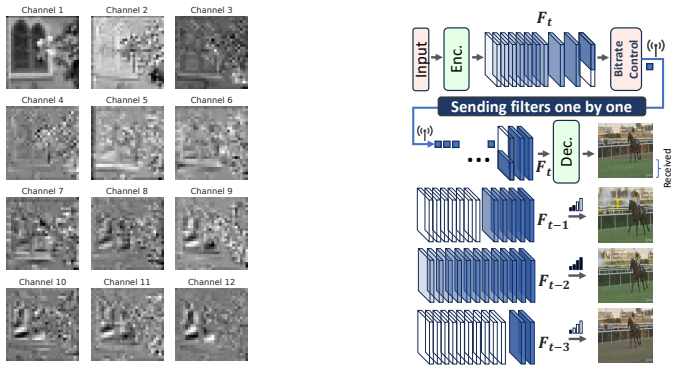
The paper's central discovery is that stochastic dropout training can make a tiny encoder produce an importance-ranked progressive latent. During training, a random fraction of the trailing latent channels is zeroed out before the decoder reconstructs the frame, forcing early channels to carry the most important low-frequency information and later channels to carry finer detail. At inference, the encoder quantizes each channel independently to 5-bit precision and transmits channels in order, so the bitrate-control module is only a gate that chooses how many channels to send. The authors report that the full model matches M-JPEG's energy consumption on the tested MCUs while achieving substantially better MS-SSIM per bit, and that the learned channel ordering mirrors the low-to-high frequency structure of a DCT.
Load-bearing premise
The paper never defines what counts as the MCUCoder bitstream—the latent resolution, the convolution strides, whether the 5-bit values are entropy-coded, or whether headers and packetization are included—so the headline BD-rate savings cannot be reconstructed or verified from the text alone.
Editorial extensions
If this is right
- IoT cameras with roughly 350 KB of available RAM can run learned per-frame compression at JPEG-level energy consumption.
- At matched MS-SSIM, the transmitted bitrate is about half of M-JPEG on the evaluated video datasets, which directly reduces bandwidth use.
- The 12-channel progressive latent provides 12 quality levels with no added encoder computation, since the bitrate controller is just a gate.
- The learned channel ordering behaves like a DCT-based progressive representation, which supports graceful quality degradation under packet or bandwidth loss.
- If the reported numbers hold, adaptive bitrate learned video compression becomes practical on memory-constrained microcontrollers rather than requiring high-end hardware.
Reading between the lines
- If the bitrate count is as reported, the largest end-to-end saving may come from radio transmission energy, which scales with bytes sent; the paper measures encoder energy but does not quantify this transmission saving.
- The 12-channel choice is not fundamental to the tail-drop training, so finer adaptive granularity or even inter-frame latents are natural extensions that the paper leaves implicit.
- The paper's bitrate appears to count the quantized latent directly; entropy-coding the 5-bit values would likely reduce the bitrate further, making the reported savings a conservative upper bound.
- A direct way to test the ordering claim is to transmit only the first few channels over a lossy link and measure reconstruction quality; the paper's monotone MS-SSIM curves predict graceful, not catastrophic, degradation.
Signed reviews
Editorial analysis
A structured set of objections, weighed in public.
Referee Report
Summary. The paper presents MCUCoder, an asymmetric learned image/video codec intended for IoT devices with 1–2 MB of RAM. The encoder is a 10.5K-parameter, INT8-quantized three-convolution network that produces 12 importance-sorted 5-bit latent channels; the decoder is a larger network intended to run on a server or cloud. The paper claims 55.65% and 55.59% BD-rate savings over M-JPEG on the MCL-JCV and UVG datasets, measured in MS-SSIM, while using approximately the same energy as M-JPEG on a nRF5340 MCU, and it reports an implementation on nRF5340 and STM32F7 with RAM/Flash measurements and 12-level adaptive bitrate truncation.
Significance. If the reported numbers hold, MCUCoder is a useful systems contribution: an extremely small encoder that runs on real MCUs, an open-source implementation, and a clean dropout-based mechanism for importance-ordered latent channels that avoids run-time content analysis. The central comparison against M-JPEG is an appropriate and meaningful external baseline, and the evaluation on real MCU hardware is a strength. The adaptive-ordering idea is inherited from the authors’ own prior ProgDTD work, so the novelty lies mainly in MCU deployment and the M-JPEG comparison rather than in the ordering mechanism itself. However, the headline bitrate claim and the real-time claim are not currently supported by the evidence presented, for the specific reasons detailed below.
major comments (3)
- [Section 3 (Asymmetric Compression), Figs. 7–8, Table 1] The bitrate of the MCUCoder bitstream is never defined. The manuscript does not state the spatial resolution of the 12-channel latent, the strides of the three convolutional layers, whether the transmitted values are 5-bit raw values or entropy-coded, or whether headers and packetization are included. Because BD-rate in Table 1 is a ratio of bitrates, the headline 55.65%/55.59% savings cannot be reconstructed or verified from the paper alone. Please provide the complete per-frame bitstream formula (latent height/width, strides, bit depth per value, any entropy coding, and all overhead), apply the same accounting to the M-JPEG anchor (which naturally includes JPEG headers), and recompute Figs. 7–8 and Table 1 with that definition.
- [Abstract, Section 4.1, Table 2] The abstract claims “smooth real-time video transmission even under fluctuating network conditions”, but Table 2 reports 237 ms per frame on the STM32F7 and 1,969 ms per frame on the nRF5340, corresponding to about 4.2 fps and 0.5 fps, respectively. The text in Section 4.1 also says the nRF5340 is “better suited for event-driven applications rather than real-time streaming”. Please remove or qualify the “real-time” claim with the achievable frame rates and the network conditions considered, and note that no dynamic bandwidth-switching experiment is presented beyond the static truncation levels in Fig. 8.
- [Figs. 1, 7, 8] The MS-SSIM values plotted are larger than 1 (e.g., 7.04 and 16.12 in Fig. 1), so the axis must use a transformed scale such as MS-SSIM in dB, but the paper never states this. Not only are the axis labels misleading, but Table 1’s “measured in MS-SSIM” wording is ambiguous. Please define the exact metric transformation used, label all axes and captions accordingly, and state whether the BD-rate in Table 1 is computed with this transformed metric or with the raw MS-SSIM values.
minor comments (9)
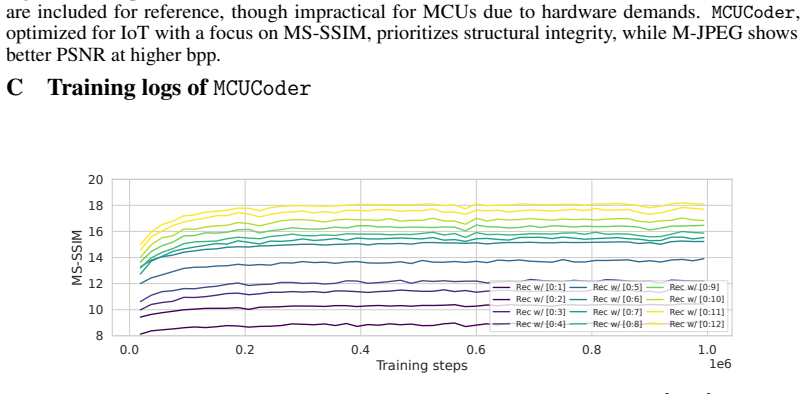
- [Section 3] The text says the decoder architecture is “see Fig. 12”, but Fig. 12 in Appendix C is the training-log figure; the reference should point to the correct architecture figure.
- [Section 4.1] The text refers to “see Table 7” for the BD-rate comparison, but no Table 7 exists; the intended reference is presumably Table 1.
- [Figure 1] The caption notes that images in a column do not necessarily have the same bitrate, which makes the visual comparison hard to interpret; presenting matched-bitrate pairs or annotating each image with its bpp would be more informative.
- [Section 4.1, Table 1] The BD-rate computation is cited only to [57]; please specify the integration interval, the number of anchor points, and the per-curve operating points used to compute Table 1.
- [Section 4, Fig. 7] No details are given for the JPEG/M-JPEG and H.264/H.265 encoder configurations (quality levels, rate control, chroma subsampling, preset), so the baseline curves are not reproducible; one sentence on each baseline would suffice.
- [Figure 9] The energy comparison reports single values (15.95 mJ vs. 14.98 mJ) with no measurement repetitions or setup description; please add this information or soften the energy claim.
- [Section 3, Eq. (1)] The notation N is not explicitly identified as 12 in the architecture section; it should be stated in the text rather than only appearing in the figure and equation.
- [Section 4] The preprocessing referred to as “noise-downsampling [55, 3]” is not described; please add a one-sentence description for reproducibility.
- [Table 2] The RAM/Flash numbers are presumably for the encoder only, since the decoder runs on the cloud; please state this explicitly in the table caption or surrounding text.
Circularity Check
Central bitrate and energy claims are externally benchmarked; only the 'importance ordering' evaluation restates its own training objective.
-
fitted input called prediction
[Section 4 ('Evaluation') and Section 4.1 ('Video compression', Figure 8 discussion)]
"Since MCUCoder is specifically designed for IoT environments, where the structure of the output is more critical than fine details, we use MS-SSIM as the loss function. ... The results show that using more channels for decoding leads to a higher MS-SSIM, which verifies the effectiveness of the proposed stochastic dropout training."
Stochastic dropout training optimizes reconstruction for every prefix z[0:floor(k*N)] with MS-SSIM as the loss, so the decoder is explicitly fitted to improve as more channels are provided. Thus the monotonic MS-SSIM improvement in Figure 8 is a check that training converged to the fitted objective, not an independent prediction or verification of the method. Similarly, the 'sorted by importance' property is produced by the dropout ordering during training rather than discovered independently. This self-referential evaluation does not affect the headline BD-rate savings, which are computed against the external M-JPEG/JPEG baselines.
full rationale
The paper's main quantitative claims are not circular: the 55.65%/55.59% BD-rate reductions are measured relative to M-JPEG on external datasets (MCL-JCV, UVG), the energy comparison in Figure 9 is a direct measurement on an nRF5340 against an external JPEG implementation, and the model is trained on ImageNet and evaluated on held-out datasets. The underspecified MCUCoder bitstream definition (latent resolution, strides, entropy coding, header overhead) is a serious verifiability/correctness concern, but it is an omission, not a circular reduction. The only self-referential element is the internal importance-ordering evaluation: since MS-SSIM is the training loss and the decoder is trained on randomized prefixes, showing that more channels improve MS-SSIM restates the training objective. The self-citations [50, 51] supply the dropout mechanism, but they are not used as proof of the external benchmark results, so they are not load-bearing circularity. Overall score 2 reflects this minor self-referential interpretation while the central external measurements remain independent.
Assumptions & free parameters
free parameters (5)
- Latent precision =
5 bits per quantized latent value
- Number of latent channels N =
12
- Dropout ratio distribution =
k ~ U(0,1)
- Training resolution =
224x224
- Quantization scheme =
INT8 weights and activations via TFLite-Micro post-training quantization
assumptions (4)
- domain assumption Inter-frame compression is not feasible on 1-2 MB RAM MCUs, so per-frame encoding is the only practical approach.
- domain assumption Stochastic tail-dropout training produces a latent whose channels are ordered by importance and remain ordered at inference for unseen frames.
- ad hoc to paper Post-training INT8 quantization to 5-bit latents does not materially change the rate-distortion tradeoff.
- domain assumption Training on the 300K largest ImageNet images transfers to the MCL-JCV, UVG, KODAK, and CLIC evaluation sets.
Cite this review
Pith. "Pith review of MCUCoder: Adaptive Bitrate Learned Video Compression for IoT Devices." pith.science (2026). https://pith.science/paper/TPDJEXUQ
@misc{pith2026241119442,
  author       = {Pith},
  title        = {Pith review of: MCUCoder: Adaptive Bitrate Learned Video Compression for IoT Devices},
  year         = {2026},
  howpublished = {\url{https://pith.science/paper/TPDJEXUQ}},
  note         = {Machine review of arXiv:2411.19442}
}
read the original abstract
The rapid growth of camera-based IoT devices demands the need for efficient video compression, particularly for edge applications where devices face hardware constraints, often with only 1 or 2 MB of RAM and unstable internet connections. Traditional and deep video compression methods are designed for high-end hardware, exceeding the capabilities of these constrained devices. Consequently, video compression in these scenarios is often limited to M-JPEG due to its high hardware efficiency and low complexity. This paper introduces , an open-source adaptive bitrate video compression model tailored for resource-limited IoT settings. MCUCoder features an ultra-lightweight encoder with only 10.5K parameters and a minimal 350KB memory footprint, making it well-suited for edge devices and MCUs. While MCUCoder uses a similar amount of energy as M-JPEG, it reduces bitrate by 55.65% on the MCL-JCV dataset and 55.59% on the UVG dataset, measured in MS-SSIM. Moreover, MCUCoder supports adaptive bitrate streaming by generating a latent representation that is sorted by importance, allowing transmission based on available bandwidth. This ensures smooth real-time video transmission even under fluctuating network conditions on low-resource devices. Source code available at https://github.com/ds-kiel/MCUCoder.
Figures


Figures from the paper (10 more)





Forward citations
Cited by 1 Pith paper
-
ProCAVE: A Self-Adaptive, Full-Lifecycle Edge Caching Framework for Video Streaming via Predictive Bandwidth Estimation and Preference-Aware Deep Reinforcement Learning
A self-adaptive edge caching framework using Transformer-based bandwidth forecasting, PPO-based bitrate selection, and DDPG-based cache control improves video delivery metrics over FlyCache in simulation.
Reference graph
Works this paper leans on
-
[1]
Haiqiang Wang, Weihao Gan, Sudeng Hu, Joe Yuchieh Lin, Lina Jin, Longguang Song, Ping Wang, Ioannis Katsavounidis, Anne Aaron, and C.-C. Jay Kuo. Mcl-jcv: A jnd-based h.264/avc video quality assessment dataset. In 2016 IEEE International Conference on Image Processing (ICIP), pages 1509–1513, 2016
work page 2016
-
[2]
Uvg dataset: 50/120fps 4k sequences for video codec analysis and development
Alexandre Mercat, Marko Viitanen, and Jarno Vanne. Uvg dataset: 50/120fps 4k sequences for video codec analysis and development. In Proceedings of the 11th ACM Multimedia Systems Conference, pages 297–302, 2020
work page 2020
-
[3]
Variational image compression with a scale hyperprior
Johannes Ballé, David Minnen, Saurabh Singh, Sung Jin Hwang, and Nick Johnston. Variational image compression with a scale hyperprior. arXiv preprint arXiv:1802.01436, 2018
arXiv 2018
-
[4]
Full resolution image compression with recurrent neural networks
George Toderici, Damien Vincent, Nick Johnston, Sung Jin Hwang, David Minnen, Joel Shor, and Michele Covell. Full resolution image compression with recurrent neural networks. In Proceedings of the IEEE conference on Computer Vision and Pattern Recognition , pages 5306–5314, 2017
work page 2017
-
[5]
Dpict: Deep progressive image compression using trit-planes
Jae-Han Lee, Seungmin Jeon, Kwang Pyo Choi, Youngo Park, and Chang-Su Kim. Dpict: Deep progressive image compression using trit-planes. In Proceedings of the IEEE/CVF Conference on Computer Vision and Pattern Recognition, pages 16113–16122, 2022
work page 2022
-
[6]
Context-based trit-plane coding for progressive image compression
Seungmin Jeon, Kwang Pyo Choi, Youngo Park, and Chang-Su Kim. Context-based trit-plane coding for progressive image compression. In Proceedings of the IEEE/CVF Conference on Computer Vision and Pattern Recognition, pages 14348–14357, 2023
work page 2023
-
[7]
Learned image compression with mixed transformer- cnn architectures
Jinming Liu, Heming Sun, and Jiro Katto. Learned image compression with mixed transformer- cnn architectures. In Proceedings of the IEEE/CVF Conference on Computer Vision and Pattern Recognition (CVPR), pages 14388–14397, June 2023
work page 2023
-
[8]
Enhanced invertible encoding for learned image compression
Yueqi Xie, Ka Leong Cheng, and Qifeng Chen. Enhanced invertible encoding for learned image compression. In Proceedings of the 29th ACM international conference on multimedia , pages 162–170, 2021
work page 2021
Show all 60 references
-
[9]
Transformer-based transform coding
Yinhao Zhu, Yang Yang, and Taco Cohen. Transformer-based transform coding. InInternational Conference on Learning Representations, 2022
2022
-
[10]
Scale-space flow for end-to-end optimized video compression
Eirikur Agustsson, David Minnen, Nick Johnston, Johannes Balle, Sung Jin Hwang, and George Toderici. Scale-space flow for end-to-end optimized video compression. In Proceedings of the IEEE/CVF Conference on Computer Vision and Pattern Recognition , pages 8503–8512, 2020
2020
-
[11]
Dvc: An end-to-end deep video compression framework
Guo Lu, Wanli Ouyang, Dong Xu, Xiaoyun Zhang, Chunlei Cai, and Zhiyong Gao. Dvc: An end-to-end deep video compression framework. In Proceedings of the IEEE/CVF conference on computer vision and pattern recognition , pages 11006–11015, 2019
2019
-
[12]
Mcunet: Tiny deep learning on iot devices
Ji Lin, Wei-Ming Chen, Yujun Lin, Chuang Gan, Song Han, et al. Mcunet: Tiny deep learning on iot devices. Advances in neural information processing systems , 33:11711–11722, 2020
2020
-
[13]
Starfish: Resilient image compression for aiot cameras
Pan Hu, Junha Im, Zain Asgar, and Sachin Katti. Starfish: Resilient image compression for aiot cameras. In Proceedings of the 18th Conference on Embedded Networked Sensor Systems , pages 395–408, 2020
2020
-
[14]
Wireless computer vision using commodity radios
Colleen Josephson, Lei Yang, Pengyu Zhang, and Sachin Katti. Wireless computer vision using commodity radios. In Proceedings of the 18th International Conference on Information Processing in Sensor Networks, pages 229–240, 2019. 7
2019
-
[15]
Towards {Battery-Free}{HD} video streaming
Saman Naderiparizi, Mehrdad Hessar, Vamsi Talla, Shyamnath Gollakota, and Joshua R Smith. Towards {Battery-Free}{HD} video streaming. In 15th USENIX Symposium on Networked Systems Design and Implementation (NSDI 18) , pages 233–247, 2018
2018
-
[16]
Neuricam: Key-frame video super-resolution and colorization for iot cameras
Bandhav Veluri, Collin Pernu, Ali Saffari, Joshua Smith, Michael Taylor, and Shyamnath Gollakota. Neuricam: Key-frame video super-resolution and colorization for iot cameras. In Proceedings of the 29th Annual International Conference on Mobile Computing and Networking, pages 1...
2023
-
[17]
Co-design of communication and machine inference for cloud robotics
Manabu Nakanoya, Sai Shankar Narasimhan, Sharachchandra Bhat, Alexandros Anemogiannis, Akul Datta, Sachin Katti, Sandeep Chinchali, and Marco Pavone. Co-design of communication and machine inference for cloud robotics. Autonomous Robots, 47(5):579–594, 2023
2023
-
[18]
Wireless steerable vision for live insects and insect-scale robots
Vikram Iyer, Ali Najafi, Johannes James, Sawyer Fuller, and Shyamnath Gollakota. Wireless steerable vision for live insects and insect-scale robots. Science robotics, 5(44):eabb0839, 2020
2020
-
[19]
Limitnet: Progressive, content- aware image offloading for extremely weak devices & networks
Ali Hojjat, Janek Haberer, Tayyaba Zainab, and Olaf Landsiedel. Limitnet: Progressive, content- aware image offloading for extremely weak devices & networks. In Proceedings of the 22nd Annual International Conference on Mobile Systems, Applications and Services , MOBISYS ’24, ...
2024
-
[20]
Wilds: A benchmark of in-the-wild distribution shifts
Pang Wei Koh, Shiori Sagawa, Henrik Marklund, Sang Michael Xie, Marvin Zhang, Akshay Balsubramani, Weihua Hu, Michihiro Yasunaga, Richard Lanas Phillips, Irena Gao, et al. Wilds: A benchmark of in-the-wild distribution shifts. In International conference on machine learning, p...
2021
-
[21]
Overview of the h
Thomas Wiegand, Gary J Sullivan, Gisle Bjontegaard, and Ajay Luthra. Overview of the h. 264/avc video coding standard. IEEE Transactions on circuits and systems for video technology , 13(7):560–576, 2003
2003
-
[22]
Overview of the high efficiency video coding (hevc) standard
Gary J Sullivan, Jens-Rainer Ohm, Woo-Jin Han, and Thomas Wiegand. Overview of the high efficiency video coding (hevc) standard. IEEE Transactions on circuits and systems for video technology, 22(12):1649–1668, 2012
2012
-
[23]
Overview of the versatile video coding (vvc) standard and its applications
Benjamin Bross, Ye-Kui Wang, Yan Ye, Shan Liu, Jianle Chen, Gary J Sullivan, and Jens- Rainer Ohm. Overview of the versatile video coding (vvc) standard and its applications. IEEE Transactions on Circuits and Systems for Video Technology, 31(10):3736–3764, 2021
2021
-
[24]
JPEG: Still image data compression standard
William B Pennebaker and Joan L Mitchell. JPEG: Still image data compression standard . Springer Science & Business Media, 1992
1992
-
[25]
Cmsis-nn: Efficient neural network kernels for arm cortex-m cpus, 2024
ARM-software. Cmsis-nn: Efficient neural network kernels for arm cortex-m cpus, 2024. Accessed: 2024-09-22
2024
-
[26]
Learning for video compres- sion with hierarchical quality and recurrent enhancement
Ren Yang, Fabian Mentzer, Luc Van Gool, and Radu Timofte. Learning for video compres- sion with hierarchical quality and recurrent enhancement. In Proceedings of the IEEE/CVF Conference on Computer Vision and Pattern Recognition, pages 6628–6637, 2020
2020
-
[27]
Neural image compression via attentional multi-scale back projection and frequency decompo- sition
Ge Gao, Pei You, Rong Pan, Shunyuan Han, Yuanyuan Zhang, Yuchao Dai, and Hojae Lee. Neural image compression via attentional multi-scale back projection and frequency decompo- sition. In Proceedings of the IEEE/CVF International Conference on Computer Vision , pages 14677–14686, 2021
2021
-
[28]
Mimt: Masked image modeling transformer for video compression
Jinxi Xiang, Kuan Tian, and Jun Zhang. Mimt: Masked image modeling transformer for video compression. In The Eleventh International Conference on Learning Representations , 2023
2023
-
[29]
Vct: A video compression transformer.arXiv preprint arXiv:2206.07307, 2022
Fabian Mentzer, George Toderici, David Minnen, Sung-Jin Hwang, Sergi Caelles, Mario Lucic, and Eirikur Agustsson. Vct: A video compression transformer.arXiv preprint arXiv:2206.07307, 2022
2022 arXiv
-
[30]
A video compression framework using an overfitted restoration neural network
Gang He, Chang Wu, Lei Li, Jinjia Zhou, Xianglin Wang, Yunfei Zheng, Bing Yu, and Weiying Xie. A video compression framework using an overfitted restoration neural network. In Proceedings of the IEEE/CVF Conference on Computer Vision and Pattern Recognition Workshops, pages 14...
2020
-
[31]
Instance-adaptive video compression: Improving neural codecs by training on the test set
Ties Van Rozendaal, Johann Brehmer, Yunfan Zhang, Reza Pourreza, Auke Wiggers, and Taco S Cohen. Instance-adaptive video compression: Improving neural codecs by training on the test set. arXiv preprint arXiv:2111.10302, 2021
2021 arXiv
-
[32]
Efficient video com- pression via content-adaptive super-resolution
Mehrdad Khani, Vibhaalakshmi Sivaraman, and Mohammad Alizadeh. Efficient video com- pression via content-adaptive super-resolution. In Proceedings of the IEEE/CVF international conference on computer vision, pages 4521–4530, 2021
2021
-
[33]
Coarse-to-fine deep video coding with hyperprior-guided mode prediction
Zhihao Hu, Guo Lu, Jinyang Guo, Shan Liu, Wei Jiang, and Dong Xu. Coarse-to-fine deep video coding with hyperprior-guided mode prediction. In Proceedings of the IEEE/CVF Conference on Computer Vision and Pattern Recognition, pages 5921–5930, 2022
2022
-
[34]
Fvc: A new framework towards deep video compression in feature space
Zhihao Hu, Guo Lu, and Dong Xu. Fvc: A new framework towards deep video compression in feature space. In Proceedings of the IEEE/CVF Conference on Computer Vision and Pattern Recognition, pages 1502–1511, 2021
2021
-
[35]
Deep contextual video compression
Jiahao Li, Bin Li, and Yan Lu. Deep contextual video compression. Advances in Neural Information Processing Systems, 34:18114–18125, 2021
2021
-
[36]
Conditional entropy coding for efficient video compression
Jerry Liu, Shenlong Wang, Wei-Chiu Ma, Meet Shah, Rui Hu, Pranaab Dhawan, and Raquel Urtasun. Conditional entropy coding for efficient video compression. In European Conference on Computer Vision, pages 453–468. Springer, 2020
2020
-
[37]
Hinerv: Video compres- sion with hierarchical encoding-based neural representation
Ho Man Kwan, Ge Gao, Fan Zhang, Andrew Gower, and David Bull. Hinerv: Video compres- sion with hierarchical encoding-based neural representation. Advances in Neural Information Processing Systems, 36, 2024
2024
-
[38]
Nerv: Neural representations for videos
Hao Chen, Bo He, Hanyu Wang, Yixuan Ren, Ser Nam Lim, and Abhinav Shrivastava. Nerv: Neural representations for videos. Advances in Neural Information Processing Sys- tems, 34:21557–21568, 2021
2021
-
[39]
A cmos image sensor and an ai accelerator for realizing edge-computing-based surveillance camera systems
Fukashi Morishita, Norihito Kato, Satoshi Okubo, Takao Toi, Mitsuru Hiraki, Sugako Otani, Hideaki Abe, Yuji Shinohara, and Hiroyuki Kondo. A cmos image sensor and an ai accelerator for realizing edge-computing-based surveillance camera systems. In 2021 Symposium on VLSI Circui...
2021
-
[40]
A 220pj/pixel/frame cmos image sensor with partial settling readout architecture
Suyao Ji, Jing Pu, Byong Chan Lim, and Mark Horowitz. A 220pj/pixel/frame cmos image sensor with partial settling readout architecture. In 2016 IEEE Symposium on VLSI Circuits (VLSI-Circuits), pages 1–2. IEEE, 2016
2016
-
[41]
Millimeter-scale ultra-low-power imaging system for intelligent edge monitoring
Andrea Bejarano-Carbo, Hyochan An, Kyojin Choo, Shiyu Liu, Qirui Zhang, Dennis Sylvester, David Blaauw, and Hun-Seok Kim. Millimeter-scale ultra-low-power imaging system for intelligent edge monitoring. arXiv preprint arXiv:2203.04496, 2022
2022 arXiv
-
[42]
7.7 a 0.2-to-3.6 tops/w programmable convolutional imager soc with in-sensor current-domain ternary-weighted mac operations for feature extraction and region-of-interest detection
Martin Lefebvre, Ludovic Moreau, Rémi Dekimpe, and David Bol. 7.7 a 0.2-to-3.6 tops/w programmable convolutional imager soc with in-sensor current-domain ternary-weighted mac operations for feature extraction and region-of-interest detection. In 2021 IEEE International Solid-S...
2021
-
[43]
4.4 a 1.3 tops/w@ 32gops fully integrated 10-core soc for iot end-nodes with 1.7µw cognitive wake-up from mram- based state-retentive sleep mode
Davide Rossi, Francesco Conti, Manuel Eggiman, Stefan Mach, Alfio Di Mauro, Marco Guermandi, Giuseppe Tagliavini, Antonio Pullini, Igor Loi, Jie Chen, et al. 4.4 a 1.3 tops/w@ 32gops fully integrated 10-core soc for iot end-nodes with 1.7µw cognitive wake-up from mram- based s...
2021
-
[44]
Macsen: A processing-in-sensor architecture integrating mac operations into image sensor for ultra-low- power bnn-based intelligent visual perception
Han Xu, Ziru Li, Ningchao Lin, Qi Wei, Fei Qiao, Xunzhao Yin, and Huazhong Yang. Macsen: A processing-in-sensor architecture integrating mac operations into image sensor for ultra-low- power bnn-based intelligent visual perception. IEEE Transactions on Circuits and Systems II:...
2020
-
[45]
Deep compressive offloading: Speeding up neural network inference by trading edge computation for network latency
Shuochao Yao, Jinyang Li, Dongxin Liu, Tianshi Wang, Shengzhong Liu, Huajie Shao, and Tarek Abdelzaher. Deep compressive offloading: Speeding up neural network inference by trading edge computation for network latency. In Proceedings of the 18th Conference on Embedded Networke...
2020
-
[46]
Elic: Efficient learned image compression with unevenly grouped space-channel contextual adaptive coding
Dailan He, Ziming Yang, Weikun Peng, Rui Ma, Hongwei Qin, and Yan Wang. Elic: Efficient learned image compression with unevenly grouped space-channel contextual adaptive coding. In Proceedings of the IEEE/CVF Conference on Computer Vision and Pattern Recognition , pages 5718–5...
2022
-
[47]
Learned image compression with discretized gaussian mixture likelihoods and attention modules
Zhengxue Cheng, Heming Sun, Masaru Takeuchi, and Jiro Katto. Learned image compression with discretized gaussian mixture likelihoods and attention modules. In Proceedings of the IEEE/CVF Conference on Computer Vision and Pattern Recognition , pages 7939–7948, 2020
2020
-
[48]
Deep residual learning for image recognition
Kaiming He, Xiangyu Zhang, Shaoqing Ren, and Jian Sun. Deep residual learning for image recognition. In Proceedings of the IEEE conference on computer vision and pattern recognition , pages 770–778, 2016
2016
-
[49]
Dropout: a simple way to prevent neural networks from overfitting
Nitish Srivastava, Geoffrey Hinton, Alex Krizhevsky, Ilya Sutskever, and Ruslan Salakhutdinov. Dropout: a simple way to prevent neural networks from overfitting. The journal of machine learning research, 15(1):1929–1958, 2014
1929
-
[50]
Progdtd: Progressive learned image compres- sion with double-tail-drop training
Ali Hojjat, Janek Haberer, and Olaf Landsiedel. Progdtd: Progressive learned image compres- sion with double-tail-drop training. In Proceedings of the IEEE/CVF Conference on Computer Vision and Pattern Recognition (CVPR) Workshops, pages 1130–1139, June 2023
2023
-
[51]
Hydravit: Stacking heads for a scalable vit
Janek Haberer, Ali Hojjat, and Olaf Landsiedel. Hydravit: Stacking heads for a scalable vit. arXiv preprint arXiv:2409.17978, 2024
2024 arXiv
-
[52]
kodak lossless true color image suite (photocd pcd0992)
Eastman kodak (1993). kodak lossless true color image suite (photocd pcd0992). https: //r0k.us/graphics/kodak
1993
-
[53]
Workshop and challenge on learned image compression (clic).http://www.compression.cc,
-
[54]
Imagenet: A large- scale hierarchical image database
Jia Deng, Wei Dong, Richard Socher, Li-Jia Li, Kai Li, and Li Fei-Fei. Imagenet: A large- scale hierarchical image database. In 2009 IEEE conference on computer vision and pattern recognition, pages 248–255. Ieee, 2009
2009
-
[55]
Checkerboard context model for efficient learned image compression
Dailan He, Yaoyan Zheng, Baocheng Sun, Yan Wang, and Hongwei Qin. Checkerboard context model for efficient learned image compression. In Proceedings of the IEEE/CVF Conference on Computer Vision and Pattern Recognition, pages 14771–14780, 2021
2021
-
[56]
https://www.tensorflow.org/lite/micro
TensorFlow Lite Micro. https://www.tensorflow.org/lite/micro. Accessed: [2023]
2023
-
[57]
Calculation of average psnr differences between rd-curves (vceg-m33)
G Bjøtegaard. Calculation of average psnr differences between rd-curves (vceg-m33). In VCEG Meeting (ITU-T SG16 Q. 6), Austin, Texas, USA„ Tech. Rep. M , volume 16090, 2001
2001
-
[58]
Kodak lossless true color image suite (photocd pcd0992)
Eastman Kodak. Kodak lossless true color image suite (photocd pcd0992). http://r0k.us/ graphics/kodak, 1993. 6
1993
-
[59]
https://github.com/zephyrproject-rtos/zephyr
Zephyr Project RTOS. https://github.com/zephyrproject-rtos/zephyr. Accessed: [2023]
2023
-
[60]
https://github.com/noritsuna/JPEGEncoder4Cortex-M/ tree/master
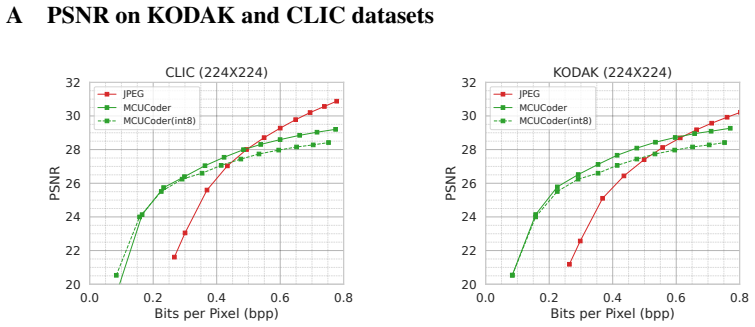
JPEGEncoder4Cortex. https://github.com/noritsuna/JPEGEncoder4Cortex-M/ tree/master. 10 A PSNR on KODAK and CLIC datasets 0.0 0.2 0.4 0.6 0.8 Bits per Pixel (bpp) 20 22 24 26 28 30 32PSNR CLIC (224X224) JPEG MCUCoder MCUCoder(int8) 0.0 0.2 0.4 0.6 0.8 Bits per Pixel (bpp) 20 22...
Reviewed August 12, 2026 · model on record in the stance chip above.
Discussion (0). Continue with ORCID to comment.