pith. sign in

arxiv: 2504.05431 · v3 · pith:TPDSJ2LOnew · submitted 2025-04-07 · 📊 stat.ME · math.ST· stat.TH

A Generalized Tangent Approximation based Variational Inference Framework for Strongly Super-Gaussian Likelihoods

Pith reviewed 2026-05-22 20:26 UTC · model grok-4.3

classification 📊 stat.ME math.STstat.TH
keywords variational inferencetangent approximationsuper-Gaussian likelihoodsconvex dualityconjugate priorsvariational risk boundsBayesian computation
0
0 comments X

The pith

A tangent transformation variational framework enables conjugate inference for strongly super-Gaussian likelihoods through convex duality.

A machine-rendered reading of the paper's core claim, the machinery that carries it, and where it could break.

The paper develops a variational inference method that uses tangent approximations for models whose likelihoods are strongly super-Gaussian. Convex duality supplies tangent minorants of the log-likelihood that restore conjugacy with Gaussian priors, turning an intractable posterior into a tractable one. The construction supplies both algorithmic convergence guarantees and near-minimax bounds on variational risk under mild conditions on the data. Numerical experiments show the approach scales better and recovers complex structure more reliably than existing black-box or model-specific variational routines.

Core claim

For a broad class of probability models with strongly super-Gaussian likelihoods, tangent minorants constructed via convex duality induce conjugacy between the likelihood and Gaussian priors on the parameters, yielding scalable variational inference together with convergence guarantees and near-minimax optimal bounds on the variational risk.

What carries the argument

Tangent minorants of the log-likelihood obtained from convex duality, which restore conjugacy with Gaussian priors.

Load-bearing premise

The data-generating mechanism satisfies mild assumptions that suffice to prove algorithmic convergence and near-minimax risk bounds.

What would settle it

A dataset generated from a strongly super-Gaussian likelihood on which the variational iterates fail to converge or the achieved risk exceeds the derived near-minimax bound.

Figures

Figures reproduced from arXiv: 2504.05431 by Bani K. Mallick, Debdeep Pati, Pritam Dey, Somjit Roy.

Figure 1
Figure 1. Figure 1: Runtimes (in log-scale) across 100 data repetitions of TAVIE-SSG and competitors for Student’s-t (Type I SSG) likelihood (ν = 5) in Section 4.1, under varying sample sizes and feature dimensions. richer posterior representations. Extensions such as non-conjugate variational message passing (NCVMP) (Knowles & Minka 2011) further adapt EP to non-conjugate exponential family models (Tan & Nott 2013). More rec… view at source ↗
Figure 2
Figure 2. Figure 2: Overview of the nonconvex landscape of L(ξ). Data Dn is generated from Student’s-t SSG likelihood (ν = 5, τ 2 = 3) with β ∼ Np(0, 0.5 2 Ip) and covariates xij ∼ N1(0, 1), i.i.d. Left: TAVIE-SSG converges in 25 iterations for (n, p) = (2, 2) with optimal ξ ⋆ = (0.822, 1.368). Right: TAVIE-SSG converges in 66 iterations for (n, p) = (100, 50); the contour plot shows a randomly selected two-dimensional slice … view at source ↗
Figure 3
Figure 3. Figure 3: MSEs of (β, τ 2 ) (in log-scale) across 100 data repetitions of TAVIE-SSG and competitors for the Student’s-t SSG likelihood (ν = 5) under experiment E1: n ∈ {200, 500, 1000, 2000}, p = 8 [PITH_FULL_IMAGE:figures/full_fig_p022_3.png] view at source ↗
Figure 4
Figure 4. Figure 4: MSEs of (β, τ 2 ) (in log-scale) across 100 data repetitions of TAVIE-SSG and competitors for the Student’s-t SSG likelihood (ν = 5) under experiment E2: p ∈ {3, 8, 15, 20}, n = 1000. Overall, the results collectively demonstrate the robust empirical performance of TAVIE-SSG across varying sample sizes and feature dimensions. In experiment E1, as in [PITH_FULL_IMAGE:figures/full_fig_p022_4.png] view at source ↗
Figure 5
Figure 5. Figure 5: Large-scale BQR performance of TAVIE-SSG with comparison against the FAST QR algorithm. Figure 5a presents the TAVIE-SSG estimates of β with 95% point-wise credible intervals (see [PITH_FULL_IMAGE:figures/full_fig_p024_5.png] view at source ↗
Figure 6
Figure 6. Figure 6: Comparison of TAVIE-SSG estimates on sub-sampled (n = 104 ) U.S. 2000 Census data with competitors and FAST QR (original estimates), corresponding to selected features. The comparative results, shown in [PITH_FULL_IMAGE:figures/full_fig_p025_6.png] view at source ↗
Figure 7
Figure 7. Figure 7: BQR runtimes on the sub-sampled (n = 104 ) U.S. 2000 Census data. 4.3 Predicting Spatial Gene Expressions in STARmap Data Spatially resolved transcript amplicon readout mapping (STARmap) (Wang et al. 2018) is a high-resolution technology for measuring gene expression across spatial locations at single-cell precision. We analyze the dataset in Wang et al. (2018). In this experiment, 4 mice were dark-housed … view at source ↗
Figure 8
Figure 8. Figure 8: Log-normalized true and predicted gene expression counts obtained from TAVIE-SSG, ADVI (MF/FR), DADVI, and PyMC (NUTS). gene expression counts while leveraging co-expression structure to capture complex spatial patterns. Let yg = (yg1, . . . , ygn) ⊤ ∈ Z n +,0 denote the gene expression counts for gene g ∈ [G] measured across n spatial locations, with corresponding spatial coordinates S = {si : i ∈ [n]} ⊂ … view at source ↗
Figure 9
Figure 9. Figure 9: Heatmap of log Pearson residual sum of squares between true and predicted gene expression counts across 40 randomly selected genes for TAVIE-SSG, ADVI (MF/FR), DADVI, and PyMC (NUTS). 5 Discussion The versatility of TAVIE-SSG opens several compelling future research directions. A natural next step is its integration with modern sparsity inducing priors, which could potentially mir￾ror TAVIE-SSG’s computati… view at source ↗
Figure 10
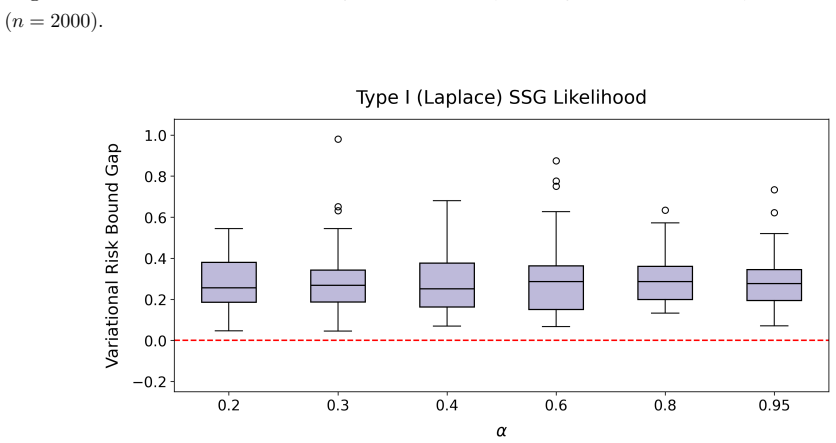
Figure 10. Figure 10: Variational risk bound gap under α-Rényi divergence for Laplace Type I SSG likelihood (n = 2000) [PITH_FULL_IMAGE:figures/full_fig_p076_10.png] view at source ↗
Figure 11
Figure 11. Figure 11: Variational risk bound gap under α-Rényi divergence for Laplace Type I SSG likelihood (n = 10000). The right hand side of the variational risk bound in (E.54) is computed accordingly, and the variational risk bound gap, defined as the difference between the right and left hand 76 [PITH_FULL_IMAGE:figures/full_fig_p076_11.png] view at source ↗
Figure 12
Figure 12. Figure 12: Variational risk bound gap under α-Rényi divergence for Negative-Binomial Type II SSG likelihood (n = 2000) [PITH_FULL_IMAGE:figures/full_fig_p078_12.png] view at source ↗
Figure 13
Figure 13. Figure 13: Variational risk bound gap under α-Rényi divergence for Negative-Binomial Type II SSG likelihood (n = 10000). 78 [PITH_FULL_IMAGE:figures/full_fig_p078_13.png] view at source ↗
Figure 14
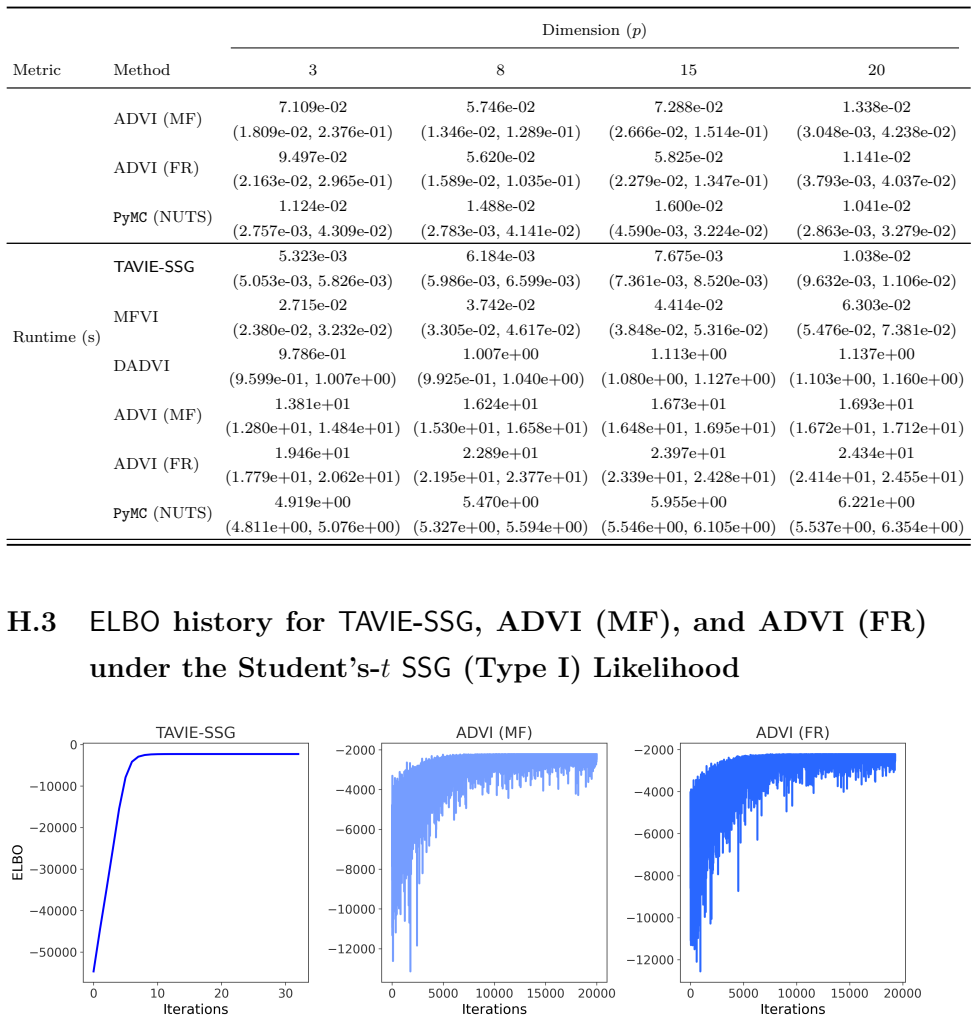
Figure 14. Figure 14: Convergence diagnostics (ELBO monitoring) of TAVIE-SSG, ADVI (MF), and ADVI (FR) for (n, p) = (2000, 8) under the Student’s-t SSG likelihood (ν = 5). 83 [PITH_FULL_IMAGE:figures/full_fig_p083_14.png] view at source ↗
Figure 15
Figure 15. Figure 15: MSEs of (β, τ 2 ) (in log-scale) across 100 data repetitions of TAVIE-SSG and competitors for the Laplace SSG likelihood under experiment E1: n ∈ {200, 500, 1000, 2000}, p = 8 [PITH_FULL_IMAGE:figures/full_fig_p087_15.png] view at source ↗
Figure 16
Figure 16. Figure 16: MSEs of (β, τ 2 ) (in log-scale) across 100 data repetitions of TAVIE-SSG and competitors for the Laplace SSG likelihood under experiment E2: p ∈ {3, 8, 15, 20}, n = 1000. 87 [PITH_FULL_IMAGE:figures/full_fig_p087_16.png] view at source ↗
Figure 17
Figure 17. Figure 17: Runtimes (in log-scale) across 100 data repetitions of TAVIE-SSG and competitors for the Laplace SSG likelihood under experiments E1 and E2 [PITH_FULL_IMAGE:figures/full_fig_p088_17.png] view at source ↗
Figure 18
Figure 18. Figure 18: Convergence diagnostics (ELBO monitoring) of TAVIE-SSG, ADVI (MF), and ADVI (FR) for (n, p) = (1000, 8) under the Laplace SSG likelihood. 88 [PITH_FULL_IMAGE:figures/full_fig_p088_18.png] view at source ↗
Figure 19
Figure 19. Figure 19: MSE of β (in log-scale) across 100 data repetitions of TAVIE-SSG and competitors for the Negative-Binomial SSG likelihood under experiment E1: n ∈ {200, 500, 1000, 2000}, p = 8. 91 [PITH_FULL_IMAGE:figures/full_fig_p091_19.png] view at source ↗
Figure 20
Figure 20. Figure 20: MSE of β (in log-scale) across 100 data repetitions of TAVIE-SSG and competitors for the Negative-Binomial SSG likelihood under experiment E2: p ∈ {3, 8, 15, 20}, n = 1000 [PITH_FULL_IMAGE:figures/full_fig_p092_20.png] view at source ↗
Figure 21
Figure 21. Figure 21: Runtimes (in log-scale) across 100 data repetitions of TAVIE-SSG and competitors for the Negative-Binomial SSG likelihood under experiments E1 and E2. 92 [PITH_FULL_IMAGE:figures/full_fig_p092_21.png] view at source ↗
Figure 22
Figure 22. Figure 22: Convergence diagnostics (ELBO monitoring) of TAVIE-SSG, ADVI (MF), and ADVI (FR) for (n, p) = (1000, 8) under the Negative-Binomial SSG likelihood. I.3 Extended Evaluation of TAVIE-SSG under Different α In addition to the results presented in Sections H, I.1, and I.2, we further evaluate the performance of TAVIE-SSG under Student’s-t (ν = 5), Laplace, and Negative-Binomial SSG likelihoods over a range of … view at source ↗
Figure 23
Figure 23. Figure 23: MSEs of (β, τ 2 ) (in log-scale) across 100 data repetitions with (n, p) = (2000, 8) for TAVIE-SSG under Student’s-t SSG likelihood (ν = 5) across different choices of the likelihood tempering parameter α. I.3.2 Laplace Type I SSG Likelihood [PITH_FULL_IMAGE:figures/full_fig_p094_23.png] view at source ↗
Figure 24
Figure 24. Figure 24: MSEs of (β, τ 2 ) (in log-scale) across 100 data repetitions with (n, p) = (2000, 8) for TAVIE-SSG under Laplace SSG likelihood across different choices of the likelihood tempering parameter α. I.3.3 Negative-Binomial Type II SSG Likelihood [PITH_FULL_IMAGE:figures/full_fig_p095_24.png] view at source ↗
Figure 25
Figure 25. Figure 25: MSE of β (in log-scale) across 100 data repetitions with (n, p) = (2000, 8) for TAVIE-SSG under Negative-Binomial SSG likelihood across different choices of the likelihood tempering parameter α. 96 [PITH_FULL_IMAGE:figures/full_fig_p096_25.png] view at source ↗
Figure 26
Figure 26. Figure 26: TAVIE-SSG variational estimates and 95% point-wise credible intervals for all features in U.S. 2000 Census data [PITH_FULL_IMAGE:figures/full_fig_p099_26.png] view at source ↗
Figure 27
Figure 27. Figure 27: Complete comparison results of TAVIE-SSG variational estimates on sub-sampled (n = 104 ) U.S. 2000 Census data with DADVI, ADVI (MF/FR), PyMC (NUTS), and statsmodels. 99 [PITH_FULL_IMAGE:figures/full_fig_p099_27.png] view at source ↗
Figure 28
Figure 28. Figure 28: ELBO of TAVIE-SSG plotted over iterations for various quantiles, demonstrating monotonic ascent and convergence [PITH_FULL_IMAGE:figures/full_fig_p100_28.png] view at source ↗
Figure 29
Figure 29. Figure 29: ELBO of ADVI (FR) plotted over iterations for various quantiles, demonstrating convergence and stochastic behavior. 100 [PITH_FULL_IMAGE:figures/full_fig_p100_29.png] view at source ↗
Figure 30
Figure 30. Figure 30: Log-normalized true and predicted gene expression counts obtained from TAVIE-SSG, ADVI (MF/FR), DADVI, and PyMC (NUTS). 101 [PITH_FULL_IMAGE:figures/full_fig_p101_30.png] view at source ↗
Figure 31
Figure 31. Figure 31: Heatmaps of the log Pearson residual sum of squares between true and predicted gene expression counts for the remaining 120 genes, across TAVIE-SSG, ADVI (MF/FR), DADVI, and PyMC (NUTS). 102 [PITH_FULL_IMAGE:figures/full_fig_p102_31.png] view at source ↗
read the original abstract

Variational inference, as an alternative to Markov chain Monte Carlo sampling, has played a transformative role in enabling scalable computation for complex Bayesian models. Nevertheless, existing approaches often depend on either rigid model-specific formulations or stochastic black-box optimization routines. Tangent approximation is a principled class of structured variational methods that exploits the geometry of the underlying probability model. However, its utility has largely been confined to logistic regression and related modeling regimes. In this article, we propose a novel variational framework based on tangent transformation for a broad class of probability models characterized by strongly super-Gaussian likelihoods. Our method leverages convex duality to construct tangent minorants of the log-likelihood, thereby inducing conjugacy with Gaussian priors over model parameters in an otherwise intractable setup. Under mild assumptions on the data-generating mechanism, we establish algorithmic convergence guarantees, a contribution that stands in contrast to the limited theoretical assurances typically available for black-box variational methods. Additionally, we derive near-minimax optimal bounds for the variational risk. Superior performance of our proposed methodology is illustrated on simulated and real-data scenarios that challenge state-of-the-art variational algorithms in terms of scalability and their ability to consistently capture complex underlying data structure.

Editorial analysis

A structured set of objections, weighed in public.

Desk editor's note, referee report, simulated authors' rebuttal, and a circularity audit. Tearing a paper down is the easy half of reading it; the pith above is the substance, this is the friction.

Referee Report

2 major / 2 minor

Summary. The paper proposes a generalized tangent approximation variational inference framework for a broad class of models with strongly super-Gaussian likelihoods. It uses convex duality to construct tangent minorants of the log-likelihood that induce conjugacy with Gaussian priors. The authors claim algorithmic convergence guarantees and near-minimax optimal bounds on variational risk under mild assumptions on the data-generating mechanism, while demonstrating improved scalability and performance over existing variational methods on simulated and real data.

Significance. If the theoretical results hold with explicit assumptions and derivations, the work would meaningfully extend tangent-based VI beyond logistic regression to a wider model class, providing rare convergence and optimality guarantees that contrast with black-box VI methods. The empirical illustrations of scalability and structure capture would add practical value in statistical modeling.

major comments (2)
  1. [Abstract and theoretical results section] The central claims of algorithmic convergence and near-minimax variational-risk bounds (Abstract) rest on 'mild assumptions on the data-generating mechanism,' but these assumptions are not explicitly stated, isolated from the strongly super-Gaussian property, or verified against the tangent-minorant construction. This directly weakens assessment of both the convergence guarantee and the optimality bound, as the skeptic note highlights; a dedicated theorem or proposition listing the precise conditions is required.
  2. [Method / variational framework section] The convex-duality construction of tangent minorants is load-bearing for inducing conjugacy with Gaussian priors across the claimed broad class. Without the explicit functional form of the minorant (e.g., the dual function or the specific tangent line parameterization) and a proof that it remains valid for general strongly super-Gaussian likelihoods rather than reducing to known special cases, the generality of the framework cannot be evaluated.
minor comments (2)
  1. [Experiments section] The abstract states superior performance on simulated and real-data scenarios, but the main text should include explicit comparison metrics, baseline methods, and reproducibility details (e.g., code or hyperparameter settings) to support the empirical claims.
  2. [Introduction / preliminaries] Notation for the tangent transformation and the resulting variational family should be introduced with a clear table or diagram early in the paper to aid readability for readers unfamiliar with prior tangent-approximation work.

Simulated Author's Rebuttal

2 responses · 0 unresolved

We thank the referee for their constructive comments, which highlight important areas for improving the clarity and accessibility of our theoretical contributions. We address each major comment in turn below, indicating the revisions we plan to implement.

read point-by-point responses
  1. Referee: [Abstract and theoretical results section] The central claims of algorithmic convergence and near-minimax variational-risk bounds (Abstract) rest on 'mild assumptions on the data-generating mechanism,' but these assumptions are not explicitly stated, isolated from the strongly super-Gaussian property, or verified against the tangent-minorant construction. This directly weakens assessment of both the convergence guarantee and the optimality bound, as the skeptic note highlights; a dedicated theorem or proposition listing the precise conditions is required.

    Authors: We agree that the assumptions on the data-generating mechanism need to be stated more explicitly and isolated for rigorous evaluation. In the revised manuscript, we will add a dedicated Proposition in the theoretical results section that lists the precise conditions, clearly separates them from the strongly super-Gaussian property, and verifies their role in supporting both the algorithmic convergence and the near-minimax variational-risk bounds under the tangent-minorant construction. revision: yes

  2. Referee: [Method / variational framework section] The convex-duality construction of tangent minorants is load-bearing for inducing conjugacy with Gaussian priors across the claimed broad class. Without the explicit functional form of the minorant (e.g., the dual function or the specific tangent line parameterization) and a proof that it remains valid for general strongly super-Gaussian likelihoods rather than reducing to known special cases, the generality of the framework cannot be evaluated.

    Authors: The explicit functional form of the tangent minorant, including the dual function obtained via convex duality and the tangent line parameterization, is derived in Section 3.2, with the general validity proof provided in Appendix B. This construction applies to the full class of strongly super-Gaussian likelihoods and does not reduce to special cases. To address the evaluation concern, we will include a self-contained derivation sketch and a non-logistic example in the main text of the revised manuscript. revision: partial

Circularity Check

0 steps flagged

No significant circularity; derivation uses convex duality independently of fitted inputs or self-citations

full rationale

The paper constructs tangent minorants via convex duality for strongly super-Gaussian likelihoods to induce conjugacy with Gaussian priors, then derives convergence guarantees and near-minimax variational-risk bounds under mild data-generating assumptions. These steps are presented as novel extensions beyond logistic regression, without reducing the central claims to self-definitional equivalences, fitted parameters renamed as predictions, or load-bearing self-citations. The framework contrasts explicitly with black-box VI, and the bounds are obtained separately rather than by construction from the minorant itself. No equations or citations in the abstract or description exhibit the required reduction to inputs.

Axiom & Free-Parameter Ledger

0 free parameters · 1 axioms · 0 invented entities

Review based on abstract only; no free parameters, invented entities, or detailed axioms are extractable beyond the stated mild data assumptions.

axioms (1)
  • domain assumption Mild assumptions on the data-generating mechanism
    Invoked to establish algorithmic convergence guarantees and near-minimax optimal bounds for the variational risk.

pith-pipeline@v0.9.0 · 5749 in / 1116 out tokens · 83655 ms · 2026-05-22T20:26:22.672850+00:00 · methodology

discussion (0)

Sign in with ORCID, Apple, or X to comment. Anyone can read and Pith papers without signing in.

Reference graph

Works this paper leans on

16 extracted references · 16 canonical work pages

  1. [1]

    J., Kochurov, M., Kumar, R., Lao, J., Luhmann, C

    Abril-Pla, O., Andreani, V., Carroll, C., Dong, L., Fonnesbeck, C. J., Kochurov, M., Kumar, R., Lao, J., Luhmann, C. C., Martin, O. A., Osthege, M., Vieira, R., Wiecki, T. & Zinkov, R. (2023), ‘PyMC: a modern, and comprehensive probabilistic programming framework in Python’,PeerJ Computer Science9

  2. [2]

    Anderson, T. W. (1955), ‘The Integral of a Symmetric Unimodal Function over a Symmetric Convex Set and Some Probability Inequalities’,Proceedings of the American Mathematical Society6(2)

  3. [3]

    (1993), ‘The reverse isoperimetric problem for Gaussian measure’,Discrete & Computational Geometry10(4)

    Ball, K. (1993), ‘The reverse isoperimetric problem for Gaussian measure’,Discrete & Computational Geometry10(4)

  4. [4]

    & Yang, Y

    Bhattacharya, A., Pati, D. & Yang, Y. (2019), ‘Bayesian fractional posteriors’,The Annals of Statistics47(1)

  5. [5]

    & Teboulle, M

    Bolte, J., Sabach, S. & Teboulle, M. (2014), ‘Proximal alternating linearized minimization for nonconvex and nonsmooth problems’,Mathematical Programming146(1)

  6. [6]

    Bolte, J. et al. (2007), ‘The Łojasiewicz Inequality for Nonsmooth Subanalytic Functions with Applications to Subgradient Dynamical Systems’,SIAM Journal on Optimization 17(4)

  7. [7]

    Danskin, J. M. (1967),The Theory of Max–Min and Its Application to Weapons Allocation

  8. [8]

    & Varadhan, S

    Donsker, M. & Varadhan, S. (1983), ‘Asymptotic evaluation of certain Markov process expectations for large time. IV’,Communications on Pure and Applied Mathematics 36(2)

  9. [9]

    & van der Vaart, A

    Ghosal, S. & van der Vaart, A. W. (2007), ‘Convergence rates of posterior distributions for noniid observations’,Annals of Statistics35(1)

  10. [10]

    & Linder, T

    Gil, M., Alajaji, F. & Linder, T. (2013), ‘Rényi divergence measures for commonly used univariate continuous distributions’,Information Sciences249

  11. [11]

    & Broderick, T

    Giordano, R., Ingram, M. & Broderick, T. (2024), ‘Black box variational inference with a deterministic objective: Faster, more accurate, and even more black box’,Journal of Machine Learning Research25(18)

  12. [12]

    & Blei, D

    Kucukelbir, A., Tran, D., Ranganath, R., Gelman, A. & Blei, D. M. (2017), ‘Automatic differentiation variational inference’,Journal of machine learning research18(14). 103

  13. [13]

    & Hutter, F

    Loshchilov, I. & Hutter, F. (2019), Decoupled Weight Decay Regularization,in‘International Conference on Learning Representations’

  14. [14]

    & Fonnesbeck, C

    Patil, A., Huard, D. & Fonnesbeck, C. J. (2010), ‘PyMC: Bayesian stochastic modelling in Python’,Journal of statistical software35

  15. [15]

    & Perktold, J

    Seabold, S. & Perktold, J. (2010), statsmodels: Econometric and statistical modeling with python,in‘9th Python in Science Conference’

  16. [16]

    P., Ormerod, J

    Wand, M. P., Ormerod, J. T., Padoan, S. A. & Frühwirth, R. (2011), ‘Mean Field Variational Bayes for Elaborate Distributions’,Bayesian Analysis6(4). 104