REVIEW 1 major objections 6 minor 93 references
Vector Fitting
T0 review · 1 major / 6 minor · reviewed 2026-08-14 · deepseek-v4-flash
Pith's one-line read Vector Fitting solves rational approximation from frequency samples by iterating linear least squares and relocating poles in closed form.
desk verdict An honest, well-crafted tutorial on Vector Fitting that breaks no new ground but delivers a usable reference with code and worked examples. read the letter →
The pith
A machine-rendered reading of the paper's core claim, the machinery that carries it, and where it could break.
The reading
What carries the argument
The load-bearing mechanism is the partial-fraction basis $1/(s-p_n^{(0)})$ with a pole set that is relocated at every iteration, combined with the eigenvalue update $\{p_n^{(i)}\} = \mathrm{eig}(A^{(i-1)} - b_w (c_w^{(i)})^T)$. Whereas the earlier Sanathanan-Koerner iteration used monomials $s^n$ and an explicit, often ill-conditioned frequency-dependent weight, Vector Fitting keeps condition numbers under control by using partial fractions and applies the weight implicitly through pole relocation. The matrix $A^{(i-1)}$ is the diagonal matrix of previous poles, $b_w$ is a vector of ones, and $c_w^{(i)}$ holds the weighting coefficients found by the linear least-squares solve; the eigenvalues of this rank-one perturbed diagonal matrix are exactly the zeros of the new denominator, hence the new poles. This machinery turns a nonlinear rational fit into repeated linear solves, with a final residue-only least-squares fit over the converged poles providing the model.
What would settle it
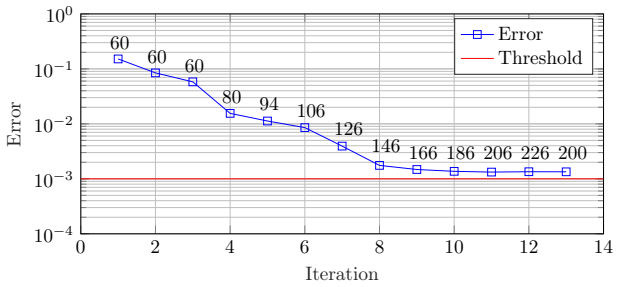
The claim would be refuted by a physically measured frequency response on which Algorithm 3.1, with standard pole initialization and a generous iteration limit, fails to meet the user's error threshold, for example by stalling at an error floor or by cycling between pole estimates while the linearized cost (17) keeps decreasing. A reader can test this by running the chapter's open-source implementation on a corpus of measured impedance or scattering-parameter datasets and counting convergence failures.
Extended reading notes
Core claim
The central claim is that the Vector Fitting iteration solves the rational approximation problem (4)—find a rational $\tilde H(s)$ matching samples $H_k = H(\mathrm{j}\omega_k)$—by minimizing a linearized least-squares error (17) instead of the original nonlinear error (6). At each iteration, the numerator and a weighting function are built from partial fractions over the previous poles, and the weighting coefficients $c_w^{(i)}$ feed the eigenvalue update $\{p_n^{(i)}\} = \mathrm{eig}(A^{(i-1)} - b_w (c_w^{(i)})^T)$, equation (18), which relocates the poles. On convergence the weight $w^{(i)}(s)$ tends to 1, so the linearized objective becomes the true nonlinear objective. The chapter maintains that this procedure, implemented as the given pseudocode, produces a stable, causal rational model for single-input and multi-input systems, with a final residue-only fit (29) over the converged poles used both as convergence test and as the actual model.
Load-bearing premise
The load-bearing premise is that the VF iteration, though not covered by a convergence theorem, will in practice reach an acceptable fit on real data within the user's iteration limit; the chapter concedes in Section 3.2 that contrived examples show convergence is not guaranteed.
Editorial extensions
If this is right
- An engineer can implement Algorithm 3.1 and obtain a reduced-order model from frequency samples alone, then convert the pole-residue form (58) into state-space, impulse-response, or equivalent-circuit representations for simulation.
- The same iteration covers multiple inputs and outputs by fitting all transfer-function entries with a shared pole set, and the fast variant in Section 3.6 reduces the cost enough to handle systems with hundreds of ports.
- Stability and causality can be enforced during the iterations, and passivity can be imposed afterwards, so the resulting model is usable in time-domain transient simulations of circuits and interconnects.
- With noisy measurement data, convergence slows and the achievable error is bounded by the noise floor; the adding-and-skimming and relaxed-normalization variants are the chapter's standard remedies.
Reading between the lines
- Editorial extension: the same pole-relocation idea could be adapted to other rational fitting problems, such as spectral densities, filter design, or parameter-dependent models, where the denominator nonlinearity is the main obstacle.
- Editorial extension: the chapter's practical-convergence claim rests on anecdotal experience; a quantitative benchmark across many measured datasets, recording the distribution of iterations to convergence and failure rates, would make it a testable statistical statement.
- Editorial extension: because convergence is not guaranteed, one could combine VF with a multistart strategy over different initial pole distributions to increase robustness; the chapter does not explore such a safeguard.
- Editorial extension: the explicit admission that no strong convergence theory exists suggests a useful theoretical target is a local convergence result under a noise or data-quality model, with the eigenvalue update (18) providing a concrete map to analyze.
Signed reviews
Editorial analysis
A structured set of objections, weighed in public.
Referee Report
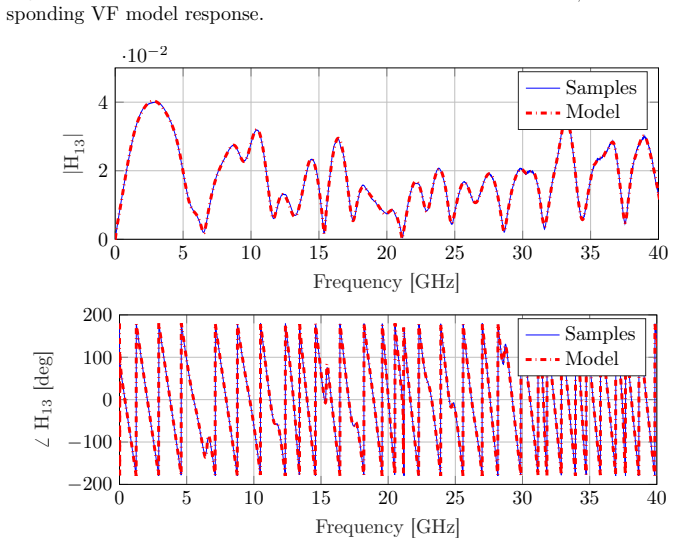
Summary. This manuscript is a draft book chapter on the Vector Fitting (VF) algorithm for constructing reduced-order models of linear time-invariant systems from sampled frequency responses. After motivating the data-driven reduction problem, the chapter reviews the Levy and Sanathanan–Koerner approaches, then derives VF as an iteratively reweighted linear least-squares method with pole relocation via an eigenvalue problem. It presents the SISO and MIMO formulations, a real-valued fast implementation with pseudocode, model realization via Gilbert's algorithm, stability/causality/passivity considerations, and a survey of time-domain, parametric, and distributed-system extensions. The chapter includes three worked examples: a synthetic rational function, aortic impedance data, and a multiport PCB measurement.
Significance. The chapter is a competent and useful survey/tutorial. Its algebraic derivations in Secs. 3.1–3.5 are consistent with the established VF literature, the pseudocode is detailed and accompanied by an open-source implementation (Sec. 3.8), and the examples illustrate typical behavior, including a synthetic case reaching machine-precision error. The main limitation is the empirical nature of the robustness/convergence claim, which the chapter itself openly acknowledges in Sec. 3.2. For a handbook chapter this limitation is not disqualifying, but the abstract and conclusion should carry the same caveat. Overall, the chapter will be a valuable reference if the framing is adjusted.
major comments (1)
- [Abstract, Sec. 3.2, Sec. 5] The chapter's central practical claim—that VF converges quickly and reliably—is empirically grounded rather than proven, as the chapter itself states in Sec. 3.2: no theoretical convergence results exist and contrived examples show nonconvergence. However, the abstract and Sec. 5 state the robustness and 'handful of iterations' claim without this caveat, and Algorithm 3.1 simply returns 'Failure' after imax iterations with no guidance on how to set imax, how to restart, or how to recognize datasets for which VF is likely to fail. Since this robustness claim is load-bearing for the chapter's value as a practitioner's guide, please qualify the abstract and conclusion and add a short practical paragraph (in Sec. 3.2 or 3.11) on handling nonconvergence. This is a framing issue rather than an error in the algorithm exposition.
minor comments (6)
- [Sec. 3.2, convergence criterion 1] 'The calculation of the norm of w′' should read 'the norm of w(i)'; the prime appears to be a typographical artifact.
- [Sec. 3.4] 'Conditioning number' should be 'condition number'.
- [Sec. 3.11.2, Eq. (75)] The constraint row omits the real-part operator from (74). As written, the row enforces (β/¯k) Σ_k w(i)(jω_k) = β on complex values rather than on their real parts; the correct constraint is on Re{w(i)(jω_k)}. Please fix or clarify the complex arithmetic.
- [Sec. 3.10] The statement that condition (70) 'becomes a condition for causality' is imprecise. Stability (Re p ≤ 0) and causality are distinct: a right-half-plane pole can still yield a causal (but unstable) impulse response under the standard right-sided ROC. Please rephrase to state that (70) enforces stability, and that a causal realization follows from the usual right-sided ROC.
- [Sec. 3.8, after Eq. (52)] The sentence 'The obtained system, which has real coefficients and unknowns will ensure...' should be split or rephrased for grammatical clarity.
- [Algorithm 3.1] Consider suggesting a default value or heuristic for imax, since the failure exit at line 17 is otherwise left unspecified and the convergence caveat in Sec. 3.2 makes this exit a realistic outcome.
Circularity Check
No significant circularity: the chapter is a self-contained tutorial whose derivations are algebraic transformations and whose robustness caveat is openly acknowledged.
full rationale
The paper's derivation chain is not circular. The core claim—that VF solves the rational approximation problem (4) by iterating the linearized least-squares problem (17) and pole relocation (18)—is a direct algebraic derivation: equations (15) and (16) express the Sanathanan-Koerner weighting and model numerator in partial fractions, and substituting them into (12) yields (17); equation (18) follows from the factored form in (15). These are identities defining the algorithm, not predictions tuned to data. The examples validate against measured or independently generated data (a known rational function in Sec. 3.3, aortic impedance measurements in Sec. 3.4, PCB scattering measurements in Sec. 3.7) and are compared to external samples, not to the fitted model by construction. The practical robustness claim is not disguised: Sec. 3.2 states explicitly that "no one has been able to support this experimental evidence with strong theoretical results on VF convergence" and cites contrived counterexamples [53,72], and Algorithms 3.1 and 3.2 return Failure if imax is exceeded. This is an honest limitation rather than a circular justification. Self-references, mainly to the companion book [35] and to the author's extension papers, are used for implementation details and extensions, not as the load-bearing evidence for the core derivation.
Assumptions & free parameters
free parameters (3)
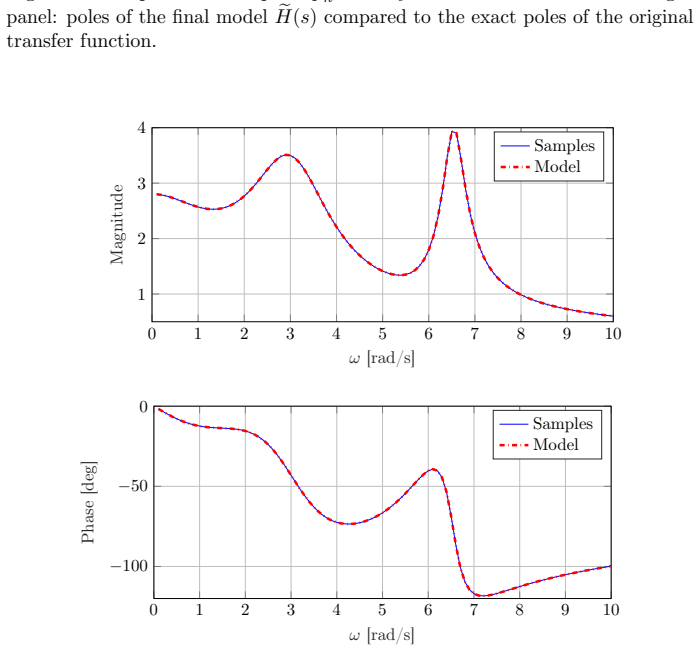
- Initial pole damping factor alpha =
0.01 (Eqs. 19-20)
- Model order n-bar =
user-specified or adapted by adding-and-skimming
- Convergence thresholds epsilon_w, epsilon_H, imax
assumptions (4)
- domain assumption The system under modeling is linear, time-invariant, and its transfer function is rational or well approximated by a rational function.
- domain assumption Initial poles can be assigned with heuristic (19)-(20) and the final result is not critically sensitive to them.
- domain assumption Stable and causal models can be enforced by flipping unstable poles without accuracy penalty on error-free samples.
- standard math QR decomposition and eigenvalue computations provide reliable numerical solutions to the least-squares and pole-update problems.
Cite this review
Pith. "Pith review of Vector Fitting." pith.science (2026). https://pith.science/paper/TPSE56GP
@misc{pith2026190808977,
  author       = {Pith},
  title        = {Pith review of: Vector Fitting},
  year         = {2026},
  howpublished = {\url{https://pith.science/paper/TPSE56GP}},
  note         = {Machine review of arXiv:1908.08977}
}
read the original abstract
We introduce the Vector Fitting algorithm for the creation of reduced-order models from the sampled response of a linear time-invariant system. This data-driven approach to reduction is particularly useful when the system under modeling is known only through experimental measurements. The theory behind Vector Fitting is presented for single- and multiple-input systems, together with numerical details, pseudocodes, and an open-source implementation. We discuss how the reduced model can be made stable and converted to a variety of forms for use in virtually any modeling context. Finally, we survey recent extensions of the Vector Fitting algorithm geared towards time-domain, parametric and distributed systems modeling.
Figures


Figures from the paper (6 more)



Reference graph
Works this paper leans on
-
[35]
S. Grivet-Talocia and B. Gustavsen. Passive macromodeling: Theory and applications. John Wiley & Sons, 2015
work page 2015
-
[1]
Chinea, S
A. Chinea, S. Grivet-Talocia, H. Hu, P. Triverio, D. Kaller, C. Siviero, M. Kindscher. Signal integrity verification of multi-chip links using passive channel macromodels. IEEE Transactions on Components, Packaging and Manufacturing Technology, 1(6):920–933, 2011
2011
-
[2]
Achar and M
R. Achar and M. S. Nakhla. Simulation of high-speed interconnects. Pro- ceedings of the IEEE , 89(5):693–728, 2001
2001
-
[3]
Almondo and M
A. Almondo and M. Sorli. Time domain fluid transmission line modelling using a passivity preserving rational approximation of the frequency de- pendent transfer matrix. International Journal of Fluid Power , 7(1):41–50, 2006
2006
-
[4]
Annakkage, N.-K
U. Annakkage, N.-K. C. Nair, Y. Liang, A. Gole, V. Dinavahi, B. Gus- tavsen, T. Noda, H. Ghasemi, A. Monti, M. Matar, et al. Dynamic system equivalents: A survey of available techniques. IEEE Transactions on Power Delivery, 27(1):411–420, 2012
2012
-
[5]
Antonini
G. Antonini. SPICE equivalent circuits of frequency-domain responses. IEEE Transactions on Electromagnetic Compatibility , 45(3):502–512, 2003
2003
-
[6]
Balm` es
E. Balm` es. GARTEUR Group on Ground Vibration Testing. Results from the Test of a Single Structure by 12 Laboratories in Europe. In 15th International Modal Analysis Conference , volume 3089, page 1346, 1997
1997
-
[7]
L. L. Barannyk, H. A. Aboutaleb, A. Elshabini, and F. D. Barlow. Spectrally accurate causality enforcement using svd-based fourier continuations for high- 32 speed digital interconnects. IEEE Transactions on Components, Packaging and Manufacturing Technology, 5(7):991–1005, 2015
2015
Show all 93 references
-
[8]
U. Baur, P. Benner, and L. Feng. Model order reduction for linear and non- linear systems: a system-theoretic perspective. Archives of Computational Methods in Engineering, 21(4):331–358, 2014
2014
-
[9]
D. S. Bayard. High-order multivariable transfer function curve fitting: Algorithms, sparse matrix methods and experimental results. Automatica, 30(9):1439–1444, 1994
1994
-
[10]
Beygi and A
A. Beygi and A. Dounavis. An instrumental variable vector-fitting approach for noisy frequency responses. IEEE Transactions on Microwave Theory and Techniques, 60(9):2702–2712, 2012
2012
-
[11]
R. R. Boix, F. Mesa, and F. Medina. Application of total least squares to the derivation of closed-form Green’s functions for planar layered media. IEEE Transactions on Microwave Theory and Techniques , 55(2):268–280, 2007
2007
-
[12]
Cai and C
Y. Cai and C. Mias. Faster 3D finite element time domain-floquet absorbing boundary condition modelling using recursive convolution and vector fitting. IET Microwaves, Antennas & Propagation , 3(2):310–324, 2009
2009
-
[13]
Charest, M
A. Charest, M. S. Nakhla, R. Achar, D. Saraswat, N. Soveiko, and I. Erdin. Time domain delay extraction-based macromodeling algorithm for long- delay networks. IEEE Transactions on Advanced Packaging , 33(1):219–235, 2010
2010
-
[14]
Chinea and S
A. Chinea and S. Grivet-Talocia. On the parallelization of vector fitting algo- rithms. IEEE Transactions on Components, Packaging and Manufacturing Technology, 1(11):1761–1773, 2011
2011
-
[15]
Chinea, P
A. Chinea, P. Triverio, and S. Grivet-Talocia. Compact macromodeling of electrically long interconnects. In Proc. of the 17th Topical Meeting on Electrical Performance of Electronic Packaging (EPEP 2008) , pages 199–202. IEEE, 2008
2008
-
[16]
Chinea, P
A. Chinea, P. Triverio, and S. Grivet-Talocia. Delay-based macromodeling of long interconnects from frequency-domain terminal responses. IEEE Transactions on Advanced Packaging, 33(1):246–256, 2010
2010
-
[17]
Cott´ e, P
B. Cott´ e, P. Blanc-Benon, C. Bogey, and F. Poisson. Time-domain impedance boundary conditions for simulations of outdoor sound prop- agation. AIAA Journal, 47(10):2391–2403, 2009
2009
-
[18]
De Jonghe and G
D. De Jonghe and G. Gielen. Characterization of analog circuits using transfer function trajectories. IEEE Transactions on Circuits and Systems I: Regular Papers, 59(8):1796–1804, 2012. 33
2012
-
[19]
Deschrijver, G
D. Deschrijver, G. Avolio, D. Schreurs, T. Dhaene, G. Crupi, and L. Knock- aert. Microwave small-signal modelling of FinFETs using multi-parameter rational fitting method. Electronics letters, 47(19):1084–1086, 2011
2011
-
[20]
Deschrijver, T
D. Deschrijver, T. Dhaene, and D. De Zutter. Robust parametric macro- modeling using multivariate orthonormal vector fitting. IEEE Transactions on Microwave Theory and Techniques , 56(7):1661–1667, 2008
2008
-
[21]
Deschrijver, B
D. Deschrijver, B. Haegeman, and T. Dhaene. Orthonormal vector fitting: A robust macromodeling tool for rational approximation of frequency domain responses. IEEE Transactions on Advanced Packaging, 30(2):216–225, 2007
2007
-
[22]
Deschrijver, M
D. Deschrijver, M. Mrozowski, T. Dhaene, and D. De Zutter. Macromodeling of multiport systems using a fast implementation of the vector fitting method. IEEE Microwave and Wireless Components Letters , 18(6):383–385, 2008
2008
-
[23]
Drmac, S
Z. Drmac, S. Gugercin, and C. Beattie. Quadrature-based vector fitting for discretized h 2 approximation. SIAM Journal on Scientific Computing , 37(2):A625–A652, 2015
2015
-
[24]
Drmac, S
Z. Drmac, S. Gugercin, and C. Beattie. Vector fitting for matrix-valued ra- tional approximation. SIAM Journal on Scientific Computing , 37(5):A2346– A2379, 2015
2015
-
[25]
Ferranti, L
F. Ferranti, L. Knockaert, and T. Dhaene. Guaranteed passive parameter- ized admittance-based macromodeling. IEEE Transactions on Advanced Packaging, 33(3):623–629, 2010
2010
-
[26]
Ferranti, Y
F. Ferranti, Y. Rolain, L. Knockaert, and T. Dhaene. Variance weighted vector fitting for noisy frequency responses. IEEE Microwave and Wireless Components Letters, 20(4):187–189, 2010
2010
-
[27]
E. G. Gilbert. Controllability and observability in multivariable control systems. Journal of the Society for Industrial and Applied Mathematics, Series A: Control , 1(2):128–151, 1963
1963
-
[28]
G. H. Golub and C. F. V. Loan. Matrix Computations . Johns Hopkins University Press, 1996
1996
-
[29]
G. H. Golub and R. J. Plemmons. Large-scale geodetic least-squares adjustment by dissection and orthogonal decomposition. Linear Algebra and Its Applications , 34:3–28, 1980
1980
-
[30]
Grivet-Talocia
S. Grivet-Talocia. Package macromodeling via time-domain vector fitting. IEEE Microwave and Wireless Components Letters , 13(11):472–474, 2003
2003
-
[31]
Grivet-Talocia
S. Grivet-Talocia. The time-domain vector fitting algorithm for linear macromodeling. International Journal of Electronics and Communications , 58(4):293, 2004. 34
2004
-
[32]
Grivet-Talocia
S. Grivet-Talocia. Delay-based macromodels for long interconnects via time-frequency decompositions. In 2006 IEEE Electrical Performance of Electronic Packaging, pages 199–202. IEEE, 2006
2006
-
[33]
Grivet-Talocia and M
S. Grivet-Talocia and M. Bandinu. Improving the convergence of vector fitting for equivalent circuit extraction from noisy frequency responses.IEEE Transactions on Electromagnetic Compatibility, 48(1):104–120, 2006
2006
-
[34]
Grivet-Talocia and E
S. Grivet-Talocia and E. Fevola. Compact parameterized black-box modeling via Fourier-rational approximations. IEEE Transactions on Electromagnetic Compatibility, 59(4):1133–1142, 2017
2017
-
[36]
Grivet-Talocia, H.-M
S. Grivet-Talocia, H.-M. Huang, A. E. Ruehli, F. Canavero, and I. Elfadel. Transient analysis of lossy transmission lines: An efficient approach based on the method of characteristics. IEEE Transactions on Advanced Packaging , 27(1):45–56, 2004
2004
-
[37]
Grivet-Talocia, S
S. Grivet-Talocia, S. Olivadese, and P. Triverio. A compression strategy for rational macromodeling of large interconnect structures. In 2011 IEEE Conference on Electrical Performance of Electronic Packaging and Systems (EPEPS), pages 53–56. IEEE, 2011
2011
-
[38]
Gustavsen
B. Gustavsen. The Vector Fitting Website. https://www.sintef.no/ projectweb/vectfit/. Accessed: 2018-12-06
2018
-
[39]
Gustavsen
B. Gustavsen. Time delay identification for transmission line modeling. In 8th IEEE Workshop on Signal Propagation on Interconnects , pages 103–106. IEEE, 2004
2004
-
[40]
Gustavsen
B. Gustavsen. Wide band modeling of power transformers. IEEE Transac- tions on Power Delivery , 19(1):414–422, 2004
2004
-
[41]
Gustavsen
B. Gustavsen. Improving the pole relocating properties of vector fitting. IEEE Transactions on Power Delivery , 21(3):1587–1592, 2006
2006
-
[42]
Gustavsen and A
B. Gustavsen and A. Semlyen. Rational approximation of frequency do- main responses by vector fitting. IEEE Transactions on Power Delivery , 14(3):1052–1061, 1999
1999
-
[43]
Rational approximation of frequency domain responses by vector fitting
W. Hendrickx and T. Dhaene. A discussion of “Rational approximation of frequency domain responses by vector fitting”. IEEE Transactions on Power Systems, 21(1):441–443, 2006
2006
-
[44]
X. Hu, L. Chaudhari, S. Lin, S. Stanton, S. Asgari, and W. Lian. A state space thermal model for HEV/EV battery using vector fitting. In 2012 IEEE Transportation Electrification Conference and Expo (ITEC) , pages 1–8. IEEE, 2012. 35
2012
-
[45]
Jaensch, C
S. Jaensch, C. Sovardi, and W. Polifke. On the robust, flexible and consistent implementation of time domain impedance boundary conditions for com- pressible flow simulations. Journal of Computational Physics , 314:145–159, 2016
2016
-
[46]
M. T. Kassis, M. Kabir, Y. Q. Xiao, and R. Khazaka. Passive reduced order macromodeling based on loewner matrix interpolation. IEEE Transactions on Microwave Theory and Techniques , 64(8):2423–2432, 2016
2016
-
[47]
macromodeling of multiport systems using a fast implementation of the vector fitting method
L. Knockaert. Comments on “macromodeling of multiport systems using a fast implementation of the vector fitting method”. IEEE Microwave and Wireless Components Letters, 19(9):602–602, 2009
2009
-
[48]
Kocar and J
I. Kocar and J. Mahseredjian. New procedure for computation of time delays in propagation function fitting for transient modeling of cables. IEEE Transactions on Power Delivery , 31(2):613–621, 2016
2016
-
[49]
V. N. Kourkoulos and A. C. Cangellaris. Accurate approximation of Green’s functions in planar stratified media in terms of a finite sum of spherical and cylindrical waves. IEEE Transactions on Antennas and Propagation , 54(5):1568–1576, 2006
2006
-
[50]
D. B. Kuznetsov and J. E. Schutt-Ain´ e. Optimal transient simulation of transmission lines. IEEE Transactions on Circuits and Systems I: Funda- mental Theory and Applications , 43(2):110–121, 1996
1996
-
[51]
S. Lalgudi. On checking causality of tabulatedS-parameters. IEEE Transac- tions on Components, Packaging and Manufacturing Technology , 3(7):1204– 1217, 2013
2013
-
[52]
Lefteriu and A
S. Lefteriu and A. C. Antoulas. A new approach to modeling multiport systems from frequency-domain data. IEEE Transactions on Computer- Aided Design of Integrated Circuits and Systems , 29(1):14–27, 2010
2010
-
[53]
Lefteriu and A
S. Lefteriu and A. C. Antoulas. On the convergence of the vector-fitting algo- rithm. IEEE Transactions on Microwave Theory and Techniques, 61(4):1435– 1443, 2013
2013
-
[54]
E. Levy. Complex-curve fitting. IRE Transactions on Automatic Control , AC-4(1):37–43, 1959
1959
-
[55]
Li, X.-C
E.-P. Li, X.-C. Wei, A. C. Cangellaris, E.-X. Liu, Y.-J. Zhang, M. D’amore, J. Kim, and T. Sudo. Progress review of electromagnetic compatibility analysis technologies for packages, printed circuit boards, and novel intercon- nects. IEEE Transactions on Electromagnetic Compati...
2010
-
[56]
Liao, C.-Y
C.-K. Liao, C.-Y. Chang, and J. Lin. A vector-fitting formulation for parameter extraction of lossy microwave filters. IEEE Microwave and Wireless Components Letters, 17(4):277–279, 2007. 36
2007
-
[57]
H. Lin, M. F. Pantoja, L. D. Angulo, J. Alvarez, R. G. Martin, and S. G. Garcia. FDTD modeling of graphene devices using complex conjugate dispersion material model. IEEE Microwave and Wireless Components Letters, 22(12):612–614, 2012
2012
-
[58]
Luo and K.-M
M. Luo and K.-M. Huang. An extended delay-rational macromodel for electromagnetic interference analysis of mixed signal circuits. Progress In Electromagnetics Research, 127:189–210, 2012
2012
-
[59]
Y. S. Mekonnen and J. E. Schutt-Aine. Broadband macromodeling of sampled frequency data using z-domain vector-fitting method. In 2007 IEEE Workshop on Signal Propagation on Interconnects, pages 45–48. IEEE, 2007
2007
-
[60]
K. A. Michalski. On the low-order partial-fraction fitting of dielectric functions at optical wavelengths. IEEE Transactions on Antennas and Propagation, 61(12):6128–6135, 2013
2013
-
[61]
Morched, B
A. Morched, B. Gustavsen, and M. Tartibi. A universal model for accurate calculation of electromagnetic transients on overhead lines and underground cables. IEEE Transactions on Power Delivery , 14(3):1032–1038, 1999
1999
-
[62]
T. Noda. Identification of a multiphase network equivalent for electromag- netic transient calculations using partitioned frequency response. IEEE Transactions on Power Delivery , 20(2):1134–1142, 2005
2005
-
[63]
S. B. Olivadese and S. Grivet-Talocia. Compressed passive macromodel- ing. IEEE Transactions on Components, Packaging and Manufacturing Technology, 2(8):1378–1388, 2012
2012
-
[64]
Triverio, S
P. Triverio, S. Grivet-Talocia, M. Bandinu, F. Canavero. Geometrically- parameterized circuit models of printed circuit board traces inclusive of antenna coupling. IEEE Transactions on Electromagnetic Compatibility , 52:471–478, 2010
2010
-
[65]
A. G. Polimeridis, T. V. Yioultsis, and T. D. Tsiboukis. A robust method for the computation of Green’s functions in stratified media. IEEE Transactions on Antennas and Propagation , 55(7):1963–1969, 2007
1963
-
[66]
S. R. Robinson, C. T. Nguyen, and J. B. Allen. Characterizing the ear canal acoustic impedance and reflectance by pole-zero fitting. Hearing research, 301:168–182, 2013
2013
-
[67]
Roy and A
S. Roy and A. Dounavis. Transient simulation of distributed networks using delay extraction based numerical convolution. IEEE Transactions on Computer-Aided Design of Integrated Circuits and Systems , 30(3):364–373, 2011. 37
2011
-
[68]
A. E. Ruehli and A. C. Cangellaris. Progress in the methodologies for the electrical modeling of interconnects and electronic packages. Proceedings of the IEEE, 89(5):740–771, 2001
2001
-
[69]
Sanathanan and J
C. Sanathanan and J. Koerner. Transfer function synthesis as a ratio of two complex polynomials. IEEE Transactions on Automatic Control, 8(1):56–58, 1963
1963
-
[70]
W. H. Schilders. The need for novel model order reduction techniques in the electronics industry. In Model reduction for circuit simulation , pages 3–23. Springer, 2011
2011
-
[71]
M. K. Sharp, G. M. Pantalos, L. Minich, L. Y. Tani, E. C. McGough, and J. A. Hawkins. Aortic input impedance in infants and children. Journal of Applied Physiology, 88(6):2227–2239, 2000
2000
-
[72]
G. Shi. On the nonconvergence of the vector fitting algorithm. IEEE Transactions on Circuits and Systems II: Express Briefs , 63(8):718–722, 2016
2016
-
[73]
Steiglitz and L
K. Steiglitz and L. McBride. A technique for the identification of linear systems. IEEE Transactions on Automatic Control , 10(4):461–464, 1965
1965
-
[74]
Swaminathan, D
M. Swaminathan, D. Chung, S. Grivet-Talocia, K. Bharath, V. Laddha, and J. Xie. Designing and modeling for power integrity. IEEE Transactions on Electromagnetic Compatibility, 52(2):288–310, 2010
2010
-
[75]
Triverio
P. Triverio. Vector Fitting Resources.http://www.modelics.org/vf.html. Accessed: 2019-08-23
2019
-
[76]
Triverio
P. Triverio. Robust causality check for sampled scattering parameters via a filtered fourier transform. IEEE Microwave and Wireless Components Letters, 24(2):72–74, 2014
2014
-
[77]
Triverio and S
P. Triverio and S. Grivet-Talocia. A robust causality verification tool for tabulated frequency data. In 2006 IEEE Workship on Signal Propagation on Interconnects, pages 65–68. IEEE, 2006
2006
-
[78]
Triverio and S
P. Triverio and S. Grivet-Talocia. Robust causality characterization via generalized dispersion relations. IEEE Transactions on Advanced Packaging, 31(3):579–593, 2008
2008
-
[79]
Triverio, S
P. Triverio, S. Grivet-Talocia, and A. Chinea. Identification of highly efficient delay-rational macromodels of long interconnects from tabulated frequency data. IEEE Transactions on Microwave Theory and Techniques , 58(3):566–577, 2010
2010
-
[80]
Triverio, S
P. Triverio, S. Grivet-Talocia, and M. S. Nakhla. An improved fitting algorithm for parametric macromodeling from tabulated data. In 2008 12th IEEE Workshop on Signal Propagation on Interconnects , pages 1–4. IEEE, 2008. 38
2008
-
[81]
Triverio, S
P. Triverio, S. Grivet-Talocia, and M. S. Nakhla. A parameterized macromod- eling strategy with uniform stability test. IEEE Transactions on Advanced Packaging, 32(1):205–215, 2009
2009
-
[82]
Triverio, S
P. Triverio, S. Grivet-Talocia, M. S. Nakhla, F. G. Canavero, and R. Achar. Stability, causality, and passivity in electrical interconnect models. IEEE Transactions on Advanced Packaging, 30(4):795–808, 2007
2007
-
[83]
Triverio, M
P. Triverio, M. Nakhla, and S. Grivet-Talocia. Parametric macromodeling of multiport networks from tabulated data. In 2007 IEEE Workshop on Electrical Performance of Electronic Packaging , pages 51–54. IEEE, 2007
2007
-
[84]
Triverio, M
P. Triverio, M. Nakhla, and S. Grivet-Talocia. Extraction of parametric circuit models from scattering parameters of passive rf components. In The 40th European Microwave Conference, pages 1635–1638. IEEE, 2010
2010
-
[85]
Triverio, M
P. Triverio, M. S. Nakhla, and S. Grivet-Talocia. Passive parametric macromodeling from sampled frequency data. In 2010 IEEE 14th Workshop on Signal Propagation on Interconnects , pages 117–120. IEEE, 2010
2010
-
[86]
Verboven, P
P. Verboven, P. Guillaume, and B. Cauberghe. Multivariable frequency– response curve fitting with application to modal parameter estimation. Automatica, 41(10):1773–1782, 2005
2005
-
[87]
Wang and J.-M
R. Wang and J.-M. Jin. Incorporation of multiport lumped networks into the hybrid time-domain finite-element analysis. IEEE Transactions on Microwave Theory and Techniques, 57(8):2030–2037, 2009
2009
-
[88]
CMP-28 Channel Modeling Platform
Wild River Technology. CMP-28 Channel Modeling Platform. https: //wildrivertech.com/index.php/cmp-28-cmp-32 . Accessed: 2019-05- 17
2019
-
[89]
Wong and C.-U
N. Wong and C.-U. Lei. IIR approximation of FIR filters via discrete-time vector fitting. IEEE Transactions on Signal Processing, 56(3):1296–1302, 2008
2008
-
[90]
T.-L. Wu, F. Buesink, and F. Canavero. Overview of signal integrity and EMC design technologies on PCB: Fundamentals and latest progress. IEEE Transactions on Electromagnetic Compatibility, 55(4):624–638, 2013
2013
-
[91]
S. Yan, P. Wang, C.-Y. Tian, and L. Li. Analysis of graphene-based devices using wave equation-based discontinuous Galerkin time domain method. IEEE Antennas and Wireless Propagation Letters , 17(12):2169–2173, 2018
2018
-
[92]
Zanco, S
A. Zanco, S. Grivet-Talocia, T. Bradde, and M. De Stefano. Enforcing passivity of parameterized LTI macromodels via Hamiltonian-driven multi- variate adaptive sampling. IEEE Transactions on Computer-Aided Design of Integrated Circuits and Systems , 2019. (early access)
2019
-
[93]
K. Zhou, J. C. Doyle, and K. Glover. Robust and optimal control, volume 40. Prentice Hall, 1996. 39
1996
Reviewed August 14, 2026 · model on record in the stance chip above.
Discussion (0). Continue with ORCID to comment.