t bar{t} production as a window to invisible new physics
Pith reviewed 2026-06-29 01:18 UTC · model grok-4.3
The pith
ttbar production at the LHC can detect light invisible spin-1 mediators and distinguish their spin and parity via angular observables.
A machine-rendered reading of the paper's core claim, the machinery that carries it, and where it could break.
Core claim
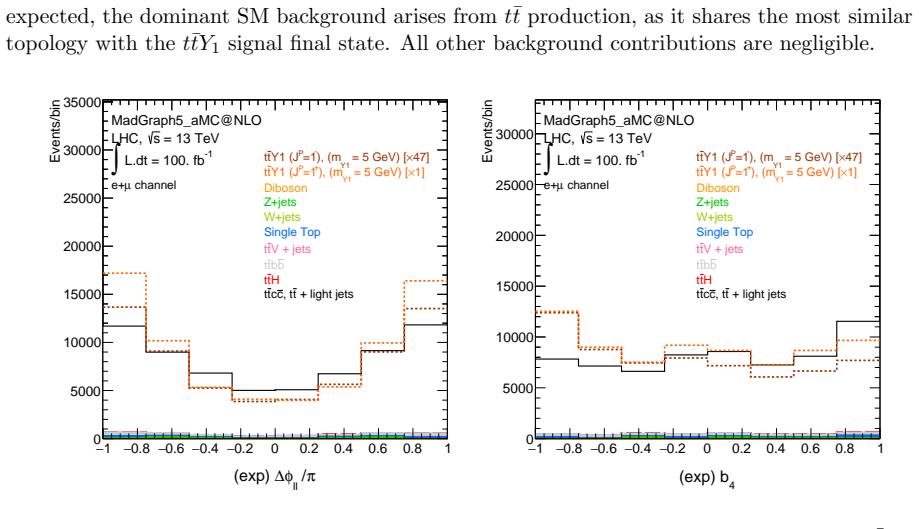
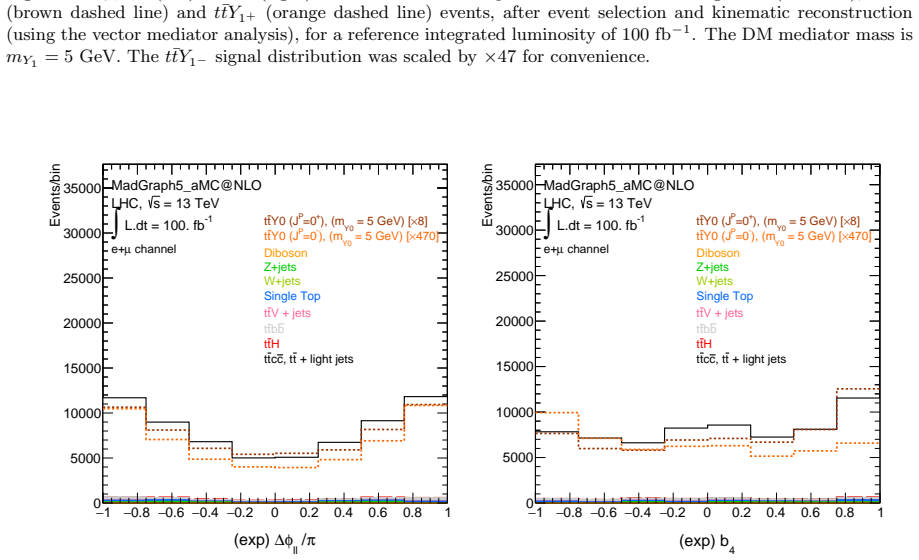
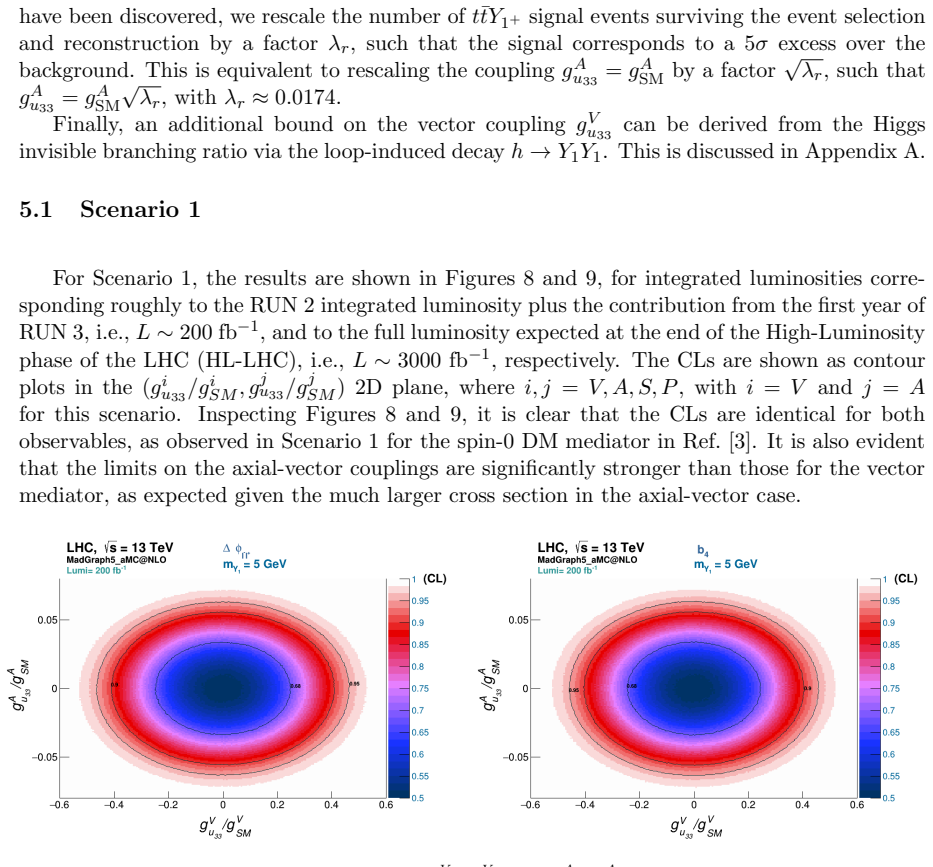
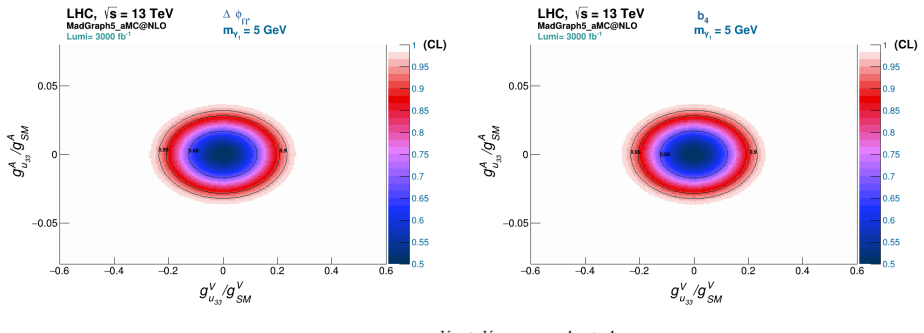
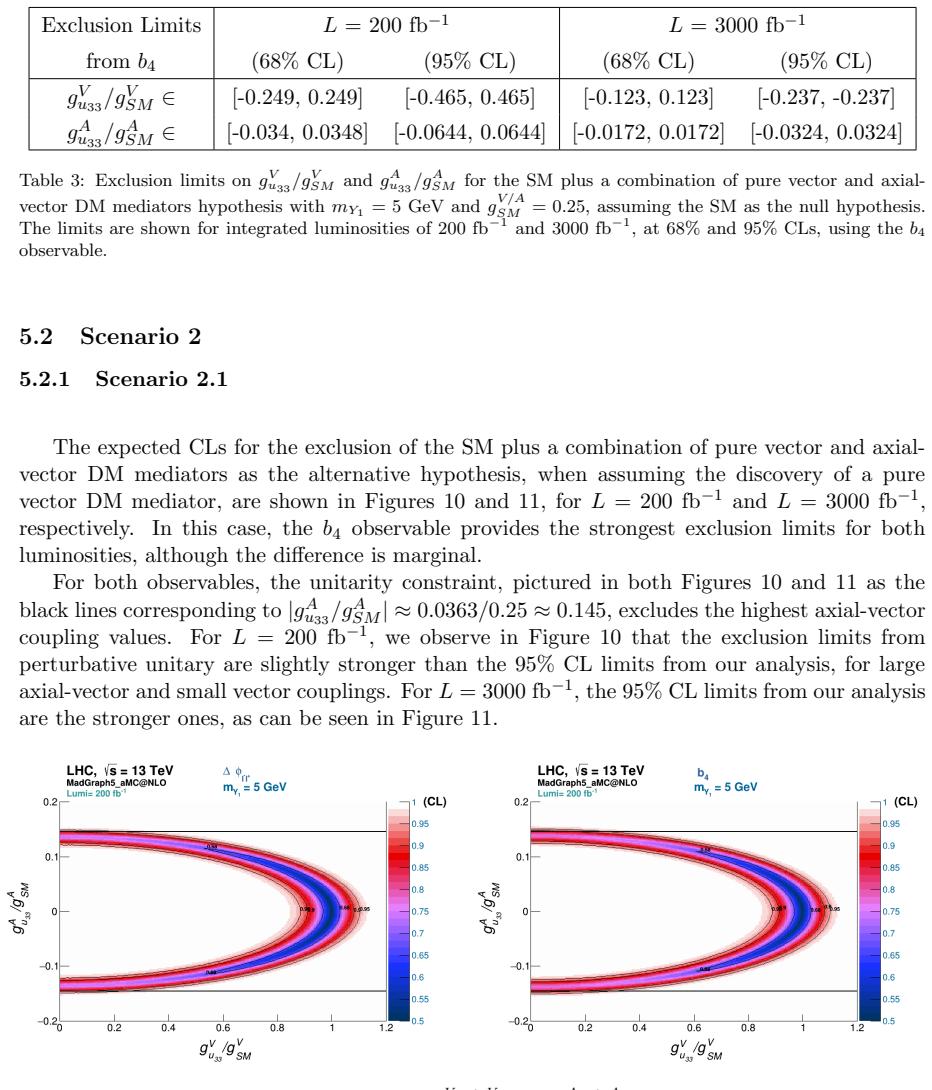
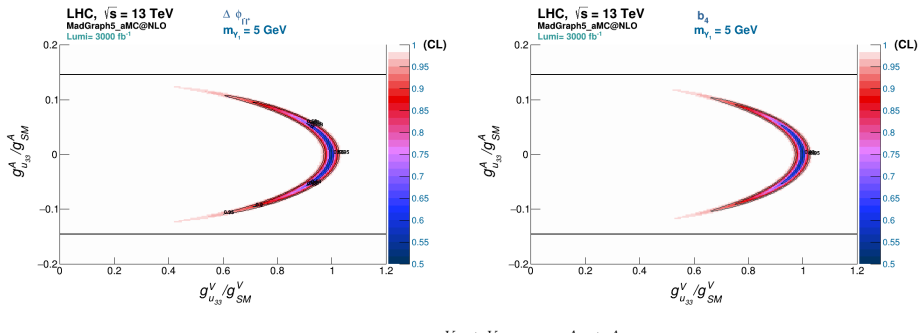
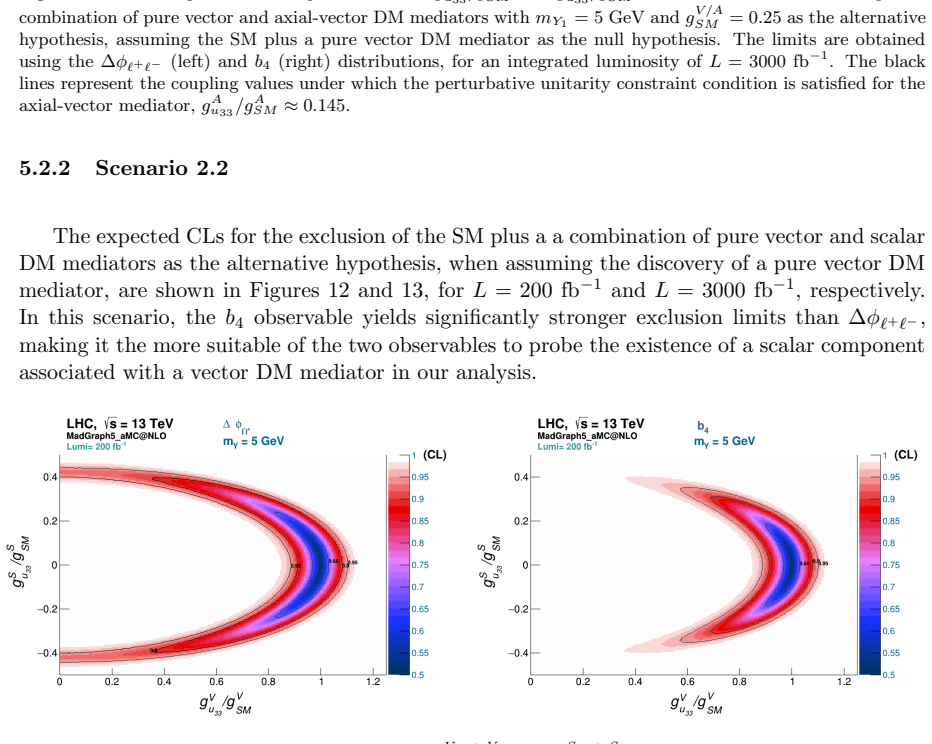
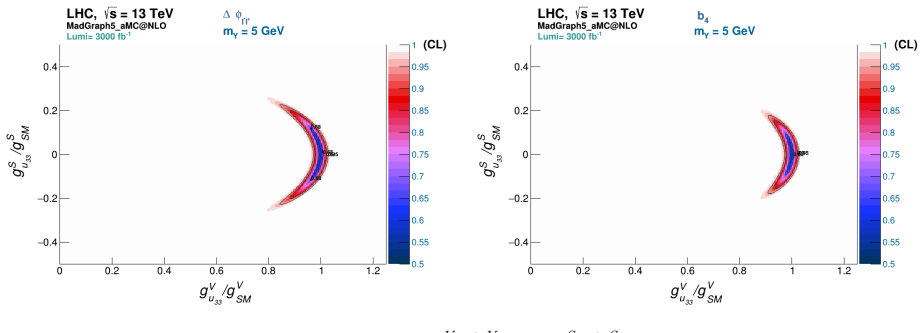
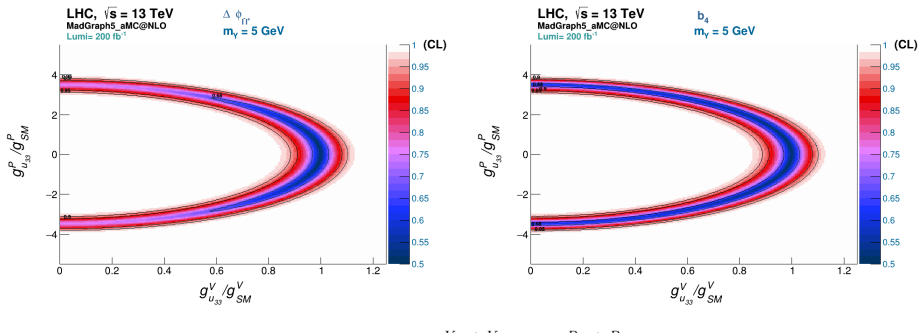
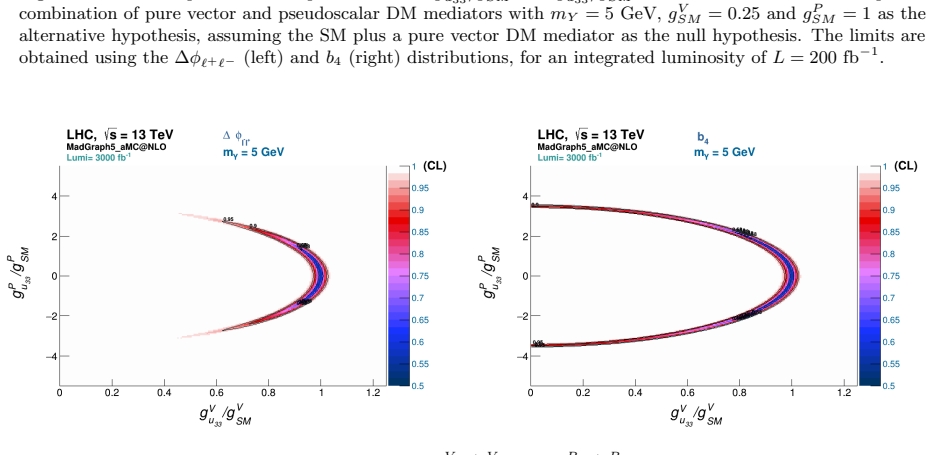
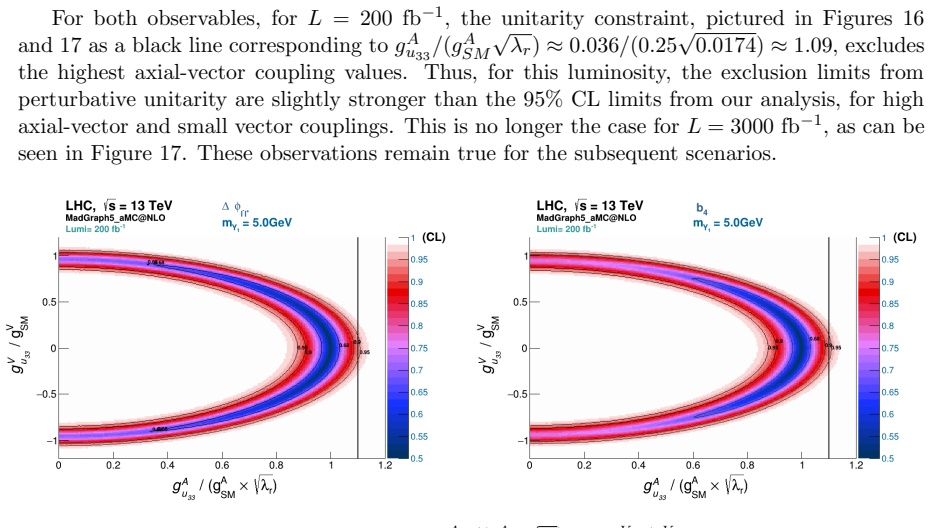
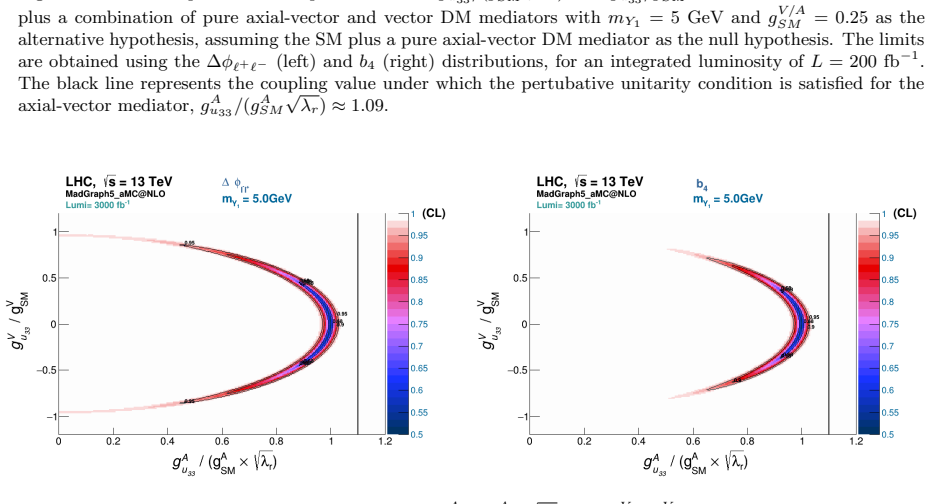
The analysis of pp to ttbar Y_i (i=0,1) in dileptonic final states is sensitive to light spin-1 mediators. CP-sensitive angular observables provide discrimination power between vector, axial-vector, scalar and pseudoscalar scenarios. These results highlight the potential of ttbar final states not only to search for invisible particles, but also to characterize their spin and parity properties in case of discovery.
What carries the argument
CP-sensitive angular observables applied to dileptonic ttbar events reconstructed by kinematic fit without explicit mediator reconstruction.
If this is right
- The LHC can exclude or discover light spin-1 mediators produced with ttbar pairs.
- Angular observables allow separation of pure vector or axial-vector mediators from scalar or pseudoscalar alternatives.
- ttbar final states can be used to characterize the spin and parity of any discovered invisible particle.
Where Pith is reading between the lines
- The same angular observables could be applied to other ttbar-related searches for new physics beyond the simplified DM model.
- Combining this channel with other LHC final states might improve overall constraints on light mediators.
- The kinematic-fit approach without mediator reconstruction could be tested in real data to assess its robustness against detector effects.
Load-bearing premise
The mediator mass is fixed at 5 GeV, only dileptonic ttbar decays are used, and the study relies on simplified DM model samples without explicit mediator reconstruction.
What would settle it
A measurement of the angular observables in dileptonic ttbar events at the LHC that matches Standard Model expectations within the projected uncertainties would show that the claimed sensitivity and discrimination power are absent.
Figures
read the original abstract
We present a phenomenological study where we probe the sensitivity to invisible dark matter (DM) mediators produced in association with a $t\bar{t}$ pair at the Large Hadron Collider (LHC). Building on previous work focused on scalar mediators, we extend the analysis to include spin-1 mediators, $Y_1$, with both vector and axial-vector couplings to top quarks. The mediator mass is fixed to 5 GeV. Signal samples of $pp \rightarrow t\bar{t}Y_i$ ($i = 0, 1$) are generated using a MadGraph5_aMC@NLO simplified DM model. Only dileptonic final states of the $t\bar{t}$ system are considered, and the reconstruction is performed through a kinematic fit without explicitly reconstructing the invisible mediator. All relevant Standard Model backgrounds are included. We consider several exclusion scenarios to assess the sensitivity to the presence of a spin-1 mediator, as well as the ability to distinguish a pure vector or axial-vector mediator from alternative hypotheses with different spin and CP properties. We find that the analysis is sensitive to light spin-1 mediators and that CP-sensitive angular observables provide discrimination power between vector, axial-vector, scalar and pseudoscalar scenarios. These results highlight the potential of $t\bar{t}$ final states not only to search for invisible particles, but also to characterize their spin and parity properties in case of discovery.
Editorial analysis
A structured set of objections, weighed in public.
Referee Report
Summary. The paper performs a phenomenological study of pp → tt̄Y production at the LHC (Y invisible mediator, m_Y fixed at 5 GeV) in a simplified DM model, restricting to dileptonic tt̄ decays. Signal and SM backgrounds are generated in MadGraph5_aMC@NLO; the tt̄ system is reconstructed via a kinematic fit that does not account for Y; several angular observables (including CP-sensitive ones) are used to claim sensitivity to light spin-1 mediators and discrimination power among vector, axial-vector, scalar, and pseudoscalar hypotheses.
Significance. If the reconstruction and discrimination results are robust, the work would show that tt̄ + invisible final states can both discover and characterize the spin/CP properties of light mediators. Credit is due for extending scalar-mediator studies to spin-1 cases, generating full background samples, and examining multiple coupling scenarios in a single framework.
major comments (2)
- [Abstract / reconstruction procedure] Abstract and reconstruction description: the kinematic fit solves only for the two neutrinos under standard dileptonic tt̄ kinematics and does not incorporate the additional invisible momentum carried by the light (5 GeV) mediator Y. Because the mediator p_T spectrum overlaps the neutrino p_T range, the fit can return biased neutrino momenta, which directly affects the lepton and top angular distributions used for spin/CP discrimination. This bias is load-bearing for the central claim that the observables retain discrimination power; it must be quantified (e.g., by comparing reconstructed distributions with and without Y or by reporting fit success rates and pull distributions).
- [Results on angular observables] Results section on discrimination: the claimed separation between vector/axial-vector and scalar/pseudoscalar scenarios relies on the post-fit angular observables. Without a demonstration that the mediator-induced bias does not erode the separation (for example, via ROC curves or significance values computed on biased versus unbiased samples), the discrimination statement cannot be assessed.
minor comments (2)
- [Simulation setup] The fixed mediator mass of 5 GeV is stated without exploring nearby values; a brief scan or justification would strengthen the robustness statement.
- [Introduction / model definition] Notation for the mediator (Y_1, Y_i) and coupling scenarios should be defined once in a dedicated paragraph rather than introduced piecemeal.
Simulated Author's Rebuttal
We thank the referee for the careful reading and constructive comments on our manuscript. We address each major comment below and will incorporate the suggested quantifications into a revised version.
read point-by-point responses
-
Referee: [Abstract / reconstruction procedure] Abstract and reconstruction description: the kinematic fit solves only for the two neutrinos under standard dileptonic tt̄ kinematics and does not incorporate the additional invisible momentum carried by the light (5 GeV) mediator Y. Because the mediator p_T spectrum overlaps the neutrino p_T range, the fit can return biased neutrino momenta, which directly affects the lepton and top angular distributions used for spin/CP discrimination. This bias is load-bearing for the central claim that the observables retain discrimination power; it must be quantified (e.g., by comparing reconstructed distributions with and without Y or by reporting fit success rates and pull distributions).
Authors: We acknowledge that the kinematic fit is performed under standard dileptonic tt̄ assumptions and does not explicitly include the additional invisible momentum from the light mediator Y. While the mediator mass is only 5 GeV, its p_T spectrum can overlap with the neutrinos and introduce biases in the reconstructed angular observables. To address this concern, we will add a dedicated subsection quantifying the effect: we will compare key angular distributions reconstructed with and without the mediator contribution, report fit success rates, and show pull distributions for the neutrino momenta. This will allow readers to assess the robustness of the claimed discrimination power. revision: yes
-
Referee: [Results on angular observables] Results section on discrimination: the claimed separation between vector/axial-vector and scalar/pseudoscalar scenarios relies on the post-fit angular observables. Without a demonstration that the mediator-induced bias does not erode the separation (for example, via ROC curves or significance values computed on biased versus unbiased samples), the discrimination statement cannot be assessed.
Authors: We agree that the discrimination claims require explicit validation against reconstruction bias. In the revised manuscript we will add ROC curves and significance estimates computed on both the reconstructed (post-fit) samples and the corresponding truth-level (unbiased) samples for the vector/axial-vector versus scalar/pseudoscalar hypotheses. This will directly demonstrate whether the separation power is preserved after the kinematic fit. revision: yes
Circularity Check
No circularity: forward simulation of simplified model with standard reconstruction
full rationale
The paper generates signal samples in MadGraph5_aMC@NLO for pp → ttbar Y (Y invisible, m=5 GeV) in a simplified DM model, includes SM backgrounds, applies a kinematic fit to dileptonic ttbar events without reconstructing the mediator, and evaluates sensitivity plus CP-sensitive angular observables. No step reduces a claimed prediction to a quantity fitted from the same dataset, no self-definitional relations (e.g., X defined via Y then Y predicted from X), and no load-bearing self-citations that justify the central result. The derivation chain consists of standard Monte Carlo event generation, reconstruction, and statistical comparison against backgrounds; it is self-contained against external benchmarks and does not invoke uniqueness theorems or ansatze from prior author work.
Axiom & Free-Parameter Ledger
free parameters (1)
- mediator mass =
5 GeV
axioms (2)
- domain assumption Simplified DM model in MadGraph5_aMC@NLO accurately represents the signal process
- domain assumption Dileptonic ttbar final states with kinematic fit suffice to probe invisible mediator without direct reconstruction
invented entities (1)
-
spin-1 mediator Y1 with vector and axial-vector couplings
no independent evidence
Reference graph
Works this paper leans on
-
[1]
L. J. Rosenberg and K. A. van Bibber, Phys. Rept.325, 1 (2000). 24
2000
- [2]
-
[3]
Azevedoet al., JHEP11, 125 (2023), 2308.00819
D. Azevedoet al., JHEP11, 125 (2023), 2308.00819
arXiv 2023
-
[4]
ATLAS, Rept. Prog. Phys.89, 057801 (2026)
2026
-
[5]
CMS, A. Hayrapetyanet al., Rept. Prog. Phys.88, 087801 (2025), 2503.22382
arXiv 2025
- [6]
-
[7]
M. Backovi´ cet al., Eur. Phys. J. C75, 482 (2015), 1508.05327
Pith/arXiv arXiv 2015
-
[8]
A. Boveiaet al., Phys. Dark Univ.27, 100365 (2020), 1603.04156
Pith/arXiv arXiv 2020
-
[9]
W. Bernreuther and A. Brandenburg, Phys. Rev. D49, 4481 (1994), hep-ph/9312210
Pith/arXiv arXiv 1994
-
[10]
J. F. Gunion and X.-G. He, Phys. Rev. Lett.76, 4468 (1996), hep-ph/9602226
Pith/arXiv arXiv 1996
-
[11]
P. S. Bhupal Dev, A. Djouadi, R. M. Godbole, M. M. Muhlleitner, and S. D. Rindani, Phys. Rev. Lett.100, 051801 (2008), 0707.2878
Pith/arXiv arXiv 2008
-
[12]
R. Frederixet al., Phys. Lett. B701, 427 (2011), 1104.5613
Pith/arXiv arXiv 2011
-
[13]
J. Ellis, D. S. Hwang, K. Sakurai, and M. Takeuchi, JHEP04, 004 (2014), 1312.5736
Pith/arXiv arXiv 2014
-
[14]
S. Khatibi and M. Mohammadi Najafabadi, Phys. Rev. D90, 074014 (2014), 1409.6553
Pith/arXiv arXiv 2014
-
[15]
F. Demartin, F. Maltoni, K. Mawatari, B. Page, and M. Zaro, Eur. Phys. J. C74, 3065 (2014), 1407.5089
Pith/arXiv arXiv 2014
- [16]
-
[17]
J. Bramante, A. Delgado, and A. Martin, Phys. Rev. D89, 093006 (2014), 1402.5985
Pith/arXiv arXiv 2014
-
[18]
F. Boudjema, R. M. Godbole, D. Guadagnoli, and K. A. Mohan, Phys. Rev.D92, 015019 (2015), 1501.03157
Pith/arXiv arXiv 2015
-
[19]
X.-G. He, G.-N. Li, and Y.-J. Zheng, Int. J. Mod. Phys. A30, 1550156 (2015), 1501.00012
Pith/arXiv arXiv 2015
-
[20]
S. P. Amor dos Santoset al., Phys. Rev.D92, 034021 (2015), 1503.07787
Pith/arXiv arXiv 2015
-
[21]
A. V. Gritsan, R. Roentsch, M. Schulze, and M. Xiao, Phys. Rev.D94, 055023 (2016), 1606.03107
arXiv 2016
-
[22]
M. J. Dolan, M. Spannowsky, Q. Wang, and Z.-H. Yu, Phys. Rev. D94, 015025 (2016), 1606.00019
Pith/arXiv arXiv 2016
-
[23]
D. Goncalves and D. Lopez-Val, Phys. Rev. D94, 095005 (2016), 1607.08614
Pith/arXiv arXiv 2016
-
[24]
M. R. Buckley and D. Goncalves, Phys. Rev. D93, 034003 (2016), 1511.06451
Pith/arXiv arXiv 2016
-
[25]
N. Mileo, K. Kiers, A. Szynkman, D. Crane, and E. Gegner, JHEP07, 056 (2016), 1603.03632
Pith/arXiv arXiv 2016
-
[26]
M. R. Buckley and D. Goncalves, Phys. Rev. Lett.116, 091801 (2016), 1507.07926. 25
Pith/arXiv arXiv 2016
-
[27]
S. Amor Dos Santoset al., Phys. Rev.D96, 013004 (2017), 1704.03565
Pith/arXiv arXiv 2017
- [28]
-
[29]
D. Azevedo, A. Onofre, F. Filthaut, and R. Gon¸ calo, Phys. Rev.D98, 033004 (2018), 1711.05292
Pith/arXiv arXiv 2018
-
[30]
J. Li, Z.-g. Si, L. Wu, and J. Yue, Phys. Lett. B779, 72 (2018), 1701.00224
Pith/arXiv arXiv 2018
-
[31]
A. Ferroglia, M. C. N. Fiolhais, E. Gouveia, and A. Onofre, Phys. Rev.D100, 075034 (2019), 1909.00490
arXiv 2019
-
[32]
D. A. Faroughy, J. F. Kamenik, N. Koˇ snik, and A. Smolkoviˇ c, JHEP02, 085 (2020), 1909.00007
arXiv 2020
-
[33]
D. Azevedo, R. Capucha, A. Onofre, and R. Santos, JHEP06, 155 (2020), 2003.09043
arXiv 2020
-
[34]
D. Azevedo, R. Capucha, E. Gouveia, A. Onofre, and R. Santos, JHEP04, 077 (2021), 2012.10730
arXiv 2021
-
[35]
B. Bortolato, J. F. Kamenik, N. Koˇ snik, and A. Smolkoviˇ c, Nucl. Phys. B964, 115328 (2021), 2006.13110
arXiv 2021
- [36]
-
[37]
D. Gon¸ calves, J. H. Kim, K. Kong, and Y. Wu, JHEP01, 158 (2022), 2108.01083
arXiv 2022
-
[38]
R. K. Barman, D. Gon¸ calves, and F. Kling, Phys. Rev. D105, 035023 (2022), 2110.07635
arXiv 2022
- [39]
- [40]
-
[41]
D. Azevedo, R. Capucha, A. Onofre, and R. Santos, JHEP09, 246 (2022), 2208.04271
arXiv 2022
- [42]
-
[43]
F. Kahlhoefer, K. Schmidt-Hoberg, T. Schwetz, and S. Vogl, JHEP02, 016 (2016), 1510.02110
Pith/arXiv arXiv 2016
-
[44]
J. Alwall, M. Herquet, F. Maltoni, O. Mattelaer, and T. Stelzer, JHEP06, 128 (2011), 1106.0522
Pith/arXiv arXiv 2011
-
[45]
Navaset al., Phys
Particle Data Group, S. Navaset al., Phys. Rev. D110, 030001 (2024)
2024
-
[46]
P. Artoisenet, R. Frederix, O. Mattelaer, and R. Rietkerk, JHEP03, 015 (2013), 1212.3460
Pith/arXiv arXiv 2013
-
[47]
T. Sjostrand, S. Mrenna, and P. Z. Skands, JHEP05, 026 (2006), hep-ph/0603175
Pith/arXiv arXiv 2006
-
[48]
de Favereauet al., JHEP02, 057 (2014), 1307.6346
DELPHES 3, J. de Favereauet al., JHEP02, 057 (2014), 1307.6346
Pith/arXiv arXiv 2014
-
[49]
J. L. R. Carreira, Search for a light vector dark matter particle in thet ¯tfinal state at the LHC, 2024. 26
2024
-
[50]
Hoeckeret al., arXiv preprint physics/0703039 (2007)
A. Hoeckeret al., arXiv preprint physics/0703039 (2007)
Pith/arXiv arXiv 2007
-
[51]
A. L. Read, J. Phys.G28, 2693 (2002), [,11(2002)]
2002
- [52]
- [53]
- [54]
- [55]
-
[56]
Passarino and M
G. Passarino and M. Veltman, Nuclear Physics B160, 151 (1979)
1979
-
[57]
A. Djouadi, M. Spira, and P. M. Zerwas, Phys. Lett. B311, 255 (1993), hep-ph/9305335. 27
Pith/arXiv arXiv 1993
discussion (0)
Sign in with ORCID, Apple, or X to comment. Anyone can read and Pith papers without signing in.