REVIEW 4 major objections 5 minor 62 references
RIGEL runs graph-neural-network diagnosis of optical anomalies entirely on programmable switches, cutting controller traffic by over three orders of magnitude.
Reviewed by Pith at T0; open to challenge. T0 means a machine referee read the full paper against a public rubric. the ladder, T0–T4 →
T0 review · deepseek-v4-flash
2026-08-03 09:32 UTC pith:TQPUDFQ5
load-bearing objection A serious systems paper with a genuinely clever VQ-index trick, but the on-switch implementation as described looks like a 1-hop GNN rather than the 2-hop GraphSAGE claimed, and the evaluation has several fixable but hard-to-ignore inconsistencies. the 4 major comments →
RIGEL: Real-time Optical Anomaly Diagnosis with Stateful In-Network Inference based on Distributed On-switch GNNs
The pith
A machine-rendered reading of the paper's core claim, the machinery that carries it, and where it could break.
Core claim
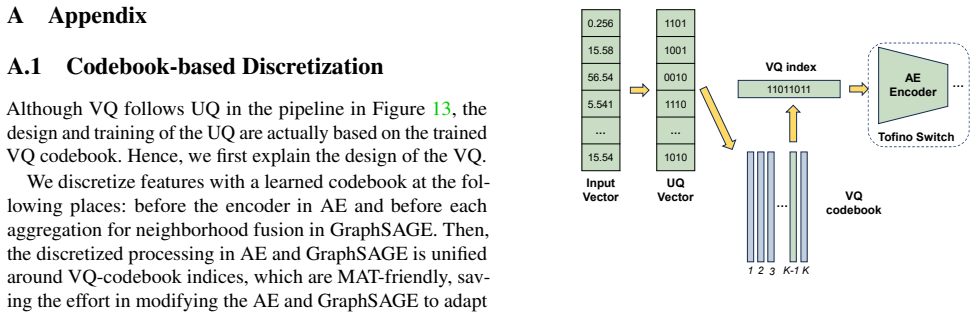
The paper's central discovery is that vector quantization—mapping each high-dimensional spectral sample to an integer codebook index—simultaneously solves the two problems that block GNNs on switch hardware: it turns the input into a single match-action table key (eliminating per-dimension arithmetic loops), and it shrinks inter-switch feature messages to a few bits. Around this key, the authors build an autoencoder to compress raw spectrum, a GraphSAGE model to aggregate features from neighboring switches, and neighbor state machines to coordinate asynchronous arrivals. On a six-node packet-over-optical testbed, the resulting system reports 99.47% classification accuracy and 99.54% location
What carries the argument
The VQ codebook index is the load-bearing object. It is a learned integer ID that represents a full spectral sample; RIGEL uses it as both the match-action table lookup key for the autoencoder and as the compact token exchanged between switches for GraphSAGE neighbor aggregation. The graph model is a two-layer GraphSAGE with fixed-size neighbor sampling, chosen because its inductive, deterministic aggregation fits the non-iterative pipeline of a programmable switch. The entire inference path is compiled into match-action tables and registers, coordinated by neighbor state machines that track which local and remote features have arrived.
Load-bearing premise
The system's accuracy depends on the OPM's CPU being able to run PCA, uniform quantization, and vector quantization on 640-dimensional spectra fast enough and with enough fidelity that the resulting codebook index still separates the subtle failure classes, especially the ±12.5 GHz filter drifts.
What would settle it
Measure the preprocessing latency and diagnostic accuracy on a stock OPM CPU using real 640-dimensional spectra. If the preprocessing cannot finish within the OPM monitoring interval, or if classification accuracy for the filter-drift classes (±12.5 GHz) falls below the reported levels, then the in-network inference has lost the information it needs and the reported results do not transfer beyond the testbed.
If this is right
- If correct, operators can diagnose soft failures without centralized analytics, freeing controllers for other tasks and avoiding round-trip latency across metro and backbone distances.
- The VQ-index trick may generalize to other high-dimensional telemetry (e.g., power, BER, q-factor) that currently overwhelms in-network machine learning.
- The multi-root reporting mechanism offers a cheap way to detect unseen anomalies and trigger automatic retraining.
- Cross-topology generalization means a model trained on one network can be deployed on another without retraining, easing network expansion.
- The hardware footprint (six of twelve stages, under 4% SRAM) suggests the diagnosis model can coexist with normal forwarding on the same switch.
Where Pith is reading between the lines
- The preprocessing on the OPM CPU (PCA to UQ to VQ) moves the real computational cost off the switch; if that CPU becomes a bottleneck, the 'real-time' advantage depends on the OPM vendor's compute budget rather than on the switch itself.
- The reported three-orders-of-magnitude overhead reduction assumes the switch only sends anomaly alerts; in a network with high anomaly rates, the saving shrinks as alerts dominate traffic.
- The VQ-index approach could be applied to other graph-structured network telemetry (e.g., wireless, datacenter, or multi-domain optical), but the paper's testbed is single-domain and may not capture cross-domain propagation effects.
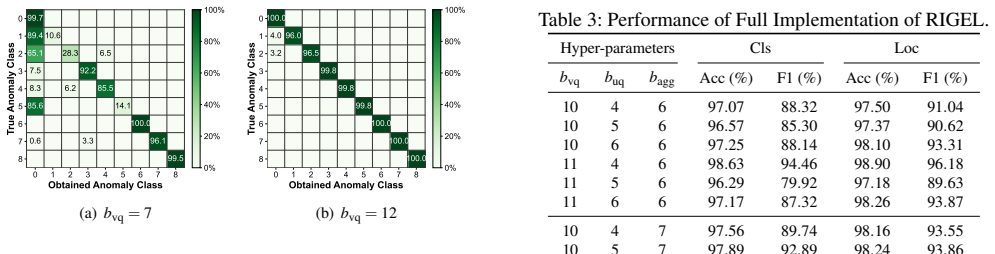
- The one-bit jump in aggregation codebook size (from 6 to 7 bits) produced the largest accuracy gains, suggesting that the inter-switch feature bottleneck, not the input quantization, is the current limiter.
Editorial analysis
A structured set of objections, weighed in public.
Referee Report
Summary. The paper proposes RIGEL, a system that performs optical anomaly diagnosis entirely in the data plane of P4/Tofino switches, using distributed GraphSAGE-style inference. The design preprocesses high-dimensional OPM spectra on the OPM CPU with a PCA→UQ→VQ pipeline, encodes each sample as a VQ codebook index, and then performs AE-based feature extraction and GraphSAGE-based neighbor aggregation inside the switch via match-action tables. The authors claim that this is the first stateful distributed in-network GNN diagnosis system, report above 99% classification/location accuracy and above 98% F1-scores on a packet-over-optical testbed, and report a reduction in control-plane data exchange overhead by more than three orders of magnitude relative to centralized GNN baselines.
Significance. If the claims hold, RIGEL is a substantive engineering contribution: it demonstrates that a GNN-based diagnostic model can be compiled into MATs on Tofino switches, that stateful multi-switch aggregation is feasible with small resource footprints (6/12 stages, <4% SRAM), and that VQ-based discretization can avoid per-dimension iterative processing. The paper's strengths include a real testbed with optical components and Tofino switches, concrete hardware resource measurements, a clearly described multi-step quantization/training pipeline (Algorithm 1 and Appendix A), and systematic ablation of the three bit-widths bvq, buq, and bagg. The reported generalization experiments across topologies and unseen anomalies are also useful. However, the central claims are currently supported by experiments that have several load-bearing gaps: the data-plane description does not fully substantiate the 2-hop GraphSAGE claim, hyperparameters appear to be selected on the same test set used for final reporting, and the stated number of testing samples is inconsistent with the dataset size.
major comments (4)
- [§3.2, §4, §6, Figure 6] The data-plane implementation appears to perform only one round of neighbor aggregation, not the two-layer GraphSAGE claimed in §4. The feature packets exchanged between switches carry the AE embedding n_feat (Figure 6, Pipe-1 Local_feature_reg/Neigh_feature_reg), not the intermediate h_feat produced by the first AGG_table. Pipe-1 sends h_feat directly to Pipe-2, where AGG_table yields cls/root, but there is no mechanism for a switch to receive its neighbors' h_feat. Therefore the implemented inference is 1-hop feature aggregation followed by classification, whereas the full-precision model in §4 aggregates 2-hop neighborhoods. Since the paper's central novelty is 'distributed in-network inference through collaborative GNNs' and the diagnostic advantage is attributed to propagation over multiple hops, please clarify this discrepancy: provide P4-level pseudocode or a definitive state mach
- [§7.3, Table 3, Table 1, Table 6] The optimal configuration (bvq=11, buq=6, bagg=7) is selected directly from Table 3, which appears to report test-set performance for all hyperparameter combinations. The same configuration is then used for the end-to-end results in Table 1 and the comparison in Table 6. If the test set is used for model selection, the reported accuracies and F1-scores are optimistically biased. The paper should either use a separate validation set for selecting bit-widths, report performance on a truly held-out test set after selection, or present nested cross-validation. Additionally, no repeated-run variance or error bars are given anywhere, so it is not possible to judge whether the differences between configurations (e.g., 99.45 vs 99.18 in Table 3) are meaningful.
- [§7.5, Table 6] The text states that the experiments in Table 6 run over 'all the ~400,000 testing samples.' However, §4 reports a total dataset of ~234,000 samples and a 0.6/0.2/0.2 train/validation/test split, which yields about 46,800 test samples, not 400,000. This is a large numerical inconsistency that directly affects the reproducibility of the reported interaction counts (66,950 vs 6,490) and the claimed overhead-reduction ratios. Please correct the sample count and recompute the ratios, or explain what 'testing samples' means here.
- [§7.2, 'In-Switch Inference Latency'] The microbenchmark compares one GraphSAGE aggregation layer on Tofino (~800 ns) against a CPU server (~10 ms) while 'deliberately excluding the latency due to inter-node communication.' For a distributed system, inter-switch feature exchange and state synchronization are part of the end-to-end diagnostic latency, and the paper elsewhere emphasizes that 'adding more neighbors increases diagnosis latency.' Please report the total diagnosis latency including feature-packet exchange, or at least bound it, so that the 'real-time' claim is supported.
minor comments (5)
- [§7.3, last paragraph] The text says 'to improve diagnosis accuracy, an operator should first try to increase the VQ/UQ bit-widths, while adding more neighbors in each neighbor aggregation should always be the second choice.' This seems inconsistent with the immediately preceding observation that bagg is the main performance bottleneck and that increasing bagg from 6 to 7 gives the largest F1 gains. Clarify whether 'adding more neighbors' refers to the aggregation neighbor count (S1, S2) or the aggregation codebook bit-width bagg, and reconcile the recommendation with Table 3.
- [Figure 8 and §7.3] Figure 8 shows performance up to bvq=12, but the text says 'we will select bvq ∈ [9,11]' after discussing the figure. Specify why bvq=12 is shown and then excluded from later experiments (presumably MAT-size constraints), or adjust the figure/text for consistency.
- [§3.4, §7.4] The multi-root reporting threshold for retraining is described only qualitatively ('preset threshold'). Since §7.4 reports multi-root reporting rates for known and unseen anomalies, please state the threshold used and how sensitive the results are to it.
- [§4, §7.1] The number of sampled neighbors per GraphSAGE aggregation is set to 1, which means each node aggregates exactly one neighbor at each hop. This is a strong constraint, and its effect on accuracy versus larger sampling counts is not investigated. Please justify this choice or note its impact.
- [General] Several related works on in-network ML (e.g., Taurus, IIsy, Planter) are cited in the introduction but not discussed in comparison with RIGEL's quantization approach. A short paragraph contrasting RIGEL with these systems would help position the contribution.
Circularity Check
No significant circularity: RIGEL's contributions are empirical and its quantized on-switch model is distilled from an independently trained full-precision baseline, not defined in terms of the reported outputs.
full rationale
RIGEL is an empirical systems paper; its central claims are demonstrated by testbed measurements and compiled P4 artifacts, not derived from self-referential equations. The full-precision AE-GraphSAGE is trained with task supervision on labeled spectral data (§4), and the quantized on-switch model is obtained by distillation from that baseline (Eqs. (2), (4), Algorithm 1). The reported end-to-end accuracy is therefore not a fitted parameter renamed as a prediction. The PCA→UQ→VQ preprocessing is a lossy compression stage whose information loss is explicitly measured (§7.3), so the accuracy claims are conditional on that compression rather than assumed by it. The few self-citations ([8,9,18,62]) are background references to prior ML-based optical fault management and to the NSFNET topology; none is invoked as a uniqueness theorem or as the justification for the system's correctness. The held-out split (0.6/0.2/0.2) is standard empirical evaluation, not circular reasoning. The skeptic's observation that the data-plane description appears to implement one hop of neighbor aggregation rather than the two SAGEConv layers described in §4 is a correctness/architecture-fidelity concern, not a circularity concern: it does not make any predicted quantity equal to a fitted input by construction. Similarly, the choice of bit-widths (bvq, buq, bagg) is tuned on the testbed and then reported; this is potential overfitting, not circularity.
Axiom & Free-Parameter Ledger
free parameters (10)
- PCA output dimensionality =
20
- AE latent dimensionality =
10
- VQ codebook bit-width bvq =
11
- UQ bit-width buq =
6
- GraphSAGE aggregation codebook bit-width bagg =
7
- Per-dimension UQ step size and zero point (Δd, σd) =
learned
- Loss weights (λz, μz, λu, λs, γ, η, α) =
tuned
- GraphSAGE neighbor sampling count and depth =
1 sample, 2 hops
- Multi-root reporting retraining threshold =
unstated
- Trained PCA projection, AE and GraphSAGE weights =
trained
axioms (6)
- domain assumption GraphSAGE inductive aggregation over a 2-hop neighborhood captures anomaly propagation signatures.
- domain assumption Optical soft failures produce distinguishable spectral signatures visible to OPMs.
- domain assumption OPM CPU preprocessing (PCA→UQ→VQ) can run at a few samples per second and preserve enough signal.
- domain assumption Tofino PISA limitations (no floating point, no native matrix multiplication, limited stages) make table-driven integer execution the right target.
- domain assumption The network topology and neighbor set are known to each NSM so neighbor features can be aggregated.
- standard math Standard ML machinery—PCA, VQ, k-means initialization, EMA codebook updates, distillation losses—works as expected.
read the original abstract
The recent booming of data-intensive applications has complicated optical network management, making real-time optical anomaly diagnosis a must-have feature. However, existing approaches are mostly based on centralized data analytics and thus can hardly avoid the latency and overhead due to message exchanges between data and control planes. In this work, we propose and prototype RIGEL, which, to the best of our knowledge, is the first real-time optical anomaly diagnosis system that realizes stateful distributed in-network inference through collaborative graph neural networks (GNNs) on Tofino switches. The system is designed to be fully in-network, and a software-hardware co-design is proposed to preprocess high-dimensional spectral data for being suitable for hardware-based in-network inference. Next, we first develop an effective model to combine an autoencoder with a GraphSAGE-based GNN, and then propose a generalizable method to adapt the model to Tofino switch. The effectiveness of RIGEL is showcased in a realistic packet-over-optical network testbed, verifying that it achieves highly accurate diagnosis to detect and locate optical anomalies timely and highlighting its benefits over the state-of-the-art methods.
Figures




Reference graph
Works this paper leans on
-
[1]
https://www.barefootnetworks
Tofino switch. https://www.barefootnetworks. com/products/brief-tofino/
-
[2]
Shale: A practical, scalable oblivious reconfigurable network
Daniel Amir, Nitika Saran, Tegan Wilson, Robert Klein- berg, Vishal Shrivastav, and Hakim Weatherspoon. Shale: A practical, scalable oblivious reconfigurable network. InAnnual Conference of the ACM Special Interest Group on Data Communication (SIGCOMM), pages 449–464, 2024
2024
-
[3]
FlowLens: Enabling efficient flow classification for ML- based network security applications
Diogo Barradas, Nuno Santos, Luís Rodrigues, Salva- tore Signorello, Fernando Ramos, and André Madeira. FlowLens: Enabling efficient flow classification for ML- based network security applications. InNetwork and Distributed System Security (NDSS), 2021
2021
-
[4]
P4: Programming protocol-independent packet processors
Pat Bosshart, Dan Daly, Glen Gibb, Martin Izzard, Nick McKeown, Jennifer Rexford, Cole Schlesinger, Dan Talayco, Amin Vahdat, George Varghese, et al. P4: Programming protocol-independent packet processors. ACM SIGCOMM Computer Communication Review, 44(3):87–95, 2014
2014
-
[5]
Forwarding metamorphosis: Fast programmable match-action processing in hardware for SDN.ACM SIGCOMM Computer Communication Re- view, 43(4):99–110, 2013
Pat Bosshart, Glen Gibb, Hun-Seok Kim, George Vargh- ese, Nick McKeown, Martin Izzard, Fernando Mujica, and Mark Horowitz. Forwarding metamorphosis: Fast programmable match-action processing in hardware for SDN.ACM SIGCOMM Computer Communication Re- view, 43(4):99–110, 2013
2013
-
[6]
pfor- est: In-network inference with random forests.arXiv preprint arXiv:1909.05680, 2019
Coralie Busse-Grawitz, Roland Meier, Alexander Di- etmüller, Tobias Bühler, and Laurent Vanbever. pfor- est: In-network inference with random forests.arXiv preprint arXiv:1909.05680, 2019
Pith/arXiv arXiv 1909
-
[7]
Dune: Distributed infer- ence in the user plane
Beyza Bütün, David De Andres Hernandez, Michele Gucciardo, and Marco Fiore. Dune: Distributed infer- ence in the user plane. InIEEE International Confer- ence on Computer Communications (INFOCOM), pages 1–10, 2025
2025
-
[8]
Automating optical network fault man- agement with machine learning.IEEE Communications Magazine, 60(12):88–94, 2022
Xiaoliang Chen, Che-Yu Liu, Roberto Proietti, Zhaohui Li, and Ben Yoo. Automating optical network fault man- agement with machine learning.IEEE Communications Magazine, 60(12):88–94, 2022
2022
-
[9]
On cooperative fault man- agement in multi-domain optical networks using hybrid learning.IEEE Journal of Selected Topics in Quantum Electronics, 28(4):1–9, 2022
Xiaoliang Chen, Che-Yu Liu, Roberto Proietti, Jie Yin, Zhaohui Li, and Ben Yoo. On cooperative fault man- agement in multi-domain optical networks using hybrid learning.IEEE Journal of Selected Topics in Quantum Electronics, 28(4):1–9, 2022
2022
-
[10]
Fernandez De Jauregui Ruiz, Amirhossein Ghazisaeidi, Thierry Zami, Sabine Louis, and Bruno Lavigne
I. Fernandez De Jauregui Ruiz, Amirhossein Ghazisaeidi, Thierry Zami, Sabine Louis, and Bruno Lavigne. An accurate model for system performance analysis of optical fibre networks with in-line filtering. InEuropean Conference on Optical Communication (ECOC), pages 1–4, 2019
2019
-
[11]
Vector quantization.IEEE Assp Magazine, 1(2):4–29, 1984
Robert Gray. Vector quantization.IEEE Assp Magazine, 1(2):4–29, 1984
1984
-
[12]
In- ductive representation learning on large graphs
Will Hamilton, Zhitao Ying, and Jure Leskovec. In- ductive representation learning on large graphs. In Advances in Neural Information Processing Systems (NeurIPS), volume 30, 2017
2017
-
[13]
Semi-supervised classi- fication with graph convolutional networks
Thomas Kipf and Max Welling. Semi-supervised classi- fication with graph convolutional networks. InInterna- tional Conference on Learning Representations (ICLR), 2017
2017
-
[14]
Distributed graph neural net- works in programmable data planes
Ivan Lamb, Pedro Arthur Duarte, Jonatas Marques, Marcelo Luizelli, Luciano Gaspary, Anderson Tavares, Ronaldo Ferreira, Ítalo Cunha, José Rodrigo Azambuja, and Weverton Cordeiro. Distributed graph neural net- works in programmable data planes. InIEEE Net- work Operations and Management Symposium (NOMS), pages 01–09, 2025
2025
-
[15]
Optimizing telemetry forwarding for distributed failure recovery in packet-optical networks.Journal of Optical Commu- nications and Networking, 17(2):152–162, 2025
Piotr Lechowicz, Carlos Natalino, Filippo Cugini, Francesco Paolucci, and Paolo Monti. Optimizing telemetry forwarding for distributed failure recovery in packet-optical networks.Journal of Optical Commu- nications and Networking, 17(2):152–162, 2025
2025
-
[16]
Deeper insights into graph convolutional networks for semi- supervised learning
Qimai Li, Zhichao Han, and Xiao-Ming Wu. Deeper insights into graph convolutional networks for semi- supervised learning. InAssociation for the Advancement of Artificial Intelligence (AAAI), volume 32, 2018
2018
-
[17]
OpticGAI: Generative AI-aided deep reinforce- ment learning for optical networks optimization
Siyuan Li, Xi Lin, Yaju Liu, Gaolei Li, and Jianhua Li. OpticGAI: Generative AI-aided deep reinforce- ment learning for optical networks optimization. In SIGCOMM Workshop on Hot Topics in Optical Tech- nologies and Applications in Networking (Hot-Optics), pages 1–6, 2024
2024
-
[18]
Scaling opti- cal network fault management with decentralized graph learning
Qunzhi Lin, Xiaokang Chen, Zhenlin Ouyang, Hanyu Gao, Xiaoliang Chen, and Zhaohui Li. Scaling opti- cal network fault management with decentralized graph learning. InOptical Fiber Communications Conference and Exhibition (OFC), pages 1–3, 2024
2024
-
[19]
An al- gorithm for vector quantizer design.IEEE Transactions on communications, 28(1):84–95, 1980
Yoseph Linde, Andres Buzo, and Robert Gray. An al- gorithm for vector quantizer design.IEEE Transactions on communications, 28(1):84–95, 1980
1980
-
[20]
Lightwave fabrics: At- scale optical circuit switching for datacenter and ma- chine learning systems
Hong Liu, Ryohei Urata, Kevin Yasumura, Xiang Zhou, Roy Bannon, Jill Berger, Pedram Dashti, Norm Jouppi, Cedric Lam, Sheng Li, et al. Lightwave fabrics: At- scale optical circuit switching for datacenter and ma- chine learning systems. InAnnual Conference of the ACM Special Interest Group on Data Communication (SIGCOMM), pages 499–515, 2023
2023
-
[21]
Jaqen: A high- performance switch-native approach for detecting and mitigating volumetric DDoS attacks with programmable switches
Zaoxing Liu, Hun Namkung, Georgios Nikolaidis, Jeongkeun Lee, Changhoon Kim, Xin Jin, Vladimir Braverman, Minlan Yu, and Vyas Sekar. Jaqen: A high- performance switch-native approach for detecting and mitigating volumetric DDoS attacks with programmable switches. InUSENIX Security Symposium (USENIX Se- curity), pages 3829–3846, 2021
2021
-
[22]
Huazhi Lun, Mengfan Fu, Xiaomin Liu, Yiwen Wu, Lilin Yi, Weisheng Hu, and Qunbi Zhuge. Soft failure identification for long-haul optical communication sys- tems based on one-dimensional convolutional neural net- work.Journal of Lightwave Technology, 38(11):2992– 2999, 2020
2020
-
[23]
A GAN based soft failure detection and identification frame- work for long-haul coherent optical communication sys- tems.Journal of Lightwave Technology, 41(8):2312– 2322, 2023
Huazhi Lun, Mengfan Fu, Yihao Zhang, Hexun Jiang, Lilin Yi, Weisheng Hu, and Qunbi Zhuge. A GAN based soft failure detection and identification frame- work for long-haul coherent optical communication sys- tems.Journal of Lightwave Technology, 41(8):2312– 2322, 2023
2023
-
[24]
Vector quantization in speech coding.Proceedings of the IEEE, 73(11):1551–1588, 1985
John Makhoul, Salim Roucos, and Herbert Gish. Vector quantization in speech coding.Proceedings of the IEEE, 73(11):1551–1588, 1985
1985
-
[25]
Realiz- ing rotorNet: Toward practical microsecond scale optical networking
William Mellette, Alex Forencich, Rukshani Athapathu, Alex Snoeren, George Papen, and George Porter. Realiz- ing rotorNet: Toward practical microsecond scale optical networking. InAnnual Conference of the ACM Special Interest Group on Data Communication (SIGCOMM), pages 392–414, 2024
2024
-
[26]
Detecting ephemeral optical events with OpTel
Congcong Miao, Minggang Chen, Arpit Gupta, Zili Meng, Lianjin Ye, Jingyu Xiao, Jie Chen, Zekun He, Xulong Luo, Jilong Wang, et al. Detecting ephemeral optical events with OpTel. InUSENIX Symposium on Networked Systems Design and Implementation (NSDI), pages 339–353, 2022
2022
-
[27]
FlexWAN: Soft- ware hardware co-design for cost-effective and resilient optical backbones
Congcong Miao, Zhizhen Zhong, Ying Zhang, Kunling He, Fangchao Li, Minggang Chen, Yiren Zhao, Xiang Li, Zekun He, Xianneng Zou, et al. FlexWAN: Soft- ware hardware co-design for cost-effective and resilient optical backbones. InAnnual Conference of the ACM Special Interest Group on Data Communication (SIG- COMM), pages 319–332, 2023
2023
-
[28]
A tutorial on machine learning for failure man- agement in optical networks.Journal of Lightwave Technology, 37(16):4125–4139, 2019
Francesco Musumeci, Cristina Rottondi, Giorgio Corani, Shahin Shahkarami, Filippo Cugini, and Massimo Tor- natore. A tutorial on machine learning for failure man- agement in optical networks.Journal of Lightwave Technology, 37(16):4125–4139, 2019
2019
-
[29]
Failure management in optical networks with ML: a tutorial on applications, challenges, and pitfalls.Journal of Optical Communications and Networking, 17(8):C144–C155, 2025
Francesco Musumeci and Massimo Tornatore. Failure management in optical networks with ML: a tutorial on applications, challenges, and pitfalls.Journal of Optical Communications and Networking, 17(8):C144–C155, 2025
2025
-
[30]
Forghieri
Pierluigi Poggiolini, Gabriella Bosco, Andrea Carena, Vittorio Curri, Yanchao Jiang, and F. Forghieri. The GN- model of fiber non-linear propagation and its applica- tions.Journal of Lightwave Technology, 32(4):694–721, 2014
2014
-
[31]
Flex- gate: High-performance heterogeneous gateway in data centers
Kun Qian, Sai Ma, Mao Miao, Jianyuan Lu, Tong Zhang, Peilong Wang, Chenghao Sun, and Fengyuan Ren. Flex- gate: High-performance heterogeneous gateway in data centers. InAsia-Pacific Workshop on Networking (AP- Net), pages 36–42, 2019
2019
-
[32]
Sales, A
R. Sales, A. Ribeiro, M. Silva, F. Lobato, A. Sgam- belluri, L. Valcarenghi, and J. Costa. Disaggregated confidentiality-preserving scheme for fault detection in optical networks. InOptical Fiber Communications Conference and Exhibition (OFC), pages 1–3, 2024
2024
-
[33]
Can the network be the AI accelerator? InACM SIGCOMM Workshop on In-Network Computing (Net- Compute), pages 20–25, 2018
Davide Sanvito, Giuseppe Siracusano, and Roberto Bi- fulco. Can the network be the AI accelerator? InACM SIGCOMM Workshop on In-Network Computing (Net- Compute), pages 20–25, 2018
2018
-
[34]
Scaling distributed machine learning with in-network aggregation
Amedeo Sapio, Marco Canini, Chen-Yu Ho, Jacob Nelson, Panos Kalnis, Changhoon Kim, Arvind Kr- ishnamurthy, Masoud Moshref, Dan Ports, and Peter Richtárik. Scaling distributed machine learning with in-network aggregation. InUSENIX Symposium on Net- worked Systems Design and Implementation (NSDI), pages 785–808, 2021
2021
-
[35]
Learning from the optical spectrum: failure detection and identification.Journal of Lightwave Tech- nology, 37(2):433–440, 2019
Behnam Shariati, Marc Ruiz, Jaume Comellas, and Luis Velasco. Learning from the optical spectrum: failure detection and identification.Journal of Lightwave Tech- nology, 37(2):433–440, 2019
2019
-
[36]
Moises Felipe Silva, Andrea Sgambelluri, Alessan- dro Pacini, Francesco Paolucci, Andre Green, David Mascarenas, and Luca Valcarenghi. Confidentiality- preserving machine learning algorithms for soft-failure detection in optical communication networks.Journal of Optical Communications and Networking, 15(8):C212– C222, 2023
2023
-
[37]
Re-architecting traffic analysis with neural network interface cards
Giuseppe Siracusano, Salvator Galea, Davide Sanvito, Mohammad Malekzadeh, Gianni Antichi, Paolo Costa, Hamed Haddadi, and Roberto Bifulco. Re-architecting traffic analysis with neural network interface cards. In USENIX Symposium on Networked Systems Design and Implementation (NSDI), pages 513–533, 2022
2022
-
[38]
Running neural networks on the NIC.arXiv preprint arXiv:2009.02353, 2020
Giuseppe Siracusano, Salvator Galea, Davide Sanvito, Mohammad Malekzadeh, Hamed Haddadi, Gianni An- tichi, and Roberto Bifulco. Running neural networks on the NIC.arXiv preprint arXiv:2009.02353, 2020
Pith/arXiv arXiv 2009
-
[39]
Deep learning inference on com- modity network interface cards
Giuseppe Siracusano, Davide Sanvito, Salvator Galea, and Roberto Bifulco. Deep learning inference on com- modity network interface cards. InWorkshop on Systems for Machine Learning at NeurIPS (MLSys), pages 1–8, 2018
2018
-
[40]
Digital residual spectrum-based generalized soft failure detection and identification in optical networks.IEEE Transactions on Communications, 71(1):324–338, 2022
Kaixuan Sun, Zhenming Yu, Liang Shu, Zhiquan Wan, Hongyu Huang, Yi Lei, and Kun Xu. Digital residual spectrum-based generalized soft failure detection and identification in optical networks.IEEE Transactions on Communications, 71(1):324–338, 2022
2022
-
[41]
Taurus: A data plane architecture for per-packet ML
Tushar Swamy, Alexander Rucker, Muhammad Shahbaz, Ishan Gaur, and Kunle Olukotun. Taurus: A data plane architecture for per-packet ML. InACM International Conference on Architectural Support for Programming Languages and Operating Systems (ASPLOS), pages 1099–1114, 2022
2022
-
[42]
Neural dis- crete representation learning.Advances in neural infor- mation processing systems (NeurIPS), 30, 2017
Aaron Van Den Oord, Oriol Vinyals, et al. Neural dis- crete representation learning.Advances in neural infor- mation processing systems (NeurIPS), 30, 2017
2017
-
[43]
BER degradation detection and failure identification in elastic optical networks
Alba Vela, Marc Ruiz, Francesco Fresi, Nicola Sambo, Filippo Cugini, Gianluca Meloni, Luca Potì, Luis Ve- lasco, and Piero Castoldi. BER degradation detection and failure identification in elastic optical networks. Journal of Lightwave Technology, 35(21):4595–4604, 2017
2017
-
[44]
Graph attention networks
Petar Veliˇckovi´c, Guillem Cucurull, Arantxa Casanova, Adriana Romero, Pietro Lio, and Yoshua Bengio. Graph attention networks. InInternational Conference on Learning Representations (ICLR), 2018
2018
-
[45]
Fast texture synthesis using tree-structured vector quantization
Li-Yi Wei and Marc Levoy. Fast texture synthesis using tree-structured vector quantization. InAnnual confer- ence on Computer graphics and interactive techniques (SIGGRAPH), pages 479–488, 2000
2000
-
[46]
Programmable switches for in-networking classification
Bruno Missi Xavier, Rafael Silva Guimarães, Giovanni Comarela, and Magnos Martinello. Programmable switches for in-networking classification. InIEEE In- ternational Conference on Computer Communications (INFOCOM), pages 1–10, 2021
2021
-
[47]
Mousika: Enable general in-network intelligence in programmable switches by knowledge distillation
Guorui Xie, Qing Li, Yutao Dong, Guanglin Duan, Yong Jiang, and Jingpu Duan. Mousika: Enable general in-network intelligence in programmable switches by knowledge distillation. InIEEE International Confer- ence on Computer Communications (INFOCOM), pages 1938–1947, 2022
1938
-
[48]
Em- powering in-network classification in programmable switches by binary decision tree and knowledge dis- tillation.IEEE/ACM Transactions on Networking, 32(1):382–395, 2024
Guorui Xie, Qing Li, Guanglin Duan, Jiaye Lin, Yutao Dong, Yong Jiang, Dan Zhao, and Yuan Yang. Em- powering in-network classification in programmable switches by binary decision tree and knowledge dis- tillation.IEEE/ACM Transactions on Networking, 32(1):382–395, 2024
2024
-
[49]
Do switches dream of machine learning? Toward in-network classification
Zhaoqi Xiong and Noa Zilberman. Do switches dream of machine learning? Toward in-network classification. InACM Workshop on Hot Topics in Networks (HotNets), pages 25–33, 2019
2019
-
[50]
Brain-on-Switch: To- wards advanced intelligent network data plane via NN- driven traffic analysis at line-speed
Jinzhu Yan, Haotian Xu, Zhuotao Liu, Qi Li, Ke Xu, Mingwei Xu, and Jianping Wu. Brain-on-Switch: To- wards advanced intelligent network data plane via NN- driven traffic analysis at line-speed. InUSENIX Sympo- sium on Networked Systems Design and Implementation (NSDI), pages 419–440, 2024
2024
-
[51]
P4pir: In-network analysis for smart iot gateways
Mingyuan Zang, Changgang Zheng, Radostin Stoyanov, Lars Dittmann, and Noa Zilberman. P4pir: In-network analysis for smart iot gateways. InSIGCOMM Poster and Demo Sessions, pages 46–48. 2022
2022
-
[52]
Toward low-complexity neural networks for failure management in optical net- works.Journal of Optical Communications and Net- working, 17(7):555–563, 2025
Lareb Zar Khan, João Pedro, Omran Ayoub, Nelson Costa, Andrea Sgambelluri, Lorenzo De Marinis, Anto- nio Napoli, and Nicola Sambo. Toward low-complexity neural networks for failure management in optical net- works.Journal of Optical Communications and Net- working, 17(7):555–563, 2025
2025
-
[53]
Expertise-enhanced ma- chine learning for failure detection on field-deployed optical modules.Journal of Lightwave Technology, 43(1):137–154, 2025
Chunyu Zhang, Zhiming Sun, Weijie Yang, Bing Ye, Min Zhang, and Danshi Wang. Expertise-enhanced ma- chine learning for failure detection on field-deployed optical modules.Journal of Lightwave Technology, 43(1):137–154, 2025
2025
-
[54]
A Machine Learning-Based Toolbox for P4 Programmable Data-Planes.IEEE Transactions on Network and Ser- vice Management, 21(4):4450–4465, 2024
Kaiyi Zhang, Nancy Samaan, and Ahmed Karmouch. A Machine Learning-Based Toolbox for P4 Programmable Data-Planes.IEEE Transactions on Network and Ser- vice Management, 21(4):4450–4465, 2024
2024
-
[55]
MUTA: En- abling Multi-Task Neural Network Inference in Pro- grammable Data-Planes
Kaiyi Zhang, Changgang Zheng, Nancy Samaan, Ahmed Karmouch, and Noa Zilberman. MUTA: En- abling Multi-Task Neural Network Inference in Pro- grammable Data-Planes. InInternational Conference on High Performance Switching and Routing (HPSR), pages 1–6, 2025
2025
-
[56]
Quark: Im- plementing convolutional neural networks entirely on programmable data plane
Mai Zhang, Lin Cui, Xiaoquan Zhang, Fung Po Tso, Zhang Zhen, Yuhui Deng, and Zhetao Li. Quark: Im- plementing convolutional neural networks entirely on programmable data plane. InIEEE International Con- ference on Computer Communications (INFOCOM), pages 1–10, 2025
2025
-
[57]
Pegasus: A universal framework for scalable deep learning inference on the dataplane
Yinchao Zhang, Su Yao, Yong Feng, Kang Chen, Tong Li, Zhuotao Liu, Yi Zhao, Lexuan Zhang, Xiangyu Gao, Feng Xiong, et al. Pegasus: A universal framework for scalable deep learning inference on the dataplane. In Annual Conference of the ACM Special Interest Group on Data Communication (SIGCOMM), pages 692–706, 2025
2025
-
[58]
Bui, Siim Kaupmees, Riyad Bensoussane, Antoine Bernabeu, Shay Vargaftik, Yaniv Ben-Itzhak, and Noa Zilber- man
Changgang Zheng, Zhaoqi Xiong, Thanh T. Bui, Siim Kaupmees, Riyad Bensoussane, Antoine Bernabeu, Shay Vargaftik, Yaniv Ben-Itzhak, and Noa Zilber- man. IIsy: Hybrid In-Network Classification Using Programmable Switches.IEEE/ACM Transactions on Networking, 32(3):2555–2570, 2024
2024
-
[59]
Planter: Rapid Prototyping of In-Network Machine Learning Inference
Changgang Zheng, Mingyuan Zang, Xinpeng Hong, Liam Perreault, Riyad Bensoussane, Shay Vargaftik, Yaniv Ben-Itzhak, and Noa Zilberman. Planter: Rapid Prototyping of In-Network Machine Learning Inference. ACM SIGCOMM Computer Communication Review (SIGCOMM CCR), 54(1):2–21, 2024
2024
-
[60]
When P4 meets run-to- completion architecture
Hao Zheng, Xin Yan, Wenbo Li, Jiaqi Zheng, Xiaoliang Wang, Qingqing Zhao, Luyou He, Xiaofei Lai, Feng Gao, Fuguang Huang, et al. When P4 meets run-to- completion architecture. InUSENIX Symposium on Networked Systems Design and Implementation (NSDI), pages 1487–1505, 2025
2025
-
[61]
An efficient design of intelligent network data plane
Guangmeng Zhou, Zhuotao Liu, Chuanpu Fu, Qi Li, and Ke Xu. An efficient design of intelligent network data plane. InUSENIX Security Symposium (USENIX Security), pages 6203–6220, 2023
2023
-
[62]
Zuqing Zhu, Wei Lu, Liang Zhang, and Nirwan Ansari. Dynamic service provisioning in elastic optical net- works with hybrid single-/multi-path routing.Journal of Lightwave Technology, 31(1):15–22, 2013. A Appendix A.1 Codebook-based Discretization Although VQ follows UQ in the pipeline in Figure 13, the design and training of the UQ are actually based on t...
arXiv 2013
discussion (0)
Sign in with ORCID, Apple, or X to comment. Anyone can read and Pith papers without signing in.