REVIEW 3 major objections 6 minor 43 references
INTACT claims that a latent world model can be trained to map an intent—the latent difference between current and goal state—directly to an action, making test-time search optional; it reports 95.33% macro official success after one epoch o
Reviewed by Pith at T0; open to challenge. T0 means a machine referee read the full paper against a public rubric. the ladder, T0–T4 →
T0 review · deepseek-v4-flash
2026-08-01 00:44 UTC pith:TQXBEZ7Q
load-bearing objection The core claim — search-free amortized control — is real, but the headline SR numbers are partly an evaluator artifact and need to be re-presented before publication. the 3 major comments →
INTACT: Isomorphic Intent-to-Action Learning for Search-Free World Models
The pith
A machine-rendered reading of the paper's core claim, the machinery that carries it, and where it could break.
Core claim
At its core, the paper claims that the inverse direction of a world model—given a state and a requested latent change, produce an action—can be learned, not searched. It introduces a conditional action quotient: two endpoint conditions (a physical successor or a future goal) are equivalent at a given state when they induce the same expert action law, and a single shared predictor is trained with a proper action likelihood on both families. The representation is shaped end-to-end by this likelihood, so the encoder keeps action-relevant distinctions, while the forward predictor and a variance regularizer preserve the richer world state. At deployment the mean of the learned action distribution
What carries the argument
The central object is the shared INTACT Predictor, a three-layer MLP that outputs a diagonal-Gaussian action distribution conditioned on four typed slots: current latent z_t, motion intent m_t (either the attached local successor z_{t+1}−z_t or the stop-gradient goal residual sg(z_g)−z_t), the bilinear state–intent interaction z_t ⊙ m_t, and the previous action embedding. The same predictor is called on both intent families, and the endpoint gradients are asymmetric: the local successor is attached, the future goal is detached, so no loss pushes the two latent families to coincide. This single operator implements the paper's conditional action quotient and is what converts representation lea
Load-bearing premise
The load-bearing premise is that the official benchmark's success rates measure actual task completion; the paper's own audit shows that 38.38% of Cube pairs and 8.82% of TwoRoom pairs already satisfy the success threshold initially, and that Reacher's periodic wrist comparison can wrap, so the headline 95.33% macro is partly an artifact—under the corrected protocol the Direct macro falls to 83.33%.
What would settle it
Run the four benchmark tasks under a corrected evaluator that removes all initially-solved start–goal pairs, repairs the wrist topology, and checks wall collisions, then recompute the Direct macro success. If Reacher Direct stays near 49.56% and macro does not stay above roughly 80%, the paper's central claim that one epoch of intent-to-action learning makes search optional is falsified; conversely, if the corrected macro remains in the mid-80s, the claim survives the evaluator artifact.
If this is right
- Test-time search stops being the interface: Direct control uses zero candidate sequences and zero terminal-cost calls, cutting planner latency to milliseconds.
- Search becomes an optional verifier: a 128×3 cross-entropy search centered on the direct plan reaches 96.86% macro with 384 candidate sequences, outperforming a 9,000-sequence search that spends 23 times more samples.
- A single shared encoder can serve four control tasks: with task-specific heads, the shared representation improves all four tasks over the forward-only baseline and yields a unified latent intent space.
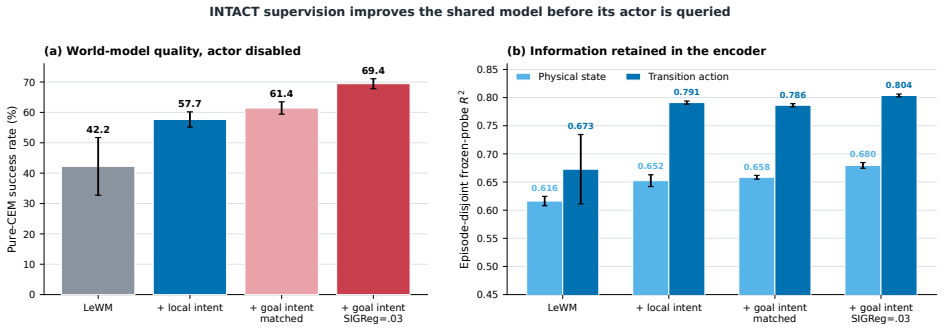
- Representation shaping and action readout separate: even with the actor disabled, pure planning from the learned encoder improves over the baseline, showing that the action likelihood improves the world model itself.
- Family-level action-law preservation, not pointwise action recovery, predicts closed-loop success: predicted–expert nearest-neighbor overlap tracks official success at r ≈ 0.95, while pointwise action R² tracks it more weakly.
Where Pith is reading between the lines
- An implication the authors leave implicit: the same shared-operator construction should work on any action-labelled offline dataset, not only JEPA-trained latents; the paper's final paragraph gestures at this, but it is not tested.
- Testable extension the authors list as a limitation: replace the diagonal-Gaussian mean with a mixture actor or sample from the learned conditional variance; at junctions the mean can lie between valid modes, so Direct success on contact-rich tasks should improve.
- The official-versus-corrected gap suggests that comparisons to prior controllers should be re-run under the stricter protocol before concluding parity; the corrected macro (83.33%) is the safer baseline for future work.
Editorial analysis
A structured set of objections, weighed in public.
Referee Report
Summary. The paper introduces INTACT, an end-to-end JEPA that augments a latent forward world model with a shared conditional action operator invoked on two intent families: attached local physical successors (z_{t+1} − z_t) and detached goal displacements (sg(z_g) − z_t). The two calls share a four-slot input grammar and parameters, and the conditional mean of the resulting action distribution is used as a zero-search Direct policy, with CEM relegated to optional local verification. The paper reports controlled single-task and shared-encoder multi-task experiments on the four official LeWM tasks, including a 2×2 factorial, an actor-sharing audit, a 576-job planner matrix, and a separate CLEAR-LeWM evaluator audit. The central claim is that latent world-model control can be amortized into a search-free policy rather than requiring test-time inversion of the forward model.
Significance. If the qualitative conclusion holds, the paper makes a useful advance: it shows, with unusually transparent controls and reproducibility infrastructure, that a joint local/goal intent-conditioned action likelihood can shape a JEPA representation so that direct action readout is competitive and search becomes optional. The controlled factorial, deterministic Math-SDPA backend, pinned evaluator version, and candid limitations section are genuine strengths. However, the headline quantitative claim as written is overstated: the official LeWM success rates used in the abstract and Section 5.1 are themselves shown by the paper's CLEAR-LeWM audit to be inflated, and the corrected Moderate numbers are substantially lower, especially on Reacher. The qualitative thesis survives the correction, but the paper's primary reported magnitudes and taskwise profile are partly evaluator artifacts. The discrepancy is load-bearing and must be fixed in revision.
major comments (3)
- [Abstract; §5.1, Table 2; Table A3; §L] The abstract and Section 5.1 present official LeWM success rates as the headline result: Direct reaches 85.78/100.00/97.67/97.89 on PushT/Cube/Reacher/TwoRoom, macro 95.33. The paper's own CLEAR-LeWM v0.5.1 audit (Table A3, Section L) demonstrates that the official evaluator is inflated: 38.38% of Cube pairs are initially solved, Reacher's periodic wrist comparison can wrap, and TwoRoom has a wall-penetration defect. On the corrected Moderate protocol, Direct macro is 83.33 and Reacher drops to 49.56. The abstract and headline repeat the uncorrected numbers without qualification, and Section 5.1 calls the result 'state-of-the-art level' on that basis. Since these success rates are the primary evidence for the central 'zero-search models reach X% success' claim, this is a load-bearing overclaim. The corrected numbers still beat pure CEM (83.33 vs 65.47 macro), so the qualitative thesis su
- [§5.2, Table 3, Table A6(c)] The shared-encoder headline, 89.39% Direct macro at E5, is also measured on the official evaluator. The CLEAR Moderate results in Table A6(c) give Goal-displacement INTACT 77.56% macro, with Reacher at 47.44%. The main text states 'Goal-displacement INTACT reaches 89.39±0.77% Direct macro' without noting the corrected protocol, which appears only in an appendix table. Because the multi-task claim 'one shared encoder improves all four domains' is partly an official-evaluator statement, the same revision is needed: at minimum, report Moderate macro parenthetically in Section 5.2 and in the abstract's shared-encoder sentence, and avoid presenting the official number as the sole measure of success.
- [§5.1, Table 2] The comparison with published rows (DINO-WM, LeWM, Fast-LeWM, Qantara, GC-IDM, PRISM) is explicitly non-paired and protocol-heterogeneous, and the paper acknowledges this. However, the text then uses the phrase 'state-of-the-art level among currently reported JEPA controllers' and the teaser states 'SOTA JEPA control.' On the corrected Moderate protocol, no published row has been audited under the same corrected evaluator, so a SOTA claim cannot be established from these data. The claim should be restricted to 'competitive with published official-SR numbers,' and the within-paper controlled comparison (Direct and Guarded A vs pure CEM on the same checkpoints) should be identified as the primary evidence.
minor comments (6)
- [§3.1] The notation switch from τ to k for the temporal index is confusing; the reader must repeatedly check whether k indexes a task or a time step. Consider using a different symbol for time throughout.
- [Figure 1] Figure 1 is extremely dense. The four-slot grammar and the 'shared twice' annotation are hard to parse; a simpler schematic or a table listing the four slots would improve readability.
- [Throughout] The term 'isomorphic' is used for both graph/typed-slot isomorphism and semantic family isomorphism. The definitions are present, but the double use should be flagged at first occurrence to avoid reader confusion.
- [§L, Table A17] CLEAR-LeWM is a self-authored software release. The pinned commit and detailed protocol contract are good, but an independent implementation or a more prominent statement that the corrected protocol is not yet independently validated would strengthen the corrected numbers.
- [Abstract] The phrase 'one-epoch, zero-search models' applies to the single-task results; the shared-encoder multi-task results use five epochs. Clarify this in the abstract to avoid ambiguity.
- [Abstract, line 5] Typo: 'isomorphic in two explicit between–and senses' should read 'between- and within-senses' or similar.
Circularity Check
No load-bearing circularity; minor self-citation (CLEAR-LeWM) is used adversarially and does not support the central claim.
full rationale
INTACT's derivation chain is self-contained. The central conditional operator G_eta:(z,m,a_-)->p_eta(a|z,m,a_-) is trained by the paired likelihood L_I2A on two explicitly defined intent coordinates, m_local = z_{t+1}-z_t and m_goal = sg(z_g)-z_t; no parameter is fitted to the reported success rates and then renamed as a prediction. The deployment procedure reuses exactly the same construction (Algorithm 2), which is the intended amortization rather than a circular step. Propositions 1-3 are definitional or standard KL/entropy identifiability results and are not used to manufacture the empirical SR numbers. The headline SR is measured by the external official LeWM evaluator for comparability, and the authors' own CLEAR-LeWM v0.5.1 audit [41] is pinned by commit hash and used adversarially: it lowers their own scores (Reacher Direct drops from 97.67 to 49.56 under Moderate), which is the opposite of a self-citation loaded in favor of the claim. The corrected Moderate macro (83.33 Direct) still beats pure CEM (65.47), so the qualitative conclusion does not reduce to the self-authored evaluator. Score 2 reflects only the presence of a minor self-citation in the evaluation audit, not any load-bearing circular reduction.
Axiom & Free-Parameter Ledger
free parameters (6)
- λ_inv (physical-inverse loss weight) =
0.1
- λ_goal (goal-intent loss weight) =
0.05
- SIGReg weight λ_sig =
0.02 (single-task) / 0.03 (multi-task)
- Guarded A verifier (σ0, K, I) =
σ0=0.25, K=128, I=3
- Intent coordinate and matched grammar =
goal displacement with [z; m; z⊙m; a−]
- Optimizer/training constants =
LR 5e-4, batch 256, wd 1e-3
axioms (6)
- standard math Expected NLL decomposes into entropy plus KL (Eq. 19)
- standard math Bijective quotient-to-law map (Prop 1)
- domain assumption Official LeWM evaluator success signal is faithful
- domain assumption Offline expert trajectories cover the deployment intent support
- domain assumption Autoregressive rollouts through F_φ stay within the training latent distribution
- ad hoc to paper The four-slot matched grammar [z; m; z⊙m; a−] is a sufficient feature for the action law
invented entities (2)
-
Conditional action quotient Y/∼_z (Def. 1)
no independent evidence
-
Motion-intent coordinates m_t = y − z (local and goal)
no independent evidence
read the original abstract
Forward latent world models predict how actions change a scene, but recover actions for a desired change only through expensive test-time search. We introduce INTACT (INtent-To-ACTion), an end-to-end JEPA that turns action-labeled, reward-free trajectories into a deployable intent-to-action interface. Each transition supplies physical intent $z_{t+1}-z_t$, while a future goal supplies deployment intent $\operatorname{sg}(z_g)-z_t$. The architecture is isomorphic between the local and goal motion-intent backbone-input graphs through an identical four-slot grammar and shared parameters, and between supported local and goal motion-intent families through action-law semantics induced by the same predictor rather than pointwise latent equality. INTACT also provides intact transfer from RGB evidence to action-effective latent intent coordinates and from intent families to their corresponding action-law families. Asymmetric endpoint gradients ground physical successors and fix future goals as anchors, joining representation learning and control without pointwise latent matching or globally linear dynamics. The resulting coordinates support a robust distributional action law: its conditional mean serves directly as a search-free policy, while sampling remains available for diversity or optional verification. On the four official LeWM tasks, one-epoch, zero-search models reach 85.78\%, 100.00\%, 97.67\%, and 97.89\% success. Optional local CEM centered on the Direct plan reaches 96.86\% macro success using 384 instead of 9,000 candidate sequences, reducing sampling by $23.44\times$ while improving pure CEM by 16.00 points. One shared four-task encoder reaches 89.39\% E5 Direct macro and improves every task over jointly trained LeWM, while predicted--expert action-family kNN tracks Direct success at $r=0.954$. Direct inference takes 2.9--5.5 ms.
Figures




Reference graph
Works this paper leans on
-
[1]
Learning latent dynamics for planning from pixels.Inter- national Conference on Machine Learning, 2019
Danijar Hafner, Timothy Lillicrap, Ian Fischer, Ruben Villegas, David Ha, Honglak Lee, and James Davidson. Learning latent dynamics for planning from pixels.Inter- national Conference on Machine Learning, 2019
2019
-
[2]
TD-MPC2: Scalable, robust world models for continuous control
Nicklas Hansen, Hao Su, and Xiaolong Wang. TD-MPC2: Scalable, robust world models for continuous control. In International Conference on Learning Representations, 2024
2024
-
[3]
DINO-WM: World models on pre-trained visual features enable zero-shot planning
Gaoyue Zhou, Hengkai Pan, Yann LeCun, and Lerrel Pinto. DINO-WM: World models on pre-trained visual features enable zero-shot planning. InInternational Conference on Machine Learning, 2025
2025
-
[4]
Lucas Maes, Quentin Le Lidec, Damien Scieur, Yann LeCun, and Randall Balestriero. Leworldmodel: Stable end-to-end joint-embedding predictive architecture from pixels.arXiv preprint arXiv:2603.19312, 2026
Pith/arXiv arXiv 2026
-
[5]
Kroese, Shie Mannor, and Reuven Y
Pieter-Tjerk de Boer, Dirk P. Kroese, Shie Mannor, and Reuven Y . Rubinstein. A tutorial on the cross-entropy method.Annals of Operations Research, 134(1):19–67, 2005
2005
-
[6]
Rehg, Byron Boots, and Evangelos A
Grady Williams, Nolan Wagener, Brian Goldfain, Paul Drews, James M. Rehg, Byron Boots, and Evangelos A. Theodorou. Information theoretic MPC for model-based reinforcement learning. InIEEE International Conference on Robotics and Automation, 2017
2017
-
[7]
Mastering diverse domains through world models.arXiv preprint arXiv:2301.04104, 2023
Danijar Hafner, Jurgis Pasukonis, Jimmy Ba, and Timo- thy Lillicrap. Mastering diverse domains through world models.arXiv preprint arXiv:2301.04104, 2023. 16
Pith/arXiv arXiv 2023
-
[8]
Vlad Sobal, Wancong Zhang, Kyunghyun Cho, Randall Balestriero, Tim G. J. Rudner, and Yann LeCun. Learning from reward-free offline data: A case for planning with la- tent dynamics models. InAdvances in Neural Information Processing Systems, 2025
2025
-
[9]
Randall Balestriero and Yann LeCun. Lejepa: Provable and scalable self-supervised learning without the heuris- tics.arXiv preprint arXiv:2511.08544, 2025
Pith/arXiv arXiv 2025
-
[10]
Causal-JEPA: Learn- ing world models through object-level latent masking
Heejeong Nam, Quentin Le Lidec, Lucas Maes, Yann LeCun, and Randall Balestriero. Causal-JEPA: Learn- ing world models through object-level latent masking. InInternational Conference on Machine Learning, 2026. arXiv:2602.11389
Pith/arXiv arXiv 2026
-
[11]
Fast LeWorldModel.arXiv preprint arXiv:2606.26217, 2026
Yuntian Gao and Xiangyu Xu. Fast LeWorldModel.arXiv preprint arXiv:2606.26217, 2026
Pith/arXiv arXiv 2026
-
[12]
Efros, and Trevor Darrell
Deepak Pathak, Pulkit Agrawal, Alexei A. Efros, and Trevor Darrell. Curiosity-driven exploration by self- supervised prediction. InInternational Conference on Machine Learning, 2017
2017
-
[13]
Provably filtering exogenous distractors using multistep inverse dynamics
Yonathan Efroni, Dipendra Misra, Akshay Krishnamurthy, Alekh Agarwal, and John Langford. Provably filtering exogenous distractors using multistep inverse dynamics. InInternational Conference on Learning Representations, 2022
2022
-
[14]
Inverse dynamics pretraining learns good representations for multitask imitation
David Brandfonbrener, Ofir Nachum, and Joan Bruna. Inverse dynamics pretraining learns good representations for multitask imitation. InAdvances in Neural Information Processing Systems, 2023
2023
-
[15]
Nair, Pieter Abbeel, Jitendra Malik, and Sergey Levine
Pulkit Agrawal, Ashvin V . Nair, Pieter Abbeel, Jitendra Malik, and Sergey Levine. Learning to poke by poking: Experiential learning of intuitive physics. InAdvances in Neural Information Processing Systems, volume 29, 2016
2016
-
[16]
Petr Ivashkov, Randall Balestriero, and Bernhard Sch¨olkopf. Sensorimotor world models: Percep- tion for action via inverse dynamics.arXiv preprint arXiv:2606.20104, 2026
Pith/arXiv arXiv 2026
-
[17]
Jewon Yeom, Hanseul Kim, Jeongjae Park, Sungmok Jung, Jaejin Lee, and Taesup Kim. What makes video world model latents action-relevant: Prediction over reconstruc- tion.arXiv preprint arXiv:2606.07687, 2026
Pith/arXiv arXiv 2026
-
[18]
Learning to reach goals via iterated supervised learning
Dibya Ghosh, Abhishek Gupta, Ashwin Reddy, Justin Fu, Coline Devin, Benjamin Eysenbach, and Sergey Levine. Learning to reach goals via iterated supervised learning. arXiv preprint arXiv:1912.06088, 2019. URL https: //arxiv.org/abs/1912.06088
Pith/arXiv arXiv 1912
-
[19]
C-Learning: Learning to achieve goals via recursive classification
Benjamin Eysenbach, Ruslan Salakhutdinov, and Sergey Levine. C-Learning: Learning to achieve goals via recursive classification. InInternational Conference on Learning Representations, 2021. URL https:// openreview.net/forum?id=tc5qisoB-C
2021
-
[20]
Contrastive learning as goal- conditioned reinforcement learning
Benjamin Eysenbach, Tianjun Zhang, Sergey Levine, and Ruslan Salakhutdinov. Contrastive learning as goal- conditioned reinforcement learning. InAdvances in Neural Information Processing Systems, volume 35, pages 35603– 35620, 2022
2022
-
[21]
Sutton, Doina Precup, and Satinder Singh
Richard S. Sutton, Doina Precup, and Satinder Singh. Be- tween MDPs and semi-MDPs: A framework for tem- poral abstraction in reinforcement learning.Artificial Intelligence, 112(1–2):181–211, 1999. doi: 10.1016/ S0004-3702(99)00052-1
1999
-
[22]
Klyubin, Daniel Polani, and Chrystopher L
Alexander S. Klyubin, Daniel Polani, and Chrystopher L. Nehaniv. Empowerment: A universal agent-centric mea- sure of control. InIEEE Congress on Evolutionary Computation, volume 1, pages 128–135, 2005. doi: 10.1109/CEC.2005.1554676
arXiv 2005
-
[23]
Diversity is all you need: Learning skills without a reward function
Benjamin Eysenbach, Abhishek Gupta, Julian Ibarz, and Sergey Levine. Diversity is all you need: Learning skills without a reward function. InInternational Conference on Learning Representations, 2019
2019
-
[24]
Dynamics-aware unsupervised discovery of skills
Archit Sharma, Shixiang Gu, Sergey Levine, Vikash Ku- mar, and Karol Hausman. Dynamics-aware unsupervised discovery of skills. InInternational Conference on Learn- ing Representations, 2020
2020
-
[25]
Unsupervised reinforcement learning with contrastive intrinsic control
Michael Laskin, Hao Liu, Xue Bin Peng, Denis Yarats, Aravind Rajeswaran, and Pieter Abbeel. Unsupervised reinforcement learning with contrastive intrinsic control. InAdvances in Neural Information Processing Systems, volume 35, 2022
2022
-
[26]
METRA: Scalable unsupervised RL with metric-aware abstraction
Seohong Park, Oleh Rybkin, and Sergey Levine. METRA: Scalable unsupervised RL with metric-aware abstraction. InInternational Conference on Learning Representations, 2024
2024
-
[27]
Dimen- sionality reduction by learning an invariant mapping
Raia Hadsell, Sumit Chopra, and Yann LeCun. Dimen- sionality reduction by learning an invariant mapping. In IEEE Computer Society Conference on Computer Vision and Pattern Recognition, pages 1735–1742, 2006. doi: 10.1109/CVPR.2006.100
-
[28]
FaceNet: A unified embedding for face recognition and clustering
Florian Schroff, Dmitry Kalenichenko, and James Philbin. FaceNet: A unified embedding for face recognition and clustering. InIEEE Conference on Computer Vision and Pattern Recognition, pages 815–823, 2015
2015
-
[29]
Learning invariant representations for reinforcement learning without recon- struction
Amy Zhang, Rowan Thomas McAllister, Roberto Calan- dra, Yarin Gal, and Sergey Levine. Learning invariant representations for reinforcement learning without recon- struction. InInternational Conference on Learning Repre- sentations, 2021. URL https://openreview.net/ forum?id=-2FCwDKRREu
2021
-
[30]
Bisimulation makes analogies in goal-conditioned reinforcement learning
Philippe Hansen-Estruch, Amy Zhang, Ashvin Nair, Patrick Yin, and Sergey Levine. Bisimulation makes analogies in goal-conditioned reinforcement learning. InProceedings of the 39th International Conference 17 on Machine Learning, volume 162 ofProceedings of Machine Learning Research, pages 8407–8426. PMLR,
-
[31]
Keiran Paster, Sheila A. McIlraith, and Jimmy Ba. Plan- ning from pixels using inverse dynamics models.arXiv preprint arXiv:2012.02419, 2020
Pith/arXiv arXiv 2012
-
[32]
Biased-MPPI: Informing sampling-based model predictive control by fus- ing ancillary controllers.IEEE Robotics and Automation Letters, 9(6):5871–5878, 2024
Enrico Trevisan and Javier Alonso-Mora. Biased-MPPI: Informing sampling-based model predictive control by fus- ing ancillary controllers.IEEE Robotics and Automation Letters, 9(6):5871–5878, 2024
2024
-
[33]
PRISM: PRior- guided imagination sampling in world models, 2026
Yuhai Wang, Jiawei Xia, Rongxuan Zhou, Xiao Hu, Yongliang Shi, Jing Du, and Yang Ye. PRISM: PRior- guided imagination sampling in world models, 2026. URL https://arxiv.org/abs/2606.07974
Pith/arXiv arXiv 2026
-
[34]
Hoang Nguyen, Xiaohao Xu, and Xiaonan Huang. Latent geometry beyond search: Amortizing planning in world models.arXiv preprint arXiv:2605.08732, 2026
Pith/arXiv arXiv 2026
-
[35]
QuoVLA: Quotient space for vision-language-action models.arXiv preprint arXiv:2605.24890, 2026
Xuan Wang, Yinan Wu, Haoran Duan, and Jungong Han. QuoVLA: Quotient space for vision-language-action models.arXiv preprint arXiv:2605.24890, 2026. URL https://arxiv.org/abs/2605.24890
Pith/arXiv arXiv 2026
-
[36]
Haihao Lin, Xiangsheng Huang, Xiao Yang, Weibang Zhou, Yiqi Zhang, Bo Yang, Simin Zeng, Jiawei Yang, Zhengyang Wang, and Jiahui Du. FiberTune: Preserving action-fiber visual residuals in vision-language-action fine- tuning.arXiv preprint arXiv:2606.08653, 2026. URL https://arxiv.org/abs/2606.08653
Pith/arXiv arXiv 2026
-
[37]
Chuning Zhu, Raymond Yu, Siyuan Feng, Benjamin Burchfiel, Paarth Shah, and Abhishek Gupta. Unified world models: Coupling video and action diffusion for pretraining on large robotic datasets.arXiv preprint arXiv:2504.02792, 2025
Pith/arXiv arXiv 2025
-
[38]
Joel Jang, Seonghyeon Ye, Zongyu Lin, Jiannan Xiang, Johan Bjorck, Yu Fang, Fengyuan Hu, Spencer Huang, Kaushil Kundalia, Yen-Chen Lin, et al. Dreamgen: Un- locking generalization in robot learning through video world models.arXiv preprint arXiv:2505.12705, 2025
Pith/arXiv arXiv 2025
-
[39]
Qantara: Bridge-flow training for multi- paradigm JEPA control.arXiv preprint arXiv:2607.04978, 2026
Ruslan Rakhimov, George Bredis, Yuriy Maksyuta, and Daniil Gavrilov. Qantara: Bridge-flow training for multi- paradigm JEPA control.arXiv preprint arXiv:2607.04978, 2026
Pith/arXiv arXiv 2026
-
[40]
OGBench: Benchmarking offline goal- conditioned reinforcement learning
Seohong Park, Kevin Frans, Benjamin Eysenbach, and Sergey Levine. OGBench: Benchmarking offline goal- conditioned reinforcement learning. InInternational Con- ference on Learning Representations, 2025
2025
-
[41]
CLEAR- LeWM: Calibrated, legality-aware evaluation for LeWM control
Junhan Sun, Guofeng Zhang, and Hao Zhao. CLEAR- LeWM: Calibrated, legality-aware evaluation for LeWM control. Software release, version 0.5.1,
-
[2022]
URL https://proceedings.mlr.press/ v162/hansen-estruch22a.html
-
[2026]
URL https://github.com/DavidSunok/ CLEAR-LeWM/releases/tag/v0.5.1. Commit 32f4416c333b5e3147641f70621ce3a9257f5920. 18 Appendix A Proofs and Statistical Interpretation Proof of Proposition 2. Let S= supp(z, z+). The successor- only risk is an integral of −logp η(a|z, y) over triples with (z, y)∈S . If two actors agree on S, their integrands and therefore ...
arXiv 2064
discussion (0)
Sign in with ORCID, Apple, or X to comment. Anyone can read and Pith papers without signing in.