Optimal finite element error estimates for an optimal control problem governed by the wave equation with controls of bounded variation
Pith reviewed 2026-05-24 15:53 UTC · model grok-4.3
The pith
Space-time finite element discretization yields optimal error rates for wave equation optimal control with bounded variation controls.
A machine-rendered reading of the paper's core claim, the machinery that carries it, and where it could break.
Core claim
The paper proves that under suitable assumptions the space-time finite element discretization of the state equation for the optimal control problem governed by the linear wave equation with controls of bounded variation produces optimal convergence rates for the errors in the state and control variables.
What carries the argument
Space-time finite element method applied to the state equation, with controls of bounded variation left undiscretized and the resulting semi-discrete problem solved by a conditional gradient method.
If this is right
- Optimal convergence rates hold for the error in the state variable.
- Optimal convergence rates hold for the error in the control variable.
- The semi-discretized problem can be solved using a conditional gradient method.
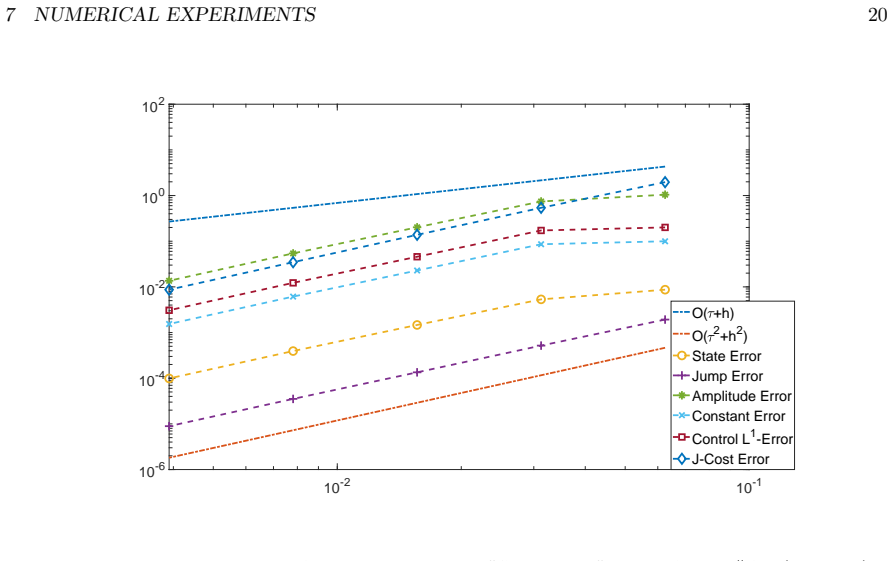
- Numerical experiments confirm the theoretical convergence rates.
Where Pith is reading between the lines
- Avoiding discretization of the controls may reduce computational effort in time-dependent settings if the regularity assumptions hold in applications.
- The same discretization strategy could apply to optimal control problems governed by other linear hyperbolic equations.
- The approach suggests that full discretization of controls is not required to reach optimal accuracy when the state discretization is sufficiently accurate.
Load-bearing premise
The problem data and solution must satisfy suitable regularity conditions that enable the stated optimal rates.
What would settle it
A numerical experiment satisfying the problem assumptions but exhibiting convergence rates strictly below the predicted optimal order would disprove the claim.
Figures
read the original abstract
This work discusses the finite element discretization of an optimal control problem for the linear wave equation with time-dependent controls of bounded variation. The main focus lies on the convergence analysis of the discretization method. The state equation is discretized by a space-time finite element method. The controls are not discretized. Under suitable assumptions optimal convergence rates for the error in the state and control variable are proven. Based on a conditional gradient method the solution of the semi-discretized optimal control problem is computed. The theoretical convergence rates are confirmed in a numerical example.
Editorial analysis
A structured set of objections, weighed in public.
Referee Report
Summary. The paper analyzes a space-time finite-element semi-discretization of an optimal control problem for the linear wave equation in which the controls are of bounded variation and are left undiscretized. Under suitable assumptions on the data and solution regularity, optimal convergence rates are proved for the errors in both the state and the control; the semi-discrete problem is solved by a conditional-gradient method and the rates are illustrated numerically.
Significance. If the error analysis holds, the work supplies the first optimal-rate theory for a wave-equation control problem whose control space is BV rather than L^2 or L^infty. This is a non-trivial extension of existing FEM theory for PDE-constrained optimization and supplies a concrete benchmark for future fully discrete schemes.
major comments (2)
- [Abstract / §1] Abstract and §1: the central claim of 'optimal convergence rates' is conditioned on 'suitable assumptions' on data and regularity that are never stated explicitly. Because these assumptions are load-bearing for every rate proved later, their precise formulation (e.g., required Sobolev or BV regularity of the optimal control) must be given before the error analysis can be assessed.
- [Error analysis sections (unspecified)] The manuscript never supplies the full error analysis or the precise statement of the discrete optimality conditions. Without these derivations it is impossible to verify that the claimed rates are indeed optimal and do not reduce to fitted constants or hidden regularity assumptions.
minor comments (1)
- [Numerical results] The numerical example is mentioned but no mesh sizes, observed rates, or comparison with theory are reported in the abstract or visible text; a table or figure caption should be added.
Simulated Author's Rebuttal
We thank the referee for the careful reading and the constructive comments on our manuscript. We address each major point below and indicate the revisions we will make.
read point-by-point responses
-
Referee: [Abstract / §1] Abstract and §1: the central claim of 'optimal convergence rates' is conditioned on 'suitable assumptions' on data and regularity that are never stated explicitly. Because these assumptions are load-bearing for every rate proved later, their precise formulation (e.g., required Sobolev or BV regularity of the optimal control) must be given before the error analysis can be assessed.
Authors: We agree that the assumptions need to be stated more explicitly in the introduction. In the revised manuscript we will insert a short paragraph immediately after the problem formulation in §1 that lists the precise regularity requirements: the optimal control lies in BV([0,T];ℝ^m) and the data satisfy the Sobolev-type conditions needed for the error estimates to hold. This will make the load-bearing hypotheses visible before any rates are claimed. revision: yes
-
Referee: [Error analysis sections (unspecified)] The manuscript never supplies the full error analysis or the precise statement of the discrete optimality conditions. Without these derivations it is impossible to verify that the claimed rates are indeed optimal and do not reduce to fitted constants or hidden regularity assumptions.
Authors: The complete error analysis appears in Sections 3 and 4, where the a-priori estimates for the state and control are derived from the approximation properties of the space-time FEM and the BV regularity of the control. The discrete optimality conditions are stated exactly in Lemma 3.1 and are used in the subsequent proofs. To improve readability we will add an explicit forward reference to these sections at the end of §1. The rates are optimal because they match the best approximation rates available for BV functions in the chosen norms; no hidden regularity is invoked beyond what is stated. revision: partial
Circularity Check
No significant circularity
full rationale
The paper establishes optimal a priori error estimates for a space-time FEM semi-discretization of a wave-equation optimal-control problem with BV controls (controls left continuous). The derivation proceeds from standard weak formulations, Galerkin orthogonality, and regularity assumptions on the data; the convergence rates are obtained by direct analysis of the discretization error rather than by fitting parameters to data or by renaming an input quantity as a prediction. No self-citation is invoked as the sole justification for a uniqueness or ansatz step that would collapse the central claim. The result is therefore a conventional, externally verifiable mathematical proof.
Axiom & Free-Parameter Ledger
Lean theorems connected to this paper
-
IndisputableMonolith/Foundation/RealityFromDistinction.leanreality_from_one_distinction unclear?
unclearRelation between the paper passage and the cited Recognition theorem.
Under suitable assumptions optimal convergence rates for the error in the state and control variable are proven.
What do these tags mean?
- matches
- The paper's claim is directly supported by a theorem in the formal canon.
- supports
- The theorem supports part of the paper's argument, but the paper may add assumptions or extra steps.
- extends
- The paper goes beyond the formal theorem; the theorem is a base layer rather than the whole result.
- uses
- The paper appears to rely on the theorem as machinery.
- contradicts
- The paper's claim conflicts with a theorem or certificate in the canon.
- unclear
- Pith found a possible connection, but the passage is too broad, indirect, or ambiguous to say the theorem truly supports the claim.
Reference graph
Works this paper leans on
-
[1]
L. Ambrosio, N. Fusco, and D. Pallara. Functions of bounded variation and free discontinuity problems. Oxford Mathematical Monographs, The Clarendon Press Oxford University Press, New York, 2000
work page 2000
-
[2]
G. A. Anastassiou.Intelligent Computations: Abstract Fractional Calculus, Inequalities, Approx- imations. Studies in Computational Intelligence. Springer International Publishing, 2017
work page 2017
-
[3]
K. Bredies and H. K. Pikkarainen. Inverse problems in spaces of measures.ESAIM Control Optim. Calc. Var., 19:190–218, Jan. 2013
work page 2013
- [4]
-
[5]
E. Casas and K. Kunisch. Optimal control of semilinear elliptic equations in measure spaces. SIAM Journal on Control and Optimization, 52(1):339–364, 2014
work page 2014
-
[6]
E. Casas and K. Kunisch. Analysis of optimal control problems of semilinear elliptic equations by bv-functions. Set-Valued and Variational Anaylsis, 1-25, 2017
work page 2017
- [7]
- [8]
-
[9]
E. Casas and F. Tröltzsch. A general theorem on error estimates with application to a quasilinear elliptic optimal control problem. Computational Optimization and Applications, 53(1):173–206, 2012
work page 2012
-
[10]
C. Clason and K. Kunisch. A duality-based approach to elliptic control problems in non-reflexive Banach spaces.ESAIM Control Optim. Calc. Var., 17:243–266, 2011
work page 2011
-
[11]
I. Ekeland and R. Témam.Convex Analysis and Variational Problems, Classics in Appl. Math. SIAM, Philadelphia, PA, english ed., 1999
work page 1999
-
[12]
S. Engel and K. Kunisch. Optimal control of the linear wave equation by time-depending bv- controls: A semi-smooth newton approach.ArXiv manuscript e-prints, 2018
work page 2018
-
[13]
Finite element error estimates for one-dimensional elliptic optimal control by BV functions
D. Hafemeyer, F. Mannel, I. Neitzel, and B. Vexler. Finite element error estimates for one- dimensional elliptic optimal control by bv functions. ArXiv e-prints 1902.05893v2, and Math. Control Relat. Fields, accepted, 2019
work page internal anchor Pith review Pith/arXiv arXiv 1902
-
[14]
O. Ladyjenskaya. Boundary value problems of mathematical physics.Nauka, Moscow, 1973
work page 1973
-
[15]
K. Pieper and B. Vexler. A priori error analysis for discretization of sparse elliptic optimal control problems in measure space. SIAM Journal on Control and Optimization 51(4),pp. 2788- 2808, 2013
work page 2013
-
[16]
K. Pieper and D. Walter. Linear convergence of accelerated conditional gradient algorithms in spaces of measures.ArXiv e-prints 1904.09218v1, 2019
-
[17]
P. Trautmann, B. Vexler, and A. Zlotnik. Finite element error analysis for measure-valued optimal control problems governed by a 1d wave equation with variable coefficients.Mathematical Control and Related Fields, 8:411, 2018
work page 2018
-
[18]
P. Trautmann, B. Vexler, and A. A. Zlotnik. Finite element error analysis for measure-valued optimal control problems governed by a 1d wave equation with variable coefficients.Mathematical Control and Related Fields, 8(2), pp. 411-449, 2018
work page 2018
-
[19]
A. A. Zlotnik. Convergence rate estimates of finite-element methods for second-order hyperbolic equations. numerical methods and applications, p.153 et.seq.Guri I. Marchuk, CRC Press, 1994
work page 1994
discussion (0)
Sign in with ORCID, Apple, or X to comment. Anyone can read and Pith papers without signing in.