REVIEW 3 major objections 4 minor 54 references
Frame-to-Frame Aggregation of Active Regions in Web Videos for Weakly Supervised Semantic Segmentation
T0 review · 3 major / 4 minor · reviewed 2026-08-14 · deepseek-v4-flash
Pith's one-line read Warping and unioning class activation maps across successive web-video frames produces proxy segmentation labels that cover more of the target object, reaching 65.0 and 67.4 mIoU on PASCAL VOC 2012.
desk verdict Promising use of web-video temporal aggregation for weakly supervised segmentation, with official benchmark gains, but the paper never isolates the flow-warping mechanism from a plain multi-frame union, and reproducibility is thin. read the letter →
The pith
A machine-rendered reading of the paper's core claim, the machinery that carries it, and where it could break.
The reading
What carries the argument
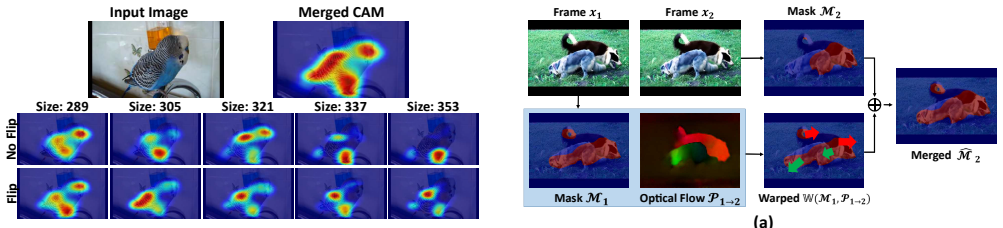
The load-bearing object is incremental flow-based warping of class activation maps (CAMs). For each class, per-frame masks are obtained by thresholding CAMs; pairwise optical flow is used to warp the accumulated mask into the next frame, and the union becomes the new accumulated mask. The second piece is the multi-class temporal filter: a $K$-frame clip is accepted only if every frame's classifier scores pick out the same set of classes and one of them is the search term, which both removes irrelevant web videos and refines noisy labels. Together they convert many frames of weak, noisy evidence into one denser proxy ground-truth image.
What would settle it
Replace the optical-flow field with a zero field (no warping) in the same pipeline and compare the final segmentation mIoU; if the union of unwarped masks performs as well as the warped union, the flow-based aggregation is not what drives the reported gain.
Extended reading notes
Core claim
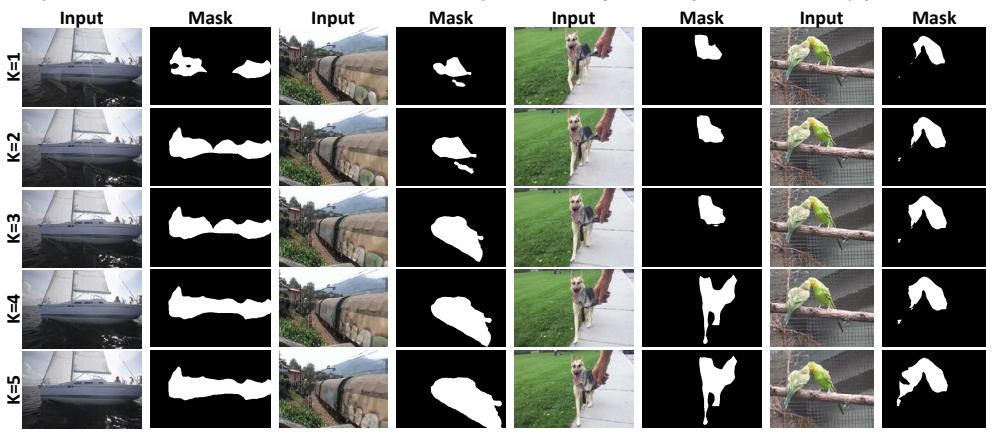
The paper's central claim is that temporal variation in video makes a classifier activate different regions of the same object, so these regions should be pooled across time. Formally, the method computes a per-class mask $M_i^c$ in each frame by thresholding the CAM, estimates optical flow $P_{i\to i+1}$ between consecutive frames, and builds an aggregated mask by $\hat M^c_{i+1}=M^c_{i+1}\cup W(\hat M^c_i, P_{i\to i+1})$, where $W$ warps the accumulated mask into the next frame. Repeating this incrementally over $K$ frames folds the activated regions of all frames into one proxy label. The paper also adds a multi-class temporal filter that keeps only $K$-frame clips whose classifier scores agree across frames, cleaning the noisy search-term labels from web videos. Trained on these proxy labels, the segmentation networks improve across every backbone and base method tested, giving PASCAL VOC 2012 test mIoU of 65.0 (VGG-16) and 67.4 (ResNet-101).
Load-bearing premise
The load-bearing premise is that the optical-flow algorithm tracks object motion accurately enough across five frames that each warped activation map lands on the same object in the target frame rather than drifting onto background or other objects.
Editorial extensions
If this is right
- With VGG-16, aggregated video masks raise PASCAL VOC validation mIoU from 61.2 (FickleNet alone) to 63.9; the test mIoU is 65.0.
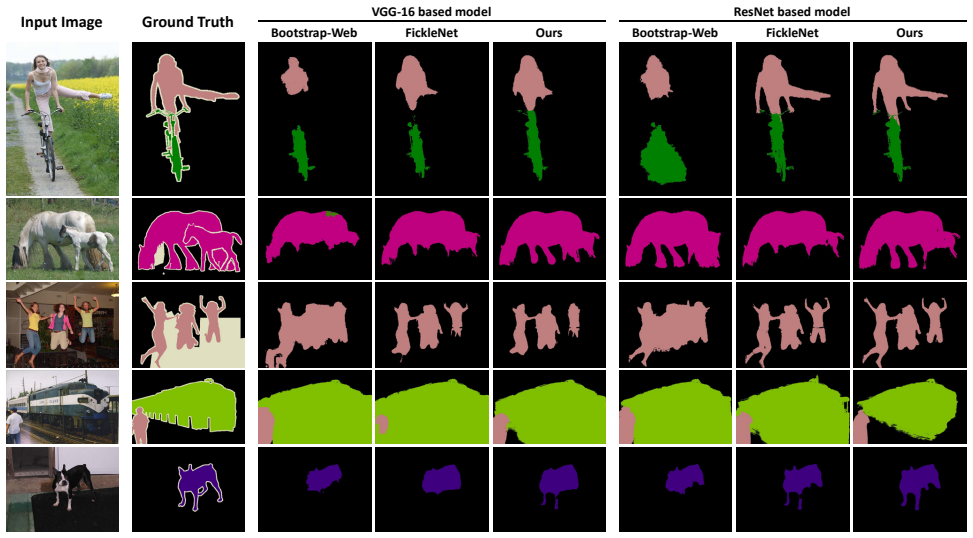
- With ResNet-101, the same recipe reaches 66.5 validation and 67.4 test mIoU, surpassing prior weakly supervised methods that use the same supervision.
- The recipe is a data-side add-on: applying it to SEC and DSRG as well as FickleNet improves each, so the gain transfers across segmentation architectures.
- In the webly supervised comparison, the method beats prior methods while training on far fewer samples: roughly 15,000 video frames rather than hundreds of thousands to nearly a million total samples.
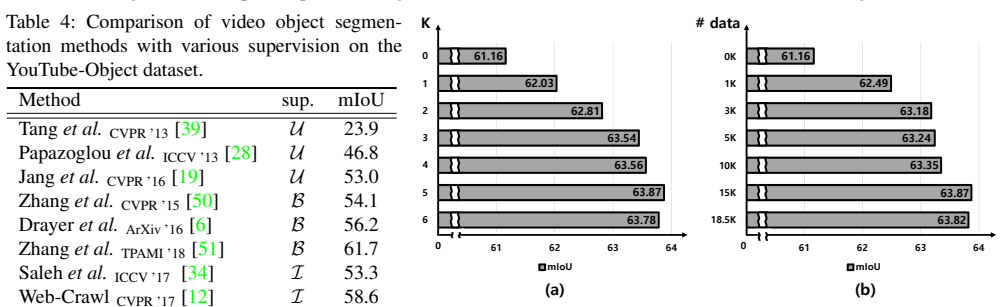
- Aggregation stops helping at K = 5 because optical-flow errors accumulate during incremental warping; the authors report a concrete failure case from this drift.
Reading between the lines
- This suggests the same warping-and-union recipe could densify other time-varying pixel-level signals, such as saliency maps or attention maps from other localization methods, not just CAMs.
- Because the gain saturates at K = 5 under fixed optical flow, an adaptive per-video aggregation length driven by flow confidence or frame similarity is a natural testable extension that could extend the mechanism to longer clips.
- The multi-class temporal filter implies that label noise in webly supervised data is best reduced by looking for agreement across time rather than across independent web images; this principle could transfer to video-based pretraining for other dense prediction tasks.
Signed reviews
Editorial analysis
A structured set of objections, weighed in public.
Referee Report
Summary. The paper proposes a weakly supervised semantic segmentation method that augments image-level supervision with automatically harvested web videos. A classifier trained on PASCAL VOC image-level labels is used to filter noisy video frames (multi-class consistency over K consecutive frames), and class activation maps (CAMs) from each frame are thresholded and then aggregated frame-to-frame by warping with PWC-Net optical flow and taking the union (Eq. 1). The aggregated masks serve as proxy ground truth to train segmentation networks (FickleNet, SEC, DSRG) jointly on the PASCAL VOC images and the filtered web frames, with an optional domain-adaptation fine-tuning step. The authors report state-of-the-art results on PASCAL VOC 2012 (65.0 mIoU test with VGG-16, 67.4 with ResNet-101) and demonstrate consistent improvements across three base segmentation networks. Ablations show that performance improves with the number of aggregated frames (up to K=5) and with more web samples, and that the method also improves video object segmentation on YouTube-Object.
Significance. If the claimed results hold, the paper provides a simple and effective way to leverage freely available web videos to reduce the gap between weakly supervised and fully supervised semantic segmentation, without requiring additional human annotations, complex optimization, or off-the-shelf segmentation methods. The strengths are the use of official PASCAL VOC evaluation server results, ablations over K and data amount, and demonstration of generality across three different weakly supervised segmentation networks. The main weakness is that the core mechanism—the benefit of optical-flow warping—is not isolated by an appropriate control, and all numbers are single runs without variance estimates. These issues do not invalidate the empirical results but they do prevent the reader from confidently attributing the gains to the proposed warping aggregation rather than to label diversity, data filtering, or training-set expansion.
major comments (3)
- [Section 4.3, Figure 5(a)] The ablation over K does not include a control without optical-flow warping, so the reported improvement from K=1 to K=5 cannot be attributed to the accuracy of the warping correspondences; it may instead reflect the inclusion of additional CAM maps from different frames (increased label diversity) or the stricter multi-frame filtering. Since the central claim of the paper rests on Eq. (1) (warping and unioning), please add a no-warp control (e.g., union of K masks in the same reference frame without any flow-based alignment) or explicitly discuss this alternative explanation and provide evidence that the gains are due to the flow-based correspondences.
- [Section 4.3, Figure 5(a)] The K ablation confounds the number of aggregated frames with the data-filtering protocol of Section 3.2, because the filtering requires K consecutive frames with identical class sets. Thus the trend in mIoU as a function of K may be driven by differences in the quality of the filtered video sample rather than by the aggregation length. A control that holds the filtering constant (e.g., collect samples using K=5 filtering but aggregate with K'=1, 2, ..., 5) would disentangle these factors and is necessary to support the conclusion that K=5 is the best aggregation length.
- [Experimental results, Tables 1-5 and Figure 5] All mIoU values are reported for a single run without error bars or significance tests. In the ablations, several configuration differences are smaller than 0.3 mIoU (e.g., between some adjacent K values and adjacent data amounts), so the selection of K=5 and the comparisons to baselines are not statistically supported. Please report mean and standard deviation across at least three training runs, or demonstrate that the training pipeline is fully deterministic, so that the reader can assess the reliability of the claimed improvements.
minor comments (4)
- [Section 4.1] The experimental setup would be clearer if the exact PASCAL VOC split (trainaug, val, test) were stated explicitly and if it were noted that test results were obtained from the official evaluation server, as is done later in the text.
- [Figure 5] In the current version of Figure 5, the numerical values are poorly aligned with the bars and some labels are barely legible. Please redraw the figure with clearly separated panels, labelled axes, and readable mIoU values for each bar.
- [Section 3.2] The multi-class filtering rule (requiring K consecutive frames to have the same class set C) would benefit from a short pseudocode block or a concrete example, because the current description leaves some ambiguity about how the set C is exactly defined and when a video contributes one versus several sample sequences.
- [Section 3.4] The domain adaptation step is described in a single sentence and references [12] without explaining the exact fine-tuning procedure (e.g., which images are used, how many iterations, and how the proxy ground truth is generated). Since this step contributes to the final results, please provide more detail in the main text or in the appendix.
Circularity Check
No circularity: the video-aggregation method is evaluated on an external benchmark against published baselines, and the only self-citation (FickleNet) is an externally published method used as a component, not as load-bearing derivation.
full rationale
The paper's derivation chain is self-contained rather than circular. A classifier is trained on PASCAL VOC image-level labels, CAMs are thresholded into masks, PWC-Net optical flow (an external, published method) is used to warp masks between frames, Eq. (1) defines the aggregated mask as the union of the warped mask and the current frame's mask, and the resulting proxy labels are used to train segmentation networks. The final mIoU numbers are reported on the official PASCAL VOC 2012 test server and compared with published methods, so the central claim is not defined in terms of its own output. The use of FickleNet, the authors' own prior CVPR 2019 method, as the base segmentation network and as a baseline is a normal self-citation; FickleNet is peer-reviewed, externally benchmarked, and used as a fixed component rather than as a premise that forces the result. The paper's known limitation, that incremental warping accumulates errors and aggregation beyond K=5 is not beneficial, is an acknowledged experimental phenomenon and not a circular step. The absence of a no-warp union control is a legitimate experimental rigor concern about whether the gain comes from optical-flow-precise aggregation or simply from additional positive pixels, but that is a missing ablation, not a case where an input is renamed as a prediction or where a self-citation is doing the logical work. No equation or claim in the paper reduces to its inputs by construction.
Assumptions & free parameters
free parameters (5)
- K (number of aggregated frames) =
5
- tau (classification threshold for video frame filtering) =
0.9
- theta_f (CAM mask threshold) =
0.2
- theta_b (background saliency threshold) =
0.12
- number of web video frames =
15,000
assumptions (5)
- domain assumption CAM channels of a fully convolutional classifier localize object classes (Zhou et al. [53]).
- domain assumption PWC-Net optical flow provides sufficiently accurate dense correspondences between successive frames.
- domain assumption Web videos from the Web-Crawl dataset [12], filtered by the K-frame consistency rule, are relevant to the PASCAL VOC classes.
- domain assumption FickleNet, SEC, and DSRG proxy ground truths for PASCAL VOC images, as provided by each method's authors, are valid training targets.
- domain assumption The domain adaptation procedure of [12] transfers knowledge between VOC images and web video frames.
Cite this review
Pith. "Pith review of Frame-to-Frame Aggregation of Active Regions in Web Videos for Weakly Supervised Semantic Segmentation." pith.science (2026). https://pith.science/paper/TRBQALEC
@misc{pith2026190804501,
  author       = {Pith},
  title        = {Pith review of: Frame-to-Frame Aggregation of Active Regions in Web Videos for Weakly Supervised Semantic Segmentation},
  year         = {2026},
  howpublished = {\url{https://pith.science/paper/TRBQALEC}},
  note         = {Machine review of arXiv:1908.04501}
}
read the original abstract
When a deep neural network is trained on data with only image-level labeling, the regions activated in each image tend to identify only a small region of the target object. We propose a method of using videos automatically harvested from the web to identify a larger region of the target object by using temporal information, which is not present in the static image. The temporal variations in a video allow different regions of the target object to be activated. We obtain an activated region in each frame of a video, and then aggregate the regions from successive frames into a single image, using a warping technique based on optical flow. The resulting localization maps cover more of the target object, and can then be used as proxy ground-truth to train a segmentation network. This simple approach outperforms existing methods under the same level of supervision, and even approaches relying on extra annotations. Based on VGG-16 and ResNet 101 backbones, our method achieves the mIoU of 65.0 and 67.4, respectively, on PASCAL VOC 2012 test images, which represents a new state-of-the-art.
Figures

Figures from the paper (3 more)
Reference graph
Works this paper leans on
-
[1]
Jiwoon Ahn and Suha Kwak. Learning pixel-level semantic affinity with image-level supervision for weakly supervised semantic segmentation. In Proceedings of the IEEE Confer- ence on Computer Vision and Pattern Recognition, 2018
work page 2018
-
[2]
Discovering class-specific pixels for weakly-supervised se- mantic segmentation
Arslan Chaudhry, Puneet K Dokania, and Philip HS Torr. Discovering class-specific pixels for weakly-supervised se- mantic segmentation. In British Machine Vision Conference, 2017
work page 2017
-
[3]
Semantic image segmen- tation with deep convolutional nets and fully connected crfs
Liang-Chieh Chen, George Papandreou, Iasonas Kokkinos, Kevin Murphy, and Alan L Yuille. Semantic image segmen- tation with deep convolutional nets and fully connected crfs. arXiv preprint arXiv:1412.7062, 2014
arXiv 2014
-
[4]
Boxsup: Exploit- ing bounding boxes to supervise convolutional networks for semantic segmentation
Jifeng Dai, Kaiming He, and Jian Sun. Boxsup: Exploit- ing bounding boxes to supervise convolutional networks for semantic segmentation. In Proceedings of the IEEE Inter- national Conference on Computer Vision, pages 1635–1643, 2015
2015
-
[5]
Imagenet: A large-scale hierarchical im- age database
Jia Deng, Wei Dong, Richard Socher, Li-Jia Li, Kai Li, and Li Fei-Fei. Imagenet: A large-scale hierarchical im- age database. In Computer Vision and Pattern Recognition,
-
[6]
Object Detection, Tracking, and Motion Segmentation for Object-level Video Segmentation
Benjamin Drayer and Thomas Brox. Object detection, track- ing, and motion segmentation for object-level video segmen- tation. arXiv preprint arXiv:1608.03066, 2016
work page Pith review arXiv 2016
-
[7]
The pascal visual object classes (voc) challenge
Mark Everingham, Luc Van Gool, Christopher KI Williams, John Winn, and Andrew Zisserman. The pascal visual object classes (voc) challenge. International journal of computer vision, 88(2):303–338, 2010
2010
-
[8]
CIAN: Cross-Image Affinity Net for Weakly Supervised Semantic Segmentation
Junsong Fan, Zhaoxiang Zhang, and Tieniu Tan. Cian: Cross-image affinity net for weakly supervised semantic seg- mentation. arXiv preprint arXiv:1811.10842, 2018
work page Pith review arXiv 2018
Show all 54 references
-
[9]
Multi-evidence filtering and fusion for multi-label classification, object de- tection and semantic segmentation based on weakly super- vised learning
Weifeng Ge, Sibei Yang, and Yizhou Yu. Multi-evidence filtering and fusion for multi-label classification, object de- tection and semantic segmentation based on weakly super- vised learning. In Proceedings of the IEEE Conference on Computer Vision and Pattern Recognition , pages...
2018
-
[10]
Deep residual learning for image recognition
Kaiming He, Xiangyu Zhang, Shaoqing Ren, and Jian Sun. Deep residual learning for image recognition. In Proceed- ings of the IEEE Conference on Computer Vision and Pattern Recognition, pages 770–778, 2016
2016
-
[11]
Learning transferrable knowledge for semantic seg- mentation with deep convolutional neural network
Seunghoon Hong, Junhyuk Oh, Honglak Lee, and Bohyung Han. Learning transferrable knowledge for semantic seg- mentation with deep convolutional neural network. In Pro- ceedings of the IEEE Conference on Computer Vision and Pattern Recognition, pages 3204–3212, 2016
2016
-
[12]
Weakly supervised semantic segmenta- tion using web-crawled videos
Seunghoon Hong, Donghun Yeo, Suha Kwak, Honglak Lee, and Bohyung Han. Weakly supervised semantic segmenta- tion using web-crawled videos. In Proceedings of the IEEE Conference on Computer Vision and Pattern Recognition , pages 7322–7330, 2017
2017
-
[13]
Deeply supervised salient object detection with short connections
Qibin Hou, Ming-Ming Cheng, Xiaowei Hu, Ali Borji, Zhuowen Tu, and Philip HS Torr. Deeply supervised salient object detection with short connections. In Proceedings of the IEEE Conference on Computer Vision and Pattern Recognition, pages 3203–3212, 2017
2017
-
[14]
Webseg: Learning semantic segmentation from web searches
Qibin Hou, Ming-Ming Cheng, Jiangjiang Liu, and Philip HS Torr. Webseg: Learning semantic segmentation from web searches. arXiv preprint arXiv:1803.09859, 2018
2018 arXiv
-
[15]
Self-erasing network for integral object attention
Qibin Hou, PengTao Jiang, Yunchao Wei, and Ming-Ming Cheng. Self-erasing network for integral object attention. In Advances in Neural Information Processing Systems , pages 547–557, 2018
2018
-
[16]
Associating inter-image salient instances for weakly supervised semantic segmentation
Shi-Min Hu. Associating inter-image salient instances for weakly supervised semantic segmentation. In European Conference on Computer Vision, 2018
2018
-
[17]
Weakly-supervised semantic segmentation network with deep seeded region growing
Zilong Huang, Xinggang Wang, Jiasi Wang, Wenyu Liu, and Jingdong Wang. Weakly-supervised semantic segmentation network with deep seeded region growing. In Proceedings of the IEEE Conference on Computer Vision and Pattern Recognition, pages 7014–7023, 2018
2018
-
[18]
Supervoxel- consistent foreground propagation in video
Suyog Dutt Jain and Kristen Grauman. Supervoxel- consistent foreground propagation in video. In European Conference on Computer Vision , pages 656–671. Springer, 2014
2014
-
[19]
Primary object segmentation in videos via alternate convex optimiza- tion of foreground and background distributions
Won-Dong Jang, Chulwoo Lee, and Chang-Su Kim. Primary object segmentation in videos via alternate convex optimiza- tion of foreground and background distributions. InProceed- ings of the IEEE Conference on Computer Vision and Pattern Recognition, pages 696–704, 2016
2016
-
[20]
Caffe: Convolutional architecture for fast feature embedding
Yangqing Jia, Evan Shelhamer, Jeff Donahue, Sergey Karayev, Jonathan Long, Ross Girshick, Sergio Guadarrama, and Trevor Darrell. Caffe: Convolutional architecture for fast feature embedding. In Proceedings of the 22nd ACM inter- national conference on Multimedia , pages 675–67...
2014
-
[21]
We- bly supervised semantic segmentation
Bin Jin, Maria V Ortiz Segovia, and Sabine Susstrunk. We- bly supervised semantic segmentation. In Proceedings of the IEEE Conference on Computer Vision and Pattern Recogni- tion, pages 3626–3635, 2017
2017
-
[22]
Two-phase learning for weakly supervised object localization
Dahun Kim, Donghyeon Cho, Donggeun Yoo, and In So Kweon. Two-phase learning for weakly supervised object localization. In Proceedings of the IEEE International Con- ference on Computer Vision, 2017
2017
-
[23]
Seed, ex- pand and constrain: Three principles for weakly-supervised image segmentation
Alexander Kolesnikov and Christoph H Lampert. Seed, ex- pand and constrain: Three principles for weakly-supervised image segmentation. In European Conference on Computer Vision, pages 695–711. Springer, 2016
2016
-
[24]
Ficklenet: Weakly and semi-supervised se- mantic image segmentation using stochastic inference
Jungbeom Lee, Eunji Kim, Sungmin Lee, Jangho Lee, and Sungroh Yoon. Ficklenet: Weakly and semi-supervised se- mantic image segmentation using stochastic inference. In Proceedings of the IEEE Conference on Computer Vision and Pattern Recognition, pages 5267–5276, 2019
2019
-
[25]
Robust tumor localization with pyramid grad-cam
Sungmin Lee, Jangho Lee, Jungbeom Lee, Chul-Kee Park, and Sungroh Yoon. Robust tumor localization with pyramid grad-cam. arXiv preprint arXiv:1805.11393, 2018
2018 arXiv
-
[26]
Tell me where to look: Guided attention inference network
Kunpeng Li, Ziyan Wu, Kuan-Chuan Peng, Jan Ernst, and Yun Fu. Tell me where to look: Guided attention inference network. In Proceedings of the IEEE Conference on Com- puter Vision and Pattern Recognition, 2018
2018
-
[27]
Fully convolutional networks for semantic segmentation
Jonathan Long, Evan Shelhamer, and Trevor Darrell. Fully convolutional networks for semantic segmentation. In Pro- ceedings of the IEEE Conference on Computer Vision and Pattern Recognition, pages 3431–3440, 2015
2015
-
[28]
Fast object segmen- tation in unconstrained video
Anestis Papazoglou and Vittorio Ferrari. Fast object segmen- tation in unconstrained video. In Proceedings of the IEEE International Conference on Computer Vision, pages 1777– 1784, 2013
2013
-
[29]
Automatic dif- ferentiation in pytorch
Adam Paszke, Sam Gross, Soumith Chintala, Gregory Chanan, Edward Yang, Zachary DeVito, Zeming Lin, Alban Desmaison, Luca Antiga, and Adam Lerer. Automatic dif- ferentiation in pytorch. 2017
2017
-
[30]
From image-level to pixel-level labeling with convolutional networks
Pedro O Pinheiro and Ronan Collobert. From image-level to pixel-level labeling with convolutional networks. In Pro- ceedings of the IEEE Conference on Computer Vision and Pattern Recognition, pages 1713–1721, 2015
2015
-
[31]
Learning object class detec- tors from weakly annotated video
Alessandro Prest, Christian Leistner, Javier Civera, Cordelia Schmid, and Vittorio Ferrari. Learning object class detec- tors from weakly annotated video. In Proceedings of the IEEE Conference on Computer Vision and Pattern Recog- nition, pages 3282–3289. IEEE, 2012
2012
-
[32]
Grabcut: Interactive foreground extraction using iterated graph cuts
Carsten Rother, Vladimir Kolmogorov, and Andrew Blake. Grabcut: Interactive foreground extraction using iterated graph cuts. In ACM transactions on graphics (TOG) , vol- ume 23, pages 309–314. ACM, 2004
2004
-
[33]
Combining bottom-up, top-down, and smoothness cues for weakly supervised im- age segmentation
Anirban Roy and Sinisa Todorovic. Combining bottom-up, top-down, and smoothness cues for weakly supervised im- age segmentation. In Proceedings of the IEEE Conference on Computer Vision and Pattern Recognition , pages 3529– 3538, 2017
2017
-
[34]
Bringing background into the foreground: Making all classes equal in weakly-supervised video semantic segmentation
Fatemeh Sadat Saleh, Mohammad Sadegh Aliakbarian, Mathieu Salzmann, Lars Petersson, and Jose M Alvarez. Bringing background into the foreground: Making all classes equal in weakly-supervised video semantic segmentation. In 2017 IEEE international conference on computer vision ...
2017
-
[35]
Bootstrapping the performance of webly supervised seman- tic segmentation
Tong Shen, Guosheng Lin, Chunhua Shen, and Ian Reid. Bootstrapping the performance of webly supervised seman- tic segmentation. In Proceedings of the IEEE Conference on Computer Vision and Pattern Recognition , pages 1363– 1371, 2018
2018
-
[36]
Very deep convo- lutional networks for large-scale image recognition
Karen Simonyan and Andrew Zisserman. Very deep convo- lutional networks for large-scale image recognition. arXiv preprint arXiv:1409.1556, 2014
2014 arXiv
-
[37]
Dropout: a simple way to prevent neural networks from overfitting
Nitish Srivastava, Geoffrey Hinton, Alex Krizhevsky, Ilya Sutskever, and Ruslan Salakhutdinov. Dropout: a simple way to prevent neural networks from overfitting. The Journal of Machine Learning Research, 15(1):1929–1958, 2014
1929
-
[38]
Pwc-net: Cnns for optical flow using pyramid, warping, and cost volume
Deqing Sun, Xiaodong Yang, Ming-Yu Liu, and Jan Kautz. Pwc-net: Cnns for optical flow using pyramid, warping, and cost volume. In Proceedings of the IEEE Conference on Computer Vision and Pattern Recognition , pages 8934– 8943, 2018
2018
-
[39]
Discriminative segment annotation in weakly labeled video
Kevin Tang, Rahul Sukthankar, Jay Yagnik, and Li Fei-Fei. Discriminative segment annotation in weakly labeled video. In Proceedings of the IEEE Conference on Computer Vision and Pattern Recognition, pages 2483–2490, 2013
2013
-
[40]
Normalized cut loss for weakly-supervised cnn segmentation
Meng Tang, Abdelaziz Djelouah, Federico Perazzi, Yuri Boykov, and Christopher Schroers. Normalized cut loss for weakly-supervised cnn segmentation. In Proceedings of the IEEE Conference on Computer Vision and Pattern Recogni- tion, 2018
2018
-
[41]
On regularized losses for weakly-supervised cnn segmentation
Meng Tang, Federico Perazzi, Abdelaziz Djelouah, Is- mail Ben Ayed, Christopher Schroers, and Yuri Boykov. On regularized losses for weakly-supervised cnn segmentation. In European Conference on Computer Vision, 2018
2018
-
[42]
Weakly-supervised semantic segmentation using motion cues
Pavel Tokmakov, Karteek Alahari, and Cordelia Schmid. Weakly-supervised semantic segmentation using motion cues. In European Conference on Computer Vision , pages 388–404. Springer, 2016
2016
-
[43]
Weakly- supervised semantic segmentation by iteratively mining common object features
Xiang Wang, Shaodi You, Xi Li, and Huimin Ma. Weakly- supervised semantic segmentation by iteratively mining common object features. In Proceedings of the IEEE Con- ference on Computer Vision and Pattern Recognition, pages 1354–1362, 2018
2018
-
[44]
Object region mining with adversarial erasing: A simple classification to semantic segmentation approach
Yunchao Wei, Jiashi Feng, Xiaodan Liang, Ming-Ming Cheng, Yao Zhao, and Shuicheng Yan. Object region mining with adversarial erasing: A simple classification to semantic segmentation approach. In Proceedings of the IEEE Confer- ence on Computer Vision and Pattern Recognition, v...
2017
-
[45]
Stc: A simple to complex framework for weakly- supervised semantic segmentation
Yunchao Wei, Xiaodan Liang, Yunpeng Chen, Xiaohui Shen, Ming-Ming Cheng, Jiashi Feng, Yao Zhao, and Shuicheng Yan. Stc: A simple to complex framework for weakly- supervised semantic segmentation. IEEE transactions on pattern analysis and machine intelligence , 39(11):2314– 2320, 2017
2017
-
[46]
Revisiting dilated convolution: A simple approach for weakly-and semi-supervised seman- tic segmentation
Yunchao Wei, Huaxin Xiao, Honghui Shi, Zequn Jie, Jiashi Feng, and Thomas S Huang. Revisiting dilated convolution: A simple approach for weakly-and semi-supervised seman- tic segmentation. In Proceedings of the IEEE Conference on Computer Vision and Pattern Recognition , pages...
2018
-
[47]
Segmentation in weakly labeled videos via a seman- tic ranking and optical warping network
Le Yang, Junwei Han, Dingwen Zhang, Nian Liu, and Dong Zhang. Segmentation in weakly labeled videos via a seman- tic ranking and optical warping network. IEEE Transactions on Image Processing, 27(8):4025–4037, 2018
2018
-
[48]
Learning a discriminative feature network for semantic segmentation
Changqian Yu, Jingbo Wang, Chao Peng, Changxin Gao, Gang Yu, and Nong Sang. Learning a discriminative feature network for semantic segmentation. In Proceedings of the IEEE Conference on Computer Vision and Pattern Recogni- tion, pages 1857–1866, 2018
2018
-
[49]
Adversarial complementary learning for weakly supervised object localization
Xiaolin Zhang, Yunchao Wei, Jiashi Feng, Yi Yang, and Thomas Huang. Adversarial complementary learning for weakly supervised object localization. In Proceedings of the IEEE Conference on Computer Vision and Pattern Recogni- tion, 2018
2018
-
[50]
Semantic object segmentation via detection in weakly labeled video
Yu Zhang, Xiaowu Chen, Jia Li, Chen Wang, and Changqun Xia. Semantic object segmentation via detection in weakly labeled video. In Proceedings of the IEEE Conference on Computer Vision and Pattern Recognition , pages 3641– 3649, 2015
2015
-
[51]
Semantic object segmentation in tagged videos via detection
Yu Zhang, Xiaowu Chen, Jia Li, Chen Wang, Changqun Xia, and Jun Li. Semantic object segmentation in tagged videos via detection. IEEE transactions on pattern analysis and machine intelligence, 40(7):1741–1754, 2018
2018
-
[52]
Pyramid scene parsing network
Hengshuang Zhao, Jianping Shi, Xiaojuan Qi, Xiaogang Wang, and Jiaya Jia. Pyramid scene parsing network. InPro- ceedings of the IEEE Conference on Computer Vision and Pattern Recognition, pages 2881–2890, 2017
2017
-
[53]
Learning deep features for discrimi- native localization
Bolei Zhou, Aditya Khosla, Agata Lapedriza, Aude Oliva, and Antonio Torralba. Learning deep features for discrimi- native localization. In Proceedings of the IEEE Conference on Computer Vision and Pattern Recognition , pages 2921– 2929, 2016
2016
-
[2009]
IEEE Conference on , pages 248–255
CVPR 2009. IEEE Conference on , pages 248–255. Ieee, 2009
2009
Reviewed August 14, 2026 · model on record in the stance chip above.
Discussion (0). Continue with ORCID to comment.