REVIEW 2 major objections 5 minor 86 references
Uniquely identifying quantum Hall phases in charge neutral graphene
T0 review · 2 major / 5 minor · reviewed 2026-08-11 · deepseek-v4-flash
Pith's one-line read Four measurable, digital quantities—gap-response signs, Goldstone-mode count, and Larmor-mode presence—uniquely identify every theoretically possible quantum Hall phase at charge neutrality in graphene.
desk verdict A useful diagnostic table for ν=0 graphene phases, but the uniqueness claim rests on an unproven completeness of the model's phase catalog. read the letter →
The pith
A machine-rendered reading of the paper's core claim, the machinery that carries it, and where it could break.
The reading
What carries the argument
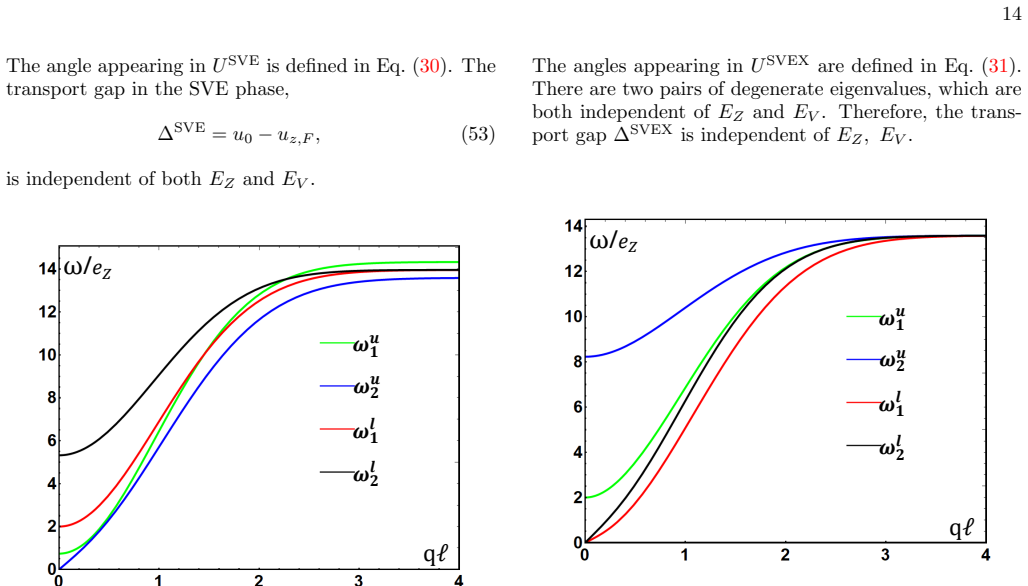
The load-bearing object is the diagnostic fingerprint table (Tables I and II), whose rows are four digital observables: the sign of $d\Delta/dE_Z$, the sign of $d\Delta/dE_V$, the number $N_G$ of gapless Goldstone modes (with the parenthesized value giving the expected count when valley $U(1)$ is broken to $Z_3$ by three-body interactions), and the presence $N_L$ of a Larmor mode. The calculations behind it use a Hartree-Fock variational ansatz with four real spinors in spin-valley space, and time-dependent Hartree-Fock (TDHF) theory to get the collective-mode dispersions. The Larmor mode is the spin magnon, pinned at energy $2E_Z$ at zero momentum whenever the phase has spin polarization; that pinning and the Goldstone count are what separate phases whose gap slopes look the same.
What would settle it
Search, by exact diagonalization or Hartree-Fock, for a stable $\nu=0$ ground state in the $n=0$ Landau level that requires a nonzero $V_2$ (or higher) Haldane pseudopotential and has order parameters not among the nine phases in Tables I/II; finding one would disprove exhaustiveness. Experimentally, a sample whose measured four-signature combination matches no column of the table would likewise show the catalog is incomplete.
Extended reading notes
Core claim
At $\nu=0$ the $n=0$ Landau level of graphene is half filled, and the Coulomb interaction plus short-range anisotropic couplings produce a family of quantum Hall ferromagnet phases: ferromagnetic, canted antiferromagnetic, bond-ordered, charge-density-wave, spin-valley entangled, and coexistence states. The central claim is that every one of these theoretically possible phases has a unique fingerprint consisting of the signs of $d\Delta/dE_Z$ and $d\Delta/dE_V$ for the one-body transport gap, the number of gapless Goldstone modes (counting the spin Goldstone mode, and treating the valley Goldstone mode as gapped once three-body interactions reduce valley symmetry to $Z_3$), and the presence of a Larmor mode. The fingerprints are derived from Hartree-Fock ground states and time-dependent Hartree-Fock collective-mode dispersions, for a model that goes beyond the ultra-short-range limit by keeping nonzero Haldane pseudopotentials $V_0$ and $V_1$. The paper's assertion is that each column of the fingerprint table is unique, so measuring the four quantities determines which phase the sample is in.
Load-bearing premise
The scheme stands or falls on whether the phase catalog built from only the $V_0$ and $V_1$ Haldane pseudopotentials contains every $\nu=0$ phase real graphene can realize; if some phase lies outside this catalog, the fingerprint table would not be exhaustive and unique identification would fail.
Editorial extensions
If this is right
- If the table is exhaustive, the phase in a real doubly encapsulated or STM sample can be fixed by combining transport gap measurements, STM imaging of bond or charge order, magnon transmission, and detection of gapless bulk modes.
- At $E_V=0$, which can be arranged by misaligning graphene from the encapsulating hexagonal boron nitride, the slope of the transport gap with $E_Z$ alone separates the three likeliest phases: negative slope in the bond-ordered phase, positive in the bond-order-plus-canted-antiferromagnet coexistence phase, and zero in the canted antiferromagnet.
- Any phase with nonzero spin polarization is predicted to show a Larmor mode and thus to transmit magnons, so magnon-transmission experiments can confirm or exclude spin-polarized phases.
- The valley Goldstone modes expected in bond-ordered and coexistence phases should be gapped in real samples once three-body interactions are included, so the experimentally relevant gapless count is the parenthesized one in the table.
Reading between the lines
- I infer that the same four-signature logic could be extended to fractional fillings such as $\nu=-1/3$, but the paper only raises this as an open direction and does not establish it.
- A natural test not performed in the paper: push the model to include a nonzero $V_2$ Haldane pseudopotential and search for a stable phase outside the nine listed; finding one would show the exhaustiveness assumption is the part to watch.
- The $Z_3$ correction implies a sharp experimental prediction: in any phase with a nominal valley Goldstone mode, heat transport should not reveal the corresponding gapless channel, so its absence would be consistent with the table's parenthesized counts rather than disproving the model.
Editorial analysis
A structured set of objections, weighed in public.
Referee Report
Summary. An and Murthy propose a set of four experimental diagnostics—the sign of dΔ/dEZ, the sign of dΔ/dEV, the number of gapless collective modes, and the presence of a Larmor mode—that they claim uniquely identify each of nine theoretically possible ν=0 quantum Hall phases in monolayer graphene. The phases arise in a Hartree-Fock treatment of a model with valley-anisotropic short-range interactions projected to the n=0 Landau level, with only Haldane pseudopotentials V0 and V1 kept nonzero. The central result is Table I/II, whose columns are asserted to be unique. The paper derives analytic transport gaps for the FM, (C)AFM, (C)BO, CDW, SVE, and SVEX phases, and obtains TDHF collective modes for all phases, with a numerical treatment of the BO+CAFM and COEX phases.
Significance. If the scheme were fully valid, it would be practically valuable: it uses established transport and magnon/heat probes, and it reduces phase identification to a small set of digital observables. The analytical expressions for the gap derivatives, the explicit eigenvectors of the mean-field Hamiltonian, and the TDHF collective-mode calculations are concrete and checkable, and the use of the microscopic estimates of Ref. [34] anchors the model in realistic parameter ranges. The paper also gives falsifiable predictions (signs of derivatives, Goldstone/Larmor counts) rather than fitting the table to data. However, the central uniqueness claim is not currently established: under the paper's own Z3-corrected Goldstone counting, the SVEX and SVE columns of Table I become identical, and the exhaustiveness of the phase catalog is asserted without proof. These issues are fixable, but they are load-bearing for the advertised conclusion.
major comments (2)
- [Table I/II; Secs. V.B and V.C] Under the paper's own Z3-corrected counting, the SVEX and SVE columns are identical. SVEX is listed as NG=2(1) and SVE as NG=1; the text in Sec. V.C argues that the valley Goldstone mode becomes gapped when the U(1)_v symmetry is reduced to Z3, so the physical count for SVEX is 1. Both columns then have dΔ/dEZ=0, dΔ/dEV=0, NG=1, and NL=1. Thus the claimed uniqueness of Table I fails precisely for the two spin-valley entangled phases that the table is meant to distinguish. The authors should either add an observable that separates SVEX from SVE (for example, the relation between the order parameters ⟨τxσx⟩ and ⟨τyσy⟩, which is equal in SVE and unequal in SVEX) or explicitly restrict the uniqueness claim to the nominal U(1)_v model and state that the physical diagnostics are incomplete for these phases.
- [Sec. IV, Eq. (22); Sec. II.C, Eq. (9)] The exhaustiveness of the phase catalog is asserted, not demonstrated. Section IV states that keeping only V0 and V1 is 'sufficient to exhibit all the potential phases' without proof or reference, and Eq. (9) is said to 'completely exhaust all the possible ground states' even though a general 4×2 projector can contain relative phases and cross-block components that are not obviously eliminated by the U(1)_s × U(1)_v symmetries used in the paper. If a nonzero V_m with m>1, or a more general mean-field state, stabilized a phase outside Table I, the uniqueness mapping would not be exhaustive. The authors should provide a symmetry-based derivation of the variational ansatz and of the V0,V1 truncation, or explicitly qualify the uniqueness claim as contingent on these assumptions.
minor comments (5)
- [Sec. IV, text after Fig. 3] The phrase 'the system goes into the CDM phase' should read 'the system goes into the CDW phase'.
- [Sec. V.C, text before Fig. 13] 'do the inevitable breaking' should be 'due to the inevitable breaking'.
- [Eq. (31)] The notation 'cos α1/2' is ambiguous; from Eq. (30) and the surrounding text it appears that these should be cos α1 and cos α2, and the right-hand side should be checked for dimensional consistency.
- [Sec. III, text before Table I] 'the presence of lack thereof' should be 'the presence or absence'.
- [Table I caption] The phrase 'The first number is the nominal number of gapless modes in our model' is potentially confusing for the SVE column, which has no parenthetical; a sentence clarifying that SVE's single Goldstone mode is expected to remain gapless under the Z3 breaking would be helpful.
Circularity Check
No significant circularity: the diagnostics are derived from the mean-field and TDHF calculations, not fitted to the table, and the phase catalog is re-derived in the paper itself.
full rationale
I find no circular step that reduces a prediction to an input. The four diagnostic quantities are computed from the same Hartree-Fock Hamiltonian that yields the phases, but they are not fitted to the target result: the transport gap Delta is defined by Eq. (17), the collective modes are obtained from the TDHF equations in Eq. (34), and the entries of Table I follow from those calculations. The phase catalog, although motivated by Refs. [50-52] (some coauthored by G. Murthy), is re-derived in Sec. IV with phase diagrams and explicit eigenvectors and energies in Sec. V, so the self-citations are contextual rather than load-bearing. The unproven assertion that nonzero V0 and V1 are sufficient to exhibit all potential phases is a completeness/model assumption that affects whether Table I is exhaustive for real graphene, but it is not circularity: no equation in the paper defines a phase in terms of its own signature, and no parameter is adjusted to force column uniqueness. The Goldstone-mode and Larmor-mode rows follow from the spontaneously broken symmetries of the explicitly solved mean-field states and are independently exhibited in the TDHF spectra. Hence the central claim has independent content within the stated model.
Assumptions & free parameters
free parameters (2)
- u0 (isotropic short-range interaction strength) =
10 eZ
- r_perp, r_z (Haldane pseudopotential ratios V1/V0) =
-0.2 in main panels; also +0.2 and -0.2 in appendix
assumptions (5)
- domain assumption Hartree-Fock approximation: the ground state is a single Slater determinant (Sec. II.B).
- domain assumption The U(1)v valley symmetry at the four-fermion level is reduced to Z3 by 3-body interactions, gapping the valley Goldstone mode (Secs. V and VI).
- domain assumption The variational four-spinor ansatz in Eq. (9) completely exhausts all possible ground states (Sec. II.C).
- ad hoc to paper Only Haldane pseudopotentials V0 and V1 are nonzero; V_m = 0 for m>1 (Eq. 22).
- domain assumption A short-range isotropic interaction (u0) replaces the full Coulomb interaction for collective mode calculations (Sec. V).
Cite this review
Pith. "Pith review of Uniquely identifying quantum Hall phases in charge neutral graphene." pith.science (2026). https://pith.science/paper/TRH4TU4K
@misc{pith2026241218179,
  author       = {Pith},
  title        = {Pith review of: Uniquely identifying quantum Hall phases in charge neutral graphene},
  year         = {2026},
  howpublished = {\url{https://pith.science/paper/TRH4TU4K}},
  note         = {Machine review of arXiv:2412.18179}
}
read the original abstract
Charge-neutral graphene in the quantum Hall regime is an example of a quantum Hall ferromagnet in a complex spin-valley space. This system exhibits a plethora of phases, with the particular spin-valley order parameters chosen by the system depending sensitively on the short-range anisotropic couplings, the Zeeman field, and the sublattice symmetry breaking field. A subset of order parameters related to lattice symmetry-breaking have been observed by scanning tunneling microscopy. However, other order parameters, particularly those which superpose spin and valley, are more elusive, making it difficult to pin down the nature of the phase. We propose a solution this problem by examining two types of experimentally measurable quantities; transport gaps and collective mode dispersions. We find that the variation of the transport gap with the Zeeman and sublattice symmetry breaking fields, in conjunction with the number of Larmor and gapless modes, provides a unique signature for each theoretically possible phase.
Figures


Figures from the paper (9 more)




Reference graph
Works this paper leans on
-
[34]
N. Wei, G. Xu, I. S. Villadiego, and C. Huang, Landau- level mixing and SU(4) symmetry breaking in graphene (2024), arXiv:2401.12528 [cond-mat.mes-hall]
work page Pith review arXiv 2024
-
[1]
K. v. Klitzing, G. Dorda, and M. Pepper, New method for high-accuracy determination of the fine-structure con- stant based on quantized Hall resistance, Phys. Rev. Lett. 45, 494 (1980)
1980
-
[2]
D. C. Tsui, H. L. Stormer, and A. C. Gossard, Two- dimensional magnetotransport in the extreme quantum limit, Phys. Rev. Lett. 48, 1559 (1982)
1982
-
[3]
R. B. Laughlin, Anomalous quantum Hall effect: An in- compressible quantum fluid with fractionally charged ex- citations, Phys. Rev. Lett. 50, 1395 (1983)
1983
-
[4]
Berger, Z
C. Berger, Z. Song, T. Li, X. Li, A. Y. Ogbazghi, R. Feng, Z. Dai, A. N. Marchenkov, E. H. Conrad, P. N. First, and W. A. de Heer, Ultrathin epitaxial graphite: 2d electron gas properties and a route toward graphene-based nano- electronics, The Journal of Physical Chemistry B 108, 19912 (2004)
2004
-
[5]
K. S. Novoselov, A. K. Geim, S. V. Morozov, D. Jiang, Y. Zhang, S. V. Dubonos, I. V. Grig- orieva, and A. A. Firsov, Electric field effect in atomically thin carbon films, Science 306, 666 (2004), https://www.science.org/doi/pdf/10.1126/science.1102896
-
[6]
Zhang, J
Y. Zhang, J. P. Small, M. E. S. Amori, and P. Kim, Elec- tric field modulation of galvanomagnetic properties of mesoscopic graphite, Phys. Rev. Lett. 94, 176803 (2005)
2005
-
[7]
A. H. Castro Neto, F. Guinea, N. M. R. Peres, K. S. Novoselov, and A. K. Geim, The electronic properties of graphene, Rev. Mod. Phys. 81, 109 (2009)
2009
Show all 86 references
-
[8]
Geim and I
A. Geim and I. V. Grigorieva, Van der waals heterostruc- tures, Nature 499, 419 (2013)
2013
-
[9]
K. S. Novoselov, A. Mishchenko, A. Carvalho, and A. H. C. Neto, 2d materials and van der waals het- erostructures, Science 353 (2016)
2016
-
[10]
S. L. Sondhi, A. Karlhede, S. A. Kivelson, and E. H. Rezayi, Skyrmions and the crossover from the integer to fractional quantum Hall effect at small Zeeman energies, Phys. Rev. B 47, 16419 (1993)
1993
-
[11]
K. Yang, K. Moon, L. Zheng, A. H. MacDonald, S. M. Girvin, D. Yoshioka, and S.-C. Zhang, Quantum ferro- magnetism and phase transitions in double-layer quan- tum Hall systems, Phys. Rev. Lett. 72, 732 (1994)
1994
-
[12]
K. Moon, H. Mori, K. Yang, S. M. Girvin, A. H. Mac- Donald, L. Zheng, D. Yoshioka, and S.-C. Zhang, Sponta- neous interlayer coherence in double-layer quantum Hall systems: Charged vortices and Kosterlitz-Thouless phase transitions, Phys. Rev. B 51, 5138 (1995)
1995
-
[13]
F. Amet, J. R. Williams, K. Watanabe, T. Taniguchi, and D. Goldhaber-Gordon, Insulating behavior at the neu- trality point in single-layer graphene, Phys. Rev. Lett. 110, 216601 (2013)
2013
-
[14]
B. Hunt, J. D. Sanchez-Yamagishi, A. F. Young, M. Yankowitz, B. J. LeRoy, K. Watanabe, T. Taniguchi, P. Moon, M. Koshino, P. Jarillo-Herrero, and R. C. Ashoori, Massive Dirac fermions and Hofstadter butter- fly in a van der Waals heterostructure, Science 340, 1427 (2013)
2013
-
[15]
J. Jung, A. M. DaSilva, A. H. MacDonald, and S. Adam, Origin of band gaps in graphene on hexagonal boron ni- tride, Nature Communications 6, 6308 (2015)
2015
-
[17]
D. A. Abanin, P. A. Lee, and L. S. Levitov, Spin-filtered edge states and quantum Hall effect in graphene, Phys. Rev. Lett. 96, 176803 (2006)
2006
-
[19]
H. Min, J. E. Hill, N. A. Sinitsyn, B. R. Sahu, L. Klein- man, and A. H. MacDonald, Intrinsic and rashba spin- orbit interactions in graphene sheets, Phys. Rev. B 74, 165310 (2006)
2006
-
[20]
Zarea and N
M. Zarea and N. Sandler, Electron-electron and spin- orbit interactions in armchair graphene ribbons, Phys. Rev. Lett. 99, 256804 (2007)
2007
-
[21]
Y. Yao, F. Ye, X.-L. Qi, S.-C. Zhang, and Z. Fang, Spin-orbit gap of graphene: First-principles calculations, Phys. Rev. B 75, 041401 (2007)
2007
-
[22]
Konschuh, M
S. Konschuh, M. Gmitra, and J. Fabian, Tight-binding theory of the spin-orbit coupling in graphene, Phys. Rev. B 82, 245412 (2010)
2010
-
[23]
Kochan, S
D. Kochan, S. Irmer, and J. Fabian, Model spin-orbit coupling hamiltonians for graphene systems, Phys. Rev. B 95, 165415 (2017). 19
2017
-
[24]
C. L. Kane and E. J. Mele, Z2 topological order and the quantum spin Hall effect, Phys. Rev. Lett. 95, 146802 (2005)
2005
-
[25]
A. F. Young, J. D. Sanchez-Yamagishi, B. Hunt, S. H. Choi, K. Watanabe, T. Taniguchi, R. C. Ashoori, and P. Jarillo-Herrero, Tunable symmetry breaking and heli- cal edge transport in a graphene quantum spin Hall state, Nature 505, 528 (2014)
2014
-
[26]
Alicea and M
J. Alicea and M. P. A. Fisher, Graphene integer quan- tum Hall effect in the ferromagnetic and paramagnetic regimes, Phys. Rev. B 74, 075422 (2006)
2006
-
[27]
K. Yang, S. Das Sarma, and A. H. MacDonald, Collec- tive modes and skyrmion excitations in graphene SU (4) quantum Hall ferromagnets, Phys. Rev. B 74, 075423 (2006)
2006
-
[28]
I. F. Herbut, Theory of integer quantum Hall effect in graphene, Phys. Rev. B 75, 165411 (2007)
2007
-
[29]
I. F. Herbut, SO(3) symmetry between N´ eel and ferro- magnetic order parameters for graphene in a magnetic field, Phys. Rev. B 76, 085432 (2007)
2007
-
[30]
H. A. Fertig and L. Brey, Luttinger liquid at the edge of undoped graphene in a strong magnetic field, Phys. Rev. Lett. 97, 116805 (2006)
2006
-
[31]
Kharitonov, Phase diagram for the ν = 0 quan- tum Hall state in monolayer graphene, Phys
M. Kharitonov, Phase diagram for the ν = 0 quan- tum Hall state in monolayer graphene, Phys. Rev. B 85, 155439 (2012)
2012
-
[32]
I. L. Aleiner, D. E. Kharzeev, and A. M. Tsvelik, Spon- taneous symmetry breaking in graphene subjected to an in-plane magnetic field, Phys. Rev. B 76, 195415 (2007)
2007
-
[33]
Stefanidis and I
N. Stefanidis and I. S. Villadiego, Competing spin-valley entangled and broken symmetry states in the n = 1 Lan- dau level of graphene, Phys. Rev. B 107, 045132 (2023)
2023
-
[35]
D. S. Wei, T. van der Sar, S. H. Lee, K. Watanabe, T. Taniguchi, B. I. Halperin, and A. Yacoby, Electrical generation and detection of spin waves in a quantum Hall ferromagnet, Science 362, 229–233 (2018)
2018
-
[36]
Stepanov, S
P. Stepanov, S. Che, D. Shcherbakov, J. Yang, R. Chen, K. Thilahar, G. Voigt, M. W. Bockrath, D. Smirnov, K. Watanabe, T. Taniguchi, R. K. Lake, Y. Barlas, A. H. MacDonald, and C. N. Lau, Long-distance spin transport through a graphene quantum Hall antiferromagnet, Na- ture Ph...
2018
-
[37]
Assouline, M
A. Assouline, M. Jo, P. Brasseur, K. Watanabe, T. Taniguchi, T. Jolicoeur, D. C. Glattli, N. Kumada, P. Roche, F. D. Parmentier, and et al., Excitonic na- ture of magnons in a quantum Hall ferromagnet, Nature Physics 17, 1369–1374 (2021)
2021
-
[38]
H. Zhou, C. Huang, N. Wei, T. Taniguchi, K. Watanabe, M. P. Zaletel, Z. Papi´ c , A. H. MacDonald, and A. F. Young, Strong-magnetic-field magnon transport in mono- layer graphene, Physical Review X 12, 10.1103/phys- revx.12.021060 (2022)
2022 doi
-
[39]
S.-Y. Li, Y. Zhang, L.-J. Yin, and L. He, Scanning tun- neling microscope study of quantum Hall isospin ferro- magnetic states in the zero Landau level in a graphene monolayer, Phys. Rev. B 100, 085437 (2019)
2019
-
[40]
X. Liu, G. Farahi, C.-L. Chiu, Z. Papic, K. Watanabe, T. Taniguchi, M. P. Zaletel, and A. Yazdani, Visualizing broken symmetry and topological defects in a quantum Hall ferromagnet, Science 375, 321–326 (2022)
2022
-
[41]
Coissard, D
A. Coissard, D. Wander, H. Vignaud, A. G. Grushin, C. Repellin, K. Watanabe, T. Taniguchi, F. Gay, C. B. Winkelmann, H. Courtois, H. Sellier, and B. Sac´ ep´ e, Imaging tunable quantum Hall broken-symmetry orders in graphene, Nature 605, 51 (2022)
2022
-
[42]
Farahi, C.-L
G. Farahi, C.-L. Chiu, X. Liu, Z. Papic, K. Watanabe, T. Taniguchi, M. P. Zaletel, and A. Yazdani, Broken sym- metries and excitation spectra of interacting electrons in partially filled landau levels, Nature Physics 19, 1482 (2023)
2023
-
[43]
Hu, Y.-C
Y. Hu, Y.-C. Tsui, M. He, U. Kamber, T. Wang, A. S. Mohammadi, K. Watanabe, T. Taniguchi, Z. Papic, M. P. Zaletel, and A. Yazdani, High-resolution tunneling spectroscopy of fractional quantum Hall states (2023), arXiv:2308.05789 [cond-mat.mes-Hall]
2023
-
[44]
Murthy and R
G. Murthy and R. Shankar, Hamiltonian theory of the fractional quantum Hall effect: Effect of Landau level mixing, Phys. Rev. B 65, 245309 (2002)
2002
-
[45]
Bishara and C
W. Bishara and C. Nayak, Effect of Landau level mix- ing on the effective interaction between electrons in the fractional quantum Hall regime, Phys. Rev. B 80, 121302 (2009)
2009
-
[46]
Sodemann and A
I. Sodemann and A. H. MacDonald, Landau level mixing and the fractional quantum hall effect, Phys. Rev. B 87, 245425 (2013)
2013
-
[47]
M. R. Peterson and C. Nayak, More realistic Hamiltoni- ans for the fractional quantum Hall regime in GaAs and graphene, Phys. Rev. B 87, 245129 (2013)
2013
-
[48]
M. R. Peterson and C. Nayak, Effects of Landau level mixing on the fractional quantum Hall effect in mono- layer graphene, Phys. Rev. Lett. 113, 086401 (2014)
2014
-
[49]
Xu and C
G. Xu and C. Huang, Influence of the dirac sea on phase transitions in monolayer graphene under strong magnetic fields (2024)
2024
-
[50]
A. Das, R. K. Kaul, and G. Murthy, Coexistence of canted antiferromagnetism and bond order in ν = 0 graphene, Phys. Rev. Lett. 128, 106803 (2022)
2022
-
[51]
S. J. De, A. Das, S. Rao, R. K. Kaul, and G. Murthy, Global phase diagram of charge-neutral graphene in the quantum Hall regime for generic interactions, Phys. Rev. B 107, 125422 (2023)
2023
-
[52]
Stefanidis and I
N. Stefanidis and I. S. Villadiego, Spin-valley entangled quantum Hall states in graphene, Phys. Rev. B 108, 235137 (2023)
2023
-
[53]
Atteia and M
J. Atteia and M. O. Goerbig, SU(4) spin waves in the ν = ±1 quantum Hall ferromagnet in graphene, Phys. Rev. B 103, 195413 (2021)
2021
-
[54]
S. S. Hegde and I. S. Villadiego, Theory of compet- ing charge density wave, Kekul´ e, and antiferromagneti- cally ordered fractional quantum Hall states in graphene aligned with boron nitride, Phys. Rev. B 105, 195417 (2022)
2022
-
[55]
Lian and M
Y. Lian and M. O. Goerbig, Spin-valley skyrmions in graphene at filling factor ν = −1, Phys. Rev. B 95, 245428 (2017)
2017
-
[56]
Sodemann and A
I. Sodemann and A. H. MacDonald, Broken SU(4) sym- metry and the fractional quantum Hall effect in graphene, Phys. Rev. Lett. 112, 126804 (2014)
2014
-
[57]
J. An, A. C. Balram, and G. Murthy, Magnetic and lat- tice ordered fractional quantum Hall phases in graphene, Phys. Rev. B 110, L081103 (2024)
2024
-
[58]
J. An, A. C. Balram, U. Khanna, and G. Murthy, Fractional quantum hall coexistence phases in higher landau levels of graphene, Phys. Rev. B in print 20 arXiv:2408.10035 (2024)
2024 arXiv
-
[59]
A. Das, R. K. Kaul, and G. Murthy, Stability of zero- energy Dirac touchings in the honeycomb Hofstadter problem, Phys. Rev. B 101, 165416 (2020)
2020
-
[60]
Zhang, Y.-W
Y. Zhang, Y.-W. Tan, H. L. Stormer, and P. Kim, Ex- perimental observation of the quantum hall effect and berry’s phase in graphene, Nature 438, 201 (2005)
2005
-
[61]
A. F. Young, C. R. Dean, L. Wang, H. Ren, P. Cadden- Zimansky, K. Watanabe, T. Taniguchi, J. C. Hone, K. L. Shepard, and P. Kim, Spin and valley quantum hall fer- romagnetism in graphene, Nature Physics 8, 550 (2012)
2012
-
[62]
Kallin and B
C. Kallin and B. I. Halperin, Excitations from a filled landau level in the two-dimensional electron gas, Phys. Rev. B 30, 5655 (1984)
1984
-
[63]
Pinczuk, B
A. Pinczuk, B. S. Dennis, L. N. Pfeiffer, and K. West, Ob- servation of collective excitations in the fractional quan- tum hall effect, Phys. Rev. Lett. 70, 3983 (1993)
1993
-
[64]
I. V. Kukushkin, J. H. Smet, V. W. Scarola, V. Uman- sky, and V. von Klitzing, Dispersion of the excitations of fractional quantum hall states, Science 324, 1044 (2009)
2009
-
[65]
A. C. Balram, U. Wurstbauer, A. W´ ojs, A. Pinczuk, and J. K. Jain, Fractionally charged skyrmions in fractional quantum hall effect, Nature Communications 6 (2014)
2014
-
[66]
Liang, Z
J. Liang, Z. Liu, Z. Yang, Y. Huang, U. Wurstbauer, C. R. Dean, K. West, L. N. Pfeiffer, L. Du, and A. Pinczuk, Evidence for chiral graviton modes in frac- tional quantum hall liquids., Nature (2024)
2024
-
[67]
H. Fu, K. Huang, K. Watanabe, T. Taniguchi, and J. Zhu, Gapless spin wave transport through a quantum canted antiferromagnet, Phys. Rev. X 11, 021012 (2021)
2021
-
[68]
Delagrange, M
R. Delagrange, M. Garg, G. Le Breton, A. Zhang, Q. Dong, Y. Jin, K. Watanabe, T. Taniguchi, P. Roul- leau, O. Maillet, P. Roche, and F. D. Parmentier, Vanish- ing bulk heat flow in the ν = 0 quantum hall ferromagnet in monolayer graphene, Nature Physics 20, 1927–1932 (2024)
2024
-
[69]
Kumar, S
R. Kumar, S. K. Srivastav, U. Roy, U. Singhal, K. Watan- abe, T. Taniguchi, V. Singh, P. Rolleau, and A. Das, Ab- sence of heat flow in ν = 0 quantum hall ferromagnet in bilayer graphene, Nature Physics 20, 1941 (2024)
2024
-
[70]
J. Jung, A. M. DaSilva, A. H. Macdonald, and S. Adam, Origin of band gaps in graphene on hexagonal boron ni- tride, Nature Communications 6 (2014)
2014
-
[71]
J. Jung, E. Laksono, A. M. DaSilva, A. H. MacDonald, M. Mucha-Kruczy´ nski, and S. Adam, Moir´ e band model and band gaps of graphene on hexagonal boron nitride, Phys. Rev. B 96, 085442 (2017)
2017
-
[72]
A. A. Zibrov, E. M. Spanton, H. Zhou, C. Kometter, T. Taniguchi, K. Watanabe, and A. F. Young, Even- denominator fractional quantum Hall states at an isospin transition in monolayer graphene, Nature Physics14, 930 (2018)
2018
-
[73]
Ribeiro-Palau, C
R. Ribeiro-Palau, C. Zhang, K. Watanabe, T. Taniguchi, J. C. Hone, and C. R. Dean, Twistable electronics with dynamically rotatable heterostructures, Science 361, 690 (2018)
2018
-
[74]
N. R. Finney, M. Yankowitz, L. Muraleetharan, K. Watanabe, T. Taniguchi, C. R. Dean, and J. C. Hone, Tunable crystal symmetry in graphene–boron nitride het- erostructures with coexisting moir´ e superlattices, Nature Nanotechnology , 1 (2019)
2019
-
[75]
Murthy, E
G. Murthy, E. Shimshoni, and H. A. Fertig, Collective edge modes near the onset of a graphene quantum spin Hall state, Phys. Rev. B 90, 241410 (2014)
2014
-
[76]
F. Wu, I. Sodemann, Y. Araki, A. H. MacDonald, and T. Jolicoeur, SO(5) symmetry in the quantum Hall effect in graphene, Phys. Rev. B 90, 235432 (2014)
2014
-
[77]
Murthy, E
G. Murthy, E. Shimshoni, and H. A. Fertig, Collective bulk and edge modes through the quantum phase tran- sition in graphene at ν = 0, Phys. Rev. B 93, 045105 (2016)
2016
-
[78]
Lambert and R
J. Lambert and R. Cˆ ot´ e, Quantum hall ferromagnetic phases in the landau level n = 0 of a graphene bilayer, Phys. Rev. B 87, 115415 (2013)
2013
-
[79]
N. Wei, C. Huang, and A. H. MacDonald, Scattering of magnons at graphene quantum-hall-magnet junctions, Phys. Rev. Lett. 126, 117203 (2021)
2021
-
[80]
S. J. De, S. Rao, and G. Murthy, Magnon transmission across ν = 1 | −1|1 monolayer graphene junction as a probe of electronic structure, Phys. Rev. B 110, 085417 (2024)
2024
-
[81]
F. D. M. Haldane, Fractional quantization of the Hall ef- fect: A hierarchy of incompressible quantum fluid states, Phys. Rev. Lett. 51, 605 (1983)
1983
-
[82]
Koma and M
T. Koma and M. Yamanaka, Detecting gapless excita- tions above ferromagnetic domain walls, Phys. Rev. B 65, 104434 (2002)
2002
-
[83]
Murthy, E
G. Murthy, E. Shimshoni, and H. A. Fertig, Spin-valley coherent phases of the ν = 0 quantum Hall state in bi- layer graphene, Phys. Rev. B 96, 245125 (2017)
2017
-
[84]
Z. Lu, T. Han, Y. Yao, A. P. Reddy, J. Yang, J. Seo, K. Watanabe, T. Taniguchi, L. Fu, and L. Ju, Fractional quantum anomalous Hall effect in multilayer graphene, Nature 626, 759 (2024)
2024
-
[85]
J. Cai, E. Anderson, C. Wang, X. Zhang, X. Liu, W. Holtzmann, Y. Zhang, F. Fan, T. Taniguchi, K. Watanabe, Y. Ran, T. Cao, L. Fu, D. Xiao, W. Yao, and X. Xu, Signatures of fractional quantum anomalous Hall states in twisted MoTe2, Nature 622, 63 (2023)
2023
-
[86]
H. Park, J. Cai, E. Anderson, Y. Zhang, J. Zhu, X. Liu, C. Wang, W. Holtzmann, C. Hu, Z. Liu, T. Taniguchi, K. Watanabe, J.-H. Chu, T. Cao, L. Fu, W. Yao, C.- Z. Chang, D. Cobden, D. Xiao, and X. Xu, Observation of fractionally quantized anomalous Hall effect, Nature 622, 74 (2023)
2023
-
[87]
Y. Zeng, Z. Xia, K. Kang, J. Zhu, P. Kn¨ uppel, C. Vaswani, K. Watanabe, T. Taniguchi, K. F. Mak, and J. Shan, Thermodynamic evidence of fractional Chern insulator in moir´ e MoTe2, Nature622, 69 (2023)
2023
-
[88]
F. Xu, Z. Sun, T. Jia, C. Liu, C. Xu, C. Li, Y. Gu, K. Watanabe, T. Taniguchi, B. Tong, J. Jia, Z. Shi, S. Jiang, Y. Zhang, X. Liu, and T. Li, Observation of integer and fractional quantum anomalous Hall effects in twisted bilayer mote2, Phys. Rev. X 13, 031037 (2023). A. PHAS...
2023
Reviewed August 11, 2026 · model on record in the stance chip above.
Discussion (0). Continue with ORCID to comment.