REVIEW 4 major objections 6 minor 40 references
A sub-modular receding horizon solution for mobile multi-agent persistent monitoring
T0 review · 4 major / 6 minor · reviewed 2026-08-14 · deepseek-v4-flash
Pith's one-line read The paper proves that the persistent-monitoring dispatch utility is monotone submodular, so a sequential greedy policy over agents achieves at least half the optimal reward in polynomial time.
desk verdict The concave-reward patrolling greedy is a good idea and likely correct, but the submodularity proof as written doesn't cover interleaved agent visits and Corollary 4.1 has a sign error; worth refereeing, not accepting as-is. read the letter →
The pith
A machine-rendered reading of the paper's core claim, the machinery that carries it, and where it could break.
The reading
What carries the argument
The load-bearing object is the augmented utility $\bar{R}(\bar{P})$ in (5), defined over policy sets subject to a partition-matroid constraint (at most one policy per agent). It turns an NP-hard dynamic scheduling problem into a monotone submodular set-function maximization, which is exactly the setting where the sequential greedy algorithm carries a $1/2$ optimality gap. The technical engine proving submodularity is the representation of a node's contribution as $\sum_j \psi_v(\Delta t^v_j)$, where $\Delta t^v_j$ are the gaps between consecutive visits to node $v$, together with concatenation lemmas (A.2 and A.3) based on Karamata's inequality that compare marginal gains of adding a policy to a smaller versus a larger set. The nodal-importance term $\mathcal{L}(v,w,\hat{t},i)$ measures the reward concentration within radius $r$ of an anchor node, normalized by travel time, and is designed to be modular so that adding it does not disturb submodularity; the paper notes its resemblance to a terminal cost in model predictive control.
What would settle it
Simulate a single node with a concave reward and three visit schedules chosen so that policy q inserts a visit between two visits of the existing set; compute the marginal gain $\Delta R(q|Q_1)$ for a smaller set $Q_1$ and a larger set $Q_2$. If any such schedule yields a marginal gain for $Q_1$ smaller than for $Q_2$, submodularity fails and the $1/2$ bound collapses. A positive check across all small exhaustive cases, for example with three or four visits, would support the missing lemma.
Extended reading notes
Core claim
The paper's discovery, stated on its own terms, is that the persistent-monitoring dispatch problem, despite being NP-hard, can be approximately solved with a constant factor because its utility is well behaved. For a selected policy set $\bar{P}$, the utility is $R(\bar{P}) = \sum_{p\in\bar{P}}\sum_{l=1}^{n_p} R_{V_p(l)}(T_p(l))$, the sum of all node rewards collected at visit times, with each node reward of the form $\psi_v(t-\bar{t}_v)$ for an increasing concave $\psi_v$. Theorem 3.1 asserts that this utility, augmented as $\bar{R}(\bar{P}) = R(\bar{P}) + \alpha\sum_{p\in\bar{P}}\max_{v\in\bar{V}}\mathcal{L}(v,p)$ with relative nodal importance $\mathcal{L}$ and any $\alpha\ge0$, is a monotone increasing and submodular set function over the feasible policy set under the constraint that at most one policy is chosen per agent. Theorem 3.2 then concludes that Algorithm 1, a sequential greedy pass over agents, returns a policy set $\bar{P}$ with $\bar{R}(\bar{P}) \ge \tfrac12 \bar{R}(P^\star)$, where $P^\star$ is the optimal solution of (4). The proof route rewrites each node's reward as a sum over gaps between consecutive visits and invokes Karamata-based lemmas to show diminishing returns.
Load-bearing premise
The whole guarantee rests on the reward staying submodular when a new agent's visits are inserted between existing visits, but the proof only covers insertions appended after the current visit sequence, so the arbitrarily interleaved case is assumed rather than proved.
Editorial extensions
If this is right
- A user can replace exponential search over all policy combinations with one greedy pass over agents and still receive a guaranteed half-optimality certificate for the augmented utility.
- The $1/2$ guarantee survives the receding-horizon shortening of plans and the addition of the nodal-importance term with any nonnegative weight $\alpha$.
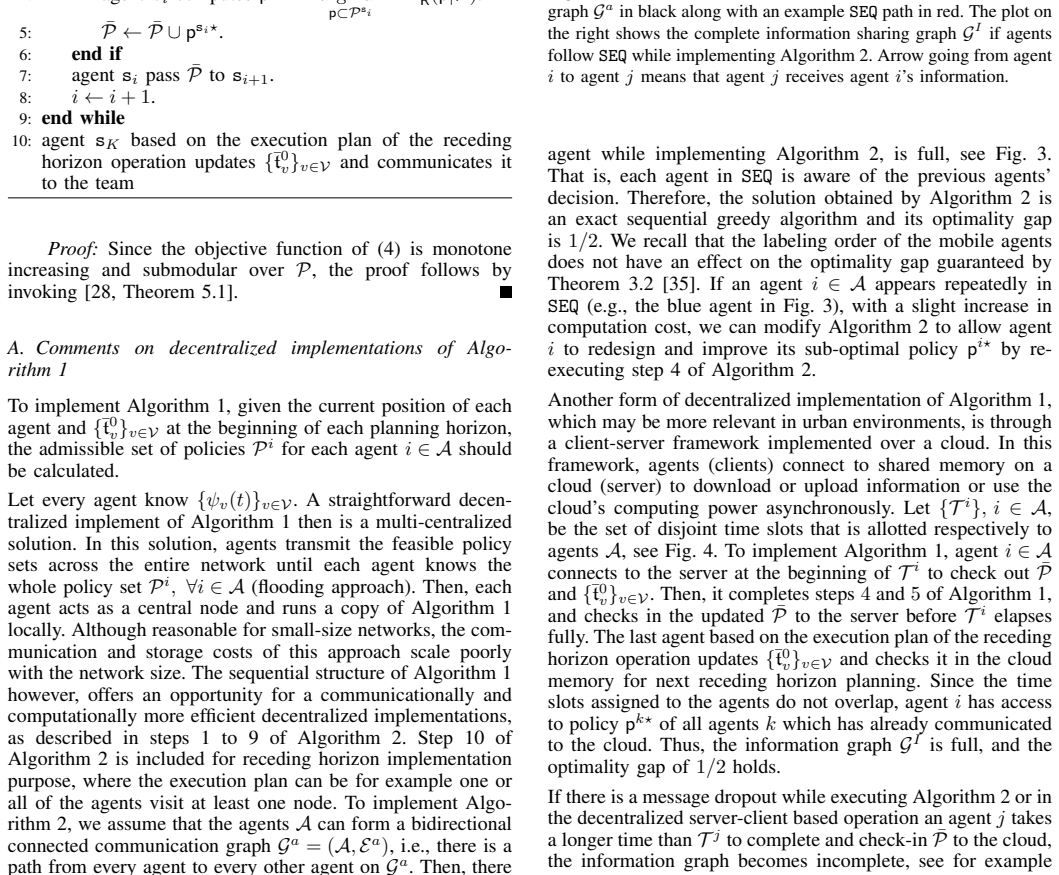
- In decentralized execution with full information sharing, such as a Hamiltonian communication route or non-overlapping cloud time slots, the same $1/2$ gap holds.
- When message dropouts make the information graph incomplete, the optimality gap degrades to $1/(M-\omega(G_I)+2)$, where $\omega(G_I)$ is the clique number of the information graph.
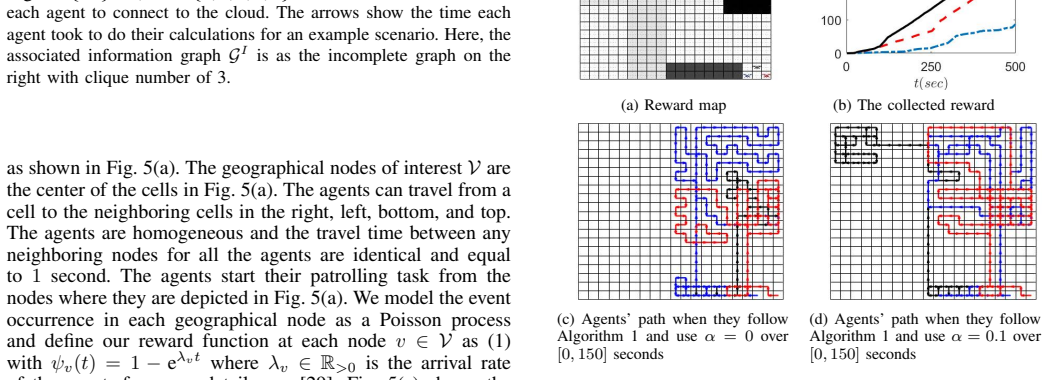
- For event-detection rewards of the form $1-e^{\lambda_v t}$ (Poisson arrivals), the nodal-importance term steers agents toward high-rate clusters beyond the current planning horizon, as the simulation demonstrates.
Reading between the lines
- The same submodularity machinery should extend to heterogeneous travel times and agent-specific scanning delays, since the per-node visit-time sequence argument does not appear to use homogeneity; testing this is a direct next step the paper does not pursue.
- If submodularity holds across arbitrarily interleaved visits, the approach should generalize to stochastic rewards or time-varying $\psi_v$ as long as concavity and reset-on-visit are preserved, but the paper makes no such claim.
- The receding-horizon-plus-terminal-importance structure suggests a bridge to model predictive control theory: tightening the terminal cost could yield stability-style guarantees on long-run visit frequencies, not just horizon-by-horizon reward.
- The choice of anchor nodes $\bar{V}$ is left as a design parameter, so an adaptive anchor-selection rule based on current reward gradients is a natural testable extension that the paper does not analyze.
Signed reviews
Editorial analysis
A structured set of objections, weighed in public.
Referee Report
Summary. The paper addresses persistent monitoring of a finite set of graph nodes by heterogeneous mobile agents. Each node carries a concave, increasing reward that resets upon a visit, and the dispatch problem is to select one policy per agent to maximize the total collected reward over a mission horizon. The authors state that the problem is NP-hard, prove in Theorem 3.1 that the utility, augmented with a nodal-importance term, is monotone submodular, and use this to claim a 1/2 optimality gap for their sequential greedy algorithm (Theorem 3.2), implemented in a receding horizon and decentralized fashion. A simulation study illustrates the method.
Significance. If the submodularity claim is correct, the paper offers a polynomial-time dispatch algorithm with a constant-factor approximation guarantee for a persistent monitoring problem with concave resetting rewards, a genuinely useful extension of submodular maximization to dynamic scheduling. The use of Karamata's inequality to study visit-interval rewards is an interesting technique and the nodal-importance term is a sensible remedy for receding-horizon shortsightedness. However, the written proof has load-bearing gaps: the auxiliary lemmas cover only concatenated visit sequences, not the interleaved insertions that arise in the actual multi-agent problem, and Corollary 4.1 is stated and proved with the wrong inequality direction. The central claim is plausible and likely repairable, but the current manuscript does not provide a gap-free derivation of the advertised 1/2 guarantee.
major comments (4)
- [Theorem 3.1 proof and Appendix Lemmas A.2, A.3] The submodularity proof is load-bearing: Theorem 3.2's 1/2 gap rests entirely on it. Yet Lemmas A.2 and A.3 are proved only for concatenated visit sequences of the form (t)⊕(u) or (v)⊕(u), where the newly added visits are appended after the existing visits. In the actual problem, adding a policy q to a set Q inserts visits at arbitrary times between previously scheduled visits at each node. The proof of Theorem 3.1 does not address interleaved insertion, so the marginal-diminishing inequality ΔR̄(q|Q1) ≥ ΔR̄(q|Q2) is not established for the feasible policy sets of (4). This gap must be closed, for example by proving that the per-node insertion benefit F(u,v)=ψ(u)+ψ(v)−ψ(u+v) is nondecreasing in both arguments for concave increasing ψ, or by a direct generalization of Lemmas A.2 and A.3 to interleaved sequences.
- [Corollary 4.1 and Lemma A.3] Corollary 4.1 is stated with the wrong inequality direction. As printed, it claims f(c)+f(d)−f(c+d) ≤ f(a)+f(b)−f(a+b) for 0≤a≤c and 0≤b≤d, but the reverse inequality is true for increasing concave f, and a counterexample is f(t)=√t, a=b=1, c=d=4 (the left side is about 1.172, the right side about 0.586). The proof concludes the same backward inequality, so both the statement and the derivation must be corrected. Lemma A.3 uses Corollary 4.1 to conclude ΔSp ≥ 0, and that conclusion requires the opposite, correct direction. This is therefore not a harmless typo in one line; it affects the validity of Lemma A.3 and hence of Theorem 3.1 as written.
- [Assumption 1 and Eq. (2)] There is an inconsistency between the model and the objective function. Assumption 1 states that if more than one agent arrives at node v at the same time, the team still collects only R_v(t). However, the utility in Eq. (2) is a sum over every visit of every policy, so simultaneous visits would double-count the reward. As written, the optimization problem (3) maximizes an objective that does not match the described monitoring reward. The authors should either reformulate the utility to count each distinct reward-earning event once, or explicitly restrict the feasible set to policies with no simultaneous visits and explain how the submodularity proof extends to that restriction.
- [Theorem 3.1 proof, monotonicity step] The monotonicity portion of the proof of Theorem 3.1 contains mismatched indices. The displayed expression compares a sum over (t_v(Q2∪q)) with a sum over (t_v(Q2)), yet the conclusion is stated as ΔR(p|Q1) ≥ 0. Neither the indexing nor the use of Lemma A.2 (which applies to concatenated sequences) establishes the intended monotonicity of R with respect to adding q to Q1. This part of the proof needs to be rewritten together with the interleaving fix described above.
minor comments (6)
- [Lemma A.2 proof] In the final displayed inequality of Lemma A.2, the index "n+1−1" is unclear and appears to be a typo; it should likely read "n+l−1" or the intended upper limit should be stated clearly.
- [Lemma A.3 proof] In the telescoping-sum equation at the end of Lemma A.3, the second term in parentheses should be (g((t)^n_1)−g((v)^m_1)) or equivalent; as printed it repeats g((v)^m_1) and does not telescope correctly.
- [Eq. (2)] Equation (2) contains a duplicated fragment: "R : 2P→ R>0 is ¯P ⊂P, the utility function R : 2P→ R>0 is" appears twice in a row, which disrupts the definition.
- [Section III-A] The definition of the clique number is incorrect: "the number of the nodes in the largest sub-graph such that adding an edge will cause a cycle" is not the clique number. The clique number is the size of the largest complete subgraph; the statement should be corrected.
- [Algorithm 2 discussion] The sentence describing what happens when an agent appears repeatedly in SEQ says the agent can "redesign and improve its sub-optimal policy" but does not specify the mechanism or its effect on the optimality gap. This should be made precise or removed.
- [Numerical example] Given the inconsistency between Assumption 1 and Eq. (2), the simulation section should state explicitly how simultaneous arrivals are resolved in the implementation.
Circularity Check
No significant circularity: the 1/2 optimality gap is derived from a submodularity proof based on Karamata-type lemmas and the external Fisher–Nemhauser–Wolsey bound, not from fitted inputs or self-citation.
full rationale
The derivation chain is self-contained. Theorem 3.1 asserts submodularity of the augmented reward Rbar in (5); its proof derives the marginal-diminishing property for the visit-reward part from Lemmas A.2 and A.3, which are proven from Karamata's inequality, and observes that the nodal-importance term is modular and hence preserves submodularity. Theorem 3.2 then invokes the classical Fisher, Nemhauser and Wolsey result [28] to obtain the 1/2 approximation gap for the sequential greedy algorithm. No parameter is fitted to data and then renamed as a prediction, and no claim reduces by definition to its own input. The self-citation [29] is used only as a preliminary workshop reference and for details of the reward model in the simulation, not as a load-bearing justification of the central theorems. The known proof gaps noted by the reader—Lemmas A.2 and A.3 are proved only for concatenated visit sequences while interleaved visits can occur in the multi-agent problem, and Corollary 4.1 is stated with an apparently reversed inequality—are correctness concerns about the written proof, not circularity. Therefore the circularity score is 0.
Assumptions & free parameters
free parameters (2)
- α (nodal importance weight) =
0.1 in simulation
- r (nodal importance radius) =
not specified numerically
assumptions (4)
- domain assumption Each node's reward ψ_v(t) is nonnegative, concave, increasing, with ψ_v(0)=0, and resets to zero after an agent's visit (Eq. 1).
- standard math Karamata's inequality (majorization) applies to the rearranged inter-visit intervals (Lemma A.1).
- ad hoc to paper The relative nodal importance L(v,p) is evaluated using the last-visit times {t_v^0} fixed at the start of the planning horizon and does not change as policies are added in the greedy selection (Eq. 5).
- domain assumption Assumption 1: an agent scans immediately on arrival; if multiple agents arrive simultaneously, the team collects only one reward; Assumption 2: agents only move along edges of the graph.
Cite this review
Pith. "Pith review of A sub-modular receding horizon solution for mobile multi-agent persistent monitoring." pith.science (2026). https://pith.science/paper/TRLHXIO7
@misc{pith2026190804425,
  author       = {Pith},
  title        = {Pith review of: A sub-modular receding horizon solution for mobile multi-agent persistent monitoring},
  year         = {2026},
  howpublished = {\url{https://pith.science/paper/TRLHXIO7}},
  note         = {Machine review of arXiv:1908.04425}
}
read the original abstract
We study the problem of persistent monitoring of a finite number of inter-connected geographical nodes by a group of heterogeneous mobile agents. We assign to each geographical node a concave and increasing reward function that resets to zero after an agent's visit. Then, we design the optimal dispatch policy of which nodes to visit at what time and by what agent by finding a policy set that maximizes a utility that is defined as the total reward collected at visit times. We show that this optimization problem is NP-hard and its computational complexity increases exponentially with the number of the agents and the length of the mission horizon. By showing that the utility function is a monotone increasing and submodular set function of agents' policy, we proceed to propose a suboptimal dispatch policy design with a known optimality gap. To reduce the time complexity of constructing the feasible search set and also to induce robustness to changes in the operational factors, we perform our suboptimal policy design in a receding horizon fashion. Then, to compensate for the shortsightedness of the receding horizon approach for reward distribution beyond the feasible policies of the agents over the receding horizon, we add a new term to our utility, which provides a measure of nodal importance beyond the receding horizon's sight. This term gives the policy design an intuition to steer the agents towards the nodes with higher rewards on the patrolling graph. Finally, we discuss how our proposed algorithm can be implemented in a decentralized manner. A simulation study demonstrates our results.
Figures



Figures from the paper (3 more)

Reference graph
Works this paper leans on
-
[1]
Coverage control for mobile sensing networks,
J. Cortes, S. Martinez, T. Karatas, and F. Bullo, “Coverage control for mobile sensing networks,” IEEE Tran. on Automatic Control , vol. 20, no. 2, pp. 243–255, 2004
work page 2004
-
[2]
Near-optimal observation selection using submodular functions,
A. Krause and C. Guestrin, “Near-optimal observation selection using submodular functions,” in American Association for Artificial Intelli- gence, vol. 7, pp. 1650–1654, 2007
work page 2007
-
[3]
A. Krause, A. Singh, and C. Guestrin, “Near-optimal sensor placements in Gaussian processes: Theory, efficient algorithms and empirical stud- ies,” Journal of Machine Learning Research , vol. 9, no. Feb, pp. 235– 284, 2008
work page 2008
-
[4]
Decentralized, adaptive coverage control for networked robots,
M. Schwager, D. Rus, and J. Slotine, “Decentralized, adaptive coverage control for networked robots,” The Int. Journal of Robotics Research , vol. 28, no. 3, pp. 357–375, 2009
work page 2009
-
[5]
Gossip coverage control for robotic networks: Dynamical systems on the space of partitions,
F. Bullo, R. Carli, and P. Frasca, “Gossip coverage control for robotic networks: Dynamical systems on the space of partitions,” SIAM Journal on Control and Optimization , vol. 50, no. 1, pp. 419–447, 2012
2012
-
[6]
Multi-agents adaptive estimation and coverage control using gaussian regression,
A. Carron, M. Todescato, R. Carli, L. Schenato, and G. Pillonetto, “Multi-agents adaptive estimation and coverage control using gaussian regression,” in 2015 European Control Conference (ECC) , pp. 2490– 2495, IEEE, 2015
work page 2015
-
[7]
M. Todescato, A. Carron, R. Carli, G. Pillonetto, and L. Schenato, “Multi-robots gaussian estimation and coverage control: From client– server to peer-to-peer architectures,” Automatica, vol. 80, pp. 284–294, 2017
work page 2017
-
[8]
A distributed service-matching coverage via heterogeneous mobile agents
Y . Chung and S. S. Kia, “A distributed service-matching cov- erage via heterogeneous mobile agents,” 2020. available at https://arxiv.org/pdf/2009.11943.pdf
work page Pith review arXiv 2020
Show all 40 references
-
[9]
A survey on technologies for automatic forest fire monitoring, detection, and fighting using unmanned aerial vehicles and remote sensing techniques,
C. Yuan, Y . Zhang, and Z. Liu, “A survey on technologies for automatic forest fire monitoring, detection, and fighting using unmanned aerial vehicles and remote sensing techniques,” Canadian Journal of Forest Research, vol. 45, no. 7, pp. 783–792, 2015
2015
-
[10]
Wireless sensor networks based pipeline vandalisation and oil spillage monitoring and detection: main benefits for nigeria oil and gas sectors,
N. Henry and O. Henry, “Wireless sensor networks based pipeline vandalisation and oil spillage monitoring and detection: main benefits for nigeria oil and gas sectors,” The SIJ Tran. on Computer Science Engineering & its Applications (CSEA) , vol. 3, no. 1, pp. 1–6, 2015
2015
-
[11]
An improved approach for predicting the distribution of rare and endangered species from occurrence and pseudo-absence data,
R. Engler, A. Guisan, and L. Rechsteiner, “An improved approach for predicting the distribution of rare and endangered species from occurrence and pseudo-absence data,” J. of Applied Ecology , vol. 41, no. 2, pp. 263–274, 2004
2004
-
[12]
Detection of incidents and events in urban networks,
T. Thomas and E. van Berkum, “Detection of incidents and events in urban networks,” IET Intelligent Transport Systems , vol. 3, no. 2, pp. 198–205, 2009
2009
-
[13]
Reducibility among combinatorial problems,
R. Karp, “Reducibility among combinatorial problems,” in Complexity of computer computations , pp. 85–103, Springer, 1972
1972
-
[14]
Multi-agent pa- trolling: An empirical analysis of alternative architectures,
A. Machado, G. Ramalho, J. Zucker, and A. Drogoul, “Multi-agent pa- trolling: An empirical analysis of alternative architectures,” in Interna- tional Workshop on Multi-Agent Systems and Agent-Based Simulation , pp. 155–170, 2002
2002
-
[15]
Recent advances on multi-agent patrolling,
A. Almeida, G. Ramalho, H. Santana, P. Tedesco, T. Menezes, V . Corru- ble, and Y . Chevaleyre, “Recent advances on multi-agent patrolling,” in Brazilian Symposium on Artificial Intelligence , pp. 474–483, Springer, 2004
2004
-
[16]
Theoretical analysis of the multi-agent patrolling prob- lem,
Y . Chevaleyre, “Theoretical analysis of the multi-agent patrolling prob- lem,” in Intelligent Agent Technology, pp. 302–308, IEEE, 2004
2004
-
[17]
On cooperative patrolling: Op- timal trajectories, complexity analysis, and approximation algorithms,
F. Pasqualetti, A. Franchi, and F. Bullo, “On cooperative patrolling: Op- timal trajectories, complexity analysis, and approximation algorithms,” IEEE Tran. on Robotics , vol. 28, no. 3, pp. 592–606, 2012
2012
-
[18]
Persistent monitoring of events with stochastic arrivals at multiple stations,
J. Yu, S. Karaman, and D. Rus, “Persistent monitoring of events with stochastic arrivals at multiple stations,”IEEE Tran. on Robotics, vol. 31, no. 3, pp. 521–535, 2015
2015
-
[19]
Persistent surveillance of transient events with unknown statistics,
M. Donahue, G. Rosman, K. Kotowick, D. Rus, and C. Baykal, “Persistent surveillance of transient events with unknown statistics,” tech. rep., MIT Lincoln Laboratory Lexington United States, 2016
2016
-
[20]
Multi-robot routing for persistent monitoring with latency constraints,
A. Asghar, S. Smith, and S. Sundaram, “Multi-robot routing for persistent monitoring with latency constraints,” arXiv preprint arXiv:1903.06105, 2019
1903 arXiv
-
[21]
Distributed on-line dynamic task assignment for multi-robot patrolling,
A. Farinelli, L. Iocchi, and D. Nardi, “Distributed on-line dynamic task assignment for multi-robot patrolling,” Autonomous Robots , vol. 41, no. 6, pp. 1321–1345, 2017
2017
-
[22]
The minimum latency problem,
A. Blum, P. Chalasani, D. Coppersmith, B. Pulleyblank, P. Raghavan, and M. Sudan, “The minimum latency problem,” in Proceedings of the Twenty-sixth Annual ACM Symposium on Theory of Computing , pp. 163–171, 1994
1994
-
[23]
Inequalities of Karamata, Schur and Muirhead, and some applications,
Z. Kadelburg, D. Dukic, M. Lukic, and I. Matic, “Inequalities of Karamata, Schur and Muirhead, and some applications,” The Teaching of Mathematics, vol. 8, no. 1, pp. 31–45, 2005
2005
-
[24]
On submodularity and con- trollability in complex dynamical networks.,
T. Summers, F. Cortesi, and J. Lygeros, “On submodularity and con- trollability in complex dynamical networks.,” IEEE Tran. on Control of Network Systems, vol. 3, no. 1, pp. 91–101, 2016
2016
-
[25]
Submodular optimization for voltage control,
Z. Liu, A. Clark, P. Lee, L. Bushnell, D. Kirschen, and R. Poovendran, “Submodular optimization for voltage control,” IEEE Tran. on Power Systems, vol. 33, no. 1, pp. 502–513, 2018
2018
-
[26]
Combi- natorial algorithms for control of biological regulatory networks,
A. Clark, P. Lee, B. Alomair, L. Bushnell, and R. Poovendran, “Combi- natorial algorithms for control of biological regulatory networks,” IEEE Tran. on Control of Network Systems , vol. 5, no. 2, pp. 748–759, 2018
2018
-
[27]
A supermodular optimiza- tion framework for leader selection under link noise in linear multi- agent systems,
A. Clark, L. Bushnell, and R. Poovendran, “A supermodular optimiza- tion framework for leader selection under link noise in linear multi- agent systems,” IEEE Tran. on Automatic Control , vol. 59, no. 2, pp. 283–296, 2014
2014
-
[28]
An analysis of approximations for maximizing submodular set functions—ii,
L. Fisher, G. Nemhauser, and L. Wolsey, “An analysis of approximations for maximizing submodular set functions—ii,” in Polyhedral combina- torics, pp. 73–87, Springer, 1978
1978
-
[29]
A sub-modular receding horizon approach to persistent monitoring for a group of mobile agents over an urban area,
N. Rezazadeh and S. S. Kia, “A sub-modular receding horizon approach to persistent monitoring for a group of mobile agents over an urban area,” IFAC-PapersOnLine, vol. 52, no. 20, pp. 217–222, 2019
2019
-
[30]
Submodular functions and convexity,
L. Lov ´asz, “Submodular functions and convexity,” in Mathematical Programming The State of the Art , pp. 235–257, Springer, 1983
1983
-
[31]
Thomas, C
T. Thomas, C. Leiserson, R. Rivest, and C. Stein, Introduction to algorithms. MIT press, 2009
2009
-
[32]
Path planning with modified a star algorithm for a mobile robot,
F. Ducho ˇn, A. .Babinec, M. Kajan, P. Be ˇno, M. Florek, T. Fico, and L. Juriˇsica, “Path planning with modified a star algorithm for a mobile robot,” Procedia Engineering, vol. 96, pp. 59–69, 2014
2014
-
[33]
Model predictive control: theory and practice—a survey,
E. Garcia, D. Prett, and M. Morari, “Model predictive control: theory and practice—a survey,” Automatica, vol. 25, no. 3, pp. 335–348, 1989
1989
-
[34]
Lawler, J
E. Lawler, J. Lenstra, A. H. R. Kan, and D. Shmoys, The traveling salesman problem; a guided tour of combinatorial optimization . Wiley, Chichester, 1985
1985
-
[35]
Distributed submodular maximization with limited information,
B. Gharesifard and S. Smith, “Distributed submodular maximization with limited information,” IEEE Tran. on Control of Network Systems , vol. 5, no. 4, pp. 1635–1645, 2018
2018
-
[36]
Bondy, U
J. Bondy, U. Murty, et al. , Graph theory with applications , vol. 290. Macmillan London, 1976
1976
-
[37]
A sub-modular receding horizon solu- tion for mobile multi-agent persistent monitoring: animated numerical example,
N. Rezazadeh and S. S. Kia, “A sub-modular receding horizon solu- tion for mobile multi-agent persistent monitoring: animated numerical example,” 2019. https://youtu.be/8NE28UjyLOQ. APPENDIX [Proof of Lemma 2.1] The time complexity of constructing the admissible policy set Pi ...
2019
-
[38]
Now, consider two increasing sequences (t)n 1 and (u)l 1, and their concatenation (a)n+l 1 = (t)n 1⊕ (u)l 1
= ∑l−1 i=1 f(∆qi), where ∆qi = qi+1−qi andf be a concave and increasing func- tion with f(0) = 0 . Now, consider two increasing sequences (t)n 1 and (u)l 1, and their concatenation (a)n+l 1 = (t)n 1⊕ (u)l 1. Then, g((a)n+l 1 )−g((t)n 1 )≥ 0. holds Proof: If ap = t1 and aq = tn...
-
[39]
= ∑l i=1 f(∆qi) where ∆qi = qi+1− qi and f is a concave and increasing function with f(0) = 0 . Now, consider three increasing se- quences (t)n 1 and (v)m 1 and (u)l 1 and concatenations (a)n+l 1 = (t)n 1⊕ (u)l 1 and (b)m+l 1 = (v)m 1 ⊕ (u)l 1 where (v)m 1 is a sub- sequence o...
-
[40]
Then, we can form ∆Sp = ( g((v)m 1 ⊕ (u)p 1)−g((v)m 1 ⊕ (u)p−1 1 ) ) −( g((t)n 1⊕ (u)p 1)−g((t)n 1⊕ (u)p−1 1 ) ) , where (u)0 1 to be an empty sequence with no members. Since (v)m 1 is a sub-sequence of (t)n 1 and (u)p 1 having one member more over (u)p−1 1 , then we have ∆Sp ...
Reviewed August 14, 2026 · model on record in the stance chip above.
Discussion (0). Continue with ORCID to comment.