REVIEW 4 major objections 5 minor 72 references
Label tree semantic losses for rich multi-class medical image segmentation
T0 review · 4 major / 5 minor · reviewed 2026-08-06 · deepseek-v4-flash
Pith's one-line read The paper claims that encoding the semantic hierarchy of medical labels as a tree, and pricing each prediction error by the tree distance between true and predicted classes, consistently improves segmentation over standard per-pixel…
desk verdict Solid, honest empirical evaluation of two borrowed loss ideas in a new setting; the manual-reference WBP gains are credible, but the cross-dataset claims rest on pseudo-ground-truth and the HSI leaf-level numbers are too weak to ignore. read the letter →
The pith
A machine-rendered reading of the paper's core claim, the machinery that carries it, and where it could break.
The reading
What carries the argument
The core objects are two tree-based loss functions. The first is the Wasserstein distance in label space, $W_M(p,g) = p^\top M g$ when $g$ is a one-hot ground truth, with $M$ the tree-path-length ground distance between leaves; with $L_{\mathrm{seg}}$ set to Dice+CE (WBP) or CE (HSI), the compound loss is $L_{\mathrm{wass+seg}} = \alpha W_M + \beta L_{\mathrm{seg}}$. The second is tree-weighted semantic cross-entropy, which aggregates leaf probabilities up the tree via $p^{\dagger} = (I-A)^{-1} \tilde{p}$ and computes a weighted CE over all nodes: $\mathrm{CE}_{\mathcal{T}}(p,g) = -\sum_v w_v g^{\dagger}_v \log p^{\dagger}_v$. Both are evaluated with an edge-weighting scheme $M_h$ that scales parent edge weights by a factor $\kappa$, and both plug into the sparse positive-only framework by thresholding aggregated probabilities at a coarse hierarchy level instead of at the leaves.
What would settle it
Take a held-out subset of AOMIC or IXI and have a neuroanatomist manually label the 108 DKT classes; then compare $L_{\mathrm{wass+seg}}$ against the CE+Dice baseline on those manual labels. If the NSD and small-structure gains disappear or reverse under manual reference, the paper's cross-dataset claim is falsified. Alternatively, train with the same loss but a scrambled or random label tree: if the gains persist, the hierarchy is not the responsible mechanism.
Extended reading notes
Core claim
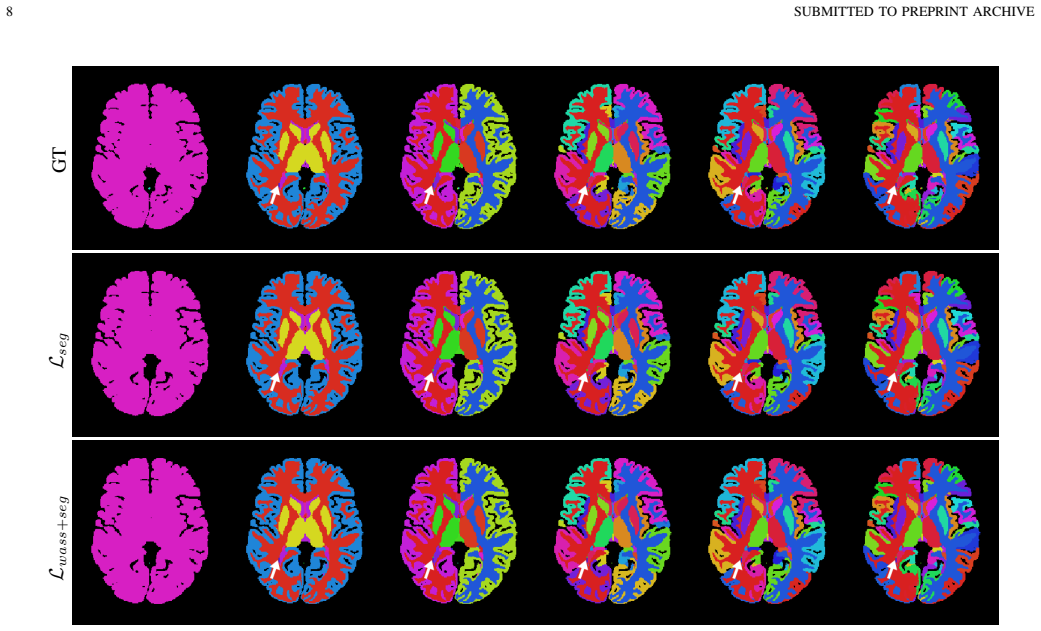
On its own terms, the paper's central claim is that semantic structure in the label space is a trainable signal that standard per-pixel losses throw away. For whole-brain parcellation with 108 classes under the DKT protocol, the compound Wasserstein loss $L_{\mathrm{wass+seg}} = \alpha W_M + \beta L_{\mathrm{seg}}$, where the ground distance $M_{l,l'}$ is the path length between leaves in a neuroanatomical label tree, outperforms the nnU-Net default CE+Dice on manual-reference (MB42) and pseudo-ground-truth (AOMIC, IXI) evaluation; after Holm-Bonferroni correction the gains are significant for NSD and small-structure metrics in nearly all train-test settings. In the sparse positive-only hyperspectral setting, supervising at coarse hierarchy levels and weighting hierarchical edges improves F1 over leaf-only CE training. The paper also claims these losses integrate into a positive-only OOD-detection framework so background is flagged at inference by thresholding coarse-level aggregated probabilities.
Load-bearing premise
The whole-brain-parcellation gains on AOMIC and IXI are measured against automated GIF pseudo-ground-truth masks, not manual annotations; if GIF's own errors share the hierarchy the losses encode, the reported gains could partly reflect fitting the tool rather than better anatomy.
Editorial extensions
If this is right
- If the WBP result is correct, model-based brain parcellation can improve boundary and small-structure accuracy without any architectural change, simply by swapping the loss for one that knows the DKT hierarchy.
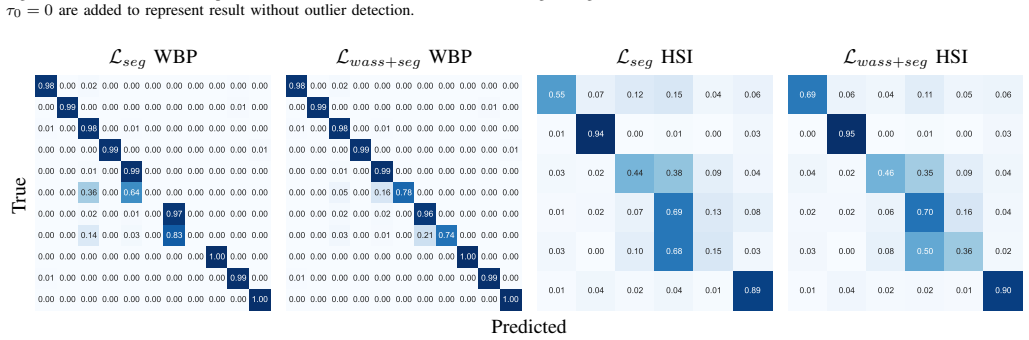
- Semantic losses make 'better mistakes': errors that stay within the same parent class cost less, so confusion matrices shift from anatomically meaningless to anatomically plausible errors.
- The sparse HSI results imply that hierarchy-aware supervision can be extracted from cheap coarse labels even when fine labels are too costly, which could lower annotation burden for surgical scene understanding.
- Because the losses are drop-in replacements, they can be combined with any segmentation backbone trained with CE/Dice-type objectives, including future nnU-Net variants.
Reading between the lines
- A testable extension the authors do not run: obtaining manual WBP annotations on a subset of AOMIC or IXI would distinguish genuine anatomical gains from improved matching to GIF's own errors, since GIF's label noise may share the same hierarchical inductive bias.
- The $M_h$ edge-weighting scheme reduces the hierarchy to a single global scaling factor $\kappa$; optimizing $\kappa$ per subtree or per hierarchy level could push the small-structure gains further than the paper reports.
- If the mechanism is truly the tree metric, then constructing hierarchies automatically, for example from label co-occurrence or atlas geometry, could extend these gains to tasks where no expert hierarchy exists, a direction the paper leaves implicit.
- The coarse-level OOD thresholding implies that background detection can be made robust by choosing the granularity at which 'unknown' is defined, which could generalize the sparse-supervision framework to applications where the background itself is hierarchical.
Signed reviews
Editorial analysis
A structured set of objections, weighed in public.
Referee Report
Summary. The paper proposes two tree-based semantic loss functions for multi-class medical image segmentation: a Wasserstein distance-based loss combined with a standard segmentation loss (L_wass+seg, Eq. 3) and a tree-weighted semantic cross-entropy loss (L_twce+seg, Eq. 6). Both losses encode a label hierarchy derived from anatomical knowledge or expert consensus. The authors integrate these losses into a positive-only sparse-annotation framework with OOD-based background detection, and evaluate on whole-brain parcellation (MB42, AOMIC, IXI) and surgical hyperspectral imaging (HSI) with sparse annotations. The main reported findings are that L_wass+seg consistently improves over the nnU-Net CE+Dice baseline on WBP, especially for NSD and small-structure metrics, and that hierarchy-aware losses improve top-level and, to a lesser extent, leaf-level HSI segmentation.
Significance. If the results are fully supported, the paper would provide a practical way to inject label semantics into high-cardinality segmentation with no architectural change, and would extend sparse positive-only training to hierarchical settings. Strengths of the manuscript include the use of established baselines (nnU-Net, EfficientNet-U-Net), paired subject-level statistical tests with Holm-Bonferroni correction on the WBP task, public code, and the MB42 manual-reference evidence, which is the most trustworthy part of the evaluation. However, the cross-dataset WBP claims rely on GIF pseudo-ground-truth agreement, the HSI leaf-level F1 scores are near zero and lack a reported baseline, and key hierarchy hyperparameters are chosen outside the target evaluation or in unreported preliminary experiments. These issues currently limit the strength of the central claims.
major comments (4)
- [§5.1, §4.1.1] The cross-dataset WBP claim for AOMIC and IXI rests entirely on GIF-derived pseudo-ground-truth masks, as Section 4.1.1 explicitly acknowledges. The manuscript's own MB42 control reports GIF-vs-manual Dice of 78.6±15.4, so GIF label error is substantial. Because the same GIF pipeline supplies the reference masks for the AOMIC/IXI test sets, the reported L_wass+seg gains on those datasets could reflect better reproduction of GIF's systematic labelling errors rather than improved anatomical accuracy. The MB42 manual-reference columns support the claim for MB42, but they do not establish that GIF-agreement gains track manual-reference gains on matched subjects. The authors should either provide such matched-subject evidence on MB42 or re-evaluate at least a subset of AOMIC/IXI with manual WBP labels; without this, the non-MB42 WBP results should be described only as improved agreement with an automated tool.
- [§5.2, leaf-node results] The HSI leaf-level F1 scores are reported as approximately 0.069 and 0.073 for L_wass+seg (Mℓ and Mh) and 0.068 and 0.037 for L_twce (Mℓ and Mh), with the statement that both losses outperform the baseline, but no baseline leaf-level F1 value is given. These numbers are near zero, which indicates that leaf-level segmentation is essentially not functioning on this task. Since the paper's central motivation is "rich multi-class" segmentation, the authors must report the baseline leaf-level F1, explain why leaf-level performance is so low, and reconcile the abstract's claim of strong support for hierarchy-weighted top-level supervision with the leaf-level results.
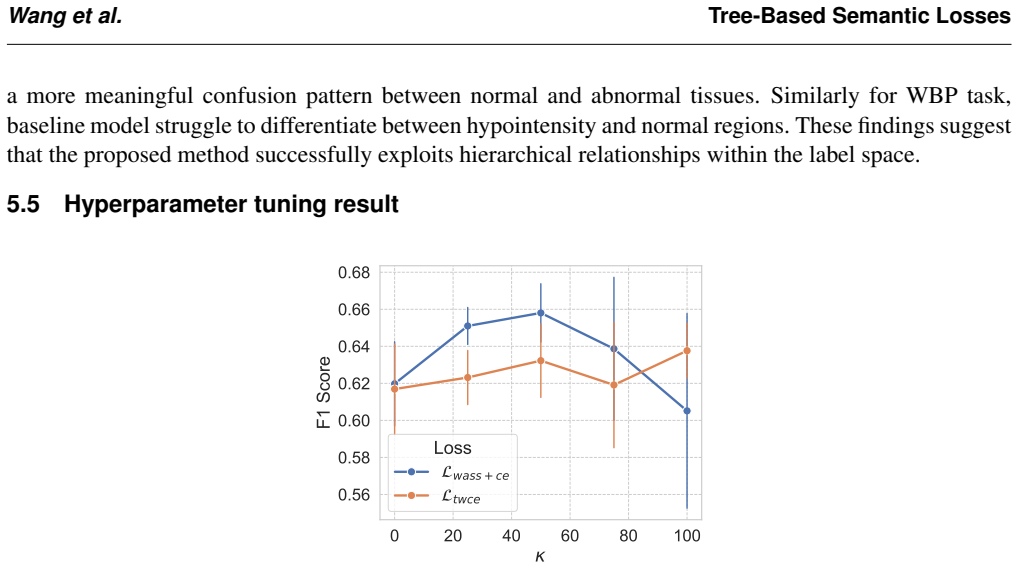
- [§4.2.3, §5.5] The hierarchy scaling parameter κ that defines the M_h ground-distance configuration is not validated on the target tasks. For WBP, the text states that the authors "reuse the best configuration identified in (Wang et al., 2025a)" and fix κ=10, but Wang et al. 2025a is an HSI paper, so this is a cross-task hyperparameter transfer without evidence. For HSI, κ=10 for L_wass+seg and κ=2 for L_twce were chosen in unreported preliminary experiments, while Section 5.5 later reports that L_wass+ce peaks at κ=50. Since κ controls the semantic ground distance that defines the proposed loss, the reported gains could be sensitive to favourable hyperparameter choices. A sensitivity analysis on the actual evaluation datasets, or a clearly described validation-based selection procedure, is needed to support the main results.
- [§5.1, Table A1] The abstract and Section 5.1 claim "consistent improvements" over baselines, but the paper's own paired statistics show that L_twce+seg is sometimes significantly worse than L_seg after Holm-Bonferroni correction. For example, in Table A1, the IXI-train / MB42-test comparison for NSD_small has MeanΔ=-0.0080 with Holm significance marked *, meaning the proposed loss is significantly worse on that metric. The claim should be restricted to the losses and metrics where the evidence is positive, and the text should acknowledge the negative paired comparisons. In addition, Table A1 reports only significance markers rather than numeric p-values, which is insufficient for readers to verify the Holm-Bonferroni correction; numeric p-values (or a supplementary table with them) should be provided.
minor comments (5)
- [§3.2, Eq. (5)] The aggregated ground-truth vector g† used in CE_T is never defined; the authors should define it analogously to p† in Eq. (4) so the reader can see how internal-node supervision is constructed from leaf labels.
- [§4.2.3, §5.5] The notation is inconsistent: Section 4.2.3 and Table 2 use L_wass+seg, while Section 5.5 and Figure 7 refer to L_wass+ce, and the reported optimal κ values differ (κ=10 vs κ=50). These should be unified and the discrepancy explained.
- [Table 2 caption] The table rows labelled Lwass Mt and Lwass+seg Mt are easy to confuse; the caption should explicitly state that Lwass denotes the pure Wasserstein loss (Eq. 2) and Lwass+seg denotes the compound loss (Eq. 3), and should clarify which rows are baselines.
- [§4.1.1] The sentence "Because manual WBP annotation is often difficult due to single manual annotations may contain local inconsistencies" is grammatically incomplete, and the following claim that GIF-derived masks "can therefore be qualitatively more anatomically coherent" is not supported by any evaluation in the manuscript.
- [References] The DOI for Wang et al. 2025a appears malformed ("10.1007/978-3-032-04984-1 56"); please correct it.
Circularity Check
No significant circularity: the loss derivations are self-contained, and the central WBP claim is supported by manual-reference evaluation on held-out subjects; only minor non-load-bearing self-citations appear.
full rationale
The claimed derivation chain is self-contained. The Wasserstein loss is defined from an optimal-transport problem (Eq. 1) with leaf-to-leaf ground distances induced by the label tree, and the closed-form evaluation against a crisp ground truth (Eq. 2) is attributed to Fidon et al. (2018) as an external mathematical identity, not derived from this paper's own outputs. The tree-weighted CE (Eq. 5) is defined directly from the hierarchy via (I-A)^{-1} probability aggregation and explicitly reduces to standard CE when only leaf nodes are weighted, so it is not a renamed version of the evaluation metric. The central WBP claim is empirical rather than derived: L_wass+seg is compared with the nnU-Net CE+Dice baseline and the Fidon et al. GWD baseline on held-out test subjects; MB42 provides manual-reference Dice/NSD with paired Holm-Bonferroni-corrected tests (Table A1). Reused or tuned hyperparameters (alpha=beta=0.5; kappa=10 for WBP from Wang et al. 2025a; HSI kappa from unreported preliminary experiments) are experimental settings, not inputs from which the conclusions are derived. Self-citations to Wang et al. (2025a, 2026) supply a prior configuration and the OOD positive-only framework; they are not load-bearing for the loss derivations or for the MB42 manual-reference result. The AOMIC/IXI GIF pseudo-ground-truth caveat, explicitly acknowledged in Sec. 4.1.1, is a benchmark-validity limitation rather than a circular reduction: the paper does not claim manual-level accuracy there, and the same pseudo-ground-truth reference is applied to all compared losses.
Assumptions & free parameters
free parameters (4)
- compound loss weights alpha and beta =
0.5
- hierarchy scaling kappa (M_h) =
10 for WBP and L_wass+seg HSI; 2 for L_twce+seg HSI
- OOD threshold tau_m =
chosen per validation fold
- edge weight matrices M_t, M_l, M_e =
binary weights on top-level or leaf edges, or all ones
assumptions (4)
- standard math The closed-form Wasserstein loss W_M(p,g)=p^T M g is valid for crisp ground truth g.
- domain assumption The label hierarchies (DKT-derived for WBP, expert consensus for HSI) capture meaningful semantic relationships where errors within a subtree are more acceptable than errors across subtrees.
- domain assumption GIF-derived pseudo-ground-truth masks on AOMIC and IXI are adequate evaluation references for comparing segmentation losses.
- domain assumption Pixel-wise OOD detection via max-softmax thresholding at hierarchy level h can separate background from positive classes in sparse positive-only training.
Cite this review
Pith. "Pith review of Label tree semantic losses for rich multi-class medical image segmentation." pith.science (2026). https://pith.science/paper/TRQ6Q2DT
@misc{pith2026250715777,
  author       = {Pith},
  title        = {Pith review of: Label tree semantic losses for rich multi-class medical image segmentation},
  year         = {2026},
  howpublished = {\url{https://pith.science/paper/TRQ6Q2DT}},
  note         = {Machine review of arXiv:2507.15777}
}
read the original abstract
Rich and accurate medical image segmentation is poised to underpin the next generation of AI-defined clinical practice by delineating critical anatomy for pre-operative planning, guiding real-time intra-operative navigation, and supporting precise post-operative assessment. However, commonly used learning methods for medical and surgical imaging segmentation tasks penalise all errors equivalently and thus fail to exploit any inter-class semantics in the label space. This becomes particularly problematic as the cardinality and richness of labels increases to include subtly different classes. In this work, we propose two tree-based semantic loss functions which take advantage of a hierarchical organisation of the labels. We further incorporate our losses in a recently proposed approach for training with sparse, background-free annotations to extend the applicability of our proposed losses. Extensive experiments are reported on two medical and surgical imaging segmentation tasks, namely head MRI for whole brain parcellation with full supervision and neurosurgical hyperspectral imaging for scene understanding with sparse annotations. Results demonstrate consistent improvements over the evaluated task-specific baselines, with the strongest support for the Wasserstein-based compound loss in whole-brain parcellation and for hierarchy-weighted top-level supervision in the sparse HSI setting.
Figures


Figures from the paper (7 more)




Reference graph
Works this paper leans on
-
[1]
, " * write output.state after.block = add.period write newline
ENTRY address annote author booktitle chapter doi edition editor eid howpublished institution journal key language month note number organization pages publisher school series title type volume year label extra.label sort.label short.list INTEGERS output.state before.all mid.sentence after.sentence after.block FUNCTION init.state.consts #0 'before.all := ...
-
[2]
write newline
" write newline "" before.all 'output.state := FUNCTION n.dashify 't := "" t empty not t #1 #1 substring "-" = t #1 #2 substring "--" = not "--" * t #2 global.max substring 't := t #1 #1 substring "-" = "-" * t #2 global.max substring 't := while if t #1 #1 substring * t #2 global.max substring 't := if while FUNCTION word.in bbl.in capitalize " " * FUNCT...
-
[3]
Bahl, A., Horgan, C. C., Janatka, M., MacCormac, O. J., Noonan, P., Xie, Y., et al. (2023). Synthetic white balancing for intra-operative hyperspectral imaging. Journal of Medical Imaging 10, 046001. doi:10.1117/1.JMI.10.4.046001 bahlSyntheticWhiteBalancing2023
-
[5]
Bocchetta, M., Todd, E. G., Bouzigues, A., Cash, D. M., Nicholas, J. M., Convery, R. S., et al. (2023). Structural MRI predicts clinical progression in presymptomatic genetic frontotemporal dementia: findings from the GENetic Frontotemporal dementia Initiative cohort. Brain Communications 5, fcad061. doi:10.1093/braincomms/fcad061 bocchettaStructuralMRIPr...
-
[7]
Bulusu, S., Kailkhura, B., Li, B., Varshney, P. K., and Song, D. (2020). Anomalous example detection in deep learning: A survey. IEEE Access 8, 132330--132347. doi:10.1109/ACCESS.2020.3010274 bulusuAnomalousExampleDetection2020
arXiv 2020
-
[8]
Cai, H., Qi, L., Yu, Q., Shi, Y., and Gao, Y. (2023). 3D medical image segmentation with sparse annotation via cross-teaching between 3D and 2D networks. In Medical Image Computing and Computer Assisted Intervention -- MICCAI 2023: 26th International Conference (Berlin, Heidelberg), 614--624. doi:10.1007/978-3-031-43898-1_59 cai3DMedicalImage2023
-
[10]
J., Modat, M., Wolz, R., Melbourne, A., Cash, D., Rueckert, D., et al
Cardoso, M. J., Modat, M., Wolz, R., Melbourne, A., Cash, D., Rueckert, D., et al. (2015 b ). Geodesic information flows: Spatially-variant graphs and their application to segmentation and fusion. IEEE Transactions on Medical Imaging 34, 1976--1988. doi:10.1109/TMI.2015.2418298 cardosoGeodesicInformationFlows2015
-
[11]
Carstens, M., Rinner, F. M., Bodenstedt, S., Jenke, A. C., Weitz, J., Distler, M., et al. (2023). The dresden surgical anatomy dataset for abdominal organ segmentation in surgical data science. Scientific Data 10, 3. doi:10.1038/s41597-022-01719-2 carstensDresdenSurgicalAnatomy2023
Show all 72 references
-
[12]
S., Brox, T., and Ronneberger, O
C i c ek, \"O ., Abdulkadir, A., Lienkamp, S. S., Brox, T., and Ronneberger, O. (2016). 3D U-Net : Learning dense volumetric segmentation from sparse annotation. In Medical Image Computing and Computer-Assisted Intervention -- MICCAI 2016 (Cham), 424--432. doi:10.1007/978-3-31...
2016 doi
-
[13]
Deng, C., Zheng, C., Chen, T., Wang, C., Zhang, J., Li, Y., et al. (2024). HATs : Hierarchical adaptive taxonomy segmentation for panoramic pathology image analysis. In Medical Image Computing and Computer Assisted Intervention -- MICCAI 2024 (Cham), 155--166. doi:10.1007/978-...
2024 doi
-
[14]
C., Li, K., and Fei-Fei , L
Deng, J., Berg, A. C., Li, K., and Fei-Fei , L. (2010). What does classifying more than 10,000 image categories tell us? In Computer Vision -- ECCV 2010 (Berlin, Heidelberg), 71--84. doi:10.1007/978-3-642-15555-0_6 dengWhatDoesClassifying2010
2010 doi
-
[15]
Deng, J., Dong, W., Socher, R., Li, L.-J., Li, K., and Fei-Fei , L. (2009). ImageNet : A large-scale hierarchical image database. In IEEE Conference on Computer Vision and Pattern Recognition ( CVPR ) . 248--255 dengImageNetLargescaleHierarchical2009
2009
-
[16]
Dorent, R., Joutard, S., Shapey, J., Kujawa, A., Modat, M., Ourselin, S., et al. (2021). Inter extreme points geodesics for end-to-end weakly supervised image segmentation. In Medical Image Computing and Computer Assisted Intervention -- MICCAI 2021 (Cham), 615--624. doi:10.10...
2021 doi
-
[17]
B., Yeo, B
Eickhoff, S. B., Yeo, B. T. T., and Genon, S. (2018). Imaging-based parcellations of the human brain. Nature Reviews Neuroscience 19, 672--686. doi:10.1038/s41583-018-0071-7 eickhoffImagingbasedParcellationsHuman2018
2018 doi
-
[18]
and Guo, Y
En, Q. and Guo, Y. (2024). Annotation by clicks: A point-supervised contrastive variance method for medical semantic segmentation. In 35th British Machine Vision Conference 2024, BMVC 2024, Glasgow, UK , November 25-28, 2024 (BMVA), 1--13 enAnnotationClicksPointSupervised2022
2024
-
[19]
R., Sosa, C., Bulters, D., et al
Fabelo, H., Ortega, S., Ravi, D., Kiran, B. R., Sosa, C., Bulters, D., et al. (2018). Spatio-spectral classification of hyperspectral images for brain cancer detection during surgical operations. PLOS ONE 13, e0193721. doi:10.1371/journal.pone.0193721 fabeloSpatiospectralClass...
2018 doi
-
[20]
C., Ekanayake, J., Kitchen, N., Ourselin, S., et al
Fidon, L., Li, W., Garcia-Peraza-Herrera , L. C., Ekanayake, J., Kitchen, N., Ourselin, S., et al. (2018). Generalised wasserstein dice score for imbalanced Multi-Class segmentation using holistic convolutional networks. In 9th International MICCAI Brainlesion Workshop (Cham),...
2018 doi
-
[21]
C., Ourselin, S., and Vercauteren, T
Fidon, L., Shit, S., Ezhov, I., Paetzold, J. C., Ourselin, S., and Vercauteren, T. (2022). Generalized wasserstein dice loss, test-time augmentation, and transformers for the BraTS 2021 challenge. In Brainlesion: Glioma, Multiple Sclerosis, Stroke and Traumatic Brain Injuries ...
2022 doi
-
[22]
H., Busa, E., Albert, M., Dieterich, M., Haselgrove, C., et al
Fischl, B., Salat, D. H., Busa, E., Albert, M., Dieterich, M., Haselgrove, C., et al. (2002). Whole brain segmentation: Automated labeling of neuroanatomical structures in the human brain. Neuron 33, 341--355. doi:10.1016/S0896-6273(02)00569-X fischlWholeBrainSegmentation2002
2002 doi
-
[23]
Frogner, C., Zhang, C., Mobahi, H., Araya, M., and Poggio, T. A. (2015). Learning with a wasserstein loss. In Advances in Neural Information Processing Systems. vol. 28, 2053–2061 frognerLearningWassersteinLoss2015
2015
-
[24]
C., Horgan, C., Ourselin, S., Ebner, M., and Vercauteren, T
Garcia Peraza Herrera, L. C., Horgan, C., Ourselin, S., Ebner, M., and Vercauteren, T. (2023). Hyperspectral image segmentation: A preliminary study on the oral and dental spectral image database ( ODSI-DB ). Computer Methods in Biomechanics and Biomedical Engineering: Imaging...
2023
-
[25]
R., and Criminisi, A
Glocker, B., Zikic, D., Konukoglu, E., Haynor, D. R., and Criminisi, A. (2013). Vertebrae localization in pathological spine CT via dense classification from sparse annotations. In Medical Image Computing and Computer-Assisted Intervention -- MICCAI 2013 (Berlin, Heidelberg), ...
2013 doi
-
[26]
Gonz \'a lez, C., Gotkowski, K., Fuchs, M., Bucher, A., Dadras, A., Fischbach, R., et al. (2022). Distance-based detection of out-of-distribution silent failures for COVID-19 lung lesion segmentation. Medical Image Analysis 82, 102596. doi:10.1016/j.media.2022.102596 gonzalezD...
2022
-
[27]
S., Sudre, C
Graham, M. S., Sudre, C. H., Varsavsky, T., Tudosiu, P.-D., Nachev, P., Ourselin, S., et al. (2020). Hierarchical brain parcellation with uncertainty. In Uncertainty for Safe Utilization of Machine Learning in Medical Imaging, and Graphs in Biomedical Image Analysis (Cham), 23...
2020 doi
-
[28]
Guha Roy, A., Conjeti, S., Navab, N., and Wachinger, C. (2019). QuickNAT : A fully convolutional network for quick and accurate segmentation of neuroanatomy. NeuroImage 186, 713--727. doi:10.1016/j.neuroimage.2018.11.042 guharoyQuickNATFullyConvolutional2019
2019 doi
-
[29]
Guo, C., Pleiss, G., Sun, Y., and Weinberger, K. Q. (2017). On calibration of modern neural networks. In Proceedings of the 34th International Conference on Machine Learning. 1321--1330 guoCalibrationModernNeural2017a
2017
-
[30]
and Gimpel, K
Hendrycks, D. and Gimpel, K. (2017). A baseline for detecting misclassified and out-of-distribution examples in neural networks. In International Conference on Learning Representations. 1--12 hendrycksBaselineDetectingMisclassified2017
2017
-
[31]
Henschel, L., Conjeti, S., Estrada, S., Diers, K., Fischl, B., and Reuter, M. (2020). Fastsurfer - a fast and accurate deep learning based neuroimaging pipeline. NeuroImage 219, 117012. doi:10.1016/j.neuroimage.2020.117012 henschelFastSurferFastAccurate2020
2020
-
[32]
Hsu, Y.-C., Shen, Y., Jin, H., and Kira, Z. (2020). Generalized ODIN : Detecting out-of-distribution image without learning from out-of-distribution data. In 2020 IEEE / CVF Conference on Computer Vision and Pattern Recognition ( CVPR ) . 10948--10957. doi:10.1109/CVPR42600.20...
2020
-
[33]
a lt, P., J \
Hyttinen, J., F \"a lt, P., J \"a sberg, H., Kullaa, A., and Hauta-Kasari , M. (2020). Oral and dental spectral image database--- ODSI-DB . Applied Sciences 10, 7246. doi:10.3390/app10207246 hyttinenOralDentalSpectral2020
2020 doi
-
[34]
F., Kohl, S
Isensee, F., Jaeger, P. F., Kohl, S. A. A., Petersen, J., and Maier-Hein , K. H. (2021). nnU-Net : A self-configuring method for deep learning-based biomedical image segmentation. Nature Methods 18, 203--211. doi:10.1038/s41592-020-01008-z isenseeNnUNetSelfconfiguringMethod2021
2021 doi
-
[35]
Isensee, F., Wald, T., Ulrich, C., Baumgartner, M., Roy, S., Maier-Hein , K., et al. (2024). nnU-Net revisited: A call for rigorous validation in 3d medical image segmentation. In Medical Image Computing and Computer Assisted Intervention -- MICCAI 2024 (Springer Nature Switze...
2024 doi
-
[36]
Jegou, S., Drozdzal, M., Vazquez, D., Romero, A., and Bengio, Y. (2017). The one hundred layers tiramisu: Fully convolutional densenets for semantic segmentation. In Proceedings of the IEEE Conference on Computer Vision and Pattern Recognition Workshops . 11--19 jegouOneHundre...
2017
-
[37]
and Gholipour, A
Karimi, D. and Gholipour, A. (2023). Improving calibration and out-of-distribution detection in deep models for medical image segmentation. IEEE Transactions on Artificial Intelligence 4, 383--397. doi:10.1109/TAI.2022.3159510 karimiImprovingCalibrationOutofDistribution2023
2023
-
[38]
P., and Devabhaktuni, V
Khan, U., Paheding, S., Elkin, C. P., and Devabhaktuni, V. K. (2021). Trends in deep learning for medical hyperspectral image analysis. IEEE Access 9, 79534--79548. doi:10.1109/ACCESS.2021.3068392 khanTrendsDeepLearning2021
2021
-
[39]
Kingma, D. P. and Ba, J. (2017). Adam: A method for stochastic optimization. In 3rd International Conference on Learning Representations ( ICLR ), San Diego, 2015 . 13 kingmaAdamMethodStochastic2017
2017
-
[40]
and Tourville, J
Klein, A. and Tourville, J. (2012). 101 labeled brain images and a consistent human cortical labeling protocol. Frontiers in Neuroscience 6. doi:10.3389/fnins.2012.00171 klein101LabeledBrain2012
2012 arXiv
-
[41]
Kuang, Z., Yan, Z., and Yu, L. (2024). Weakly supervised learning for Multi-Class medical image segmentation via feature decomposition. Computers in Biology and Medicine 171, 108228. doi:10.1016/j.compbiomed.2024.108228 kuangWeaklySupervisedLearning2024
2024
-
[42]
Kujawa, A., Dorent, R., Ourselin, S., and Vercauteren, T. (2024). Label merge-and-split: A graph-colouring approach for memory-efficient brain parcellation. In Medical Image Computing and Computer Assisted Intervention -- MICCAI 2024 (Cham), 350--360. doi:10.1007/978-3-031-721...
2024 doi
-
[43]
Lambert, B., Forbes, F., Doyle, S., Dehaene, H., and Dojat, M. (2024). Trustworthy clinical AI solutions: A unified review of uncertainty quantification in deep learning models for medical image analysis. Artificial Intelligence in Medicine 150, 102830. doi:10.1016/j.artmed.20...
2024
-
[44]
Le, T., Yamada, M., Fukumizu, K., and Cuturi, M. (2019). Tree-sliced variants of wasserstein distances. In Advances in Neural Information Processing Systems. vol. 32, 1--12 leTreeSlicedVariantsWasserstein2019a
2019
-
[45]
Lee, K., Lee, K., Lee, H., and Shin, J. (2018). A simple unified framework for detecting out-of-distribution samples and adversarial attacks. In Advances in Neural Information Processing Systems. vol. 31, 1--12 leeSimpleUnifiedFramework2018
2018
-
[46]
(2024 a )
Li, L., Wang, W., Zhou, T., Quan, R., and Yang, Y. (2024 a ). Semantic hierarchy-aware segmentation. IEEE Transactions on Pattern Analysis and Machine Intelligence 46, 2123--2138. doi:10.1109/TPAMI.2023.3332435 liSemanticHierarchyAwareSegmentation2024
2024
-
[47]
Li, P., Ebner, M., Noonan, P., Horgan, C., Bahl, A., Ourselin, S., et al. (2022). Deep learning approach for hyperspectral image demosaicking, spectral correction and high-resolution RGB reconstruction. Computer Methods in Biomechanics and Biomedical Engineering: Imaging & Vis...
2022
-
[48]
(2024 b )
Li, P., MacCormac, O., Shapey, J., and Vercauteren, T. (2024 b ). A self-supervised and adversarial approach to hyperspectral demosaicking and RGB reconstruction in surgical imaging. In 35th British Machine Vision Conference 2024, BMVC 2024, Glasgow, UK , November 25-28, 2024 ...
2024
-
[49]
Liang, S., Li, Y., and Srikant, R. (2018). Enhancing the reliability of out-of-distribution image detection in neural networks. In International Conference on Learning Representations. 1--12 liangEnhancingReliabilityOutofdistribution2018
2018
-
[50]
Lu, H., Yan, K., Zhang, F., Wang, P., and Tian, J. (2024). H2ASeg : Hierarchical adaptive interaction and weighting network for tumor segmentation in PET / CT images. In Medical Image Computing and Computer Assisted Intervention -- MICCAI 2024 (Cham), 89--99. doi:10.1007/978-3...
2024 doi
-
[51]
Ma, J., Chen, J., Ng, M., Huang, R., Li, Y., Li, C., et al. (2021). Loss odyssey in medical image segmentation. Medical Image Analysis 71, 102035. doi:10.1016/j.media.2021.102035 maLossOdysseyMedical2021
2021
-
[52]
[Dataset] Mart \'i n-P \'e rez , A., Martinez-Vega , B., Villa, M., Leon, R., Martinez de Ternero , A., Fabelo, H., et al. (2024). Machine learning performance trends: A comparative study of independent hyperspectral human brain cancer databases martin-perezMachineLearningPerf...
2024
-
[53]
H., Jakab, A., Bauer, S., Kalpathy-Cramer , J., Farahani, K., Kirby, J., et al
Menze, B. H., Jakab, A., Bauer, S., Kalpathy-Cramer , J., Farahani, K., Kirby, J., et al. (2015). The multimodal brain tumor image segmentation benchmark ( BRATS ). IEEE Transactions on Medical Imaging 34, 1993--2024. doi:10.1109/TMI.2014.2377694 menzeMultimodalBrainTumor2015
2015
-
[54]
J., Kenngott, H., Vemuri, A
Moccia, S., Wirkert, S. J., Kenngott, H., Vemuri, A. S., Apitz, M., Mayer, B., et al. (2018). Uncertainty-aware organ classification for surgical data science applications in laparoscopy. IEEE Transactions on Biomedical Engineering 65, 2649--2659. doi:10.1109/TBME.2018.2813015...
2018
-
[55]
M., and Yang, G.-Z
Rav \`i , D., Fabelo, H., Callic, G. M., and Yang, G.-Z. (2017). Manifold embedding and semantic segmentation for intraoperative guidance with hyperspectral brain imaging. IEEE Transactions on Medical Imaging 36, 1845--1857. doi:10.1109/TMI.2017.2695523 raviManifoldEmbeddingSe...
2017
-
[56]
Ronneberger, O., Fischer, P., and Brox, T. (2015). U-Net : Convolutional networks for biomedical image segmentation. In Medical Image Computing and Computer-Assisted Intervention -- MICCAI 2015 (Cham), 234--241. doi:10.1007/978-3-319-24574-4_28 ronnebergerUNetConvolutionalNetworks2015
2015 doi
-
[57]
G., Conjeti, S., Sheet, D., Katouzian, A., Navab, N., and Wachinger, C
Roy, A. G., Conjeti, S., Sheet, D., Katouzian, A., Navab, N., and Wachinger, C. (2017). Error corrective boosting for learning fully convolutional networks with limited data. In Medical Image Computing and Computer Assisted Intervention - MICCAI 2017 (Cham), 231--239. doi:10.1...
2017 doi
-
[58]
O zdemir, B., Studier-Fischer , A., Kn \
Seidlitz, S., Sellner, J., Odenthal, J., \"O zdemir, B., Studier-Fischer , A., Kn \"o dler, S., et al. (2022). Robust deep learning-based semantic organ segmentation in hyperspectral images. Medical Image Analysis 80, 102488. doi:10.1016/j.media.2022.102488 seidlitzRobustDeepL...
2022
-
[59]
R., Ourselin, S., et al
Shapey, J., Xie, Y., Nabavi, E., Bradford, R., Saeed, S. R., Ourselin, S., et al. (2019). Intraoperative multispectral and hyperspectral label-free imaging: A systematic review of in vivo clinical studies. Journal of Biophotonics 12, e201800455. doi:10.1002/jbio.201800455 shap...
2019 doi
-
[60]
M., Beemsterboer, T., van der Leij , A., Eigenhuis, A., and Steven Scholte, H
Snoek, L., van der Miesen , M. M., Beemsterboer, T., van der Leij , A., Eigenhuis, A., and Steven Scholte, H. (2021). The amsterdam open MRI collection, a set of multimodal MRI datasets for individual difference analyses. Scientific Data 8, 85. doi:10.1038/s41597-021-00870-6 s...
2021 doi
-
[61]
Studier-Fischer , A., Seidlitz, S., Sellner, J., Bressan, M., \"O zdemir, B., Ayala, L., et al. (2023). HeiPorSPECTRAL - the heidelberg porcine HyperSPECTRAL imaging dataset of 20 physiological organs. Scientific Data 10, 414. doi:10.1038/s41597-023-02315-8 studier-fischerHeiP...
2023 doi
-
[62]
Takezawa, Y., Sato, R., and Yamada, M. (2021). Supervised tree-wasserstein distance. In Proceedings of the 38th International Conference on Machine Learning. 10086--10095 takezawaSupervisedTreeWassersteinDistance2021
2021
-
[63]
and Le, Q
Tan, M. and Le, Q. (2019). EfficientNet : Rethinking model scaling for convolutional neural networks. In Proceedings of the 36th International Conference on Machine Learning. 6105--6114 tanEfficientNetRethinkingModel2019
2019
-
[64]
Trajanovski, S., Shan, C., Weijtmans, P. J. C., de Koning , S. G. B., and Ruers, T. J. M. (2021). Tongue tumor detection in hyperspectral images using deep learning semantic segmentation. IEEE Transactions on Biomedical Engineering 68, 1330--1340. doi:10.1109/TBME.2020.3026683...
2021
-
[65]
Verma, N., Mahajan, D., Sellamanickam, S., and Nair, V. (2012). Learning hierarchical similarity metrics. In 2012 IEEE Conference on Computer Vision and Pattern Recognition . 2280--2287. doi:10.1109/CVPR.2012.6247938 vermaLearningHierarchicalSimilarity2012
2012
-
[66]
A., Pratt, R., Patel, P
Wang, G., Li, W., Zuluaga, M. A., Pratt, R., Patel, P. A., Aertsen, M., et al. (2018). Interactive medical image segmentation using deep learning with image-specific fine tuning. IEEE Transactions on Medical Imaging 37, 1562--1573. doi:10.1109/TMI.2018.2791721 wangInteractiveM...
2018
-
[67]
A., Li, W., Pratt, R., Patel, P
Wang, G., Zuluaga, M. A., Li, W., Pratt, R., Patel, P. A., Aertsen, M., et al. (2019). DeepIGeoS : A deep interactive geodesic framework for medical image segmentation. IEEE Transactions on Pattern Analysis and Machine Intelligence 41, 1559--1572. doi:10.1109/TPAMI.2018.284069...
2019
-
[68]
(2025 a )
Wang, J., Maccormac, O., Rochford, W., Kujawa, A., Shapey, J., and Vercauteren, T. (2025 a ). Tree-based semantic losses: Application to sparsely-supervised large Multi-Class hyperspectral segmentation. In Medical Image Computing and Computer Assisted Intervention -- MICCAI 20...
2025 doi
-
[69]
Wang, J., Wang, Z., MacCormac, O., Shapey, J., and Vercauteren, T. (2026). OOD-SEG : Exploiting out-of-distribution detection techniques for learning image segmentation from sparse multi-class positive-only annotations. Medical Image Analysis , 104046doi:10.1016/j.media.2026.1...
2026
-
[70]
and Xia, B
Wang, J. and Xia, B. (2021). Bounding box tightness prior for weakly supervised image segmentation. In Medical Image Computing and Computer Assisted Intervention -- MICCAI 2021 (Cham), 526--536. doi:10.1007/978-3-030-87196-3_49 wangBoundingBoxTightness2021
2021 doi
-
[71]
(2025 b )
Wang, Z., Ye, Y., Chen, Z., Shu, M., Zhang, Y., and Xia, Y. (2025 b ). From few to more: Scribble-based medical image segmentation via masked context modeling and continuous pseudo labels. IEEE Journal of Biomedical and Health Informatics , 1--14doi:10.1109/JBHI.2025.3599066 w...
2025
-
[72]
K., and Li, Z
Wei, J., Hu, Y., Cui, S., Zhou, S. K., and Li, Z. (2023). WeakPolyp : You only look bounding box for polyp segmentation. In Medical Image Computing and Computer Assisted Intervention -- MICCAI 2023 (Cham: Springer Nature Switzerland), vol. 14222 of Lecture Notes in Computer Sc...
2023 doi
-
[73]
I.-C., Lai, M., and Tu, Z
Xu, Y., Zhu, J.-Y., Chang, E. I.-C., Lai, M., and Tu, Z. (2014). Weakly supervised histopathology cancer image segmentation and classification. Medical Image Analysis 18, 591--604. doi:10.1016/j.media.2014.01.010 xuWeaklySupervisedHistopathology2014
2014 doi
-
[74]
L., Bocchetta, M., Russell, L
Young, A. L., Bocchetta, M., Russell, L. L., Convery, R. S., Peakman, G., Todd, E., et al. (2021). Characterizing the clinical features and atrophy patterns of MAPT -related frontotemporal dementia with disease progression modeling. Neurology 97, e941--e952. doi:10.1212/WNL.00...
2021 doi
-
[75]
Zhao, B., Li, F., and Xing, E. (2011). Large-scale category structure aware image categorization. In Advances in Neural Information Processing Systems. vol. 24, 1251–1259 zhaoLargeScaleCategoryStructure2011
2011
Reviewed August 6, 2026 · model on record in the stance chip above.
Discussion (0). Continue with ORCID to comment.