REVIEW 3 major objections 4 minor 76 references
Can boundary configuration be tuned to optimize directional quantum steering harvesting?
T0 review · 3 major / 4 minor · reviewed 2026-08-15 · deepseek-v4-flash
Pith's one-line read The paper claims that a perfectly reflecting boundary can act as a tunable directional control for quantum steering harvested from the vacuum: across most of the parameter space, orthogonal alignment enhances Bob-to-Alice steering and…
desk verdict Worth a serious referee: the directional steering asymmetry is new and the derivation is clean, but the headline 'enhance/suppress' claims rest on an unproven steering witness magnitude, so the paper needs a tightness check or softened claims. read the letter →
The pith
A machine-rendered reading of the paper's core claim, the machinery that carries it, and where it could break.
The reading
What carries the argument
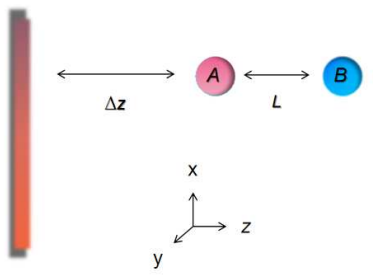
The load-bearing machinery is the X-state density matrix produced at leading order in the detector-field coupling, together with a steering quantifier built from entanglement. The authors take the usual perturbative Unruh-DeWitt result for the two-detector state and record its matrix elements $P_A$, $P_B$ (excitation probabilities) and $C$, $X$ (correlation amplitudes). They then use the fact that steering from Bob to Alice can be witnessed by entanglement of a locally depolarised version of that state, and similarly for Alice to Bob, to write explicit quantities $S_{B\to A}$ and $S_{A\to B}$ (Eqs. (11)-(12)). The reflecting boundary enters through the method-of-images Wightman function, producing correlation terms $f(L)-f(\sqrt{L^2+4\Delta z^2})$ in the parallel case and $f(L)-f(L+2\Delta z)$ in the orthogonal case, where $f$ and $g$ are auxiliary functions encoding the Gaussian switching and energy gaps. Because the orthogonal case gives the two detectors different distances to the boundary, $P_A$ and $P_B$ differ even for identical energy gaps, and that difference is what breaks the symmetry.
What would settle it
Compute a certified steering monotone, for example the steering robustness obtained by semidefinite programming, for the same X states used in the paper's plots, and check whether the orthogonal configuration still gives $S_{B\to A} > S_{A\to B}$ in the parameter regions where the paper's witness says it does. A reversal or vanishing of the ordering under the certified measure would show that the directional boundary effect is an artifact of the concurrence-based witness; preservation would independently confirm the paper's central claim.
Extended reading notes
Core claim
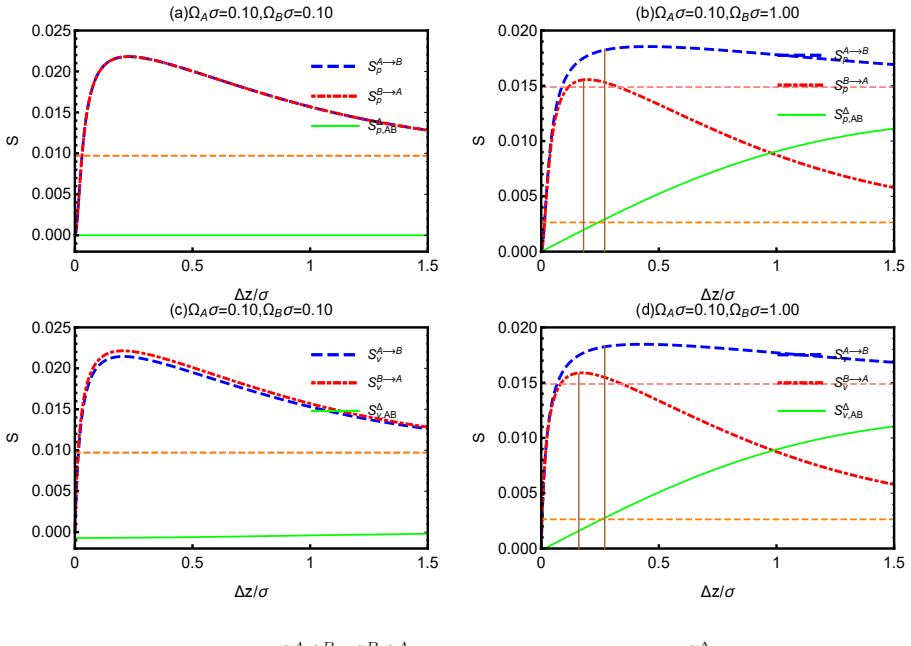
On the paper's own terms, the central discovery is a directional asymmetry in vacuum steering harvesting that is controlled by detector orientation. For two detectors with Bob's energy gap at least as large as Alice's, the parallel configuration generally gives stronger steering from Alice to Bob than from Bob to Alice, while the orthogonal configuration tends to reverse or weaken that ordering: as the detector-boundary distance grows, the boundary suppresses steering in one direction and enhances it in the other. Identical detectors orthogonal to the boundary already show one-way bias because the closer detector experiences a different boundary-modified vacuum response than the farther one. The paper interprets this as evidence that steering, unlike entanglement, is a directional probe of spatial structure in the vacuum, and that optimal extraction of steering depends on which direction is wanted: parallel placement favors Alice-to-Bob steering and orthogonal placement favors Bob-to-Alice steering.
Load-bearing premise
The directional comparison rests on treating the entanglement-based expressions $S_{B\to A}$ and $S_{A\to B}$ as faithful quantitative measures of steerability; if those witnesses overestimate or underestimate one direction for these X states, the claimed boundary-induced enhancement could be an artifact of the detection criterion rather than a property of the harvested vacuum correlations.
Editorial extensions
If this is right
- To maximize steering from the detector closer to the boundary (Bob to Alice), place the detector pair orthogonal to the reflecting plane; to maximize the reverse direction (Alice to Bob), place them parallel.
- Steering harvesting can serve as a directional probe of vacuum structure: the sign and size of the asymmetry reveal which detector is nearer the boundary and how strongly the boundary modifies the field.
- Detuning the energy gaps widens the separation range over which Alice-to-Bob steering survives and shrinks the range for Bob-to-Alice steering, so gap difference and geometry can be co-tuned to engineer one-way steering.
- The predicted two-way to one-way to no-way transitions as separation grows give an operational way to certify one-way steering from the vacuum in a single experimental setup.
- Because entanglement harvesting shows no such directional bias, steering-based protocols gain an extra degree of freedom, detector orientation, that entanglement-based protocols do not have.
Reading between the lines
- If the witness is faithful, the same asymmetry should be visible under any exact steering monotone; a numerical check with steering robustness would turn the paper's directional claims into a quantitative prediction rather than a witness-dependent one.
- By continuity, detector orientations between parallel and orthogonal should interpolate between the two preferred directions, and the optimal angle may itself depend on separation, boundary distance, and energy-gap difference; scanning intermediate angles could reveal that the extremes are not always optimal.
- The method-of-images structure suggests that more complex boundaries, such as two mirrors, a cavity, or curved mirrors, should create spatially varying preferred steering directions, so the effect is likely not limited to the single-plane geometry studied here.
- A laboratory analogue with superconducting qubits coupled to an engineered vacuum could test the predicted reversal of one-way steering by state tomography, connecting this relativistic-vacuum result to tabletop quantum-information experiments.
Signed reviews
Editorial analysis
A structured set of objections, weighed in public.
Referee Report
Summary. The paper studies quantum steering harvesting by two static Unruh-DeWitt detectors coupled to a massless scalar vacuum in the presence of a perfectly reflecting boundary, comparing detectors aligned parallel or orthogonal to the boundary. Using the method-of-images Wightman function, the authors derive the leading-order detector density matrix and construct two directional steering witnesses, S_{B→A} and S_{A→B}, from entanglement-based detection inequalities of Refs. [68,69,72]. They then analyze how these quantities depend on detector separation, distance from the boundary, and energy-gap difference, concluding that the boundary can suppress steering in one direction while enhancing it in the other, and that boundary configuration can thus be used to optimize directional steering harvesting.
Significance. The closed-form calculations are a solid technical contribution: the correlation integrals reduce to explicit special functions, no free parameters are introduced, and the numerical results are internally consistent with the analytic expressions. The physical question—whether a boundary can act as a directional control knob for harvested steering, in contrast to boundary-influenced entanglement harvesting—is interesting and well matched to the relativistic quantum information literature. The main caveat is that the directional claims are currently quantitative statements about a sufficient detection witness rather than about a validated steering measure; unless that issue is resolved or the claims are explicitly reframed, the results are significant mainly at the level of steering detection rather than quantitative steering resource.
major comments (3)
- [II, Eqs. (11)–(12); §IV, Figs. 4–7] The quantities S_{B→A} and S_{A→B} are the largest violations of sufficient entanglement-based steering-detection inequalities, not established steering measures. A positive value certifies steerability in one direction, but the magnitude of the violation is not shown to be monotone under one-way LOCC, tight for the X-state family of Eq. (16), or otherwise proportional to a steering resource. The central conclusions—'orthogonal alignment enhances B→A and suppresses A→B', the ordering in Fig. 4(a), and the difference plots in Fig. 7—compare these witness magnitudes as if they were faithful quantitative measures. If the criterion is loose for these states, the reported enhancement/suppression and even the sign of S^Δ_{AB} could be artifacts of the detection criterion. I request an explicit steering measure for the harvested X states (e.g., an SDP-based steering robustness or a tight steering criterion), or a reformulation of all quantitative claims as statements about this witness rather than about steering strength.
- [IV.A, Fig. 2 and Conclusion (iii)] The text interprets vanishing of the same witness as a 'sudden death of quantum steering' and as transitions from two-way to one-way and then to no-way steering. A zero of a sufficient detection inequality only means that the witness does not certify steerability; it does not establish that the state is not steerable. These existence claims require an exact steering criterion for the states under study. Please either prove the absence of steering in the relevant regions (for example with an exact one-way-steering characterization of X states) or reword the discussion in terms of 'no steering detected by the criterion'.
- [Abstract and §IV.B] The abstract's claim that 'across most of the parameter space' the orthogonal alignment enhances B→A and suppresses A→B is not supported by the numerical evidence presented. The parameter scan in Figs. 4–7 is limited to ΩA σ = 0.10, with a small set of values for ΩB σ, L/σ and Δz/σ (notably Δz/σ = 1.00 in Figs. 4, 6 and 7, and L/σ = 0.05 in Fig. 5). The phrase 'most of the parameter space' overstates the demonstrated domain. I ask that the claim be qualified to the explored parameter region or supported by a systematic scan.
minor comments (4)
- [Figure captions, Figs. 2, 4 and 5] Several captions say 'for various values of ΩB σ' but show only two or three selected values; please list the exact displayed values in each caption.
- [Figures 2–8] The value of the coupling λ used to produce the plots is not stated, so the plotted steering values are meaningful only up to an overall factor λ²; please state λ or indicate that all plotted values are in units of λ².
- [Eq. (16) and §III] A brief statement of the perturbative regime (λ ≪ 1) and of the size of the omitted O(λ^4) terms relative to the plotted steering values would make the quantitative discussion more precise.
- [§IV.B and figure labels] The notation for the orthogonal configuration alternates between S_V, S^v and S in the text and figure labels; please standardize the symbol.
Circularity Check
No circularity found: the steering quantities are computed from the UDW Hamiltonian and external steering-witness criteria, not fitted or self-cited into existence.
full rationale
The central derivation is self-contained. The steering quantifiers S_B→A and S_A→B in Eqs. (11)–(12) are obtained by applying concurrence to the X-state matrices τ_AB and τ_BA, using the external entanglement-based steering criteria of Refs. [68,69,72]. The harvesting expressions in Eqs. (20)–(21) follow algebraically from the perturbative density matrix Eq. (16), and the concrete values in Eqs. (24)–(31) are computed from the image-method Wightman function Eq. (23) with no free parameters fitted to the outputs being compared. The directional claims compare these derived functions across parallel and orthogonal configurations; no equation is defined in terms of the claimed conclusion, and no fitted quantity is renamed as a prediction. Self-citations such as Refs. [17,61,67] appear only as contextual background and do not carry any load-bearing assumption. Any concern that the entanglement-based witness is only sufficient and may not be a faithful steering measure is a validity or robustness caveat, not a circularity, because the witness is external to the paper and not tuned to produce the reported asymmetry.
Assumptions & free parameters
assumptions (4)
- domain assumption The UDW interaction is treated to leading order in the coupling constant lambda, and the density matrix is truncated at O(lambda^4) in Eq. (16).
- standard math The vacuum Wightman function for a massless scalar with a perfectly reflecting boundary is given by the method of images in Eq. (23).
- domain assumption Steering in each direction is faithfully quantified by the entanglement-based inequalities from Refs. [68,69,72], encoded in Eqs. (11) and (12).
- domain assumption Static detectors satisfy t = tau, so coordinate time and proper time coincide.
Cite this review
Pith. "Pith review of Can boundary configuration be tuned to optimize directional quantum steering harvesting?." pith.science (2026). https://pith.science/paper/TRWMWKRG
@misc{pith2026250618734,
  author       = {Pith},
  title        = {Pith review of: Can boundary configuration be tuned to optimize directional quantum steering harvesting?},
  year         = {2026},
  howpublished = {\url{https://pith.science/paper/TRWMWKRG}},
  note         = {Machine review of arXiv:2506.18734}
}
abstract
We investigate the harvesting of quantum steering and its asymmetry between two static detectors locally interacting with a vacuum massless scalar field near an infinite, perfectly reflecting boundary. The detectors are arranged either parallel or orthogonal to the boundary, with detector $B$ assumed to have an energy gap greater than or equal to that of detector $A$. It is interesting to observe that, with increasing distance between the detectors and the boundary, the boundary tends to suppress quantum steering in one direction while enhancing it in the opposite direction. In the case of identical detectors, steering is symmetric when they are aligned parallel to the boundary. However, orthogonal alignment breaks this symmetry due to their unequal spatial proximity to the boundary. For non-identical detectors in the parallel configuration, the steering from $A$ to $B$ ($A \rightarrow B$) generally surpasses that from $B$ to $A$ ($B \rightarrow A$). In contrast, when the detectors are oriented orthogonally to the boundary, the relative strength of $A \rightarrow B$ and $B \rightarrow A$ steerability depends on the interplay between the boundary effects and the detectors' energy gap difference. Across most of the parameter space, the orthogonal alignment tends to enhance $B \rightarrow A$ steering while suppressing $A \rightarrow B$ steering compared to the parallel setup. These findings suggest that boundary configurations should be flexibly adjusted according to the directional dependence of steering harvesting in order to optimize quantum information extraction.
Figures


Figures from the paper (5 more)



Reference graph
Works this paper leans on
-
[1]
A. Einstein, B. Podolsky and N. Rosen, Can quantum-mecha nical description of physical reality be considered complete?, Phys. Rev. 47, 777 (1935)
work page 1935
-
[2]
D. Cavalcanti, P . Skrzypczyk, Quantum steering: a revie w with focus on semidefinite programming, Rep. Prog. Phys. 80, 024001 (2016)
work page 2016
-
[3]
R. Uola, A. C. S. Costa, H. C. Nguyen and O. G¨ uhne, Quantum steering, Rev. Mod. Phys. 92, 015001 (2020)
work page 2020
- [4]
-
[5]
× 10- $ 0.000010 0.000015 0.000020 0.000025 % & % % % % " % B S (' ) A =0.10,L/ =1.5 FIG. 6: The quantum steering SA→B, SB→A, and the steering asymmetry S∆ AB of two detectors as a function of the Ω Bσ with Ω Aσ = 0. 10 and ∆ z/σ =1.00. ∆Ω σ/Ω A. From Fig.6(a) and (c), we observe that for small values of L/σ, the asymmetry S∆ AB initially increases with Ω...
-
[6]
Schr¨ odinger, Discussion of probability relations b etween separated systems, Math
E. Schr¨ odinger, Discussion of probability relations b etween separated systems, Math. Proc. Cam- bridge Philos. Soc. 31, 555 (1935)
work page 1935
-
[7]
Schr¨ odinger, Probability relations between separated systems, Math
E. Schr¨ odinger, Probability relations between separated systems, Math. Proc. Cambridge Philos. Soc. 32, 446 (1936)
work page 1936
-
[8]
M. D. Reid, P . D. Drummond, W. P . Bowen, E. G. Cavalcanti, P. K. Lam, H. A. Bachor, U. L. Andersen and G. Leuchs, Colloquium: The Einstein-Podolsky-Rosen pa radox: From concepts to applications, Rev. Mod. Phys. 81, 1727 (2009)
work page 2009
Show all 76 references
-
[9]
H. M. Wiseman, S. J. Jones and A. C. Doherty, Steering, ent anglement, nonlocality, and the Einstein- Podolsky-Rosen paradox, Phys. Rev. Lett. 98, 140402 (2007)
2007
-
[10]
S. M. Wu, H. S. Zeng, Fermionic steering and its monogamy r elations in Schwarzschild spacetime, Eur. Phys. J. C 82, 716 (2022)
2022
-
[11]
Sarkar, Distrustful quantum steering, Phys
S. Sarkar, Distrustful quantum steering, Phys. Rev. A 108, L040401 (2023)
2023
-
[12]
Sekatski, F
P . Sekatski, F. Giraud, R. Uola, N. Brunner, Unlimited O ne-Way Steering, Phys. Rev. Lett. 131, 110201 (2023)
2023
-
[13]
Z. Y . Hao, Y . Wang, J. K. Li, Y . Xiang, Q. Y . He, Z. H. Liu, M.Y ang, K. Sun, J. S. Xu,et al., Filtering one-way Einstein-Podolsky-Rosen steering, Phys. Rev. A 109, 022411 ( 2024)
2024
-
[14]
Wollmann, N
S. Wollmann, N. Walk, A. J. Bennet, H. M. Wiseman and G. J. Pryde, Observation of Genuine One- Way Einstein-Podolsky-Rosen Steering, Phys. Rev. Lett. 116, 160403 (2016)
2016
-
[15]
S. Y . Guan, H. F. Wang and X. Yi, Manipulation of tunable n onreciprocal entanglement and one-way steering induced by two-photon driving, Phys. Rev. A 109, 062423 (2024). 18
2024
-
[16]
Y . Wang, Z. Y . Hao, J. K. Li, Z. H. Liu, K. Sun, J. S. Xu, C. F. Li and G. C. Gou, Observation of Non- Markovian Evolution of Einstein-Podolsky-Rosen Steering , Phys. Rev. Lett. 130, 200202 (2023)
2023
-
[17]
S. M. Wu, H. Y . Wu, Y . X. Wang, J. Wang, Gaussian tripartit e steering in Schwarzschild black hole, Phys. Lett. B 865, 139493 (2025)
2025
-
[18]
Huang, H
X. Huang, H. Wu, S. Wu, Generated genuine tripartite ste ering and its monogamy in the background of a Kerr-Newman black hole, Chin. Phys. C 48, 115106 (2024)
2024
-
[19]
M. X. Li, Y . Li, Y . Xi, C. Y . Zhang, Y . Z. Wang, R. B. Xu, S. M. Fei and Z. J. Zheng, Detecting quantum steering in networks, Phys. Rev. A 111, 012624 (2025)
2025
-
[20]
Y . Fan, C. Jia and L. Qiu, Quantum steering as resource of quantum teleportation, Phys. Rev. A 106, 012433 (2022)
2022
-
[21]
L. M. Seifert, K. Beyer, K. Luoma and W. T. Strunz, Quantu m steering on IBM quantum processors, Phys. Rev. A 105, 042413 (2022)
2022
-
[22]
K. Y . Lee, J. D. Lin, A. Miranowicz, F. Nori, H. Y . Ku and Y . N. Chen, Steering-enhanced quantum metrology using superpositions of noisy phase shifts, Phys . Rev. Research 5, 013103 (2023)
2023
-
[23]
Xiang, X
Y . Xiang, X. Su, L. M. Jr, G. Adesso and Q. He, Multipartite Einstein-Podolsky-Rosen steering sharing with separable states, Phys. Rev. A 99, 010104(R) (2019)
2019
-
[24]
W. Liu, C. Wen, J. Wang, Lorentz violation alleviates gr avitationally induced entanglement degrada- tion, J. High Energ. Phys. 2025, 184 (2025)
2025
-
[25]
S. M. Wu and H. S. Zeng, Genuine tripartite nonlocality a nd entanglement in curved spacetime, Eur. Phys. J. C 82, 4 (2022)
2022
-
[26]
Elghaayda, A
S. Elghaayda, A. Ali, M. Y . Abd-Rabbou, M. Mansour, S. Al -Kuwari, Quantum correlations and metrological advantage among Unruh-DeWitt detectors in de Sitter spacetime, Eur. Phys. J. C 85, 447 (2025)
2025
-
[27]
A. Ali, S. Al-Kuwari, M. Ghominejad, M. T. Rahim, D. Wang and S. Haddadi, Quantum characteris- tics near event horizons, Phys. Rev. D 110, 064001 (2024)
2024
-
[28]
S. M. Wu, X. W. Fan, R. D. Wang, H. Y . Wu, X. L. Huang and H. S. Zeng, Does Hawking effect always degrade fidelity of quantum teleportation in Schwarz schild spacetime?, J. High Energ. Phys. 2023, 232 (2023)
2023
-
[29]
Z. Liu, R. Q. Y ang, H. Fan, J. Wang, Simulation of the mass less Dirac field in 1+1D curved spacetime, Sci. China Phys. Mech. Astron. 68, 290411 (2025)
2025
-
[30]
Rahman, A
A. Rahman, A. X. Liu, S. Haddadi and C. F. Qiao, Gravitati onal cat states as a resource for quantum 19 information processing, Phys. Rev. D 111, 064077 (2025)
2025
-
[31]
S. M. Wu, Y . X. Wang, S. H. Shang, W. Liu, Influence of dark m atter on quantum entanglement and coherence in curved spacetime, arXiv:2507.16142
-
[32]
Elghaayda, X
S. Elghaayda, X. Zhou, M. Mansour, Distribution of dist ance-based quantum resources outside a radiating Schwarzschild black hole, Class. Quantum Grav. 41, 195010 (2024)
2024
-
[33]
Gonzalez-Raya, S
T. Gonzalez-Raya, S. Pirandola and M. Sanz, Satellite- based entanglement distribution and quantum teleportation with continuous variables, Commun. Phys 7, 126 (2024)
2024
-
[34]
S. M. Wu, X. W. Teng, J. X. Li, S. H. Li, T. H. Liu and J. C. Wan g, Genuinely accessible and inaccessible entanglement in Schwarzschild black hole, Ph ys. Lett. B 848, 138334 (2024)
2024
-
[35]
Y . Tang, W. Liu, J. Wang, Observational signature of Lor entz violation in acceleration radiation, arXiv:2502.03043
-
[36]
Dolatkhah, A
H. Dolatkhah, A. Czerwinski, A. Ali, S. Al-Kuwari and S. Haddadi, Tripartite measurement uncer- tainty in Schwarzschild space-time, Eur. Phys. J. C 84, 1162 (2024)
2024
-
[37]
S. M. Wu, C. X. Wang, D. D. Liu, X. L. Huang, H. S. Zeng, Woul d quantum coherence be increased by curvature effect in de Sitter space?, J. High Energ. Phys. 2023, 115 (2023)
2023
-
[38]
L. H. Ford, Cosmological particle production: a review , Rep. Prog. Phys. 84, 116901 (2021)
2021
-
[39]
Witten, APS medal for exceptional achievement in res earch: Invited article on entanglement prop- erties of quantum field theory, Rev
E. Witten, APS medal for exceptional achievement in res earch: Invited article on entanglement prop- erties of quantum field theory, Rev. Mod. Phys. 90, 045003 (2018)
2018
-
[40]
S. J. Summers and R. Werner, Bell’s inequalities and qua ntum field theory. II. Bell’s inequalities are maximally violated in the vacuum, J. Math. Phys. 28, 2448 (1987)
1987
-
[41]
S. J. Summers and R. Werner, Bell’s inequalities and qua ntum field theory. I. General setting, J. Math. Phys. 28, 2440 (1987)
1987
-
[42]
S. J. Summers and R. Werner, The vacuum violates Bell’s i nequalities, Phys. Lett. A 110, 257 (1985)
1985
-
[43]
S. H. Li, S. H. Shang, S. M. Wu, Does acceleration always d egrade quantum entanglement for tetra- partite Unruh-DeWitt detectors?, J. High Energ. Phys. 2025, 214 (2025)
2025
-
[44]
Izquierdo, J
W. Izquierdo, J. Beltran, E. Arias, Enhancement of harv esting vacuum entanglement in Cosmic String Spacetime, J. High Energ. Phys. 2025, 49 (2025)
2025
-
[45]
L. J. Henderson, R. A. Hennigar, R. B. Mann, A. R. H. Smith and J. Zhang, Entangling detectors in anti-de Sitter space, J. High Energ. Phys. 2019, 178 (2019)
2019
-
[46]
Chakraborty, L
A. Chakraborty, L. Hackl and M. Zych, Entanglement harv esting in quantum superposed spacetime, Phys. Rev. D 111, 104052 (2025). 20
2025
-
[47]
Funai and N
N. Funai and N. C. Menicucci, Locality and entanglement harvesting in covariantly bandlimited scalar fields, Phys. Rev. D 110, 105001 (2024)
2024
-
[48]
Z. Liu, J. Zhang, H. Y u, Entanglement harvesting of acce lerated detectors versus static ones in a thermal bath, Phys. Rev. D 107, 045010 (2023)
2023
-
[49]
Z. Liu, J. Zhang, R. B. Mann and H. Y u, Does acceleration a ssist entanglement harvesting, Phys. Rev. D 105, 085012 (2022)
2022
-
[50]
Y . H. Shi, R. Q. Y ang, Z. Xiang, Z. Y . Ge, H. Li, Y . Y . Wang, K. Huang, Y . Tian, X. Song, D. Zheng, K. Xu, R. G. Cai, H. Fan, Quantum simulation of Hawking radiat ion and curved spacetime with a superconducting on-chip black hole. Nat Commun 14, 3263 (2023)
2023
-
[51]
Tomonaga and Y
M. Tomonaga and Y . Nambu, Second-order coherence as an i ndicator of quantum entanglement of Hawking radiation in moving-mirror models, Phys. Rev. D 110, 105004 (2024)
2024
-
[52]
F. L. Lin, S. Mondal, Entanglement harvesting and quant um discord of alpha vacua in de Sitter space, J. High Energ. Phys. 2024, 159 (2024)
2024
-
[53]
M. P . G. Robbins, L. J. Henderson and R. B. Mann, Entangle ment amplification from rotating black holes, Class. Quant. Grav. 39, 02LT01 (2022)
2022
-
[54]
M. H. Zambianco, A. Teixid´ o-Bonfill, E. Mart´ ın-Mart´ınez, Interference of communication and field correlations in entanglement harvesting, Phys. Rev. D 110, 025016 (2024)
2024
-
[55]
Tjoa and R
E. Tjoa and R. B. Mann, Harvesting correlations in Schwa rzschild and collapsing shell spacetimes, J. High Energ. Phys. 2020, 155 (2020)
2020
-
[56]
Gallock-Y oshimura, E
K. Gallock-Y oshimura, E. Tjoa and R. B. Mann, Harvestin g entanglement with detectors freely falling into a black hole, Phys. Rev. D 104, 025001 (2021)
2021
-
[57]
Li and Z
R. Li and Z. Zhao, Entanglement harvesting of circularl y accelerated detectors with a reflecting bound- ary, J. High Energ. Phys. 2025, 185 (2025)
2025
-
[58]
Y . Ji, J. Zhang, H. Y u, Entanglement harvesting in cosmic string spacetime, J. High Energ. Phys. 2024, 161 (2024)
2024
-
[59]
Lindel, A
F. Lindel, A. Herter, V . Gebhart, J. Faist and S. Y . Buhma nn, Entanglement harvesting from electro- magnetic quantum fields, Phys. Rev. A 110, 022414 (2024)
2024
-
[60]
Gooding, A
C. Gooding, A. Sachs, R. B. Mann, and S. Weinfurtner, V ac uum entanglement probes for ultra-cold atom systems, New J. Phys. 26, 105001 (2024)
2024
-
[61]
Barman and B
D. Barman and B. R. Majhi, Are multiple reflecting bounda ries capable of enhancing entanglement harvesting?, Phys. Rev. D 108, 085007 (2023). 21
2023
-
[62]
S. M. Wu, R. D. Wang, X. L. Huang, Z. Wang, Does gravitatio nal wave assist vacuum steering and Bell nonlocality?, J. High Energ. Phys. 2024, 155 (2024)
2024
-
[63]
J. G. A. Carib´ e, R. H. Jonsson, M. Casals, A. Kempf, E. Ma rt´ ın-Mart´ ınez, Lensing of vacuum entan- glement near Schwarzschild black holes, Phys. Rev. D 108, 025016 (2023)
2023
-
[64]
W. Cong, E. Tjoa and R. B. Mann, Entanglement harvesting with moving mirrors, J. High Energ. Phys. 2019, 21 (2019)
2019
-
[65]
Simidzija and E
P . Simidzija and E. Mart´ ın-Mart´ ınez, Harvesting correlations from thermal and squeezed coherent states, Phys. Rev. D 98, 085007 (2018)
2018
-
[66]
X. Liu, W. Liu, Z. Liu, J. Wang, Harvesting correlations from BTZ black hole coupled to a Lorentz- violating vector field, arXiv:2503.06404 (2025)
2025
-
[67]
Sachs, R
A. Sachs, R. B. Mann and E. Mart´ ın-Mart´ ınez, Entanglement harvesting and divergences in quadratic Unruh-DeWitt detector pairs, Phys. Rev. D 96, 085012 (2017)
2017
-
[68]
S. M. Wu, Y . X. Wang, W. Liu, Entangled Unruh-DeWitt dete ctors amplify quantum coherence, arXiv:2506.14115
-
[69]
C. Chen, C. Ren, X. J. Y e, J. L. Chen, Mapping criteria bet ween nonlocality and steerability in qudit- qubit systems and between steerability and entanglement in qubit-qudit systems, Phys. Rev. A 98, 052114 (2018)
2018
-
[70]
D. Das, S. Sasmal, S. Roy, Detecting Einstein-Podolsky -Rosen steering through entanglement detec- tion, Phys. Rev. A 99, 052109 (2019)
2019
-
[71]
W. K. Wootters, Entanglement of formation of an arbitra ry state of two qubits, Phys. Rev. Lett. 80, 2245 (1998)
1998
-
[72]
S. M. H. Rafsanjani, M. Huber, C. J. Broadbent, J. H. Eber ly, Genuinely multipartite concurrence of N-qubit X matrices, Phys. Rev. A 86, 062303 (2012)
2012
-
[73]
Zhang, J
K. Zhang, J. Wang, Asymmetric steerability of quantum e quilibrium and nonequilibrium steady states through entanglement detection, Phys. Rev. A 104, 042404 (2021)
2021
-
[74]
Pozas-Kerstjens and E
A. Pozas-Kerstjens and E. Mart´ ın-Mart´ ınez, Harvesting correlations from the quantum vacuum, Phys. Rev. D 92, 064042 (2015)
2015
-
[75]
N. D. Birrell and P . C. W. Davies, Quantum fields in curved space, Cambridge University Press, Cambridge, U. K. (1984)
1984
-
[76]
Z. Liu, J. Zhang, H. Y u, Harvesting correlations from va cuum quantum fields in the presence of a reflecting boundary, J. High Energ. Phys. 2023, 184 (2023). 22
2023
Reviewed August 15, 2026 · model on record in the stance chip above.
Discussion (0). Continue with ORCID to comment.