A new model for long-term forecasting of Galactic cosmic rays
Pith reviewed 2026-07-01 02:47 UTC · model grok-4.3
The pith
A one-dimensional Parker transport model with proxy-derived parameters reconstructs galactic cosmic-ray fluxes across solar cycles and enables decadal forecasts.
A machine-rendered reading of the paper's core claim, the machinery that carries it, and where it could break.
Core claim
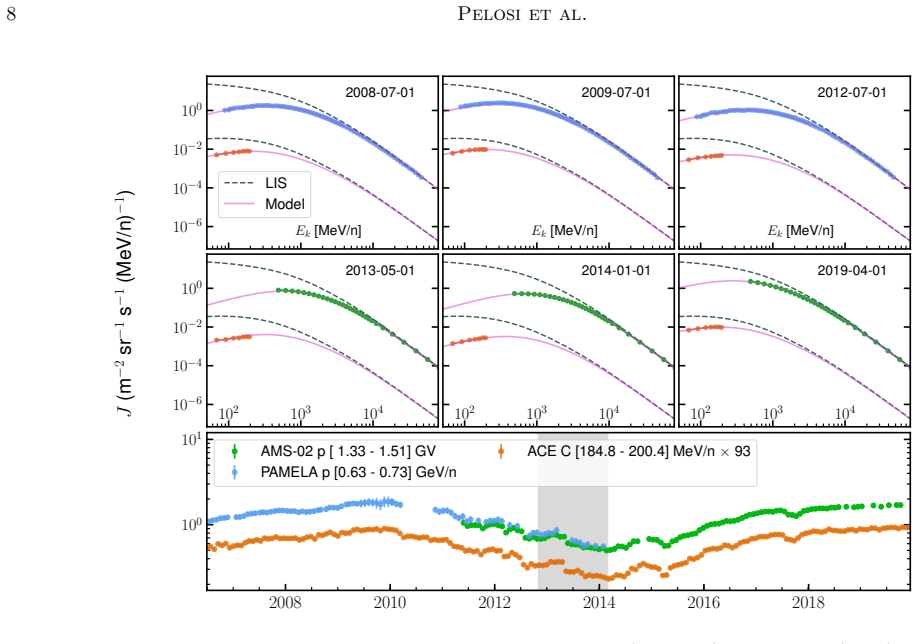
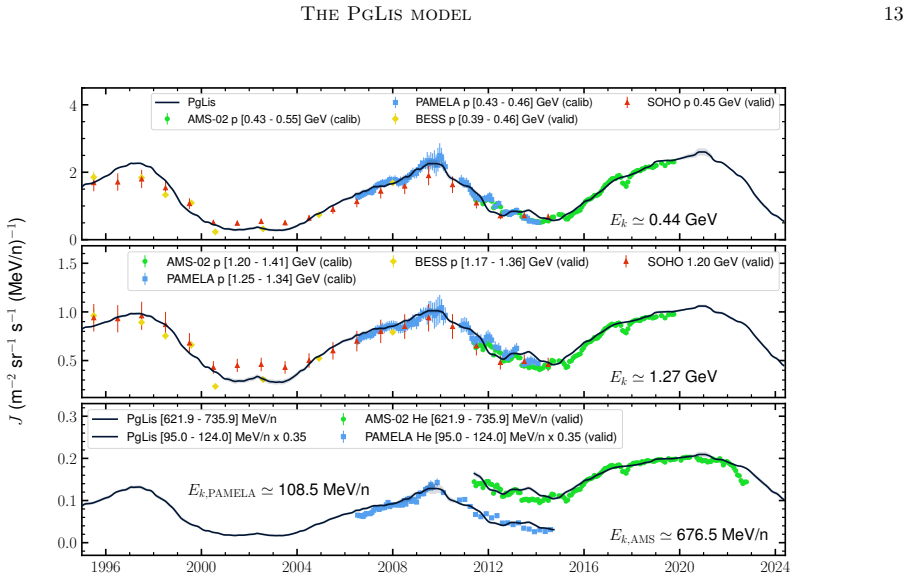
The charge-sign- and rigidity-dependent parametric description of the diffusion-advection processes in the one-dimensional Parker transport equation yields good overall agreement with the data, as shown by the reconstruction uncertainty. The robustness of this approach is validated across a broad set of multichannel datasets covering different particle species, energy ranges, and phases of solar activity, supporting its applicability to space radiation monitoring and forecasting. Furthermore, when coupled with solar-proxy forecasting models, it enables decadal-scale predictions of galactic cosmic-ray fluxes.
What carries the argument
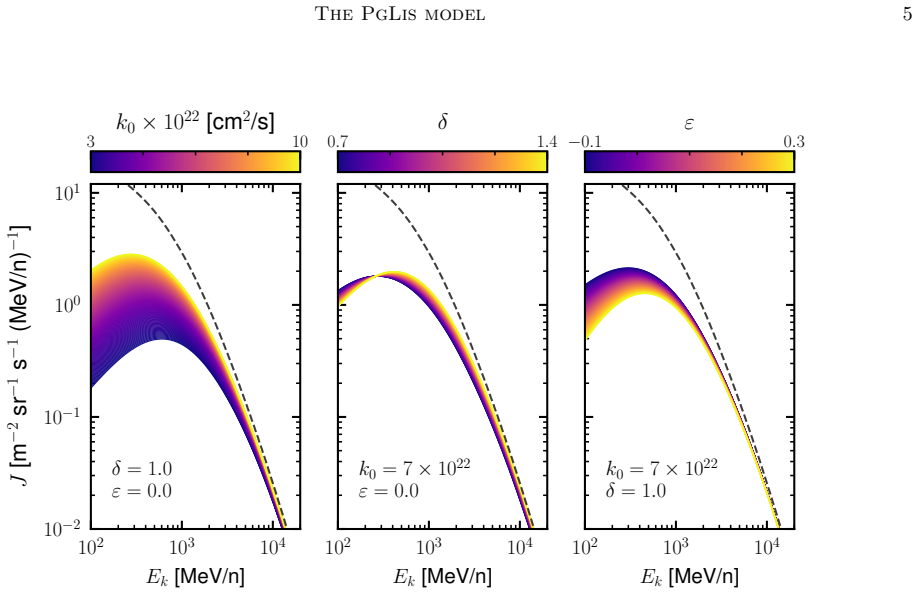
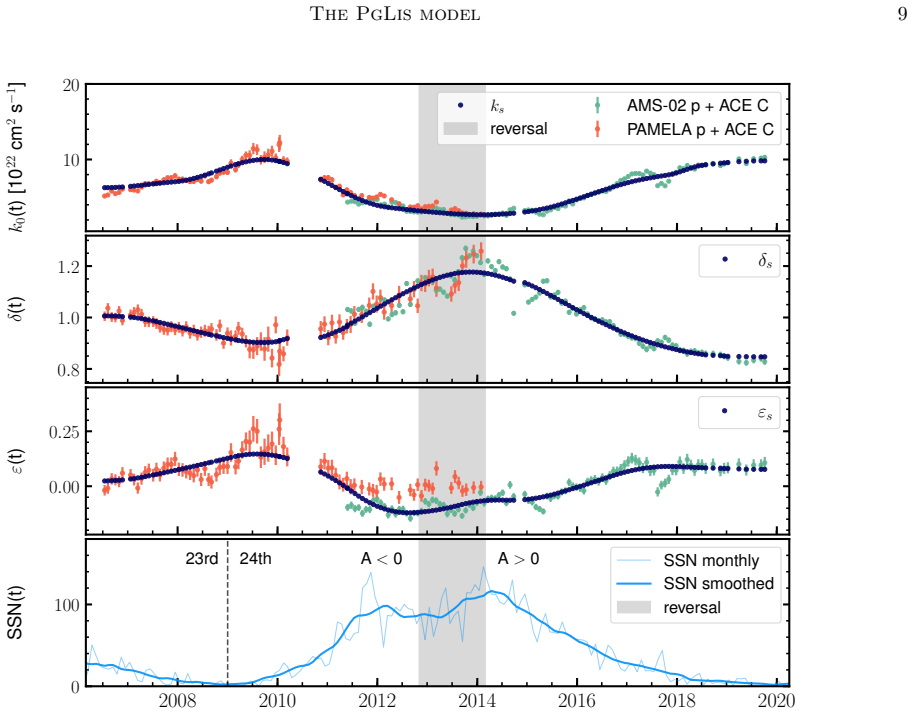
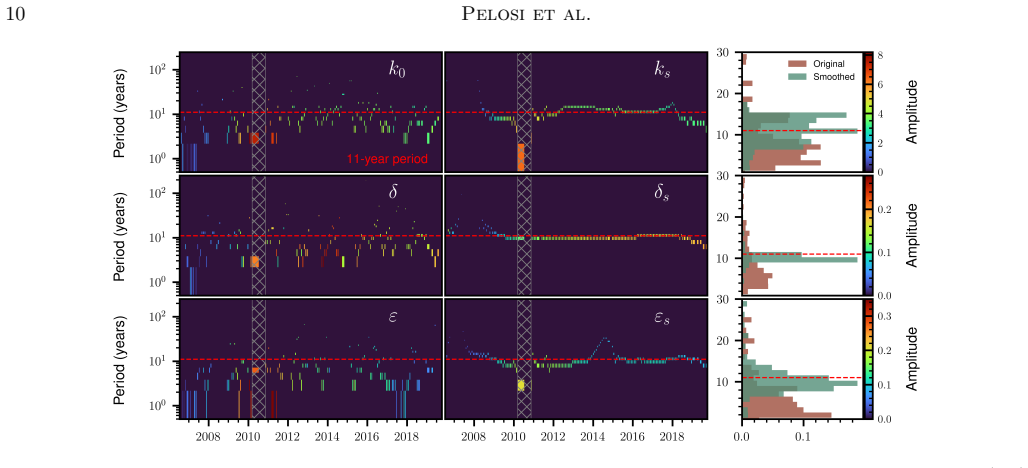
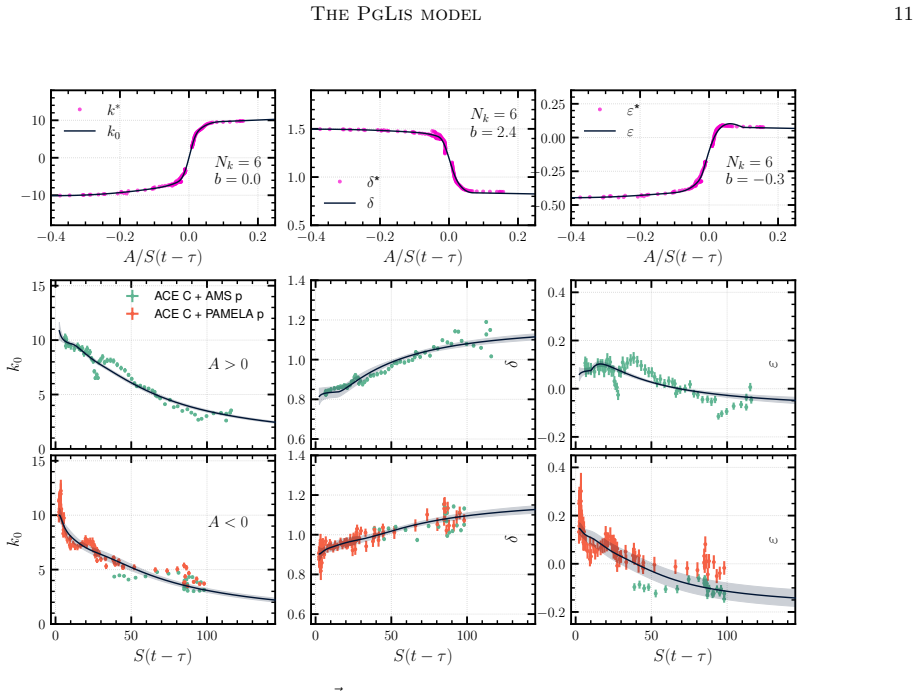
The one-dimensional spherically symmetric Parker transport equation with a charge-sign- and rigidity-dependent parametric description of diffusion-advection processes, whose effective parameters are obtained via Hilbert-Huang filtering and cross-correlation with solar proxies.
If this is right
- Reconstruction uncertainties remain low across multiple particle species and rigidity ranges when the parametric description is applied to historical data.
- The framework can be used for space radiation monitoring because it reproduces observed fluxes during different phases of solar activity.
- Coupling the transport model to independent solar-proxy forecasting models produces quantitative predictions of galactic cosmic-ray intensities on decadal time scales.
- Such predictions support long-term planning and radiation-risk assessment for future space missions.
Where Pith is reading between the lines
- If the proxy-parameter correlations shift in future cycles, the model would require periodic recalibration using new flight data.
- Extending the one-dimensional description to include latitudinal or azimuthal dependence could reduce residuals at high rigidities where drift effects matter.
- Real-time assimilation of current solar-proxy values could turn the same machinery into a short-term nowcasting tool in addition to its long-term forecasting role.
- Comparison of the predicted spectra with measurements from probes at different heliocentric distances would test whether the assumed spherical symmetry remains adequate.
Load-bearing premise
The cross-correlation relationships between solar proxies and the effective model parameters, derived from historical data, will continue to hold for future solar cycles outside the training interval.
What would settle it
Direct comparison of the model's decadal predictions against measured cosmic-ray fluxes from PAMELA, AMS-02 or ACE during the next solar cycle that lies entirely outside the current training interval.
Figures
read the original abstract
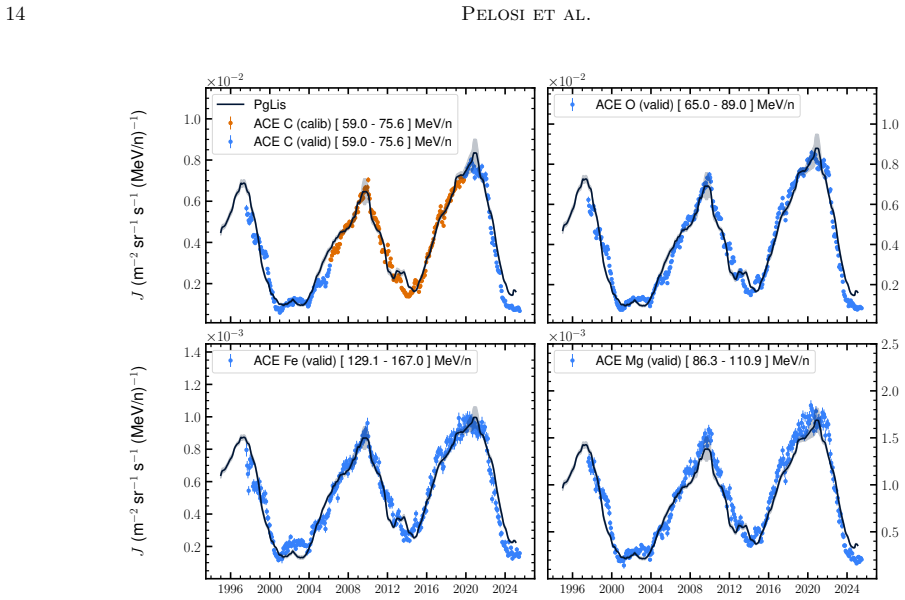
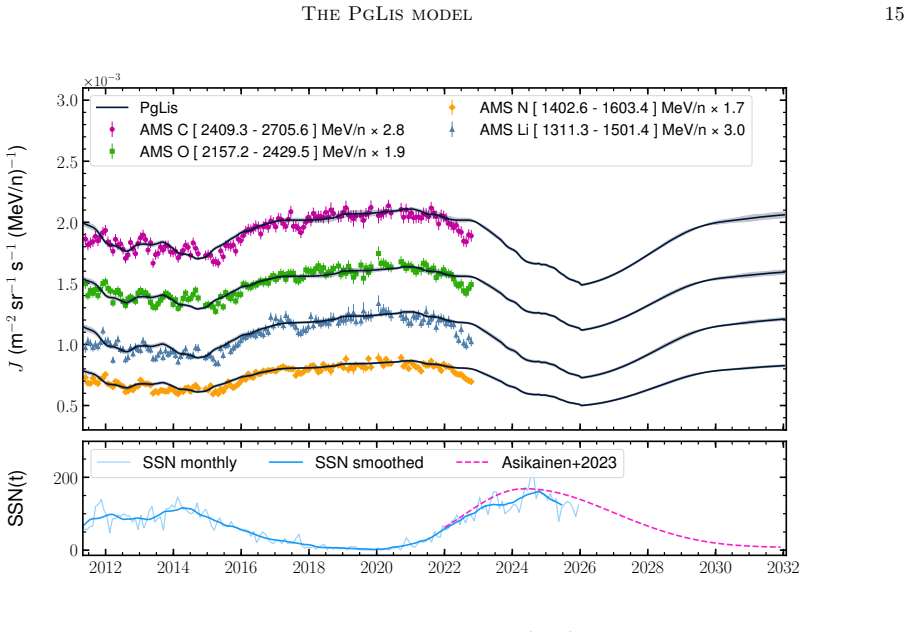
The modulation of galactic cosmic rays, driven by the evolution of the heliospheric magnetic field, strongly influences the intensity of cosmic rays reaching near-Earth space. Characterizing this process is crucial both for advancing our understanding of cosmic-ray transport and for assessing radiation exposure and related hazards in space environments. Here we present a newly developed forecasting framework built on a numerical description of charged particle transport in the heliosphere and its dependence on solar activity, designed for the long-term forecasting of galactic cosmic-ray fluxes. It solves a one-dimensional, spherically symmetric form of the Parker transport equation, including diffusion, solar-wind advection, and adiabatic energy losses. The model has been validated using multi-species flux measurements from space-based experiments: PAMELA, AMS-02, and ACE. Its strategy is based on Hilbert-Huang transform filtering and cross-correlation between delayed solar proxies and effective model parameters. Our charge-sign- and rigidity-dependent parametric description of the diffusion-advection processes yields good overall agreement with the data, as shown by the reconstruction uncertainty. The robustness of this approach is validated across a broad set of multichannel datasets covering different particle species, energy ranges, and phases of solar activity, supporting its applicability to space radiation monitoring and forecasting. Furthermore, when coupled with solar-proxy forecasting models, it enables decadal-scale predictions of galactic cosmic-ray fluxes, thereby supporting long-term planning and radiation-risk assessment for future space missions.
Editorial analysis
A structured set of objections, weighed in public.
Referee Report
Summary. The manuscript presents a one-dimensional spherically symmetric numerical model based on the Parker transport equation (diffusion, solar-wind advection, adiabatic losses) for long-term forecasting of galactic cosmic-ray (GCR) fluxes. Effective charge-sign- and rigidity-dependent diffusion and advection parameters are obtained via Hilbert-Huang transform filtering and cross-correlation with solar proxies on historical PAMELA, AMS-02, and ACE multi-species flux data; the resulting parametric description is reported to yield good reconstruction agreement, and coupling to solar-proxy forecasts is claimed to enable decadal-scale GCR predictions for space radiation applications.
Significance. If the derived proxy-parameter relationships prove stationary, the framework could supply a practical, data-constrained tool for decadal GCR forecasting that complements existing modulation models. The reported multi-channel validation across particle species, energies, and solar phases constitutes a concrete strength for monitoring applications.
major comments (2)
- [Abstract] Abstract: The central forecasting claim—that coupling the fitted model to solar-proxy forecasts 'enables decadal-scale predictions'—rests on the untested assumption that the Hilbert-Huang-derived lag relationships and rigidity/charge-sign scalings between proxies and effective parameters remain valid outside the training solar cycles. No hold-out validation across independent cycles or forward-test of transferability is described, directly undermining the decadal utility asserted in the abstract and conclusion.
- [Abstract] Abstract and validation description: Effective diffusion-advection parameters are obtained by cross-correlation and fitting to the same historical flux datasets (PAMELA/AMS-02/ACE) subsequently used to demonstrate 'good overall agreement' and 'reconstruction uncertainty.' This circularity means the reported validation quantifies consistency with the fitted relationships rather than independent predictive skill, which is load-bearing for any claim of applicability beyond the training interval.
Simulated Author's Rebuttal
We thank the referee for their constructive comments. We respond point-by-point to the major comments below.
read point-by-point responses
-
Referee: [Abstract] Abstract: The central forecasting claim—that coupling the fitted model to solar-proxy forecasts 'enables decadal-scale predictions'—rests on the untested assumption that the Hilbert-Huang-derived lag relationships and rigidity/charge-sign scalings between proxies and effective parameters remain valid outside the training solar cycles. No hold-out validation across independent cycles or forward-test of transferability is described, directly undermining the decadal utility asserted in the abstract and conclusion.
Authors: We acknowledge that no explicit hold-out validation on solar cycles fully independent of the fitting data is presented. The cross-correlations and scalings were derived from the available multi-cycle datasets (PAMELA covering cycle 24, AMS-02 spanning cycle 24 into 25, and ACE over multiple cycles), with consistency checked across species and phases. This provides support for the parametric form but does not constitute a forward test of stationarity. We agree the forecasting language should be qualified. In revision we will adjust the abstract and conclusions to state that the framework, when coupled to solar-proxy forecasts, offers a basis for decadal predictions whose reliability depends on the stationarity of the derived relationships, which remains to be verified. revision: yes
-
Referee: [Abstract] Abstract and validation description: Effective diffusion-advection parameters are obtained by cross-correlation and fitting to the same historical flux datasets (PAMELA/AMS-02/ACE) subsequently used to demonstrate 'good overall agreement' and 'reconstruction uncertainty.' This circularity means the reported validation quantifies consistency with the fitted relationships rather than independent predictive skill, which is load-bearing for any claim of applicability beyond the training interval.
Authors: The reported agreement is indeed a reconstruction using parameters fitted via proxy cross-correlation on the same historical fluxes. This is the standard procedure for determining effective transport coefficients in modulation models. The value of the validation lies in the demonstrated consistency of the single charge-sign- and rigidity-dependent parametric description across multiple species, energies, and solar phases. We will revise the manuscript to describe the comparison explicitly as reconstruction and to clarify that claims of applicability beyond the training interval rest on the assumption that the proxy-parameter relationships remain valid, without independent predictive testing in the present work. revision: yes
Circularity Check
No significant circularity detected
full rationale
The paper presents a numerical solution of the 1D Parker transport equation whose effective diffusion-advection parameters are calibrated via Hilbert-Huang filtering and cross-correlation against historical PAMELA/AMS-02/ACE flux data. Validation consists of showing agreement between the calibrated model and the same multichannel datasets; forecasting is described as coupling the calibrated model to separate solar-proxy forecasts. No quoted equation or derivation step reduces the claimed GCR fluxes or decadal predictions to the input data by construction. The transport physics supplies independent content, the empirical calibration is standard, and no self-citation chain or uniqueness theorem is invoked to force the result. The stationarity assumption for future cycles is an extrapolation risk, not a circular reduction.
Axiom & Free-Parameter Ledger
free parameters (2)
- charge-sign and rigidity dependent diffusion coefficients
- advection and adiabatic loss scaling factors
axioms (1)
- domain assumption One-dimensional spherically symmetric form of the Parker transport equation governs GCR modulation
Reference graph
Works this paper leans on
-
[1]
2016, The Astrophysical Journal, 822, 65, doi: 10.3847/0004-637X/822/2/65
Abe, K., et al. 2016, The Astrophysical Journal, 822, 65, doi: 10.3847/0004-637X/822/2/65
-
[2]
Adams, J. H. 1983, IEEE Trans. Nucl. Sci., 30, 4475, doi: 10.1109/TNS.1983.4333157 The PgLis model19
-
[3]
Adams, Jr, J. H., Beahm, L. P., & Tylka, A. J. 1991, Astrophys. J., 377, 292, doi: 10.1086/170359
-
[4]
2013, The Astrophysical Journal, 765, 91, doi: 10.1088/0004-637X/765/2/91 —
Adriani, O., et al. 2013, The Astrophysical Journal, 765, 91, doi: 10.1088/0004-637X/765/2/91 —. 2014, Physics Reports, 544, 323, doi: 10.1016/j.physrep.2014.06.003
-
[5]
Aguilar, M., et al. 2013, Phys. Rev. Lett., 110, 141102, doi: 10.1103/PhysRevLett.110.141102 —. 2021, Phys. Rev. Lett., 127, 271102, doi: 10.1103/PhysRevLett.127.271102 —. 2025, Phys. Rev. Lett., 134, 051001, doi: 10.1103/PhysRevLett.134.051001
-
[6]
Asikainen, T., & Mantere, M. J. 2023, Journal of Space Weather and Space Climate, 13, 25, doi: 10.1051/swsc/2023024
-
[7]
Aslam, O. P. M., MacTaggart, D., Battiston, R., Potgieter, M. S., & Ngobeni, M. D. 2025, Astrophys. J., 981, 174, doi: 10.3847/1538-4357/adb61c
-
[8]
Bieber, J. W., Matthaeus, W. H., Smith, C. W., et al. 1994, Astrophys. J., 420, 294, doi: 10.1086/173559
-
[9]
Bisschoff, D., Potgieter, M. S., & Aslam, O. P. M. 2019, Astrophys. J., 878, 59, doi: 10.3847/1538-4357/ab1e4a
-
[10]
1992, Proceedings of the IEEE, 80, 520, doi: 10.1109/5.135376
Boashash, B. 1992, Proceedings of the IEEE, 80, 520, doi: 10.1109/5.135376
-
[11]
J., Cavallotto, G., Della Torre, S., et al
Boschini, M. J., Cavallotto, G., Della Torre, S., et al. 2024, Adv. Space Res., doi: 10.1016/j.asr.2024.04.021
-
[12]
J., Della Torre, S., Gervasi, M., La Vacca, G., & Rancoita, P
Boschini, M. J., Della Torre, S., Gervasi, M., La Vacca, G., & Rancoita, P. G. 2019, Adv. Space Res., 64, 2459, doi: 10.1016/j.asr.2019.04.007
-
[13]
Boschini, M. J., Torre, S. D., Gervasi, M., et al. 2020, The Astrophysical Journal Supplement Series, 250, 27, doi: 10.3847/1538-4365/aba901
-
[14]
Burger, R. A., Potgieter, M. S., & Heber, B. 2000, J. Geophys. Res., 105, 27447, doi: 10.1029/2000JA000153
-
[15]
Cavallotto, G., Torre, S. D., Vacca, G. L., & Gervasi, M. 2025, in 2025 33rd Euromicro International Conference on Parallel, Distributed, and Network-Based Processing (PDP) (IEEE), 420–427, doi: 10.1109/PDP66500.2025.00065
-
[16]
Cholis, I., Hooper, D., & Linden, T. 2016, Phys. Rev. D., 93, doi: 10.1103/PhysRevD.93.043016
-
[17]
Corti, C., Bindi, V., Consolandi, C., & Whitman, K. 2016, Astrophys. J., 829, 8, doi: 10.3847/0004-637X/829/1/8
-
[18]
Corti, C., Potgieter, M. S., Bindi, V., et al. 2019, Astrophys. J., 871, 253, doi: 10.3847/1538-4357/aafac4
-
[19]
Bindi, V. 2023, in Proceedings of 38th International Cosmic Ray Conference — PoS(ICRC2023) (Trieste, Italy: Sissa Medialab), 1283, doi: 10.22323/1.444.1283
-
[20]
Cummings, A. C., Moskalenko, I. V., Heikkila, B. C., J´ ohannesson, G., & Porter, T. A. 2025, The Astrophysical Journal, 993, 81, doi: 10.3847/1538-4357/adf550
-
[21]
Cummings, A. C., Stone, E. C., Heikkila, B. C., et al. 2016, The Astrophysical Journal, 831, 18, doi: 10.3847/0004-637X/831/1/18 de Wet, W. C., Slaba, T. C., Rahmanifard, F., et al. 2020, Life Sci. Space Res. (Amst.), 26, 149, doi: 10.1016/j.lssr.2020.04.004
-
[22]
Dobney, W., Mols, L., Mistry, D., et al. 2023, Front. Nucl. Med., 3, doi: 10.3389/fnume.2023.1225034
-
[23]
E., Vogt, A., Herbst, K., Du Toit Strauss, R., & Burger, R
Engelbrecht, N. E., Vogt, A., Herbst, K., Du Toit Strauss, R., & Burger, R. A. 2022a, Astrophys. J., 929, 8, doi: 10.3847/1538-4357/ac58f5
-
[24]
E., Effenberger, F., Florinski, V., et al
Engelbrecht, N. E., Effenberger, F., Florinski, V., et al. 2022b, Space Sci. Rev., 218, doi: 10.1007/s11214-022-00896-1
-
[25]
Eyring, V., Bony, S., Meehl, G. A., et al. 2016, Geosci. Model Dev., 9, 1937, doi: 10.5194/gmd-9-1937-2016
-
[26]
Fiandrini, E., Tomassetti, N., Bertucci, B., et al. 2021, Phys. Rev. D, 104, 023012, doi: 10.1103/PhysRevD.104.023012
-
[27]
Fraser-Smith, A. C. 1987, Reviews of Geophysics, 25, 1, doi: 10.1029/RG025i001p00001
-
[28]
M., Owens, M., Macneil, A., & Lockwood, M
Frost, A. M., Owens, M., Macneil, A., & Lockwood, M. 2022, Sol. Phys., 297, doi: 10.1007/s11207-022-02004-6 God lowski, W., & Szyd lowski, M. 2005, Phys. Lett. B, 623, 10, doi: 10.1016/j.physletb.2005.07.044
-
[29]
Golubenko, K., Rozanov, E., Kovaltsov, G., et al. 2024, J. Geophys. Res. Space Phys., 129, doi: 10.1029/2024JA032504 Guzm´ an, J. G. A., Florinski, V., T´ oth, G., et al. 2024, Astrophys. J. Suppl. Ser., 272, 46, doi: 10.3847/1538-4365/ad4637
-
[30]
Huang, N. E., Shen, Z., Long, S. R., et al. 1998, Proceedings of the Royal Society of London Series A, 454, 903, doi: 10.1098/rspa.1998.0193 ICRP. 1990, 1990 Recommendations of the International Commission on Radiological Protection. ICRP Publication 60, Vol. 21(1-3) (Pergamon Press) —. 2013, Assessment of Radiation Exposure of Astronauts in Space. ICRP P...
-
[31]
1961, The Theory of Probability, 3rd edn
Jeffreys, H. 1961, The Theory of Probability, 3rd edn. (Oxford University Press)
1961
-
[32]
Jokipii, J. R. 1966, Astrophys. J., 146, 480, doi: 10.1086/148912
-
[33]
Jokipii, J. R., Levy, E. H., & Hubbard, W. B. 1977, The Astrophysical Journal, 213, 861, doi: 10.1086/155218 20Pelosi et al
-
[34]
A., K¨ ahk¨ onen, R., Hofer, B., et al
Koldobskiy, S. A., K¨ ahk¨ onen, R., Hofer, B., et al. 2022, Solar Physics, 297, 38, doi: 10.1007/s11207-022-01970-1 K¨ uhl, P., G´ omez-Herrero, R., & Heber, B. 2016, Solar Physics, 291, 965, doi: 10.1007/s11207-016-0879-0
-
[35]
2023, Journal of Geophysical Research: Space Physics, 128, e2022JA031061, doi: 10.1029/2022JA031061
Larsen, N., Mishev, A., & Usoskin, I. 2023, Journal of Geophysical Research: Space Physics, 128, e2022JA031061, doi: 10.1029/2022JA031061
-
[36]
Liddle, A. R. 2004, Mon. Not. R. Astron. Soc., 351, L49, doi: 10.1111/j.1365-2966.2004.08033.x
-
[37]
Liu, W., Guo, J., Wang, Y., & Slaba, T. C. 2024, Astrophys. J. Suppl. Ser., 271, 18, doi: 10.3847/1538-4365/ad18ad
-
[38]
2020, The Astrophysical Journal, 893, 145, doi: 10.3847/1538-4357/ab80c2 —
Marcelli, N., et al. 2020, The Astrophysical Journal, 893, 145, doi: 10.3847/1538-4357/ab80c2 —. 2022, The Astrophysical Journal Letters, 925, L24, doi: 10.3847/2041-8213/ac4787
-
[39]
2018, The Astrophysical Journal Letters, 854, L2, doi: 10.3847/2041-8213/aaa9b2
Martucci, M., et al. 2018, The Astrophysical Journal Letters, 854, L2, doi: 10.3847/2041-8213/aaa9b2
-
[40]
McIntosh, S. W., Chapman, S., Leamon, R. J., Egeland, R., & Watkins, N. W. 2020, Sol. Phys., 295, doi: 10.1007/s11207-020-01723-y
-
[41]
2011, Space Science Reviews, 176, 299, doi: 10.1007/s11214-011-9819-3
Moraal, H. 2011, Space Science Reviews, 176, 299, doi: 10.1007/s11214-011-9819-3
-
[42]
Naito, M., & Kodaira, S. 2022, Sci. Rep., 12, 13617, doi: 10.1038/s41598-022-17079-1
-
[43]
Narici, L., Casolino, M., Di Fino, L., et al. 2012, Radiat. Meas., 47, 1030, doi: 10.1016/j.radmeas.2012.07.006 National Academies of Sciences, Engineering, and Medicine. 2021, Space Radiation and Astronaut Health: Managing and Communicating Cancer Risks (Washington, DC: The National Academies Press), doi: 10.17226/26155
-
[44]
Ngobeni, M. D., Aslam, O. P. M., Bisschoff, D., et al. 2020, Astrophys. Space Sci., 365, doi: 10.1007/s10509-020-03896-1
-
[45]
2025, in ECRS 2024 Proceedings, doi: 10.48550/arXiv.2509.11837
Orcinha, M., Bar˜ ao, F., Bertucci, B., et al. 2025, in ECRS 2024 Proceedings, doi: 10.48550/arXiv.2509.11837
-
[46]
1965, Planetary and Space Science, 13, 9, doi: 10.1016/0032-0633(65)90131-5
Parker, E. 1965, Planetary and Space Science, 13, 9, doi: 10.1016/0032-0633(65)90131-5
-
[47]
2025, Advances in Space Research, 76, 5700, doi: 10.1016/j.asr.2025.08.022
Pelosi, D., Bar˜ ao, F., Bertucci, B., et al. 2025, Advances in Space Research, 76, 5700, doi: 10.1016/j.asr.2025.08.022
-
[48]
2026b, Galactic cosmic ray flux model PgLis, Zenodo, doi: 10.5281/zenodo.19607312
Pelosi, D., Orcinha, M., Tomassetti, N., et al. 2026b, Galactic cosmic ray flux model PgLis, Zenodo, doi: 10.5281/zenodo.19607312
-
[49]
2021, The Astrophysical Journal Letters, 922, L12, doi: 10.3847/2041-8213/ac3663
Criscuoli, S. 2021, The Astrophysical Journal Letters, 922, L12, doi: 10.3847/2041-8213/ac3663
-
[50]
Potgieter, M. 2013, Living Rev. Sol. Phys., 10, doi: 10.12942/lrsp-2013-3
-
[51]
Potgieter, M. S. 2017, Adv. Space Res., 60, 848, doi: 10.1016/j.asr.2016.09.003
-
[52]
Reda, R., Giovannelli, L., & Alberti, T. 2024, Sol. Phys., 299, doi: 10.1007/s11207-024-02346-3
-
[53]
Restier-Verlet, J., El-Nachef, L., Ferlazzo, M. L., et al. 2021, International Journal of Molecular Sciences, 22, 3739, doi: 10.3390/ijms22073739
-
[54]
2023, Sensors, 23, doi: 10.3390/s23073559
Romoli, G., Di Fino, L., Santi Amantini, G., et al. 2023, Sensors, 23, doi: 10.3390/s23073559
-
[55]
J., Webbon, B., Simonsen, L
Ross, A. J., Webbon, B., Simonsen, L. C., & Wilson, J. W. 1997, in Shielding Strategies for Human Space Exploration, ed. J. Wilson, J. Miller, A. Konradi, & F. Cucinotta, National Aeronautics and Space Administration
1997
-
[56]
Schwarz, G. 1978, Ann. Stat., 6, 461, doi: 10.1214/aos/1176344136
-
[57]
2000, Advances in Space Research, 26, 1831, doi: 10.1016/S0273-1177(99)01232-6
Seo, E., et al. 2000, Advances in Space Research, 26, 1831, doi: 10.1016/S0273-1177(99)01232-6
-
[58]
Shalchi, A., Bieber, J. W., Matthaeus, W. H., & Qin, G. 2004, Astrophys. J., 616, 617, doi: 10.1086/424839
-
[59]
Shavers, M., Semones, E., Tomi, L., et al. 2024, Z. Med. Phys., 34, 14, doi: 10.1016/j.zemedi.2023.06.005
-
[60]
2003, in 28th International Cosmic Ray Conference, 4027–4030
Shikaze, Y., et al. 2003, in 28th International Cosmic Ray Conference, 4027–4030
2003
-
[61]
2007, Astroparticle Physics, 28, 154, doi: 10.1016/j.astropartphys.2007.05.001
Shikaze, Y., et al. 2007, Astroparticle Physics, 28, 154, doi: 10.1016/j.astropartphys.2007.05.001
-
[62]
Slaba, T. C., & Whitman, K. 2020, Space Weather, 18, e2020SW002456, doi: 10.1029/2020SW002456
-
[63]
1994, Advances in Space Research, 14, 787, doi: 10.1016/0273-1177(94)90543-6
Smart, D., & Shea, M. 1994, Advances in Space Research, 14, 787, doi: 10.1016/0273-1177(94)90543-6
-
[64]
Song, X., Luo, X., Potgieter, M. S., Liu, X., & Geng, Z. 2021, Astrophys. J. Suppl. Ser., 257, 48, doi: 10.3847/1538-4365/ac281c
-
[65]
Spence, H. E., Golightly, M. J., Joyce, C. J., et al. 2013, Space Weather, 11, 643, doi: 10.1002/2013SW000995
-
[66]
Stone, E. C., et al. 1998, Space Science Reviews, 86, 285, doi: 10.1023/A:1005075813033
-
[67]
Sun, X., Hoeksema, J. T., Liu, Y., & Zhao, J. 2015a, The Astrophysical Journal, 798, 114, doi: 10.1088/0004-637X/798/2/114
-
[68]
Sun, Y.-Y., Chen, C.-H., Liu, J.-Y., Wang, C.-H., & Chen, D.-L. 2015b, J. Geophys. Res Atmos., 120, 1670, doi: 10.1002/2014JD022574
-
[69]
2019, Advances in Space Research, doi: 10.1016/j.asr.2019.06.025
Orcinha, M. 2019, Advances in Space Research, doi: 10.1016/j.asr.2019.06.025
-
[70]
Tomassetti, N., Bertucci, B., & Fiandrini, E. 2022, Phys. Rev. D, 106, 103022, doi: 10.1103/PhysRevD.106.103022
-
[71]
2025, Galaxies, 13, 23, doi: 10.3390/galaxies13020023 The PgLis model21
Tomassetti, N., Bertucci, B., Fiandrini, E., & Khiali, B. 2025, Galaxies, 13, 23, doi: 10.3390/galaxies13020023 The PgLis model21
-
[72]
2017, The Astrophysical Journal Letters, 849, L32, doi: 10.3847/2041-8213/aa9373
Tomassetti, N., Orcinha, M., Bar˜ ao, F., & Bertucci, B. 2017, The Astrophysical Journal Letters, 849, L32, doi: 10.3847/2041-8213/aa9373
-
[73]
Wang, B., Bi, X.-J., Fang, K., Lin, S.-J., & Yin, P.-F. 2019, Phys. Rev. D, 100, 063006, doi: 10.1103/PhysRevD.100.063006
-
[74]
Wang, Y., Guo, J., Li, G., Roussos, E., & Zhao, J. 2022, Astrophys. J., 928, 157, doi: 10.3847/1538-4357/ac5896
-
[75]
Badavi, F. F. 2019, Life Sciences in Space Research, 22, 76, doi: 10.1016/j.lssr.2019.07.007
-
[76]
2023, Geosci
Zheng, M., Liu, H., Adolphi, F., et al. 2023, Geosci. Model Dev., 16, 7037
2023
-
[77]
Zhu, C.-R., & Wang, M.-J. 2025, Astrophys. J., 980, 116, doi: 10.3847/1538-4357/adacd8
discussion (0)
Sign in with ORCID, Apple, or X to comment. Anyone can read and Pith papers without signing in.