REVIEW 4 major objections 6 minor 30 references
AquiLLM: An Architecture for Supporting Tacit Knowledge Capture in Research Groups
T0 review · 4 major / 6 minor · reviewed 2026-08-14 · deepseek-v4-flash
Pith's one-line read The paper claims that a locally hosted, open-weight RAG architecture organized around persistent project collections can capture and reuse a research group's tacit knowledge.
desk verdict A well-written architecture report that is honest about its own central gap: the tacit knowledge capture claim is explicitly deferred, so the paper is more of a systems description than a validated contribution. read the letter →
The pith
A machine-rendered reading of the paper's core claim, the machinery that carries it, and where it could break.
The reading
What carries the argument
The load-bearing mechanism is skills, a form of procedural memory implemented as Markdown workflow instructions attached to a project collection and loaded into the session prompt only when that collection is active and its access permissions are verified. Around that sits a configurable memory layer that separates stable facts about the user from episodic semantic memories indexed for similarity search against prior message history. Salience-aware context packing carries the argument over the hardware constraint: deterministic token budgets, pinned sections, and staged pruning—tool-header deduplication, boilerplate collapse, extractive shortening, optional prompt compression, then salience-ordered dropping—keep prompts within GPU limits while guaranteeing inclusion of the latest turn, contiguous tool-call chains, and the last user turns.
What would settle it
Re-run the prior expert-rating study (141 responses over the 31-document astronomy corpus) with the new local retrieval stack and no external services; if faithfulness ratings, especially on comparative questions, fall below the earlier results, the claim that local control preserves answer quality is refuted. In a second check, ask new group members an onboarding question with and without the collection's skills loaded and look for the group's standards in the answers; no difference would show procedural memory is inert.
Extended reading notes
Core claim
On its own terms, the paper's central claim is that the tacit-knowledge problem in small research groups can be treated as an architecture problem rather than just a model problem. AquiLLM makes the research group, not an individual notebook or shared knowledge base, the unit of shared context: project collections define document boundaries, carry their own workflow instructions, and persist user-specific facts and episodic conversation memories that can be retrieved by similarity search. The system layers procedural memory on top of the corpus so that how a group wants its documents read is bundled with the documents themselves. It replaces external retrieval services with local embedding and reranking, adds multimodal ingestion for plots and figures, and applies deterministic token budgets with staged pruning so long contexts fit in GPU memory. A prior expert evaluation of the system on astronomy material found that responses grounded in strongly localized evidence scored highest, while questions requiring synthesis across documents scored lowest, which motivates the memory and context-packing mechanisms introduced here.
Load-bearing premise
The load-bearing premise is that replacing external retrieval services with local embedding, reranking, and memory models does not silently degrade answer quality, and that the system actually captures tacit knowledge; neither has been measured.
Editorial extensions
If this is right
- A research group can run the full pipeline—chat, embedding, reranking, transcription, and memory—on its own hardware, so papers, figures, and meeting minutes never leave local control.
- Collection-scoped skills make onboarding documents, plotting standards, and reduction checklists the default frame for any chat over that project's corpus, while staying invisible to other projects.
- Multimodal ingestion lets the system read plots and figures from slides or publications, so visual results enter the same retrieval and memory loop as text.
- The memory layer carries user preferences and prior conversations across sessions, so follow-up work accumulates rather than restarting from scratch.
- Deterministic token budgets and staged pruning keep long-context and multi-tool conversations within GPU memory, which is what makes local deployment on modest hardware feasible.
Reading between the lines
- If the architecture works as intended, the unit a system answers from shifts from isolated documents to a living group corpus plus its unwritten rules; evaluation should then measure onboarding speed or answer fidelity for new group members rather than standard RAG benchmarks.
- A direct test would compare answers with skills enabled versus disabled: if procedural memory is active, the system should measurably favor the group's own plot formats, reduction steps, and checklists over generic advice.
- The paper's reported weakness in cross-document synthesis suggests that memory and context packing alone may not fix multi-source questions; a natural extension is to test whether explicit synthesis tooling closes that gap on informal artifacts such as Slack threads and meeting minutes.
- Because local embedding and reranking are unmeasured, the pragmatic check is an A/B comparison against the previous external retrieval service on the same astronomy corpus; equal faithfulness would establish that local control costs nothing in answer quality.
Signed reviews
Editorial analysis
A structured set of objections, weighed in public.
Referee Report
Summary. The paper presents AquiLLM, an open-source, modular RAG-LLM framework intended for research groups, and describes a set of architectural and feature enhancements: local embedding and reranking with open-weight models, multimodal ingestion, vLLM-based OpenAI-compatible inference, a configurable semantic/episodic memory layer, collection-scoped skills, salience-aware context packing, and UI improvements. The authors argue that these enhancements support the capture and reuse of tacit knowledge in collaborative scientific settings while maintaining local control over data and infrastructure. No new quantitative evaluation is reported; the only evaluation cited is the authors' prior accepted paper [6], which assessed faithfulness on formal astronomy documents. Section 4 explicitly states that benchmarking on informal knowledge artifacts, such as meeting minutes, Slack messages, code comments, and playbooks, has not been done and that rigorously evaluating the capture and reuse of tacit knowledge remains to be done.
Significance. If the central claim were validated, AquiLLM would be a valuable contribution: a fully local, open-source RAG-LLM system with memory and skills could help small research groups retain informal expertise, protect sensitive data, and avoid vendor lock-in. The paper provides a detailed, internally consistent architecture description, a thoughtful comparison with related tools in Table 1, and honest discussion of failure modes from a prior evaluation. However, the significance is currently limited because the paper's headline claim—supporting tacit knowledge capture—is explicitly unevaluated, and the new retrieval and memory components are not benchmarked. The contribution is thus an architecture proposal with plausible design rationale rather than a demonstrated capability.
major comments (4)
- [Section 4] The central claim that AquiLLM supports tacit knowledge capture is explicitly deferred. The paper states: "we have not yet benchmarked our current approach on informal knowledge artifacts produced collaboratively by research groups such as meeting minutes, Slack messages, code comments, or collection-specific playbooks. Therefore, rigorously evaluating the capture and reuse of tacit knowledge remains to be done." Since the title, abstract, and Section 1 assert that AquiLLM supports tacit knowledge capture, the manuscript currently provides no evidence for its primary claim. The authors should either add a rigorous evaluation on informal artifacts or reframe the paper as a system-description/position paper in which tacit knowledge capture is a design goal, not an established property.
- [Section 3, local embedding and reranking] The new multimodal embedding and reranking models (Qwen3-VL-Embedding-2B and Qwen3-VL-Reranker-2B) are described as central improvements, but the manuscript states they "have not yet been fully evaluated in this deployment." No retrieval quality metrics, comparisons against the previous external services (e.g., Cohere), or ablation results are provided. Because retrieval quality is foundational to the claimed RAG improvements and to any downstream tacit knowledge capture, this missing evaluation is load-bearing.
- [Section 3, memory layer] The memory layer is a key mechanism for accumulating tacit knowledge, yet it is disabled by default, optional, and the authors note that it "introduces additional complexity around privacy and correctness, such as stale memories." No experiments, case studies, or user demonstrations show that semantic and episodic memory improves knowledge capture or retrieval. As described, the memory component remains a speculative design feature rather than a validated capability.
- [Section 2 and reference [6]] The only prior evaluation cited to support the system's effectiveness is [6], an accepted paper not included in this preprint and with overlapping authorship. That study assessed faithfulness on 141 responses over 31 formal astronomy documents, not on informal or tacit artifacts. Thus [6] cannot serve as evidence for the current paper's claim of supporting tacit knowledge capture, and its exclusion makes verification of even the formal-document results impossible for readers.
minor comments (6)
- [Abstract] The abstract contains "userinterfaceimprovements" with missing spaces; it should read "user interface improvements."
- [Section 3, chat model paragraph] The phrase "hybrid gated delta network" is used without a citation or explanation; either define the architecture or add a reference to a source that describes it.
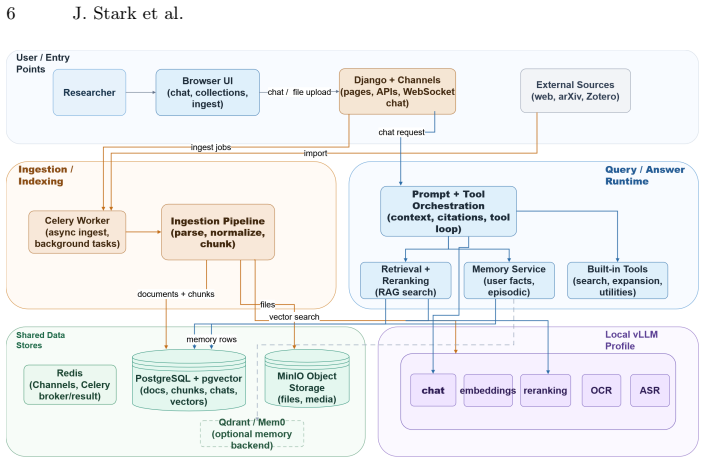
- [Figure 1] Figure 1 is referenced in the text but is not visible in the provided manuscript; ensure the figure is included and legible, with a caption that names all labeled components.
- [Table 1] Table 1 gives a qualitative comparison with Open WebUI and NotebookLM, but no criteria or methodology are stated; clarify whether the comparison is based on documentation, hands-on testing, or authors' design intent.
- [Section 4] The Limitations section conflates known limitations with future work; consider separating unresolved limitations from planned extensions and adding a dedicated evaluation section if any benchmarking is included.
- [References] Several references are dated 2026 and may be future or in-press works; verify that all cited works (including the accepted paper [6]) are publicly available and correctly dated.
Circularity Check
No circular derivation found: the paper is an architecture report whose central tacit-knowledge claim is explicitly deferred, with only a minor overlapping-author self-citation.
full rationale
This paper is an architecture and deployment description rather than a derived prediction, so the standard circularity patterns do not apply: there are no equations, no fitted parameters, and no quantity is predicted from an input that already contains it. The only potentially load-bearing citation is [6], the authors' prior accepted study of AquiLLM faithfulness on 141 responses over 31 astronomy documents; it is used to motivate retrieval and context-packing design choices. While this is a self-citation by overlapping authors and the cited manuscript is not included in the preprint, it is an externally falsifiable evaluation rather than a definitional or numerical input, and the current paper does not derive its central tacit-knowledge claim from it. In fact, Section 4 explicitly states that 'rigorously evaluating the capture and reuse of tacit knowledge remains to be done,' and Section 3 concedes that the new local embedding and reranking models 'have not yet been fully evaluated in this deployment.' Those are evidence gaps, not circular reductions. The architecture description is self-contained as a design proposal; the central claim is under-supported rather than circular.
Assumptions & free parameters
assumptions (2)
- domain assumption Tacit knowledge in research groups can be captured and reused via collection-level Markdown instruction prompts (skills) and user-specific memory.
- domain assumption Locally hosted open-weight models (e.g., Qwen3.6-27B) provide sufficiently faithful and capable inference for scientific research use without external commercial services.
Cite this review
Pith. "Pith review of AquiLLM: An Architecture for Supporting Tacit Knowledge Capture in Research Groups." pith.science (2026). https://pith.science/paper/TSGVJPCX
@misc{pith2026260808883,
  author       = {Pith},
  title        = {Pith review of: AquiLLM: An Architecture for Supporting Tacit Knowledge Capture in Research Groups},
  year         = {2026},
  howpublished = {\url{https://pith.science/paper/TSGVJPCX}},
  note         = {Machine review of arXiv:2608.08883}
}
read the original abstract
Recent advances in retrieval-augmented generation (RAG) and large language models (LLMs) enable researchers to integrate AI into scientific workflows. However, using proprietary commercial AI systems raises concerns about transparency, reproducibility and privacy, which are essential for scientific practices. To this end, AquiLLM was developed as an open-source modular RAG-LLM framework using open-weight models, designed to support research groups in capturing tacit knowledge. In this work, we present a series of architectural improvements and feature enhancements to AquiLLM, including local embedding and reranking, multimodal capabilities, OpenAI-compatible inference interfaces, user interface improvements, semantic and episodic memory capabilities, and skills support. These enhancements were informed by discussions with domain experts, including astrophysicists and environmental researchers, and represent a step toward AI systems more closely aligned with scientific research practices.
Figures
Reference graph
Works this paper leans on
-
[6]
AquiLLM: Evaluating Faithfulness in Open-Weight RAG-LLM Systems for Scientific Research
Bernie Boscoe et al. “AquiLLM: Evaluating Faithfulness in Open-Weight RAG-LLM Systems for Scientific Research”. In:Proceedings of the 2026 US Research Software Engineer Conference (US-RSE). Accepted. San Jose, California, 2026
work page 2026
-
[1]
Allen Institute for AI.More Than Open.url:https://allenai.org/ more-than-open(visited on 06/20/2026)
work page 2026
-
[2]
AquiLLM.AquiLLM.https : / / aquillm . org/. Accessed: 2026-06-21. 2026
work page 2026
-
[3]
AquiLLM.AquiLLM.https://github.com/AquiLLM/AquiLLM. GitHub repository. Accessed: 2026-06-21. 2026
work page 2026
-
[4]
On the Dangers of Stochastic Parrots: Can Lan- guage Models Be Too Big?
Emily M. Bender et al. “On the Dangers of Stochastic Parrots: Can Lan- guage Models Be Too Big?” In:Proceedings of the 2021 ACM Confer- ence on Fairness, Accountability, and Transparency. FAccT ’21. New York, NY, USA: Association for Computing Machinery, Mar. 2021, pp. 610–623. isbn: 978-1-4503-8309-7.doi:10.1145/3442188.3445922.url:https: //dl.acm.org/do...
arXiv 2021
-
[5]
Rishi Bommasani et al.On the Opportunities and Risks of Foundation Models. arXiv:2108.07258 [cs]. July 2022.doi:10.48550/arXiv. 2108 . 07258.url:http://arxiv.org/abs/2108.07258
-
[7]
AquiLLM: a RAG Tool for Capturing Tacit Knowledge in Research Groups
Chandler Campbell, Bernie Boscoe, and Tuan Do. “AquiLLM: a RAG Tool for Capturing Tacit Knowledge in Research Groups”. In: arXiv:2508.05648 [cs]. US-RSE Conference, Oct. 2025.doi:10.48550/arXiv.2508.05648. url:http://arxiv.org/abs/2508.05648(visited on 10/25/2025)
work page Pith review arXiv doi:10.48550/arxiv.2508.05648 2025
-
[8]
Carnegie Mellon University.Open Forum for AI (OFAI).url:https : //www.cmu.edu/engin/programs/ofai.html(visited on 06/20/2026)
work page 2026
Show all 30 references
-
[9]
Harry Collins.Tacit and explicit knowledge. eng. Chicago, Ill: University of Chicago Press, 2013.isbn: 978-0-226-00421-1 978-0-226-11382-1
2013
- [10]
-
[11]
Jetstream2: Accelerating cloud computing via Jetstream
David Y. Hancock et al. “Jetstream2: Accelerating cloud computing via Jetstream”. en. In:Practice and Experience in Advanced Research Comput- ing. Boston MA USA: ACM, July 2021, pp. 1–8.isbn: 978-1-4503-8292-2. doi:10.1145/3437359.3465565.url:https://dl.acm.org/doi/10. 1145/34...
2021
-
[12]
MorganHimesetal.Multi-Modal Masked Autoencoders for Learning Image- Spectrum Associations for Galaxy Evolution and Cosmology.arXiv:2510.22527 [astro-ph]. Oct. 2025.doi:10 . 48550 / arXiv . 2510 . 22527.url:http : //arxiv.org/abs/2510.22527
2025 doi
- [13]
-
[14]
Survey of Hallucination in Natural Language Generation
Ziwei Ji et al. “Survey of Hallucination in Natural Language Generation”. In:ACM Comput. Surv.55.12 (Mar. 2023), 248:1–248:38.issn: 0360-0300. doi:10 . 1145 / 3571730.url:https : / / dl . acm . org / doi / 10 . 1145 / 3571730(visited on 03/26/2026)
2023
-
[15]
Huiqiang Jiang et al.LLMLingua: Compressing Prompts for Accelerated Inference of Large Language Models. en. Oct. 2023.url:https://arxiv. org/abs/2310.05736v2
2023 arXiv
- [16]
- [17]
-
[18]
From Stochas- tic Parrots to Digital Intelligence: The Evolution of Language Models and Their Cognitive Capabilities
Andrew Lizarraga, Edouardo Honig, and Ying Nian Wu. “From Stochas- tic Parrots to Digital Intelligence: The Evolution of Language Models and Their Cognitive Capabilities”. In:WIREs Computational Statistics17.3 (2025),e70035.doi:10.1002/wics.70035.url:https://onlinelibrary. wil...
2025 doi
- [19]
-
[20]
Latent Adaptive Planner for Dynamic Manipulation
Donghun Noh et al. “Latent Adaptive Planner for Dynamic Manipulation”. en. In:Proceedings of The 9th Conference on Robot Learning. PMLR, Oct. 2025, pp. 2430–2448.url:https : / / proceedings . mlr . press / v305 / noh25a.html(visited on 03/28/2026)
2025
-
[21]
Tejul Pandit et al.The Evolution of Reranking Models in Information Re- trieval: From Heuristic Methods to Large Language Models.arXiv:2512.16236 [cs]. Dec. 2025.doi:10.48550/arXiv.2512.16236.url:http://arxiv. org/abs/2512.16236
2025 doi
-
[22]
Abenchmarkofexpert-levelacademicquestionstoassess AI capabilities
LongPhanetal.“Abenchmarkofexpert-levelacademicquestionstoassess AI capabilities”. en. In:Nature649.8099 (Jan. 2026), pp. 1139–1146.issn: 1476-4687.doi:10 . 1038 / s41586 - 025 - 09962 - 4.url:https : / / www . nature.com/articles/s41586-025-09962-4(visited on 03/26/2026)
2026
-
[23]
Polanyi.The Tacit Dimension
M. Polanyi.The Tacit Dimension. Anchor books. Anchor Books, 1967. isbn: 978-0-14-341418-6.url:https://books.google.com/books?id= jwLXAAAAMAAJ
1967
-
[24]
Model weights and configuration files for the post-trainedQwen3.6-27Bmodel.Apr.2026.url:https://huggingface
Qwen Team.Qwen3.6-27B. Model weights and configuration files for the post-trainedQwen3.6-27Bmodel.Apr.2026.url:https://huggingface. co/Qwen/Qwen3.6-27B
2026
-
[25]
Alec Radford et al.Robust Speech Recognition via Large-Scale Weak Su- pervision. en. Dec. 2022.url:https://arxiv.org/abs/2212.04356v1 (visited on 03/29/2026). AquiLLM Architecture for Tacit Knowledge Capture 13
2022 arXiv
- [26]
-
[27]
Cognitive Architectures for Language Agents
Theodore R. Sumers et al. “Cognitive Architectures for Language Agents”. In:Transactions on Machine Learning Research(2024). Also available as arXiv:2309.02427.url:https://openreview.net/forum?id=1i6ZCvflQJ
2024 arXiv
-
[28]
Texas Advanced Computing Center.NSF Selects TACC Supercomput- ers for National AI Research Resource Pilot. Feb. 2024.url:https : //tacc.utexas.edu/news/latest- news/2024/02/01/nsf- selects- tacc-supercomputers-for-national-ai-research-resource-nairr- pilot/(visited on 06/20/2026)
2024
-
[29]
Evans.Large language models in materials science and the need for open-source approaches.arXiv:2511.10673 [cs]
Fengxu Yang, Weitong Chen, and Jack D. Evans.Large language models in materials science and the need for open-source approaches.arXiv:2511.10673 [cs]. Nov. 2025.doi:10.48550/arXiv.2511.10673.url:http://arxiv. org/abs/2511.10673
2025 doi
- [30]
Reviewed August 14, 2026 · model on record in the stance chip above.
Discussion (0). Continue with ORCID to comment.