Sensitivity Analysis and Generalized Chaos Expansions. Lower Bounds for Sobol indices
Pith reviewed 2026-05-25 17:14 UTC · model grok-4.3
The pith
Generalized chaos expansions on tensor Hilbert bases yield lower bounds for Sobol indices, including derivative forms from Poincaré operators for variable screening.
A machine-rendered reading of the paper's core claim, the machinery that carries it, and where it could break.
Core claim
Generalized chaos expansions built on general tensor Hilbert bases allow the computation of Sobol indices to be revisited and yield general lower bounds for these indices. When the basis consists of the eigenfunctions of a Poincaré differential operator, the resulting lower bounds involve derivatives of the analyzed function and act as an efficient tool for variable screening, with demonstrated accuracy on toy and real-life models.
What carries the argument
Generalized chaos expansions on tensor Hilbert bases, which decompose the function into an orthonormal series from which lower bounds on Sobol indices are extracted; the Poincaré eigenfunction case supplies derivative-based versions of these bounds.
If this is right
- Lower bounds on Sobol indices become available for any orthonormal tensor Hilbert basis without requiring the full index computation.
- Derivative-based bounds from Poincaré operators enable variable screening that depends only on first-order information about the function.
- The approach applies to any function belonging to the underlying tensor product space, covering a wide class of models used in computer experiments.
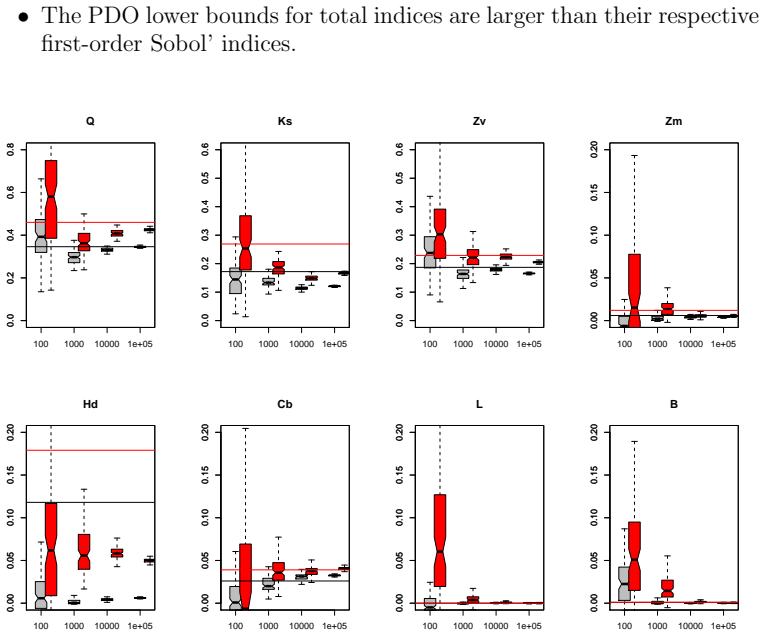
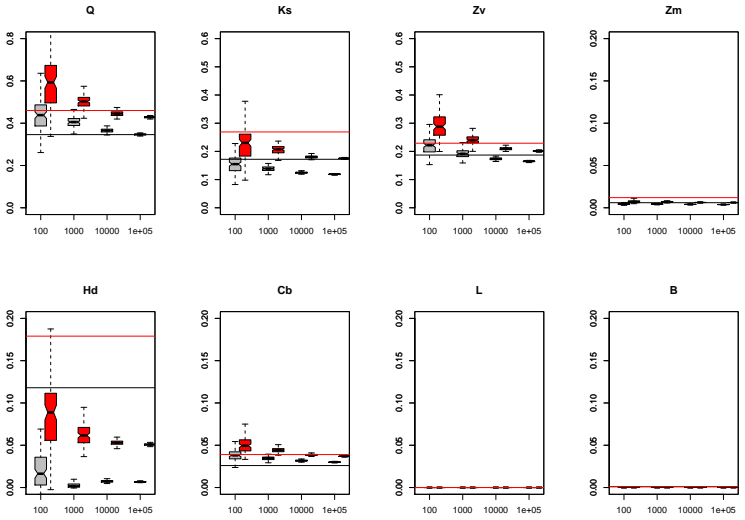
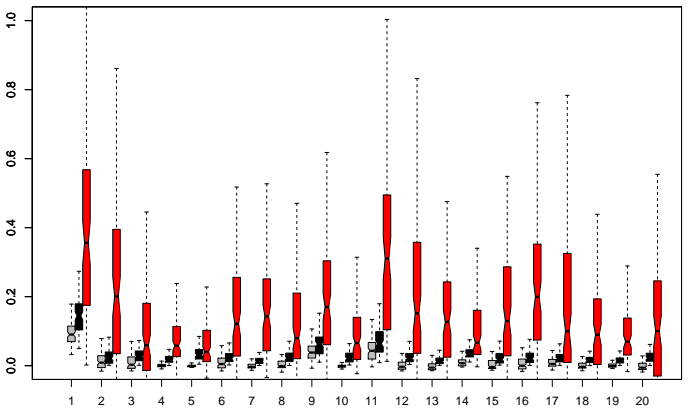
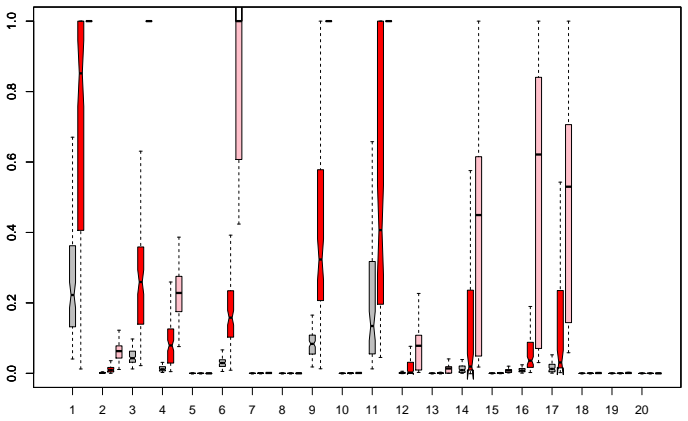
- Numerical tests on toy and real-life models confirm that the bounds correctly identify the most influential inputs.
Where Pith is reading between the lines
- The derivative bounds could be paired with existing gradient-based screening methods to reduce the number of model evaluations needed in high-dimensional settings.
- Different choices of differential operators might produce screening bounds adapted to functions with particular smoothness or periodicity properties.
- The framework suggests that similar lower-bound techniques could be developed for other global sensitivity measures beyond Sobol indices.
Load-bearing premise
The function lies inside the tensor product Hilbert space so that the generalized chaos expansion exists and the lower bounds follow from the basis decomposition.
What would settle it
A concrete counter-example would be a function in the tensor product Hilbert space for which the derived lower bounds on Sobol indices are violated by the true values, or for which the Poincaré-based derivative bounds fail to rank variables correctly in a screening task.
Figures
read the original abstract
The so-called polynomial chaos expansion is widely used in computer experiments. For example, it is a powerful tool to estimate Sobol' sensitivity indices. In this paper, we consider generalized chaos expansions built on general tensor Hilbert basis. In this frame, we revisit the computation of the Sobol' indices and give general lower bounds for these indices. The case of the eigenfunctions system associated with a Poincar{\'e} differential operator leads to lower bounds involving the derivatives of the analyzed function and provides an efficient tool for variable screening. These lower bounds are put in action both on toy and real life models demonstrating their accuracy.
Editorial analysis
A structured set of objections, weighed in public.
Referee Report
Summary. The paper develops generalized chaos expansions on arbitrary tensor-product Hilbert bases to revisit Sobol' index computation and derive general lower bounds on these indices. The special case of eigenfunctions of a Poincaré differential operator produces derivative-based lower bounds that are proposed as an efficient screening tool; the bounds are illustrated on both analytic toy functions and a real-life model.
Significance. If the central derivations are valid, the work supplies a mathematically grounded family of lower bounds that can be computed from function derivatives or basis coefficients without a full variance decomposition, extending the classical polynomial-chaos route to sensitivity analysis and offering a practical screening device when only low-order information is available.
major comments (2)
- [§3.2, Eq. (3.8)] §3.2, Eq. (3.8): the passage from the orthogonal expansion to the lower bound on the first-order Sobol' index relies on dropping all cross terms; the argument does not address whether the remainder is controlled uniformly when the basis is not the standard polynomial one, which is load-bearing for the claim that the bound remains useful for screening.
- [Theorem 4.2] Theorem 4.2: the derivative bound is stated for functions in the domain of the Poincaré operator, yet the numerical examples apply it to a non-smooth real-life model; the paper must either verify the required Sobolev regularity or quantify the approximation error introduced by smoothing.
minor comments (2)
- [§2] Notation for the tensor-product measure is introduced only in §2 and then used without reminder in later sections; a short recap would improve readability.
- [§5.2] The real-life example in §5.2 lacks a table of the computed lower bounds versus Monte-Carlo reference values; adding one would make the accuracy claim easier to assess.
Simulated Author's Rebuttal
We are grateful to the referee for the careful reading of our manuscript. The comments have identified areas where additional clarification and discussion will strengthen the presentation. We respond to each major comment below.
read point-by-point responses
-
Referee: [§3.2, Eq. (3.8)] §3.2, Eq. (3.8): the passage from the orthogonal expansion to the lower bound on the first-order Sobol' index relies on dropping all cross terms; the argument does not address whether the remainder is controlled uniformly when the basis is not the standard polynomial one, which is load-bearing for the claim that the bound remains useful for screening.
Authors: The lower bound in Eq. (3.8) is obtained from the orthonormal tensor-product structure of the generalized chaos expansion. Parseval's identity gives that the total variance equals the sum of squared coefficients over all multi-indices, with no cross terms appearing because distinct basis functions are orthogonal in L2. The contribution associated with a given variable is therefore the subsum of squared coefficients whose multi-indices depend only on that variable; any proper subsum of these terms yields a valid lower bound that holds uniformly for every orthonormal tensor Hilbert basis. We will revise §3.2 to state this orthogonality argument explicitly. revision: yes
-
Referee: [Theorem 4.2] Theorem 4.2: the derivative bound is stated for functions in the domain of the Poincaré operator, yet the numerical examples apply it to a non-smooth real-life model; the paper must either verify the required Sobolev regularity or quantify the approximation error introduced by smoothing.
Authors: Theorem 4.2 is stated under the assumption that the function belongs to the domain of the Poincaré operator and therefore satisfies the requisite Sobolev regularity. The real-life example is non-smooth, and the numerical results were obtained after applying a smoothing approximation. We will revise the manuscript to describe the smoothing procedure employed and to provide, to the extent possible, a quantification of the approximation error or an explicit statement of the limitation. revision: yes
Circularity Check
No significant circularity in derivation chain
full rationale
The paper derives lower bounds on Sobol indices from orthogonal decompositions in tensor-product Hilbert spaces and Poincaré eigenfunction properties. These follow directly from the stated assumptions on the function space and basis orthonormality without any reduction to fitted parameters, self-definitional loops, or load-bearing self-citations. The framework is the standard setting for generalized chaos expansions, and the bounds are obtained via explicit inequalities on the expansion coefficients rather than by renaming or smuggling prior results. Demonstrations on toy and real models serve as validation, not as the source of the claimed bounds.
Axiom & Free-Parameter Ledger
axioms (2)
- domain assumption The function belongs to the tensor product Hilbert space allowing orthonormal expansion.
- standard math The chosen basis (including Poincaré eigenfunctions) is orthonormal.
Reference graph
Works this paper leans on
-
[1]
G. Allaire. A review of adjoint methods for sensitivity analysis, uncer- tainty quantification and optimization in numerical codes. Ing´ enieurs de l’Automobile, 836:33–36, 2015
work page 2015
-
[2]
A. Antoniadis. Analysis of variance on function spaces. Statistics: A Journal of Theoretical and Applied Statistics, 15(1):59–71, 1984
work page 1984
- [3]
-
[4]
D. Bakry and O. Mazet. Characterization of markov semigroups on associated to some families of orthogonal polynomials. In S´ eminairede Probabilit´ esXXXVII, pages 60–80. Springer, 2003
work page 2003
-
[5]
M. Bonnefont, A. Joulin, and Y. Ma. A note on spectral gap and weighted Poincar´ e inequalities for some one-dimensional diffusions. ESAIM: Probability and Statistics, 20:18–29, 2016
work page 2016
- [6]
-
[7]
T. Crestaux, O. L. Maˆ ıtre, and J.-M. Martinez. Polynomial chaos expan- sions for uncertainties quantification and sensitivity analysis. Reliability Engineering and System Safety, 94:1161–1172, 2009
work page 2009
- [8]
-
[9]
S. Da Veiga and F. Gamboa. Efficient estimation of sensitivity indices. Journal of Nonparametric Statistics, 25(3):573–595, 2013
work page 2013
-
[10]
S. Da Veiga, F. Wahl, and F. Gamboa. Local polynomial estimation for sensitivity analysis on models with correlated inputs. Technometrics, 51(4):452–463, 2009
work page 2009
-
[11]
B. Efron and C. Stein. The jackknife estimate of variance. The Annals of Statistics, 9(3):586–596, 1981
work page 1981
-
[12]
O. G. Ernst, A. Mugler, H.-J. Starkloff, and E. Ullmann. On the convergence of generalized polynomial chaos expansions. ESAIM: Mathematical Modelling and Numerical Analysis, 46(2):317–339, 2012
work page 2012
-
[13]
R. Ghanem and P. Spanos. Stochastic finite elements - A spectral approach. Berlin: Springer, 1991
work page 1991
-
[14]
E. Gin´ e and R. Nickl. A simple adaptive estimator of the integrated square of a density. Bernoulli, 14(1):47–61, 2008
work page 2008
- [15]
-
[16]
T. Homma and A. Saltelli. Importance measures in global sensitivity analysis of non linear models.Reliability Engineering and System Safety, 52:1–17, 1996
work page 1996
- [17]
-
[18]
B. Iooss and P. Lemaitre. A review on global sensitivity analysis meth- ods. In C. Meloni and G. Dellino, editors, Uncertainty management in Simulation-Optimization of Complex Systems: Algorithms and Applications, pages 101–122. Springer, 2015
work page 2015
-
[19]
B. Iooss, A.-L. Popelin, G. Blatman, C. Ciric, F. Gamboa, S. Lacaze, and M. Lamboni. Some new insights in derivative-based global sensitivity measures. In Proceedings of the PSAM11 ESREL 2012 Conference, pages 1094–1104, Helsinki, Finland, June 2012. 30
work page 2012
-
[20]
B. Iooss and A. Saltelli. Introduction: Sensitivity analysis. In R. Ghanem, D. Higdon, and H. Owhadi, editors, Springer Handbook on Uncertainty Quantification, pages 1103–1122. Springer, 2017
work page 2017
-
[21]
S. Kucherenko and B. Iooss. Derivative-based global sensitivity mea- sures. In R. Ghanem, D. Higdon, and H. Owhadi, editors, Springer Handbook on Uncertainty Quantification, pages 1241–1263. Springer, 2017
work page 2017
-
[22]
S. Kucherenko, M. Rodriguez-Fernandez, C. Pantelides, and N. Shah. Monte carlo evaluation of derivative-based global sensitivity measures. Reliability Engineering and System Safety, 94:1135–1148, 2009
work page 2009
-
[23]
S. Kucherenko and S. Song. Derivative-based global sensitivity measures and their link with Sobol’ sensitivity indices. In R. Cools and D. Nuyens, editors, Monte Carlo and Quasi-Monte Carlo Methods, pages 455–469, Cham, 2016. Springer International Publishing
work page 2016
-
[24]
F. Kuo, I. Sloan, G. Wasilkowski, and H.Wo´ zniakowski. On de- compositions of multivariate functions. Mathematics of Computation, 79(270):953–966, 2010
work page 2010
-
[25]
M. Lamboni, B. Iooss, A.-L. Popelin, and F. Gamboa. Derivative-based global sensitivity measures: General links with Sobol’ indices and nu- merical tests. Mathematics and Computers in Simulation, 87:45–54, 2013
work page 2013
-
[26]
B. Laurent. Efficient estimation of integral functionals of a density. The Annals of Statistics, 24(2):659–681, 1996
work page 1996
-
[27]
B. Laurent and P. Massart. Adaptive estimation of a quadratic func- tional by model selection. The Annals of Statistics, 28(5):1302–1338, 2000
work page 2000
-
[28]
C. Prieur and S. Tarantola. Variance-based sensitivity analysis: Theory and estimation algorithms. In R. Ghanem, D. Higdon, and H. Owhadi, editors, Springer Handbook on Uncertainty Quantification, pages 1217–
- [29]
-
[30]
O. Roustant, F. Barthe, and B. Iooss. Poincar´ e inequalities on intervals - application to sensitivity analysis. Electron. J. Statist., 11(2):3081–3119, 2017
work page 2017
-
[31]
I. Sobol’. Multidimensional quadrature formulas and Haar functions. Izdat” Nauka”, Moscow, 1969
work page 1969
-
[32]
I. Sobol’. Sensitivity estimates for non linear mathematical models. Mathematical Modelling and Computational Experiments, 1:407–414, 1993
work page 1993
-
[33]
I. Sobol’ and A. Gershman. On an alternative global sensitivity esti- mator. In Proceedings of SAMO 1995, pages 40–42, Belgirate, Italy, 1995
work page 1995
-
[34]
I. Sobol’ and S. Kucherenko. Derivative based global sensitivity mea- sures and their links with global sensitivity indices. Mathematics and Computers in Simulation, 79:3009–3017, 2009
work page 2009
-
[35]
S. Song, T. Zhou, L. Wang, S. Kucherenko, and Z. Lu. Derivative-based new upper bound of Sobol’ sensitivity measure. Reliability Engineering & System Safety, 187:142 – 148, 2019
work page 2019
-
[36]
B. Sudret. Global sensitivity analysis using polynomial chaos expansion. Reliability Engineering and System Safety, 93:964–979, 2008
work page 2008
-
[37]
B. Sudret and C. V. Mai. Computing derivative-based global sensitivity measures using polynomial chaos expansions. Reliability Engineering & System Safety, 134:241–250, 2015
work page 2015
-
[38]
J.-Y. Tissot. Sur la d´ ecompositionANOVA et l’estimation des indices de Sobol’. Application ` aun mod` eled’´ ecosyst` ememarin. PhD thesis, Grenoble University, 2012
work page 2012
-
[39]
N. Wiener. The homogeneous chaos. American Journal of Mathematics, 60(4):897–936, 1938. 32
work page 1938
discussion (0)
Sign in with ORCID, Apple, or X to comment. Anyone can read and Pith papers without signing in.