Gender equality activities in Astronomical Society of Japan
Pith reviewed 2026-05-08 13:58 UTC · model grok-4.3
The pith
The Astronomical Society of Japan is documenting its programs to improve gender balance through membership data, surveys, and meeting support services.
A machine-rendered reading of the paper's core claim, the machinery that carries it, and where it could break.
Core claim
We, the Astronomical Society of Japan, summarize our statistics on gender ratios, the findings from a questionnaire on members' views about gender equality, the history and results of the day-care system provided during annual meetings, and other activities undertaken to equalize the gender balance in astronomy.
What carries the argument
The combination of gender-ratio statistics, member questionnaires, and the day-care program at conferences, which together measure current participation and enable parents to attend meetings.
Load-bearing premise
That listing these activities and statistics demonstrates meaningful progress toward gender equality without needing to show direct causal effects or compare against trends outside the society.
What would settle it
Future membership records that show no rise in the female ratio in the Astronomical Society of Japan after several years of the day-care system and related programs.
Figures
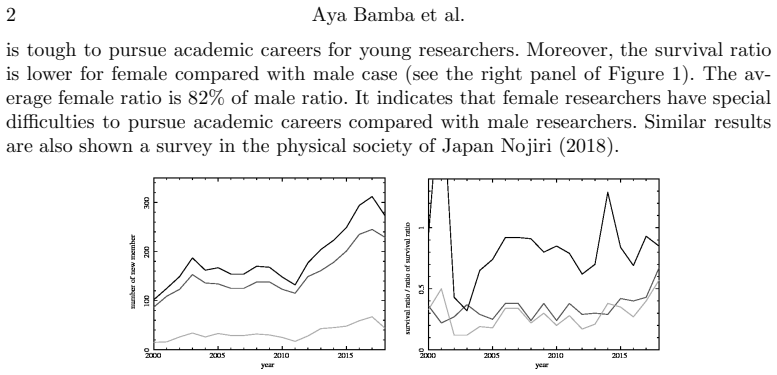
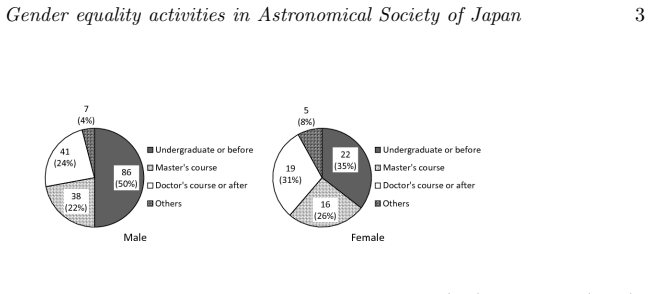
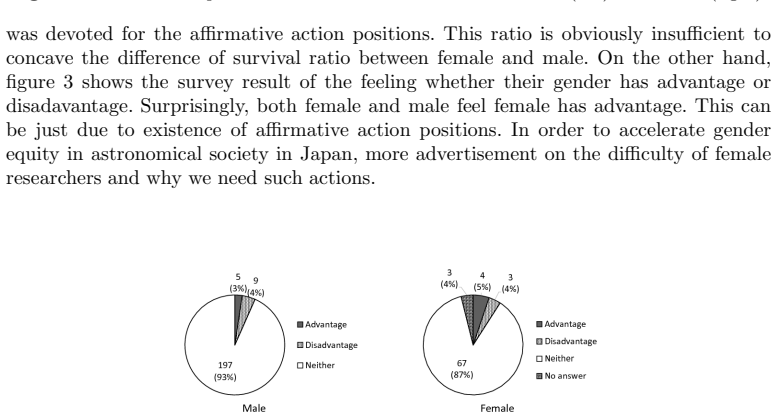
read the original abstract
The female ratio in science field, including astronomy, is still quite low in Japan. We, the Astronomical Society of Japan, are making efforts to equalise the gender balance. In this paper, we summarise our statistics, member's thinking shown in our questionnaire, the history and accomplishments of the day-care system during annual meetings, and other activities.
Editorial analysis
A structured set of objections, weighed in public.
Referee Report
Summary. The manuscript is a descriptive report on gender equality efforts by the Astronomical Society of Japan (ASJ). It summarizes membership statistics on the female ratio in astronomy, presents results from a member questionnaire regarding perceptions of gender balance, details the history and implementation of a day-care system at annual meetings, and outlines additional related activities.
Significance. If the descriptive content holds, the paper provides a useful institutional record of targeted initiatives to address gender imbalance in Japanese astronomy. The combination of statistical overviews, attitudinal data from the questionnaire, and practical measures such as meeting childcare offers a concrete case study that other professional societies could reference when developing similar programs. No machine-checked proofs or parameter-free derivations are present, but the report's value lies in its factual documentation of ongoing activities.
minor comments (3)
- The statistics section would benefit from explicit mention of the time span covered by the membership data and any sources for the figures, to allow readers to assess trends more readily.
- In the questionnaire results, the response rate and sample size should be stated clearly near the tabulated or summarized findings to contextualize the reported member thinking.
- The day-care system subsection could include a brief note on how attendance or utilization data were collected, even if only qualitatively, to strengthen the description of accomplishments.
Simulated Author's Rebuttal
We thank the referee for their positive and accurate summary of our manuscript, which correctly identifies it as a descriptive report on the Astronomical Society of Japan's gender-equality initiatives. We appreciate the recommendation to accept and the recognition of its potential value as a case study for other societies.
Circularity Check
No significant circularity
full rationale
The manuscript is a purely descriptive institutional summary of membership statistics, questionnaire results, day-care provisions at meetings, and related gender-equality activities by the Astronomical Society of Japan. It contains no equations, derivations, fitted parameters, predictions, uniqueness theorems, or ansatzes. All content is factual enumeration of existing efforts and data; no step reduces by construction to its own inputs or to a self-citation chain. The paper is therefore self-contained against external benchmarks with no load-bearing circular elements.
Axiom & Free-Parameter Ledger
Reference graph
Works this paper leans on
- [1]
- [2]
-
[3]
2018, Journal of the Physical Society of Japan, 73 , 331
Nojiri, M. 2018, Journal of the Physical Society of Japan, 73 , 331
work page 2018
discussion (0)
Sign in with ORCID, Apple, or X to comment. Anyone can read and Pith papers without signing in.