REVIEW 3 major objections 5 minor 22 references
On LLM-generated Logic Programs and their Inference Execution Methods
T0 review · 3 major / 5 minor · reviewed 2026-08-07 · deepseek-v4-flash
Pith's one-line read LLM answers become logic programs you can run and verify
desk verdict A useful systems paper with a real circularity problem: the inference is sound, but the pipeline lets the LLM certify its own output. read the letter →
The pith
A machine-rendered reading of the paper's core claim, the machinery that carries it, and where it could break.
The reading
What carries the argument
The load-bearing mechanisms are the compiled logic programs themselves and the inference engines that execute them. A propositional Horn clause program, whose clauses are heads implied by conjunctions of body atoms, is evaluated by fixpoint propagation: starting from facts, repeatedly add any head whose body atoms are all true until no new atoms appear. For scalability, that fixpoint is also implemented as matrix-vector multiplication in a linear-algebra form, where one step of the operator applies a matrix to a truth vector and rounds entries to 0 or 1, with the iteration run until the vector stops changing. Dual Horn clauses, written as implications from a single positive literal to a disjunction of alternatives, support goal-oriented falsification: if every consequence of a hypothesis is known false, the hypothesis itself is refuted. Definite clause grammars generated from question-answer-follow-up chains let the dialog tree be replayed symbolically, and soft-unification overrides ordinary fact matching with a K-nearest-neighbor query in an embedding space so that a query goal can unify with a stored sentence within a distance threshold.
What would settle it
Take a domain with a known gold-standard knowledge graph, run the recursive pipeline to compile a Horn clause program and compute its minimal model, then check whether every gold-standard entailment is derivable and every derived fact is in the gold standard; any substantial divergence would refute the claim that the generated programs verify alignment.
Extended reading notes
Core claim
On the paper's own terms, the central claim is that an automated recursive pipeline can elicit an LLM's parameter-memory as declarative logic programs and then reason over them exactly. The pipeline starts from a short initiator prompt, lets the LLM generate and refine answers in a tree of follow-up queries, and compiles the accepted facts and rules into a propositional Horn clause program whose minimal model captures the consequences. Dual Horn clauses are generated to explore counterfactual or unwanted consequences, allowing the system to back-propagate falsity from undesired outcomes to a hypothesis. The question-answer tree itself is compiled into a definite clause grammar that replays the stream of thoughts generated by the model, and natural-language queries can be answered by soft-unification against an embedding store of ground-truth sentences, inserting abduced clauses into the program. The paper positions these mechanisms as a way to verify alignment of LLM outputs with their intended uses and to extend their inference capabilities through sound symbolic execution.
Load-bearing premise
The whole scheme rests on the premise that the clauses, facts, and accept-or-reject decisions produced by the LLM are accurate enough that the compiled logic program faithfully represents the intended knowledge.
Editorial extensions
If this is right
- A user can inspect the compiled logic program and compute exactly what the LLM's claims entail, rather than relying on the surface text of the answer.
- Dual Horn falsification gives a constructive way to screen advice: if an action leads only to undesirable consequences, the system can conclude the action should be avoided.
- The compiled definite clause grammars let a dialog tree be replayed inside a logic programming environment, making the reasoning trace available for further symbolic processing.
- Soft-unification turns semantic search into abductive logic programming, so queries close in meaning to stored facts can still be answered, with the matched sentences added as abduced clauses.
- GPU-accelerated minimal-model computation makes sound inference feasible on very large LLM-generated programs, into the range of millions of clauses.
Reading between the lines
- If the pipeline works as described, a natural next step is to benchmark the compiled minimal models against a gold-standard knowledge base; the paper itself provides no such ground-truth benchmark, so the alignment claim is not yet measured.
- The soundness the paper claims applies to the inference over the compiled program, not to the truthfulness of the LLM's knowledge; a deployment would still need an independent check of the oracle decisions.
- A testable extension would convert soft-unification distances into probabilities for a probabilistic logic programming language and compare the resulting answers against human relevance judgments.
- The same recursive compilation could be applied to smaller local models, using the open questions collected at the recursion depth limit as a cheap diagnostic of a model's knowledge coverage.
Editorial analysis
A structured set of objections, weighed in public.
Referee Report
Summary. The paper describes DeepLLM, a system that recursively queries an LLM and compiles the resulting dialog threads into logic programs of several forms: propositional Horn clauses, Dual Horn clauses, Definite Clause Grammars, and relation triplets. It also introduces two execution mechanisms: a GPU-accelerated Torch-based fixpoint computation for propositional Horn programs and a soft-unification mechanism that matches abducible facts against a vector database of embedded sentences. The paper's central claim is that exposing LLM knowledge as executable logic programs enables sound reasoning methods that can verify alignment of LLM outputs and extend their inference capabilities (Abstract).
Significance. The idea of using standard logic-programming semantics to check and extend LLM outputs is attractive and timely. The paper's strengths are its clear architecture, the open-source release of the DeepLLM, Softlog, and sentence-store code, and the use of well-established algorithms such as linear-time Horn satisfiability and fixpoint semantics. The GPU implementation follows prior linear-algebraic characterizations and is succinctly presented. However, the central verification claim depends on the fidelity of the LLM-generated programs to the user's intended knowledge, and that dependency is neither tested against ground truth nor justified. The paper is therefore better read as a system description and proof-of-concept than as a demonstration of verified alignment.
major comments (3)
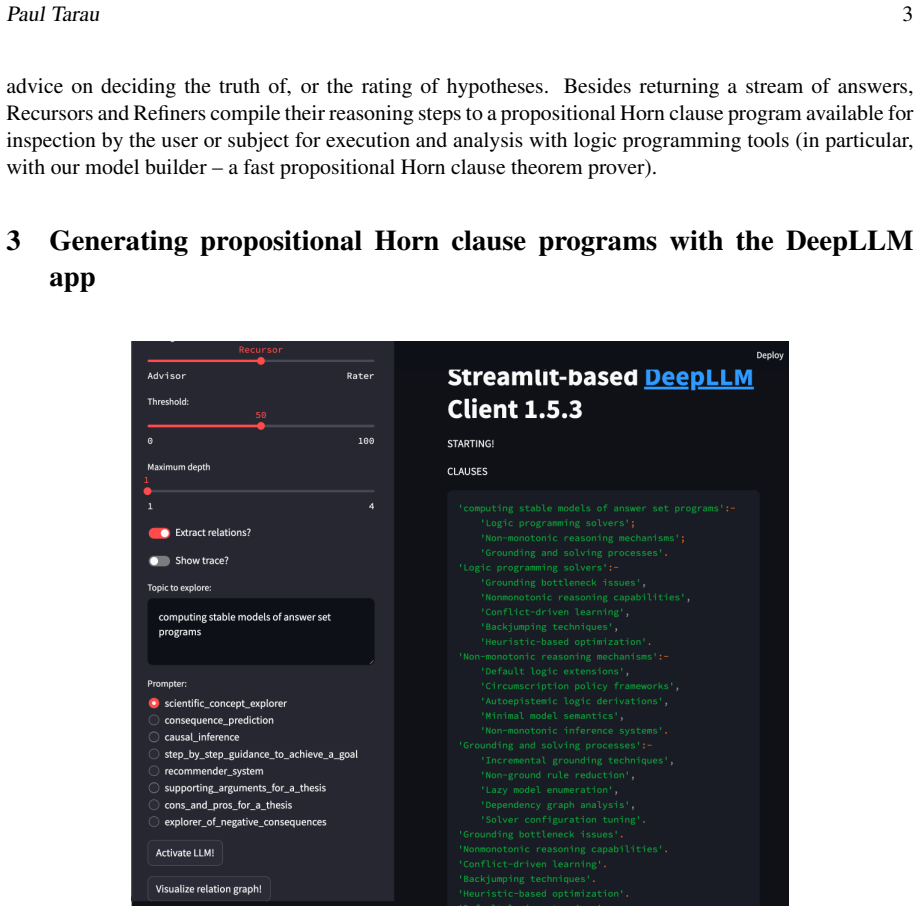
- [Section 6.1] The scalability claim is internally inconsistent. The Abstract and Section 6.1 announce support for 'large LLM-generated programs' and mention programs reaching 'millions of clauses', yet the same section states that the implementation 'can handle medium size programs (a few thousand clauses)' and that complexity is 'dominated by O(N^3) matrix products'. No benchmark data are provided for runtime or memory as a function of program size. Please either add scaling experiments (including with sparse tensors, as suggested in Section 6.1) or revise the claims to match the demonstrated scale.
- [Sections 2, 3 and 6.2] The paper's claim that sound reasoning 'verif[ies] alignment of LLM outputs to their intended uses' (Abstract) is not supported because the validation step is circular. In Section 3, the Rater oracle is itself an LLM call configured by a threshold slider, and it decides whether a generated rule head or fact is accepted. This means the same type of fallible model certifies its own outputs. Section 6.2 then concedes that generated items 'are not necessarily expressing logically connected facts' and that contradiction detection is optional. Consequently, a computed minimal model can be a correct model of an unfaithful or inconsistent knowledge base, and the connection to 'intended uses' is untested. The paper should either benchmark the generated programs against a ground-truth knowledge base or explicitly downgrade the claim to 'reasoning over the LLM's stated knowledge'.
- [Section 8] The soft-unification proof of concept is not evaluated. The demonstration uses a 'small quotation dataset consisting of a few sentences' and reports only successful query matches; it provides no precision, recall, false-match rate, or sensitivity analysis for the two free parameters (k in the KNN query and the distance threshold d). The claim that soft-unification is 'a principled encapsulation of the RAG retrieval process' (Section 1) therefore remains a qualitative demonstration. Please add quantitative evaluation on a larger corpus or state explicitly that the contribution is an architecture, not an experimentally supported retrieval method.
minor comments (5)
- [Section 4] Example 1 contains a formatting error: 'Emotional trauma impact '=> false.' has a stray space and unmatched quote; Example 2 uses 'loosing' instead of 'losing'.
- [Section 5] The last paragraph ends with 'The full Prolog code discussed in thus example is available online'; 'thus' should be 'this'.
- [Section 9] The paragraph on Dual Horn clauses says 'similarly to their of Horn clause counterparts'; this should be 'similarly to their Horn clause counterparts'.
- [Section 3] The application is called both 'DeepLLM' and 'DeeLLM' in the same section; please unify the spelling.
- [Section 8] In the Softlog example, the user enters 'threshold 70' and the code converts it with 'd = float(d) / 100'; please clarify the intended scale (0–100 versus 0–1) to avoid ambiguity.
Circularity Check
Inference engines are independent, but the 'validated' knowledge base is filtered by an LLM oracle, so the claimed verification of alignment reduces to LLM self-agreement.
-
other
[Section 1 (oracles) and Section 3 (Rater agent, DeepLLM app)]
"it can also use new LLM client instances as 'oracles' deciding the validity of the synthesized rules or facts. ... The threshold informs the Rater oracle to accept or reject a generated rule head or fact (the higher the threshold the stricter the accept decision)."
The acceptance of a generated rule head or fact is defined by a thresholded LLM rating, so the 'validity' of the knowledge in the compiled logic program is the product of LLM self-evaluation rather than an external check. Consequently, the abstract's claim that exposing knowledge as logic programs can 'verify alignment of LLM outputs to their intended uses' reduces to the same fallible model ratifying its own output: the logic program is soundly executed, but its premises are certified by the very system being verified. This is a self-referential validation loop rather than a flaw in the Horn, Dual Horn, DCG, or soft-unification inference methods themselves.
full rationale
The core inference machinery is not circular: the minimal-model computation is standard Horn-clause fixpoint propagation, its GPU variant follows the external linear-algebra characterization of Sakama et al., the soft-unification layer uses externally developed Sentence Transformers and KNN retrieval, and the DCG encoding is a direct transcription of the LLM question-answer tree. Self-citations to the author's prior DeepLLM papers provide architecture and open-source code, which is checkable evidence rather than an imported uniqueness theorem. The one genuinely circular element is the Rater/LLM oracle: generated rules and facts are accepted or rejected by another LLM call, so the 'validity' of the knowledge base is internally defined by the model's own ratings. This undermines the abstract's 'verify alignment' claim, since the verification is not anchored to independent ground truth, but it does not collapse the logical inference algorithms, which operate soundly on whatever premises they are given. The result is a moderate partial circularity in the knowledge-acquisition stage, not a derivation that is equivalent to its inputs by construction.
Assumptions & free parameters
free parameters (4)
- KNN count k =
3 in example
- Soft-unification distance threshold =
70 (normalized to 0.70 in code)
- Rater oracle acceptance threshold =
slider, not fixed
- Recursion depth =
user-set
assumptions (4)
- standard math Propositional Horn and Dual Horn satisfiability is polynomial and fixpoint iteration yields the minimal model.
- domain assumption Embedding-space distance is a sufficient proxy for logical unifiability of natural-language facts.
- domain assumption LLM-generated sentences and the LLM oracle responses are sufficiently accurate and consistent to be treated as a knowledge base.
- domain assumption The generated DCG's loop detection ensures a finite language that faithfully represents the follow-up question tree.
Cite this review
Pith. "Pith review of On LLM-generated Logic Programs and their Inference Execution Methods." pith.science (2026). https://pith.science/paper/TTKUMNJO
@misc{pith2026250209209,
  author       = {Pith},
  title        = {Pith review of: On LLM-generated Logic Programs and their Inference Execution Methods},
  year         = {2026},
  howpublished = {\url{https://pith.science/paper/TTKUMNJO}},
  note         = {Machine review of arXiv:2502.09209}
}
read the original abstract
Large Language Models (LLMs) trained on petabytes of data are highly compressed repositories of a significant proportion of the knowledge accumulated and distilled so far. In this paper we study techniques to elicit this knowledge in the form of several classes of logic programs, including propositional Horn clauses, Dual Horn clauses, relational triplets and Definite Clause Grammars. Exposing this knowledge as logic programs enables sound reasoning methods that can verify alignment of LLM outputs to their intended uses and extend their inference capabilities. We study new execution methods for the generated programs, including soft-unification of abducible facts against LLM-generated content stored in a vector database as well as GPU-based acceleration of minimal model computation that supports inference with large LLM-generated programs.
Figures


Reference graph
Works this paper leans on
-
[1]
Theory and Practice of Logic Programming 18(3-4), pp
Joaquin Arias, Manuel Carro, Elmer Salazar, Kyle Marple & Gopal Gupta (2018): Constraint Answer Set Programming without Grounding . Theory and Practice of Logic Programming 18(3-4), pp. 337–354, doi:10.1017/S1471068418000285
-
[2]
Artificial Intelligence 303, p
Samy Badreddine, Artur d’Avila Garcez, Luciano Serafini & Michael Spranger (2022): Logic Tensor Networks. Artificial Intelligence 303, p. 103649, doi:10.1016/j.artint.2021.103649. Available at https: //www.sciencedirect.com/science/article/pii/S0004370221002009
arXiv 2022
-
[3]
Available at https://github.com/hwchase17/langchain
Harrison Chase (2022): LangChain. Available at https://github.com/hwchase17/langchain. Https://www.langchain.com/
work page 2022
-
[4]
Learning Invariants through Soft Unification
Nuri Cingillioglu & Alessandra Russo (2020): Learning Invariants through Soft Unification , doi:10.48550/arXiv.1909.07328. arXiv:1909.07328
work page Pith review arXiv doi:10.48550/arxiv.1909.07328 2020
-
[5]
Luc De Raedt, Angelika Kimmig & Hannu Toivonen (2007): ProbLog: A Probabilistic Prolog and Its Application in Link Discovery. In: IJCAI, 7, pp. 2462–2467, doi:10.5555/1625275.1625673
-
[6]
William F. Dowling & Jean H. Gallier (1984): Linear-Time Algorithms for Testing the Satisfiability of Propo- sitional Horn Formulae. J. Log. Program. 1(3), pp. 267–284, doi:10.1016/0743-1066(84)90014-1. Available at 10.1016/0743-1066(84)90014-1
-
[7]
(2020): Retrieval-augmented generation for knowledge-intensive nlp tasks
Patrick Lewis, Ethan Perez, Aleksandra Piktus, Fabio Petroni, Vladimir Karpukhin, Naman Goyal, Hein- rich K¨uttler, Mike Lewis, Wen-tau Yih, Tim Rockt¨aschel et al. (2020): Retrieval-augmented generation for knowledge-intensive nlp tasks. Advances in Neural Information Processing Systems 33, pp. 9459–9474
work page 2020
-
[8]
Hunter Lightman, Vineet Kosaraju, Yura Burda, Harri Edwards, Bowen Baker, Teddy Lee, Jan Leike, John Schulman, Ilya Sutskever & Karl Cobbe (2023): Let’s Verify Step by Step, doi:10.48550/arXiv.2305.20050. arXiv:2305.20050
Show all 22 references
- [9]
-
[10]
14 On LLM-generated Logic Programs and their Inference Execution Methods
Jaron Maene & Luc De Raedt (2023): Soft-Unification in Deep Probabilistic Logic. 14 On LLM-generated Logic Programs and their Inference Execution Methods
2023
-
[11]
New Generation Computing 40(1), pp
Tuan Quoc Nguyen, Katsumi Inoue & Chiaki Sakama (2022): Enhancing linear algebraic computa- tion of logic programs using sparse representation . New Generation Computing 40(1), pp. 225–254, doi:10.1007/s00354-021-00142-2
2022 doi
-
[12]
In Kentaro Inui, Jing Jiang, Vincent Ng & Xiaojun Wan, editors: EMNLP/IJCNLP (1) , As- sociation for Computational Linguistics, pp
Nils Reimers & Iryna Gurevych (2019): Sentence-BERT: Sentence Embeddings using Siamese BERT- Networks. In Kentaro Inui, Jing Jiang, Vincent Ng & Xiaojun Wan, editors: EMNLP/IJCNLP (1) , As- sociation for Computational Linguistics, pp. 3980–3990, doi:10.18653/v1/D19-1410. Avail...
2019 doi
-
[13]
In Gang Li, Yong Ge, Zili Zhang, Zhi Jin & Michael Blumenstein, editors: Knowledge Science, Engineering and Management , Springer International Publishing, Cham, pp
Chiaki Sakama, Katsumi Inoue & Taisuke Sato (2017): Linear Algebraic Characterization of Logic Pro- grams. In Gang Li, Yong Ge, Zili Zhang, Zhi Jin & Michael Blumenstein, editors: Knowledge Science, Engineering and Management , Springer International Publishing, Cham, pp. 520–...
2017 doi
- [14]
-
[15]
Manning (2024): RAPTOR: Recursive Abstractive Processing for Tree-Organized Retrieval, doi:10.48550/arXiv.2401.18059
Parth Sarthi, Salman Abdullah, Aditi Tuli, Shubh Khanna, Anna Goldie & Christopher D. Manning (2024): RAPTOR: Recursive Abstractive Processing for Tree-Organized Retrieval, doi:10.48550/arXiv.2401.18059. arXiv:2401.18059
-
[16]
Schaefer (1978): The complexity of satisfiability problems
Thomas J. Schaefer (1978): The complexity of satisfiability problems. In: Proceedings of the Tenth Annual ACM Symposium on Theory of Computing , STOC ’78, Association for Computing Machinery, New York, NY , USA, p. 216?226, doi:10.1145/800133.804350. Available at https://doi.o...
1978
-
[17]
Paul Tarau (2021): Natlog: a Lightweight Logic Programming Language with a Neuro-symbolic Touch . In Andrea Formisano, Yanhong Annie Liu, Bart Bogaerts, Alex Brik, Veronica Dahl, Carmine Do- daro, Paul Fodor, Gian Luca Pozzato, Joost Vennekens & Neng-Fa Zhou, editors: Proceedi...
2021 doi
- [18]
-
[19]
Paul Tarau (2023): Natlog: Embedding Logic Programming into the Python Deep-Learning Ecosystem . In Enrico Pontelli, Stefania Costantini, Carmine Dodaro, Sarah Gaggl, Roberta Calegari, Artur D’Avila Garcez, Francesco Fabiano, Alessandra Mileo, Alessandra Russo & Francesca Toni...
2023
-
[20]
In Jeremy Gibbons & Dale Miller, editors: Functional and Logic Programming, Springer Nature Singapore, Singapore, pp
Paul Tarau (2024): System Description: DeepLLM, Casting Dialog Threads into Logic Programs. In Jeremy Gibbons & Dale Miller, editors: Functional and Logic Programming, Springer Nature Singapore, Singapore, pp. 117–134, doi:10.1007/978-981-97-2300-3 7
2024 doi
-
[21]
Theory Pract
Paul Tarau & Eduardo Blanco (2021): Interactive Text Graph Mining with a Prolog-Based Dialog Engine . Theory Pract. Log. Program. 21(2), pp. 244–263, doi:10.1017/S1471068420000137
2021 doi
-
[22]
Chi, Quoc Le & Denny Zhou (2022): Chain of Thought Prompting Elicits Reasoning in Large Language Models
Jason Wei, Xuezhi Wang, Dale Schuurmans, Maarten Bosma, Ed H. Chi, Quoc Le & Denny Zhou (2022): Chain of Thought Prompting Elicits Reasoning in Large Language Models. CoRR abs/2201.11903, doi:10.48550/arXiv.2201.11903. arXiv:2201.11903
Reviewed August 7, 2026 · model on record in the stance chip above.
Discussion (0). Continue with ORCID to comment.