REVIEW 2 major objections 6 minor 47 references
Decomposition of low-angle grain boundaries
T0 review · 2 major / 6 minor · reviewed 2026-08-05 · deepseek-v4-flash
Pith's one-line read A grain boundary can split into two boundaries with a new grain between them when stress drives one dislocation type away from another.
desk verdict Core result is a real MD demonstration, but the mixed-GB temperature/strain-rate story is self-contradictory and needs rewriting. read the letter →
The pith
A machine-rendered reading of the paper's core claim, the machinery that carries it, and where it could break.
The reading
What carries the argument
The central object is the Peach-Koehler force F = (sigma dot b) cross l acting on a dislocation with Burgers vector b and line direction l. By designing a stress state sigma such that this force is nonzero for one dislocation type and zero for another, the authors make only one array glide. The paper's three stated conditions for decomposition at least two Burgers vectors, differential forces, and dislocation separability determine when this selective glide results in boundary splitting. In the mixed boundary, separability is governed by reactions at tilt-twist intersection nodes, where the two dislocation types form loops and can become sessile; this node behavior is what makes the process
What would settle it
In-situ transmission electron microscopy of a nickel bicrystal with an 8.8 degree asymmetric tilt boundary loaded in the direction that should move only one edge dislocation array: if the two arrays do not separate into two boundaries with a new grain between them, or if the supposedly stationary array also glides, the decomposition claim is falsified for that regime.
Extended reading notes
Core claim
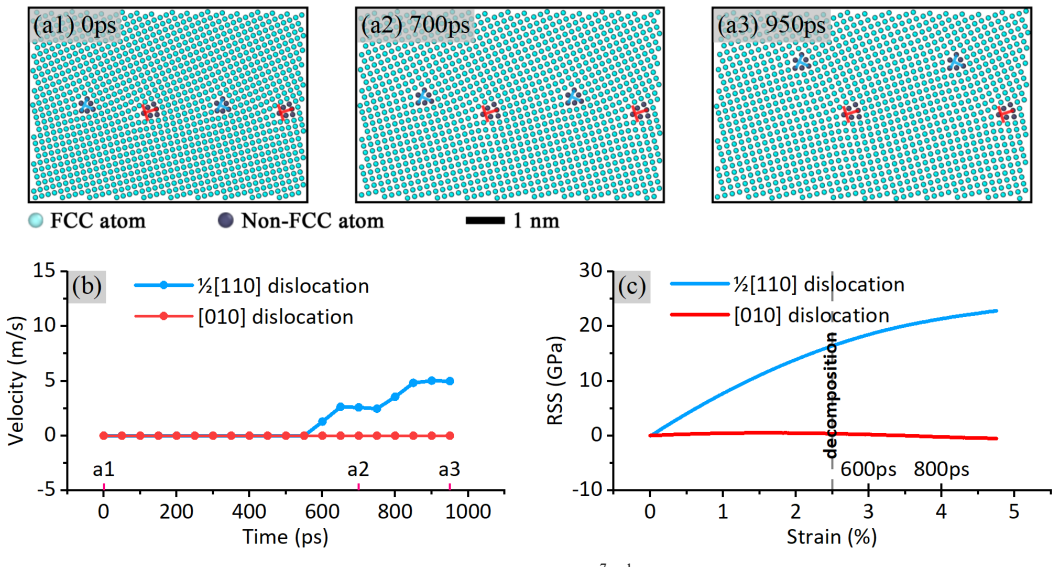
The central claim is that low-angle grain boundaries can decompose when their dislocation content responds non-uniformly to an applied stress. In a simulated [001] asymmetric tilt boundary, a 1/2[110] edge array glides away from a stationary [010] edge array, leaving two tilt boundaries with a new grain between them. In a mixed tilt-twist boundary, a [001] edge array stays pinned while a 1/2[110] screw network bows, then breaks away after overcoming a stress barrier, yielding separate tilt and twist boundaries. The paper gives three conditions for decomposition: the boundary has at least two different Burgers vectors, the stress state produces sufficiently different Peach-Koehler forces, and
Load-bearing premise
The load-bearing premise is that the imposed constant-strain loading really does keep one dislocation type immobile while the other glides; if local stress, lattice rotation, or the interatomic potential lets the supposedly stationary dislocations move or pins the mobile ones differently, selective separation will not occur.
Editorial extensions
If this is right
- If the three criteria hold, any low-angle grain boundary with at least two separable dislocation types should be inducible to decompose, not just the two simulated cases.
- For asymmetric tilt boundaries, decomposition occurs at every temperature and strain rate tested, with the critical stress rising with strain rate and falling with temperature, consistent with a thermally activated process.
- For mixed tilt-twist boundaries, decomposition occurs only at low temperatures and high strain rates; otherwise the screw network bows out but remains pinned by edge dislocations, producing partially mobile boundaries.
- The extra stress needed to separate the twist component from a mixed boundary is about 134 +/- 10 MPa in this model and is nearly independent of strain rate.
- Decomposition offers a mechanical route to control dislocation arrays in thin films and could be used to sweep dislocation arrays through grains to gather defects or impurities.
Reading between the lines
- Editorial inference: because the three criteria are stated in terms of local stress and dislocation character, the same decomposition should be realizable in other easy-glide metals and alloys, not only nickel; the paper's material choice is presented as a modeling convenience.
- Editorial inference: the stress barrier seen in the mixed boundary suggests that engineering the intersection nodes through alloying, precipitate pinning, or temperature could tune whether a boundary decomposes or merely bows, making the effect a controllable processing variable.
- Editorial inference: a direct extension would be unloading-reloading cycles on the asymmetric tilt case to test whether the two boundaries re-merge reversibly, which would turn decomposition into a mechanically driven switch for dislocation arrangements.
Signed reviews
Editorial analysis
A structured set of objections, weighed in public.
Referee Report
Summary. The manuscript reports atomistic simulations demonstrating that a low-angle grain boundary can decompose into two separate grain boundaries when the applied stress state exerts sufficiently different Peach-Koehler forces on the different dislocation types composing the boundary. Two cases are studied in Ni with an EAM potential: a [001] low-angle asymmetric tilt GB (two edge dislocation types) and a (001) low-angle mixed tilt-twist GB (an edge dislocation array plus a screw dislocation network). In both cases, the mobile dislocation component separates from the stationary one, leaving a new grain between two GBs. The paper also examines strain-rate and temperature effects, identifies double-loop versus single-loop node reaction products at intersections in the mixed GB, and reports an apparent stress barrier for separating the twist component. Three conditions for GB decomposition are proposed.
Significance. If correct, the claimed phenomenon is a genuinely new elementary process in grain-boundary microstructure evolution: a single boundary splitting into two boundaries with a new grain between them, i.e., the inverse of GB coalescence. The central evidence is direct MD visualization, and the Peach-Koehler model is used as a prior design principle rather than fitted to the simulations, which is a strength. The three-condition framework is concrete and falsifiable, and the stress-barrier quantification is a useful target for future work. However, the parameter-space interpretation is currently compromised by a direct internal contradiction in the temperature/strain-rate narrative and by the definition of 'critical RSS'; these issues must be resolved before the conclusions can be accepted.
major comments (2)
- [Strain rate and temperature effects] This section contains a direct contradiction. It first states 'For the low-angle mixed GB, decomposition is only observed at low temperatures and high strain rates,' and two paragraphs later states 'At 300 K, decomposition is observed at low strain rates but not at high strain rates.' The proposed mechanism then argues that at 300 K the slower strain rate provides more time for the double-loop node to evolve into the single-loop node, which is described as 'unable to break away.' That mechanism predicts suppression, not decomposition, at low strain rates. Because this passage underpins the separability discussion and conclusion (2), and is used to interpret Figure 4b and Supplementary Figures S2–S4, the reported parameter-space behavior is indeterminate as written. The text and the data/figure must be reconciled; if the intended statement is 'decomposition at low temperatures and high st
- [Strain rate and temperature effects / Figure 4b-d] For the mixed GB, the authors define the critical RSS as 'the highest RSS achieved during each simulation,' considered as the critical RSS to activate decomposition or partial mobility. This conflates a peak stress with a threshold. For decomposition, the meaningful quantity is the RSS at the moment the screw network breaks away, which may be lower than the later peak if stress continues to increase; for non-decomposing cases, there is no single critical event and the highest RSS is just an endpoint value. This affects the interpretation of Figure 4b and the quantitative barrier of 134 ± 10 MPa in Figure 4d. Please report the RSS at the onset of separation (or justify that the maximum coincides with it) and specify a criterion for partial mobility.
minor comments (6)
- [Methodology, Eq. (2)] The displayed formula for RSS is garbled in the provided text. Please define all symbols (unit Burgers vector, slip-plane normal, summation convention) and correct the typography so that Eq. (2) is unambiguous.
- [Conclusions] The phrase 'At higher temperatures and lower simulation times (slower strain rates)' is internally inconsistent: lower simulation times correspond to higher strain rates, not slower ones. This typo should be corrected to avoid compounding the confusion in the Results section.
- [Figure 2 caption] The text refers to 'the stress-strain curve in Figure 2b,' but the caption lists (b) as 'Velocities' and (c) as 'RSS-strain/time curve.' Please align the references with the caption.
- [Figure 3 caption] The caption states 'at 100 K and 107 strain rate'; the exponent appears to be missing and should read 10^7 s^-1.
- [Asymmetric tilt GB / reversibility] The reversibility of the asymmetric-tilt decomposition is asserted from the smooth stress-strain curve, but no unloading or reverse-loading simulation is shown. Either add such a test or soften the reversibility claim.
- [Generality] The three proposed conditions are supported by only two low-angle GBs in one EAM Ni potential. A sentence noting that node reactions and core energetics may differ for other potentials or materials would help calibrate the scope of the claim.
Circularity Check
No significant circularity: low-angle decomposition is independently demonstrated in MD; only minor non-load-bearing self-citations are present.
full rationale
The paper's central derivation is not circular. The Peach-Koehler force (Eq. 1) is used as an external physical input to select a stress state (Methods: 'the Peach-Koehler model is used to determine the desired stress states to induce decomposition'), but the subsequent decomposition is an emergent outcome of MD simulation, not an input to the model. No model parameter is fitted to the simulation output: the critical RSS values in Figure 4 are measured from the simulations, and the stress barrier (134±10 MPa) is a post-hoc difference of measured values, not a fitted prediction. The asymmetric-tilt demonstration is self-contained: the two dislocation types are constructed, the stress is selected from P-K, and the MD shows one array gliding while the other remains stationary (Figs. 2a1-2a3). The mixed-GB case is even less trivial because the screw network is initially pinned at nodes and separates only after a stress barrier (Fig. 3), so the input stress does not by construction force separation. There are self-citations (Refs. [24,25] for mixed-GB construction; Ref. [43] for high-angle decomposition), but none is load-bearing for the low-angle claim; [43] appears only in the concluding suggestion that high-angle GBs can decompose. Separately, the Results text contains an internal inconsistency about strain-rate/temperature dependence: 'decomposition is only observed at low temperatures and high strain rates' is followed two sentences later by 'At 300 K, decomposition is observed at low strain rates but not at high strain rates,' and the node-evolution mechanism is explicitly 'hypothesized.' These are correctness/consistency concerns, not circularity, and do not change the low-angle decomposition demonstration.
Assumptions & free parameters
assumptions (5)
- standard math Peach-Koehler force equation (eq 1) and Schmid's law (eq 2) correctly describe the forces on the dislocations in the grain boundary under the applied stress.
- domain assumption The Foiles-Hoyt EAM potential accurately represents nickel grain-boundary structures, dislocation mobilities, and their temperature and strain-rate dependence.
- domain assumption Dislocation structures identified by DXA on zero-temperature relaxed GBs are the operative defects during the deformation simulations, and no other defect mechanisms dominate.
- domain assumption Constant-strain boundary conditions produce the intended stress states, and the global stress tensor can be used to compute local resolved shear stresses via eq (2).
- domain assumption Materials with the same lattice type will exhibit the same dislocation-based decomposition behavior as nickel.
Cite this review
Pith. "Pith review of Decomposition of low-angle grain boundaries." pith.science (2026). https://pith.science/paper/TTWZWICY
@misc{pith2026250902789,
  author       = {Pith},
  title        = {Pith review of: Decomposition of low-angle grain boundaries},
  year         = {2026},
  howpublished = {\url{https://pith.science/paper/TTWZWICY}},
  note         = {Machine review of arXiv:2509.02789}
}
read the original abstract
Grain boundaries (GBs) merge and grains disappear during microstructure evolution. However, the Peach-Koehler model predicts that particular stress states may reverse such a process by exerting differential Peach-Koehler forces on different dislocations. This work considers this reversal as GB decomposition and illustrates it in a low-angle asymmetric tilt GB and a low-angle mixed tilt-twist GB via atomistic simulation. In both cases, the dislocations separate into two GBs separated by a new grain. This work describes the requirements for decomposition and the importance of dislocation separability. Additionally, we examine the dislocation behaviors and stress signatures associated with this process, along with the impact of strain rate and temperature on those aspects.
Figures


Reference graph
Works this paper leans on
-
[1]
Grain boundary engineering: an overview after 25 years
Randle, V . Grain boundary engineering: an overview after 25 years. Mater. Sci. Technol. 2010, 26(3), 253–261
work page 2010
-
[2]
Strengthening materials by engineering coherent internal boundaries at the nanoscale
Lu, K.; Lu, L.; Suresh, S. Strengthening materials by engineering coherent internal boundaries at the nanoscale. Science 2009, 324, 349–352
work page 2009
-
[3]
Revealing extraordinary intrinsic tensile plasticity in gradient nano-grained copper
Fang, T.H.; Li, W.L.; Tao, N.R.; Lu, K. Revealing extraordinary intrinsic tensile plasticity in gradient nano-grained copper. Science 2011, 331, 1587–1590
work page 2011
-
[4]
Shimada, M.; Kokawa, H.; Wang, Z.J.; Sato, Y .S.; Karibe, I. Optimization of grain boundary character distribution for intergranular corrosion resistant 304 stainless steel by twin-induced grain boundary engineering. Acta Mater. 2002, 50(9), 2331–2341
work page 2002
-
[5]
Cryogenic indentation-induced grain growth in nanotwinned copper
Brons, J.G.; Padilla, H.A.; Thompson, G.B.; Boyce, B.L. Cryogenic indentation-induced grain growth in nanotwinned copper. Scr. Mater. 2013, 68(10) 781–784
work page 2013
-
[6]
How grain growth stops: A mechanism for grain-growth stagnation in pure materials
Holm, E.A.; Foiles, S.M. How grain growth stops: A mechanism for grain-growth stagnation in pure materials. Science 2010, 328(5982), 1138–1141
work page 2010
-
[7]
Stress induced grain boundary motion
Winning, M.; Gottstein, G.; Shvindlerman, L. Stress induced grain boundary motion. Acta Mater. 2001, 49(2), 211–219
work page 2001
-
[8]
On the mechanisms of grain boundary migration
Winning, M.; Gottstein, G.; Shvindlerman, L. On the mechanisms of grain boundary migration. Acta Mater. 2002, 50(2), 353–363
work page 2002
Show all 47 references
-
[9]
Coupling grain boundary motion to shear deformation
Cahn, J.W.; Mishin, Y .; Suzuki, A. Coupling grain boundary motion to shear deformation. Acta Mater. 2006, 54(19), 4953–4975
2006
-
[10]
Phenomenology of shear-coupled grain boundary motion in symmetric tilt and general grain boundaries
Homer, E.R.; Foiles, S.M.; Holm, E.A.; Olmsted, D.L. Phenomenology of shear-coupled grain boundary motion in symmetric tilt and general grain boundaries. Acta Mater. 2013, 61(4), 1048–1060
2013
-
[11]
Reconciling grain growth and shear-coupled grain boundary migration
Thomas, S.L.; Chen, K.T.; Han, J.; Purohit, P.K.; Srolovitz, D.J. Reconciling grain growth and shear-coupled grain boundary migration. Nat. Commun. 2017, 8(1),
2017
-
[12]
Grain boundary shear coupling is not a grain boundary property
Chen, K.T.; Han, J.; Thomas, S.L.; Srolovitz, D.J. Grain boundary shear coupling is not a grain boundary property. Acta Mater. 2019, 167, 241–247
2019
-
[13]
Sliding mechanisms in aluminum grain boundaries
Molteni, C.; Marzari, N.; Payne, M.; Heine, V. Sliding mechanisms in aluminum grain boundaries. Phys. Rev. Lett. 1997, 79(5),
1997
-
[14]
First principles simulation of grain boundary sliding
Molteni, C.; Francis, G.; Payne, M.; Heine, V . First principles simulation of grain boundary sliding. Phys. Rev. Lett. 1996, 76(8),
1996
-
[15]
Sliding behavior of coincidence grain boundaries deviating from ideal symmetric tilt relationship
Fukutomi, H.; Iseki, T.; Endo, T.; Kamijo, T. Sliding behavior of coincidence grain boundaries deviating from ideal symmetric tilt relationship. Acta Metall. Mater. 1991, 39(7), 1445–1448
1991
-
[16]
Phase field crystal simulation of grain boundary motion, grain rotation and dislocation reactions in a BCC bicrystal
Yamanaka, A.; McReynolds, K.; Voorhees, P.W. Phase field crystal simulation of grain boundary motion, grain rotation and dislocation reactions in a BCC bicrystal. Acta Mater. 2017, 133, 160–171
2017
-
[17]
Grain boundary migration and grain rotation studied by molecular dynamics, Acta Mater
Trautt, Z.T.; Mishin, Y. Grain boundary migration and grain rotation studied by molecular dynamics, Acta Mater. 2012, 60(5), 2407–2424
2012
-
[18]
Grain rotation mechanisms in nanocrystalline materials: Multiscale observations in Pt thin films
Tian, Y.; Gong, X.G.; Xu, M.J.; Qiu, C.H.; Han, Y.; Bi, Y.T.; Estrada, L.V.; Boltynjuk, E.; Hahn, H.; Han, J.; Srolovitz, D.J.; Pan, X.Q. Grain rotation mechanisms in nanocrystalline materials: Multiscale observations in Pt thin films. Science 2024, 386(6717), 49–54
2024
-
[19]
The forces exerted on dislocations and the stress fields produced by them
Peach, M.; Koehler, J.S. The forces exerted on dislocations and the stress fields produced by them. Phys. Rev. 1950, 80(3), 436–439
1950
-
[21]
M.; Cohen, D
Medlin, D.L.; Foiles, S. M.; Cohen, D. A dislocation-based description of grain boundary dissociation: application to a 90° <110> tilt boundary in gold. Acta Mater. 2001, 49, 3689–3697
2001
-
[22]
Dissociation of tilt dislocation walls in Au
Geng, Y .J.; Wang, C.Y .; Yan, J.X.; Zhang, Z.J.; Yang, H.J.; Yang, J.B.; Du, K.; Zhang, Z.F. Dissociation of tilt dislocation walls in Au. Acta Metall. Sin. 2022, 35, 1787–1792
2022
-
[23]
macroscopic
Morawiec, A.; Glowinski, K. On “macroscopic” characterization of mixed grain boundaries. Acta Mater. 2013, 61, 5756–5767
2013
-
[24]
Structures and energies of computed silicon (001) small angle mixed grain boundaries as a function of three macroscopic characters
Wan, W.; Tang, C.X. Structures and energies of computed silicon (001) small angle mixed grain boundaries as a function of three macroscopic characters. Acta Mater. 2023, 261, 119353
2023
-
[25]
Can we predict mixed grain boundaries from their tilt and twist components
Wan, W.; Tang, C.X.; Homer, E.R. Can we predict mixed grain boundaries from their tilt and twist components. Acta Mater. 2024, 279, 120293
2024
-
[26]
Accurate control of the misorientation angles in direct wafer bonding
Fournel, F.; Moriceau, H.; Aspar, B. Accurate control of the misorientation angles in direct wafer bonding. Appl. Phys. Lett. 2002, 80,
2002
-
[27]
Lateral ordering of quantum dots by periodic subsurface stressors
Romanov, A.E.; Petroff, P.M.; Speck, J.S. Lateral ordering of quantum dots by periodic subsurface stressors. Appl. Phys. Lett. 1999, 74,
1999
-
[28]
How to control the self-organization of nanoparticles by bonded thin layers
Bourret, A. How to control the self-organization of nanoparticles by bonded thin layers. Surf. Sci. 1999, 432, 37–53
1999
-
[29]
Controlled surface nanopatterning with buried dislocation arrays
Leroy, F.; Eymery, J.; Gentile, P.; Fournel, F. Controlled surface nanopatterning with buried dislocation arrays. Surf. Sci. 2003, 545, 211–219
2003
-
[30]
Stress-driven migration of simple low-angle mixed grain boundaries
Lim, A.T.; Haataja, M.; Cai, W.; Srolovitz, D.J. Stress-driven migration of simple low-angle mixed grain boundaries. Acta Mater. 2012, 60, 1395–1407
2012
-
[31]
Structure identification methods for atomistic simulations of crystalline materials
Stukowski, A. Structure identification methods for atomistic simulations of crystalline materials. Model. Simul. Mater. Sc. 2012, 20, 045021
2012
-
[32]
Nodal effects in dislocation mobility
Bulatov, V .V .; Cai W. Nodal effects in dislocation mobility. Phys. Rev. Lett. 2002, 89,
2002
-
[33]
Enhanced mobility of dislocation network nodes and its effect on dislocation multiplication and strain hardening
Bertin, N.; Cai, W.; Aubry, S.; Arsenlis, A.; Bulatov, V .V . Enhanced mobility of dislocation network nodes and its effect on dislocation multiplication and strain hardening. Acta Mater. 2024, 271, 119884
2024
-
[34]
Strain rate dependency of dislocation plasticity
Fan, H.D.; Wang, Q.Y .; El-Awady, J.A.; Raabe, D.; Zaiser, M. Strain rate dependency of dislocation plasticity. Nat. Commun. 2021, 12,
2021
-
[35]
Stukowski, A.; Bulatov, V .V .; Arsenlis, A.; Automated identification and indexing of dislocations in crystal interfaces. Model. Simul. Mater. Sc. 2012, 20, 085007
2012
-
[36]
Temperature dependence of dislocation dissociation mode in L12 trialuminides
Fukunaga, K.; Kolbe, M.; Yamada, K.; Miura, Y . Temperature dependence of dislocation dissociation mode in L12 trialuminides. Mater. Sci. Eng. A 1997, 234, 594–597
1997
-
[37]
Atomistic simulations of dislocation mobility in Al, Ni and Al/Mg alloys
Olmsted, D.L.; Hector Jr, L.G.; Curtin, W.A.; Clifton, R.J. Atomistic simulations of dislocation mobility in Al, Ni and Al/Mg alloys. Model. Simul. Mater. Sc. 2005, 13, 371–388
2005
-
[39]
The impurity-drag effect in grain boundary motion, Acta Metall
Cahn, J.W. The impurity-drag effect in grain boundary motion, Acta Metall. 1962, 10(9), 789–798
1962
-
[40]
Stüwe, H.P
Lücke, K. Stüwe, H.P. On the theory of impurity controlled grain boundary motion. Acta Metall. 1971, 19(10), 1087–1099
1971
-
[41]
The effect of solute atoms on grain boundary migration: a solute pinning approach, Metall
Hersent, E.; Marthinsen, K.; Nes, E. The effect of solute atoms on grain boundary migration: a solute pinning approach, Metall. Mater. Trans. A 2013, 44(7), 3364–3375
2013
-
[42]
Small-angle twist grain boundaries as sinks for point defects
Jiang, H.; Szlufarska, I. Small-angle twist grain boundaries as sinks for point defects. Sci. Rep. 2018, 8,
2018
-
[43]
Decomposition of general grain boundaries
Wan, W.; Deng, J.W.; Tang, C.X. Decomposition of general grain boundaries. arXiv preprint 2025 https://arxiv.org/abs/2507.00759
2025 arXiv
-
[44]
Bhattacharya, A.; Shen, Y. F. ; Hefferan, C.M.; Li, S.F.; Lind, J.; Suter, R.M.; Krill III, C.E.; Rohrer, G.S. Grain boundary velocity and curvature are not correlated in Ni polycrystals. Science, 2021, 374, 189–193
2021
-
[45]
Computation of grain boundary stiffness and mobility from boundary fluctuations
Foiles, S.M.; Hoyt, J.J. Computation of grain boundary stiffness and mobility from boundary fluctuations. Acta Mater. 2006, 54(12), 3351-3357
2006
-
[46]
LAMMPS-a flexible simulation tool for particle-based materials modeling at the atomic, meso, and continuum scales
Thompson, A.P.; Aktulga, H.M.; Berger, R.; Bolintineanu, D.S.; Brown, W.N.; Crozier, P.S.; Veld, P.J.I.; Kohlmeyer, A.; Moore, S.G.; Nguyen, T.D.; Shan, R.; Stevens, M.J.; Tranchida, J.; Trott, C.; Plimpton, S.J. LAMMPS-a flexible simulation tool for particle-based materials m...
2021
-
[47]
Foiles, S.M., Holm, E.A
Olmsted, D.L. Foiles, S.M., Holm, E.A. Survey of computed grain boundary properties in face-centered cubic metals: I. Grain boundary energy. Acta Mater. 2009, 57,
2009
-
[48]
Examination of computed aluminium grain boundary structures and energies that span the 5D space of crystallographic character
Homer, E.R.; Hart, G.L.W.; Owens, C.B.; Hensley, D.M.; Spendlove, J.C.; Serafinb, L.H. Examination of computed aluminium grain boundary structures and energies that span the 5D space of crystallographic character. Acta Mater. 2022, 234, 118006
2022
-
[49]
Visualization and analysis of atomistic simulation data with ovito–the open visualization tool
Stukowski, A. Visualization and analysis of atomistic simulation data with ovito–the open visualization tool. Model. Simul. Mater. Sc. 2010, 18, 015012
2010
Reviewed August 5, 2026 · model on record in the stance chip above.
Discussion (0). Continue with ORCID to comment.