REVIEW 3 major objections 5 minor 86 references
InDeed: Interpretable image deep decomposition with guaranteed generalizability
T0 review · 3 major / 5 minor · reviewed 2026-08-10 · deepseek-v4-flash
Pith's one-line read Minimizing the variational loss of a Bayesian image-decomposition network is claimed to minimize a PAC-Bayesian upper bound on its generalization error.
desk verdict Solid empirical framework, but the 'guaranteed generalizability' claim rests on a PAC-Bayes bound that is not a valid PAC-Bayes bound. read the letter →
The pith
A machine-rendered reading of the paper's core claim, the machinery that carries it, and where it could break.
The reading
What carries the argument
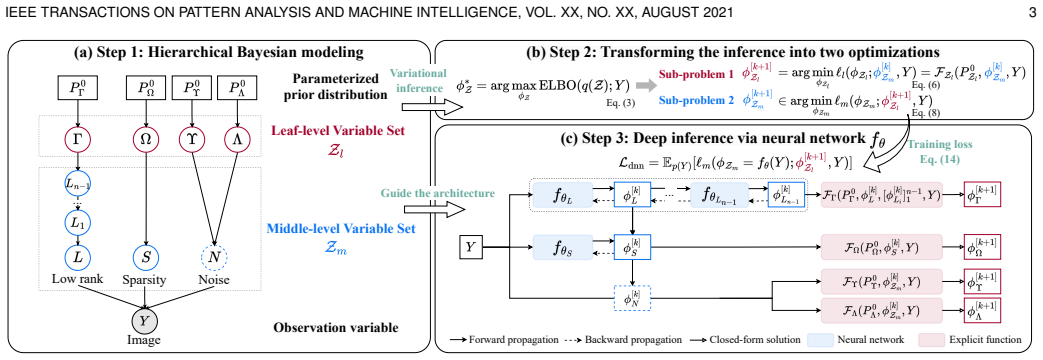
The load-bearing object is the variational training loss $L_{\mathrm{dnn}} = \mathbb{E}_{p(Y)}[-\mathrm{ELBO}(q_{f_\theta(Y)}(Z);Y)]$, equivalently the sum of fidelity, supervision, low-rank, sparsity, and prior KL terms in Eq. (35). The argument that this loss controls generalization runs through Theorem 1, a PAC-Bayesian bound patterned on references [22], [23], [69], whose right-hand side contains the empirical loss plus the empirical KL between variational posterior and prior, so that $\hat{L}_{\mathrm{dnn}}$ appears as the empirical part of the bound. The network architecture is also machinery: $f_\theta$ has a low-rank module $f_{\theta_L}$ with two parallel sub-networks predicting mean/variance of factors $A$ and $B$, and a sparsity module $f_{\theta_S}$ predicting mean/variance of $S$ from the residual $Y - \hat{A}\hat{B}^T$; the leaf-level variables $\gamma$, $\Omega$, $\Lambda$ are updated in closed form by conjugate-prior formulas (Eqs. (26), (28), (30)).
What would settle it
Re-derive Theorem 1 with explicit constants and check whether the bound contains a term that shrinks as the training set size $|\mathcal{D}|$ grows and as $\delta$ decreases; a concrete falsifier is to compute the bound and the true expected error on a small synthetic denoising task where the expected risk is known in closed form, and show that the inequality fails for some $\delta$ or dataset size.
Extended reading notes
Core claim
InDeed models an image observation as $Y = L + S + N$, with $L = AB^T$ a low-rank product, $S$ sparse, and $N$ pixel-wise Gaussian noise, all governed by conjugate priors (Gamma priors on precision-like variables to control rank and sparsity). Variational inference over the posterior $q(Z) = q(A)q(B)q(S|A,B)q(\gamma)q(\Omega)q(\Lambda)$ splits the negative ELBO into seven additive terms, of which the leaf-level variables ($\gamma$, $\Omega$, $\Lambda$) have closed-form updates while the middle-level variables ($A$, $B$, $S$) are predicted by a modular network $f_\theta$. The paper's main theoretical assertion is Theorem 1, which states that the expected generalization error $R(f_\theta)$ is bounded, with probability at least $1-\delta$, by the sum of the empirical error, the empirical KL term, a distribution-discrepancy term $K\cdot d(\cdot,\cdot)$, and a constant $C$; because the first two terms are exactly the network's training loss $\hat{L}_{\mathrm{dnn}}$, the authors conclude that minimizing $\hat{L}_{\mathrm{dnn}}$ controls generalization error. From this bound they derive an unsupervised test-time adaptation method that fine-tunes selected modules on out-of-distribution data, and they report gains over strong baselines in denoising (SIDD, PolyU) and anomaly detection (noisy MVTecAD, Severstal, MOOD).
Load-bearing premise
Theorem 1 must be a genuine PAC-Bayesian inequality with constants that depend on the sample size and the confidence parameter; if the derivation is invalid, the paper's guarantee of generalizability reduces to an unproven heuristic.
Editorial extensions
If this is right
- If Theorem 1 is valid, then any architecture that minimizes $\hat{L}_{\mathrm{dnn}}$ inherits a PAC-Bayesian guarantee, making the claimed generalizability a formal property rather than an empirical hope.
- The test-time adaptation algorithm InDeedAG follows directly from the bound: fine-tuning only the sparsity module on unlabeled OOD data reduces the empirical loss and therefore the bound, which matches the reported improvements on SIDD and PolyU.
- The modularized architecture means that adaptation can be targeted to the module most responsible for the distribution shift (in these experiments, the sparsity module $f_{\theta_S}$), offering a cheap, selective fine-tuning strategy.
- The framework's interpretability is a by-product of the same construction: each loss term and each intermediate output corresponds to a named variable in the probabilistic model, so the decomposition $L$, $S$, $N$ is directly inspectable.
Reading between the lines
- Inference: A standard PAC-Bayes bound must contain a term that decays with the training sample size $|\mathcal{D}|$ and scales with $\log(1/\delta)$; Eq. (36) as printed shows neither, so whether the claimed guarantee is a valid PAC-Bayes result is a question that determines the strength of the paper's central assertion.
- Inference: The distribution-discrepancy term $K\cdot d(\hat{p}_{\mathcal{D}}(Y),p(Y))$ suggests that test-time adaptation implicitly minimizes an empirical distribution shift, and a direct measurement of $d(\cdot,\cdot)$ before and after adaptation would make that mechanism explicit.
- Inference: The modular separation of low-rank and sparsity modules may support transfer learning, for instance reusing $f_{\theta_L}$ across tasks with different noise types; the paper mentions this as future work, so it is an untested consequence.
Editorial analysis
A structured set of objections, weighed in public.
Referee Report
Summary. The paper proposes InDeed, a framework for interpretable deep image decomposition that combines hierarchical Bayesian modeling (HBM) with a modular neural network whose architecture mirrors the probabilistic graphical model. Variational inference is used to derive two optimization sub-problems, one of which has closed-form solutions; the other is solved by a DNN trained on a negative-ELBO loss. The paper claims a PAC-Bayesian generalization error bound (Theorem 1) showing that minimizing this loss reduces an upper bound on the expected risk, and uses this claimed connection to motivate two test-time adaptation algorithms, InDeedAG and InDeedOAG, for out-of-distribution scenarios. The framework is instantiated on image denoising and unsupervised anomaly detection, with extensive experiments including OOD benchmarks.
Significance. If Theorem 1 were valid, the paper would provide a valuable bridge between variational inference and generalization guarantees for an interpretable, modular architecture, and the proposed test-time adaptation would be well motivated. The experimental portion is substantial and contains useful contributions: closed-form updates for leaf-level variables (Eqs. 26-30), a modular architecture with interpretable intermediate outputs, and an adaptation scheme that improves OOD denoising performance in Table 5. However, the central theoretical claim underpinning both the title and the adaptation motivation is not established; the stated bound is not a correct PAC-Bayes inequality, and the claimed equivalence between the loss and the bound is broken by terms that are actually minimized. The strong empirical results do not repair the collapse of the 'guaranteed generalizability' claim.
major comments (3)
- [§3.5.1, Theorem 1 and Eq. (36)] Theorem 1 is not a valid PAC-Bayes bound as stated. The right-hand side of Eq. (36) contains no dependence on the sample size |D| and no dependence on the confidence parameter δ, while the theorem asserts the inequality holds with probability at least 1−δ over D for any δ∈(0,1). Every standard PAC-Bayes inequality must include a term that grows with ln(1/δ) and with 1/√|D| (e.g., McAllester's bound), so as δ approaches 0 the right-hand side would need to grow, whereas Eq. (36) is fixed. Moreover, the theorem is asserted without any proof in the manuscript or supplement, and the cited references [22], [23], [69] do not contain this result in this form. Because Theorem 1 is the basis for the title's 'guaranteed generalizability' and for the design of InDeedAG, this is a load-bearing unsupported assertion.
- [§3.5.1, Eq. (37) vs. §3.4.1, Eq. (35)] The claimed equivalence between the empirical terms of the bound and the training loss does not hold. Eq. (37) identifies Rhat + KLhat with Ldnn, but the actual loss minimized in Eq. (35) includes the supervision term ℓsup (instantiated in Eq. (44) or (45)), and the full objective in Eq. (43) adds the orthogonality term τℓorth. Even if Theorem 1 were correct, minimizing Eq. (43) is not equivalent to minimizing Rhat + KLhat; the minimized objective contains terms that are absent from the bound and vice versa. Therefore the statement in §3.5.1 that 'minimizing Eq (35) tends to reduce the error bound' is not logically supported by the preceding equations.
- [§3.5.1, constants K, C and discrepancy d] The quantities K = c(Kθ) and C are never specified, and d(pHat(Y), p(Y)) is an unknown distribution discrepancy. Consequently Eq. (36) cannot be evaluated, tightened, or controlled from finite data; even a formally correct bound of this form would not provide a practical or verifiable guarantee unless these terms are quantified or bounded. The paper gives no analysis of Kθ or C and no definition of the discrepancy beyond a reference to [23]. As a result, the 'guarantee' is vacuous in its present form, and the relation to the training loss remains symbolic.
minor comments (5)
- [§3.1.1, Eq. (16)] The expression L = ABT = Pr0 i=1 ai × bT i is likely a rendering issue; it should be written with an explicit summation sign over i=1 to r0.
- [§4.4.1 and Table 5] The notation InDeedAGβ (L) and InDeedAGβ (LS) is never defined; the superscript β is unexplained and appears only in the table and surrounding text.
- [§4.1] The batch size for the main training phase is not reported, while the batch size for adaptation is given as 1 in §4.4; please provide this implementation detail for reproducibility.
- [§3.5.2] The description says Dood is 'sampled from p(Y)', which makes the out-of-distribution setting unclear if p(Y) is also the training distribution; the relationship between the training distribution and the test distribution should be stated more precisely.
- [Figure 6] The scatter plots in Fig. 6 have unlabeled axes; adding axis labels (e.g., ℓrank, ℓsparse, PSNR) would improve readability.
Circularity Check
No significant circularity: the loss-to-bound connection is a standard PAC-Bayes-style reduction, and the main weakness (an unproven bound missing sample-size and confidence terms) is a validity issue, not a self-referential one.
full rationale
Walking the derivation chain, no load-bearing step reduces to its own input by construction. The variational loss Ldnn in Eq. (12) is defined as the expected negative ELBO; Eq. (37) then observes that the empirical risk plus empirical KL is the empirical version of that same loss, so minimizing the variational objective targets the first two terms of the proposed bound in Eq. (36). This is the standard PAC-Bayes mechanism: the bound is an inequality relating true risk to empirical quantities, and the presence of the training objective on the right-hand side is what makes the bound usable. It is not a circular redefinition. The test-time adaptation losses in Eqs. (39)-(41) are computed on Dood and evaluated on Dood, but the paper clearly frames these as adaptation and compares against fixed-model baselines, so no fitted parameter is renamed as a prediction. Self-citations [21], [30], and [66] are used for motivation, baselines, and standard modeling facts; they are not load-bearing for the main theoretical claim. Reviewer flag: Theorem 1 in Section 3.5.1 is asserted without proof, and Eq. (36) has no |D| or delta dependence despite claiming probability at least 1-delta, so the 'guaranteed generalizability' conclusion is not established by the paper. That is a serious correctness and missing-support issue, not a circularity issue: the inequality is unproven, not identical to its inputs.
Assumptions & free parameters
free parameters (5)
- r0 (maximal rank) =
64
- tau (orthogonality weight) =
1
- prior hyper-parameters alpha0_gamma, alpha0_omega, alpha0_lambda =
2 for all
- prior hyper-parameters beta0_gamma, beta0_omega, beta0_lambda =
1e-6, 1e-6, 1e-8
- supervision scale sigma0 =
not reported
assumptions (5)
- domain assumption Mean-field factorization q(Z)=q(A)q(B)q(S|A,B)q(gamma)q(omega)q(lambda)
- domain assumption Conjugate Gaussian and Gamma variational families
- ad hoc to paper PAC-Bayes theorem in the form stated in Theorem 1
- domain assumption Observation model Y = L + S + N with pixel-wise Gaussian noise
- domain assumption Images are composed of a low-rank part, a sparse part, and noise
Cite this review
Pith. "Pith review of InDeed: Interpretable image deep decomposition with guaranteed generalizability." pith.science (2026). https://pith.science/paper/TUNMXAQ6
@misc{pith2026250101127,
  author       = {Pith},
  title        = {Pith review of: InDeed: Interpretable image deep decomposition with guaranteed generalizability},
  year         = {2026},
  howpublished = {\url{https://pith.science/paper/TUNMXAQ6}},
  note         = {Machine review of arXiv:2501.01127}
}
read the original abstract
Image decomposition aims to analyze an image into elementary components, which is essential for numerous downstream tasks and also by nature provides certain interpretability to the analysis. Deep learning can be powerful for such tasks, but surprisingly their combination with a focus on interpretability and generalizability is rarely explored. In this work, we introduce a novel framework for interpretable deep image decomposition, combining hierarchical Bayesian modeling and deep learning to create an architecture-modularized and model-generalizable deep neural network (DNN). The proposed framework includes three steps: (1) hierarchical Bayesian modeling of image decomposition, (2) transforming the inference problem into optimization tasks, and (3) deep inference via a modularized Bayesian DNN. We further establish a theoretical connection between the loss function and the generalization error bound, which inspires a new test-time adaptation approach for out-of-distribution scenarios. We instantiated the application using two downstream tasks, \textit{i.e.}, image denoising, and unsupervised anomaly detection, and the results demonstrated improved generalizability as well as interpretability of our methods. The source code will be released upon the acceptance of this paper.
Figures


Figures from the paper (6 more)


Reference graph
Works this paper leans on
-
[22]
Simplified pac-bayesian margin bounds,
D. McAllester, “Simplified pac-bayesian margin bounds,” in Learn- ing Theory and Kernel Machines, 2003, pp. 203–215
work page 2003
-
[23]
Statistical guarantees for variational autoencoders using pac-bayesian theory,
S. D. Mbacke, F. Clerc, and P . Germain, “Statistical guarantees for variational autoencoders using pac-bayesian theory,” in Advances in Neural Information Processing Systems , vol. 36, 2023, pp. 56 903– 56 915
work page 2023
-
[69]
Pac- bayesian theory meets bayesian inference,
P . Germain, F. Bach, A. Lacoste, and S. Lacoste-Julien, “Pac- bayesian theory meets bayesian inference,” in Advances in Neural Information Processing Systems , D. Lee, M. Sugiyama, U. Luxburg, I. Guyon, and R. Garnett, Eds., vol. 29, 2016
work page 2016
-
[1]
Deep image prior,
D. Ulyanov, A. Vedaldi, and V . Lempitsky, “Deep image prior,” in Proceedings of the IEEE conference on computer vision and pattern recognition, 2018, pp. 9446–9454
2018
-
[2]
Structure-texture image decomposition using deep variational priors,
Y. Kim, B. Ham, M. N. Do, and K. Sohn, “Structure-texture image decomposition using deep variational priors,” IEEE Transactions on Image Processing, vol. 28, no. 6, pp. 2692–2704, 2018
2018
-
[3]
Double-dip: unsu- pervised image decomposition via coupled deep-image-priors,
Y. Gandelsman, A. Shocher, and M. Irani, “Double-dip: unsu- pervised image decomposition via coupled deep-image-priors,” in Proceedings of the IEEE/CVF Conference on Computer Vision and Pattern Recognition, 2019, pp. 11 026–11 035
2019
-
[4]
A review of image denoising algorithms, with a new one,
A. Buades, B. Coll, and J.-M. Morel, “A review of image denoising algorithms, with a new one,” Multiscale modeling & simulation , vol. 4, no. 2, pp. 490–530, 2005
2005
-
[5]
Nonlinear total variation based noise removal algorithms,
L. I. Rudin, S. Osher, and E. Fatemi, “Nonlinear total variation based noise removal algorithms,” Physica D: nonlinear phenomena , vol. 60, no. 1-4, pp. 259–268, 1992
1992
Show all 86 references
-
[6]
Robust principal component analysis?
E. J. Cand `es, X. Li, Y. Ma, and J. Wright, “Robust principal component analysis?” Journal of the ACM , vol. 58, no. 3, pp. 1–37, May 2011
2011
-
[7]
Ouahabi, Signal and image multiresolution analysis
A. Ouahabi, Signal and image multiresolution analysis . John Wiley & Sons, 2012
2012
-
[8]
Sparse Bayesian Methods for Low-Rank Matrix Estimation,
S. D. Babacan, M. Luessi, R. Molina, and A. K. Katsaggelos, “Sparse Bayesian Methods for Low-Rank Matrix Estimation,” IEEE Transactions on Signal Processing, vol. 60, no. 8, pp. 3964–3977, Aug. 2012
2012
-
[9]
Bilateral filtering for gray and color images,
C. Tomasi and R. Manduchi, “Bilateral filtering for gray and color images,” in Sixth International Conference on Computer Vision , 1998, pp. 839–846
1998
-
[10]
Structure extraction from texture via relative total variation,
L. Xu, Q. Yan, Y. Xia, and J. Jia, “Structure extraction from texture via relative total variation,” ACM transactions on graphics , vol. 31, no. 6, pp. 1–10, 2012
2012
-
[11]
Image decomposition combining low-rank and deep image prior,
J. Xu, Y. Guo, W. Shang, and S. You, “Image decomposition combining low-rank and deep image prior,” Multimedia Tools and Applications, vol. 83, no. 5, pp. 13 887–13 903, 2024
2024
-
[12]
Internal statistics of a single natural image,
M. Zontak and M. Irani, “Internal statistics of a single natural image,” in CVPR 2011, 2011, pp. 977–984
2011
-
[13]
Didfuse: deep image decomposition for infrared and visible image fusion,
Z. Zhao, S. Xu, C. Zhang, J. Liu, J. Zhang, and P . Li, “Didfuse: deep image decomposition for infrared and visible image fusion,” in Proceedings of the Twenty-Ninth International Joint Conference on Artificial Intelligence, ser. IJCAI’20, 2021
2021
-
[14]
Darn: a deep adversarial residual network for intrinsic image decomposition,
L. Lettry, K. Vanhoey, and L. Van Gool, “Darn: a deep adversarial residual network for intrinsic image decomposition,” in 2018 IEEE winter conference on applications of computer vision . IEEE, 2018, pp. 1359–1367
2018
-
[15]
A survey on neural network interpretability,
Y. Zhang, P . Tiˇno, A. Leonardis, and K. Tang, “A survey on neural network interpretability,” IEEE Transactions on Emerging Topics in Computational Intelligence, vol. 5, no. 5, pp. 726–742, 2021
2021
-
[16]
Stop explaining black box machine learning models for high stakes decisions and use interpretable models instead,
C. Rudin, “Stop explaining black box machine learning models for high stakes decisions and use interpretable models instead,” Nature machine intelligence, vol. 1, no. 5, pp. 206–215, 2019
2019
-
[17]
Algorithm unrolling: Inter- pretable, efficient deep learning for signal and image processing,
V . Monga, Y. Li, and Y. C. Eldar, “Algorithm unrolling: Inter- pretable, efficient deep learning for signal and image processing,” IEEE Signal Processing Magazine, vol. 38, no. 2, pp. 18–44, 2021
2021
-
[18]
Deep proximal unrolling: Algorithmic framework, convergence analysis and ap- plications,
R. Liu, S. Cheng, L. Ma, X. Fan, and Z. Luo, “Deep proximal unrolling: Algorithmic framework, convergence analysis and ap- plications,” IEEE Transactions on Image Processing , vol. 28, no. 10, pp. 5013–5026, 2019
2019
-
[19]
An unsupervised deep unrolling framework for constrained op- timization problems in wireless networks,
S. He, S. Xiong, Z. An, W. Zhang, Y. Huang, and Y. Zhang, “An unsupervised deep unrolling framework for constrained op- timization problems in wireless networks,” IEEE Transactions on Wireless Communications, vol. 21, no. 10, pp. 8552–8564, 2022. IEEE TRANSACTIONS ON P A TTERN...
2022
-
[20]
Interpretable convolutional neural networks,
Q. Zhang, Y. N. Wu, and S.-C. Zhu, “Interpretable convolutional neural networks,” in Proceedings of the IEEE conference on computer vision and pattern recognition, 2018, pp. 8827–8836
2018
-
[21]
Bayeseg: Bayesian modeling for medical image segmentation with interpretable gen- eralizability,
S. Gao, H. Zhou, Y. Gao, and X. Zhuang, “Bayeseg: Bayesian modeling for medical image segmentation with interpretable gen- eralizability,” Medical Image Analysis, vol. 89, p. 102889, 2023
2023
-
[24]
Stable princi- pal component pursuit,
Z. Zhou, X. Li, J. Wright, E. Candes, and Y. Ma, “Stable princi- pal component pursuit,” in 2010 IEEE international symposium on information theory. IEEE, 2010, pp. 1518–1522
2010
-
[25]
Exact matrix completion via convex optimization,
E. Cand `es and B. Recht, “Exact matrix completion via convex optimization,” Commun. ACM, vol. 55, no. 6, p. 111–119, Jun. 2012
2012
-
[26]
Robust prin- cipal component analysis: A factorization-based approach with linear complexity,
C. Peng, Y. Chen, Z. Kang, C. Chen, and Q. Cheng, “Robust prin- cipal component analysis: A factorization-based approach with linear complexity,”Information Sciences, vol. 513, pp. 581–599, 2020
2020
-
[27]
Fast convex optimization algorithms for exact recovery of a corrupted low-rank matrix,
Z. Lin, A. Ganesh, J. Wright, L. Wu, M. Chen, and Y. Ma, “Fast convex optimization algorithms for exact recovery of a corrupted low-rank matrix,” Coordinated Science Laboratory Report no. UILU- ENG-09-2214, DC-246, 2009
2009
-
[28]
The augmented lagrange multiplier method for exact recovery of corrupted low-rank matrices,
Z. Lin, M. Chen, and Y. Ma, “The augmented lagrange multiplier method for exact recovery of corrupted low-rank matrices,” arXiv preprint arXiv:1009.5055, 2010
2010 arXiv
-
[29]
Nonparametric bayesian matrix completion,
M. Zhou, C. Wang, M. Chen, J. Paisley, D. Dunson, and L. Carin, “Nonparametric bayesian matrix completion,” in 2010 IEEE Sensor Array and Multichannel Signal Processing Workshop. IEEE, 2010, pp. 213–216
2010
-
[30]
Rank-One Network: An Effective Frame- work for Image Restoration,
S. Gao and X. Zhuang, “Rank-One Network: An Effective Frame- work for Image Restoration,” IEEE Transactions on Pattern Analysis and Machine Intelligence, vol. 44, no. 6, pp. 3224–3238, Jun. 2022
2022
-
[31]
A non-local algorithm for image denoising,
A. Buades, B. Coll, and J.-M. Morel, “A non-local algorithm for image denoising,” in 2005 IEEE computer society conference on computer vision and pattern recognition, vol. 2. Ieee, 2005, pp. 60–65
2005
-
[32]
Image denoising via sparse and redun- dant representations over learned dictionaries,
M. Elad and M. Aharon, “Image denoising via sparse and redun- dant representations over learned dictionaries,” IEEE Transactions on Image processing, vol. 15, no. 12, pp. 3736–3745, 2006
2006
-
[34]
Pseudo 3d auto-correlation network for real image denoising,
X. Hu, R. Ma, Z. Liu, Y. Cai, X. Zhao, Y. Zhang, and H. Wang, “Pseudo 3d auto-correlation network for real image denoising,” in Proceedings of the IEEE/CVF Conference on Computer Vision and Pattern Recognition, 2021, pp. 16 175–16 184
2021
-
[36]
Nbnet: Noise basis learning for image denoising with subspace projec- tion,
S. Cheng, Y. Wang, H. Huang, D. Liu, H. Fan, and S. Liu, “Nbnet: Noise basis learning for image denoising with subspace projec- tion,” in Proceedings of the IEEE/CVF conference on computer vision and pattern recognition, 2021, pp. 4896–4906
2021
-
[37]
Deep image demosaicking using a cascade of convolutional residual denoising networks,
F. Kokkinos and S. Lefkimmiatis, “Deep image demosaicking using a cascade of convolutional residual denoising networks,” in Proceedings of the European conference on computer vision , 2018, pp. 303–319
2018
-
[38]
Deeply-recursive convolutional network for image super-resolution,
J. Kim, J. K. Lee, and K. M. Lee, “Deeply-recursive convolutional network for image super-resolution,” in Proceedings of the IEEE conference on computer vision and pattern recognition, 2016, pp. 1637– 1645
2016
-
[39]
Blind universal bayesian image denoising with gaussian noise level learning,
M. El Helou and S. S ¨usstrunk, “Blind universal bayesian image denoising with gaussian noise level learning,” IEEE Transactions on Image Processing, vol. 29, pp. 4885–4897, 2020
2020
-
[40]
A high-quality de- noising dataset for smartphone cameras,
A. Abdelhamed, S. Lin, and M. S. Brown, “A high-quality de- noising dataset for smartphone cameras,” in IEEE Conference on Computer Vision and Pattern Recognition, June 2018
2018
-
[41]
Unrolling of deep graph total variation for image denoising,
H. Vu, G. Cheung, and Y. C. Eldar, “Unrolling of deep graph total variation for image denoising,” in ICASSP 2021 - 2021 IEEE International Conference on Acoustics, Speech and Signal Processing , 2021, pp. 2050–2054
2021
-
[42]
Residual denoising diffusion models,
J. Liu, Q. Wang, H. Fan, Y. Wang, Y. Tang, and L. Qu, “Residual denoising diffusion models,” in Proceedings of the IEEE/CVF Con- ference on Computer Vision and Pattern Recognition , June 2024, pp. 2773–2783
2024
-
[43]
Masked image training for generalizable deep image denoising,
H. Chen, J. Gu, Y. Liu, S. A. Magid, C. Dong, Q. Wang, H. Pfister, and L. Zhu, “Masked image training for generalizable deep image denoising,” in Proceedings of the IEEE/CVF Conference on Computer Vision and Pattern Recognition, 2023, pp. 1692–1703
2023
-
[44]
DRÆM – A discrim- inatively trained reconstruction embedding for surface anomaly detection,
V . Zavrtanik, M. Kristan, and D. Skocaj, “DRÆM – A discrim- inatively trained reconstruction embedding for surface anomaly detection,” in 2021 IEEE/CVF International Conference on Computer Vision, Oct. 2021, pp. 8310–8319
2021
-
[45]
Anomaly detection in video via self-supervised and multi-task learning,
M.-I. Georgescu, A. Barbalau, R. T. Ionescu, F. S. Khan, M. Popescu, and M. Shah, “Anomaly detection in video via self-supervised and multi-task learning,” in Proceedings of the IEEE/CVF conference on computer vision and pattern recognition, 2021, pp. 12 742–12 752
2021
-
[46]
Anomaly detection with domain adaptation,
Z. Yang, I. Soltani, and E. Darve, “Anomaly detection with domain adaptation,” in Proceedings of the IEEE/CVF Conference on Computer Vision and Pattern Recognition Workshops, June 2023, pp. 2958–2967
2023
-
[47]
A unified model for multi-class anomaly detection,
Z. You, L. Cui, Y. Shen, K. Yang, X. Lu, Y. Zheng, and X. Le, “A unified model for multi-class anomaly detection,” in Advances in Neural Information Processing Systems , S. Koyejo, S. Mohamed, A. Agarwal, D. Belgrave, K. Cho, and A. Oh, Eds., vol. 35, 2022, pp. 4571–4584
2022
-
[48]
Self-supervised predictive convolu- tional attentive block for anomaly detection,
N.-C. Ristea, N. Madan, R. T. Ionescu, K. Nasrollahi, F. S. Khan, T. B. Moeslund, and M. Shah, “Self-supervised predictive convolu- tional attentive block for anomaly detection,” in Proceedings of the IEEE/CVF Conference on Computer Vision and Pattern Recognition , June 2022, ...
2022
-
[49]
Skip- ganomaly: Skip connected and adversarially trained encoder- decoder anomaly detection,
S. Akc ¸ay, A. Atapour-Abarghouei, and T. P . Breckon, “Skip- ganomaly: Skip connected and adversarially trained encoder- decoder anomaly detection,” in 2019 International Joint Conference on Neural Networks. IEEE, 2019, pp. 1–8
2019
-
[50]
Learning temporal regularity in video sequences,
M. Hasan, J. Choi, J. Neumann, A. K. Roy-Chowdhury, and L. S. Davis, “Learning temporal regularity in video sequences,” in Proceedings of the IEEE conference on computer vision and pattern recognition, 2016, pp. 733–742
2016
-
[51]
Anomaly localization by modeling perceptual features,
D. Dehaene and P . Eline, “Anomaly localization by modeling perceptual features,” arXiv preprint arXiv:2008.05369, 2020
2008 arXiv
-
[52]
A hybrid video anomaly detection framework via memory-augmented flow re- construction and flow-guided frame prediction,
Z. Liu, Y. Nie, C. Long, Q. Zhang, and G. Li, “A hybrid video anomaly detection framework via memory-augmented flow re- construction and flow-guided frame prediction,” in Proceedings of the IEEE/CVF International Conference on Computer Vision, 2021, pp. 13 588–13 597
2021
-
[53]
Fastflow: Unsupervised anomaly detection and localization via 2d normalizing flows,
J. Yu, Y. Zheng, X. Wang, W. Li, Y. Wu, R. Zhao, and L. Wu, “Fastflow: Unsupervised anomaly detection and localization via 2d normalizing flows,” arXiv preprint arXiv:2111.07677, 2021
2021 arXiv
-
[54]
Improved regularization of convolutional neural networks with cutout,
T. DeVries and G. W. Taylor, “Improved regularization of convolutional neural networks with cutout,” arXiv preprint arXiv:1708.04552, 2017
2017 arXiv
-
[55]
Cutpaste: Self-supervised learning for anomaly detection and localization,
C.-L. Li, K. Sohn, J. Yoon, and T. Pfister, “Cutpaste: Self-supervised learning for anomaly detection and localization,” in Proceedings of the IEEE/CVF conference on computer vision and pattern recognition , 2021, pp. 9664–9674
2021
-
[56]
Superpixel masking and inpainting for self-supervised anomaly detection
Z. Li, N. Li, K. Jiang, Z. Ma, X. Wei, X. Hong, and Y. Gong, “Superpixel masking and inpainting for self-supervised anomaly detection.” in Bmvc, 2020
2020
-
[57]
Learning semantic context from normal samples for unsupervised anomaly detection,
X. Yan, H. Zhang, X. Xu, X. Hu, and P .-A. Heng, “Learning semantic context from normal samples for unsupervised anomaly detection,” in Proceedings of the AAAI Conference on Artificial Intelli- gence, vol. 35, no. 4, 2021, pp. 3110–3118
2021
-
[58]
Uninformed students: Student-teacher anomaly detection with discriminative latent embeddings,
P . Bergmann, M. Fauser, D. Sattlegger, and C. Steger, “Uninformed students: Student-teacher anomaly detection with discriminative latent embeddings,” in Proceedings of the IEEE/CVF conference on computer vision and pattern recognition, 2020, pp. 4183–4192
2020
-
[59]
Deep learning for anomaly detection: A review,
G. Pang, C. Shen, L. Cao, and A. V . D. Hengel, “Deep learning for anomaly detection: A review,” ACM Comput. Surv., vol. 54, no. 2, Mar. 2021
2021
-
[60]
Hics: High contrast subspaces for density-based outlier ranking,
F. Keller, E. Muller, and K. Bohm, “Hics: High contrast subspaces for density-based outlier ranking,” in 2012 IEEE 28th international conference on data engineering. IEEE, 2012, pp. 1037–1048
2012
-
[61]
Variational infer- ence: A review for statisticians,
D. M. Blei, A. Kucukelbir, and J. D. McAuliffe, “Variational infer- ence: A review for statisticians,” Journal of the American statistical Association, vol. 112, no. 518, pp. 859–877, 2017
2017
-
[62]
Advances in variational inference,
C. Zhang, J. B ¨utepage, H. Kjellstr ¨om, and S. Mandt, “Advances in variational inference,” IEEE transactions on pattern analysis and machine intelligence, vol. 41, no. 8, pp. 2008–2026, 2018
2008
-
[63]
No free lunch theorems for optimization,
D. H. Wolpert and W. G. Macready, “No free lunch theorems for optimization,” IEEE transactions on evolutionary computation, vol. 1, no. 1, pp. 67–82, 1997. IEEE TRANSACTIONS ON P A TTERN ANAL YSIS AND MACHINE INTELLIGENCE, VOL. XX, NO. XX, AUGUST 2021 18
1997
-
[64]
A model of inductive bias learning,
J. Baxter, “A model of inductive bias learning,” Journal of artificial intelligence research, vol. 12, pp. 149–198, 2000
2000
-
[65]
Inductive biases for deep learning of higher-level cognition,
A. Goyal and Y. Bengio, “Inductive biases for deep learning of higher-level cognition,” Proceedings of the Royal Society A , vol. 478, no. 2266, p. 20210068, 2022
2022
-
[66]
Bayesian image super-resolution with deep modeling of image statistics,
S. Gao and X. Zhuang, “Bayesian image super-resolution with deep modeling of image statistics,” IEEE Transactions on Pattern Analysis and Machine Intelligence, vol. 45, no. 2, pp. 1405–1423, 2023
2023
-
[67]
Tutorial on variational autoencoders,
C. Doersch, “Tutorial on variational autoencoders,” arXiv preprint arXiv:1606.05908, 2016
2016 arXiv
-
[68]
Deep residual learning for image recognition,
K. He, X. Zhang, S. Ren, and J. Sun, “Deep residual learning for image recognition,” in Proceedings of the IEEE conference on computer vision and pattern recognition, 2016, pp. 770–778
2016
-
[70]
Efficient and accurate estimation of lipschitz constants for deep neural networks,
M. Fazlyab, A. Robey, H. Hassani, M. Morari, and G. Pappas, “Efficient and accurate estimation of lipschitz constants for deep neural networks,” in Advances in Neural Information Processing Systems, vol. 32, 2019
2019
-
[71]
Optimal adaptation for early stopping in statistical inverse problems,
G. Blanchard, M. Hoffmann, and M. Reiß, “Optimal adaptation for early stopping in statistical inverse problems,” SIAM/ASA Journal on Uncertainty Quantification, vol. 6, no. 3, pp. 1043–1075, 2018
2018
-
[72]
Ntire 2017 challenge on single image super-resolution: Dataset and study,
E. Agustsson and R. Timofte, “Ntire 2017 challenge on single image super-resolution: Dataset and study,” inThe IEEE Conference on Computer Vision and Pattern Recognition Workshops, July 2017
2017
-
[73]
Fields of experts: A framework for learning image priors,
S. Roth and M. J. Black, “Fields of experts: A framework for learning image priors,” in 2005 IEEE Computer Society Conference on Computer Vision and Pattern Recognition, vol. 2. IEEE, 2005, pp. 860–867
2005
-
[74]
Kodak lossless true color image suite,
R. Franzen, “Kodak lossless true color image suite,” source: http://r0k. us/graphics/kodak, vol. 4, no. 2, p. 9, 1999
1999
-
[75]
Color demosaicking by local directional interpolation and nonlocal adaptive threshold- ing,
L. Zhang, X. Wu, A. Buades, and X. Li, “Color demosaicking by local directional interpolation and nonlocal adaptive threshold- ing,” Journal of Electronic imaging, vol. 20, no. 2, pp. 023 016–023 016, 2011
2011
-
[76]
Real- world noisy image denoising: A new benchmark,
J. Xu, H. Li, Z. Liang, D. Zhang, and L. Zhang, “Real- world noisy image denoising: A new benchmark,” arXiv preprint arXiv:1804.02603, 2018
2018 arXiv
-
[77]
Mvtec ad– a comprehensive real-world dataset for unsupervised anomaly detection,
P . Bergmann, M. Fauser, D. Sattlegger, and C. Steger, “Mvtec ad– a comprehensive real-world dataset for unsupervised anomaly detection,” in Proceedings of the IEEE/CVF conference on computer vision and pattern recognition, 2019, pp. 9592–9600
2019
-
[78]
Steel defect detection,
K. Severstal, “Steel defect detection,” Can You Detect and Classify Defects in Steel, 2019
2019
-
[79]
A bench- mark of medical out of distribution detection,
T. Cao, C.-W. Huang, D. Y.-T. Hui, and J. P . Cohen, “A bench- mark of medical out of distribution detection,” arXiv preprint arXiv:2007.04250, 2020
2007 arXiv
-
[80]
The relationship between precision- recall and roc curves,
J. Davis and M. Goadrich, “The relationship between precision- recall and roc curves,” in Proceedings of the 23rd international conference on Machine learning, 2006, pp. 233–240
2006
-
[81]
Adam: A method for stochastic optimiza- tion,
D. P . Kingma and J. Ba, “Adam: A method for stochastic optimiza- tion,” arXiv preprint arXiv:1412.6980, 2014
2014 arXiv
-
[82]
Image denois- ing by sparse 3-d transform-domain collaborative filtering,
K. Dabov, A. Foi, V . Katkovnik, and K. Egiazarian, “Image denois- ing by sparse 3-d transform-domain collaborative filtering,” IEEE Transactions on image processing, vol. 16, no. 8, pp. 2080–2095, 2007
2007
-
[83]
Beyond a gaussian denoiser: Residual learning of deep cnn for image denoising,
K. Zhang, W. Zuo, Y. Chen, D. Meng, and L. Zhang, “Beyond a gaussian denoiser: Residual learning of deep cnn for image denoising,” IEEE transactions on image processing , vol. 26, no. 7, pp. 3142–3155, 2017
2017
-
[84]
Ffdnet: Toward a fast and flexible solution for cnn-based image denoising,
K. Zhang, W. Zuo, and L. Zhang, “Ffdnet: Toward a fast and flexible solution for cnn-based image denoising,”IEEE Transactions on Image Processing, vol. 27, no. 9, pp. 4608–4622, 2018
2018
-
[85]
Rank-one network: An effective frame- work for image restoration,
S. Gao and X. Zhuang, “Rank-one network: An effective frame- work for image restoration,” IEEE Transactions on Pattern Analysis and Machine Intelligence, vol. 44, no. 6, pp. 3224–3238, 2022
2022
-
[86]
Deep variational network toward blind image restoration,
Z. Yue, H. Yong, Q. Zhao, L. Zhang, D. Meng, and K.-Y. K. Wong, “Deep variational network toward blind image restoration,” IEEE Transactions on Pattern Analysis and Machine Intelligence, 2024
2024
-
[87]
Student-teacher feature pyramid matching for unsupervised anomaly detection,
G. Wang, S. Han, E. Ding, and D. Huang, “Student-teacher feature pyramid matching for unsupervised anomaly detection,” arXiv preprint arXiv:2103.04257, 2021. Sihan Wang is doing a Ph.D. at the School of Data Science, Fudan University , Shanghai, China, with Prof. Xiahai Zhuang...
2021 arXiv
-
[2021]
Shangqi Gao is a Research Associate at the University of Cambridge
Her current research interests focus on model interpretability , generalizability , and mod- ularity for computer vision, with applications in tasks such as image restoration and segmenta- tion. Shangqi Gao is a Research Associate at the University of Cambridge. Before that, h...
2022
Reviewed August 10, 2026 · model on record in the stance chip above.
Discussion (0). Continue with ORCID to comment.