REVIEW 4 major objections 5 minor 1 cited by
CrossVideoMAE: Self-Supervised Image-Video Representation Learning with Masked Autoencoders
T0 review · 4 major / 5 minor · reviewed 2026-08-08 · deepseek-v4-flash
Pith's one-line read CrossVideoMAE claims that pairing a video masked autoencoder with single sampled frames during self-supervised pretraining yields state-of-the-art action recognition on four benchmarks, reaching 97.6% on UCF101 and 83.2% on K400.
desk verdict SOTA claim rests on a test-time adaptation step that baselines don't get, and the paper never reports numbers without it, so the main comparison is confounded. read the letter →
The pith
A machine-rendered reading of the paper's core claim, the machinery that carries it, and where it could break.
The reading
What carries the argument
The load-bearing mechanism is a two-branch, three-tower pretraining setup: two shared-weight SpatioTemporalMAE video encoders process the original and an augmented video, while a pre-trained MAE image encoder processes a single randomly sampled frame from the same clip. Visible tokens from each branch are projected into a shared invariant space, and NT-Xent contrastive losses are applied at two scales—video level and frame level (frame-level vectors are sampled from the video-level embeddings)—both within the video modality and across the video and image modalities. The masking ratios are deliberately asymmetric (90–95% on video, 75–90% on frames) so the two branches see complementary information; the overall loss is a weighted sum of intra-modal contrastive, cross-modal contrastive, reconstruction, and MSE terms. This design is what lets a static image encoder inject semantic attributes into a video encoder without any labels.
What would settle it
Run CrossVideoMAE and a strong baseline such as SpatioTemporalMAE or VideoMAE with the same fine-tuning protocol but with test-time adaptation disabled (or, symmetrically, give the baselines the same 20-step TTA) on SSv2 and K400; if the reported accuracy differences shrink to noise or reverse, the claim that cross-modal pretraining is the source of the gains is falsified.
Extended reading notes
Core claim
The central claim is that joining a video masked autoencoder with an image masked autoencoder during self-supervised pretraining produces video representations that transfer better than either modality alone. CrossVideoMAE takes a SpatioTemporalMAE video encoder and a pre-trained MAE image encoder, randomly masks each branch at different ratios (90–95% for video, 75–90% for frames), and optimizes NT-Xent contrastive losses that align the two views of the same clip at both video level and frame level, plus reconstruction and MSE losses. On its own terms, the paper states that this joint intra-modal and cross-modal objective distills semantic attributes from sampled frames into the video encoder while preserving invariance to spatiotemporal augmentations. The paper reports state-of-the-art Acc@1 on four benchmarks and ablation studies showing that each objective contributes, with the largest gains on SSv2 (73.7%). The image branch is discarded after pretraining, so downstream inference uses only the video encoder.
Load-bearing premise
The reported comparison assumes that the 20 gradient updates of test-time adaptation performed on the evaluation set (Section 4.4) are not responsible for the margin over baselines that are evaluated without the same adaptation.
Editorial extensions
If this is right
- If the central claim holds, self-supervised video pretraining can be improved with no extra labels by using a single sampled frame per clip as a second modality.
- The method's downstream encoder is the same ViT-B/16 as existing video MAEs, so better accuracy on these benchmarks comes without an increase in inference parameters.
- High masking ratios (95% on video, 90% on frames) are shown to be beneficial when combined with contrastive alignment, pointing to masking-ratio asymmetry as a reusable design choice.
- Because the image branch is discarded after pretraining, the approach could be applied to any video MAE that has access to unlabeled video and the corresponding frames.
- Reported gains on SSv2 are larger than on K400, suggesting the cross-modal alignment is most helpful for motion-centric datasets where static scene semantics matter.
Reading between the lines
- A testable extension the paper does not pursue is to apply the same test-time adaptation protocol to the leading baselines; if TTA is what drives the gap, the pretraining contribution would need to be evaluated without adaptation.
- If the cross-modal alignment generalizes, the same sampled-frame distillation should transfer to other spatiotemporal tasks such as video retrieval, and the paper's retrieval results (85.5% R@1 on UCF101, 49.7% on HMDB51) are consistent with that direction.
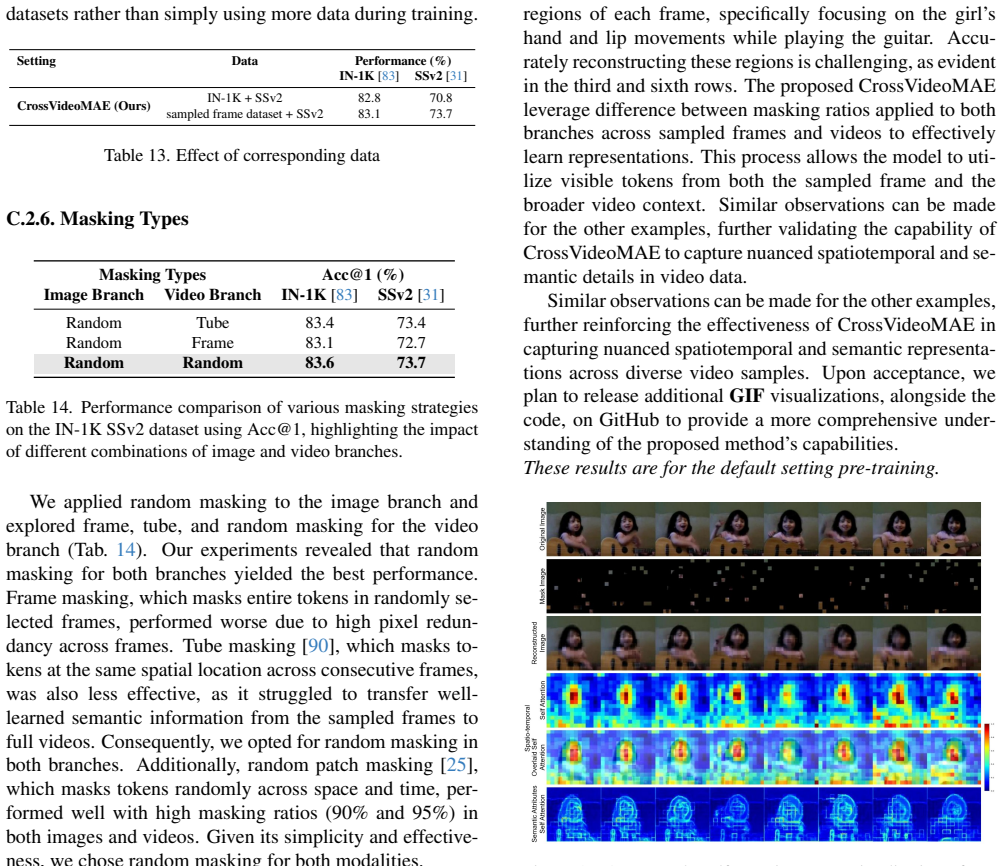
- The paper's ablation in the supplement (Table 13) suggests the gain comes from using corresponding video-frame pairs rather than simply adding ImageNet data; a natural next test is varying the number and choice of sampled frames at larger scale.
- The asymmetry in optimal masking ratios hints that the two branches should be forced to see complementary information; one could test this by tuning the ratio gap on other backbone scales.
Editorial analysis
A structured set of objections, weighed in public.
Referee Report
Summary. The paper proposes CrossVideoMAE, a self-supervised video representation learning method that couples a video MAE branch with an image MAE branch on sampled frames using intra-modal and cross-modal contrastive losses at both video and frame levels, together with reconstruction and MSE losses (Eqs. 1-11). The method is evaluated by full fine-tuning on UCF101, HMDB51, K400, and SSv2, with state-of-the-art accuracy reported in Table 1 (e.g., 97.6% on UCF101, 78.4% on HMDB51, 73.7% on SSv2, 83.2% on K400). The empirical protocol includes a test-time adaptation step (Section 4.4) in which the model performs 20 gradient updates on evaluation-set data before final inference. Ablation studies on SSv2 are used to justify design choices such as masking ratios, number of sampled frames, and loss components.
Significance. If the reported results held under a standard inductive evaluation, the paper would make a useful contribution: the idea of distilling semantic information from randomly sampled frames into a video MAE via contrastive objectives is well motivated, the loss definitions are explicit and reproducible from the text, and supplementary Table 13 provides a sensible control (corresponding sampled frames vs IN-1K) suggesting that data pairing matters. However, the empirical claims as stated are not yet supported because of the transductive TTA protocol; the significance depends on whether the authors can demonstrate the gains without TTA or with TTA applied equally to baselines.
major comments (4)
- [Section 4.4, Table 1] The main comparison is confounded by test-time adaptation on the evaluation set. All CrossVideoMAE numbers in Table 1 are produced after 20 gradient updates on evaluation-set data, whereas the cited baselines are evaluated with fixed weights. The paper provides no non-TTA results, so the reported improvements (e.g., 73.7 vs 72.5 on SSv2, 97.6 vs 97.0 on UCF101) cannot be attributed to the proposed pre-training. Please report the same results without TTA, and either drop TTA from the method or apply the same TTA procedure to all baselines.
- [Section 4.4] It is ambiguous what weights are being adapted. The text says 'initial inference is conducted using pre-trained weights available from open-source repositories (MAE for the image branch and SpatioTemporalMAE for the video branch)' and later describes TTA as 'dynamically fine-tuning pre-trained weights (from MAE and SpatioTemporalMAE)'. If TTA operates on the open-source checkpoints directly rather than on the CrossVideoMAE-pretrained model, Table 1 would not reflect the proposed pre-training at all. Please specify whether TTA starts from the CrossVideoMAE-pretrained fine-tuned encoder, and describe the exact losses and data used during the 20 updates.
- [Tables 3-6 and supplementary Tables 9-14] The ablations also include TTA, so they do not isolate the effect of the proposed components. For example, Table 6's claim that removing cross-modal contrastive training costs 0.7 points is only valid under the TTA protocol; without a non-TTA ablation, the marginal contributions of the contrastive losses, masking ratios, and augmentations are not measured. A non-TTA version of at least Tables 3 and 6 is needed to support the attribution.
- [Section 4.4] The description of TTA data is incomplete. The paper says 'due to GPU constraints, we created smaller subsets of K400 and SSv2 from the subset randomly sampled frames to create corresponding pre-sampled frame datasets-our test-time data'. It is unclear how these subsets relate to the test split used for accuracy reporting, whether the same videos appear in both the TTA data and the evaluation set, and how many videos are used. This compounds the transductive-evaluation concern.
minor comments (5)
- [Equations (1)-(2)] The denominators in Eq. (1) and Eq. (2) are rendered unreadably with 'NP' and an undefined summation; please typeset the NT-Xent denominator properly as sums over k=1..N with k != i.
- [Table 2] The heading '1N-1K' should be 'IN-1K'.
- [Sections 4.3 and 4.4] The claim that TTA 'saves GPU memory and reduces pre-training time' is confusing, since TTA is applied during inference; please clarify how it affects pre-training compute.
- [Abstract] The abstract contains grammatical errors ('CrossVideoMAE an end-to-end' should be 'CrossVideoMAE is an end-to-end'; 'Our approach aim' should be 'Our approach aims').
- [Table 2] Reporting IN-1K accuracy for a video pre-training method is not explained; please clarify how the IN-1K fine-tuning is performed (e.g., treating images as single-frame videos).
Circularity Check
No circular derivation; reported SOTA comparison is confounded by test-time adaptation but not circular.
full rationale
We walked the claimed derivation chain: CrossVideoMAE combines intra- and cross-modal NT-Xent losses (Eqs. 1-7) with reconstruction (Eq. 10) and MSE (Eqs. 8-9) losses; the overall objective (Eq. 11) is optimized during pre-training on unlabeled video/frame pairs. The downstream 'prediction' is an action-class posterior after supervised fine-tuning, not a re-derivation of the pre-training loss. No parameter is fitted to a subset and then used to predict that same subset; masking ratios, sampled-frame count, decoder depth, and augmentation choices are selected by SSv2 ablations and applied to other datasets, which is standard hyperparameter selection, not circular. The two self-citations ([17] survey, [33] contact-identification study) are contextual and do not carry the load of the SOTA claim. The only serious concern is the test-time adaptation in Sec. 4.4: 20 gradient updates on the evaluation set before final inference are not given to the baselines, so the Table 1 comparison may overstate the benefit of the proposed pre-training. That is a validity/fairness issue, not an equivalence-by-construction; it does not make the derivation circular. Hence no circular step is identified, and the paper is assigned a low score reflecting the minor self-citations and the protocol caveat.
Assumptions & free parameters
free parameters (6)
- Video branch masking ratio =
95% (default)
- Image branch masking ratio =
90% (default)
- Number of sampled frames n =
1
- TTA gradient update steps =
20
- Loss weight lambda_c =
not specified
- Temperature tau =
not specified
assumptions (4)
- standard math NT-Xent contrastive loss with cosine similarity and temperature tau provides a valid learning signal.
- domain assumption Random masking with very high ratios (90-95%) is beneficial.
- domain assumption A single randomly sampled frame per video is sufficient to distill semantic knowledge to the video encoder.
- ad hoc to paper Test-time adaptation on unlabeled evaluation-set data is a valid inference-time refinement and does not break comparability with baselines that do not use it.
Cite this review
Pith. "Pith review of CrossVideoMAE: Self-Supervised Image-Video Representation Learning with Masked Autoencoders." pith.science (2026). https://pith.science/paper/TUX6QHUU
@misc{pith2026250207811,
  author       = {Pith},
  title        = {Pith review of: CrossVideoMAE: Self-Supervised Image-Video Representation Learning with Masked Autoencoders},
  year         = {2026},
  howpublished = {\url{https://pith.science/paper/TUX6QHUU}},
  note         = {Machine review of arXiv:2502.07811}
}
read the original abstract
Current video-based Masked Autoencoders (MAEs) primarily focus on learning effective spatiotemporal representations from a visual perspective, which may lead the model to prioritize general spatial-temporal patterns but often overlook nuanced semantic attributes like specific interactions or sequences that define actions - such as action-specific features that align more closely with human cognition for space-time correspondence. This can limit the model's ability to capture the essence of certain actions that are contextually rich and continuous. Humans are capable of mapping visual concepts, object view invariance, and semantic attributes available in static instances to comprehend natural dynamic scenes or videos. Existing MAEs for videos and static images rely on separate datasets for videos and images, which may lack the rich semantic attributes necessary for fully understanding the learned concepts, especially when compared to using video and corresponding sampled frame images together. To this end, we propose CrossVideoMAE an end-to-end self-supervised cross-modal contrastive learning MAE that effectively learns both video-level and frame-level rich spatiotemporal representations and semantic attributes. Our method integrates mutual spatiotemporal information from videos with spatial information from sampled frames within a feature-invariant space, while encouraging invariance to augmentations within the video domain. This objective is achieved through jointly embedding features of visible tokens and combining feature correspondence within and across modalities, which is critical for acquiring rich, label-free guiding signals from both video and frame image modalities in a self-supervised manner. Extensive experiments demonstrate that our approach surpasses previous state-of-the-art methods and ablation studies validate the effectiveness of our approach.
Figures


Figures from the paper (8 more)


Forward citations
Cited by 1 Pith paper
-
Infinite Video Understanding
The paper argues that video understanding research should aim at processing streams of arbitrary, unbounded duration and outlines the challenges, directions, and metrics needed.
Reference graph
Works this paper leans on
-
[1]
Self-supervised multimodal versatile networks
Jean-Baptiste Alayrac, Adria Recasens, Rosalia Schneider, Relja Arandjelovi ´c, Jason Ramapuram, Jeffrey De Fauw, Lucas Smaira, Sander Dieleman, and Andrew Zisserman. Self-supervised multimodal versatile networks. Advances in neural information processing systems, 33:25–37, 2020. 7
2020
-
[2]
Self-supervised learning by cross-modal audio-video clustering
Humam Alwassel, Dhruv Mahajan, Bruno Korbar, Lorenzo Torresani, Bernard Ghanem, and Du Tran. Self-supervised learning by cross-modal audio-video clustering. Advances in Neural Information Processing Systems, 33:9758–9770,
-
[3]
Look, listen and learn
Relja Arandjelovic and Andrew Zisserman. Look, listen and learn. In Proceedings of the IEEE international confer- ence on computer vision, pages 609–617, 2017. 3
2017
-
[4]
Objects that sound
Relja Arandjelovic and Andrew Zisserman. Objects that sound. In Proceedings of the European Conference on Computer Vision, pages 435–451, 2018. 3
2018
-
[5]
Vivit: A video vision transformer
Anurag Arnab, Mostafa Dehghani, Georg Heigold, Chen Sun, Mario Lu ˇci´c, and Cordelia Schmid. Vivit: A video vision transformer. In Proceedings of the IEEE/CVF inter- national conference on computer vision, pages 6836–6846,
-
[6]
Adamae: Adaptive masking for efficient spatiotempo- ral learning with masked autoencoders
Wele Gedara Chaminda Bandara, Naman Patel, Ali Gho- lami, Mehdi Nikkhah, Motilal Agrawal, and Vishal M Pa- tel. Adamae: Adaptive masking for efficient spatiotempo- ral learning with masked autoencoders. In Proceedings of the IEEE/CVF Conference on Computer Vision and Pattern Recognition, pages 14507–14517, 2023. 3, 7
2023
-
[7]
BEit: BERT pre-training of image transformers
Hangbo Bao, Li Dong, Songhao Piao, and Furu Wei. BEit: BERT pre-training of image transformers. In International Conference on Learning Representations, 2022. 2, 3, 7
2022
-
[8]
Speednet: Learning the speediness in videos
Sagie Benaim, Ariel Ephrat, Oran Lang, Inbar Mosseri, William T Freeman, Michael Rubinstein, Michal Irani, and Tali Dekel. Speednet: Learning the speediness in videos. In Proceedings of the IEEE/CVF Conference on Computer Vision and Pattern Recognition, pages 9922–9931, 2020. 3, 7
2020
Show all 111 references
-
[9]
Is space-time attention all you need for video understanding? In Proceedings of the 38th International Conference on Ma- chine Learning (ICML), pages 813–824
Gedas Bertasius, Heng Wang, and Lorenzo Torresani. Is space-time attention all you need for video understanding? In Proceedings of the 38th International Conference on Ma- chine Learning (ICML), pages 813–824. PMLR, 2021. 4, 5
2021
-
[10]
Emerging properties in self-supervised vision transformers
Mathilde Caron, Hugo Touvron, Ishan Misra, Herv ´e J´egou, Julien Mairal, Piotr Bojanowski, and Armand Joulin. Emerging properties in self-supervised vision transformers. In Proceedings of the IEEE/CVF international conference on computer vision, pages 9650–9660, 2021. 1
2021
-
[11]
Learning aligned cross-modal representations from weakly aligned data
Lluis Castrejon, Yusuf Aytar, Carl V ondrick, Hamed Pirsi- avash, and Antonio Torralba. Learning aligned cross-modal representations from weakly aligned data. In Proceedings of the IEEE/CVF Conference on Computer Vision and Pat- tern Recognition, pages 2940–2949, 2016. 3
2016
-
[12]
Generative pre- training from pixels
Mark Chen, Alec Radford, Rewon Child, Jeffrey Wu, Hee- woo Jun, David Luan, and Ilya Sutskever. Generative pre- training from pixels. In International conference on ma- chine learning, pages 1691–1703. PMLR, 2020. 2
2020
-
[13]
Rspnet: Relative speed perception for unsupervised video representation learning
Peihao Chen, Deng Huang, Dongliang He, Xiang Long, Runhao Zeng, Shilei Wen, Mingkui Tan, and Chuang Gan. Rspnet: Relative speed perception for unsupervised video representation learning. In Proceedings of the AAAI Con- ference on Artificial Intelligence , pages 1045–1053, 2021. 7
2021
-
[14]
A simple framework for contrastive learning of visual representations
Ting Chen, Simon Kornblith, Mohammad Norouzi, and Ge- offrey Hinton. A simple framework for contrastive learning of visual representations. In International conference on machine learning, pages 1597–1607. PMLR, 2020. 3, 4
2020
-
[15]
Electra: Pre-training text encoders as dis- criminators rather than generators
Kevin Clark, Minh-Thang Luong, Quoc V Le, and Christo- pher D Manning. Electra: Pre-training text encoders as dis- criminators rather than generators. In International Confer- ence on Learning Representations, 2020. 3
2020
-
[16]
Randaugment: Practical automated data augmen- tation with a reduced search space
Ekin D Cubuk, Barret Zoph, Jonathon Shlens, and Quoc V Le. Randaugment: Practical automated data augmen- tation with a reduced search space. In Proceedings of the IEEE/CVF conference on computer vision and pattern recognition workshops, pages 702–703, 2020. 8, 3
2020
-
[17]
Unifying video self-supervised learning across families of tasks: A survey
Ishan Dave, Malitha Gunawardhana, Limalka Sadith, Honglu Zhou, Liel David, Daniel Harari, Mubarak Shah, and Muhammad Khan. Unifying video self-supervised learning across families of tasks: A survey. 2024. 2
2024
-
[18]
Imagenet: A large-scale hierarchical im- age database
Jia Deng, Wei Dong, Richard Socher, Li-Jia Li, Kai Li, and Li Fei-Fei. Imagenet: A large-scale hierarchical im- age database. In 2009 IEEE conference on computer vision and pattern recognition, pages 248–255. Ieee, 2009. 8
2009
-
[19]
Virtex: Learning visual representations from textual annotations
Karan Desai and Justin Johnson. Virtex: Learning visual representations from textual annotations. In Proceedings of the IEEE/CVF conference on computer vision and pattern recognition, pages 11162–11173, 2021. 2, 3
2021
-
[20]
9 Vi2clr: Video and image for visual contrastive learning of representation
Ali Diba, Vivek Sharma, Reza Safdari, Dariush Lotfi, Saquib Sarfraz, Rainer Stiefelhagen, and Luc Van Gool. 9 Vi2clr: Video and image for visual contrastive learning of representation. In Proceedings of the IEEE/CVF interna- tional conference on computer vision , pages 1502–1512,
-
[21]
Taming transformers for high-resolution image synthesis
Patrick Esser, Robin Rombach, and Bjorn Ommer. Taming transformers for high-resolution image synthesis. In Pro- ceedings of the IEEE/CVF conference on computer vision and pattern recognition, pages 12873–12883, 2021. 2
2021
-
[22]
Multiscale vision transformers
Haoqi Fan, Bo Xiong, Karttikeya Mangalam, Yanghao Li, Zhicheng Yan, Jitendra Malik, and Christoph Feichten- hofer. Multiscale vision transformers. In Proceedings of the IEEE/CVF international conference on computer vi- sion, pages 6824–6835, 2021. 4, 5
2021
-
[23]
Slowfast networks for video recognition
Christoph Feichtenhofer, Haoqi Fan, Jitendra Malik, and Kaiming He. Slowfast networks for video recognition. In Proceedings of the IEEE/CVF international conference on computer vision, pages 6202–6211, 2019. 4, 5
2019
-
[24]
A large-scale study on unsuper- vised spatiotemporal representation learning
Christoph Feichtenhofer, Haoqi Fan, Bo Xiong, Ross Gir- shick, and Kaiming He. A large-scale study on unsuper- vised spatiotemporal representation learning. In Proceed- ings of the IEEE/CVF Conference on Computer Vision and Pattern Recognition, pages 3299–3309, 2021. 3, 4, 5
2021
-
[25]
Masked autoencoders as spatiotemporal learners
Christoph Feichtenhofer, Yanghao Li, Kaiming He, et al. Masked autoencoders as spatiotemporal learners. Ad- vances in neural information processing systems , 35: 35946–35958, 2022. 3, 6, 7, 8, 1, 2
2022
-
[26]
Mcmae: Masked convolution meets masked autoencoders
Peng Gao, Teli Ma, Hongsheng Li, Ziyi Lin, Jifeng Dai, and Yu Qiao. Mcmae: Masked convolution meets masked autoencoders. Advances in Neural Information Processing Systems, 35:35632–35644, 2022. 7
2022
-
[27]
Revitalizing cnn attention via transformers in self-supervised visual representation learn- ing
Chongjian Ge, Youwei Liang, Yibing Song, Jianbo Jiao, Jue Wang, and Ping Luo. Revitalizing cnn attention via transformers in self-supervised visual representation learn- ing. Advances in Neural Information Processing Systems , 34:4193–4206, 2021. 3
2021
-
[28]
Omnimae: Single model masked pretraining on images and videos
Rohit Girdhar, Alaaeldin El-Nouby, Mannat Singh, Kalyan Vasudev Alwala, Armand Joulin, and Ishan Misra. Omnimae: Single model masked pretraining on images and videos. In Proceedings of the IEEE/CVF conference on computer vision and pattern recognition, pages 10406– 10417, 2023...
2023
-
[29]
Improving image-sentence embeddings using large weakly annotated photo collec- tions
Yunchao Gong, Liwei Wang, Micah Hodosh, Julia Hocken- maier, and Svetlana Lazebnik. Improving image-sentence embeddings using large weakly annotated photo collec- tions. In Computer Vision–ECCV 2014: 13th European Conference, Zurich, Switzerland, September 6-12, 2014, Proceedi...
2014
-
[30]
Accurate, large mini- batch sgd: Training imagenet in 1 hour
Priya Goyal, Piotr Doll ´ar, Ross Girshick, Pieter Noord- huis, Lukasz Wesolowski, Aapo Kyrola, Andrew Tulloch, Yangqing Jia, and Kaiming He. Accurate, large mini- batch sgd: Training imagenet in 1 hour. arXiv preprint arXiv:1706.02677, 2017. 2, 4
2017 arXiv
-
[31]
The” something something” video database for learning and evaluating visual common sense
Raghav Goyal, Samira Ebrahimi Kahou, Vincent Michal- ski, Joanna Materzynska, Susanne Westphal, Heuna Kim, Valentin Haenel, Ingo Fruend, Peter Yianilos, Moritz Mueller-Freitag, et al. The” something something” video database for learning and evaluating visual common sense. In ...
2017
-
[32]
Bootstrap your own latent-a new approach to self-supervised learning
Jean-Bastien Grill, Florian Strub, Florent Altch ´e, Corentin Tallec, Pierre Richemond, Elena Buchatskaya, Carl Do- ersch, Bernardo Avila Pires, Zhaohan Guo, Mohammad Gheshlaghi Azar, et al. Bootstrap your own latent-a new approach to self-supervised learning. Advances in neur...
2020
-
[33]
How effec- tive are self-supervised models for contact identification in videos
Malitha Gunawardhana, Limalka Sadith, Liel David, Daniel Harari, and Muhammad Haris Khan. How effec- tive are self-supervised models for contact identification in videos. arXiv preprint arXiv:2408.00498, 2024. 2
2024 arXiv
-
[34]
Maskvit: Masked visual pre-training for video prediction
Agrim Gupta, Stephen Tian, Yunzhi Zhang, Jiajun Wu, Roberto Mart´ın-Mart´ın, and Li Fei-Fei. Maskvit: Masked visual pre-training for video prediction. arXiv preprint arXiv:2206.11894, 2022. 3
2022 arXiv
-
[35]
Memory- augmented dense predictive coding for video representa- tion learning
Tengda Han, Weidi Xie, and Andrew Zisserman. Memory- augmented dense predictive coding for video representa- tion learning. In European Conference on Computer Vision, pages 312–329. Springer, 2020. 3, 7
2020
-
[36]
Self- supervised co-training for video representation learning
Tengda Han, Weidi Xie, and Andrew Zisserman. Self- supervised co-training for video representation learning. Advances in Neural Information Processing Systems , 33: 5679–5690, 2020. 4, 5
2020
-
[37]
Momentum contrast for unsupervised visual rep- resentation learning
Kaiming He, Haoqi Fan, Yuxin Wu, Saining Xie, and Ross Girshick. Momentum contrast for unsupervised visual rep- resentation learning. In Proceedings of the IEEE/CVF con- ference on computer vision and pattern recognition , pages 9729–9738, 2020. 2, 3, 4
2020
-
[38]
Masked autoencoders are scal- able vision learners
Kaiming He, Xinlei Chen, Saining Xie, Yanghao Li, Piotr Doll´ar, and Ross Girshick. Masked autoencoders are scal- able vision learners. In Proceedings of the IEEE/CVF con- ference on computer vision and pattern recognition , pages 16000–16009, 2022. 2, 3, 4, 6, 7, 8, 1
2022
-
[39]
Human gaze control during real-world scene perception
John M Henderson. Human gaze control during real-world scene perception. Trends in cognitive sciences, 7(11):498– 504, 2003. 2
2003
-
[40]
Visual representation learning from unlabeled video using contrastive masked autoencoders
Jefferson Hernandez, Ruben Villegas, and Vicente Or- donez. Visual representation learning from unlabeled video using contrastive masked autoencoders. arXiv preprint arXiv:2303.12001, 2023. 7
2023 arXiv
-
[41]
Augment your batch: Improv- ing generalization through instance repetition
Elad Hoffer, Tal Ben-Nun, Itay Hubara, Niv Giladi, Torsten Hoefler, and Daniel Soudry. Augment your batch: Improv- ing generalization through instance repetition. In Proceed- ings of the IEEE/CVF Conference on Computer Vision and Pattern Recognition, pages 8129–8138, 2020. 3
2020
-
[42]
Contrast and order representa- tions for video self-supervised learning
Kai Hu, Jie Shao, Yuan Liu, Bhiksha Raj, Marios Sav- vides, and Zhiqiang Shen. Contrast and order representa- tions for video self-supervised learning. In Proceedings of the IEEE/CVF International Conference on Computer Vi- sion, pages 7939–7949, 2021. 4
2021
-
[43]
Mgmae: Motion guided masking for video masked autoencoding
Bingkun Huang, Zhiyu Zhao, Guozhen Zhang, Yu Qiao, and Limin Wang. Mgmae: Motion guided masking for video masked autoencoding. In Proceedings of the IEEE/CVF International Conference on Computer Vision , pages 13493–13504, 2023. 3, 7 10
2023
-
[44]
Self-supervised video representation learn- ing by context and motion decoupling
Lianghua Huang, Yu Liu, Bin Wang, Pan Pan, Yinghui Xu, and Rong Jin. Self-supervised video representation learn- ing by context and motion decoupling. In Proceedings of the IEEE/CVF Conference on Computer Vision and Pattern Recognition, pages 13886–13895, 2021. 2
2021
-
[45]
Tada! temporally-adaptive convolutions for video understanding
Ziyuan Huang, Shiwei Zhang, Liang Pan, Zhiwu Qing, Mingqian Tang, Ziwei Liu, and Marcelo H Ang Jr. Tada! temporally-adaptive convolutions for video understanding. arXiv preprint arXiv:2110.06178, 2021. 4, 5
2021 arXiv
-
[46]
Self-supervised spatiotemporal feature learn- ing via video rotation prediction
Longlong Jing, Xiaodong Yang, Jingen Liu, and Yingli Tian. Self-supervised spatiotemporal feature learn- ing via video rotation prediction. arXiv preprint arXiv:1811.11387, 2018. 2
2018 arXiv
-
[47]
Hard negative mixing for contrastive learning
Yannis Kalantidis, Mert Bulent Sariyildiz, Noe Pion, Philippe Weinzaepfel, and Diane Larlus. Hard negative mixing for contrastive learning. Advances in neural infor- mation processing systems, 33:21798–21809, 2020. 2
2020
-
[48]
Deep visual-semantic alignments for generating image descriptions
Andrej Karpathy and Li Fei-Fei. Deep visual-semantic alignments for generating image descriptions. In Proceed- ings of the IEEE/CVF Conference on Computer Vision and Pattern Recognition, pages 3128–3137, 2015. 3
2015
-
[49]
The kinetics human action video dataset
Will Kay, Joao Carreira, Karen Simonyan, Brian Zhang, Chloe Hillier, Sudheendra Vijayanarasimhan, Fabio Vi- ola, Tim Green, Trevor Back, Paul Natsev, et al. The kinetics human action video dataset. arXiv preprint arXiv:1705.06950, 2017. 6, 7, 2, 3
2017 arXiv
-
[50]
Fusion attention for action recognition: Integrating sparse-dense and global at- tention for video action recognition
Hyun-Woo Kim and Yong-Suk Choi. Fusion attention for action recognition: Integrating sparse-dense and global at- tention for video action recognition. Sensors, 24(21):6842,
-
[51]
Co- operative learning of audio and video models from self- supervised synchronization
Bruno Korbar, Du Tran, and Lorenzo Torresani. Co- operative learning of audio and video models from self- supervised synchronization. Advances in Neural Informa- tion Processing Systems, 31, 2018. 2, 3
2018
-
[52]
Hmdb: a large video database for human motion recognition
Hildegard Kuehne, Hueihan Jhuang, Est ´ıbaliz Garrote, Tomaso Poggio, and Thomas Serre. Hmdb: a large video database for human motion recognition. In 2011 Interna- tional conference on computer vision , pages 2556–2563. IEEE, 2011. 6, 7, 3
2011
-
[53]
A large-scale analysis on self- supervised video representation learning
Akash Kumar, Ashlesha Kumar, Vibhav Vineet, and Yo- gesh Singh Rawat. A large-scale analysis on self- supervised video representation learning. arXiv e-prints , pages arXiv–2306, 2023. 2
2023
-
[54]
Semmae: Semantic-guided masking for learning masked autoencoders
Gang Li, Heliang Zheng, Daqing Liu, Chaoyue Wang, Bing Su, and Changwen Zheng. Semmae: Semantic-guided masking for learning masked autoencoders. Advances in Neural Information Processing Systems, 35:14290–14302,
-
[55]
Improve unsuper- vised pretraining for few-label transfer
Suichan Li, Dongdong Chen, Yinpeng Chen, Lu Yuan, Lei Zhang, Qi Chu, Bin Liu, and Nenghai Yu. Improve unsuper- vised pretraining for few-label transfer. In Proceedings of the IEEE/CVF International Conference on Computer Vi- sion, pages 10201–10210, 2021. 3
2021
-
[56]
Learning spatiotemporal fea- tures via video and text pair discrimination
Tianhao Li and Limin Wang. Learning spatiotemporal fea- tures via video and text pair discrimination. arXiv preprint arXiv:2001.05691, 2020. 7
2001 arXiv
-
[57]
Tsm: Temporal shift module for efficient video understanding
Ji Lin, Chuang Gan, and Song Han. Tsm: Temporal shift module for efficient video understanding. In Proceedings of the IEEE/CVF international conference on computer vi- sion, pages 7083–7093, 2019. 4
2019
-
[58]
Self-supervised video-based action recognition with distur- bances
Wei Lin, Xinghao Ding, Yue Huang, and Huanqiang Zeng. Self-supervised video-based action recognition with distur- bances. IEEE Transactions on Image Processing, 32:2493– 2507, 2023. 2
2023
-
[59]
Crossvideo: Self-supervised cross-modal contrastive learn- ing for point cloud video understanding
Yunze Liu, Changxi Chen, Zifan Wang, and Li Yi. Crossvideo: Self-supervised cross-modal contrastive learn- ing for point cloud video understanding. arXiv preprint arXiv:2401.09057, 2024. 2, 3
2024 arXiv
-
[60]
Teinet: Towards an efficient architecture for video recognition
Zhaoyang Liu, Donghao Luo, Yabiao Wang, Limin Wang, Ying Tai, Chengjie Wang, Jilin Li, Feiyue Huang, and Tong Lu. Teinet: Towards an efficient architecture for video recognition. In Proceedings of the AAAI conference on ar- tificial intelligence, pages 11669–11676, 2020. 4, 5
2020
-
[61]
Tam: Temporal adaptive module for video recog- nition
Zhaoyang Liu, Limin Wang, Wayne Wu, Chen Qian, and Tong Lu. Tam: Temporal adaptive module for video recog- nition. In Proceedings of the IEEE/CVF international con- ference on computer vision, pages 13708–13718, 2021. 4, 5
2021
-
[62]
Video swin transformer
Ze Liu, Jia Ning, Yue Cao, Yixuan Wei, Zheng Zhang, Stephen Lin, and Han Hu. Video swin transformer. In Pro- ceedings of the IEEE/CVF conference on computer vision and pattern recognition, pages 3202–3211, 2022. 1
2022
-
[63]
Sgdr: Stochastic gradient descent with warm restarts
Ilya Loshchilov and Frank Hutter. Sgdr: Stochastic gradient descent with warm restarts. arXiv preprint arXiv:1608.03983, 2016. 2
2016 arXiv
-
[64]
Decoupled weight de- cay regularization
Ilya Loshchilov and Frank Hutter. Decoupled weight de- cay regularization. In International Conference on Learn- ing Representations, 2019. 6, 2
2019
-
[65]
Cmae-v: Contrastive masked autoencoders for video action recognition
Cheng-Ze Lu, Xiaojie Jin, Zhicheng Huang, Qibin Hou, Ming-Ming Cheng, and Jiashi Feng. Cmae-v: Contrastive masked autoencoders for video action recognition. arXiv preprint arXiv:2301.06018, 2023. 7
2023 arXiv
-
[66]
12-in-1: Multi-task vision and language representation learning
Jiasen Lu, Vedanuj Goswami, Marcus Rohrbach, Devi Parikh, and Stefan Lee. 12-in-1: Multi-task vision and language representation learning. In Proceedings of the IEEE/CVF conference on computer vision and pattern recognition, pages 10437–10446, 2020. 3
2020
-
[67]
End-to-end learning of visual representations from uncurated instruc- tional videos
Antoine Miech, Jean-Baptiste Alayrac, Lucas Smaira, Ivan Laptev, Josef Sivic, and Andrew Zisserman. End-to-end learning of visual representations from uncurated instruc- tional videos. In Proceedings of the IEEE/CVF Conference on Computer Vision and Pattern Recognition, pages ...
2020
-
[68]
Self-supervised learning of pretext-invariant representations
Ishan Misra and Laurens van der Maaten. Self-supervised learning of pretext-invariant representations. In Proceed- ings of the IEEE/CVF conference on computer vision and pattern recognition, pages 6707–6717, 2020. 2
2020
-
[69]
Shuffle and learn: unsupervised learning using temporal order verification
Ishan Misra, C Lawrence Zitnick, and Martial Hebert. Shuffle and learn: unsupervised learning using temporal order verification. In Computer Vision–ECCV 2016: 14th European Conference, Amsterdam, The Netherlands, Octo- ber 11–14, 2016, Proceedings, Part I 14 , pages 527–544. S...
2016
-
[70]
Ro- bust audio-visual instance discrimination
Pedro Morgado, Ishan Misra, and Nuno Vasconcelos. Ro- bust audio-visual instance discrimination. In Proceedings 11 of the IEEE/CVF Conference on Computer Vision and Pat- tern Recognition, pages 12934–12945, 2021. 2, 3
2021
-
[71]
Audio-visual instance discrimination with cross-modal agreement
Pedro Morgado, Nuno Vasconcelos, and Ishan Misra. Audio-visual instance discrimination with cross-modal agreement. In Proceedings of the IEEE/CVF conference on computer vision and pattern recognition, pages 12475– 12486, 2021. 1
2021
-
[72]
Audio-visual scene analysis with self-supervised multisensory features
Andrew Owens and Alexei A Efros. Audio-visual scene analysis with self-supervised multisensory features. InPro- ceedings of the European conference on computer vision (ECCV), pages 631–648, 2018. 3
2018
-
[73]
Videomoco: Contrastive video representation learning with temporally adversarial examples
Tian Pan, Yibing Song, Tianyu Yang, Wenhao Jiang, and Wei Liu. Videomoco: Contrastive video representation learning with temporally adversarial examples. InProceed- ings of the IEEE/CVF conference on computer vision and pattern recognition, pages 11205–11214, 2021. 2, 3, 7, 4
2021
-
[74]
Multi-modal self-supervision from generalized data transformations
Mandela Patrick, Yuki Asano, Polina Kuznetsova, Ruth Fong, Joao F Henriques, Geoffrey Zweig, and Andrea Vedaldi. Multi-modal self-supervision from generalized data transformations. In IEEE/CVF International Confer- ence on Computer Vision, 2021. 7, 4
2021
-
[75]
Keeping your eye on the ball: Trajectory attention in video transformers
Mandela Patrick, Dylan Campbell, Yuki Asano, Ishan Misra, Florian Metze, Christoph Feichtenhofer, Andrea Vedaldi, and Joao F Henriques. Keeping your eye on the ball: Trajectory attention in video transformers. Ad- vances in neural information processing systems , 34: 12493–125...
2021
-
[76]
Evolving losses for unsupervised video representation learning
AJ Piergiovanni, Anelia Angelova, and Michael S Ryoo. Evolving losses for unsupervised video representation learning. In Proceedings of the IEEE/CVF conference on computer vision and pattern recognition , pages 133–142,
-
[77]
Spa- tiotemporal contrastive video representation learning
Rui Qian, Tianjian Meng, Boqing Gong, Ming-Hsuan Yang, Huisheng Wang, Serge Belongie, and Yin Cui. Spa- tiotemporal contrastive video representation learning. In Proceedings of the IEEE/CVF conference on computer vi- sion and pattern recognition, pages 6964–6974, 2021. 2, 3, 7, 4
2021
-
[78]
Learning from untrimmed videos: Self-supervised video representation learning with hierarchical consistency
Zhiwu Qing, Shiwei Zhang, Ziyuan Huang, Yi Xu, Xiang Wang, Mingqian Tang, Changxin Gao, Rong Jin, and Nong Sang. Learning from untrimmed videos: Self-supervised video representation learning with hierarchical consistency. In Proceedings of the IEEE/CVF Conference on Computer V...
2022
-
[79]
Mar: Masked autoencoders for efficient action recognition
Zhiwu Qing, Shiwei Zhang, Ziyuan Huang, Xiang Wang, Yuehuan Wang, Yiliang Lv, Changxin Gao, and Nong Sang. Mar: Masked autoencoders for efficient action recognition. IEEE Transactions on Multimedia, 2023. 3, 7
2023
-
[80]
Learn- ing transferable visual models from natural language super- vision
Alec Radford, Jong Wook Kim, Chris Hallacy, Aditya Ramesh, Gabriel Goh, Sandhini Agarwal, Girish Sastry, Amanda Askell, Pamela Mishkin, Jack Clark, et al. Learn- ing transferable visual models from natural language super- vision. In International conference on machine learning...
2021
-
[81]
Self-supervised video transformer
Kanchana Ranasinghe, Muzammal Naseer, Salman Khan, Fahad Shahbaz Khan, and Michael S Ryoo. Self-supervised video transformer. In Proceedings of the IEEE/CVF Con- ference on Computer Vision and Pattern Recognition, pages 2874–2884, 2022. 7, 4, 5
2022
-
[82]
The development of visual attention and the brain
John E Richards. The development of visual attention and the brain. The cognitive neuroscience of development, pages 73–98, 2003. 2
2003
-
[83]
Im- agenet large scale visual recognition challenge
Olga Russakovsky, Jia Deng, Hao Su, Jonathan Krause, Sanjeev Satheesh, Sean Ma, Zhiheng Huang, Andrej Karpathy, Aditya Khosla, Michael Bernstein, et al. Im- agenet large scale visual recognition challenge. Interna- tional journal of computer vision, 115:211–252, 2015. 8, 2, 3, 6, 7
2015
-
[84]
Learning visual representations with caption annotations
Mert Bulent Sariyildiz, Julien Perez, and Diane Larlus. Learning visual representations with caption annotations. In Computer Vision–ECCV 2020: 16th European Confer- ence, Glasgow, UK, August 23–28, 2020, Proceedings, Part VIII 16, pages 153–170. Springer, 2020. 2, 3
2020
-
[85]
Two-stream con- volutional networks for action recognition in videos
Karen Simonyan and Andrew Zisserman. Two-stream con- volutional networks for action recognition in videos. Ad- vances in neural information processing systems, 27, 2014. 3
2014
-
[86]
Ucf101: A dataset of 101 human actions classes from videos in the wild
K Soomro. Ucf101: A dataset of 101 human actions classes from videos in the wild. arXiv preprint arXiv:1212.0402,
-
[87]
Masked motion encoding for self-supervised video representation learning
Xinyu Sun, Peihao Chen, Liangwei Chen, Changhao Li, Thomas H Li, Mingkui Tan, and Chuang Gan. Masked motion encoding for self-supervised video representation learning. In Proceedings of the IEEE/CVF Conference on Computer Vision and Pattern Recognition, pages 2235– 2245, 2023. 3, 7, 4
2023
-
[88]
Rethinking the inception architecture for computer vision
Christian Szegedy, Vincent Vanhoucke, Sergey Ioffe, Jon Shlens, and Zbigniew Wojna. Rethinking the inception architecture for computer vision. In Proceedings of the IEEE conference on computer vision and pattern recogni- tion, pages 2818–2826, 2016. 3
2016
-
[89]
Vimpac: Video pre-training via masked token prediction and con- trastive learning
Hao Tan, Jie Lei, Thomas Wolf, and Mohit Bansal. Vimpac: Video pre-training via masked token prediction and con- trastive learning. arXiv preprint arXiv:2106.11250, 2021. 7, 4
2021 arXiv
-
[90]
Videomae: Masked autoencoders are data-efficient learners for self-supervised video pre-training
Zhan Tong, Yibing Song, Jue Wang, and Limin Wang. Videomae: Masked autoencoders are data-efficient learners for self-supervised video pre-training. Advances in neural information processing systems, 35:10078–10093, 2022. 3, 6, 7, 8, 4, 5
2022
-
[91]
Learning spatiotemporal fea- tures with 3d convolutional networks
Du Tran, Lubomir Bourdev, Rob Fergus, Lorenzo Torre- sani, and Manohar Paluri. Learning spatiotemporal fea- tures with 3d convolutional networks. InProceedings of the IEEE international conference on computer vision , pages 4489–4497, 2015. 2, 3
2015
-
[92]
Video classification with channel-separated convolutional networks
Du Tran, Heng Wang, Lorenzo Torresani, and Matt Feiszli. Video classification with channel-separated convolutional networks. In Proceedings of the IEEE/CVF international conference on computer vision, pages 5552–5561, 2019. 5
2019
-
[93]
Spa- tiotemporal integration and object perception in infancy: Perceiving unity versus form
Gretchen A Van, de Walle and Elizabeth S Spelke. Spa- tiotemporal integration and object perception in infancy: Perceiving unity versus form. Child Development, 67(6): 2621–2640, 1996. 2 12
1996
-
[94]
Generating videos with scene dynamics
Carl V ondrick, Hamed Pirsiavash, and Antonio Torralba. Generating videos with scene dynamics. Advances in neu- ral information processing systems, 29, 2016. 2
2016
-
[95]
Unsupervised visual rep- resentation learning by tracking patches in video
Guangting Wang, Yizhou Zhou, Chong Luo, Wenxuan Xie, Wenjun Zeng, and Zhiwei Xiong. Unsupervised visual rep- resentation learning by tracking patches in video. In Pro- ceedings of the IEEE/CVF Conference on Computer Vision and Pattern Recognition, pages 2563–2572, 2021. 2
2021
-
[96]
Self- supervised video representation learning by pace predic- tion
Jiangliu Wang, Jianbo Jiao, and Yun-Hui Liu. Self- supervised video representation learning by pace predic- tion. In Computer Vision–ECCV 2020: 16th European Conference, Glasgow, UK, August 23–28, 2020, Proceed- ings, Part XVII 16, pages 504–521. Springer, 2020. 7
2020
-
[97]
Self-supervised temporal discriminative learning for video representation learning
Jinpeng Wang, Yiqi Lin, Andy J Ma, and Pong C Yuen. Self-supervised temporal discriminative learning for video representation learning. arXiv preprint arXiv:2008.02129,
2008 arXiv
-
[98]
Temporal segment networks for action recognition in videos
Limin Wang, Yuanjun Xiong, Zhe Wang, Yu Qiao, Dahua Lin, Xiaoou Tang, and Luc Van Gool. Temporal segment networks for action recognition in videos. IEEE transac- tions on pattern analysis and machine intelligence, 41(11): 2740–2755, 2018. 2, 3
2018
-
[99]
Tdn: Temporal difference networks for efficient action recog- nition
Limin Wang, Zhan Tong, Bin Ji, and Gangshan Wu. Tdn: Temporal difference networks for efficient action recog- nition. In Proceedings of the IEEE/CVF conference on computer vision and pattern recognition, pages 1895–1904,
1904
-
[100]
Videomae v2: Scaling video masked autoencoders with dual masking
Limin Wang, Bingkun Huang, Zhiyu Zhao, Zhan Tong, Yi- nan He, Yi Wang, Yali Wang, and Yu Qiao. Videomae v2: Scaling video masked autoencoders with dual masking. In Proceedings of the IEEE/CVF Conference on Computer Vi- sion and Pattern Recognition , pages 14549–14560, 2023. 3
2023
-
[101]
Bevt: Bert pretraining of video transformers
Rui Wang, Dongdong Chen, Zuxuan Wu, Yinpeng Chen, Xiyang Dai, Mengchen Liu, Yu-Gang Jiang, Luowei Zhou, and Lu Yuan. Bevt: Bert pretraining of video transformers. In Proceedings of the IEEE/CVF conference on computer vision and pattern recognition, pages 14733–14743, 2022. 2, 3, 7
2022
-
[102]
Masked video distillation: Rethinking masked feature mod- eling for self-supervised video representation learning
Rui Wang, Dongdong Chen, Zuxuan Wu, Yinpeng Chen, Xiyang Dai, Mengchen Liu, Lu Yuan, and Yu-Gang Jiang. Masked video distillation: Rethinking masked feature mod- eling for self-supervised video representation learning. In Proceedings of the IEEE/CVF conference on computer vi- ...
2023
-
[103]
Unsupervised learn- ing of visual representations using videos
Xiaolong Wang and Abhinav Gupta. Unsupervised learn- ing of visual representations using videos. In Proceedings of the IEEE international conference on computer vision , pages 2794–2802, 2015. 3
2015
-
[104]
Non-local neural networks
Xiaolong Wang, Ross Girshick, Abhinav Gupta, and Kaim- ing He. Non-local neural networks. In Proceedings of the IEEE conference on computer vision and pattern recogni- tion, pages 7794–7803, 2018. 5
2018
-
[105]
Masked feature pre- diction for self-supervised visual pre-training
Chen Wei, Haoqi Fan, Saining Xie, Chao-Yuan Wu, Alan Yuille, and Christoph Feichtenhofer. Masked feature pre- diction for self-supervised visual pre-training. In Proceed- ings of the IEEE/CVF Conference on Computer Vision and Pattern Recognition, pages 14668–14678, 2022. 3
2022
-
[106]
Self-supervised spatiotemporal learn- ing via video clip order prediction
Dejing Xu, Jun Xiao, Zhou Zhao, Jian Shao, Di Xie, and Yueting Zhuang. Self-supervised spatiotemporal learn- ing via video clip order prediction. In Proceedings of the IEEE/CVF conference on computer vision and pattern recognition, pages 10334–10343, 2019. 3, 5
2019
-
[107]
Video playback rate perception for self-supervised spatio-temporal representation learning
Yuan Yao, Chang Liu, Dezhao Luo, Yu Zhou, and Qixi- ang Ye. Video playback rate perception for self-supervised spatio-temporal representation learning. In Proceedings of the IEEE/CVF conference on computer vision and pattern recognition, pages 6548–6557, 2020. 2
2020
-
[108]
Cutmix: Regu- larization strategy to train strong classifiers with localizable features
Sangdoo Yun, Dongyoon Han, Seong Joon Oh, Sanghyuk Chun, Junsuk Choe, and Youngjoon Yoo. Cutmix: Regu- larization strategy to train strong classifiers with localizable features. In Proceedings of the IEEE/CVF international conference on computer vision, pages 6023–6032, 2019. 8, 3
2019
-
[109]
Co-training transformer with videos and images improves action recog- nition
Bowen Zhang, Jiahui Yu, Christopher Fifty, Wei Han, An- drew M Dai, Ruoming Pang, and Fei Sha. Co-training transformer with videos and images improves action recog- nition. arXiv preprint arXiv:2112.07175, 2021. 2, 3
2021 arXiv
-
[110]
mixup: Beyond empirical risk minimiza- tion
Hongyi Zhang. mixup: Beyond empirical risk minimiza- tion. arXiv preprint arXiv:1710.09412, 2017. 8, 3
2017 arXiv
-
[111]
Random erasing data augmentation
Zhun Zhong, Liang Zheng, Guoliang Kang, Shaozi Li, and Yi Yang. Random erasing data augmentation. In Proceed- ings of the AAAI conference on artificial intelligence, pages 13001–13008, 2020. 8 13 CrossVideoMAE: Self-Supervised Image-Video Representation Learning with Masked Au...
2020
Reviewed August 8, 2026 · model on record in the stance chip above.
Discussion (0). Continue with ORCID to comment.