REVIEW 3 major objections 6 minor 4 cited by
Reducing Tool Hallucination via Reliability Alignment
T0 review · 3 major / 6 minor · reviewed 2026-08-11 · deepseek-v4-flash
Pith's one-line read Giving LLMs an explicit option to defer or switch tools cuts tool-call hallucinations by roughly 70 percent and raises reliable task completion.
desk verdict Solid, practical contribution on tool hallucination that deserves engagement; the main caveat is a real evaluator-dependence gap that revision should close. read the letter →
The pith
A machine-rendered reading of the paper's core claim, the machinery that carries it, and where it could break.
The reading
What carries the argument
The load-bearing mechanism is the indecisive action space: two deliberately non-decisive actions, ChangeTools and TalkToUser, that the model may output when tool preconditions are unmet. The paper also introduces RePR, the Reliable Pass Rate, defined as pass rate minus task hallucination rate, which discounts tasks whose final answers are contaminated by hallucinated tool calls. The preference hierarchy used to build DPO pairs—correct call preferred over indecisive action preferred over hallucinated call—is what turns the expanded space into a training signal.
What would settle it
Have human annotators independently label a random sample of RelyToolBench trajectories, including the final-answer correlation step, for the LLaMA-3.1 baseline and LLaMA-3.1 plus Relign; if the human labels do not reproduce the reported 50.8% to 14.6% hallucination drop and 65.3 to 77.2 RePR gain within reasonable error bars, the claim that Relign reduces hallucinations is not established.
Extended reading notes
Core claim
The paper's central claim is that tool hallucination is better modeled as a decision under missing preconditions than as a generic text-generation error, and that the remedy is to enlarge the model's action space so that abstention is a legitimate move. In Relign the model may still call the tool correctly, but may also invoke ChangeTools or TalkToUser, and the alignment objective orders trajectories as success > failure > hallucination, and actions as correct call > indecisive action > hallucinated call. Using SFT to teach the two new actions and DPO with preference pairs synthesized by a hallucination detector, the trained models reduce hallucination rates and tool-call counts across RelyToolBench, and the improvement transfers to APIBench without retraining on that benchmark.
Load-bearing premise
Everything hinges on GPT-4o judging hallucinations correctly, both when labeling training data and when scoring results, and the human check only covers 150 cases and not the step that decides whether a hallucinated call also corrupted the final answer.
Editorial extensions
If this is right
- A model trained with Relign on LLaMA-3.1-8B cuts tool hallucination from 50.8% to 14.6% overall, and the reliable pass rate rises from 65.3% to 77.2%.
- Relign lowers average tool calls per task (for example, LLaMA-3.1 goes from 2.2 to 1.5), so reliability gains also reduce compute and latency.
- RePR is consistently below the original pass rate, showing that ordinary task success metrics overstate how often a task was completed without hallucination-tainted steps.
- The gains transfer out of distribution: on APIBench, Relign reduces hallucination and improves tool-calling accuracy across HuggingFace, TorchHub, and TensorHub retrievals.
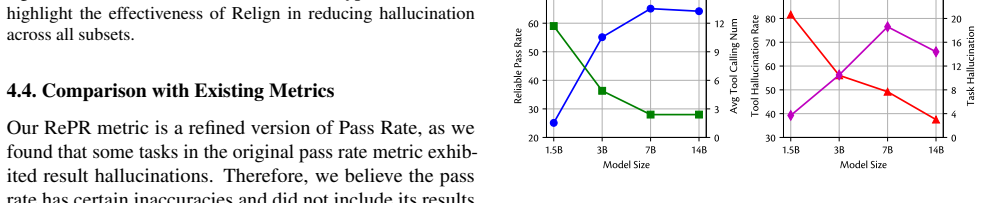
- The paper's scaling analysis finds that larger models reduce hallucination under fixed data, while simply adding more ToolBench data does not, because that data lacks failure-case examples.
Reading between the lines
- Inference: the abstention hierarchy is not tool-specific; any sequential decision task with detectable missing preconditions, such as web browsing, database queries, or robot commands, could use the same correct > indecisive > hallucinated preference ordering with domain-appropriate fallback actions.
- Inference: because GPT-4o labels the preference pairs and scores the final metrics, the reported improvement could partly reflect overfitting to one judge; the paper's human validation covers only 150 cases and not the answer-correlation step that RePR relies on.
- Inference: a natural testable extension is to re-run Relign's DPO pipeline with an open-weight judge or human preference labels; if the hallucination drop persists, the method is robust to judge choice, and if not, the measured gains are partially judge-fitting.
- Inference: RePR treats hallucinated-call-to-answer correlation as a binary discount; future work could relax this to partial credit and estimate error bars on the discounted pass rate.
Signed reviews
Editorial analysis
A structured set of objections, weighed in public.
Referee Report
Summary. The paper addresses tool hallucination in LLM tool-use by (1) proposing a taxonomy (tool selection vs. tool usage, with four subtypes), (2) introducing RelyToolBench, a benchmark with missing-parameter and unmatched-tools subsets, along with two new metrics—Reliable Pass Rate (RePR) and Benefit-Cost Utility, and (3) presenting Relign, a reliability alignment framework that augments the tool-use action space with indecisive actions (ChangeTools, TalkToUser) and trains via SFT and DPO. Experiments on ToolLLaMA, LLaMA-3.1-8B, and Qwen2.5-7B report large reductions in tool hallucination rate (e.g., LLaMA-3.1: 50.8% to 14.6%) and improvements in RePR (65.3% to 77.2%), plus an OOD evaluation on APIBench.
Significance. If the results hold, the paper makes a useful contribution: it provides a systematic taxonomy of tool hallucinations, a benchmark that stresses failure modes not covered by existing tool benchmarks, and a practical training approach that yields substantial improvements across multiple base models. The release of code and data, the multi-model consistency, and the OOD generalization experiment are concrete strengths. The significance is tempered, however, by the fact that the headline claims rest on a single LLM evaluator (GPT-4o) that is also used to construct the DPO training signal, and the human validation of that evaluator is narrow. The metric definitions also need correction. These issues are addressable but currently leave the central quantitative claims less certain than the paper suggests.
major comments (3)
- [§3.2.2, §4.1, Appendix A] The same GPT-4o model is used both to label hallucination types for DPO preference construction (§3.2.2) and to compute the reported tool hallucination rate and RePR (§4.1). The human validation in Appendix A covers only 150 cases across three categories (no hallucination, parameter value hallucination, tool relevance hallucination) and does not validate timing or format hallucinations, nor does it validate the Appendix D answer-correlation step that converts tool hallucinations into the task hallucination rate subtracted in RePR. Since RePR and the hallucination-rate reductions are the paper's central claims, this evaluator circularity is load-bearing. I recommend validating the evaluator with a second independent LLM or a larger human sample covering all four subtypes and the answer-correlation step, and reporting agreement statistics separately for each component.
- [§2.2.2, Eq. (Utility)] The definition of P_hallucination is internally inconsistent. The text states 'P_hallucination is the penalty for hallucinations in the task (-10 for hallucination)' but the formula subtracts P_hallucination. If P_hallucination is negative, subtracting it adds to the utility, which would reward hallucinations; if the intended penalty is a nonnegative magnitude of 10, the parenthetical is misleading. Please clarify the sign convention and recompute the Utility values in Table 2 under a consistent definition, or explain why the current convention is correct.
- [§4.2, Table 2 caption] The table caption reads 'Utility: Benifit-cost utility↓' while the column header and the text indicate that higher Utility is better (GPT-4o scores 13.4 vs. 5.2 for GPT-3.5-turbo, and the text describes utility as a measure to be maximized). This direct contradiction in the direction of the arrow makes the utility results ambiguous. Please correct the caption and ensure the arrow direction matches the text and the reported numbers.
minor comments (6)
- [§2.2.2] The word 'Benifit' is misspelled; it should be 'Benefit'.
- [§3.2.2] The term 'Acoreect' appears to be a typo for 'Acorrect'.
- [§4.1] The phrase 'For computing both benefit-cost utility' is ungrammatical; it should read 'For computing the benefit-cost utility'.
- [§3.2.1] The sentence 'the training data we selected involves only a single tool' is ambiguous—does it mean each training example contains only one tool call, or that the examples are restricted to a single-tool task? Please clarify.
- [Appendix A] The human evaluation is described as validating 'outputs generated by GPT-4, GPT-3.5, and ToolLLaMA3.1,' but the paper's evaluator is GPT-4o; please specify which model's outputs were judged and whether the human agreement applies directly to the GPT-4o-based pipeline.
- [Table 2] The column header 'Utility↑' is inconsistent with the caption's 'Benifit-cost utility↓' (see major comment); beyond the direction, consider using a consistent notation such as 'Utility ↑' and 'Tool Hallu ↓' in both the header and caption.
Circularity Check
The headline hallucination reduction is measured by the same GPT-4o judge used to build the DPO preference data, and the human check covers only 150 cases without validating the answer-correlation step inside RePR.
-
fitted input called prediction
[Section 3.2.2 (Reliable DPO) and Section 4.1 (Experimental Setup); Table 2]
"In each round, we sample ten tool-use trajectories at a temperature of 0.7 and use GPT-4O as a hallucination evaluator to construct preference pairs. ... Additionally, evaluations regarding tool hallucinations and task success were performed using the GPT-4 O model"
The DPO training signal is generated by GPT-4o classifying tool calls as hallucinated, non-hallucinated, or indecisive, and the same GPT-4o judge computes the reported tool hallucination rate and RePR components in Table 2. Thus the headline reductions (e.g., LLaMA-3.1-8B Hallu dropping from 50.8 to 14.6 and RePR rising from 65.3 to 77.2) partly measure how well Relign matches the biases of the judge that created its preference labels, rather than an independent property. The Appendix A human validation covers only 150 cases across three categories and does not validate the Appendix D answer-correlation step that converts tool hallucinations into Task Hallucination Rate inside RePR, so the load-bearing part of the metric depends on the same unvalidated judge used for training.
full rationale
This paper does not present a mathematical derivation, so the circularity question is about the evaluation loop. The central empirical claim is that Relign reduces tool hallucination and improves reliability, but the judge used to label the DPO preference data (Section 3.2.2: 'use GPT-4O as a hallucination evaluator to construct preference pairs') is the same model used to compute the reported hallucination and task-reliability metrics (Section 4.1: 'evaluations regarding tool hallucinations and task success were performed using the GPT-4 O model'). Any systematic bias in the GPT-4o judge can be learned by the model during preference optimization and then rewarded by the same judge during evaluation, so the reported reduction is partially a fit to the judge rather than an independently verified reduction in hallucination. The human evaluation in Appendix A is small (150 cases) and covers only no hallucination, parameter value hallucination, and tool relevance hallucination; it does not validate timing or format hallucination judgments, and it does not validate the Appendix D answer-correlation step used by RePR. Multi-model consistency and public code are real supporting evidence, but they do not break the dependence on a single judge. The score is 4 rather than higher because the method also improves on external measures such as APIBench AST accuracy and the pass-rate component of RePR, so the central claim is not entirely determined by the judge alone.
Assumptions & free parameters
free parameters (4)
- R_task success reward =
20
- P_hallucination penalty =
-10 (as written)
- P_tool penalty cap =
10
- necessary tool call count =
1 for solvable, 0 for unsolvable
assumptions (4)
- domain assumption Preference hierarchy Tsuccess > Tfailure > Thallucination
- domain assumption Step-level preference Acorrect > Aindecisive > Ahallucinated
- domain assumption The four-subtype taxonomy of tool hallucinations is exhaustive and meaningful
- domain assumption GPT-4o-based evaluator agrees with human judgment in the full evaluation setup
invented entities (1)
-
Indecisive action space (ChangeTools, TalkToUser)
Cite this review
Pith. "Pith review of Reducing Tool Hallucination via Reliability Alignment." pith.science (2026). https://pith.science/paper/TV5X63E6
@misc{pith2026241204141,
  author       = {Pith},
  title        = {Pith review of: Reducing Tool Hallucination via Reliability Alignment},
  year         = {2026},
  howpublished = {\url{https://pith.science/paper/TV5X63E6}},
  note         = {Machine review of arXiv:2412.04141}
}
read the original abstract
Large Language Models (LLMs) have expanded their capabilities beyond language generation to interact with external tools, enabling automation and real-world applications. However, tool hallucinations, where models either select inappropriate tools or misuse them, pose significant challenges, leading to erroneous task execution, increased computational costs, and reduced system reliability. To systematically address this issue, we define and categorize tool hallucinations into two main types, tool selection hallucination and tool usage hallucination. To evaluate and mitigate these issues, we introduce RelyToolBench, which integrates specialized test cases and novel metrics to assess hallucination-aware task success and efficiency. Finally, we propose Relign, a reliability alignment framework that expands the tool-use action space to include indecisive actions, allowing LLMs to defer tool use, seek clarification, or adjust tool selection dynamically. Through extensive experiments, we demonstrate that Relign significantly reduces tool hallucinations, improves task reliability, and enhances the efficiency of LLM tool interactions.
Figures


Figures from the paper (5 more)



Forward citations
Cited by 4 Pith papers
-
AgentOPSD: Recursive Self-Distillation for Agentic Reinforcement Learning
AgentOPSD converts sparse outcome rewards into turn-level credit by recursively accumulating self-distillation evidence in log-odds space, beating GRPO on most agentic benchmarks.
-
PredAct-Bench: Benchmarking Tool-Augmented Dialogue under Controlled Tool Noise
When grade-prediction tools are noisy, most LLM instructors over-rely on them in multi-turn dialogue and their decisions degrade, whereas human instructors stay better calibrated.
-
Multi-Head Latent Control: A Unified Interface for LLM Agent Decision Making
Hidden-state traces of frozen LLMs/VLMs can be read by lightweight trained heads to predict when to defer, clarify, call tools, or abstain, cutting routed inference cost 27–90%.
-
Enhancing Tool Learning in Large Language Models with Hierarchical Error Checklists
HiTEC improves LLM tool calling by embedding hierarchical error checklists in prompts or using them to generate negative examples for KTO fine-tuning.
Reference graph
Works this paper leans on
-
[1]
L., Almeida, D., Altenschmidt, J., Altman, S., Anadkat, S., et al
Achiam, J., Adler, S., Agarwal, S., Ahmad, L., Akkaya, I., Aleman, F. L., Almeida, D., Altenschmidt, J., Altman, S., Anadkat, S., et al. Gpt-4 technical report. arXiv preprint arXiv:2303.08774, 2023
arXiv 2023
-
[2]
Azaria, A. and Mitchell, T. The internal state of an llm knows when its lying. arXiv preprint arXiv:2304.13734, 2023
arXiv 2023
-
[3]
Large Language Models as Tool Makers
Cai, T., Wang, X., Ma, T., Chen, X., and Zhou, D. Large Language Models as Tool Makers . In Proc. of The Twelfth International Conference on Learning Representations (ICLR 2024) , 2024. URL https://openreview.net/forum?id=qV83K9d5WB
work page 2024
-
[4]
Alpagasus: Training a better alpaca with fewer data
Chen, L., Li, S., Yan, J., Wang, H., Gunaratna, K., Yadav, V., Tang, Z., Srinivasan, V., Zhou, T., Huang, H., et al. Alpagasus: Training a better alpaca with fewer data. arXiv preprint arXiv:2307.08701, 2023 a
arXiv 2023
-
[5]
T-Eval: Evaluating the Tool Utilization Capability Step by Step
Chen, Z., Du, W., Zhang, W., Liu, K., Liu, J., Zheng, M., Zhuo, J., Zhang, S., Lin, D., Chen, K., et al. T-Eval: Evaluating the Tool Utilization Capability Step by Step . ArXiv preprint, abs/2312.14033, 2023 b . URL https://arxiv.org/abs/2312.14033
arXiv 2023
-
[6]
Dubey, A., Jauhri, A., Pandey, A., Kadian, A., Al-Dahle, A., Letman, A., Mathur, A., Schelten, A., Yang, A., Fan, A., et al. The llama 3 herd of models. arXiv preprint arXiv:2407.21783, 2024
arXiv 2024
-
[7]
Retrieval-augmented generation for large language models: A survey
Gao, Y., Xiong, Y., Gao, X., Jia, K., Pan, J., Bi, Y., Dai, Y., Sun, J., and Wang, H. Retrieval-augmented generation for large language models: A survey. arXiv preprint arXiv:2312.10997, 2023
arXiv 2023
-
[8]
Gemini: A Family of Highly Capable Multimodal Models , 2023
Gemini Team . Gemini: A Family of Highly Capable Multimodal Models , 2023
work page 2023
Show all 44 references
-
[9]
M., Alves, D
Guerreiro, N. M., Alves, D. M., Waldendorf, J., Haddow, B., Birch, A., Colombo, P., and Martins, A. F. Hallucinations in large multilingual translation models. Transactions of the Association for Computational Linguistics, 11: 0 1500--1517, 2023
2023
-
[10]
Stabletoolbench: Towards stable large-scale benchmarking on tool learning of large language models
Guo, Z., Cheng, S., Wang, H., Liang, S., Qin, Y., Li, P., Liu, Z., Sun, M., and Liu, Y. Stabletoolbench: Towards stable large-scale benchmarking on tool learning of large language models. arXiv preprint arXiv:2403.07714, 2024
2024 arXiv
-
[11]
and Kembhavi, A
Gupta, T. and Kembhavi, A. Visual programming: Compositional visual reasoning without training. In In Proceedings of the IEEE/CVF Conference on Computer Vision and Pattern Recognition (CVPR 2023) , pp.\ 14953--14962, 2023
2023
-
[12]
ToolkenGPT: Augmenting Frozen Language Models with Massive Tools via Tool Embeddings
Hao, S., Liu, T., Wang, Z., and Hu, Z. ToolkenGPT: Augmenting Frozen Language Models with Massive Tools via Tool Embeddings . ArXiv preprint, abs/2305.11554, 2023. URL https://arxiv.org/abs/2305.11554
2023 arXiv
-
[13]
Hong, S., Zhuge, M., Chen, J., Zheng, X., Cheng, Y., Wang, J., Zhang, C., Wang, Z., Yau, S. K. S., Lin, Z., Zhou, L., Ran, C., Xiao, L., Wu, C., and Schmidhuber, J. Meta GPT : Meta programming for a multi-agent collaborative framework. In The Twelfth International Conference o...
2024
-
[14]
Tool documentation enables zero-shot tool-usage with large language models
Hsieh, C.-Y., Chen, S.-A., Li, C.-L., Fujii, Y., Ratner, A., Lee, C.-Y., Krishna, R., and Pfister, T. Tool documentation enables zero-shot tool-usage with large language models. ArXiv preprint, abs/2308.00675, 2023. URL https://arxiv.org/abs/2308.00675
2023 arXiv
-
[15]
K., and Kumar, V
Jain, N., Kwiatkowski, R., Ray, B., Ramanathan, M. K., and Kumar, V. On mitigating code llm hallucinations with api documentation. arXiv preprint arXiv:2407.09726, 2024
2024 arXiv
-
[16]
J., Madotto, A., and Fung, P
Ji, Z., Lee, N., Frieske, R., Yu, T., Su, D., Xu, Y., Ishii, E., Bang, Y. J., Madotto, A., and Fung, P. Survey of hallucination in natural language generation. ACM Computing Surveys, 55 0 (12): 0 1--38, 2023
2023
-
[17]
GeneGPT: augmenting large language models with domain tools for improved access to biomedical information
Jin, Q., Yang, Y., Chen, Q., and Lu, Z. GeneGPT: augmenting large language models with domain tools for improved access to biomedical information . Bioinformatics, 40 0 (2): 0 btae075, 2024. ISSN 1367-4811. doi:10.1093/bioinformatics/btae075. URL https://doi.org/10.1093/bioinf...
2024 doi
-
[18]
Crafting papers on machine learning
Langley, P. Crafting papers on machine learning. In Langley, P. (ed.), Proceedings of the Seventeenth International Conference on Machine Learning (ICML 2000), Stanford University, Stanford, CA, USA, June 29 - July 2, 2000 , pp.\ 1207--1216. Morgan Kaufmann, 2000
2000
-
[19]
W., Iyyer, M., Zettlemoyer, L., and Hajishirzi, H
Min, S., Krishna, K., Lyu, X., Lewis, M., Yih, W.-t., Koh, P. W., Iyyer, M., Zettlemoyer, L., and Hajishirzi, H. Factscore: Fine-grained atomic evaluation of factual precision in long form text generation. arXiv preprint arXiv:2305.14251, 2023
2023 arXiv
-
[20]
Self-contradictory hallucinations of large language models: Evaluation, detection and mitigation
M \"u ndler, N., He, J., Jenko, S., and Vechev, M. Self-contradictory hallucinations of large language models: Evaluation, detection and mitigation. arXiv preprint arXiv:2305.15852, 2023
2023 arXiv
-
[21]
G., Zhang, T., Wang, X., and Gonzalez, J
Patil, S. G., Zhang, T., Wang, X., and Gonzalez, J. E. Gorilla: Large Language Model Connected with Massive APIs . ArXiv preprint, abs/2305.15334, 2023. URL https://arxiv.org/abs/2305.15334
2023 arXiv
-
[22]
The RefinedWeb dataset for Falcon LLM: outperforming curated corpora with web data, and web data only
Penedo, G., Malartic, Q., Hesslow, D., Cojocaru, R., Cappelli, A., Alobeidli, H., Pannier, B., Almazrouei, E., and Launay, J. The RefinedWeb dataset for Falcon LLM: outperforming curated corpora with web data, and web data only . ArXiv preprint, abs/2306.01116, 2023. URL https...
2023 arXiv
-
[23]
WebCPM: Interactive Web Search for Chinese Long-form Question Answering
Qin, Y., Cai, Z., Jin, D., Yan, L., Liang, S., Zhu, K., Lin, Y., Han, X., Ding, N., Wang, H., et al. WebCPM: Interactive Web Search for Chinese Long-form Question Answering . ArXiv preprint, abs/2305.06849, 2023 a . URL https://arxiv.org/abs/2305.06849
2023 arXiv
-
[24]
ToolLLM: Facilitating Large Language Models to Master 16000+ Real-world APIs , 2023 b
Qin, Y., Liang, S., Ye, Y., Zhu, K., Yan, L., Lu, Y., Lin, Y., Cong, X., Tang, X., Qian, B., Zhao, S., Tian, R., Xie, R., Zhou, J., Gerstein, M., Li, D., Liu, Z., and Sun, M. ToolLLM: Facilitating Large Language Models to Master 16000+ Real-world APIs , 2023 b
2023
-
[25]
Qin, Y., Hu, S., Lin, Y., Chen, W., Ding, N., Cui, G., Zeng, Z., Huang, Y., Xiao, C., Han, C., Fung, Y. R., Su, Y., Wang, H., Qian, C., Tian, R., Zhu, K., Liang, S., Shen, X., Xu, B., Zhang, Z., Ye, Y., Li, B., Tang, Z., Yi, J., Zhu, Y., Dai, Z., Yan, L., Cong, X., Lu, Y., Zha...
2024 arXiv
-
[26]
D., Ermon, S., and Finn, C
Rafailov, R., Sharma, A., Mitchell, E., Manning, C. D., Ermon, S., and Finn, C. Direct preference optimization: Your language model is secretly a reward model. Advances in Neural Information Processing Systems, 36, 2024
2024
-
[27]
Toolformer: Language Models Can Teach Themselves to Use Tools
Schick, T., Dwivedi-Yu, J., Dess \` , R., Raileanu, R., Lomeli, M., Zettlemoyer, L., Cancedda, N., and Scialom, T. Toolformer: Language Models Can Teach Themselves to Use Tools . ArXiv preprint, abs/2302.04761, 2023. URL https://arxiv.org/abs/2302.04761
2023 arXiv
-
[28]
Shi, W., Han, X., Lewis, M., Tsvetkov, Y., Zettlemoyer, L., and Yih, S. W.-t. Trusting your evidence: Hallucinate less with context-aware decoding. arXiv preprint arXiv:2305.14739, 2023
2023 arXiv
-
[29]
ToolAlpaca: Generalized Tool Learning for Language Models with 3000 Simulated Cases , 2023
Tang, Q., Deng, Z., Lin, H., Han, X., Liang, Q., and Sun, L. ToolAlpaca: Generalized Tool Learning for Language Models with 3000 Simulated Cases , 2023
2023
-
[30]
Llama 2: Open foundation and fine-tuned chat models
Touvron, H., Martin, L., Stone, K., Albert, P., Almahairi, A., Babaei, Y., Bashlykov, N., Batra, S., Bhargava, P., Bhosale, S., et al. Llama 2: Open foundation and fine-tuned chat models. arXiv preprint arXiv:2307.09288, 2023
2023 arXiv
-
[31]
A stitch in time saves nine: Detecting and mitigating hallucinations of llms by validating low-confidence generation
Varshney, N., Yao, W., Zhang, H., Chen, J., and Yu, D. A stitch in time saves nine: Detecting and mitigating hallucinations of llms by validating low-confidence generation. arXiv preprint arXiv:2307.03987, 2023
2023 arXiv
-
[32]
Can llms express their uncertainty? an empirical evaluation of confidence elicitation in llms
Xiong, M., Hu, Z., Lu, X., Li, Y., Fu, J., He, J., and Hooi, B. Can llms express their uncertainty? an empirical evaluation of confidence elicitation in llms. arXiv preprint arXiv:2306.13063, 2023
2023 arXiv
-
[33]
Rejection improves reliability: Training llms to refuse unknown questions using rl from knowledge feedback
Xu, H., Zhu, Z., Ma, D., Zhang, S., Fan, S., Chen, L., and Yu, K. Rejection improves reliability: Training llms to refuse unknown questions using rl from knowledge feedback. arXiv preprint arXiv:2403.18349, 2024
2024 arXiv
-
[34]
Alignment for efficient tool calling of large language models
Xu, H., Wang, Z., Zhu, Z., Pan, L., Chen, X., Chen, L., and Yu, K. Alignment for efficient tool calling of large language models. arXiv preprint arXiv:2503.06708, 2025
2025 arXiv
-
[35]
Yang, A., Yang, B., Zhang, B., Hui, B., Zheng, B., Yu, B., Li, C., Liu, D., Huang, F., Wei, H., et al. Qwen2. 5 technical report. arXiv preprint arXiv:2412.15115, 2024
2024 arXiv
-
[36]
ChatGPT is not Enough: Enhancing Large Language Models with Knowledge Graphs for Fact-aware Language Modeling
Yang, L., Chen, H., Li, Z., Ding, X., and Wu, X. ChatGPT is not Enough: Enhancing Large Language Models with Knowledge Graphs for Fact-aware Language Modeling . ArXiv preprint, abs/2306.11489, 2023. URL https://arxiv.org/abs/2306.11489
2023 arXiv
-
[37]
WebShop: Towards Scalable Real-World Web Interaction with Grounded Language Agents
Yao, S., Chen, H., Yang, J., and Narasimhan, K. WebShop: Towards Scalable Real-World Web Interaction with Grounded Language Agents . In Koyejo, S., Mohamed, S., Agarwal, A., Belgrave, D., Cho, K., and Oh, A. (eds.), In Proceedings of the Advances in Neural Information Processi...
2022
-
[38]
Steptool: A step-grained reinforcement learning framework for tool learning in llms
Yu, Y., Wang, Z., Ma, W., Guo, Z., Zhan, J., Wang, S., Wu, C., Guo, Z., and Zhang, M. Steptool: A step-grained reinforcement learning framework for tool learning in llms. arXiv preprint arXiv:2410.07745, 2024
2024 arXiv
-
[39]
Instruction tuning for large language models: A survey
Zhang, S., Dong, L., Li, X., Zhang, S., Sun, X., Wang, S., Li, J., Hu, R., Zhang, T., Wu, F., et al. Instruction tuning for large language models: A survey. arXiv preprint arXiv:2308.10792, 2023
2023
-
[40]
Toolbehonest: A multi-level hallucination diagnostic benchmark for tool-augmented large language models
Zhang, Y., Chen, J., Wang, J., Liu, Y., Yang, C., Shi, C., Zhu, X., Lin, Z., Wan, H., Yang, Y., et al. Toolbehonest: A multi-level hallucination diagnostic benchmark for tool-augmented large language models. arXiv preprint arXiv:2406.20015, 2024
2024 arXiv
-
[41]
Verify-and-edit: A knowledge-enhanced chain-of-thought framework
Zhao, R., Li, X., Joty, S., Qin, C., and Bing, L. Verify-and-edit: A knowledge-enhanced chain-of-thought framework. arXiv preprint arXiv:2305.03268, 2023
2023 arXiv
-
[42]
Enhancing llm reliability via explicit knowledge boundary modeling
Zheng, H., Xu, H., Liu, Y., Chen, L., Fung, P., and Yu, K. Enhancing llm reliability via explicit knowledge boundary modeling. arXiv preprint arXiv:2503.02233, 2025
2025
-
[43]
Lima: Less is more for alignment
Zhou, C., Liu, P., Xu, P., Iyer, S., Sun, J., Mao, Y., Ma, X., Efrat, A., Yu, P., Yu, L., et al. Lima: Less is more for alignment. arXiv preprint arXiv:2305.11206, 2023
2023 arXiv
-
[44]
ToolQA: A Dataset for LLM Question Answering with External Tools
Zhuang, Y., Yu, Y., Wang, K., Sun, H., and Zhang, C. ToolQA: A Dataset for LLM Question Answering with External Tools . ArXiv preprint, abs/2306.13304, 2023. URL https://arxiv.org/abs/2306.13304
2023 arXiv
Reviewed August 11, 2026 · model on record in the stance chip above.
Discussion (0). Continue with ORCID to comment.