REVIEW 4 major objections 5 minor 194 references
Security in Brain-Computer Interfaces: State-of-the-art, opportunities, and future challenges
T0 review · 4 major / 5 minor · reviewed 2026-08-14 · deepseek-v4-flash
Pith's one-line read This paper claims that BCI security can be mapped onto a single bidirectional five-phase cycle covering both reading brain signals and stimulating the brain, and uses that cycle to catalogue attacks, impacts, and countermeasures.
desk verdict Useful five-phase BCI security framework and a solid survey, but the 'first exhaustive review' claim is undermined by the paper's own cited 2020 Landau survey. read the letter →
The pith
A machine-rendered reading of the paper's core claim, the machinery that carries it, and where it could break.
The reading
What carries the argument
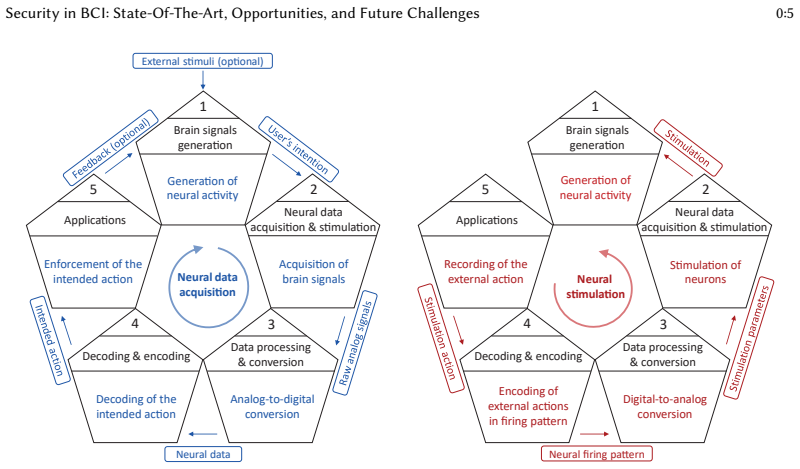
The central object is the proposed five-phase bidirectional BCI cycle, a closed-loop abstraction in which each phase has defined tasks, inputs, and outputs for both neural-data acquisition and neural stimulation. The cycle carries the entire argument: it is the grid on which every attack, impact, and countermeasure is placed, and it is what lets the paper claim exhaustive coverage by checking each phase and each direction.
What would settle it
Inspect a fully implantable closed-loop neurostimulator that performs acquisition, detection, and stimulation on one chip with no separate application layer; if an attack that works on that device, such as a firmware exploit altering stimulation amplitude, cannot be assigned to one of the five phases, the cycle's claim to cover all BCI systems is false.
Extended reading notes
Core claim
The paper's central claim is that existing BCI life-cycles, which mostly describe signal acquisition, can be homogenized into a single bidirectional five-phase cycle: generation of brain signals, neural data acquisition and stimulation, data processing and conversion, decoding and encoding, and applications. In the recording direction the cycle runs clockwise from signal generation to the execution of the intended action; in the stimulation direction it runs counterclockwise from the application's stimulation action back to neuron stimulation. On this cycle the paper places a taxonomy of attacks—misleading stimuli, replay and spoofing, jamming, malware, adversarial machine-learning attacks, injection, buffer overflows, misconfiguration, and others—and for each phase states the impacts on integrity, confidentiality, availability, and safety, along with the countermeasures documented in the literature or newly identified. It further distinguishes local BCI deployments, with a device plus a near control device, from global BCI deployments that add a remote control device or cloud, and argues that the trend toward interconnected BCIs will make these threats more severe.
Load-bearing premise
The load-bearing premise is that every real BCI system, including future implantable, brain-to-brain, and brain-to-internet devices, can be decomposed into the paper's five phases; if a working system merges or omits phases, the claimed exhaustive attack mapping could miss or misattribute threats.
Editorial extensions
If this is right
- Security analysis can be localized: a new BCI can be checked phase by phase, and a vulnerability in decoding or in the application layer is distinguishable from one in acquisition or stimulation.
- Known attack families transfer predictably: malware hits processing, adversarial examples hit decoding, spoofing and replay hit acquisition and applications, and firmware and battery attacks hit the device.
- The stimulation direction makes safety a first-class impact, because modified firing patterns can cause tissue damage, psychiatric effects, or misdiagnosis without sophisticated attack tooling.
- Global BCI deployments enlarge the attack surface: once raw neural data leaves the local device for clouds, remote attackers can steal it or reach stimulation systems, so anonymization and encryption of neural data become necessary.
- The survey supports standardization and security-by-design: unified phases make it possible to define common protocols, ontologies, privacy policies, and certification expectations across BCI manufacturers.
Reading between the lines
- A testable extension of the paper's grid: the mapping predicts that the most exploitable points of a real BCI are the boundary links—electrode-to-device analog capture, BCI-to-phone wireless link, and device-to-cloud traffic—because the empirically documented attacks (P300 leakage, Bluetooth man-in-the-middle, firmware cracking) all target those transitions.
- The paper's safety analysis implies a priority order for defenders: protect the stimulation parameter pipeline first, since altered voltage, frequency, or pulse width is where abstract integrity loss becomes tissue damage.
- If the cycle is treated as an ontology rather than a hardware blueprint, it suggests a research direction the paper does not develop: formally verifying each phase's data-flow constraints so that a static analyzer could reject malicious firing patterns before they reach the stimulator.
Signed reviews
Editorial analysis
A structured set of objections, weighed in public.
Referee Report
Summary. This paper surveys security and privacy issues in Brain-Computer Interfaces (BCIs). It proposes a unified five-phase bidirectional BCI cycle that integrates neural signal acquisition and neurostimulation, then organizes attacks, impacts, and countermeasures around the phases of this cycle and around two architectural deployment families (Local BCI and Global BCI). It also sketches future trends and challenges, including brain-to-brain and brain-to-Internet scenarios. The authors claim to be the first to exhaustively review and analyze the BCI field from a security perspective.
Significance. The paper is useful as a structured reference point for BCI security: it assembles a broad bibliography, distinguishes literature-documented results from author-proposed attack scenarios in its figures, and provides a phase-based framework that covers both recording and stimulation. The proposed five-phase cycle is a plausible organizational device, and the deployment-level discussion (Local vs. Global BCIs) adds practical value. If the positioning against prior surveys and the status of author-proposed attacks are clarified, the survey could serve as a useful entry point for researchers and practitioners. The paper does not provide machine-checked proofs or quantitative evaluations; its contribution is qualitative and taxonomic.
major comments (4)
- [Introduction, paragraph 5; reference [79]] The claim that this is 'the first work that exhaustively reviews and analyses the BCI field from the security point of view' is not substantiated in light of reference [79] (Landau, Puzis, and Nissim, 'Mind Your Mind,' ACM Computing Surveys 53(1), 2020), which is a 38-page survey of BCI security that the manuscript itself cites for concrete attacks, impacts, and countermeasures. The authors never compare their scope, phase model, inclusion criteria, or coverage with [79], nor do they explain what [79] misses. Since the stated novelty rests on exhaustiveness and firstness, the manuscript must either provide an explicit differentiation from [79] or soften the claim.
- [Section 2.3.1 and Figure 3; Section 2.1.1] Several entries in the attack mapping are author-generated hypotheses rather than surveyed results. For example, Section 2.3.1 states that 'the literature has not detected security problems in this phase' and then fills the gap with 'we identify' statements about malware disrupting analog-to-digital conversion, and Section 2.1.1 identifies the possibility of recreating neurodegenerative conditions as 'nowadays just theoretical [11]'. The color coding in Figure 3 already distinguishes literature-backed from author-proposed items, but the prose still presents the whole mapping as an 'exhaustive review.' The authors should explicitly state that the survey part covers documented attacks and that the 'we identify' items are new proposals, so that the exhaustiveness claim applies only to the documented subset.
- [Section 2, Figure 2] The proposed five-phase bidirectional BCI cycle is central to the paper's organization, but its derivation is not justified in detail. The text critiques prior life-cycle models ([6, 26, 59, 87, 172]) and then asserts a new five-phase structure 'with clearly defined tasks, inputs, and outputs,' yet it does not provide a mapping showing how each cited life-cycle corresponds to the five phases, nor does it discuss systems that may not decompose along these boundaries (e.g., fully implantable closed-loop devices). Without such a mapping, the completeness of the phase-based attack analysis is difficult to evaluate. Please add a table or explicit derivation that shows how existing cycle models and representative BCI systems map onto Figure 2.
- [Section 3.2.3] The transfer of IoT and cloud attack taxonomies to Global BCIs is asserted rather than argued in detail. For instance, the paper states that 'most of the security attacks and impacts defined by Stellios et al. [160] are also applicable in this architecture' and that OWASP IoT issues are 'critical aspects of Global BCIs,' but it does not identify which attacks are directly applicable, which require adaptation, and which are not applicable. Since the paper distinguishes literature-backed and author-proposed contributions elsewhere, this section should similarly separate documented BCI-specific attacks from generic IoT/cloud attacks that the authors believe carry over.
minor comments (5)
- [Section 2.1.2] There is a typo: 'themisleading stimuli attacks' should read 'the misleading stimuli attacks.'
- [Section 3.1.3] The phrase 'firmware throw a configuration link' should read 'firmware through a configuration link,' and 'close-loop IMDs' should be 'closed-loop IMDs.'
- [Figure 3] The blue/red color coding for literature-documented versus author-proposed items is central to interpreting the figure, but the printed grayscale version may be hard to read; consider adding textual labels or hatching.
- [Section 2.1.1 and reference [11]] The dependence on reference [11], a self-cited prior work, for the feasibility of theoretical neurostimulation attacks should be made more explicit in the text, since the reader may otherwise assume the cited source is independent.
- [Section 5] The conclusions list five lessons but do not summarize the main open problems from Section 4 (e.g., interoperability, extensibility, data protection) in the same level of detail; a short mapping between the challenges and the proposed future work would improve closure.
Circularity Check
No circular derivation: the BCI-cycle survey and attack mapping are not fitted to their own outputs; only minor, non-load-bearing self-citations appear.
full rationale
This paper is a qualitative survey plus a proposed organizational framework; it contains no equations, fitted parameters, or predictive quantities whose value could be forced by the input data. The five-phase bidirectional BCI cycle is explicitly presented as a homogenization of previously published life-cycles (citations [1, 26, 59, 87, 172] are discussed in Section 2) and is not derived from the security mappings that follow. The attack/impact/countermeasure tables are enumerated per phase and are transparently marked: entries with references come from the literature, entries without references are labeled as the authors' own identifications (Figure 3 caption and Section 2). No phase's attack set is defined as that which makes the phase's own definition true; the authors even note where the literature is silent (Section 2.3.1: 'the literature has not detected security problems in this phase') and then explicitly call their additions 'our contribution.' The paper does contain self-citations: reference [11] (López Bernal et al., IEEE Access) is used to support the statement that neurostimulation-based attacks are 'nowadays just theoretical,' and reference [37] (Fernández Maimó et al., including author Huertas Celdrán) supports a generic ransomware-mitigation technique. Neither citation is load-bearing: the theoretical attacks are independently identified in the text as the authors' own opportunity analysis, and the ransomware point is a peripheral example, not a premise of the survey's central claim. The claim to be 'the first work that exhaustively reviews and analyses the BCI field from the security point of view' (Section 1) is potentially weakened by the fact that reference [79] (Landau, Puzis, and Nissim, ACM Computing Surveys) is a same-topic survey never compared or differentiated; however, that is a completeness and novelty concern, not a circular-reasoning reduction. There is no step in which a prediction is equivalent by construction to its inputs, so the paper's derivation chain is not circular; the low score reflects only the presence of minor, non-load-bearing self-citations.
Assumptions & free parameters
assumptions (1)
- domain assumption The five-phase bidirectional BCI cycle (Figure 2) faithfully represents all BCI architectures, including future brain-to-brain and brain-to-Internet systems.
Cite this review
Pith. "Pith review of Security in Brain-Computer Interfaces: State-of-the-art, opportunities, and future challenges." pith.science (2026). https://pith.science/paper/TV6YMZAV
@misc{pith2026190803536,
  author       = {Pith},
  title        = {Pith review of: Security in Brain-Computer Interfaces: State-of-the-art, opportunities, and future challenges},
  year         = {2026},
  howpublished = {\url{https://pith.science/paper/TV6YMZAV}},
  note         = {Machine review of arXiv:1908.03536}
}
read the original abstract
BCIs have significantly improved the patients' quality of life by restoring damaged hearing, sight, and movement capabilities. After evolving their application scenarios, the current trend of BCI is to enable new innovative brain-to-brain and brain-to-the-Internet communication paradigms. This technological advancement generates opportunities for attackers since users' personal information and physical integrity could be under tremendous risk. This work presents the existing versions of the BCI life-cycle and homogenizes them in a new approach that overcomes current limitations. After that, we offer a qualitative characterization of the security attacks affecting each phase of the BCI cycle to analyze their impacts and countermeasures documented in the literature. Finally, we reflect on lessons learned, highlighting research trends and future challenges concerning security on BCIs.
Figures


Figures from the paper (4 more)


Reference graph
Works this paper leans on
-
[79]
Ofir Landau, Rami Puzis, and Nir Nissim. 2020. Mind Your Mind. Comput. Surveys 53, 1 (2020), 1–38
2020
-
[11]
S. L. Bernal, A. H. Celdrán, L. F. Maimó, M. T. Barros, S. Balasubramaniam, and G. M. Pérez. 2020. Cyberattacks on Miniature Brain Implants to Disrupt Spontaneous Neural Signaling. IEEE Access (2020)
2020
-
[160]
Ioannis Stellios, Panayiotis Kotzanikolaou, Mihalis Psarakis, Cristina Alcaraz, and Javier Lopez. 2018. A Survey of IoT-Enabled Cyberattacks: Assessing Attack Paths to Critical Infrastructures and Services. IEEE Communications Surveys & Tutorials 20, 4 (2018), 3453–3495
work page 2018
-
[1]
Minkyu Ahn, Mijin Lee, Jinyoung Choi, Sung Jun, Minkyu Ahn, Mijin Lee, Jinyoung Choi, and Sung Chan Jun. 2014. A Review of Brain-Computer Interface Games and an Opinion Survey from Researchers, Developers and Users. Sensors 14, 8 (Aug 2014), 14601–14633
2014
-
[2]
Bander Ali Saleh Al-rimy, Mohd Aizaini Maarof, and Syed Zainudeen Mohd Shaid. 2018. Ransomware threat success factors, taxonomy, and countermeasures: A survey and research directions. Computers & Security 74 (May 2018), 144–166
2018
-
[3]
Naseer Amara, Huang Zhiqui, and Awais Ali. 2017. Cloud Computing Security Threats and Attacks with Their Mitigation Techniques. In 2017 International Conference on Cyber-Enabled Distributed Computing and Knowledge Discovery (CyberC). IEEE, Nanjing, China, 244–251. J. ACM, Vol. 0, No. 0, Article 0. Publication date: 2020. 0:28 López Bernal, et al
2017
-
[4]
Pedram Amini, Muhammad Amin Araghizadeh, and Reza Azmi. 2015. A survey on Botnet: Classification, detection and defense. In 2015 International Electronics Symposium (IES) . IEEE, Surabaya, Indonesia, 233–238
2015
-
[5]
Anu and S
P. Anu and S. Vimala. 2017. A survey on sniffing attacks on computer networks. In 2017 International Conference on Intelligent Computing and Control (I2C2) . IEEE, Coimbatore, India, 5
2017
Show all 194 references
-
[6]
Arico, G Borghini, G Di Flumeri, N Sciaraffa, and F Babiloni
P. Arico, G Borghini, G Di Flumeri, N Sciaraffa, and F Babiloni. 2018. Passive BCI beyond the lab: Current trends and future directions. Physiological Measurement 39, 8 (Aug 2018), 08TR02
2018
-
[7]
Attiah, M
A. Attiah, M. Chatterjee, and C. C. Zou. 2018. A Game Theoretic Approach to Model Cyber Attack and Defense Strategies. In 2018 IEEE International Conference on Communications (ICC) . IEEE, Kansas City, MO, USA, 1–7
2018
-
[8]
Pablo Ballarin Usieto and Javier Minguez. 2018. Avoiding brain hacking - Challenges of cybersecurity and privacy in Brain Computer Interfaces. https://www.bitbrain.com/blog/cybersecurity-brain-computer-interface
2018
-
[9]
Srijita Basu, Arjun Bardhan, Koyal Gupta, Payel Saha, Mahasweta Pal, Manjima Bose, Kaushik Basu, Saunak Chaudhury, and Pritika Sarkar. 2018. Cloud computing security challenges & solutions-A survey. In2018 IEEE 8th Annual Computing and Communication Workshop and Conference, CC...
2018
-
[10]
Nebia Bentabet and Nasr Eddine Berrached. 2016. Synchronous P300 based BCI to control home appliances. In Proceedings of 2016 8th International Conference on Modelling, Identification and Control, ICMIC 2016 . IEEE, Algiers, Algeria, 835–838
2016
-
[12]
Abraham Bernstein, Mark Klein, and Thomas W. Malone. 2012. Programming the global brain. Commun. ACM 55, 5 (May 2012), 41
2012
-
[13]
Meriem Bettayeb, Qassim Nasir, and Manar Abu Talib. 2019. Firmware Update Attacks and Security for IoT Devices. In Proceedings of the ArabWIC 6th Annual International Conference Research Track . ACM Press, New York, New York, USA, 6
2019
-
[14]
Brunoni, Leigh E
Marom Bikson, Andre R. Brunoni, Leigh E. Charvet, Vincent P. Clark, Leonardo G. Cohen, Zhi-De Deng, Jacek Dmochowski, Dylan J. Edwards, Flavio Frohlich, Emily S. Kappenman, Kelvin O. Lim, Colleen Loo, Antonio Mantovani, David P. McMullen, Lucas C. Parra, Michele Pearson, Jessi...
2018
-
[15]
Birajdar and Vijay H
Gajanan K. Birajdar and Vijay H. Mankar. 2013. Digital image forgery detection using passive techniques: A survey. Digital Investigation 10, 3 (Oct 2013), 226–245
2013
-
[16]
Black and Irena Bojanova
Paul E. Black and Irena Bojanova. 2016. Defeating Buffer Overflow: A Trivial but Dangerous Bug. IT Professional 18, 6 (Nov 2016), 58–61
2016
-
[17]
Tamara Bonaci, Ryan Calo, and Howard Jay Chizeck. 2015. App Stores for the Brain : Privacy and Security in Brain-Computer Interfaces. IEEE Technology and Society Magazine 34, 2 (Jun 2015), 32–39
2015
-
[18]
Tamara Bonaci, Jeffrey Herron, Charles Matlack, and Howard Jay Chizeck. 2015. Securing the Exocortex: A Twenty- First Century Cybernetics Challenge. IEEE Technology and Society Magazine 34, 3 (Sep 2015), 44–51. arXiv:hep- ph/0011146
2015
-
[19]
Alessio Botta, Walter de Donato, Valerio Persico, and Antonio Pescapé. 2016. Integration of Cloud computing and Internet of Things: A survey. Future Generation Computer Systems 56 (Mar 2016), 684–700
2016
-
[20]
Brain/MINDS project. 2019. Brain/MINDS project. https://brainminds.jp/en/
2019
-
[21]
Brain/Neural Computer Interaction project. 2015. Brain/Neural Computer Interaction project. http://bnci-horizon- 2020.eu/
2015
-
[22]
Millán, Felip Miralles, Anton Nijholt, Eloy Opisso, Nick Ramsey, Patric Salomon, and Gernot R
Clemens Brunner, Niels Birbaumer, Benjamin Blankertz, Christoph Guger, Andrea Kübler, Donatella Mattia, José del R. Millán, Felip Miralles, Anton Nijholt, Eloy Opisso, Nick Ramsey, Patric Salomon, and Gernot R. Müller-Putz
-
[23]
Engel, Christian Gerloff, Manfred Westphal, Johannes A
Carsten Buhmann, Torge Huckhagel, Katja Engel, Alessandro Gulberti, Ute Hidding, Monika Poetter-Nerger, Ines Goerendt, Peter Ludewig, Hanna Braass, Chi-un Choe, Kara Krajewski, Christian Oehlwein, Katrin Mittmann, Andreas K. Engel, Christian Gerloff, Manfred Westphal, Johannes...
2017
-
[24]
Tapiador
Carmen Camara, Pedro Peris-Lopez, and Juan E. Tapiador. 2015. Security and privacy issues in implantable medical devices: A comprehensive survey. Journal of Biomedical Informatics 55 (Jun 2015), 272–289
2015
-
[25]
Debashis Das Chakladar and Sanjay Chakraborty. 2018. Feature Extraction and Classification in Brain-Computer Interfacing : Future Research Issues and Challenges. In Natural Computing for Unsupervised Learning . Springer, Cham, Cham, Switzerland, Chapter 5, 101–131. J. ACM, Vol...
2018
-
[26]
Howard Jay Chizeck and Tamara Bonaci. 2014. Brain-Computer Interface Anonymizer. US Patent Application. US20140228701A1
2014
-
[27]
Cybersecurity & Infrastructure Security Agancy (CISA). 2020. ICS Medical Advisory (ICSMA-19-080-01). https://us- cert.cisa.gov/ics/advisories/ICSMA-19-080-01
2020
-
[28]
Coogan and Bin He
Christopher G. Coogan and Bin He. 2018. Brain-Computer Interface Control in a Virtual Reality Environment and Applications for the Internet of Things. IEEE Access 6 (2018), 10840–10849
2018
-
[29]
de Oliveira Júnior, Juliana M
Wilson G. de Oliveira Júnior, Juliana M. de Oliveira, Roberto Munoz, and Victor Hugo C. de Albuquerque. 2018. A proposal for Internet of Smart Home Things based on BCI system to aid patients with amyotrophic lateral sclerosis. Neural Computing and Applications (2018), 11
2018
-
[30]
Dembek, Paul Reker, Veerle Visser-Vandewalle, Jochen Wirths, Harald Treuer, Martin Klehr, Jan Roediger, Haidar S
Till A. Dembek, Paul Reker, Veerle Visser-Vandewalle, Jochen Wirths, Harald Treuer, Martin Klehr, Jan Roediger, Haidar S. Dafsari, Michael T. Barbe, and Lars Timmermann. 2017. Directional DBS increases side-effect thresholds—A prospective, double-blind trial. Movement Disorder...
2017
-
[31]
Tamara Denning, Yoky Matsuoka, and Tadayoshi Kohno. 2009. Neurosecurity: security and privacy for neural devices. Neurosurgical Focus 27, 1 (2009), E7
2009
-
[32]
Eckstein, Koel Das, Binh T
Miguel P. Eckstein, Koel Das, Binh T. Pham, Matthew F. Peterson, Craig K. Abbey, Jocelyn L. Sy, and Barry Giesbrecht
-
[33]
Edwards, Abbas Kouzani, Kendall H
Christine A. Edwards, Abbas Kouzani, Kendall H. Lee, and Erika K. Ross. 2017. Neurostimulation Devices for the Treatment of Neurologic Disorders. Mayo Clinic Proceedings 92, 9 (2017), 1427–1444
2017
-
[34]
Emotiv. 2019. Emotiv. https://www.emotiv.com/
2019
-
[35]
Emotiv. 2019. Emotiv Cortex API. https://emotiv.github.io/cortex-docs/{#}introduction
2019
-
[36]
Emotiv. 2019. EMOTIV EPOC+. https://www.emotiv.com/epoc/
2019
-
[37]
Lorenzo Fernández Maimó, Alberto Huertas Celdrán, Ángel Perales Gómez, Félix García Clemente, James Weimer, and Insup Lee. 2019. Intelligent and Dynamic Ransomware Spread Detection and Mitigation in Integrated Clinical Environments. Sensors 19, 5 (Mar 2019), 1114
2019
-
[38]
Samuel G Finlayson, John D Bowers, Joichi Ito, Jonathan L Zittrain, Andrew L Beam, and Isaac S Kohane. 2019. Adversarial attacks on medical machine learning. Science 363, 6433 (Mar 2019), 1287–1289
2019
-
[39]
Heylighen Francis. 2007. The Global Superorganism: an evolutionary-cybernetic model of the emerging network society. Social Evolution & History 6, 1 (2007), 58–119
2007
-
[40]
Knight, Ivan Martinovic, Prateek Mittal, Daniele Perito, Ivo Sluganovic, and Dawn Song
Mario Frank, Tiffany Hwu, Sakshi Jain, Robert T. Knight, Ivan Martinovic, Prateek Mittal, Daniele Perito, Ivo Sluganovic, and Dawn Song. 2017. Using EEG-Based BCI Devices to Subliminally Probe for Private Information. In Proceedings of the 2017 on Workshop on Privacy in the El...
2017 arXiv
-
[41]
Jianwen Fu, Jingfeng Xue, Yong Wang, Zhenyan Liu, and Chun Shan. 2018. Malware Visualization for Fine-Grained Classification. IEEE Access 6 (2018), 14510–14523
2018
-
[42]
Ariko Fukushima, Reiko Yagi, Norie Kawai, Manabu Honda, Emi Nishina, and Tsutomu Oohashi. 2014. Frequencies of Inaudible High-Frequency Sounds Differentially Affect Brain Activity: Positive and Negative Hypersonic Effects. PLoS ONE 9, 4 (apr 2014), e95464
2014
-
[43]
Fried, Danylo L
Joyce Gomes-Osman, Aprinda Indahlastari, Peter J. Fried, Danylo L. F. Cabral, Jordyn Rice, Nicole R. Nissim, Serkan Aksu, Molly E. McLaren, and Adam J. Woods. 2018. Non-invasive Brain Stimulation: Probing Intracortical Circuits and Improving Cognition in the Aging Brain. Front...
2018
-
[44]
Ian Goodfellow, Patrick McDaniel, and Nicolas Papernot. 2018. Making machine learning robust against adversarial inputs. Commun. ACM 61, 7 (Jul 2018), 56–66
2018
-
[45]
Amengual, Alvaro Pascual-Leone, and Giulio Ruffini
Carles Grau, Romuald Ginhoux, Alejandro Riera, Thanh Lam Nguyen, Hubert Chauvat, Michel Berg, Julià L. Amengual, Alvaro Pascual-Leone, and Giulio Ruffini. 2014. Conscious Brain-to-Brain Communication in Humans Using Non- Invasive Technologies. PLoS ONE 9, 8 (Aug 2014), e105225
2014
-
[46]
Kanika Grover, Alvin Lim, and Qing Yang. 2014. Jamming and anti-jamming techniques in wireless networks: a survey. International Journal of Ad Hoc and Ubiquitous Computing 17, 4 (2014), 197
2014
-
[47]
Surbhi Gupta, Abhishek Singhal, and Akanksha Kapoor. 2017. A literature survey on social engineering attacks: Phishing attack. In Proceeding - IEEE International Conference on Computing, Communication and Automation, ICCCA
2017
-
[48]
Hartmann, Sabine Fliegen, Stefan J
Christian J. Hartmann, Sabine Fliegen, Stefan J. Groiss, Lars Wojtecki, and Alfons Schnitzler. 2019. An update on best practice of deep brain stimulation in Parkinson’s disease. Therapeutic Advances in Neurological Disorders 12 (2019)
2019
-
[49]
Hatfield
Joseph M. Hatfield. 2018. Social engineering in cybersecurity: The evolution of a concept. Computers and Security 73 (2018), 102–113
2018
-
[50]
Vincent Haupert, Dominik Maier, Nicolas Schneider, Julian Kirsch, and Tilo Müller. 2018. Honey, I Shrunk Your App Security: The State of Android App Hardening. In Detection of Intrusions and Malware, and Vulnerability Assessment . Springer International Publishing, Cham, 69–91...
2018
-
[51]
Shenghong He, Tianyou Yu, Zhenghui Gu, and Yuanqing Li. 2017. A hybrid BCI web browser based on EEG and EOG signals. In 2017 39th Annual International Conference of the IEEE Engineering in Medicine and Biology Society (EMBC) . IEEE, Seogwipo, South Korea, 1006–1009
2017
-
[52]
Mehrkens, Thomas Koeglsperger, and Kai Bötzel
Franz Hell, Carla Palleis, Jan H. Mehrkens, Thomas Koeglsperger, and Kai Bötzel. 2019. Deep Brain Stimulation Programming 2.0: Future Perspectives for Target Identification and Adaptive Closed Loop Stimulation. Frontiers in Neurology 10 (2019), 314
2019
-
[53]
HL7 International. 2019. Health Level Seven. https://www.hl7.org/
2019
-
[54]
Keum Shik Hong and Muhammad Jawad Khan. 2017. Hybrid brain-computer interface techniques for improved classification accuracy and increased number of commands: A review. Frontiers in Neurorobotics 11 (Jul 2017), 35
2017
-
[55]
Mohammad-Parsa Hosseini, Dario Pompili, Kost Elisevich, and Hamid Soltanian-Zadeh. 2017. Optimized Deep Learning for EEG Big Data and Seizure Prediction BCI via Internet of Things. IEEE Transactions on Big Data 3, 4 (Dec 2017), 392–404
2017
-
[56]
Alberto Huertas Celdrán, Ginés Dólera Tormo, Félix Gómez Mármol, Manuel Gil Pérez, and Gregorio Martínez Pérez
-
[57]
Luca Iandoli, Mark Klein, and Giuseppe Zollo. 2009. Enabling On-Line Deliberation and Collective Decision-Making through Large-Scale Argumentation. International Journal of Decision Support System Technology 1, 1 (Jan 2009), 69–92
2009
-
[58]
Marcello Ienca. 2015. Neuroprivacy, neurosecurity and brain-hacking: Emerging issues in neural engineering.Bioethica Forum 8, 2 (2015), 51–53
2015
-
[59]
Marcello Ienca and Pim Haselager. 2016. Hacking the brain: brain–computer interfacing technology and the ethics of neurosecurity. Ethics and Information Technology 18, 2 (Jun 2016), 117–129
2016
-
[60]
International Journal of Information Security 15, 2 (Apr 2016), 195–209
Resolving privacy-preserving relationships over outsourced encrypted data storages. International Journal of Information Security 15, 2 (Apr 2016), 195–209
2016
-
[61]
IETF. 2011. IP Security (IPsec) and Internet Key Exchange (IKE) Document Roadmap. https://tools.ietf.org/html/rfc6071
2011
-
[62]
IETF. 2018. The Transport Layer Security (TLS) Protocol Version 1.3. https://tools.ietf.org/html/rfc8446
2018
-
[63]
Judy Illes, Samuel Weiss, Jaideep Bains, Jennifer A Chandler, Patricia Conrod, Yves De Koninck, Lesley K Fellows, Deanna Groetzinger, Eric Racine, Julie M Robillard, and Marla B Sokolowski. 2019. A Neuroethics Backbone for the Evolving Canadian Brain Research Strategy. Neuron ...
2019
-
[64]
Marcello Ienca, Pim Haselager, and Ezekiel J. Emanuel. 2018. Brain leaks and consumer neurotechnology. Nature Biotechnology 36, 9 (2018), 805–810
2018
-
[65]
ISO. 2018. ISO/IEC 27001 Information security management. https://www.iso.org/isoiec-27001-information- security.html
2018
-
[66]
Matthew Jagielski, Alina Oprea, Battista Biggio, Chang Liu, Cristina Nita-Rotaru, and Bo Li. 2018. Manipulating Machine Learning: Poisoning Attacks and Countermeasures for Regression Learning. InProceedings - IEEE Symposium on Security and Privacy . IEEE, San Francisco, CA, USA, 19–35
2018
-
[67]
Losey, Justin A
Linxing Jiang, Andrea Stocco, Darby M. Losey, Justin A. Abernethy, Chantel S. Prat, and Rajesh P. N. Rao. 2019. BrainNet: A Multi-Person Brain-to-Brain Interface for Direct Collaboration Between Brains. Scientific Reports 9, 1 (Dec 2019), 6115
2019
-
[68]
The BRAIN Initiative. 2019. The BRAIN Initiative. https://braininitiative.nih.gov/
2019
-
[69]
Allison, Christoph Guger, and Günter Edlinger
Christoph Kapeller, Rupert Ortner, Gunther Krausz, Markus Bruckner, Brendan Z. Allison, Christoph Guger, and Günter Edlinger. 2014. Toward Multi-brain Communication: Collaborative Spelling with a P300 BCI. In International Conference on Augmented Cognition. Springer, Cham, Cham, 47–54
2014
-
[70]
Karim, Thilo Hinterberger, Jürgen Richter, Jürgen Mellinger, Nicola Neumann, Herta Flor, Andrea Kübler, and Niels Birbaumer
Ahmed A. Karim, Thilo Hinterberger, Jürgen Richter, Jürgen Mellinger, Nicola Neumann, Herta Flor, Andrea Kübler, and Niels Birbaumer. 2006. Neural Internet: Web Surfing with Brain Potentials for the Completely Paralyzed. Neurorehabilitation and Neural Repair 20, 4 (Dec 2006), 508–515
2006
-
[71]
Jozsef Katona, Tibor Ujbanyi, Gergely Sziladi, and Attila Kovari. 2019. Electroencephalogram-Based Brain-Computer Interface for Internet of Robotic Things . Springer International Publishing, Cham, Chapter 12, 253–275
2019
-
[72]
Sergio José and Rodríguez Méndez. 2018. Modeling actuations in BCI-O. In Proceedings of the 8th International Conference on the Internet of Things - IOT ’18 . ACM Press, New York, New York, USA, 6
2018
-
[73]
Kirubavathi and R
G. Kirubavathi and R. Anitha. 2018. Structural analysis and detection of android botnets using machine learning techniques. International Journal of Information Security 17, 2 (Apr 2018), 153–167
2018
-
[74]
Constantinos Kolias, Georgios Kambourakis, Angelos Stavrou, and Jeffrey Voas. 2017. DDoS in the IoT: Mirai and other botnets. Computer 50, 7 (2017), 80–84
2017
-
[75]
Jan Kubanek. 2018. Neuromodulation with transcranial focused ultrasound. Neurosurgical focus 44, 2 (feb 2018), E14. J. ACM, Vol. 0, No. 0, Article 0. Publication date: 2020. Security in BCI: State-Of-The-Art, Opportunities, and Future Challenges 0:31
2018
-
[76]
Elena Khabarova, Natalia Denisova, Aleksandr Dmitriev, Konstantin Slavin, and Leo Verhagen Metman. 2018. Deep Brain Stimulation of the Subthalamic Nucleus in Patients with Parkinson Disease with Prior Pallidotomy or Thalamo- tomy. Brain Sciences 8, 4 (Apr 2018), 66
2018
-
[77]
James Kurose and Keith Ross. 2017. Computer Networking: A Top-Down Approach (7 ed.). Pearson, London. 852 pages
2017
-
[78]
Marios Kyriazis. 2015. Systems neuroscience in focus: from the human brain to the global brain? Frontiers in Systems Neuroscience 9 (Feb 2015), 7
2015
-
[80]
Richard Kuhn, Vincent C Hu, W
D. Richard Kuhn, Vincent C Hu, W. Timothy Polk, and Shu-Jen Chang. 2001. Introduction to Public Key Technology and the Federal PKI Infrastructure . Technical Report. National Institute of Standards and Technology. 1–54 pages. https://nvlpubs.nist.gov/nistpubs/Legacy/SP/nistspe...
2001
-
[81]
Verschure, Marti Sanchez, Andre Luvizotto, Anna Mura, Aleksander Valjamae, Christoph Guger, Robert Prueckl, and Ulysses Bernardet
Sylvain Le Groux, Jonatas Manzolli, Paul F. Verschure, Marti Sanchez, Andre Luvizotto, Anna Mura, Aleksander Valjamae, Christoph Guger, Robert Prueckl, and Ulysses Bernardet. 2010. Disembodied and Collaborative Musical Interaction in the Multimodal Brain Orchestra. In Proceedi...
2010
-
[82]
Lebedev and Miguel A
Mikhail A. Lebedev and Miguel A. L. Nicolelis. 2017. Brain-Machine Interfaces: From Basic Science to Neuroprostheses and Neurorehabilitation. Physiological Reviews 97, 2 (Apr 2017), 767–837
2017
-
[83]
Wonhye Lee, Suji Kim, Byeongnam Kim, Chungki Lee, Yong An Chung, Laehyun Kim, and Seung-Schik Yoo. 2017. Non-invasive transmission of sensorimotor information in humans using an EEG/focused ultrasound brain-to-brain interface. PLOS ONE 12, 6 (Jul 2017), e0178476
2017
-
[84]
Vazquez-Araujo, Paula M
Francisco Laport, Francisco J. Vazquez-Araujo, Paula M. Castro, Adriana Dapena, Francisco Laport, Francisco J. Vazquez-Araujo, Paula M. Castro, and Adriana Dapena. 2018. Brain-Computer Interfaces for Internet of Things. Proceedings 2, 18 (Sep 2018), 1179
2018
-
[85]
Timothée Levi, Paolo Bonifazi, Paolo Massobrio, and Michela Chiappalone. 2018. Editorial: Closed-Loop Systems for Next-Generation Neuroprostheses. Frontiers in Neuroscience 12 (2018), 26
2018
-
[86]
Guangye Li and Dingguo Zhang. 2016. Brain-Computer Interface Controlled Cyborg: Establishing a Functional Information Transfer Pathway from Human Brain to Cockroach Brain. PLOS ONE 11, 3 (Mar 2016), e0150667
2016
-
[87]
Qianqian Li, Ding Ding, and Mauro Conti. 2015. Brain-Computer Interface applications: Security and privacy challenges. In 2015 IEEE Conference on Communications and Network Security (CNS) . IEEE, San Francisco, CA, USA, 663–666
2015
-
[88]
León Ruiz, M
M. León Ruiz, M. L. Rodríguez Sarasa, L. Sanjuán Rodríguez, J. Benito-León, E. García-Albea Ristol, and S. Arce Arce
-
[89]
Krause, Yu Huang, Alexander Opitz, Ashesh Mehta, Christopher C
Anli Liu, Mihály Vöröslakos, Greg Kronberg, Simon Henin, Matthew R. Krause, Yu Huang, Alexander Opitz, Ashesh Mehta, Christopher C. Pack, Bart Krekelberg, Antal Berényi, Lucas C. Parra, Lucia Melloni, Orrin Devinsky, and György Buzsáki. 2018. Immediate neurophysiological effec...
2018
-
[90]
Qiang Liu, Pan Li, Wentao Zhao, Wei Cai, Shui Yu, and Victor C.M. Leung. 2018. A survey on security threats and defensive techniques of machine learning: A data driven view. IEEE Access 6 (2018), 12103–12117
2018
-
[91]
Huimin Lu, Hyoungseop Kim, Yujie Li, and Yin Zhang. 2018. BrainNets: Human Emotion Recognition Using an Internet of Brian Things Platform. In 2018 14th International Wireless Communications & Mobile Computing Conference (IWCMC). IEEE, Limassol, Cyprus, 1313–1316
2018
-
[92]
Muhammad Mahmoud, Manjinder Nir, and Ashraf Matrawy. 2015. A Survey on Botnet Architectures, Detection and Defences. International Journal of Network Security 17, 3 (May 2015), 272–289
2015
-
[93]
Lifelines Neuro. 2020. Neurodiagnostics Without Boundaries. https://www.lifelinesneuro.com/
2020
-
[94]
Maksimenko, Alexander E
Vladimir A. Maksimenko, Alexander E. Hramov, Nikita S. Frolov, Annika Lüttjohann, Vladimir O. Nedaivozov, Vadim V. Grubov, Anastasia E. Runnova, Vladimir V. Makarov, Jürgen Kurths, and Alexander N. Pisarchik. 2018. Increasing Human Performance by Sharing Cognitive Load Using B...
2018
-
[95]
Eduard Marin, Dave Singelée, Bohan Yang, Vladimir Volski, Guy A. E. Vandenbosch, Bart Nuttin, and Bart Preneel
-
[96]
Ivan Martinovic, Doug Davies, and Mario Frank. 2012. On the feasibility of side-channel attacks with brain-computer interfaces. In Proceedings of the 21st USENIX Security Symposium . USENIX, Bellevue, WA, 143–158
2012
-
[97]
Nuno R. B. Martins, Amara Angelica, Krishnan Chakravarthy, Yuriy Svidinenko, Frank J. Boehm, Ioan Opris, Mikhail A. Lebedev, Melanie Swan, Steven A. Garan, Jeffrey V. Rosenfeld, Tad Hogg, and Robert A. Freitas. 2019. Human Brain/Cloud Interface. Frontiers in Neuroscience 13 (M...
2019
-
[98]
Redowan Mahmud, Ramamohanarao Kotagiri, and Rajkumar Buyya. 2018. Fog Computing: A Taxonomy, Survey and Future Directions. In Internet of Everything. Springer, Singapore, Singapore, 103–130
2018
-
[99]
Hideyuki Matsumoto and Yoshikazu Ugawa. 2017. Adverse events of tDCS and tACS: A review. Clinical Neurophysi- ology Practice 2 (2017), 19 – 25
2017
-
[100]
McMahon and M
M. McMahon and M. Schukat. 2018. A low-Cost, Open-Source, BCI- VR Game Control Development Environment Prototype for Game Based Neurorehabilitation. In 2018 IEEE Games, Entertainment, Media Conference (GEM) . IEEE, Galway, Ireland, 1–9
2018
-
[101]
In Proceedings of the Eighth ACM Conference on Data and Application Security and Privacy (CODASPY ’18)
Securing Wireless Neurostimulators. In Proceedings of the Eighth ACM Conference on Data and Application Security and Privacy (CODASPY ’18) . Association for Computing Machinery, New York, NY, USA, 287–298
-
[102]
Medtronic. 2020. DBS Theraphy for OCD. https://www.medtronic.com/us-en/patients/treatments-therapies/deep- brain-stimulation-ocd/about/risks-probable-benefits.html
2020
-
[103]
Medtronic. 2020. Security Bulletins. https://global.medtronic.com/xg-en/product-security/security-bulletins.html
2020
-
[104]
Ebrahim M
M. Ebrahim M. Mashat, Guangye Li, and Dingguo Zhang. 2017. Human-to-human closed-loop control based on brain-to-brain interface and muscle-to-muscle interface. Scientific Reports 7, 1 (Dec 2017), 11001
2017
-
[105]
MITRE. 2019. CWE - CWE-74: Improper Neutralization of Special Elements in Output Used by a Downstream Component (’Injection’) (3.2). https://cwe.mitre.org/data/definitions/74.html
2019
-
[106]
MITRE. 2019. CWE - CWE-77: Improper Neutralization of Special Elements used in a Command (’Command Injection’) (3.2). https://cwe.mitre.org/data/definitions/77.html
2019
-
[107]
Medtronic. 2020. DBS Security Reference Guide. http://manuals.medtronic.com/content/dam/emanuals/neuro/ NDHF1550-189563.pdf
2020
-
[108]
MITRE. 2019. CWE - CWE-89: Improper Neutralization of Special Elements used in an SQL Command (’SQL Injection’) (3.2). https://cwe.mitre.org/data/definitions/89.html
2019
-
[109]
MITRE. 2019. CWE-119: Improper Restriction of Operations within the Bounds of a Memory Buffer. https: //cwe.mitre.org/data/definitions/119.html
2019
-
[110]
Najmeh Miramirkhani, Mahathi Priya Appini, Nick Nikiforakis, and Michalis Polychronakis. 2017. Spotless Sandboxes: Evading Malware Analysis Systems Using Wear-and-Tear Artifacts. In2017 IEEE Symposium on Security and Privacy (SP). IEEE, San Jose, CA, USA, 1009–1024
2017
-
[111]
MITRE. 2019. CWE-121: Stack-based Buffer Overflow (3.2). https://cwe.mitre.org/data/definitions/121.html
2019
-
[112]
MITRE. 2019. CWE-122: Heap-based Buffer Overflow (3.2). https://cwe.mitre.org/data/definitions/122.html
2019
-
[113]
MITRE. 2019. CWE - CWE-78: Improper Neutralization of Special Elements used in an OS Command (’OS Command Injection’) (3.2). https://cwe.mitre.org/data/definitions/78.html
2019
-
[114]
Ingrid Moreno-Duarte, Nigel Gebodh, Pedro Schestatsky, Berkan Guleyupoglu, Davide Reato, Marom Bikson, and Felipe Fregni. 2014. Chapter 2 - Transcranial Electrical Stimulation: Transcranial Direct Current Stimulation (tDCS), Transcranial Alternating Current Stimulation (tACS),...
2014
-
[115]
Emily M Mugler, Carolin A Ruf, Sebastian Halder, Michael Bensch, and Andrea Kubler. 2010. Design and Implementa- tion of a P300-Based Brain-Computer Interface for Controlling an Internet Browser. IEEE Transactions on Neural Systems and Rehabilitation Engineering 18, 6 (Dec 201...
2010
-
[116]
MITRE. 2019. CWE-120: Buffer Copy without Checking Size of Input (’Classic Buffer Overflow’) (3.2). https: //cwe.mitre.org/data/definitions/120.html
2019
-
[117]
NeuroPace. 2013. NeuroPace® RNS® System Patient Manual. https://www.accessdata.fda.gov/cdrh{_}docs/pdf10/ p100026c.pdf
2013
-
[118]
NeuroSky. 2019. NeuroSky. http://neurosky.com/
2019
-
[119]
Abul Kalam Azad, and Athanasios Vasilakos
Muhammad Baqer Mollah, Md. Abul Kalam Azad, and Athanasios Vasilakos. 2017. Security and privacy challenges in mobile cloud computing: Survey and way ahead. Journal of Network and Computer Applications 84 (Apr 2017), 38–54
2017
-
[120]
NIST. 2018. Cybersecurity Framework. https://www.nist.gov/cyberframework
2018
-
[121]
Angle, Jan Müller, Nora Brackbill, William Wray, Felix Franke, E
Abdulmalik Obaid, Mina-Elraheb Hanna, Yu-Wei Wu, Mihaly Kollo, Romeo Racz, Matthew R. Angle, Jan Müller, Nora Brackbill, William Wray, Felix Franke, E. J. Chichilnisky, Andreas Hierlemann, Jun B. Ding, Andreas T. Schaefer, and Nicholas A. Melosh. 2020. Massively parallel micro...
2020
-
[122]
Elon Musk and Neuralink. 2019. An integrated brain-machine interface platform with thousands of channels. bioRxiv (2019). arXiv:https://www.biorxiv.org/content/early/2019/08/02/703801.full.pdf
2019
-
[123]
Open Web Application Security Project. 2017. Top 10-2017 A6-Security Misconfiguration - OWASP. https: //www.owasp.org/index.php/Top_10-2017_A6-Security_Misconfiguration
2017
-
[124]
Open Web Application Security Project. 2017. Top 10-2017 Top 10 - OWASP. https://www.owasp.org/index.php/ Top_10-2017_Top_10 J. ACM, Vol. 0, No. 0, Article 0. Publication date: 2020. Security in BCI: State-Of-The-Art, Opportunities, and Future Challenges 0:33
2017
-
[125]
Miguel A. L. Nicolelis. 2001. Actions from thoughts. Nature 409, 6818 (2001), 403–407
2001
-
[126]
Miguel Pais-Vieira, Gabriela Chiuffa, Mikhail Lebedev, Amol Yadav, and Miguel A. L. Nicolelis. 2015. Building an organic computing device with multiple interconnected brains. Scientific Reports 5, 1 (Dec 2015), 11869
2015
-
[127]
Miguel Pais-Vieira, Mikhail Lebedev, Carolina Kunicki, Jing Wang, and Miguel A. L. Nicolelis. 2013. A Brain-to-Brain Interface for Real-Time Sharing of Sensorimotor Information. Scientific Reports 3, 1 (Dec 2013), 1319
2013
-
[128]
O’Doherty, Mikhail A
Joseph E. O’Doherty, Mikhail A. Lebedev, Peter J. Ifft, Katie Z. Zhuang, Solaiman Shokur, Hannes Bleuler, and Miguel A. L. Nicolelis. 2011. Active tactile exploration using a brain–machine–brain interface. Nature 479, 7372 (Nov 2011), 228–231
2011
-
[129]
Nitsche, and Christian C
Rafael Polanía, Michael A. Nitsche, and Christian C. Ruff. 2018. Studying and modifying brain function with non-invasive brain stimulation. Nature Neuroscience 21, 2 (01 Feb 2018), 174–187
2018
-
[130]
Riccardo Poli, Caterina Cinel, Ana Matran-Fernandez, Francisco Sepulveda, and Adrian Stoica. 2013. Towards cooperative brain-computer interfaces for space navigation. In Proceedings of the 2013 international conference on Intelligent user interfaces - IUI ’13 . ACM Press, New ...
2013
-
[131]
Open Web Application Security Project. 2018. OWASP Internet of Things Project. https://www.owasp.org/index. php/OWASP_Internet_of_Things_Project
2018
-
[132]
Ip, Zhi-Qi Xiong, Bo Xu, and Tieniu Tan
Mu-ming Poo, Jiu-lin Du, Nancy Y. Ip, Zhi-Qi Xiong, Bo Xu, and Tieniu Tan. 2016. China Brain Project: Basic Neuroscience, Brain Diseases, and Brain-Inspired Computing. Neuron 92, 3 (Nov 2016), 591–596
2016
-
[133]
Human Brain Project. 2019. Human Brain Project. https://www.humanbrainproject.eu/en/
2019
-
[134]
Mahboubeh Parastarfeizabadi and Abbas Z. Kouzani. 2017. Advances in closed-loop deep brain stimulation devices. Journal of NeuroEngineering and Rehabilitation 14, 1 (11 Aug 2017), 79
2017
-
[135]
Laurie Pycroft and Tipu Z. Aziz. 2018. Security of implantable medical devices with wireless connections: The dangers of cyber-attacks. Expert Review of Medical Devices 15, 6 (Jul 2018), 403–406
2018
-
[136]
Boccard, Sarah L.F
Laurie Pycroft, Sandra G. Boccard, Sarah L.F. Owen, John F. Stein, James J. Fitzgerald, Alexander L. Green, and Tipu Z. Aziz. 2016. Brainjacking: Implant Security Issues in Invasive Neuromodulation. World Neurosurgery 92 (Aug 2016), 454–462
2016
-
[137]
Riccardo Poli, Davide Valeriani, and Caterina Cinel. 2014. Collaborative Brain-Computer Interface for Aiding Decision-Making. PLoS ONE 9, 7 (Jul 2014), 22
2014
-
[138]
Ifft, Miguel Pais-Vieira, Yoon Woo Byun, Katie Z
Arjun Ramakrishnan, Peter J. Ifft, Miguel Pais-Vieira, Yoon Woo Byun, Katie Z. Zhuang, Mikhail A. Lebedev, and Miguel A.L. Nicolelis. 2015. Computing Arm Movements with a Monkey Brainet. Scientific Reports 5, 1 (Sep 2015), 10767
2015
-
[139]
Rajesh PN Rao. 2019. Towards neural co-processors for the brain: combining decoding and encoding in brain–computer interfaces. Current Opinion in Neurobiology 55 (Apr 2019), 142–151
2019
-
[140]
Open Web Application Security Project. 2017. Top 10-2017 A1-Injection - OWASP. https://www.owasp.org/index. php/Top_10-2017_A1-Injection
2017
-
[141]
Heena Rathore, Chenglong Fu, Amr Mohamed, Abdulla Al-Ali, Xiaojiang Du, Mohsen Guizani, and Zhengtao Yu
-
[142]
Rodrigo Roman, Javier Lopez, and Masahiro Mambo. 2018. Mobile edge computing, Fog et al.: A survey and analysis of security threats and challenges. Future Generation Computer Systems 78 (Jan 2018), 680–698
2018
-
[143]
Ramadan and Athanasios V
Rabie A. Ramadan and Athanasios V. Vasilakos. 2017. Brain computer interface: control signals review.Neurocomputing 223 (Feb 2017), 26–44
2017
-
[144]
W. Saad, M. Bennis, and M. Chen. 2019. A Vision of 6G Wireless Systems: Applications, Trends, Technologies, and Open Research Problems. IEEE Network (2019), 1–9
2019
-
[145]
Abdul Saboor, Felix Gembler, Mihaly Benda, Piotr Stawicki, Aya Rezeika, Roland Grichnik, and Ivan Volosyak. 2018. A Browser-Driven SSVEP-Based BCI Web Speller. In2018 IEEE International Conference on Systems, Man, and Cybernetics (SMC). IEEE, Miyazaki, Japan, 625–630
2018
-
[146]
Rajesh P. N. Rao, Andrea Stocco, Matthew Bryan, Devapratim Sarma, Tiffany M. Youngquist, Joseph Wu, and Chantel S. Prat. 2014. A Direct Brain-to-Brain Interface in Humans. PLoS ONE 9, 11 (Nov 2014), e111332
2014
-
[147]
Takamichi Saito, Ryohei Watanabe, Shuta Kondo, Shota Sugawara, and Masahiro Yokoyama. 2016. A Survey of Prevention/Mitigation against Memory Corruption Attacks. In 2016 19th International Conference on Network-Based Information Systems (NBiS). IEEE, Ostrava, Czech Republic, 500–505
2016
-
[148]
Parthana Sarma, Prakash Tripathi, Manash Pratim Sarma, and Kandarpa Kumar Sarma. 2016. Pre-processing and Feature Extraction Techniques for EEG- BCI Applications-A Review of Recent Research.ADBU-Journal of Engineering Technology 5 (2016), 2348–7305. J. ACM, Vol. 0, No. 0, Arti...
2016
-
[149]
M A Scholl, K M Stine, J Hash, P Bowen, L A Johnson, C D Smith, and D I Steinberg. 2008. An introductory resource guide for implementing the Health Insurance Portability and Accountability Act (HIPAA) security rule . Technical Report. National Institute of Standards and Techno...
2008
-
[150]
Ron Ross, Victoria Pillitteri, Richard Graubart, Deborah Bodeau, and Rosalie McQuaid. 2019. Developing Cyber Resilient Systems: A Systems Security Engineering Approach . Technical Report. National Institute of Standards and Technology. https://nvlpubs.nist.gov/nistpubs/Special...
2019
-
[151]
Boston Scientific. 2020. Product Security Information. https://www.bostonscientific.com/en-US/customer-service/ product-security/product-security-information.html
2020
-
[152]
Diego Sempreboni and Luca Viganò. 2018. Privacy, Security and Trust in the Internet of Neurons. arXiv:cs.CY/1807.06077
2018 arXiv
-
[153]
Abdul Saboor, Aya Rezeika, Piotr Stawicki, Felix Gembler, Mihaly Benda, Thomas Grunenberg, and Ivan Volosyak
-
[154]
Sibi Chakkaravarthy, D
S. Sibi Chakkaravarthy, D. Sangeetha, and V. Vaidehi. 2019. A Survey on malware analysis and mitigation techniques. Computer Science Review 32 (May 2019), 23
2019
-
[155]
Saurabh Singh, Young-Sik Jeong, and Jong Hyuk Park. 2016. A survey on cloud computing security: Issues, threats, and solutions. Journal of Network and Computer Applications 75 (Nov 2016), 200–222
2016
-
[156]
Sirvent, José M
José L. Sirvent, José M. Azorín, Eduardo Iáñez, Andrés Úbeda, and Eduardo Fernández. 2010. P300-Based Brain- Computer Interface for Internet Browsing. In Trends in Practical Applications of Agents and Multiagent Systems . Springer, Berlin, Heidelberg, Berlin, Heidelberg, 615–622
2010
-
[157]
International Neuromodulation Society. 2020. International Neuromodulation Society. https://www.neuromodulation. com/
2020
-
[158]
Schwartz
Suzanne B. Schwartz. 2018. Medical Device Cybersecurity through the FDA Lens. In27th USENIX Security Symposium. USENIX Association, Baltimore, MD
2018
-
[159]
William Stallings. 2017. Cryptography and Network Security: Principles and Practice (7 ed.). Pearson, London. 766 pages
2017
-
[161]
Reza Shokri, Marco Stronati, Congzheng Song, and Vitaly Shmatikov. 2017. Membership Inference Attacks Against Machine Learning Models. In Proceedings - IEEE Symposium on Security and Privacy . IEEE, San Jose, CA, USA, 3–18
2017
-
[162]
Canadian Brain Research Strategy. 2019. Canadian Brain Research Strategy. https://canadianbrain.ca/
2019
-
[163]
Kaushik Sundararajan. 2017. Privacy and security issues in Brain Computer Interface . Master’s thesis. Auckland University of Technology
2017
-
[164]
Hassan Takabi. 2016. Firewall for brain: Towards a privacy preserving ecosystem for BCI applications. In 2016 IEEE Conference on Communications and Network Security, CNS 2016 . IEEE, Philadelphia, PA, USA, 370–371
2016
-
[165]
Hassan Takabi, Anuj Bhalotiya, and Manar Alohaly. 2016. Brain computer interface (BCI) applications: Privacy threats and countermeasures. In IEEE 2nd International Conference on Collaboration and Internet Computing . IEEE, Pittsburgh, PA, USA, 102–111
2016
-
[166]
Kandhasamy Sowndhararajan, Minju Kim, Ponnuvel Deepa, Se Park, and Songmun Kim. 2018. Application of the P300 Event-Related Potential in the Diagnosis of Epilepsy Disorder: A Review. Scientia Pharmaceutica 86, 2 (Mar 2018), 10
2018
-
[167]
Tyler, Joseph L
William J. Tyler, Joseph L. Sanguinetti, Maria Fini, and Nicholas Hool. 2017. Non-invasive neural stimulation. In Micro- and Nanotechnology Sensors, Systems, and Applications IX , Thomas George, Achyut K. Dutta, and M. Saif Islam (Eds.), Vol. 10194. International Society for O...
2017
-
[168]
Food and Drug Administration
U.S. Food and Drug Administration. 2016. Postmarket Management of Cybersecurity in Medical Devices . Technical Report. U.S. Food and Drug Administration, Rockville, MD, USA
2016
-
[169]
Prat, Darby M
Andrea Stocco, Chantel S. Prat, Darby M. Losey, Jeneva A. Cronin, Joseph Wu, Justin A. Abernethy, and Rajesh P. N. Rao. 2015. Playing 20 Questions with the Mind: Collaborative Problem Solving by Humans Using a Brain-to-Brain Interface. PLOS ONE 10, 9 (Sep 2015), e0137303
2015
-
[170]
Satish Vadlamani, Burak Eksioglu, Hugh Medal, and Apurba Nandi. 2016. Jamming attacks on wireless networks: A taxonomic survey. International Journal of Production Economics 172 (Feb 2016), 76–94
2016
-
[171]
Swati Vaid, Preeti Singh, and Chamandeep Kaur. 2015. EEG Signal Analysis for BCI Interface: A Review. InInternational Conference on Advanced Computing and Communication Technologies, ACCT . IEEE, Haryana, India, 143–147
2015
-
[172]
Marcel van Gerven, Jason Farquhar, Rebecca Schaefer, Rutger Vlek, Jeroen Geuze, Anton Nijholt, Nick Ramsey, Pim Haselager, Louis Vuurpijl, Stan Gielen, and Peter Desain. 2009. The brain–computer interface cycle. Journal of Neural Engineering 6, 4 (Aug 2009), 041001
2009
-
[173]
Sebastian Vasile, David Oswald, and Tom Chothia. 2019. Breaking All the Things—A Systematic Survey of Firmware Extraction Techniques for IoT Devices. In Smart Card Research and Advanced Applications . Springer, Cham, Cham, J. ACM, Vol. 0, No. 0, Article 0. Publication date: 20...
2019
-
[174]
Tanenbaum and David J
Andrew S. Tanenbaum and David J. Wetherall. 2011. Computer Networks (5 ed.). Pearson, London
2011
-
[175]
Ainuddin Wahid Abdul Wahab, Mustapha Aminu Bagiwa, Mohd Yamani Idna Idris, Suleman Khan, Zaidi Razak, and Muhammad Rezal Kamel Ariffin. 2014. Passive video forgery detection techniques: A survey. In2014 10th International Conference on Information Assurance and Security . IEEE...
2014
-
[176]
Yijun Wang and Tzyy-Ping Jung. 2011. A Collaborative Brain-Computer Interface for Improving Human Performance. PLoS ONE 6, 5 (May 2011), e20422
2011
-
[177]
Food and Drug Administration
U.S. Food and Drug Administration. 2018. Content of Premarket Submissions for Management of Cybersecurity in Medical Devices. Technical Report. U.S. Food and Drug Administration, Rockville, MD, USA
2018
-
[178]
Yaqoob, H
T. Yaqoob, H. Abbas, and M. Atiquzzaman. 2019. Security Vulnerabilities, Attacks, Countermeasures, and Regulations of Networked Medical Devices—A Review. IEEE Communications Surveys Tutorials 21, 4 (2019), 3723–3768
2019
-
[179]
Seung-Schik Yoo, Hyungmin Kim, Emmanuel Filandrianos, Seyed Javid Taghados, and Shinsuk Park. 2013. Non- Invasive Brain-to-Brain Interface (BBI): Establishing Functional Links between Two Brains. PLoS ONE 8, 4 (Apr 2013), e60410
2013
-
[180]
Tianyou Yu, Yuanqing Li, Jinyi Long, and Zhenghui Gu. 2012. Surfing the internet with a BCI mouse. Journal of Neural Engineering 9, 3 (Jun 2012), 036012
2012
-
[181]
Peng Yuan, Yijun Wang, Xiaorong Gao, Tzyy-Ping Jung, and Shangkai Gao. 2013. A Collaborative Brain-Computer Interface for Accelerating Human Decision Making. InInternational Conference on Universal Access in Human-Computer Interaction. Springer, Berlin, Heidelberg, Berlin, Hei...
2013
-
[182]
Vaughan, D.J
T.M. Vaughan, D.J. Mcfarland, G. Schalk, W.A. Sarnacki, D.J. Krusienski, E.W. Sellers, and J.R. Wolpaw. 2006. The Wadsworth BCI Research and Development Program: At Home With BCI. IEEE Transactions on Neural Systems and Rehabilitation Engineering 14, 2 (Jun 2006), 229–233
2006
-
[183]
PeiYun Zhang, MengChu Zhou, and Giancarlo Fortino. 2018. Security and trust issues in Fog computing: A survey. Future Generation Computer Systems 88 (Nov 2018), 16–27
2018
-
[184]
Shaomin Zhang, Sheng Yuan, Lipeng Huang, Xiaoxiang Zheng, Zhaohui Wu, Kedi Xu, and Gang Pan. 2019. Human Mind Control of Rat Cyborg’s Continuous Locomotion with Wireless Brain-to-Brain Interface. Scientific Reports 9, 1 (Dec 2019), 1321
2019
-
[185]
Ping Yan and Zheng Yan. 2018. A survey on dynamic mobile malware detection. Software Quality Journal 26, 3 (Sep 2018), 891–919
2018
-
[186]
Yulong Zou, Jia Zhu, Xianbin Wang, and Lajos Hanzo. 2016. A Survey on Wireless Security: Technical Challenges, Recent Advances, and Future Trends. Proc. IEEE 104, 9 (Sep 2016), 1727–1765. J. ACM, Vol. 0, No. 0, Article 0. Publication date: 2020
2016
-
[190]
Lan Zhang, Ker Jiun Wang, Huan Chen, and Zhi Hong Mao. 2016. Internet of Brain: Decoding Human Intention and Coupling EEG Signals with Internet Services. In Proceedings of International Conference on Service Science, ICSS . IEEE, Chongqing, China, 172–179
2016
-
[193]
Xiang Zhang, Lina Yao, Shuai Zhang, Salil Kanhere, Michael Sheng, and Yunhao Liu. 2019. Internet of Things Meets Brain–Computer Interface: A Unified Deep Learning Framework for Enabling Human-Thing Cognitive Interactivity. IEEE Internet of Things Journal 6, 2 (Apr 2019), 2084–2092
2019
-
[2012]
NeuroImage 59, 1 (Jan 2012), 94–108
Neural decoding of collective wisdom with multi-brain computing. NeuroImage 59, 1 (Jan 2012), 94–108
2012
-
[2015]
Brain-Computer Interfaces 2, 1 (Jan 2015), 10
BNCI Horizon 2020: towards a roadmap for the BCI community. Brain-Computer Interfaces 2, 1 (Jan 2015), 10
2020
-
[2016]
IEEE, Noida, India, 537–540
-
[2017]
In International Work-Conference on Artificial Neural Networks
SSVEP-Based BCI in a Smart Home Scenario. In International Work-Conference on Artificial Neural Networks. Springer, Cham, Cham, 474–485
-
[2018]
Neurología (English Edition) 33, 7 (2018), 459–472
Current evidence on transcranial magnetic stimulation and its potential usefulness in post-stroke neurorehabil- itation: Opening new doors to the treatment of cerebrovascular disease. Neurología (English Edition) 33, 7 (2018), 459–472
2018
-
[2020]
Neural Computing and Applications 32, 9 (2020), 4347–4360
Multi-layer security scheme for implantable medical devices. Neural Computing and Applications 32, 9 (2020), 4347–4360
2020
Reviewed August 14, 2026 · model on record in the stance chip above.
Discussion (0). Continue with ORCID to comment.