REVIEW 3 major objections 3 minor 31 references
Anomalous Hall effect at the spontaneously electron-doped polar surface of PdCoO2 ultrathin films
T0 review · 3 major / 3 minor · reviewed 2026-08-14 · deepseek-v4-flash
Pith's one-line read Ultrathin films of the nonmagnetic layered metal PdCoO2 host a ferromagnetic Pd surface that produces an anomalous Hall effect scaling roughly as the inverse square of film thickness.
desk verdict First transport evidence for surface ferromagnetism in PdCoO2, with real cross-checks, but the AHE extraction leans on unvalidated subtraction and saturation assumptions. read the letter →
The pith
A machine-rendered reading of the paper's core claim, the machinery that carries it, and where it could break.
The reading
What carries the argument
The load-bearing mechanism is the Stoner-like surface ferromagnetism induced by polar-surface charge compensation. At the Pd-terminated surface, extra electrons shift the surface Pd band to higher binding energy and create a flat branch near the Fermi level; the enhanced density of states drives a spin splitting of the surface bands (the Stoner instability), as previously predicted and observed by ARPES. In the transport data, the thickness scaling of the nonlinear Hall resistance (roughly $d^{-2}$) is the key discriminator that localizes the effect to the surface, while the CoOx cap experiment provides termination control.
What would settle it
Measure the Hall resistance of a 3-nm PdCoO2 film at fields well above 7 T (e.g., up to 30 T): if the transverse resistance is not linear above 7 T, the linear-background subtraction is invalid and the extracted R_AH and R_UH would change. Alternatively, perform X-ray magnetic circular dichroism at the Co L-edge on the same film: the claimed electron-doped CoO2 moments of roughly 2 μB per areal unit should show a Co2+ spectrum, while the surface-Pd origin would show Pd magnetization.
Extended reading notes
Core claim
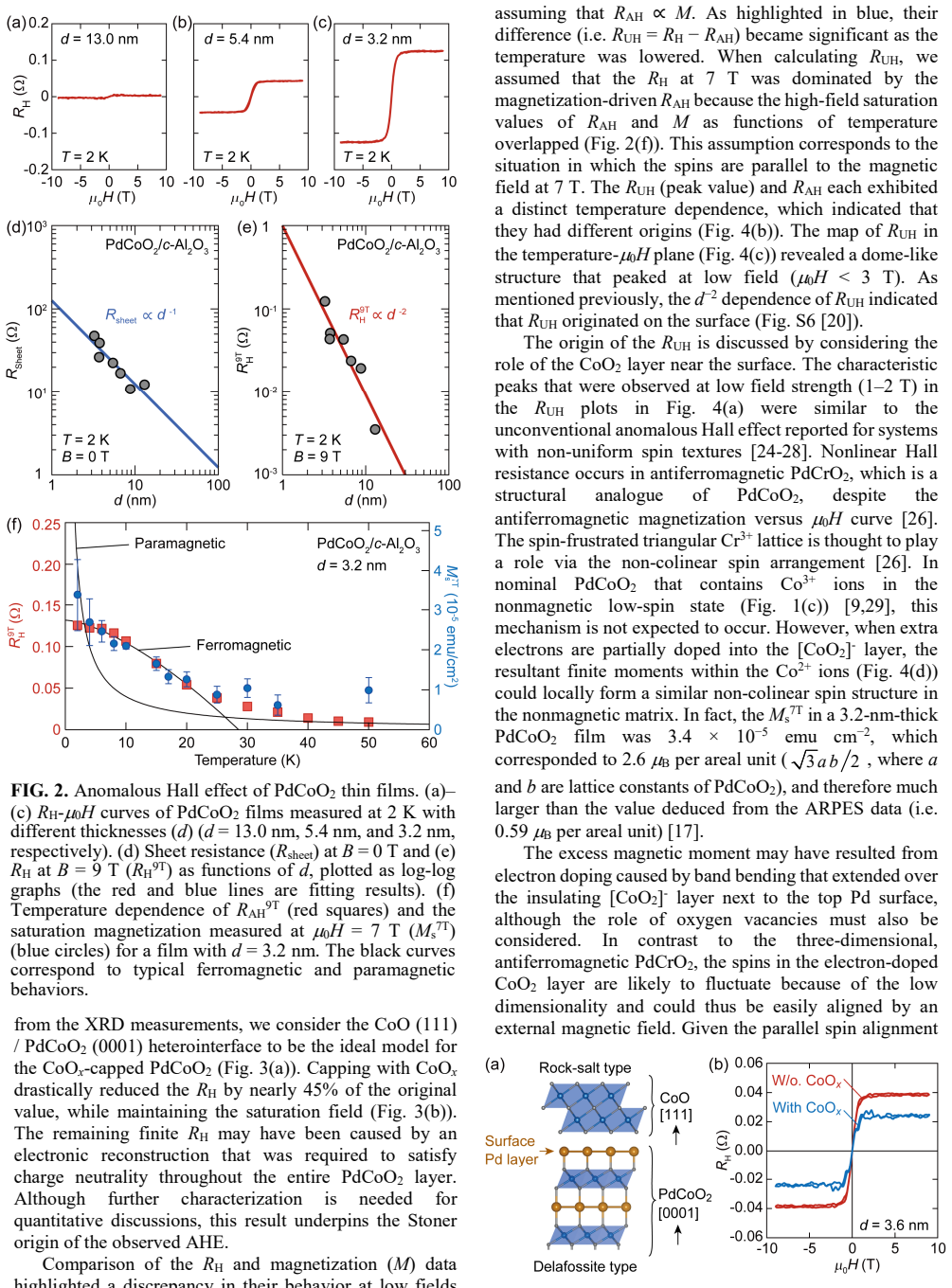
The central claim is that surface charge compensation at the Pd-terminated surface of PdCoO2 dopes extra electrons into the Pd layer, creating a flat band at the Fermi level whose high density of states triggers Stoner splitting and a ferromagnetic surface state. This surface ferromagnetism is detected through an anomalous Hall effect in ultrathin films: the nonlinear part of the Hall resistance scales as $d^{-2}$ with film thickness, as expected if only a finite surface layer of thickness d_s carries the anomalous signal. Systematic measurements show the saturation magnetization follows Bloch-law temperature dependence, and capping with CoOx suppresses the anomalous Hall resistance by nearly half, supporting the surface-Stoner origin. A remaining Hall component, R_UH, is interpreted as an unconventional anomalous Hall effect from non-colinearly ordered moments in electron-doped CoO2 layers near the surface.
Load-bearing premise
The extraction of the anomalous Hall signal assumes that the transverse resistance in the 5–7 T range is exactly a linear ordinary Hall term plus a saturated anomalous term, and that at 7 T the anomalous Hall resistance is strictly proportional to the measured magnetization; any high-field nonlinearity or substrate paramagnetic contribution would bias the decomposition.
Editorial extensions
If this is right
- If the surface ferromagnetism is real, ultrathin PdCoO2 becomes a candidate spin-polarized conductor whose magnetic state can be switched by surface termination rather than by doping.
- The d^-2 scaling gives a practical way to estimate the magnetic dead-layer thickness d_s from transport alone.
- The observed R_UH suggests that electron-doped CoO2 layers support non-colinear spin textures, potentially giving a new route to Berry-phase Hall effects in triangular-lattice oxides.
- Because PdCoO2 already shows hydrodynamic electron flow in bulk, combining surface magnetism with high-mobility transport could enable spin-related hydrodynamic phenomena.
Reading between the lines
- The authors do not spell out that the same surface-ferromagnetic state should produce a spin-polarized current; a spin-valve or spin-torque measurement on a capped versus uncapped Pd-terminated film would test this directly.
- The electron-doped CoO2 interpretation predicts that the residual Hall term R_UH should be tunable by chemical or electrostatic doping of the CoO2 layers; a field-effect experiment on the same films could separate that contribution from the Pd surface term.
- If the 7 T magnetization includes a paramagnetic substrate component, the extracted R_AH and R_UH would be systematically biased; comparing films of different thickness on identical substrates would isolate this, since the authors report Ms7T independent of d.
Signed reviews
Editorial analysis
A structured set of objections, weighed in public.
Referee Report
Summary. The paper reports transport evidence for surface ferromagnetism in ultrathin films of the nonmagnetic delafossite metal PdCoO2. The authors observe a nonlinear Hall resistance that grows with decreasing film thickness, is reduced by CoO_x capping, and tracks the temperature dependence of the saturation magnetization. They attribute this to an anomalous Hall effect arising from Stoner-split ferromagnetic Pd surface bands confined to a thickness d_s near the surface. In addition, they interpret a residual low-field Hall signal R_UH as an unconventional Hall effect originating from electron-doped CoO2 layers with non-collinear spin arrangements. The conclusion explicitly notes that direct observation of the Co valence state, e.g. by XMCD, remains a future challenge.
Significance. If the interpretation is correct, the work provides the first transport evidence for surface ferromagnetism in a nonmagnetic delafossite metal and demonstrates a thin-film strategy to access surface-dominated transport. The study has notable strengths: the systematic thickness and termination dependence, the ARPES observation of Stoner-like splitting at the Pd-terminated surface, and the capping experiment all provide independent support for the surface origin of the signal. The central quantitative claim, however, depends on the subtraction of a linear ordinary Hall background and on the assumption of full magnetic saturation at 7 T; these assumptions are not independently validated in the manuscript. The result is therefore plausible but not yet conclusive, and the extracted R_UH, in particular, is sensitive to the subtraction procedure.
major comments (3)
- [Fig. 2(a)–(c) and Supplemental Fig. S3] The anomalous Hall signal is defined by subtracting a linear ordinary Hall term determined from the 5–7 T range of the transverse resistance. If the high-field transverse resistance still contains curvature from multiband conduction, field-dependent mobility, or an unsaturated magnetic contribution, subtracting a straight line fitted to 5–7 T will manufacture a nonlinear component whose thickness and temperature dependence may mimic the reported AHE. Please provide an independent test of this subtraction, for example by fitting the transverse resistance over different field windows, comparing with a two-band Hall model, or showing that the extracted d^-2 scaling and temperature dependence are robust to the choice of the linear-background range.
- [Fig. 4(a) and corresponding text] The anomalous Hall resistance R_AH is computed from the magnetization M under the explicit assumptions that R_AH ∝ M and that at 7 T the spins are fully aligned. Because R_UH = R_H − R_AH is the difference of two comparable quantities, a small systematic error in the 7 T anchor can produce the low-field dome in Fig. 4(c) even if no unconventional Hall effect exists. Please quantify the sensitivity of R_UH to the normalization choice and, if possible, provide an independent determination of the saturated anomalous Hall contribution, such as measurements at higher fields or a comparison with a magnetic characterization that isolates the surface contribution.
- [Fig. 2(f) and measurement of M_s7T] The similarity between the temperature dependence of R_H^9T and M_s7T is used as evidence for the surface AHE. However, M_s7T is obtained by subtracting only the c-Al2O3 substrate background from the raw magnetization. Any paramagnetic impurity, surface oxide, or high-field susceptibility of the film itself would contribute to M_s7T without necessarily contributing to the anomalous Hall effect, biasing the comparison. The manuscript should state the magnetic background corrections more explicitly and provide error bars for M_s7T.
minor comments (3)
- [Fig. 2(e) and text] The sentence describing the fitting of R_H at 9 T versus d states 'dlog(R_sheet)/dlog(d)' but should read 'dlog(R_H^9T)/dlog(d)'.
- [Throughout] The term 'non-colinear' is misspelled; it should be 'non-collinear'.
- [References] Reference [20] appears as 'http://*****' and should be completed with the actual journal or repository information.
Circularity Check
No circularity: the anomalous Hall signal is extracted by standard background subtraction and compared against an independent surface-Stoner framework; the residual-decomposition assumptions are estimation risks, not circular reductions.
full rationale
The paper's central claim is that a nonlinear Hall resistance in ultrathin PdCoO2 films originates from a surface ferromagnetic state. The derivation chain is not circular: the Stoner-type surface ferromagnetism is taken from independent prior work by Kim, Choi, and Min (ref 17) and from ARPES studies by Mazzola et al. (ref 18), not from the present authors' own results. The present ARPES data are then used to confirm the Pd-terminated surface and the spin-split bands, which is an independent experimental check rather than an input. The Hall-resistance extraction subtracts a linear ordinary term fitted to the 5-7 T range; this is a standard background subtraction, and the residual is presented as an observed signal, not as a prediction forced by the fit. The R_AH curve is computed from magnetization under the explicit assumption R_AH proportional to M, with the 7 T anchor described as an assumption, and R_UH is then defined as the difference R_H minus R_AH. This decomposition is an interpretation of the data rather than a derivation of the phenomenon from the same data; the existence of the low-field residual is not manufactured by the definition, although its physical assignment could be biased if the anchoring assumptions fail. The paper also acknowledges the missing direct observation of the Co valence state, for example by XMCD, as a future challenge, and it states that further characterization is needed for quantitative discussion of the capping experiment. These are explicit limitations and correctness risks, not circular reasoning. No load-bearing step reduces to a self-citation: the thin-film growth recipe cited as ref 19 is a method reference by the same group, but the physical conclusions do not depend on an unverified self-cited theorem or uniqueness claim. The thickness scaling, capping control, and temperature dependence provide external constraints on the surface-origin scenario. Accordingly, the analysis is self-contained and shows no significant circularity.
Assumptions & free parameters
free parameters (2)
- Linear ordinary Hall slope used for subtraction =
not stated; determined from a linear fit over 5 to 7 T
- Surface ferromagnetic layer thickness d_s =
not directly measured
assumptions (5)
- domain assumption Polar surface charge compensation dopes electrons into the Pd surface layer, shifting the surface band and producing Stoner splitting.
- domain assumption The top surface of the grown films is predominantly Pd-terminated.
- domain assumption At 7 T the magnetization is saturated and the anomalous Hall resistance is proportional to M.
- domain assumption The transverse resistance in the 5 to 7 T range is purely a linear ordinary Hall term plus a saturated anomalous term.
- domain assumption A CoOx (111) capping layer mimics a [CoO2]- layer and cancels the surface polarity.
invented entities (1)
-
Electron-doped CoO2 layer with finite Co2+ moments in a non-colinear spin arrangement
Cite this review
Pith. "Pith review of Anomalous Hall effect at the spontaneously electron-doped polar surface of PdCoO2 ultrathin films." pith.science (2026). https://pith.science/paper/TVB6FML7
@misc{pith2026190808173,
  author       = {Pith},
  title        = {Pith review of: Anomalous Hall effect at the spontaneously electron-doped polar surface of PdCoO2 ultrathin films},
  year         = {2026},
  howpublished = {\url{https://pith.science/paper/TVB6FML7}},
  note         = {Machine review of arXiv:1908.08173}
}
read the original abstract
We revealed the electrical transport through surface ferromagnetic states of a nonmagnetic metal PdCoO2. Electronic reconstruction at the Pd-terminated surface of PdCoO2 induces Stoner-like ferromagnetic states, which could lead to spin-related phenomena among the highly conducting electrons in PdCoO2. Fabricating a series of nanometer-thick PdCoO2 thin films, we detected a surface-magnetization-driven anomalous Hall effect via systematic thickness- and termination-dependent measurements. Besides, we discuss that finite magnetic moments in electron doped CoO2 triangular lattices may have given rise to additional unconventional Hall resistance.
Figures


Reference graph
Works this paper leans on
- [1]
-
[2]
S. J. Moon et al., Phys. Rev. Lett. 101 , 226402 (2008)
work page 2008
- [3]
- [4]
-
[5]
R. D. Shannon, D. B. Rogers, and C. T. Prewitt, Inorg. Chem. 10 , 713 (1971)
work page 1971
-
[6]
A. P. Mackenzie, Rep. Prog. Phys. 80 , 032501 (2017)
work page 2017
-
[7]
R. Daou, R. Frésard, V. Eyert, S. Hébert, and A. Maignan, Sci. Technol. Adv. Mater. 18 , 919 (2017)
work page 2017
-
[8]
R. Seshadri, C. Felser, K. Thieme, and W. Treme l, Chem. Mater. 10 , 2189 (1998)
work page 1998
Show all 31 references
-
[9]
Tanaka, M
M. Tanaka, M. Hasegawa, T. Higuchi, T. Tsukamot o, Y. Tezuka, S. Shin, and H. Takei, Physica B 245 , 157 (1998)
1998
-
[10]
Higuchi, M
T. Higuchi, M. Hasegawa, M. Tanaka, H. Takei, S. Shin, and T. Tsukamoto, Jpn. J. Appl. Phys. 43 , 699 (2004)
2004
-
[11]
Eyert, R
V. Eyert, R. Frésard, and A. Maignan, Chem. Ma ter. 20 , 2370 (2008)
2008
-
[12]
M. J. M. de Jong and L. W. Molenkamp, Phys. Re v. B 51 , 13389 (1995)
1995
-
[13]
P. J. W. Moll, P. Kushwaha, N. Nandi, B. Schmi dt, and A. P. Mackenzie, Science 351 , 1061 (2016)
2016
-
[14]
Crossno et al., Science 351 , 1058 (2016)
J. Crossno et al., Science 351 , 1058 (2016)
2016
-
[15]
D. A. Bandurin et al., Science 351 , 1055 (2016)
2016
-
[16]
Gooth et al., Nat
J. Gooth et al., Nat. Commun. 9, 4093 (2018)
2018
-
[17]
K. Kim, H. C. Choi, and B. I. Min, Phys. Rev. B 80 , 035116 (2009)
2009
-
[18]
Mazzola et al., Proc
F. Mazzola et al., Proc. Natl. Acad. Sci. U.S.A. 115 , 12956 (2018)
2018
-
[19]
Harada, K
T. Harada, K. Fujiwara, and A. Tsukazaki, APL Mater. 6, 046107 (2018)
2018
-
[20]
See Supplemental Material at http://***** for detailed information
-
[21]
H.-J. Noh, J. Jeong, J. Jeong, E.-J. Cho, S. B. Kim, K. Kim, B. I. Min, and H.-D. Kim, Phys. Rev. Lett. 102 , 256404 (2009)
2009
-
[22]
Sunko et al., Nature 549 , 492 (2017)
V. Sunko et al., Nature 549 , 492 (2017)
2017
-
[23]
Bloch, Z
F. Bloch, Z. Physik 61 , 206 (1930)
1930
-
[24]
Taguchi, Y
Y. Taguchi, Y. Oohara, H. Yoshizawa, N. Nagaos a, and Y. Tokura, Science 291 , 2573 (2001)
2001
-
[25]
Neubauer, C
A. Neubauer, C. Pfleiderer, B. Binz, A. Rosch, R. Ritz, P. G. Niklowitz, and P. Böni, Phys. Rev. Lett. 102 , 186602 (2009)
2009
-
[26]
Takatsu, S
H. Takatsu, S. Yonezawa, S. Fujimoto, and Y. Maeno, Phys. Rev. Lett. 105 , 137201 (2010)
2010
-
[27]
Matsuno, N
J. Matsuno, N. Ogawa, K. Yasuda, F. Kagawa, W. Koshibae, N. Nagaosa, Y. Tokura, and M. Kawasaki, Sci. Adv. 2, e1600304 (2016)
2016
-
[28]
K. G. Rana et al., New J. Phys. 18 , 085007 (2016)
2016
-
[29]
Noh et al., Phys
H.-J. Noh et al., Phys. Rev. B 80 , 073104 (2009)
2009
-
[30]
Nagaosa, J
N. Nagaosa, J. Sinova, S. Onoda, A. H. MacDonald, and N. P. Ong, Rev. Mod. Phys. 82 , 1539 (2010)
2010
- [31]
Reviewed August 14, 2026 · model on record in the stance chip above.
Discussion (0). Continue with ORCID to comment.