REVIEW 3 major objections 5 minor 1 cited by
Longitudinal weighted and trimmed treatment effects with flip interventions
T0 review · 3 major / 5 minor · reviewed 2026-08-07 · deepseek-v4-flash
Pith's one-line read Weighted average treatment effects are exactly the per-unit effects of stochastic flip interventions, and the same construction extends weighting and trimming to longitudinal data under arbitrary positivity violations.
desk verdict Single-timepoint WATEs get a clean policy interpretation and the longitudinal extension is the first principled trimming-on-non-baseline method with identifiability under positivity violations; the price is strong sequential randomization, and the paper owns that. read the letter →
The pith
A machine-rendered reading of the paper's core claim, the machinery that carries it, and where it could break.
The reading
What carries the argument
The load-bearing object is the flip intervention $D_f(a)$, defined with an independent uniform variable $V$: at each timepoint the assigned treatment is the natural value of treatment if it already equals the target $a$, and otherwise is flipped to $a$ with probability $f(H)$. This single mechanism converts a weighting or trimming estimand into a contrast of two stochastic modified treatment policies. In the longitudinal version the intervention propensity score $Q_t(a \mid h) = P(A_t = a \mid h) + f_t(h)(1 - P(A_t = a \mid h))$ replaces the usual propensity score, giving g-formula and inverse-probability identification in Theorem 1; a debiased sequential pseudo-outcome based on the efficient influence function carries the estimation, yielding the multiply robust and sequentially doubly robust guarantees.
What would settle it
A simulation with two timepoints in which an unmeasured baseline variable affects both the first treatment and the final outcome would settle the role of the key assumption: if the flip-effect estimator, using only measured histories, converges to the true zero effect despite the confounder, then strong sequential randomization is stronger than needed; if it shows bias away from zero, the assumption is load-bearing.
Extended reading notes
Core claim
On the paper's own terms, the central discovery is that flip interventions exactly represent weighted average treatment effects: Proposition 1 shows $\psi_f = E[E(Y(1)-Y(0)\mid X) f(X)] / E[f(X)]$, so every weighted average treatment effect with weights in $[0,1]$ is the per-unit treatment effect of two implementable stochastic policies. In longitudinal data, a time-indexed version of these interventions targets a full treatment regime, flips only subjects who would not have taken the target treatment, and uses weights built from time-varying natural propensity scores; Theorem 1 identifies the resulting causal effects under strong sequential randomization whenever the weight vanishes where the target propensity is zero, or positivity holds otherwise. The paper argues that these longitudinal flip effects are single-world, hence practically implementable, while direct extensions of trimming that condition on both regimes are cross-world and cannot be implemented. For smooth weights it gives the efficient influence function, plus estimators whose bias is bounded by products of nuisance errors and that are asymptotically normal under rate conditions.
Load-bearing premise
The paper's primary identification result requires strong sequential randomization: at every timepoint, the observed treatment must be independent of future covariates, future treatments, and the final outcome once the measured past is conditioned on, so unmeasured common causes of treatment and later variables would break the effect estimates.
Editorial extensions
If this is right
- Every weighted average treatment effect with weights in $[0,1]$ gets a policy interpretation as the per-unit effect of two flip interventions, so covariate-balancing weights can be described as an implementable policy contrast.
- Longitudinal weighting and trimming can be applied to non-baseline covariates and remain identifiable under arbitrary positivity violations, removing the need to restrict trimming to baseline covariates.
- Direct longitudinal trimmed estimands that condition on propensity scores under both regimes are cross-world and cannot be implemented, making the flip-intervention version the practical alternative.
- For smooth weights, the multiply robust and sequentially doubly robust estimators reach root-n consistency and asymptotic normality when products of nuisance errors vanish at rate $n^{-1/2}$, with the sequentially doubly robust guarantee being new for stochastic longitudinal modified treatment policies.
- The illustrative analysis estimates that union membership raised 1983 log wages by about 6% per worker shifted into union membership per timepoint.
Reading between the lines
- An extension the paper leaves implicit: because flip interventions are single-world and implementable, the same identification and estimator machinery could target data-adaptive weights such as a chosen trimming threshold and still be understood as a well-defined policy effect.
- The link the paper notes to maximally coupled policies suggests a sensitivity-analysis route: bounding the flip probability under unmeasured confounding would turn each flip effect into an interval, directly addressing the assumption flagged as weakest.
- The per-timepoint absolute-difference denominator in the longitudinal effect could be replaced by other treatment-distribution distances, such as average switching probability or an $f$-divergence, changing the interpretation and offering testable alternatives on the same estimands.
- A natural testable extension is categorical treatment: flipping to a target category with probability proportional to the weight would preserve the single-world property, though the per-unit treatment interpretation would need a generalized denominator.
Editorial analysis
A structured set of objections, weighed in public.
Referee Report
Summary. The paper proposes 'flip' interventions, stochastic treatment policies that keep treatment as observed for subjects already taking the target value and otherwise flip the subject to the target with probability given by a weight function, and shows that in single-timepoint data the resulting interventional effect equals a weighted average treatment effect (Proposition 1). It then extends the construction to longitudinal data, defining flip interventions at each time based on the natural value of treatment, and claims identification under arbitrary positivity violations when the weight vanishes at propensity scores equal to zero (Theorem 1). The paper derives an efficient influence function for smooth weights (Proposition 4), constructs multiply robust and sequentially doubly robust estimators (Algorithms 1 and 2) with bias bounds (Theorems 2 and 3) and weak-convergence corollaries, and illustrates the methods with a wage-panel analysis of union membership. The appendix contains proofs, additional estimation results for the average treatment value, and a simulation study.
Significance. If the results hold, the paper makes a useful contribution by giving a policy interpretation to a broad class of weighted average treatment effects and by proposing a longitudinal generalization of weighting and trimming that remains well defined under positivity violations. The single-timepoint equivalence in Proposition 1 is simple but likely new and of independent interest, and the proposed estimators extend existing LMTP theory to stochastic interventions whose intervention propensity scores are estimated. The paper also ships reproducible code and a data analysis, which strengthens the contribution. The main caveat is that the intuitive longitudinal flip intervention requires the stronger of the two sequential randomization assumptions, and the identification claim in the abstract should be read with this caveat.
major comments (3)
- [Section 3.1, Definition 3, Theorem 1, Remark 3] The longitudinal flip intervention in Definition 3 depends on the natural value of treatment At(Dt-1). Consequently, Theorem 1's identification proof relies on Lemma 3, which requires Assumption 2 (strong sequential randomization), not the standard Assumption 1. The paper acknowledges in Remark 3 that under Assumption 1 one can use a modified intervention that does not depend on the natural treatment value, but that modified intervention is a different stochastic policy and loses the 'flip if you would not have taken the target' interpretation. As written, the paper's headline longitudinal claim--that flip interventions are identifiable under standard conditions--is therefore conditional on the stronger, unverifiable Assumption 2. The manuscript should either reframe the central longitudinal estimand as requiring Assumption 2 and present the Assumption 1 variant as a separate intervention with its own interpretation, or develop identification and estimation results for the Assumption 1 variant and state explicitly how its estimand relates to the flip effect.
- [Abstract and Section 4.1, Theorem 1] The abstract states that flip interventions 'yield effects that are identifiable under arbitrary positivity violations,' but Theorem 1 requires either that the weight function is zero whenever the target propensity score is zero (condition 1) or that positivity holds for the target treatment (condition 2). This is a real limitation, not a presentation nuance: for weights such as 'no weighting' or weights targeting the non-target treatment, the effect is not identified without a positivity assumption. The paper should state this condition more prominently, including in the abstract, so that readers do not overgeneralize the robustness claim.
- [Section 5.3, Theorem 2] The two bias bounds in Theorem 2 are stated as holding simultaneously, and the proof derives them by two different decompositions, one 'backwards-in-time' and one 'forwards-in-time.' However, the statement of the theorem uses the same notation emt(At,Ht) in both bounds, while the proof distinguishes the backwards and forwards definitions of the sequential regression error. This makes it difficult for the reader to verify the claimed minimum. The authors should separate the two bounds into clearly labeled lemmas or state the two decompositions with distinct notation for the two versions of emt, so the claim that the bias is bounded by the minimum of the two expressions is directly checkable.
minor comments (5)
- [Section 2, Definition 2] The denominator in (3) is written as E{Df(1) - Df(0)}; since this equals E[f(X)], the notation is correct, but it would help to state explicitly that the denominator is assumed nonzero, as is standard for WATEs.
- [Section 4.1, Remark 3] The notation Dft(at) in Definition 3 is reused for both a single-time intervention and a sequence of interventions; the paper should clarify when Dt denotes the entire sequence versus a single timepoint to avoid confusion in statements such as 'Dft(at) = 1(...)'.
- [Section 6, Table 3] The text says a log-wage difference of 0.059 corresponds to a roughly 6% wage increase; it might be more precise to say the expected percent change is approximately exp(0.059)-1, which is about 6.1%, and to avoid interpreting the log scale as exactly a percentage.
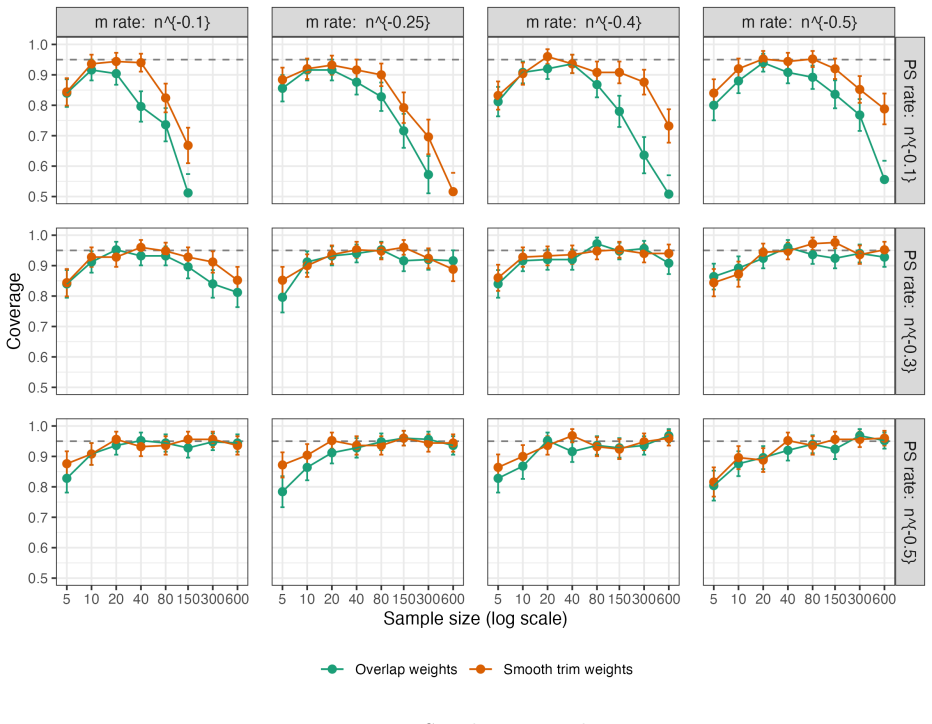
- [Appendix B, Simulation study] The simulation description says that 'data points with coverage less than 0.5 were omitted from the figure.' This should be justified: omitting failed convergence cases from a coverage plot can make the estimator's behavior appear better than it is, and the figure should either include all runs or the paper should show a separate display for the non-convergent cases.
- [Section 5.1, Eq. (10)] In the recursive definition of mt(bt,ht), the notation Qt+1(bt+1 | Ht+1) is used, but the definition of the sequential regression in (10) should make clear that the expectation is over future covariates under the natural regime, not under the intervention; a brief clarifying sentence would help readers unfamiliar with LMTP notation.
Circularity Check
No significant circularity: the flip/WATE equivalence is derived from definitions, and the longitudinal identification and efficiency results are proved in the paper's own appendices.
full rationale
The central single-timepoint claim is a direct derivation, not an assumed input: Definition 2 defines psi_f = E[Y{Df(1)}-Y{Df(0)}]/E[Df(1)-Df(0)], and the proof of Proposition 1 (Appendix C) uses consistency plus V independent of (Y(0),Y(1)) given X to obtain E[Y{Df(1)}-Y{Df(0)}]=E[f(X)E{Y(1)-Y(0)|X}] and E[Df(1)-Df(0)]=E[f(X)]; no fitted parameter is relabeled as a prediction. The longitudinal identification claim (Theorem 1) is likewise proved from the NPSEM, consistency, Assumption 2, and Lemma 5 in Appendix D, rather than imported by citation; the stronger Assumption 2 is explicitly flagged as the cost of the intuitive natural-value flip, and point 3 of Section 4.1 provides a modified intervention under standard sequential randomization. The paper cites the authors' earlier S-LMTP work (Diaz et al. 2023) and maximally coupled policies (Levis et al. 2024), but those citations supply context and vocabulary, not the identification or efficiency results; the proofs of the efficient influence function, multiply robust bounds, and sequential double robustness are carried out in Appendix E. The acknowledged limitations (strong sequential randomization, cross-world alternatives, open robustness question) are validity and interpretation concerns, not circular reductions. Hence the derivation chain is self-contained and no circular step is present.
Assumptions & free parameters
free parameters (2)
- Smooth trimming scale k in data application =
20
- Trimming threshold epsilon =
User-specified, e.g., epsilon appearing in trimming and smooth trimming weights
assumptions (6)
- domain assumption The observed data arise from a nonparametric structural equation model with deterministic functions and independent exogenous variables.
- domain assumption Consistency holds and there is no interference between subjects, embedded in the NPSEM framework.
- domain assumption Assumption 1: standard sequential randomization UA,t independent of future exogenous variables given Ht.
- domain assumption Assumption 2: strong sequential randomization UA,t independent of {UX,t+1, UA,t+1, UY} given Ht.
- domain assumption Auxiliary random variables V1,...,VT are iid uniform and independent of the observed data Z.
- domain assumption The weight function is smooth: twice differentiable with bounded derivatives, and the ratio rt = Qt/Pt is uniformly bounded.
Cite this review
Pith. "Pith review of Longitudinal weighted and trimmed treatment effects with flip interventions." pith.science (2026). https://pith.science/paper/TVEJGA6L
@misc{pith2026250609188,
  author       = {Pith},
  title        = {Pith review of: Longitudinal weighted and trimmed treatment effects with flip interventions},
  year         = {2026},
  howpublished = {\url{https://pith.science/paper/TVEJGA6L}},
  note         = {Machine review of arXiv:2506.09188}
}
read the original abstract
Weighting and trimming are popular methods for addressing positivity violations in causal inference. While well-studied with single-timepoint data, standard methods do not easily generalize to address non-baseline positivity violations in longitudinal data, and remain vulnerable to such violations. In this paper, we extend weighting and trimming to longitudinal data via stochastic ``flip'' interventions, which maintain the treatment status of subjects who would have received the target treatment, and flip others' treatment to the target with probability equal to their weight (e.g., overlap weight, trimming indicator). We first show, in single-timepoint data, that flip interventions yield a large class of weighted average treatment effects, ascribing a novel policy interpretation to these popular weighted estimands. With longitudinal data, we then show that flip interventions provide interpretable weighting or trimming on non-baseline covariates and, crucially, yield effects that are identifiable under arbitrary positivity violations. Moreover, we demonstrate that flip interventions are policy-relevant since they could be implemented in practice. By contrast, we show that alternative approaches for weighting on non-baseline covariates fail to achieve this property. We derive flexible and efficient estimators based on efficient influence functions when the weight is a smooth function of the propensity score. Namely, we construct multiply robust-style and sequentially doubly robust-style estimators that achieve root-n consistency and asymptotic normality under nonparametric conditions. Finally, we demonstrate our methods through an analysis of the effect of union membership on earnings.
Figures


Forward citations
Cited by 1 Pith paper
-
Propensity score weighting across counterfactual worlds: longitudinal effects under positivity violations
A proposed longitudinal cross-world weighting estimand is not identified by the proof given, because the derivation silently assumes the two regimes' counterfactual covariate processes coincide.
Reference graph
Works this paper leans on
-
[1]
Insights into the cross-world independence assumption of causal mediation analysis
Ryan M Andrews and Vanessa Didelez. Insights into the cross-world independence assumption of causal mediation analysis. Epidemiology, 32 0 (2): 0 209--219, 2021
2021
-
[2]
Efficient and adaptive estimation for semiparametric models, volume 4
Peter J Bickel, Chris AJ Klaassen, Y Ritov, and JA Wellner. Efficient and adaptive estimation for semiparametric models, volume 4. Springer, 1993
1993
-
[3]
Incremental causal effects: an introduction and review
Matteo Bonvini, Alec McClean, Zach Branson, and Edward H Kennedy. Incremental causal effects: an introduction and review. In Handbook of matching and weighting adjustments for causal inference, pages 349--372. Chapman and Hall/CRC, 2023
work page 2023
-
[4]
Causal effect estimation after propensity score trimming with continuous treatments
Zach Branson, Edward H Kennedy, Sivaraman Balakrishnan, and Larry Wasserman. Causal effect estimation after propensity score trimming with continuous treatments. arXiv preprint arXiv:2309.00706, 2023
arXiv 2023
-
[5]
Debiased machine learning without sample-splitting for stable estimators
Qizhao Chen, Vasilis Syrgkanis, and Morgane Austern. Debiased machine learning without sample-splitting for stable estimators. Advances in Neural Information Processing Systems, 35: 0 3096--3109, 2022
work page 2022
-
[6]
Double/debiased machine learning for treatment and structural parameters
Victor Chernozhukov, Denis Chetverikov, Mert Demirer, Esther Duflo, Christian Hansen, Whitney Newey, and James Robins. Double/debiased machine learning for treatment and structural parameters. The Econometrics Journal, 21 0 (1): 0 C1--C68, 2018
2018
-
[7]
Balancing weights for causal inference
Eric R Cohn, Eli Ben-Michael, Avi Feller, and Jos \'e R Zubizarreta. Balancing weights for causal inference. In Handbook of Matching and Weighting Adjustments for Causal Inference, pages 293--312. Chapman and Hall/CRC, 2023
work page 2023
-
[8]
Dealing with limited overlap in estimation of average treatment effects
Richard K Crump, V Joseph Hotz, Guido W Imbens, and Oscar A Mitnik. Dealing with limited overlap in estimation of average treatment effects. Biometrika, 96 0 (1): 0 187--199, 2009
2009
Show all 66 references
-
[9]
Population intervention causal effects based on stochastic interventions
Iv \'a n D \' az and Mark van der Laan. Population intervention causal effects based on stochastic interventions. Biometrics, 68 0 (2): 0 541--549, 2012
2012
-
[10]
Nonparametric causal effects based on longitudinal modified treatment policies
Iv \'a n D \' az, Nicholas Williams, Katherine L Hoffman, and Edward J Schenck. Nonparametric causal effects based on longitudinal modified treatment policies. Journal of the American Statistical Association, 118 0 (542): 0 846--857, 2023
2023
-
[11]
A distribution-free theory of nonparametric regression, volume 1
L \'a szl \'o Gy \"o rfi, Michael Kohler, Adam Krzyzak, Harro Walk, et al. A distribution-free theory of nonparametric regression, volume 1. Springer, 2002
2002
-
[12]
Entropy balancing for causal effects: A multivariate reweighting method to produce balanced samples in observational studies
Jens Hainmueller. Entropy balancing for causal effects: A multivariate reweighting method to produce balanced samples in observational studies. Political analysis, 20 0 (1): 0 25--46, 2012
2012
-
[13]
Estimation of the effect of interventions that modify the received treatment
Sebastian Haneuse and Andrea Rotnitzky. Estimation of the effect of interventions that modify the received treatment. Statistics in medicine, 32 0 (30): 0 5260--5277, 2013
2013
-
[14]
Policy-relevant treatment effects
James J Heckman and Edward Vytlacil. Policy-relevant treatment effects. American Economic Review, 91 0 (2): 0 107--111, 2001
2001
-
[15]
Structural equations, treatment effects, and econometric policy evaluation 1
James J Heckman and Edward Vytlacil. Structural equations, treatment effects, and econometric policy evaluation 1. Econometrica, 73 0 (3): 0 669--738, 2005
2005
-
[16]
Causal Inference: What if
Miguel Hern\' a n and James Robins. Causal Inference: What if. Boca Raton: Chapman & Hall/CRC, 2020
2020
-
[17]
Robust estimation of inverse probability weights for marginal structural models
Kosuke Imai and Marc Ratkovic. Robust estimation of inverse probability weights for marginal structural models. Journal of the American Statistical Association, 110 0 (511): 0 1013--1023, 2015
2015
-
[18]
Identification and responses to positivity violations in longitudinal studies: an illustration based on invasively mechanically ventilated icu patients
Aksel KG Jensen, Theis Lange, Olav L Schj rring, and Maya L Petersen. Identification and responses to positivity violations in longitudinal studies: an illustration based on invasively mechanically ventilated icu patients. Biostatistics & Epidemiology, 8 0 (1): 0 e2347709, 2024
2024
-
[19]
Demystifying double robustness: A comparison of alternative strategies for estimating a population mean from incomplete data
Joseph DY Kang and Joseph L Schafer. Demystifying double robustness: A comparison of alternative strategies for estimating a population mean from incomplete data. Statistical Science, 22 0 (4): 0 523--539, 2007
2007
-
[20]
Semiparametric counterfactual density estimation
Edward Kennedy, Sivaraman Balakrishnan, and Larry Wasserman. Semiparametric counterfactual density estimation. Biometrika, 110 0 (4): 0 875--896, 2023
2023
-
[21]
Nonparametric causal effects based on incremental propensity score interventions
Edward H Kennedy. Nonparametric causal effects based on incremental propensity score interventions. Journal of the American Statistical Association, 114 0 (526): 0 645--656, 2019
2019
-
[22]
Towards optimal doubly robust estimation of heterogeneous causal effects
Edward H Kennedy. Towards optimal doubly robust estimation of heterogeneous causal effects. Electronic Journal of Statistics, 17 0 (2): 0 3008--3049, 2023
2023
-
[23]
Non-parametric methods for doubly robust estimation of continuous treatment effects
Edward H Kennedy, Zongming Ma, Matthew D McHugh, and Dylan S Small. Non-parametric methods for doubly robust estimation of continuous treatment effects. Journal of the Royal Statistical Society Series B: Statistical Methodology, 79 0 (4): 0 1229--1245, 2017
2017
-
[24]
Sharp instruments for classifying compliers and generalizing causal effects
Edward H Kennedy, Sivaraman Balakrishnan, and Max G’Sell. Sharp instruments for classifying compliers and generalizing causal effects. The Annals of Statistics, 48 0 (4): 0 2008--2030, 2020
2008
-
[25]
Doubly-robust and heteroscedasticity-aware sample trimming for causal inference
Samir Khan and Johan Ugander. Doubly-robust and heteroscedasticity-aware sample trimming for causal inference. arXiv preprint arXiv:2210.10171, 2022
2022 arXiv
-
[26]
Stochastic interventions, sensitivity analysis, and optimal transport
Alexander W Levis, Edward H Kennedy, Alec McClean, Sivaraman Balakrishnan, and Larry Wasserman. Stochastic interventions, sensitivity analysis, and optimal transport. arXiv preprint arXiv:2411.14285, 2024
2024 arXiv
-
[27]
Propensity score weighting for causal inference with multiple treatments
Fan Li and Fan Li. Propensity score weighting for causal inference with multiple treatments. The Annals of Applied Statistics, 13 0 (4): 0 2389--2415, 2019
2019
-
[28]
Balancing covariates via propensity score weighting
Fan Li, Kari Lock Morgan, and Alan M Zaslavsky. Balancing covariates via propensity score weighting. Journal of the American Statistical Association, 113 0 (521): 0 390--400, 2018
2018
-
[29]
Sequential double robustness in right-censored longitudinal models
Alexander R Luedtke, Oleg Sofrygin, Mark J van der Laan, and Marco Carone. Sequential double robustness in right-censored longitudinal models. arXiv preprint arXiv:1705.02459, 2017
2017 arXiv
-
[30]
Nonparametric estimation of conditional incremental effects
Alec McClean, Zach Branson, and Edward H Kennedy. Nonparametric estimation of conditional incremental effects. Journal of Causal Inference, 12 0 (1): 0 20230024, 2024 a
2024
-
[31]
Fair comparisons of causal parameters with many treatments and positivity violations
Alec McClean, Yiting Li, Sunjae Bae, Mara A McAdams-DeMarco, Iv \'a n D \' az, and Wenbo Wu. Fair comparisons of causal parameters with many treatments and positivity violations. arXiv preprint arXiv:2410.13522, 2024 b
2024
-
[32]
Causal inference in epidemiological studies with strong confounding
Kelly L Moore, Romain Neugebauer, Mark J van der Laan, and Ira B Tager. Causal inference in epidemiological studies with strong confounding. Statistics in medicine, 31 0 (13): 0 1380--1404, 2012
2012
-
[33]
Causality
Judea Pearl. Causality. Cambridge University Press, 2009
2009
-
[34]
Diagnosing and responding to violations in the positivity assumption
Maya L Petersen, Kristin E Porter, Susan Gruber, Yue Wang, and Mark J Van Der Laan. Diagnosing and responding to violations in the positivity assumption. Statistical methods in medical research, 21 0 (1): 0 31--54, 2012
2012
-
[35]
SuperLearner: Super Learner Prediction, 2024
Eric Polley, Erin LeDell, Chris Kennedy, and Mark van der Laan . SuperLearner: Super Learner Prediction, 2024. URL https://CRAN.R-project.org/package=SuperLearner. R package version 2.0-29
2024
-
[36]
R: A Language and Environment for Statistical Computing
R Core Team . R: A Language and Environment for Statistical Computing. R Foundation for Statistical Computing, Vienna, Austria, 2024. URL https://www.R-project.org/
2024
-
[37]
Single world intervention graphs (swigs): A unification of the counterfactual and graphical approaches to causality
Thomas S Richardson and James M Robins. Single world intervention graphs (swigs): A unification of the counterfactual and graphical approaches to causality. Center for the Statistics and the Social Sciences, University of Washington Series. Working Paper, 128 0 (30): 0 2013, 2013
2013
-
[38]
A new approach to causal inference in mortality studies with a sustained exposure period—application to control of the healthy worker survivor effect
James Robins. A new approach to causal inference in mortality studies with a sustained exposure period—application to control of the healthy worker survivor effect. Mathematical modelling, 7 0 (9-12): 0 1393--1512, 1986
1986
-
[39]
Higher order influence functions and minimax estimation of nonlinear functionals
James Robins, Lingling Li, Eric Tchetgen Tchetgen, and Aad van der Vaart. Higher order influence functions and minimax estimation of nonlinear functionals. In Institute of Mathematical Statistics Collections, pages 335--421. Institute of Mathematical Statistics, 2008
2008
-
[40]
Effects of multiple interventions
James M Robins, Miguel A Hern \'a n, and Uwe Siebert. Effects of multiple interventions. Comparative quantification of health risks: global and regional burden of disease attributable to selected major risk factors, 1: 0 2191--2230, 2004
2004
-
[41]
On the multiply robust estimation of the mean of the g-functional
Andrea Rotnitzky, James Robins, and Lucia Babino. On the multiply robust estimation of the mean of the g-functional. arXiv preprint arXiv:1705.08582, 2017
2017 arXiv
-
[42]
Characterization of parameters with a mixed bias property
Andrea Rotnitzky, Ezequiel Smucler, and James M Robins. Characterization of parameters with a mixed bias property. Biometrika, 108 0 (1): 0 231--238, 2021
2021
-
[43]
A doubly robust censoring unbiased transformation
Daniel Rubin and Mark J van der Laan. A doubly robust censoring unbiased transformation. The international journal of biostatistics, 3 0 (1), 2007
2007
-
[44]
Incremental effects for continuous exposures
Kyle Schindl, Shuying Shen, and Edward H Kennedy. Incremental effects for continuous exposures. arXiv preprint arXiv:2409.11967, 2024
2024
-
[45]
Introductory Econometrics: A Modern Approach, 7e
Justin M. Shea. wooldridge: 115 Data Sets from "Introductory Econometrics: A Modern Approach, 7e" by Jeffrey M. Wooldridge, 2024. URL https://CRAN.R-project.org/package=wooldridge. R package version 1.4-4
2024
-
[46]
Optimal regimes for algorithm-assisted human decision-making
Mats J Stensrud, JD Laurendeau, and Aaron L Sarvet. Optimal regimes for algorithm-assisted human decision-making. Biometrika, page asae016, 2024
2024
-
[47]
Nonparametric policy analysis
James H Stock. Nonparametric policy analysis. Journal of the American Statistical Association, 84 0 (406): 0 567--575, 1989
1989
-
[48]
Intervening on risk factors for coronary heart disease: an application of the parametric g-formula
Sarah L Taubman, James M Robins, Murray A Mittleman, and Miguel A Hern \'a n. Intervening on risk factors for coronary heart disease: an application of the parametric g-formula. International journal of epidemiology, 38 0 (6): 0 1599--1611, 2009
2009
-
[49]
On causal inference in the presence of interference
Eric J Tchetgen Tchetgen and Tyler J VanderWeele. On causal inference in the presence of interference. Statistical methods in medical research, 21 0 (1): 0 55--75, 2012
2012
-
[50]
rpart: Recursive Partitioning and Regression Trees, 2023
Terry Therneau and Beth Atkinson. rpart: Recursive Partitioning and Regression Trees, 2023. URL https://CRAN.R-project.org/package=rpart. R package version 4.1.23
2023
-
[51]
Semiparametric theory and missing data, volume 4
Anastasios A Tsiatis. Semiparametric theory and missing data, volume 4. Springer, 2006
2006
-
[52]
Causal effect models for realistic individualized treatment and intention to treat rules
Mark J van der Laan and Maya L Petersen. Causal effect models for realistic individualized treatment and intention to treat rules. The international journal of biostatistics, 3 0 (1), 2007
2007
-
[53]
Asymptotic statistics, volume 3
Aad W van der Vaart. Asymptotic statistics, volume 3. Cambridge University Press, 2000
2000
-
[54]
Weak convergence and empirical processes
Aad W van der Vaart and Jon A Wellner. Weak convergence and empirical processes. Springer, 1996
1996
-
[55]
On model selection and model misspecification in causal inference
Stijn Vansteelandt, Maarten Bekaert, and Gerda Claeskens. On model selection and model misspecification in causal inference. Statistical methods in medical research, 21 0 (1): 0 7--30, 2012
2012
-
[56]
Whose wages do unions raise? a dynamic model of unionism and wage rate determination for young men
Francis Vella and Marno Verbeek. Whose wages do unions raise? a dynamic model of unionism and wage rate determination for young men. Journal of Applied Econometrics, 13 0 (2): 0 163--183, 1998
1998
-
[57]
Dynamic covariate balancing: estimating treatment effects over time
Davide Viviano and Jelena Bradic. Dynamic covariate balancing: estimating treatment effects over time. arXiv preprint arXiv:2103.01280, 2021
2021
-
[58]
On the asymptotic distribution of differentiable statistical functions
Richard von Mises. On the asymptotic distribution of differentiable statistical functions. The annals of mathematical statistics, 18 0 (3): 0 309--348, 1947
1947
-
[59]
Intervention treatment distributions that depend on the observed treatment process and model double robustness in causal survival analysis
Lan Wen, Julia L Marcus, and Jessica G Young. Intervention treatment distributions that depend on the observed treatment process and model double robustness in causal survival analysis. Statistical methods in medical research, 32 0 (3): 0 509--523, 2023
2023
-
[60]
lmtp: An r package for estimating the causal effects of modified treatment policies
Nicholas Williams and Iván Díaz. lmtp: An r package for estimating the causal effects of modified treatment policies. Observational Studies, 2023. URL https://muse.jhu.edu/article/883479
2023
-
[61]
Wright and Andreas Ziegler
Marvin N. Wright and Andreas Ziegler. ranger : A fast implementation of random forests for high dimensional data in C++ and R . Journal of Statistical Software, 77 0 (1): 0 1--17, 2017. doi:10.18637/jss.v077.i01
2017 doi
-
[62]
Asymptotic inference of causal effects with observational studies trimmed by the estimated propensity scores
Shu Yang and Peng Ding. Asymptotic inference of causal effects with observational studies trimmed by the estimated propensity scores. Biometrika, 105 0 (2): 0 487--493, 2018
2018
-
[63]
Identification, estimation and approximation of risk under interventions that depend on the natural value of treatment using observational data
Jessica G Young, Miguel A Hern \'a n, and James M Robins. Identification, estimation and approximation of risk under interventions that depend on the natural value of treatment using observational data. Epidemiologic methods, 3 0 (1): 0 1--19, 2014
2014
-
[64]
Propensity score weighting analysis of survival outcomes using pseudo-observations
Shuxi Zeng, Fan Li, and Liangyuan Hu. Propensity score weighting analysis of survival outcomes using pseudo-observations. Statistica Sinica, 33 0 (3): 0 2161--2184, 2023
2023
-
[65]
Asymptotic theory for cross-validated targeted maximum likelihood estimation
Wenjing Zheng and Mark J van der Laan. Asymptotic theory for cross-validated targeted maximum likelihood estimation. U.C. Berkeley Division of Biostatistics Working Paper Series, 2010
2010
-
[66]
Marginal interventional effects
Xiang Zhou and Aleksei Opacic. Marginal interventional effects. arXiv preprint arXiv:2206.10717, 2022
2022
Reviewed August 7, 2026 · model on record in the stance chip above.
Discussion (0). Sign in to comment.