Constraining boundary conditions in non-rational CFTs
Pith reviewed 2026-05-22 22:28 UTC · model grok-4.3
The pith
Proposed extra boundary states in the compact free boson CFT at irrational radii yield a continuous open-string spectrum but carry a divergent g-function and possible cluster violations.
A machine-rendered reading of the paper's core claim, the machinery that carries it, and where it could break.
Core claim
Besides the standard Neumann and Dirichlet boundary states, a one-parameter family of additional boundary states exists when the radius is an irrational multiple of the self-dual radius. These states possess a continuous open-string spectrum whose density of states is given by an explicit formula. The states exhibit pathologies: their g-function diverges and they may violate the cluster condition.
What carries the argument
The one-parameter family of boundary states at irrational radii, which permits direct computation of the open-string density of states and the g-function.
If this is right
- The open-string spectrum between these states is continuous rather than discrete.
- An explicit density-of-states formula governs the open channel.
- The g-function for these states diverges.
- These states may violate the cluster condition.
- Only Neumann and Dirichlet boundary conditions remain free of these pathologies.
Where Pith is reading between the lines
- Ruling out the extra states would mean non-rational CFTs admit fewer consistent boundaries than their rational counterparts.
- Analogous one-parameter families in other non-rational models may display similar divergences.
- The divergence of the g-function could signal that the usual boundary-state formalism itself breaks down at irrational radii.
- A lattice regularization of the free boson might allow numerical tests of the cluster condition for these states.
Load-bearing premise
The previously proposed one-parameter family of boundary states can be realized inside the CFT and standard techniques suffice to compute their spectrum and g-function without further hidden inconsistencies.
What would settle it
An explicit evaluation of the g-function for a concrete irrational radius (such as R = sqrt(2) R_sd) that shows whether the result remains finite or diverges, or a direct check of four-point functions on the boundary to test the cluster condition.
Figures
read the original abstract
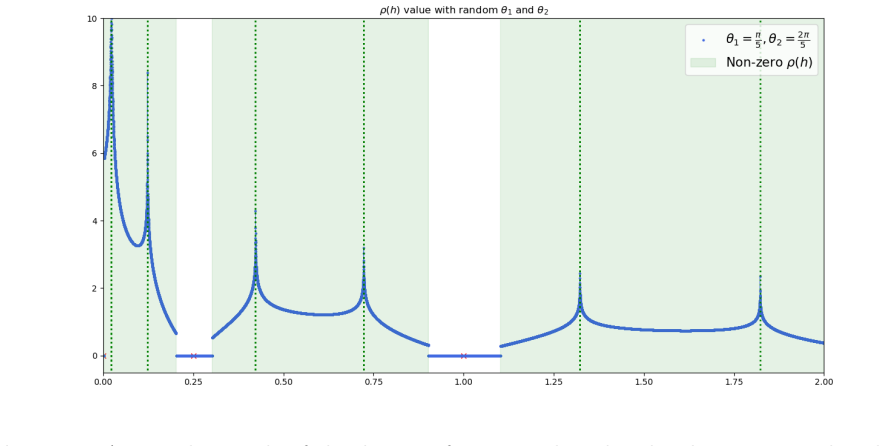
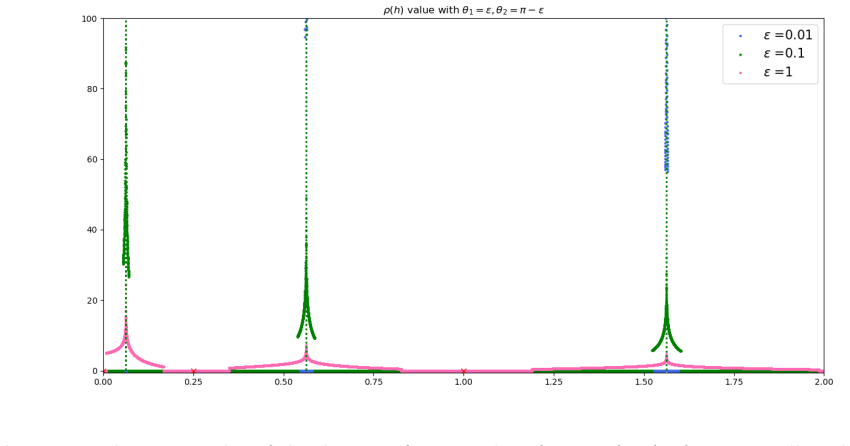
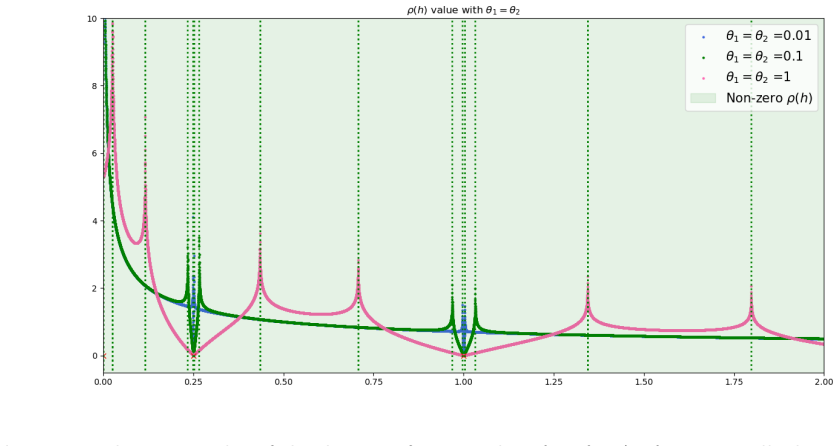
We revisit the question of conformal boundary conditions in the compact free boson CFT in two dimensions. Besides the well-known Neumann and Dirichlet cases, there is an additional proposed one-parameter family of boundary states when the radius is an irrational multiple of the self-dual radius. These additional states have a continuous open string spectrum, and we give an explicit formula for the density of states. We also discuss several pathologies of these states, including the possible violation of the cluster condition, and that they have a divergent g-function.
Editorial analysis
A structured set of objections, weighed in public.
Referee Report
Summary. The manuscript revisits conformal boundary conditions in the compact free boson CFT. Besides the standard Neumann and Dirichlet boundary states, it proposes an additional one-parameter family of boundary states when the compactification radius is an irrational multiple of the self-dual radius. These states are stated to possess a continuous open-string spectrum, for which an explicit density-of-states formula is derived; the authors further analyze pathologies including possible violation of the cluster condition and divergence of the g-function.
Significance. If the derivations hold, the work is significant for constraining the space of consistent boundary conditions in non-rational CFTs by exhibiting concrete pathologies (continuous spectrum, cluster violation, divergent g-function) that rule out the proposed family. The explicit density formula constitutes a concrete, falsifiable output that can be checked against other CFT techniques.
minor comments (3)
- [Abstract] The abstract states that an explicit density-of-states formula is given, but the manuscript should cross-reference the precise equation or section (e.g., §4, Eq. (12)) where the formula appears and where its derivation from the boundary state overlap is shown.
- [§2] Notation for the irrational radius parameter (denoted R in the abstract) should be introduced with a clear definition in §2 to avoid confusion with the conventional radius variable used for Neumann/Dirichlet cases.
- [§5] The discussion of the cluster-condition violation would benefit from a short explicit check (e.g., a two-point function computation) rather than a qualitative statement, even if the result is negative.
Simulated Author's Rebuttal
We thank the referee for their positive assessment of the manuscript, recognition of its potential significance for constraining boundary conditions in non-rational CFTs, and recommendation of minor revision. No specific major comments were raised in the report.
Circularity Check
No significant circularity detected
full rationale
The paper revisits boundary conditions in the compact free boson CFT and analyzes a proposed one-parameter family of states at irrational radii, deriving an explicit density-of-states formula and identifying pathologies such as possible cluster violation and divergent g-function. No load-bearing step reduces by construction to a fitted input or self-citation chain; the derivation relies on standard CFT techniques applied to the boundary states without the central claims being equivalent to their own definitions. The work is self-contained against external CFT benchmarks, with the pathologies serving as independent consistency checks rather than tautological outputs.
Axiom & Free-Parameter Ledger
axioms (1)
- standard math Standard axioms of two-dimensional conformal field theory including conformal invariance and modular invariance
Reference graph
Works this paper leans on
-
[1]
Conformal Invariance and Surface Critical Behavior,
J. L. Cardy, “Conformal Invariance and Surface Critical Behavior,”Nucl. Phys. B, vol. 240, pp. 514–532, 1984
work page 1984
-
[2]
Boundary Conditions, Fusion Rules and the Verlinde Formula,
J. L. Cardy, “Boundary Conditions, Fusion Rules and the Verlinde Formula,”Nucl. Phys. B, vol. 324, pp. 581–596, 1989
work page 1989
-
[3]
Bulk and boundary operators in conformal field theory,
J. L. Cardy and D. C. Lewellen, “Bulk and boundary operators in conformal field theory,”Phys. Lett. B, vol. 259, pp. 274–278, 1991
work page 1991
-
[4]
Sewing constraints for conformal field theories on surfaces with bound- aries,
D. C. Lewellen, “Sewing constraints for conformal field theories on surfaces with bound- aries,”Nucl. Phys. B, vol. 372, pp. 654–682, 1992
work page 1992
-
[5]
The Boundary and Crosscap States in Conformal Field Theories,
N. Ishibashi, “The Boundary and Crosscap States in Conformal Field Theories,”Mod. Phys. Lett. A, vol. 4, p. 251, 1989
work page 1989
-
[6]
The space of conformal boundary conditions for the c=1 gaussian model,
D. Friedan, “The space of conformal boundary conditions for the c=1 gaussian model,” Unpublished note, 1999
work page 1999
-
[7]
Exceptional boundary states at c=1,
R. A. Janik, “Exceptional boundary states at c=1,”Nucl. Phys. B, vol. 618, pp. 675– 688, 2001
work page 2001
-
[8]
Conformal boundary states for free bosons and fermions,
M. R. Gaberdiel and A. Recknagel, “Conformal boundary states for free bosons and fermions,”JHEP, vol. 11, p. 016, 2001
work page 2001
-
[9]
The Conformal boundary states for SU(2) at level 1,
M. R. Gaberdiel, A. Recknagel, and G. M. T. Watts, “The Conformal boundary states for SU(2) at level 1,”Nucl. Phys. B, vol. 626, pp. 344–362, 2002. 26
work page 2002
-
[10]
SEWING CONFORMAL FIELD THEORIES,
H. Sonoda, “SEWING CONFORMAL FIELD THEORIES,”Nucl. Phys. B, vol. 311, pp. 401–416, 1988
work page 1988
-
[11]
SEWING CONFORMAL FIELD THEORIES. 2.,
H. Sonoda, “SEWING CONFORMAL FIELD THEORIES. 2.,”Nucl. Phys. B, vol. 311, pp. 417–432, 1988
work page 1988
-
[12]
A Classifying algebra for boundary conditions,
J. Fuchs and C. Schweigert, “A Classifying algebra for boundary conditions,”Phys. Lett. B, vol. 414, pp. 251–259, 1997
work page 1997
-
[13]
Conformal interfaces between free boson orbifold theories,
M. Becker, Y. Cabrera, and D. Robbins, “Conformal interfaces between free boson orbifold theories,”JHEP, vol. 09, p. 148, 2017
work page 2017
-
[14]
A Note on c = 1 Virasoro boundary states and asymmetric shift orb- ifolds,
L.-S. Tseng, “A Note on c = 1 Virasoro boundary states and asymmetric shift orb- ifolds,”JHEP, vol. 04, p. 051, 2002
work page 2002
-
[15]
Universal noninteger ’ground state degeneracy’ in critical quantum systems,
I. Affleck and A. W. W. Ludwig, “Universal noninteger ’ground state degeneracy’ in critical quantum systems,”Phys. Rev. Lett., vol. 67, pp. 161–164, 1991
work page 1991
-
[16]
g function flow in perturbed boundary conformal field theories,
P. Dorey, I. Runkel, R. Tateo, and G. Watts, “g function flow in perturbed boundary conformal field theories,”Nucl. Phys. B, vol. 578, pp. 85–122, 2000
work page 2000
-
[17]
On the boundary entropy of one-dimensional quantum systems at low temperature,
D. Friedan and A. Konechny, “On the boundary entropy of one-dimensional quantum systems at low temperature,”Phys. Rev. Lett., vol. 93, p. 030402, 2004
work page 2004
-
[18]
Boundary Entropy Can Increase Under Bulk RG Flow,
D. R. Green, M. Mulligan, and D. Starr, “Boundary Entropy Can Increase Under Bulk RG Flow,”Nucl. Phys. B, vol. 798, pp. 491–504, 2008
work page 2008
-
[19]
NS5-branes, T duality and world sheet instantons,
D. Tong, “NS5-branes, T duality and world sheet instantons,”JHEP, vol. 07, p. 013, 2002
work page 2002
-
[20]
Worldsheet instanton corrections to the Kaluza-Klein monopole,
J. A. Harvey and S. Jensen, “Worldsheet instanton corrections to the Kaluza-Klein monopole,”JHEP, vol. 10, p. 028, 2005. 27
work page 2005
discussion (0)
Sign in with ORCID, Apple, or X to comment. Anyone can read and Pith papers without signing in.