Thermodynamic-Kinetic Decoupling Enables Stable Excitonic Emission in Defect-Tolerant Cu-Based Quantum Dots
Pith reviewed 2026-06-26 20:11 UTC · model grok-4.3
The pith
Zn2+ alloying and Ga3+ incorporation in CuInS2 quantum dots suppress copper vacancies to yield stable excitonic emission with near-unity quantum yield and single-photon purity.
A machine-rendered reading of the paper's core claim, the machinery that carries it, and where it could break.
Core claim
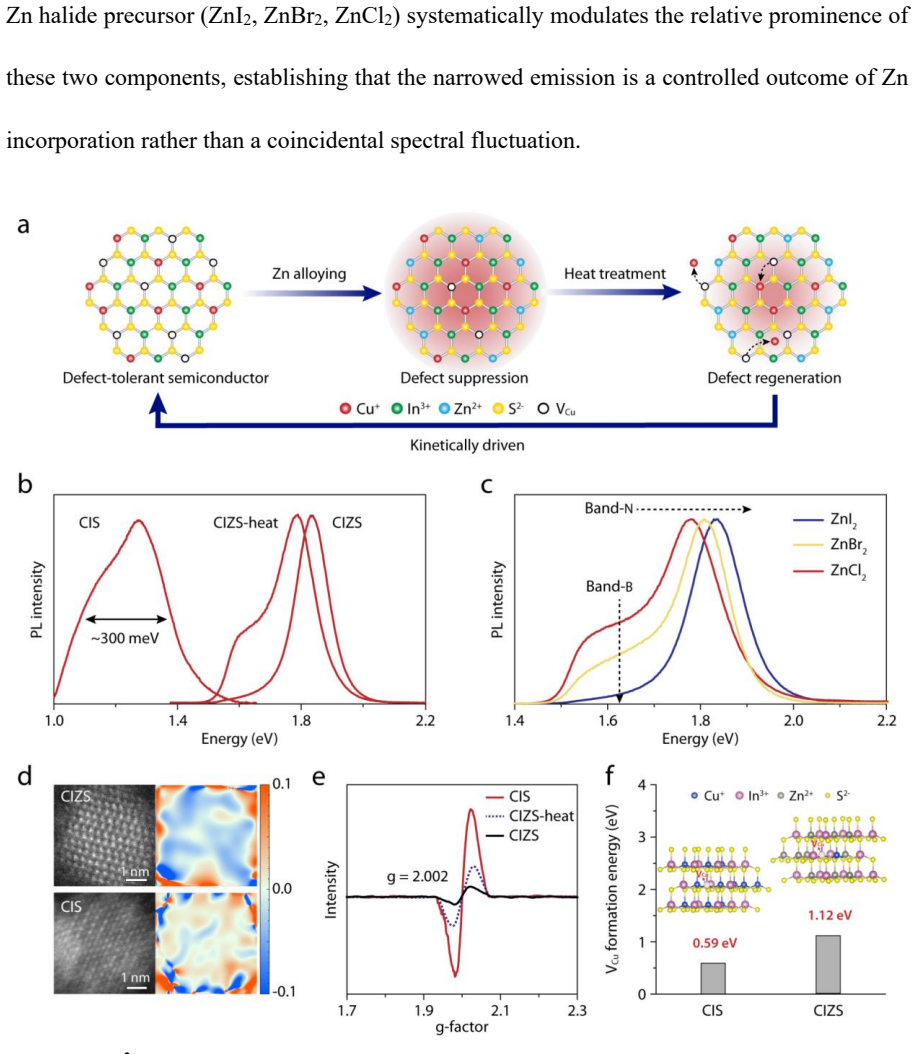
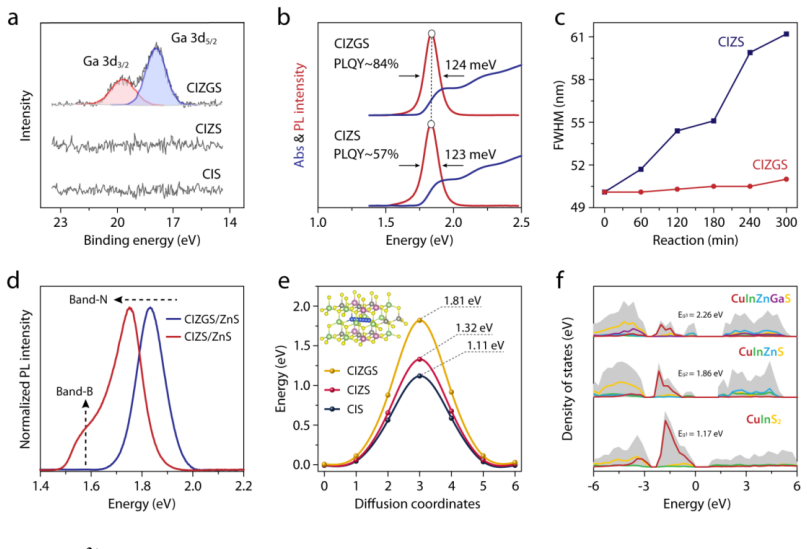
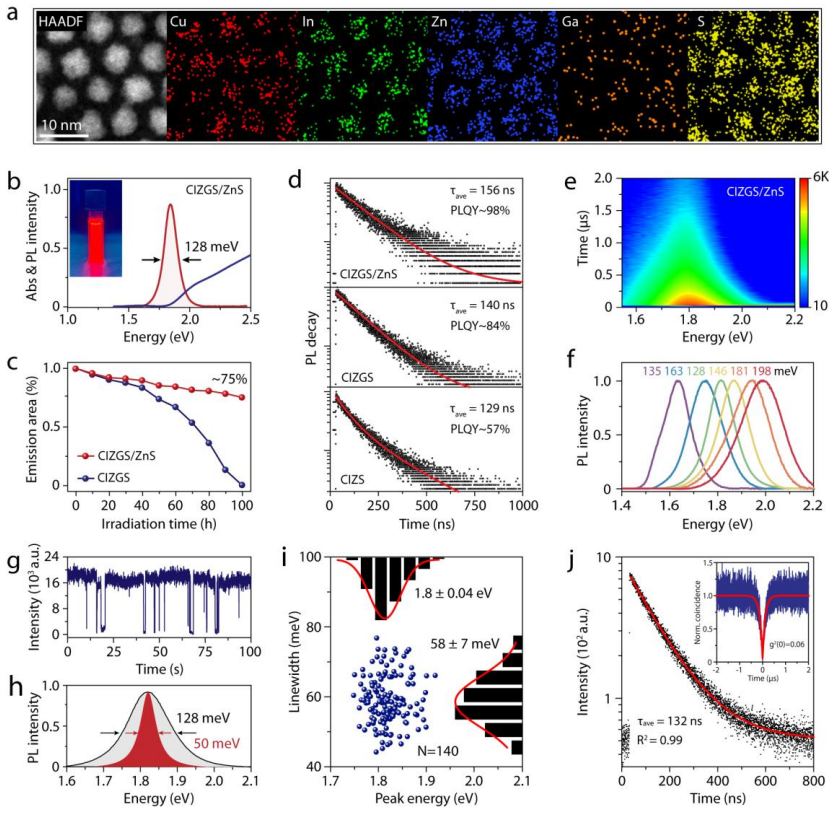
A thermodynamic-kinetic decoupling strategy transforms defect-tolerant CuInS2 quantum dots into bright, narrowband, photostable single-photon emitters: Zn2+ alloying strains the lattice to thermodynamically suppress native copper vacancies and narrow the emission from a broad defect band to an excitonic line of approximately 120 meV, while Ga3+ incorporation kinetically pins the cation sublattice against Cu+ migration to prevent defect regeneration during shell growth, resulting in near-unity quantum yield of approximately 98 percent, homogeneous linewidths as low as 58 meV, strongly suppressed blinking, and g2(0) = 0.06.
What carries the argument
The thermodynamic-kinetic decoupling strategy, in which Zn2+ alloying provides thermodynamic suppression of copper vacancies via lattice strain and Ga3+ incorporation provides kinetic pinning of the cation sublattice against migration.
If this is right
- The core/shell dots achieve near-unity quantum yield of approximately 98 percent while retaining narrow excitonic emission of approximately 120 meV.
- Room-temperature single-dot spectroscopy reveals homogeneous linewidths as low as 58 meV, strongly suppressed blinking, and high-purity single-photon emission with g2(0) = 0.06.
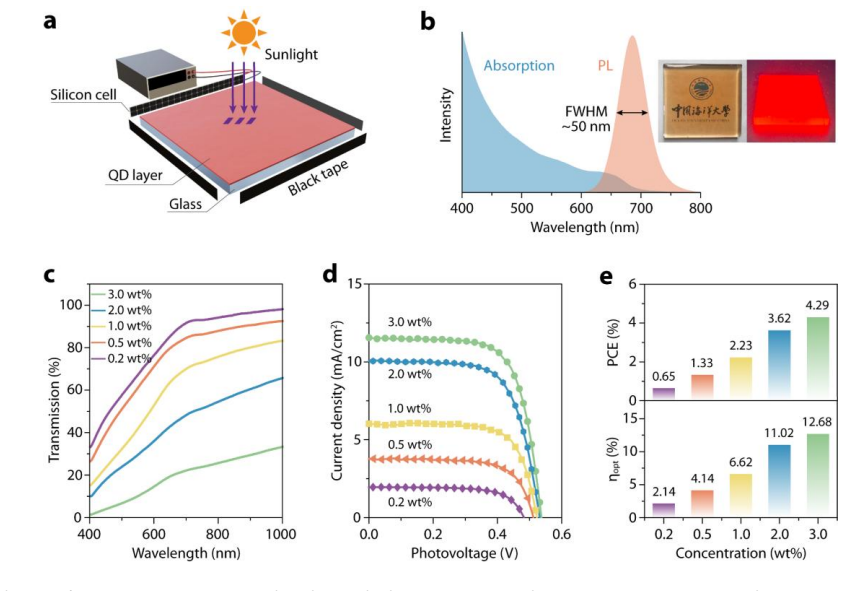
- The stabilized excitonic emission reduces reabsorption losses in luminescent solar concentrators, yielding an external optical efficiency of 12.68 percent.
- The approach establishes a framework to unlock intrinsic excitonic photophysics in other ion-mobile, defect-prone semiconductors for heavy-metal-free emitters.
Where Pith is reading between the lines
- The same decoupling principle could be tested in related ternary or quaternary copper chalcogenides to check whether lattice strain and sublattice pinning generalize beyond CuInS2.
- Systematic variation of the Zn and Ga concentrations during synthesis would reveal whether an optimal ratio exists that further narrows the linewidth below 58 meV without lowering quantum yield.
- If the mechanism holds, similar alloying sequences might be applied to improve charge transport or stability in thin-film devices made from the same defect-prone materials.
Load-bearing premise
The observed narrowing of emission and suppression of blinking arise specifically from thermodynamic suppression of copper vacancies by Zn2+ alloying and kinetic pinning by Ga3+ incorporation rather than from changes in surface chemistry, size distribution, or other synthesis conditions.
What would settle it
Preparation of control CuInS2 core/shell samples using identical shell-growth conditions but without Zn2+ alloying or Ga3+ incorporation, followed by observation of equivalent narrow linewidths, high quantum yield, and single-photon purity, would falsify the claim that the decoupling is required.
Figures
read the original abstract
Colloidal quantum dots that simultaneously offer room-temperature single-photon purity and high photoluminescence quantum yield are sought for quantum optics, but remain elusive in environmentally benign materials. We introduce a thermodynamic-kinetic decoupling strategy that transforms defect-tolerant CuInS2 quantum dots into bright, narrowband, and photostable single-photon emitters. Zn2+ alloying strains the lattice, thermodynamically suppressing native copper vacancies and narrowing the emission from a broad defect band of approximately 300 meV to an excitonic line of approximately 120 meV. Ga3+ incorporation then kinetically pins the cation sublattice against Cu+ migration, preventing defect regeneration during ZnS shell growth. The resulting Cd-free core/shell dots achieve near-unity quantum yield of approximately 98% while retaining narrow excitonic emission. Critically, room-temperature single-dot spectroscopy reveals homogeneous linewidths as low as approximately 58 meV, strongly suppressed blinking, and high-purity single-photon emission with g2(0) = 0.06. This stabilized excitonic emission directly reduces reabsorption losses in luminescent solar concentrators, yielding an external optical efficiency of 12.68%. Our work establishes a generalizable framework to unlock intrinsic excitonic photophysics in ion-mobile, defect-prone semiconductors, opening a viable path toward high-performance heavy-metal-free emitters for quantum light sources.
Editorial analysis
A structured set of objections, weighed in public.
Referee Report
Summary. The paper introduces a thermodynamic-kinetic decoupling strategy for defect-tolerant CuInS2 quantum dots: Zn2+ alloying is claimed to strain the lattice and thermodynamically suppress Cu vacancies (narrowing emission from a ~300 meV defect band to a ~120 meV excitonic line), while Ga3+ incorporation kinetically pins the cation sublattice to prevent defect regeneration during ZnS shell growth. The resulting Cd-free core/shell dots are reported to reach ~98% quantum yield, room-temperature homogeneous linewidths down to ~58 meV, strongly suppressed blinking, and g2(0)=0.06 single-photon purity, with an additional demonstration of 12.68% external optical efficiency in luminescent solar concentrators.
Significance. If the proposed mechanism is substantiated by direct evidence, the work would offer a generalizable route to convert ion-mobile, defect-prone semiconductors into high-performance, heavy-metal-free single-photon emitters and improve LSC performance by reducing reabsorption. The reported combination of near-unity QY, narrow room-temperature linewidth, and high single-photon purity in a Cd-free system would be a notable advance for quantum optics applications.
major comments (2)
- [Abstract] Abstract: The central attribution of the linewidth narrowing (~300 meV defect band to ~120 meV excitonic line) and blinking suppression specifically to thermodynamic suppression of Cu vacancies by Zn2+ alloying and kinetic pinning by Ga3+ is presented without any direct defect characterization (e.g., EPR, positron annihilation spectroscopy, or formation-energy calculations). This leaves open the possibility that the observed improvements arise instead from uncharacterized changes in surface chemistry, size distribution, or the ZnS shell itself, undermining the mechanistic claim that is load-bearing for the thermodynamic-kinetic decoupling framework.
- [Abstract] Abstract (performance metrics): The reported values (~98% QY, ~58 meV linewidth, g2(0)=0.06, 12.68% LSC efficiency) are stated without reference to measurement protocols, controls, error bars, or raw data in the provided text. Full evaluation of whether post-hoc selection or measurement conditions affect these central numbers requires the methods and results sections.
minor comments (1)
- [Abstract] Abstract: The phrase 'strongly suppressed blinking' is qualitative; quantitative metrics (e.g., on/off time distributions or duty cycle) should be supplied in the main text.
Simulated Author's Rebuttal
We thank the referee for their detailed and constructive feedback on our manuscript. We address each major comment below with point-by-point responses and indicate where revisions will be made to the manuscript.
read point-by-point responses
-
Referee: [Abstract] Abstract: The central attribution of the linewidth narrowing (~300 meV defect band to ~120 meV excitonic line) and blinking suppression specifically to thermodynamic suppression of Cu vacancies by Zn2+ alloying and kinetic pinning by Ga3+ is presented without any direct defect characterization (e.g., EPR, positron annihilation spectroscopy, or formation-energy calculations). This leaves open the possibility that the observed improvements arise instead from uncharacterized changes in surface chemistry, size distribution, or the ZnS shell itself, undermining the mechanistic claim that is load-bearing for the thermodynamic-kinetic decoupling framework.
Authors: We acknowledge that the manuscript does not include direct defect characterization methods such as EPR, positron annihilation spectroscopy, or explicit formation-energy calculations. The mechanistic interpretation instead rests on systematic compositional controls: linewidth narrowing correlates directly with Zn-induced lattice strain measured by XRD, while Ga incorporation prevents emission broadening during shell growth in paired samples. Size distribution effects are addressed via TEM statistics and absorption spectra showing consistent core sizes, and surface chemistry is held constant through identical ligand and shelling protocols. We agree that alternative explanations merit explicit discussion and will add a revised paragraph in the Results/Discussion section comparing the proposed mechanism against possible surface or shell contributions, supported by the existing control data. This will be incorporated as a partial revision. revision: partial
-
Referee: [Abstract] Abstract (performance metrics): The reported values (~98% QY, ~58 meV linewidth, g2(0)=0.06, 12.68% LSC efficiency) are stated without reference to measurement protocols, controls, error bars, or raw data in the provided text. Full evaluation of whether post-hoc selection or measurement conditions affect these central numbers requires the methods and results sections.
Authors: The full manuscript contains a dedicated Methods section detailing the integrating-sphere QY protocol with reabsorption corrections, single-dot spectroscopy setup and fitting for the 58 meV linewidth, Hanbury Brown-Twiss configuration for g2(0), and LSC efficiency measurement with device geometry and error propagation. Uncertainties, control samples, and raw datasets appear in the Supplementary Information. To improve clarity, we will insert explicit cross-references from the abstract to these sections in the revised version. No changes to the reported values themselves are required. revision: yes
Circularity Check
No circularity detected; paper reports experimental results without mathematical derivations or self-referential predictions
full rationale
The manuscript describes an experimental synthesis strategy (Zn2+ alloying and Ga3+ incorporation) applied to CuInS2 quantum dots, followed by measured outcomes such as ~98% QY, ~58 meV linewidth, and g2(0)=0.06. No equations, fitted parameters, or first-principles derivations are present in the provided text. Claims rest on direct spectroscopy and efficiency measurements rather than any reduction of a 'prediction' to its own inputs. No self-citation chains or ansatzes are invoked as load-bearing steps. The derivation chain is therefore self-contained against external benchmarks.
Axiom & Free-Parameter Ledger
Reference graph
Works this paper leans on
-
[1]
& Furthmüller, J
1 Kresse, G. & Furthmüller, J. Efficiency of ab-initio total energy calculations for metals and semiconductors using a plane-wave basis set. Comput. Mater. Sci. 6, 15–50 (1996). 2 Perdew, J. P., Burke, K. & Ernzerhof, M. Generalized gradient approximation made simple. Phys. Rev. Lett. 77, 3865 (1996). 3 Blöchl, P. E. Projector augmented-wave method. Phys....
1996
discussion (0)
Sign in with ORCID, Apple, or X to comment. Anyone can read and Pith papers without signing in.