Flexible PDMS/La_(0.7)Sr_(0.3)MnO₃/MWCNT Composite Thin Films for Multifunctional Temperature and Magnetic Sensing Electronic Skin
Pith reviewed 2026-06-27 21:28 UTC · model grok-4.3
The pith
Flexible composite film detects both temperature and magnetic fields via resistance changes
A machine-rendered reading of the paper's core claim, the machinery that carries it, and where it could break.
Core claim
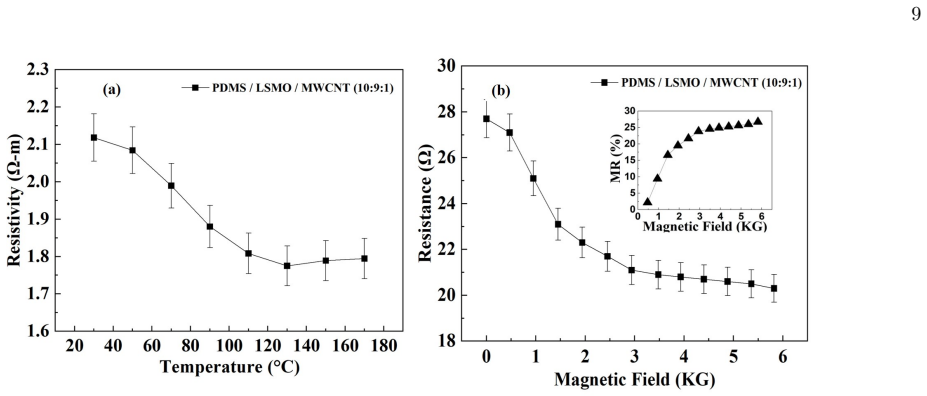
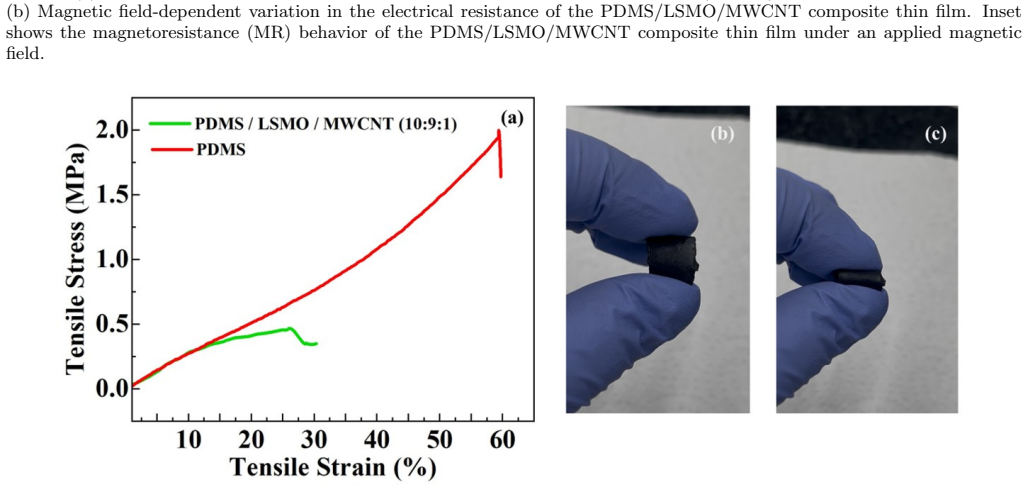
The PDMS/La0.7Sr0.3MnO3/MWCNT composite thin film shows thermally activated resistivity behavior for temperature sensing and a decrease in resistance under magnetic field due to spin-dependent transport in the LSMO phase, while exhibiting elastomeric behavior with stretchability of approximately 26 percent.
What carries the argument
The solution-cast PDMS/LSMO/MWCNT composite thin film, which integrates the magnetically responsive LSMO with the conductive MWCNT network in the flexible PDMS to produce dual sensing responses.
If this is right
- The composite can function as a temperature sensor based on its resistivity changes.
- It can function as a magnetic sensor based on its magnetoresistance effect.
- The film maintains mechanical flexibility suitable for wearable e-skin.
- The material shows improved thermal stability compared to pure PDMS.
Where Pith is reading between the lines
- Comparing responses of binary composites (PDMS+LSMO and PDMS+MWCNT) to the ternary one would test if the dual sensing is truly synergistic.
- This approach might extend to other combinations of functional fillers in elastomers for multi-stimuli sensors.
- The sensing mechanism could be modeled to predict performance under varying compositions or fields.
Load-bearing premise
The multifunctional sensing depends on a synergistic interaction between the MWCNT network and LSMO particles inside the PDMS rather than their independent contributions.
What would settle it
Prepare films with LSMO in PDMS but no MWCNT and with MWCNT in PDMS but no LSMO, then measure if they show both temperature and magnetic sensing responses at levels comparable to the full composite.
Figures
read the original abstract
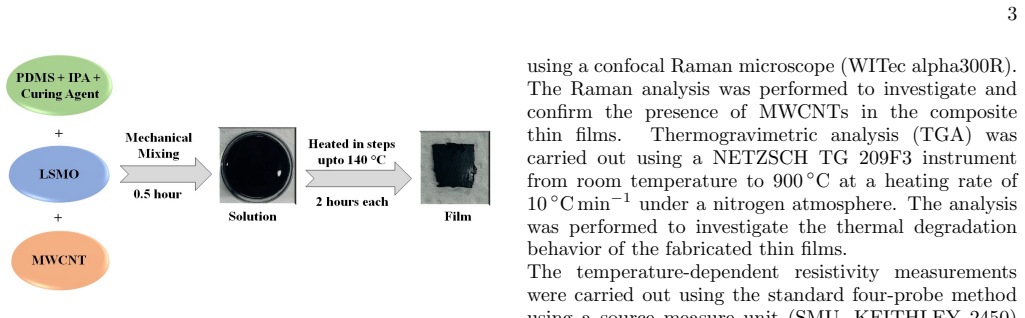
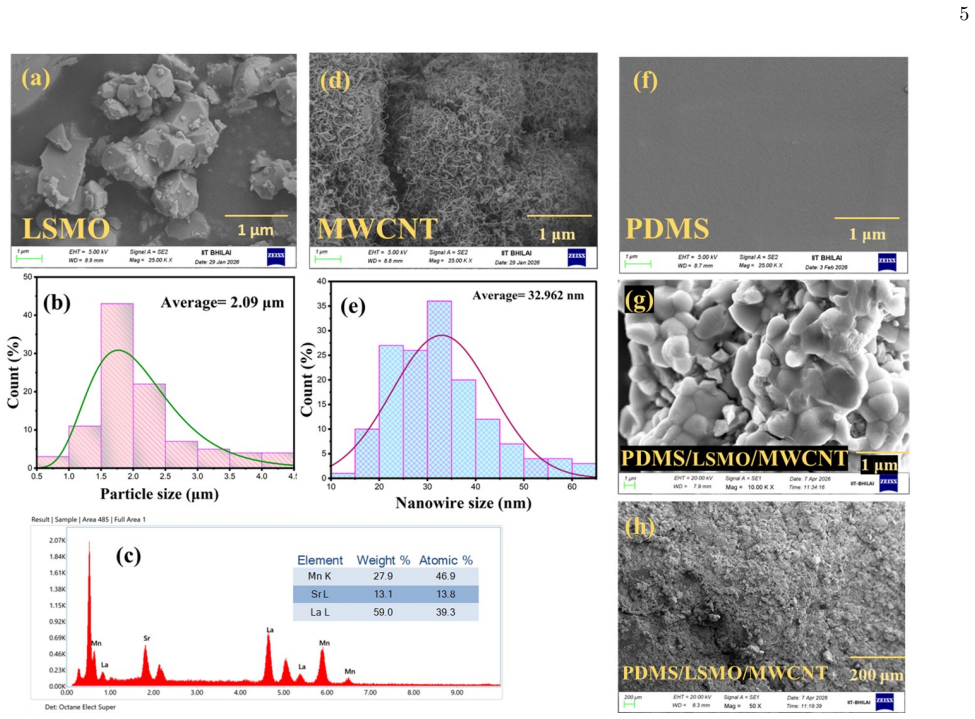
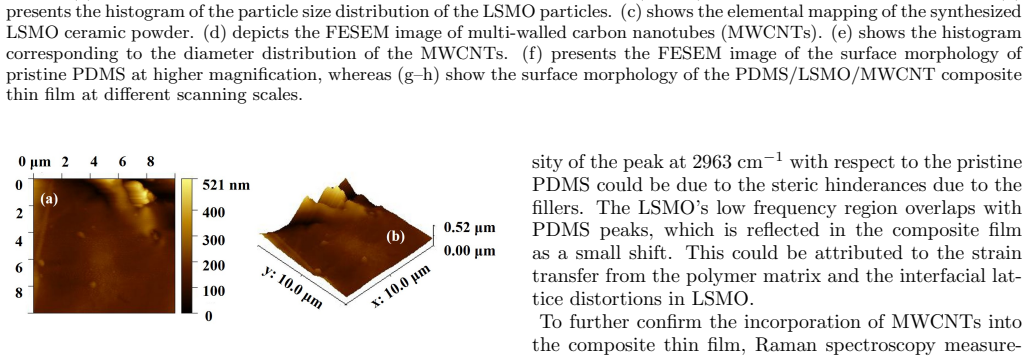
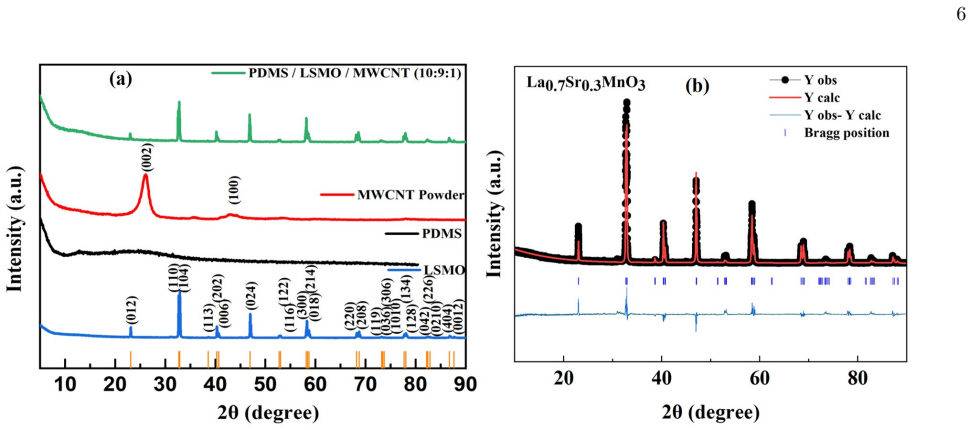
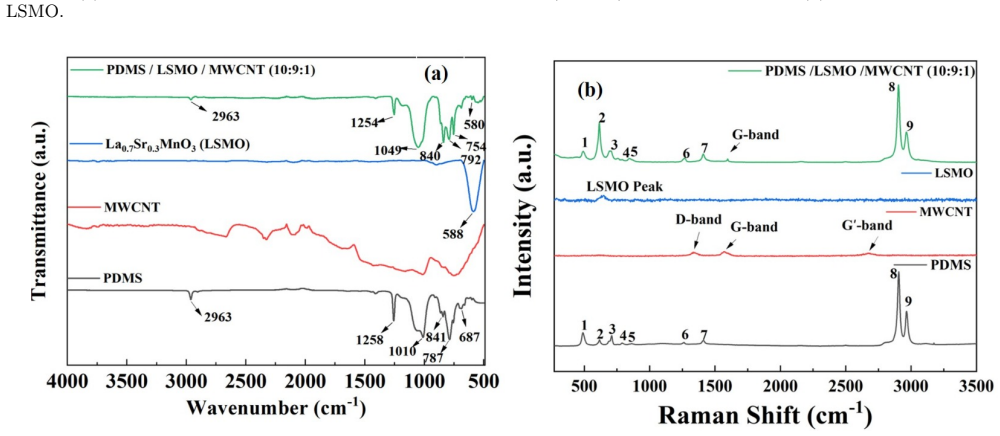
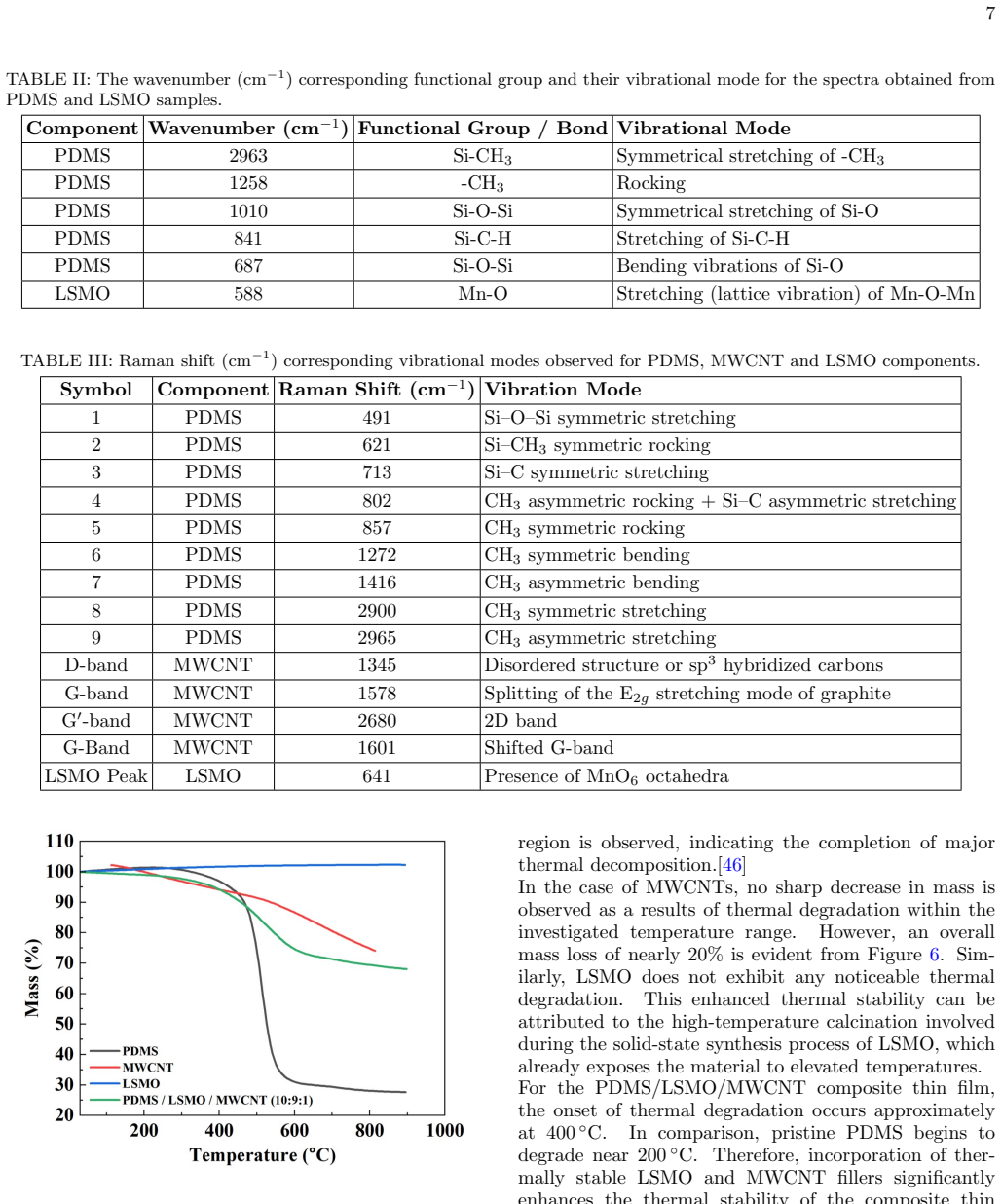
The development of multifunctional electronic skin (e-skin) requires materials that combine mechanical flexibility with responsiveness to multiple stimuli. In this work, a flexible PDMS/La0.7Sr0.3MnO3 (LSMO)/MWCNT composite thin film was fabricated via solution casting, using LSMO powder synthesized by a solid-state reaction method. Structural and spectroscopic analyses confirm the formation of single-phase rhombohedral LSMO and successful incorporation of PDMS, LSMO, and MWCNT components. The composite exhibits a smooth and uniform surface morphology, along with significantly enhanced thermal stability, retaining ~70% mass at elevated temperatures. Electrical measurements reveal thermally activated resistivity behavior, enabling temperature sensing functionality. Additionally, the composite shows a notable decrease in resistance under an applied magnetic field, exhibiting magnetoresistance due to spin-dependent transport in the LSMO phase. Mechanical testing indicates elastomeric behavior with a maximum load of ~0.49 N and stretchability of ~26%, along with ductile deformation characteristics. The multifunctional sensing properties arise from the synergistic interaction between the conductive MWCNT network and magnetically active LSMO within the flexible PDMS matrix. Overall, the composite demonstrates a unique combination of thermal stability, mechanical flexibility, and dual sensing capability, making it a promising material for next-generation e-skin applications.
Editorial analysis
A structured set of objections, weighed in public.
Referee Report
Summary. The manuscript describes fabrication of PDMS/La$_{0.7}$Sr$_{0.3}$MnO$_3$/MWCNT composite thin films by solution casting, reporting single-phase rhombohedral LSMO, uniform morphology, enhanced thermal stability (~70% mass retention), thermally activated resistivity for temperature sensing, a decrease in resistance under magnetic field attributed to spin-dependent transport in LSMO, and elastomeric mechanical behavior (max load ~0.49 N, stretchability ~26%). The central claim is that dual sensing arises from synergistic interaction between the MWCNT network and LSMO within the PDMS matrix, positioning the material for multifunctional e-skin applications.
Significance. If supported by quantitative data and controls, the work would demonstrate a flexible composite combining thermal stability, mechanical compliance, and dual (temperature + magnetic) sensing, which could be relevant for e-skin. The experimental approach (solid-state LSMO synthesis + solution casting) is standard, but the lack of numerical metrics or baselines reduces the strength of the contribution.
major comments (2)
- [Abstract] Abstract: the statement that 'the multifunctional sensing properties arise from the synergistic interaction between the conductive MWCNT network and magnetically active LSMO' is unsupported; no resistivity or magnetoresistance data are shown for binary control films (PDMS/LSMO or PDMS/MWCNT) that would distinguish synergy from simple additive or percolation effects of the individual fillers.
- [Abstract] Abstract: electrical measurements are described only qualitatively ('thermally activated resistivity behavior', 'notable decrease in resistance'); no numerical values, activation energies, MR ratios, error bars, sample sizes, or field/temperature ranges are reported, so the sensing functionality cannot be evaluated for magnitude, reproducibility, or practical utility.
minor comments (1)
- [Abstract] Abstract: the mechanical values (~0.49 N maximum load, ~26% stretchability) should specify specimen geometry, strain rate, and number of replicates to allow assessment of the elastomeric claim.
Simulated Author's Rebuttal
We thank the referee for the detailed review and constructive comments on our manuscript. We address each major comment point by point below, indicating where revisions will be incorporated.
read point-by-point responses
-
Referee: [Abstract] Abstract: the statement that 'the multifunctional sensing properties arise from the synergistic interaction between the conductive MWCNT network and magnetically active LSMO' is unsupported; no resistivity or magnetoresistance data are shown for binary control films (PDMS/LSMO or PDMS/MWCNT) that would distinguish synergy from simple additive or percolation effects of the individual fillers.
Authors: We agree that the explicit claim of synergistic interaction requires supporting data from binary control samples to distinguish it from additive effects. The present study reports results exclusively for the ternary composite and bases the attribution on the established individual properties of each filler. To address this, we will revise the abstract (and relevant discussion text) to describe the dual functionality as resulting from the combined incorporation of the MWCNT network and LSMO particles within the PDMS matrix, removing the unsupported synergy phrasing. No new experimental data can be added at this stage. revision: yes
-
Referee: [Abstract] Abstract: electrical measurements are described only qualitatively ('thermally activated resistivity behavior', 'notable decrease in resistance'); no numerical values, activation energies, MR ratios, error bars, sample sizes, or field/temperature ranges are reported, so the sensing functionality cannot be evaluated for magnitude, reproducibility, or practical utility.
Authors: We concur that quantitative metrics are necessary for assessing the sensing performance. While the abstract is intentionally concise, the full manuscript includes supporting figures and text with resistivity vs. temperature data and magnetoresistance measurements. In revision we will update the abstract to report key extracted values, including the activation energy derived from Arrhenius fitting, the MR ratio at the applied field, the temperature and magnetic field ranges, and associated uncertainties or sample statistics where available. revision: yes
Circularity Check
No significant circularity; purely experimental observations with no derivations
full rationale
The paper reports fabrication via solution casting, structural characterization, thermal stability tests, electrical resistivity measurements (thermally activated behavior), magnetoresistance data, and mechanical testing of the PDMS/LSMO/MWCNT composite. No equations, models, fitted parameters, predictions, or derivation chains appear in the abstract or described full text. All claims rest on direct experimental results rather than any reduction of outputs to inputs by construction. The synergy interpretation is an assertion (unsupported by controls per the skeptic note), but this is a matter of evidence strength, not circularity in a derivation. Self-contained experimental work scores at the default non-circular level.
Axiom & Free-Parameter Ledger
axioms (2)
- domain assumption LSMO exhibits spin-dependent transport leading to magnetoresistance
- domain assumption Thermally activated resistivity follows expected semiconductor-like behavior in the composite
Reference graph
Works this paper leans on
-
[1]
M. L. Hammock, A. Chortos, B. C.-K. Tee, J. B.-H. Tok, and Z. Bao, Advanced materials25, 5997 (2013)
2013
-
[2]
Zimmerman, L
A. Zimmerman, L. Bai, and D. D. Ginty, Science346, 950 (2014)
2014
-
[3]
Chortos, J
A. Chortos, J. Liu, and Z. Bao, Nature materials15, 937 (2016)
2016
-
[4]
J. Chen, Y. Zhu, X. Chang, D. Pan, G. Song, Z. Guo, and N. Naik, Advanced Functional Materials31, 2104686 (2021)
2021
-
[5]
Yadav, Q
N. Yadav, Q. Zhang, D. Qi, A. Yadav, and H. Zheng, Nanoscale Advances7, 4803 (2025)
2025
-
[6]
Y. Guo, X. Wei, S. Gao, W. Yue, Y. Li, and G. Shen, Advanced Functional Materials31, 2104288 (2021)
2021
-
[7]
Zhang, J
J. Zhang, J. Li, W. Cheng, J.-H. Zhang, Z. Zhou, X. Sun, L. Li, J.-G. Liang, Y. Shi, and L. Pan, ACS Materials Letters4, 577 (2022)
2022
-
[8]
X. Yang, W. Chen, Q. Fan, J. Chen, Y. Chen, F. Lai, and H. Liu, Advanced Materials36, 2402542 (2024)
2024
-
[9]
J. Li, Z. Fang, D. Wei, and Y. Liu, Advanced healthcare materials13, 2401532 (2024)
2024
-
[10]
Thorat, V
N. Thorat, V. Khot, A. Salunkhe, R. Ningthoujam, and S. Pawar, Colloids and Surfaces B: Biointerfaces104, 40 (2013)
2013
-
[11]
X. Zhao, Q. Hua, R. Yu, Y. Zhang, and C. Pan, Advanced Electronic Materials1, 1500142 (2015)
2015
-
[12]
H.-H. Chou, A. Nguyen, A. Chortos, J. W. To, C. Lu, J. Mei, T. Kurosawa, W.-G. Bae, J. B.-H. Tok, and Z. Bao, Nature communications6, 8011 (2015)
2015
-
[13]
Zhang, M
C. Zhang, M. Wu, S. Cao, M. Liu, D. Guo, Z. Kang, M. Li, D. Ye, Z. Yang, X. Wang,et al., Small19, 2304004 (2023)
2023
-
[14]
Schwartz, B
G. Schwartz, B. C.-K. Tee, J. Mei, A. L. Appleton, D. H. Kim, H. Wang, and Z. Bao, Nature communications4, 1859 (2013)
2013
-
[15]
Y. Tian, M. Huang, Y. Wang, Y. Zheng, R. Yin, H. Liu, C. Liu, and C. Shen, Chemical engineering journal480, 147899 (2024)
2024
-
[16]
Zhang, H
M. Zhang, H. Zhao, Y. Tong, J. Sun, H. Zhang, P. Xue, H. Liu, X. Sun, X. Song, X. Zhao,et al., IEEE Electron Device Letters47, 1189 (2026)
2026
-
[17]
Suresh, B
G. Suresh, B. Satyanarayna, C. Thirmal, K. Jagarlamudi, T. Komala, J. Patowary, and A. Kumar, Journal of Ap- plied Polymer Science , e70307 (2026)
2026
-
[18]
P. N. Mohan, C. Thirmal, G. Suresh, B. Arun, A. Joseph, T. Vishwam, and K. James Raju, Journal of Applied Polymer Science142, e56462 (2025)
2025
-
[19]
S. Li, J. Zhang, J. He, W. Liu, Y. Wang, Z. Huang, H. Pang, and Y. Chen, Advanced Science10, 2304506 (2023)
2023
-
[20]
X. Yang, W. Huang, H. Dong, and J.-W. Zha, Advanced Materials37, 2500472 (2025)
2025
-
[21]
Jugade and S
S. Jugade and S. Kulkarni, Bulletin of Materials Science 43, 209 (2020)
2020
-
[22]
B. Chen, L. Zhang, H. Li, X. Lai, and X. Zeng, Journal of colloid and interface science617, 478 (2022)
2022
-
[23]
Q. Bai, X. Liu, X. Shi, Z. Wang, Z. Wu, Q. Dong, N. Liu, T. Liu, and S. Liu, ACS Applied Electronic Materials7, 463 (2024)
2024
-
[24]
G. Lee, J. H. Son, S. Lee, S. W. Kim, D. Kim, N. N. Nguyen, S. G. Lee, and K. Cho, Advanced Science8, 2002606 (2021)
2021
-
[25]
F. Yin, H. Niu, E.-S. Kim, Y. K. Shin, Y. Li, and N.-Y. Kim, InfoMat5, e12424 (2023)
2023
-
[26]
X. Sun, J. Sun, T. Li, S. Zheng, C. Wang, W. Tan, J. Zhang, C. Liu, T. Ma, Z. Qi,et al., Nano-micro letters 11, 57 (2019)
2019
-
[27]
M. Iqra, F. Anwar, R. Jan, and M. A. Mohammad, Sci- entific reports12, 4882 (2022)
2022
-
[28]
Nayak, S
B. Nayak, S. Anwar, A. Kumar, and S. Anwar, ACS Ap- plied Electronic Materials6, 1189 (2024)
2024
-
[29]
Anand and M
A. Anand and M. Bhatnagar, Materials Research Express 6, 055011 (2019)
2019
-
[30]
A. Vera, I. Mart´ ınez, L. G. Enger, B. Guillet, R. Guer- rero, J. M. Diez, O. Rousseau, M. Lam Chok Sing, V. Pierron, P. Perna,et al., ACS Biomaterials Science & Engineering9, 1020 (2023)
2023
-
[31]
W. Hou, Y. Yao, Y. Li, B. Peng, K. Shi, Z. Zhou, J. Pan, M. Liu, and J. Hu, Frontiers of Materials Science16, 220589 (2022)
2022
-
[32]
M. B. Salamon and M. Jaime, Reviews of modern physics 73, 583 (2001)
2001
-
[33]
S. Zhao, Y. Li, Y. Wang, Z. Ma, and X. Huang, Fuel244, 78 (2019)
2019
-
[34]
P. Nie, C. Min, H.-J. Song, X. Chen, Z. Zhang, and K. Zhao, Tribology Letters58, 7 (2015)
2015
-
[35]
H. M. Rietveld, Applied Crystallography2, 65 (1969). 11
1969
-
[36]
Z. J. Razi, S. Sebt, and A. Khajehnezhad, Journal of Theoretical and Applied Physics12, 243 (2018)
2018
-
[37]
S. Wu, X. Zhang, Y. Sun, H. Yang, B. Lin, X. Han, and P. Chen, Colloid and Polymer Science299, 1327 (2021)
2021
-
[38]
Hamouni, O
S. Hamouni, O. Arous, D. Abdessemed, G. Nezzal, and B. Van der Bruggen, inMacromolecular Symposia, Vol. 386 (Wiley Online Library, 2019) p. 1800247
2019
-
[39]
S. C. Bae, H. Lee, Z. Lin, and S. Granick, Langmuir21, 5685 (2005)
2005
-
[40]
Kumari, A
K. Kumari, A. Kumar, D. K. Kotnees, J. Balakrishnan, A. D. Thakur, and S. Ray, Journal of Alloys and Com- pounds815, 152213 (2020)
2020
-
[41]
X. Zeng, S. Yu, L. Ye, M. Li, Z. Pan, R. Sun, and J. Xu, Journal of Materials Chemistry C3, 187 (2015)
2015
-
[42]
Yashiro, Y
S. Yashiro, Y. Sakaida, Y. Shimamura, and Y. Inoue, Composites Part A: Applied Science and Manufacturing 85, 192 (2016)
2016
-
[43]
A. Aoki, T. Ogasawara, T. Aoki, Y. Ishida, Y. Shima- mura, and Y. Inoue, Composites Part A: Applied Science and Manufacturing167, 107448 (2023)
2023
-
[44]
Antunes, A
E. Antunes, A. Lobo, E. Corat, V. Trava-Airoldi, A. Mar- tin, and C. Ver´ ıssimo, Carbon44, 2202 (2006)
2006
-
[45]
M. V. Avramenko, M. J. Hokkanen, Y. Slabodyan, M. Ahlskog, and D. I. Levshov, The Journal of Physi- cal Chemistry C126, 15759 (2022)
2022
-
[46]
Camino, S
G. Camino, S. Lomakin, and M. Lazzari, Polymer42, 2395 (2001)
2001
-
[47]
Kumar, K
A. Kumar, K. Kumari, S. Ray, and A. D. Thakur, Journal of Applied Physics127(2020)
2020
-
[48]
Kumar, D
A. Kumar, D. B´ erardan, D. Dragoe, E. Riviere, T. Takayama, H. Takagi, and N. Dragoe, Materials To- day Physics32, 101026 (2023)
2023
-
[49]
Pandey, R
D. Pandey, R. Singh, P. Karmakar, S. Das, H. Roy, S. Sen, S. Mandal, and N. Chanda, Sensors and Actu- ators A: Physical372, 115341 (2024)
2024
-
[50]
Kumar, C
A. Kumar, C. Tomy, and A. D. Thakur, Materials Re- search Express5, 086110 (2018)
2018
-
[51]
J. S. Sidhu, A. Misra, and A. Bhardwaj, Nanoscale Ad- vances7, 6941 (2025)
2025
-
[52]
Wahlsten, A
A. Wahlsten, A. Stracuzzi, I. L¨ uchtefeld, G. Restivo, N. Lindenblatt, C. Giampietro, A. E. Ehret, and E. Mazza, Acta Biomaterialia170, 155 (2023)
2023
-
[53]
Zhao and X
Y. Zhao and X. Huang, Micromachines8, 69 (2017)
2017
discussion (0)
Sign in with ORCID, Apple, or X to comment. Anyone can read and Pith papers without signing in.