REVIEW 3 major objections 4 minor 41 references
The lexical and grammatical sources of neg-raising inferences
T0 review · 3 major / 4 minor · reviewed 2026-08-14 · deepseek-v4-flash
Pith's one-line read Neg-raising inferences come from both the verb and the clause it embeds, a new model of 925 English verbs suggests.
desk verdict A valuable new dataset and a model that is honestly reported, but the structural-source conclusion is not supported by the paper's own model comparison. read the letter →
The pith
A machine-rendered reading of the paper's core claim, the machinery that carries it, and where it could break.
The reading
What carries the argument
The key object is a probabilistic boolean matrix factorization model that extends a prior s-selection model from the literature. It factorizes a tensor of neg-raising judgments $N$ into a verb–lexical-property matrix $\Psi$, a lexical-property–structure–subject–tense tensor $\Phi$, a verb–structure-type matrix $\Lambda$, a structure-type–frame matrix $\Pi$, and a structure-type–subject–tense tensor $\Omega$, via the approximation $n_{vfjk} \approx \bigvee_{t,i} \lambda_{vt} \wedge \psi_{vi} \wedge \varphi_{ijk} \wedge \pi_{tf} \wedge \omega_{tjk}$. The number of lexical properties $|I|$ and structural properties $|T|$ are hyperparameters; cross-validation selects $|I|=|T|=1$ as the best trade-off between fit and generalization.
What would settle it
A permutation test that shuffles verbs across frames while preserving each verb's estimated lexical property should leave the frame-level structural parameters $\pi_{tf}$ unchanged if those parameters reflect real structure; if the $\pi_{tf}$ values collapse toward equality under such shuffling, the structural effect is an artifact of which verbs happen to appear in each frame.
Extended reading notes
Core claim
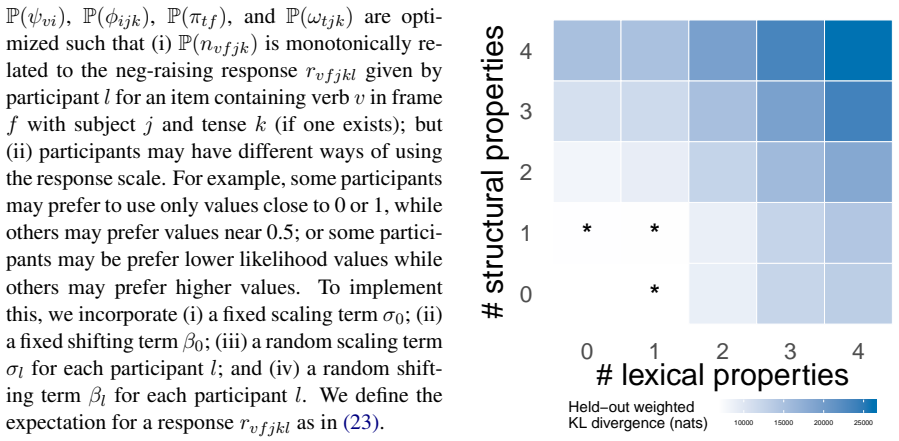
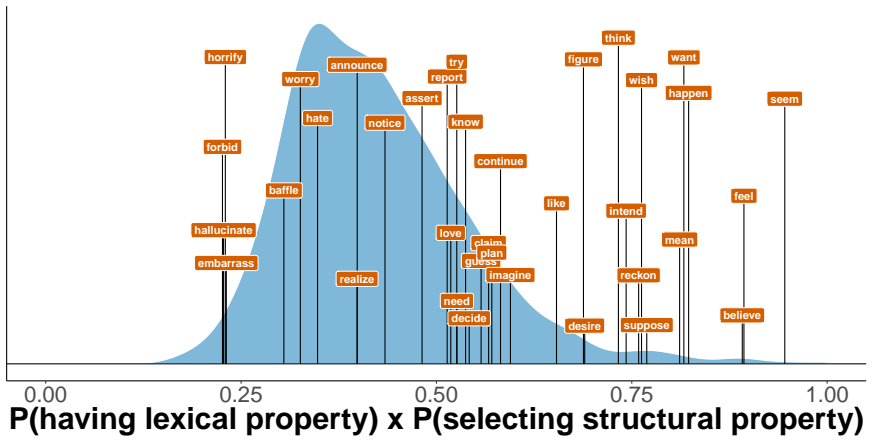
The central discovery is that neg-raising is not purely a product of lexical knowledge. In a five-fold cross-validation, the model that generalizes best posits one lexical property and one structural property; models with only lexical properties or only structural properties perform comparably, but the joint model is the best fit. The fitted parameters show that the lexical property and the structural property each contribute near-deterministically to neg-raising across subjects and tenses, while variability across verbs is captured by the probability that a verb has the lexical property and selects the structural property. Differences across syntactic frames are captured by the probability that the structural property maps onto each frame. The authors interpret this as evidence that properties of the subordinate clause—such as finiteness, presence of an overt subject, or eventivity—influence whether neg-raising is triggered, a role that prior proposals do not assign to complement structure.
Load-bearing premise
The paper's central claim depends on interpreting the model's single 'structural property' as a real property of subordinate clause structure, such as finiteness or eventivity, rather than as a free latent intercept that merely absorbs frame-level differences in the data.
Editorial extensions
If this is right
- Theories of neg-raising must explain why subordinate clause structure modulates the inference, not just which predicates trigger it.
- The same verb can differ in neg-raising behavior across complement types; the model predicts this is systematic, not noise.
- Subject and tense variability in neg-raising is captured as predicate-specific idiosyncrasy, supporting pragmatic rather than purely syntactic accounts of that variability.
- The dataset and model provide a reusable tool for measuring neg-raising at scale and for jointly modeling related lexically triggered inferences such as veridicality.
Reading between the lines
- If the structural property is a real syntactic feature, neg-raising diagnostics such as negative-polarity-item licensing and Horn-clause behavior should differ between finite and non-finite complements of the same verb; this is a testable consequence the paper does not draw.
- Because the single lexical and structural properties are almost perfectly correlated, the model may be reducible to a one-dimensional 'neg-raising propensity' per verb modulated by frame-specific weights; a simpler model should be tested before accepting two separate sources.
- The authors' treatment of subject and tense variation as noise suggests that first-person present-tense effects such as 'I don't know' are pragmatic speaker-commitment effects rather than lexical semantic facts, which could be tested with controlled decontextualized prompts.
Signed reviews
Editorial analysis
A structured set of objections, weighed in public.
Referee Report
Summary. The paper collects a large-scale dataset of neg-raising judgments for 925 English clause-embedding verbs across six syntactic frames, two matrix tenses, and two matrix subjects. It extends White and Rawlins' boolean matrix factorization model of s-selection with latent lexical properties and latent structural properties, and fits variants with different numbers of lexical and structural properties using held-out weighted KL loss. On the basis of the fitted model with one lexical and one structural property, the paper claims that some neg-raising inferences are attributable to properties of particular predicates while others are attributable to subordinate clause structure (abstract, §5, §7).
Significance. If the central claim were supported, the paper would provide a novel large-scale empirical constraint on theories of neg-raising, and the dataset of 7,936 verb-tense-frame-subject items would be a useful resource. The validation experiments in Appendix C and the care taken with stimulus construction are strengths. However, the two load-bearing premises — that the model comparison favors a joint lexical/structural model, and that the fitted latent 'structural property' corresponds to an identifiable property of subordinate clause structure — are not established by the paper's own analyses. Since the abstract's main finding depends on both premises, the contribution as stated is not supported.
major comments (3)
- [§5, Results] The model comparison reported in §5 does not support the claim that subordinate clause structure contributes to neg-raising. The paper lists the three best held-out models (Figure 2, starred) 'in order': |I|=1, |T|=0 (pure lexical), |I|=0, |T|=1 (pure structural), and |I|=1, |T|=1 (joint), and states that none is reliably different from the others. The subsequent sentence, 'Among these three, the model with the best fit to the dataset has |I|=1 and |T|=1,' is contradicted by that ordering; and even if the joint model were numerically best, the reported 95% confidence intervals for pairwise differences imply the difference is within noise. The abstract's attribution of some inferences to subordinate clause structure is therefore not licensed by the held-out loss comparison.
- [§4, Eq. (21); §6, Table 3] The structural property is a latent factor fitted to the neg-raising judgments themselves: P(πtf) is a free parameter in Eq. (21), optimized against the same responses it is later used to explain. Table 3 therefore reports fitted frame-level values of this latent factor, not evidence that any independently identifiable syntactic property (finiteness, overt subject, eventivity) drives neg-raising. With |I|=|T|=1, the model has only one structural factor, and the six nonzero P(πtf) values in Table 3 are, in effect, a per-frame latent intercept. Nothing outside the model confirms the mapping from this factor to 'subordinate clause structure' asserted in the abstract, so the central claim rests on an interpretation that the modeling framework does not provide.
- [§6, Table 2 and Footnotes 9–10] The analysis of the selected model does not provide independent evidence for two distinct sources of neg-raising. Table 2 reports P(φijk) and P(ωtjk) values that are all near 1 and nearly identical; Footnote 9 explains that the optimizer sets these to the square root of the largest expected neg-raising value. Footnote 10 further states that P(ψvi) and P(λvt) are effectively a single parameter p. As a result, the decomposition into 'lexical' and 'structural' sources is not identified: the same predictions could be obtained by a single per-verb propensity combined with a per-frame effect, which is exactly what the pure-lexical boundary model provides. The paper does not supply an identifiability or model-comparison test that would distinguish these alternatives beyond the reported, non-significant held-out loss differences.
minor comments (4)
- [§4, boundary models] The description of the |T|=0 boundary model, which fixes Λ=1|V| and Π=1|F|, is formally unclear if the tensor dimensions are |V|×0 and 0×|F|; the boundary model should be defined directly, e.g., by omitting the λ and π factors from Eq. (21).
- [§5, Method] The fold-construction constraint that every verb-frame combination appears at least once in the training folds makes the held-out loss closer to interpolation over frames than to prediction of unseen verb-frame combinations; this should be stated when interpreting the model comparison.
- [Figure 2] The y-axis label reads 'Held-out weighted KL divergence (nats)' while the text and caption describe the sum of the weighted KL loss across all five folds; the figure should make explicit whether one fold or the summed value is plotted.
- [Reference list] The reference 'Pollack 1976' may be a misspelling of 'Pollock'; please verify the cited author's name.
Circularity Check
No significant circularity: the structural property is a free latent parameter tested by held-out model comparison, not defined by the target neg-raising inference.
full rationale
The paper's central claim is that neg-raising inferences have both lexical and structural sources. The evidence is the model comparison in Section 5: boundary models with |I|=0 or |T|=0 are fit and evaluated on held-out data, so the inclusion of a structural property is not forced by construction. The latent parameter P(pi_tf) in Table 3 is fitted to the neg-raising judgments, but it is presented descriptively as the fitted relationship, not as an out-of-sample prediction, and the paper does not define the structural property in terms of the neg-raising response; it is a free factor in the factorization in Eq. (21). The use of White and Rawlins' s-selection model and MegaAcceptability is a modeling framework and data resource, not a load-bearing self-citation: the neg-raising measurement itself is externally validated in Appendix C against canonical neg-raising predicates from the literature. The fact that the pure lexical model has the lowest held-out loss and is not reliably different from the joint model is a serious evidential weakness in the paper's conclusion, but that is a correctness and statistical-inference concern, not circularity. No equation reduces to its own input, and no fitted parameter is relabeled as an independent prediction.
Assumptions & free parameters
free parameters (6)
- P(ψvi), probability verb v has the lexical property =
estimated per verb from neg-raising responses
- P(λvt), probability verb v selects the structural property =
estimated per verb; paper reports near-perfect rank correlation with P(ψvi)
- P(φijk), probability lexical property licenses neg-raising for subject j, tense k =
0.93, 0.98, 0.95, 0.98 (Table 2)
- P(ωtjk), probability structural property licenses neg-raising for subject j, tense k =
same values as P(φijk), Table 2
- P(πtf), probability structural property maps to frame f =
0.84 to 0.98 (Table 3)
- Acceptability means αvfjk and response scale terms σ0, β0, participant random effects =
not reported in detail
assumptions (4)
- domain assumption Strong pairwise independence of all latent parameters in the factorization (Eqs. 20 and 22)
- domain assumption The 0-1 slider question measures neg-raising inferences rather than some other judgment
- domain assumption Acceptability-weighted loss appropriately downweights unreliable items
- ad hoc to paper The single structural latent factor corresponds to a property of subordinate clause structure
invented entities (2)
-
lexical property (model latent ψ)
-
structural property (model latent λ/π/ω)
Cite this review
Pith. "Pith review of The lexical and grammatical sources of neg-raising inferences." pith.science (2026). https://pith.science/paper/TW44QWVJ
@misc{pith2026190805253,
  author       = {Pith},
  title        = {Pith review of: The lexical and grammatical sources of neg-raising inferences},
  year         = {2026},
  howpublished = {\url{https://pith.science/paper/TW44QWVJ}},
  note         = {Machine review of arXiv:1908.05253}
}
read the original abstract
We investigate neg(ation)-raising inferences, wherein negation on a predicate can be interpreted as though in that predicate's subordinate clause. To do this, we collect a large-scale dataset of neg-raising judgments for effectively all English clause-embedding verbs and develop a model to jointly induce the semantic types of verbs and their subordinate clauses and the relationship of these types to neg-raising inferences. We find that some neg-raising inferences are attributable to properties of particular predicates, while others are attributable to subordinate clause structure.
Figures

Reference graph
Works this paper leans on
-
[1]
URL: " 'urlintro :=
ENTRY address author booktitle chapter edition editor howpublished institution journal key month note number organization pages publisher school series title type volume year eprint doi pubmed url lastchecked label extra.label sort.label short.list INTEGERS output.state before.all mid.sentence after.sentence after.block STRINGS urlintro eprinturl eprintpr...
-
[2]
write newline
" write newline "" before.all 'output.state := FUNCTION n.dashify 't := "" t empty not t #1 #1 substring "-" = t #1 #2 substring "--" = not "--" * t #2 global.max substring 't := t #1 #1 substring "-" = "-" * t #2 global.max substring 't := while if t #1 #1 substring * t #2 global.max substring 't := if while FUNCTION word.in bbl.in capitalize " " * FUNCT...
-
[3]
Martin Abadi, Paul Barham, Jianmin Chen, Zhifeng Chen, Andy Davis, Jeffrey Dean, Matthieu Devin, Sanjay Ghemawat, Geoffrey Irving, Michael Isard, Manjunath Kudlur, Josh Levenberg, Rajat Monga, Sherry Moore, Derek G. Murray, Benoit Steiner, Paul Tucker, Vijay Vasudevan, Pete Warden, Martin Wicke, Yuan Yu, and Xiaoqiang Zheng. 2016. https://www.usenix.org/s...
work page 2016
-
[4]
Dorit Abusch. 2002. Lexical alternatives as a source of pragmatic presuppositions. Semantics and Linguistic Theory, 12:1--19
work page 2002
-
[5]
Renate Bartsch. 1973. `` N egative transportation'' gibt es nicht. Linguistische Berichte, 27(7)
work page 1973
-
[6]
Marc Brysbaert and Boris New. 2009. Moving beyond kucera and francis: A critical evaluation of current word frequency norms and the introduction of a new and improved word frequency measure for american english. Behavior Research Methods, 41:977--990
work page 2009
-
[7]
Gennaro Chierchia. 2013. Logic in grammar: polarity, free choice, and intervention, first edition. Oxford University Press, Oxford
work page 2013
-
[8]
Chris Collins and Paul Martin Postal. 2014. Classical NEG Raising: An Essay on the Syntax of Negation. MIT Press
work page 2014
Show all 41 references
-
[9]
Chris Collins and Paul Martin Postal. 2017. Interclausal neg raising and the scope of negation. Glossa: A Journal of General Linguistics, 2:1--29
2017
-
[10]
Chris Collins and Paul Martin Postal. 2018. Disentangling two distinct notions of neg raising. Semantics and Pragmatics, 11(5)
2018
-
[11]
Paul Crowley. 2019. Neg-raising and neg movement. Natural Language Semantics, 27(1):1--17
2019
-
[12]
Mark Davies. 2017. https://www.english-corpora.org/coca/ Corpus of Contemporary American English (COCA)
2017
-
[13]
Fillmore
Charles J. Fillmore. 1963. The position of embedding transformations in a grammar. WORD, 19(2):208--231
1963
-
[14]
Gajewski
Jon R. Gajewski. 2007. Neg-raising and polarity. Linguistics and Philosophy, 30(3):289--328
2007
-
[15]
Gajewski
Jon R. Gajewski. 2011. Licensing strong npis. Natural Language Semantics, 19(2):109--148
2011
-
[16]
Vincent Homer. 2015. Neg-raising and positive polarity: The view from modals. Semantics and Pragmatics, 8(4):1--88
2015
-
[17]
Laurence Robert Horn. 1971. Negative transportation: unsafe at any speed? Papers from the seventh regional meeting, Chicago Linguistic Society, pages 120--133
1971
-
[18]
Laurence Robert Horn. 1978. Remarks on neg-raising. Syntax and Semantics, 9:129--220
1978
-
[19]
Laurence Robert Horn. 1989. A Natural History of Negation. University of Chicago Press
1989
-
[20]
Laurence Robert Horn. 2014. The cloud of unknowing. In Jack Hoeksema and Dicky Gilbers, editors, Black Book: A Festschrift for Frans Zwarts, pages 178--196. University of Groningen, Groningen, the Netherlands
2014
-
[21]
Laurence Robert Horn and Samuel Bayer. 1984. Short-circuited implicature: A negative contribution. Linguistics and Philosophy, 7(4):397--414
1984
-
[22]
Jackendoff
Ray S. Jackendoff. 1971. On some questionable arguments about quantifiers and negation. Language, 47(2):282--297
1971
-
[23]
Adam Kilgarriff, Vít Baisa, Jan Bušta, Miloš Jakubíček, Vojtěch Kovář, Jan Michelfeit, Pavel Rychlý, and Vít Suchomel. 2014. http://www.sketchengine.eu The sketch engine: ten years on . Lexicography, pages 7--36
2014
-
[24]
Kingma and Jimmy Lei Ba
Diederik P. Kingma and Jimmy Lei Ba. 2015. Adam: A method for stochastic optimization. Proceedings of the 3rd International Conference on Learning Representations
2015
-
[25]
Paul Kiparsky. 1970. Semantic rules in grammar. In Hreinn Benediktsson, editor, The Nordic Languages and Modern Linguistics, pages 262--285. Visindafelag Islendinga, Reykjavik
1970
-
[26]
Edward S. Klima. 1964. Negation in English. Englewood Cliffs, NJ: Prentice-Hall
1964
-
[27]
Howard Lasnik. 1972. Analyses of Negation in English. Ph.D. thesis, Massachusetts Institute of Technology, Cambridge, MA
1972
-
[28]
Fabian Pedregosa, Gaël Varoquaux, Alexandre Gramfort, Vincent Michel, Bertrand Thirion, Olivier Grisel, Mathieu Blondel, Peter Prettenhofer, Ron Weiss, Vincent Dubourg, Jake Vanderplas, Alexandre Passos, David Cournapeau, Matthieu Brucher, Matthieu Perrot, and Edouard Duchesna...
2011
-
[29]
Jay M. Pollack. 1976. A re-analysis of neg-raising in english. Working Papers in Linguistics, 21:189--239
1976
-
[30]
Jacopo Romoli. 2013. A scalar implicature-based approach to neg-raising. Linguistics and Philosophy, 36(4):291--353
2013
-
[31]
Jacopo Romoli and Matthew Mandelkern. 2019. What’s not to like. Linguistic Inquiry, 0(ja):1--21
2019
-
[32]
Nadine Theiler, Floris Roelofsen, and Maria Aloni. 2017. What’s wrong with believing whether? Semantics and Linguistic Theory, 27:248--265
2017
-
[33]
Lucia M. Tovena. 2001. Neg-raising: negation as failure. In Jack Hoeksema, Hotze Rullmann, Víctor Sánchez-Valencia, and Ton van der Wouden, editors, Perspectives on Negation and Polarity Items, pages 331--356. John Benjamins, Amsterdam
2001
-
[34]
Aaron Steven White. 2019. Lexically triggered veridicality inferences. To appear in Handbook of Pragmatics
2019
-
[35]
Aaron Steven White and Kyle Rawlins. 2016. A computational model of s-selection. Semantics and Linguistic Theory, 26:641--663
2016
-
[36]
Aaron Steven White and Kyle Rawlins. 2018. The role of veridicality and factivity in clause selection. Proceedings of the 48th Meeting of the North East Linguistic Society
2018
-
[37]
Aaron Steven White and Kyle Rawlins. 2019. Frequency, acceptability, and selection: A case study of clause-embedding. Under revision for Glossa
2019
-
[38]
Aaron Steven White, Rachel Rudinger, Kyle Rawlins, and Benjamin Van Durme. 2018. Lexicosyntactic inference in neural models. Proceedings of the 2018 Conference on Empirical Methods in Natural Language Processing, pages 4717--4724
2018
-
[39]
Yimei Xiang. 2013. Neg-raising: Focus and implicatures. Proceedings of Sinn und Bedeutung, 18:487--503
2013
-
[40]
Hedde Zeijlstra. 2018. Does neg-raising involve neg-raising? Topoi, 37(3):417--433
2018
-
[41]
Frans Zwarts. 1998. Three types of polarity. In Fritz Hamm and Erhard Hinrichs, editors, Plurality and Quantification, pages 177--238. Springer Netherland, Dordrecht
1998
Reviewed August 14, 2026 · model on record in the stance chip above.
Discussion (0). Continue with ORCID to comment.