REVIEW 3 major objections 4 minor 46 references
A wireless link that sends LiDAR point clouds as digital learned features reconstructs them more faithfully than classic compression plus channel coding, at half the data.
Reviewed by Pith at T0; open to challenge. T0 means a machine referee read the full paper against a public rubric. the ladder, T0–T4 →
LPC-FT transmits LiDAR point clouds as compressed learned features over digital channels and, in OpV2V experiments, reduces Chamfer Distance by 30% and raises PSNR by 1.9 dB versus the SEPT baseline.
T0 review reviewed 2026-08-04 challenge →
load-bearing objection Plausible digital semantic-communication system for LiDAR point clouds, but the headline gains depend on an unaccounted side channel for point coordinates, plus missing code and thin baselines. the 3 major comments →
Synesthesia of Machines (SoM)-Aided LiDAR Point Cloud Transmission for Collaborative Perception
The pith
A machine-rendered reading of the paper's core claim, the machinery that carries it, and where it could break.
The reading
Core claim
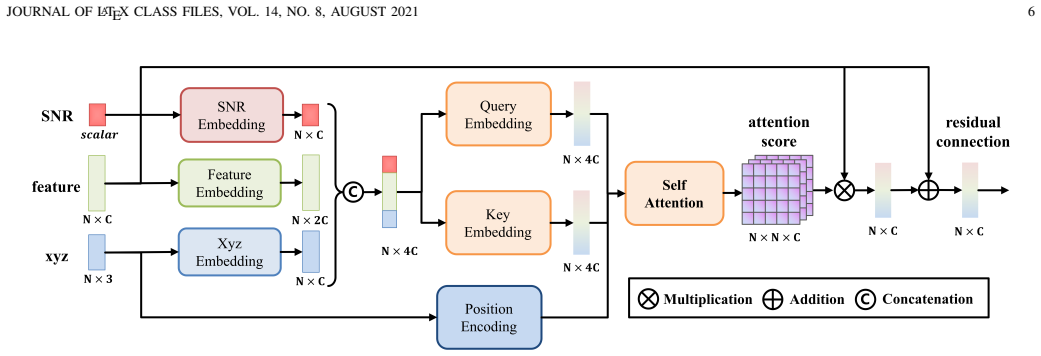
The central claim is that a digital semantic communication system can transmit LiDAR point clouds for collaborative perception more faithfully than both traditional octree-based compression followed by LDPC channel coding and existing deep learning-based point cloud transmission methods. LPC-FT encodes the whole point cloud into a compact downsampled representation using a density-preserving compression network, adds an absolute coordinate position encoding to the point transformer blocks, and then protects the features with a self-attention channel encoder that also ingests a channel SNR embedding. At the receiver, a symmetric channel decoder cleans the noisy features, a cross-attention mod
What carries the argument
The central mechanism is the density-preserving point cloud autoencoder, which represents a LiDAR cloud as a downsampled point set Ps and a compact feature set Fs, decoupled from the channel code. The transmitted coordinates Ps are assumed error-free via a pre-shared anchor point set, while the features Fs are passed through a self-attention channel encoder with SNR embedding, quantized, modulated, sent over AWGN or Rayleigh fading, demodulated, and decoded. At the receiver, a cross-attention feature fusion module exploits the correlation between the transmitter's and receiver's point clouds to enhance reconstruction. The digital link is made trainable by a straight-through estimator paired
Load-bearing premise
The receiver must already have the exact downsampled point coordinates Ps before transmission; the paper assumes these arrive error-free through a pre-shared anchor point set, but if those coordinates are corrupted, delayed, or unavailable in a real wireless link, the entire reconstruction pipeline has no anchor on which to rebuild the point cloud.
What would settle it
Take the trained LPC-FT and transmit the anchor coordinates Ps through a noisy bitstream at the same SNR instead of assuming they are error-free, then measure reconstruction Chamfer Distance and PSNR; a sharp degradation with even small coordinate errors would show that the reported robustness depends on a side channel that the real wireless system does not provide.
If this is right
- If the reported gains reproduce, LiDAR sharing between vehicles can operate at half the transmission data of prior learned methods while producing point clouds closer to the original, enabling lower-latency collaborative perception.
- The system's digital modulation and demodulation stages make it directly compatible with existing digital communication hardware, unlike discrete-time analog transmission schemes that dominate semantic communication research.
- The SNR embedding allows a single trained model to operate over a range of channel conditions, so vehicles do not need to retrain for each channel state.
- The two-stage training strategy, with a pretrained compression model fine-tuned for the channel, means adapting to new channel conditions requires only a short fine-tuning run rather than full retraining.
- Because the system reconstructs the complete environment rather than only object-level features, it can support downstream planning and prediction tasks that need background context, not just detection.
Where Pith is reading between the lines
- A natural stress test would be to transmit the anchor coordinates Ps through the same wireless link with a modest coding overhead; if reconstructing the downsampled coordinates degrades gracefully with channel quality, the system's robustness claim would extend to a fully wireless setup, whereas any error in Ps would likely collapse reconstruction quality.
- The cross-attention fusion assumes the transmitter and receiver point clouds are roughly aligned; a test with imperfect or missing extrinsic calibration between vehicles would reveal how much of the reported gain depends on accurate spatial registration.
- The same bottleneck features could be reused for downstream object detection or trajectory prediction without full point cloud reconstruction, potentially making the semantic link serve multiple perception tasks with a single transmission.
- The SNR-adaptive model could be extended to time-varying channels by feeding real-time channel estimates into the same SNR embedding, moving the system from block-fading-static assumptions toward more realistic dynamic vehicular channels.
Editorial analysis
A structured set of objections, weighed in public.
Referee Report
Summary. The paper proposes LPC-FT, a digital semantic communication system for LiDAR point cloud transmission in collaborative perception. The transmitter compresses a LiDAR point cloud with a density-preserving autoencoder, enhances the bottleneck features with a self-attention channel encoder, quantizes and modulates them, and the receiver applies a channel decoder, a cross-attention feature fusion module that uses the receiver's own point cloud, and a density-aware upsampling decoder to reconstruct the transmitter's cloud. Digital quantization/modulation is handled with a nonlinear straight-through estimator and tanh activation, and transfer learning is used to adapt to different SNRs. Experiments on OpV2V report that LPC-FT outperforms SEPT, an internal no-channel-coding ablation (LPC-FC), and octree+LDPC, with an average 30% Chamfer Distance reduction and 1.9 dB PSNR improvement over SEPT, at lower bpp.
Significance. If the results hold, the paper makes a useful contribution to semantic communications for LiDAR point clouds: it is one of the few works to consider a digital (quantized, modulated) transmission framework rather than discrete-time analog transmission, and the ablation study on the channel encoder and feature fusion modules is informative. The use of SNR embeddings, transfer learning, and the nonlinear STE is practical and well motivated. However, the central empirical claim is weakened by three issues: the load-bearing assumption that downsampled coordinates are delivered error-free with no protocol or bit cost, the absence of the underlying compression backbone [32] as a baseline, and the lack of error bars or significance measures. The paper is not reproducible as no code is released.
major comments (3)
- [Section III and Eq. (7)-(18)] The assumption that the downsampled coordinates Ps are delivered error-free via a pre-obtained 'anchor point set' is load-bearing and unquantified. The receiver conditions all reconstruction on Ps: Eq. (12) centers every upsampled point at Ps, Eqs. (15)-(18) use Ps in attention position encodings, and Eq. (7) decodes features aligned to Ps. If Ps is the FPS output of the current transmitter frame, the receiver cannot have it before transmission; if the anchor set is pre-shared and scene-independent, it is not the encoder's Ps. No protocol, bit budget, or protection mechanism is given, and no coordinate bit cost is included in the reported bpp. Because the headline gains are measured against baselines that also receive some free bits (first 1/8 for octree), the 'same data cost' claim is not established. Please specify how Ps is obtained/transmitted and include its cost in the comparison,
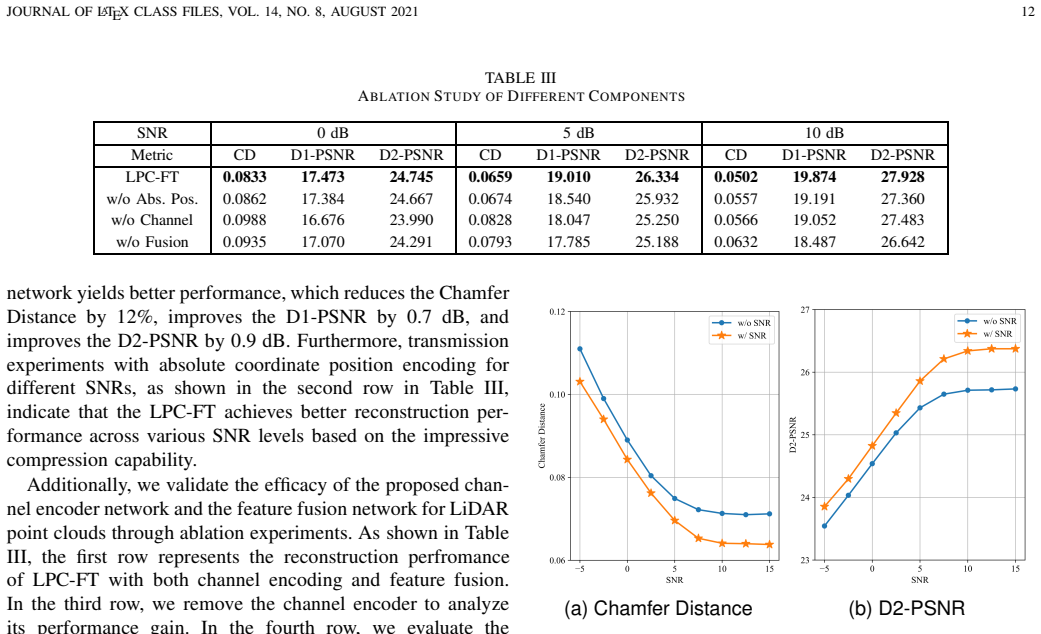
- [Section V-B and Figs. 7-8] The baseline set does not include the underlying compression backbone [32] that the feature encoder is explicitly adopted from. LPC-FC is an internal ablation, and SEPT is modified with an anchor-point strategy. Without a noiseless and digital-channel comparison to [32] at matched bpp, the reader cannot separate the contribution of the proposed channel/fusion/activation modules from the choice of the compression backbone. Please add [32] (or its re-implementation) at the same bpp and same coordinate side-information accounting, and report the noiseless performance of LPC-FT as an upper bound.
- [Section V-D] No error bars or significance tests are reported. The central numerical claims (30% CD reduction, 1.9 dB PSNR improvement) are averaged over test frames, but single-run curves in Figs. 7-8 cannot support confidence in these differences. Moreover, the text concedes that octree+LDPC with 1/2 rate outperforms LPC-FT on the point-to-point CD at SNR=5 dB, and the counter-argument depends on the factor-of-two data rate. With Ps side-information unaccounted, this comparison is not yet conclusive. Report variance/per-scene results and a rate-matched comparison.
minor comments (4)
- [Section IV-C, Eq. (18)] In the cross-attention equation, the key index appears to be a typo: eK_i should likely be eK_j, since the text describes attention between transmitter query i and receiver key j.
- [Throughout] There are numerous typos and grammatical errors, e.g., 'actiavtion', 'incorprate', 'transmssion', 'caculate', 'asssume'. A full proofread is needed.
- [Fig. 9] The ground-truth rows are labeled 'Bpp: 96' in every column, which is confusing; only reconstruction methods should carry bpp labels, and the ground-truth row should be clean.
- [Section III] The 'anchor point set' is mentioned but never formally defined. Please define it, distinguish it from the current frame's Ps, and specify whether it is pre-shared, updated, or transmitted.
Circularity Check
No circular derivation; the reported gains are empirical against external baselines. The error-free Ps side-channel assumption is a missing-support fairness risk, not a circularity.
full rationale
The central claims (30% CD reduction, 1.9 dB PSNR improvement) are established by simulations on OpV2V against external baselines (SEPT [40], octree+LDPC, and the LPC-FC ablation). No equation is defined in terms of the quantity it is supposed to predict, and no fitted parameter is renamed as a prediction. The only self-citations ([10] SoM framing, [19], [37] multi-modal semantic communications) are motivational and do not carry technical weight; no uniqueness theorem or ansatz is imported from them. The one load-bearing weakness is in Section III: "We assume the transmission of coordinates is error-free, because we can define an anchor point set that the transmitter and the receiver have already obtained before the transmission." This matters because Eq. (12) centers every upsampled neighborhood at points of Ps, and Eqs. (15)-(18) use Ps as the geometric conditioning of the attention modules. If Ps is the current frame's FPS output, the receiver cannot possess it before transmission; if the anchor set is pre-shared and scene-independent, it cannot be the encoder's Ps. No protocol is given for obtaining or protecting Ps, so the bitrate comparison may count coordinate delivery as free side information. This is a correctness/fairness risk, but it is not circular in the derivation sense: the reconstruction is still evaluated on held-out frames against external benchmarks, and the assumption does not make the output equal to an input by construction. Hence score 1 rather than 0 only to reflect that the self-citations, while non-load-bearing, are present.
Axiom & Free-Parameter Ledger
free parameters (3)
- density loss weight alpha =
5e-4
- cardinality loss weight beta =
5e-6
- bottleneck feature dimension C =
8
axioms (5)
- domain assumption Radio channel is block fading with known CSI; the coherence time equals the symbol block length NsC, and ZF equalization is applied.
- domain assumption The downsampled point coordinates Ps are transmitted error-free via a pre-shared anchor point set.
- domain assumption The receiver's own point cloud PR is available and is encoded with the same feature encoder S alpha to provide fusion features.
- domain assumption The density-preserving point cloud compression network of [32] is a valid autoencoder base, and its settings are reused.
- domain assumption OpV2V simulated LiDAR frames are representative for evaluating the generalization of LPC-FT.
invented entities (1)
-
Anchor point set
no independent evidence
Cite this review
Pith. "Pith review of Synesthesia of Machines (SoM)-Aided LiDAR Point Cloud Transmission for Collaborative Perception." pith.science (2026). https://pith.science/paper/TWDQ4RVC
@misc{pith2026250906506,
  author       = {Pith},
  title        = {Pith review of: Synesthesia of Machines (SoM)-Aided LiDAR Point Cloud Transmission for Collaborative Perception},
  year         = {2026},
  howpublished = {\url{https://pith.science/paper/TWDQ4RVC}},
  note         = {Machine review of arXiv:2509.06506}
}
read the original abstract
Collaborative perception enables more accurate and comprehensive scene understanding by learning how to share information between agents, with LiDAR point clouds providing essential precise spatial data. Due to the substantial data volume generated by LiDAR sensors, efficient point cloud transmission is essential for low-latency multi-agent collaboration. In this work, we propose an efficient, robust and applicable LiDAR point cloud transmission system via the Synesthesia of Machines (SoM), termed LiDAR Point Cloud Feature Transmission (LPC-FT), to support collaborative perception among multiple agents. Specifically, we employ a density-preserving deep point cloud compression method that encodes the complete point cloud into a downsampled efficient representation. To mitigate the effects of the wireless channel, we design a channel encoder module based on self-attention to enhance LiDAR point cloud features and a feature fusion module based on cross-attention to integrate features from transceivers. Furthermore, we utilize the nonlinear activation layer and transfer learning to improve the training of deep neural networks in the presence the digital channel noise. Experimental results demonstrate that the proposed LPC-FT is more robust and effective than traditional octree-based compression followed by channel coding, and outperforms state-of-the-art deep learning-based compression techniques and existing semantic communication methods, reducing the Chamfer Distance by 30% and improving the PSNR by 1.9 dB on average. Owing to its superior reconstruction performance and robustness against channel variations, LPC-FT is expected to support collaborative perception tasks.
Figures





Reference graph
Works this paper leans on
-
[1]
Collabo rative perception in autonomous driving: Methods, datasets, and c hallenges,
Y . Han, H. Zhang, H. Li, Y . Jin, C. Lang, and Y . Li, “Collabo rative perception in autonomous driving: Methods, datasets, and c hallenges,” IEEE Intell. Transp. Syst. Mag. , vol. 15, no. 6, pp. 131–151, Nov.-Dec. 2023. JOURNAL OF LATEX CLASS FILES, VOL. 14, NO. 8, AUGUST 2021 14
work page 2023
-
[2]
Y . Li and J. Ibanez-Guzman, “Lidar for autonomous drivin g: The principles, challenges, and trends for automotive lidar an d perception systems,” IEEE Signal Process. Mag. , vol. 37, no. 4, pp. 50–61, Jul. 2020
work page 2020
-
[3]
Cooper: Cooperative perception for connected autonomous vehicles based on 3d point clouds,
Q. Chen, S. Tang, Q. Y ang, and S. Fu, “Cooper: Cooperative perception for connected autonomous vehicles based on 3d point clouds, ” in Proc. IEEE Int. Conf. Distri. Comp. Syst. , Dallas, TX, USA, Jul. 2019, pp. 514–524
work page 2019
-
[4]
Learning distilled collaboration graph for multi-agent perception,
Y . Li, S. Ren, P . Wu, S. Chen, C. Feng, and W. Zhang, “Learning distilled collaboration graph for multi-agent perception,” Proc. Adv. Neural Inf. Process. Syst., pp. 29 541–29 552, 2021
work page 2021
-
[5]
V2x-v it: V ehicle-to-everything cooperative perception with visio n transformer,
R. Xu, H. Xiang, Z. Tu, X. Xia, M.-H. Y ang, and J. Ma, “V2x-v it: V ehicle-to-everything cooperative perception with visio n transformer,” in Proc. Eur . Conf. Comput. Vis. , Berlin, Heidelberg, Oct. 2022, pp. 107–124
work page 2022
-
[6]
Core: Coo perative reconstruction for multi-agent perception,
B. Wang, L. Zhang, Z. Wang, Y . Zhao, and T. Zhou, “Core: Coo perative reconstruction for multi-agent perception,” in Proc. IEEE Int. Conf. Comput. Vis., Paris, France, Oct. 2023, pp. 8710–8720
work page 2023
-
[7]
Learnin g for vehicle-to-vehicle cooperative perception under lossy co mmunication,
J. Li, R. Xu, X. Liu, J. Ma, Z. Chi, J. Ma, and H. Y u, “Learnin g for vehicle-to-vehicle cooperative perception under lossy co mmunication,” IEEE Trans. Intell. V ehicles, vol. 8, no. 4, pp. 2650–2660, 2023
work page 2023
-
[8]
Semantic commu nications: Principles and challenges,
Z. Qin, X. Tao, J. Lu, W. Tong, and G. Y . Li, “Semantic commu nications: Principles and challenges,” arXiv preprint arXiv:2201.01389 , 2021
Pith/arXiv arXiv 2021
-
[9]
Semantic communications for fu ture internet: Fundamentals, applications, and challenges,
W. Y ang, H. Du, Z. Q. Liew, W. Y . B. Lim, Z. Xiong, D. Niyato, X. Chi, X. Shen, and C. Miao, “Semantic communications for fu ture internet: Fundamentals, applications, and challenges,” IEEE Commun. Surv. Tutor ., vol. 25, no. 1, pp. 213–250, Firstquarter 2023
work page 2023
-
[10]
Intelligent multi-modal sen sing- communication integration: Synesthesia of machines,
X. Cheng, H. Zhang, J. Zhang, S. Gao, S. Li, Z. Huang, L. Ba i, Z. Y ang, X. Zheng, and L. Y ang, “Intelligent multi-modal sen sing- communication integration: Synesthesia of machines,” IEEE Commun. Surv. Tutor ., vol. 26, no. 1, pp. 258–301, Firstquarter 2024
work page 2024
-
[11]
A lite distributed semantic communic ation system for internet of things,
H. Xie and Z. Qin, “A lite distributed semantic communic ation system for internet of things,” IEEE J. Sel. Areas Commun. , vol. 39, no. 1, pp. 142–153, Jan. 2021
work page 2021
-
[12]
Deep learning e nabled semantic communication systems,
H. Xie, Z. Qin, G. Y . Li, and B.-H. Juang, “Deep learning e nabled semantic communication systems,” IEEE Trans. Signal Process., vol. 69, pp. 2663–2675, Apr. 2021
work page 2021
-
[13]
Performa nce limits of a deep learning-enabled text semantic communicat ion under interference,
T. M. Getu, W. Saad, G. Kaddoum, and M. Bennis, “Performa nce limits of a deep learning-enabled text semantic communicat ion under interference,” IEEE Trans. Wireless Commun., vol. 23, no. 8, pp. 10 213– 10 228, Aug. 2024
work page 2024
-
[14]
Deep jo int source- channel coding for wireless image transmission,
E. Bourtsoulatze, D. B. Kurka, and D. G¨ und¨ uz, “Deep jo int source- channel coding for wireless image transmission,” IEEE Trans. Cogn. Commun. Netw., vol. 5, no. 3, pp. 567–579, Sept. 2019
work page 2019
-
[15]
W ireless image transmission using deep source channel coding with at tention modules,
J. Xu, B. Ai, W. Chen, A. Y ang, P . Sun, and M. Rodrigues, “W ireless image transmission using deep source channel coding with at tention modules,” IEEE Trans. Circuits Syst. Video Technol. , vol. 32, no. 4, pp. 2315–2328, Apr. 2021
work page 2021
-
[16]
WIT T: A wireless image transmission transformer for semantic comm unications,
K. Y ang, S. Wang, J. Dai, K. Tan, K. Niu, and P . Zhang, “WIT T: A wireless image transmission transformer for semantic comm unications,” in Proc. IEEE Int. Conf. Acoust. Speech Signal Process. , Rhodes Island, Greece,, Jun. 2023, pp. 1–5
work page 2023
-
[17]
Task-oriented explainable semantic commun ications,
S. Ma, W. Qiao, Y . Wu, H. Li, G. Shi, D. Gao, Y . Shi, S. Li, an d N. Al-Dhahir, “Task-oriented explainable semantic commun ications,” IEEE Trans. Wireless Commun. , vol. 22, no. 12, pp. 9248–9262, Dec. 2023
2023
-
[18]
Classification-oriented semant ic wireless com- munications,
E. Kutay and A. Y ener, “Classification-oriented semant ic wireless com- munications,” in Proc. IEEE Int. Conf. Acoustics Speech Signal Process. , Seoul, Korea (South), Apr. 2024, pp. 9096–9100
work page 2024
-
[19]
Classification-driven discrete neural represen tation learning for semantic communications,
W. Hua, L. Xiong, S. Liu, L. Chen, X. Hong, J. F. Mota, and X. Cheng, “Classification-driven discrete neural represen tation learning for semantic communications,” IEEE Internet Things J. , vol. 11, no. 9, pp. 16 061–16 073, May 2024
work page 2024
-
[20]
Semantic communications with di screte-time analog transmission: A papr perspective,
Y . Shao and D. Gunduz, “Semantic communications with di screte-time analog transmission: A papr perspective,” IEEE Wireless Commun. Lett. , vol. 12, no. 3, pp. 510–514, Mar. 2022
work page 2022
-
[21]
Google/draco: a library for compressing and decompressin g 3d geo- metric meshes and point clouds,
F. Galligan, M. Hemmer, O. Stava, F. Zhang, and J. Brettl e, “Google/draco: a library for compressing and decompressin g 3d geo- metric meshes and point clouds,” 2018
work page 2018
-
[22]
D. Graziosi, O. Nakagami, S. Kuma, A. Zaghetto, T. Suzuk i, and A. Tabatabai, “An overview of ongoing point cloud compressi on stan- dardization activities: Video-based (v-pcc) and geometry -based (g-pcc),” APSIPA Transactions on Signal and Information Processing , vol. 9, p. e13, 2020
work page 2020
-
[23]
Geometric modeling using octree encoding ,
D. Meagher, “Geometric modeling using octree encoding ,” Computer graphics and image processing , vol. 19, no. 2, pp. 129–147, 1982
work page 1982
-
[24]
Multidimensional binary search trees u sed for associative searching,
J. L. Bentley, “Multidimensional binary search trees u sed for associative searching,” Communications of the ACM , vol. 18, no. 9, pp. 509–517, 1975
work page 1975
-
[25]
Pointnet: Deep le arning on point sets for 3d classification and segmentation,
C. R. Qi, H. Su, K. Mo, and L. J. Guibas, “Pointnet: Deep le arning on point sets for 3d classification and segmentation,” in Proc. IEEE Conf. Comput. Vis. Pattern Recognit. , Honolulu, HI, USA, Jul. 2017, pp. 77–85
work page 2017
-
[26]
Pointnet++: Deep hierarchical feature learning on point sets in a metric space,
C. R. Qi, L. Yi, H. Su, and L. J. Guibas, “Pointnet++: Deep hierarchical feature learning on point sets in a metric space,” Red Hook, N Y , USA, 2017, pp. 5105–5114
work page 2017
-
[27]
H. Zhao, L. Jiang, J. Jia, P . H. Torr, and V . Koltun, “Poin t transformer,” in Proc. IEEE Int. Conf. Comput. Vis., Montreal, QC, Canada, Oct. 2021, pp. 16 239–16 248
work page 2021
-
[28]
3d point cloud geometry compressio n on deep learning,
T. Huang and Y . Liu, “3d point cloud geometry compressio n on deep learning,” in Proc. ACM Int. Conf. Multimedia , New Y ork, NY , USA, Oct. 2019, pp. 890–898
work page 2019
-
[29]
Transformer and ups ampling- based point cloud compression,
J. Zhang, G. Liu, D. Ding, and Z. Ma, “Transformer and ups ampling- based point cloud compression,” in Proc. ACM Adv. Point Cloud Comp. Process. Analysis, New Y ork, NY , USA, Oct. 2022, pp. 33–39
work page 2022
-
[30]
Deep compression for dense point cloud maps,
L. Wiesmann, A. Milioto, X. Chen, C. Stachniss, and J. Be hley, “Deep compression for dense point cloud maps,” IEEE Rob. Autom. Lett., vol. 6, no. 2, pp. 2060–2067, Apr. 2021
work page 2060
-
[31]
Octattention: O ctree-based large-scale contexts model for point cloud compression,
C. Fu, G. Li, R. Song, W. Gao, and S. Liu, “Octattention: O ctree-based large-scale contexts model for point cloud compression,” i n Proc. AAAI Conf. Artif. Intell. , vol. 36, no. 1, Jun. 2022, pp. 625–633
work page 2022
-
[32]
Densit y- preserving deep point cloud compression,
Y . He, X. Ren, D. Tang, Y . Zhang, X. Xue, and Y . Fu, “Densit y- preserving deep point cloud compression,” in Proc. IEEE Conf. Comput. Vis. Pattern Recognit. , New Orleans, LA, USA, Jun. 2022, pp. 2323– 2332
work page 2022
-
[33]
C. E. Shannon and W. Weaver, The Mathematical Theory of Communi- cation. The University of Illinois Press, 1949
work page 1949
-
[34]
Deep joint source-cha nnel coding for csi feedback: An end-to-end approach,
J. Xu, B. Ai, N. Wang, and W. Chen, “Deep joint source-cha nnel coding for csi feedback: An end-to-end approach,” IEEE J. Sel. Areas Commun. , vol. 41, no. 1, pp. 260–273, Jan. 2023
work page 2023
-
[35]
Task-oriented multi-user semantic communications,
H. Xie, Z. Qin, X. Tao, and K. B. Letaief, “Task-oriented multi-user semantic communications,” IEEE J. Sel. Areas Commun. , vol. 40, no. 9, pp. 2584–2597, Sept. 2022
work page 2022
-
[36]
A unified multi- task semantic communication system with domain adaptation,
G. Zhang, Q. Hu, Z. Qin, Y . Cai, and G. Y u, “A unified multi- task semantic communication system with domain adaptation,” in Proc. IEEE Global Comm. Conf. , Rio de Janeiro, Brazil, Dec. 2022, pp. 3971–3976
work page 2022
-
[37]
Multi-modal fus ion- based multi-task semantic communication system,
Z. Zhu, R. Zhang, X. Cheng, and L. Y ang, “Multi-modal fus ion- based multi-task semantic communication system,” arXiv preprint arXiv:2407.00964, 2024
arXiv 2024
-
[38]
Wireless 3d point cloud delivery using deep graph neural networks,
T. Fujihashi, T. Koike-Akino, S. Chen, and T. Watanabe, “Wireless 3d point cloud delivery using deep graph neural networks,” in IEEE Int. Conf. Commun. , Montreal, QC, Canada, Jun. 2021, pp. 1–6
work page 2021
-
[39]
X. Liu, H. Liang, Z. Bao, C. Dong, and X. Xu, “Semantic com mu- nications system with model division multiple access and co ntrollable coding rate for point cloud,” arXiv preprint arXiv:2307.06027 , 2023
Pith/arXiv arXiv 2023
-
[40]
Over-the-Air Learning-based Geometry Point Cloud Transmission
C. Bian, Y . Shao, and D. Gunduz, “Wireless point cloud tr ansmission,” arXiv preprint arXiv:2306.08730 , 2023
work page internal anchor Pith review Pith/arXiv arXiv 2023
-
[41]
Shapenet: An information- rich 3d model repository,
A. X. Chang, T. Funkhouser, L. Guibas, P . Hanrahan, Q. Hu ang, Z. Li, S. Savarese, M. Savva, S. Song, H. Su et al., “Shapenet: An information- rich 3d model repository,” arXiv preprint arXiv:1512.03012 , 2015
Pith/arXiv arXiv 2015
-
[42]
3d shapenets: A deep representation for volumetric shapes,
Z. Wu, S. Song, A. Khosla, F. Y u, L. Zhang, X. Tang, and J. X iao, “3d shapenets: A deep representation for volumetric shapes,” i n Proc. IEEE Conf. Comput. Vis. Pattern Recognit. , Boston, MA, USA, Jun. 2015, pp. 1912–1920
work page 2015
-
[43]
Estimating o r propagating gradients through stochastic neurons for conditional comp utation,
Y . Bengio, N. L´ eonard, and A. Courville, “Estimating o r propagating gradients through stochastic neurons for conditional comp utation,” arXiv preprint arXiv:1308.3432, 2013
Pith/arXiv arXiv 2013
-
[44]
Differentiable soft quantization: Bridging full-precis ion and low-bit neural networks,
R. Gong, X. Liu, S. Jiang, T. Li, P . Hu, J. Lin, F. Y u, and J. Y an, “Differentiable soft quantization: Bridging full-precis ion and low-bit neural networks,” in Proc. IEEE Conf. Comput. Vis. Pattern Recognit. , Seoul, Korea (South), Oct.-Nov. 2019, pp. 4852–4861
work page 2019
-
[45]
Unde rstanding straight-through estimator in training activation quanti zed neural nets,
P . Yin, J. Lyu, S. Zhang, S. Osher, Y . Qi, and J. Xin, “Unde rstanding straight-through estimator in training activation quanti zed neural nets,” arXiv preprint arXiv:1903.05662 , 2019
Pith/arXiv arXiv 1903
-
[46]
R. Xu, H. Xiang, X. Xia, X. Han, J. Li, and J. Ma, “Opv2v: An open benchmark dataset and fusion pipeline for perception w ith vehicle- to-vehicle communication,” in Proc. IEEE Int. Conf. Robot. Autom. , Philadelphia, PA, USA, May 2022, pp. 2583–2589
work page 2022
This paper was first reviewed by deepseek-v4-flash on August 4, 2026.
discussion (0)
Sign in with ORCID, Apple, or X to comment. Anyone can read and Pith papers without signing in.