REVIEW 3 major objections 6 minor 3 cited by
SonicBoom: Contact Localization Using Array of Microphones
T0 review · 3 major / 6 minor · reviewed 2026-08-11 · deepseek-v4-flash
Pith's one-line read Six microphones on a robot arm localize a bump to under half a centimeter by listening to vibrations in the arm itself.
desk verdict The paper's few-centimeter localization claim is credible, but the headline 0.43 cm in-distribution number rests on unvalidated mesh-intersection labels and should not be taken at face value. read the letter →
The pith
A machine-rendered reading of the paper's core claim, the machinery that carries it, and where it could break.
The reading
What carries the argument
The central object is SonicBoom's sensing geometry: six piezoelectric contact microphones arranged in two rings of three on a split PVC tube, which turns the tube into an instrumented surface parameterized by cylinder coordinates. The argument is carried by relative features: per-channel mel spectrograms encode local intensity patterns, while GCC-PHAT (a phase-normalized cross-correlation between each microphone pair) encodes arrival-time differences without requiring gain calibration; robot proprioception supplies a motion-direction prior. A multi-modal transformer with modality-specific encoders fuses these into a single $(z, \theta)$ prediction, and the azimuth loss is computed in Cartesian form to avoid angle-wrapping discontinuities.
What would settle it
Strike a set of physically marked, known positions on the stationary tube while tracking a tool or target with an optical motion-capture system, then compare SonicBoom's predictions with the optical positions. If the two ground-truth sources disagree by about the claimed 0.43 cm error, the mesh-averaging label pipeline cannot be treated as accurate enough to certify sub-centimeter localization.
Extended reading notes
Core claim
The central claim is that relative acoustic features between microphones let a supervised model localize single-point impulsive contacts on a robot's PVC end-effector tube in cylindrical coordinates (height $z$ and azimuth $\theta$). Using six channels of mel spectrogram and 15 pairwise GCC-PHAT vectors fused with robot proprioception in a multi-sensory transformer, the model reports mean Euclidean errors of 0.43 cm on in-distribution data and remains under 2.3 cm when tested on novel objects, exploratory motions, and human strikes, including stationary-robot zero-shot transfer. The paper further claims that phase information, not magnitude alone, is what generalizes to out-of-distribution contacts.
Load-bearing premise
The reported accuracy assumes the automatically generated ground-truth contact labels—averaged mesh-intersection points projected onto the tube—are more accurate than the predictions, but they are never checked against an independent measurement.
Editorial extensions
If this is right
- A robot arm fitted with this microphone array can localize a single impact to under half a centimeter on the training distribution, so the vibration signal itself is spatially informative.
- The error grows to about 1.0 cm on unseen rod and branch-like geometries, suggesting the learned mapping generalizes beyond the specific training objects rather than memorizing them.
- In an occluded mock canopy, haptic mapping reconstructs branch positions with roughly 2 cm error, which is precise enough to support obstacle avoidance when vision is blocked.
- With the robot stationary, audio alone reaches about 2.2 cm error, so the method does not depend on knowing the robot's motion to locate a contact.
Reading between the lines
- The same hardware should extend to longer links by adding more microphone rings, as the paper notes, which suggests the per-ring triangulation scheme scales linearly with tube length.
- Because phase features are what generalize, an audio-only variant could be mounted on existing rigid links without robot proprioception, such as tools or grippers, at the cost of the larger errors seen in the stationary test.
- Applying temporal filtering or a probabilistic tracker over consecutive predictions could lift the single-impact assumption and track sliding contacts, a natural next step the paper lists as future work.
Signed reviews
Editorial analysis
A structured set of objections, weighed in public.
Referee Report
Summary. The paper presents SonicBoom, a hardware and learning pipeline that localizes impulsive single-point contacts on a PVC end-effector link using an array of six piezoelectric contact microphones and robot proprioception. The system maps mel spectrograms, GCC-PHAT features, and one-second end-effector trajectories to cylindrical coordinates (z, θ) via a multimodal transformer. The authors report mean Euclidean distances of 0.43 cm on in-distribution data, 1.01 cm on novel rod geometries, 2.01 cm in robot-active haptic mapping, and 2.22 cm when a human strikes the stationary robot. They also provide extensive ablations of input modalities, preprocessing, and augmentation, plus real-world demonstrations in a mock canopy.
Significance. If the reported accuracy is genuine, this is a practical contribution to tactile sensing for occluded manipulation: it shows that a small array of cheap contact microphones can turn a rigid robot link into a contact-aware surface, with generalization to novel objects, materials, and human strikes. The strengths of the paper include a large autonomously collected dataset (18,000 events), open-sourced hardware and software, thorough feature and ablation comparisons, and real-robot demonstrations. The phase-based features (GCC-PHAT) are shown to be particularly important for out-of-distribution generalization, which is a useful empirical finding. However, the headline sub-centimeter accuracy depends entirely on an unvalidated label-generation procedure, and the paper lacks baselines against simpler analytical or classical methods, so the contribution of the learning pipeline over conventional TDOA approaches is not yet established.
major comments (3)
- [V-B] The ground-truth contact labels are generated by averaging near-zero mesh-intersection points and projecting the average onto the SonicBoom surface, but this procedure is never validated against an independent measurement such as an optical marker, a tactile sensor, or manual annotation. The centroid of a mesh-intersection volume is not generally the first physical contact point, and the projection step can systematically shift labels along z or θ. Since the reported MEDs are computed relative to these labels, the 0.43 cm in-distribution error on Test Set 1 may partly reflect consistency with a biased label generator rather than true physical localization accuracy. The authors should validate the label pipeline on a subset of collisions with independent ground truth and report the resulting label error, and ideally also report localization error against that independent ground truth.
- [VII-A] Test Set 1 is explicitly described as the validation set used during model development. Reporting it as the headline 'in-distribution' performance is therefore not a measure of held-out generalization: the model architecture and hyperparameters were selected using this set, so the 0.43 cm MED may be optimistically biased. The authors should evaluate on a separate held-out test set collected under the same conditions as the training distribution, or at least clearly label Test Set 1 as validation and move the headline number to a true test set.
- [VII-B] The paper claims 'state-of-the-art contact localization' (Sec. II-B) but provides no comparison to any baseline, such as analytical TDOA triangulation from GCC-PHAT peaks, a simpler classical model, or a non-transformer architecture. Without such a baseline, it is unclear how much of the performance comes from the learned model versus the information already present in the microphone array. Additionally, all reported MEDs appear to come from a single trained model with no error bars or multiple-seed runs, so the statistical significance of differences between ablations (e.g., Fig. 7) is not established. The authors should add at least one classical TDOA baseline on the same test sets and report mean and variance over multiple training runs.
minor comments (6)
- [Abstract and Introduction] The abstract reports a 0.42 cm in-distribution error, while the body text (Sec. VII-A and conclusion) reports 0.43 cm; this inconsistency should be corrected.
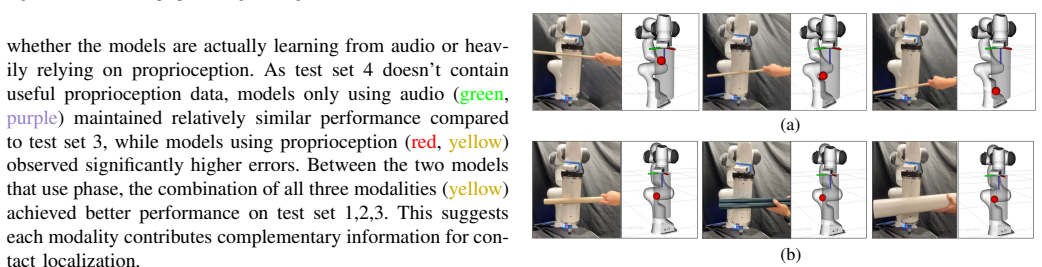
- [VII-C2] The robot-stationary human-strike experiment reports a 2.4 cm mean error in Sec. VII-C2, while Test Set 4 in Sec. VII-A reports 2.22 cm for the same scenario; the discrepancy should be clarified.
- [VII-A] The term 'zero-shot transfer' for Test Set 4 is ambiguous: the robot is stationary, so proprioceptive data are uninformative but still available to models that use them. The paper should clarify whether the test uses the audio-only model or feeds a stationary trajectory to the full model, and should avoid implying that the proprioceptive input channel is absent.
- [VI-B] The description of GCC-PHAT features says 'full representation of GCC-PHAT vector' is used, but the dimensionality and time-lag range of the vector fed to the MLP are not specified, making the architecture hard to reproduce.
- [VI-C] Equations (3) and (4) are duplicated and the second is typeset incorrectly; one equation with the circular-loss substitution for θ would suffice.
- [VII-B2] The preprocessing ablation is reported only on Test Set 1 (the validation set), which limits the conclusions about generalization; stating this explicitly and reporting on at least one out-of-distribution set would strengthen the claim.
Circularity Check
No significant circularity: SonicBoom's localization predictions are supervised outputs trained on externally generated mesh-collision labels; the only caveat is reuse of the validation set for preprocessing selection, which is a benchmarking concern, not a circular derivation.
full rationale
SonicBoom is a supervised learning pipeline: f(A,G,X) -> p(z,theta) is trained with MSE against labels p obtained in Sec. V-B by post-processing recorded robot trajectories and FARO laser-scanned object pointclouds via mesh intersection and projection. These labels are external to the model and are not derived from the acoustic inputs or from the paper's own fitted constants, so the localization prediction is not equivalent to its training input by construction. The MED values on Test Sets 2-4 are computed on held-out objects, motions, and a zero-shot human-striking scenario, so the generalization claim has independent empirical content. The only in-scope caveats are: (i) Sec. VII-A calls Test Set 1 'our validation set', and Sec. VII-B2 states that preprocessing and augmentation combinations were evaluated on Test Set 1, so the 0.43 cm in-distribution number is selection-optimized rather than a fresh held-out estimate; this is a benchmarking or leakage concern, not a circular derivation, because the model weights were still trained on a separate training set. (ii) Reference [26], which supports the 'branches can be approximated as cylinders' assumption, is a self-citation by overlapping authors, but it is not load-bearing for the localization result. No uniqueness theorem, ansatz smuggled by citation, or renaming of a known result is invoked. The unvalidated mesh-intersection labeling pipeline is a legitimate correctness risk, but it is not circularity, since the labels are not functions of the model's predictions or of the paper's claimed outputs. Overall, the derivation chain is self-contained with respect to the supervised learning setup, and the central generalization claims rest on held-out evaluations.
Assumptions & free parameters
free parameters (6)
- STFT window size (samples) =
512
- STFT hop length (samples) =
128
- Number of mel filter banks =
50
- Audio embedding dimension relative to proprioception =
2x
- Dropout rates for audio vs proprioception =
Lower for audio (exact values not given)
- Spectral gating noise-reduction parameters =
Not reported
assumptions (6)
- domain assumption All contact events of interest are single-point and impulsive (strikes), not sliding or multi-point contacts.
- domain assumption Ground-truth contact labels from mesh collision post-processing are accurate enough for sub-centimeter evaluation.
- domain assumption Spectral gating with a pre-recorded motor-noise reference isolates the collision signal.
- domain assumption Wooden rods are a valid proxy for tree branches and yield single-point cylinder-to-cylinder contacts.
- domain assumption Mel spectrograms, GCC-PHAT vectors, and one-second end-effector trajectories are sufficient input representations for contact localization.
- domain assumption The chosen multi-modal transformer architecture is expressive enough to learn the mapping with the available 18,000 samples.
invented entities (1)
-
SonicBoom end-effector hardware (PVC tube with six piezoelectric contact microphones in two rings)
independent evidence
Cite this review
Pith. "Pith review of SonicBoom: Contact Localization Using Array of Microphones." pith.science (2026). https://pith.science/paper/TWKNRYZY
@misc{pith2026241209878,
  author       = {Pith},
  title        = {Pith review of: SonicBoom: Contact Localization Using Array of Microphones},
  year         = {2026},
  howpublished = {\url{https://pith.science/paper/TWKNRYZY}},
  note         = {Machine review of arXiv:2412.09878}
}
read the original abstract
In cluttered environments where visual sensors encounter heavy occlusion, such as in agricultural settings, tactile signals can provide crucial spatial information for the robot to locate rigid objects and maneuver around them. We introduce SonicBoom, a holistic hardware and learning pipeline that enables contact localization through an array of contact microphones. While conventional sound source localization methods effectively triangulate sources in air, localization through solid media with irregular geometry and structure presents challenges that are difficult to model analytically. We address this challenge through a feature engineering and learning based approach, autonomously collecting 18,000 robot interaction sound pairs to learn a mapping between acoustic signals and collision locations on the robot end effector link. By leveraging relative features between microphones, SonicBoom achieves localization errors of 0.42cm for in distribution interactions and maintains robust performance of 2.22cm error even with novel objects and contact conditions. We demonstrate the system's practical utility through haptic mapping of occluded branches in mock canopy settings, showing that acoustic based sensing can enable reliable robot navigation in visually challenging environments.
Figures


Figures from the paper (5 more)


Forward citations
Cited by 3 Pith papers
-
Planning-Query-Guided Model Generation for Model-Based Deformable Object Manipulation
A diffusion model trained on optimized resolution labels picks which regions of a deformable object need high-resolution dynamics for a planning query, yielding 2.1x faster planning with a small cost increase.
-
VibeCheck: Using Active Acoustic Tactile Sensing for Contact-Rich Manipulation
Active acoustic sensing between the gripper fingers, with only acoustic feedback, can drive a UR5 robot through peg insertion, building on classifiers for material, grasp position, internal pose, and contact type.
-
Audio-Visual Contact Classification for Tree Structures in Agriculture
Fusing contact microphone audio with camera images classifies leaf, twig, trunk, or ambient contacts in orchards, and transfers from a hand-held probe to a robot-mounted probe, with reported F1 between 0.74 and 0.82.
Reference graph
Works this paper leans on
-
[1]
Exploratory hand: Leveraging safe contact to facilitate manipulation in cluttered spaces,
M. A. Lin, R. Thomasson, G. Uribe, H. Choi, and M. R. Cutkosky, “Exploratory hand: Leveraging safe contact to facilitate manipulation in cluttered spaces,” IEEE Robotics and Automation Letters , vol. 6, no. 3, pp. 5159–5166, 2021
work page 2021
-
[2]
Tactile-sensing technologies: Trends, challenges and outlook in agri- food manipulation,
W. Mandil, V . Rajendran, K. Nazari, and A. Ghalamzan-Esfahani, “Tactile-sensing technologies: Trends, challenges and outlook in agri- food manipulation,” Sensors, vol. 23, no. 17, p. 7362, 2023
work page 2023
-
[3]
Gelslim 4.0: Focusing on touch and reproducibility,
A. Sipos, W. v. d. Bogert, and N. Fazeli, “Gelslim 4.0: Focusing on touch and reproducibility,” arXiv preprint arXiv:2409.19770 , 2024
arXiv 2024
-
[4]
Digit: A novel design for a low-cost compact high-resolution tactile sensor with application to in-hand manipulation,
M. Lambeta, P.-W. Chou, S. Tian, B. Yang, B. Maloon, V . R. Most, D. Stroud, R. Santos, A. Byagowi, G. Kammerer et al. , “Digit: A novel design for a low-cost compact high-resolution tactile sensor with application to in-hand manipulation,” IEEE Robotics and Automation Letters, vol. 5, no. 3, pp. 3838–3845, 2020
2020
-
[5]
Gelsight: High-resolution robot tactile sensors for estimating geometry and force,
W. Yuan, S. Dong, and E. H. Adelson, “Gelsight: High-resolution robot tactile sensors for estimating geometry and force,” Sensors, vol. 17, no. 12, p. 2762, 2017
2017
-
[6]
Active acoustic sensing for robot manipula- tion,
S. Lu and H. Culbertson, “Active acoustic sensing for robot manipula- tion,” in 2023 IEEE/RSJ International Conference on Intelligent Robots and Systems (IROS) . IEEE, 2023, pp. 3161–3168
work page 2023
-
[7]
Swoosh! rattle! thump!–actions that sound,
D. Gandhi, A. Gupta, and L. Pinto, “Swoosh! rattle! thump!–actions that sound,” arXiv preprint arXiv:2007.01851 , 2020
arXiv 2007
-
[8]
Active acoustic contact sensing for soft pneumatic actuators,
G. Z ¨oller, V . Wall, and O. Brock, “Active acoustic contact sensing for soft pneumatic actuators,” in 2020 IEEE International Conference on Robotics and Automation (ICRA) . IEEE, 2020, pp. 7966–7972
work page 2020
Show all 30 references
-
[9]
A virtual 2d tactile array for soft actuators using acoustic sensing,
V . Wall and O. Brock, “A virtual 2d tactile array for soft actuators using acoustic sensing,” in 2022 IEEE/RSJ International Conference on Intelligent Robots and Systems (IROS) . IEEE, 2022, pp. 10 029–10 034
2022
-
[10]
Passive and active acoustic sensing for soft pneumatic actuators,
V . Wall, G. Z ¨oller, and O. Brock, “Passive and active acoustic sensing for soft pneumatic actuators,” The International Journal of Robotics Research, vol. 42, no. 3, pp. 108–122, 2023
2023
-
[11]
Sonicsense: Object perception from in-hand acoustic vibration,
J. Liu and B. Chen, “Sonicsense: Object perception from in-hand acoustic vibration,” arXiv preprint arXiv:2406.17932 , 2024
2024 arXiv
-
[12]
A review on sound source localization systems,
D. Desai and N. Mehendale, “A review on sound source localization systems,” Archives of Computational Methods in Engineering , vol. 29, no. 7, pp. 4631–4642, 2022
2022
-
[13]
A biomimetic elastomeric robot skin using electrical impedance and acoustic tomogra- phy for tactile sensing,
K. Park, H. Yuk, M. Yang, J. Cho, H. Lee, and J. Kim, “A biomimetic elastomeric robot skin using electrical impedance and acoustic tomogra- phy for tactile sensing,” Science Robotics , vol. 7, no. 67, p. eabm7187, 2022
2022
-
[14]
Poe: Acoustic soft robotic proprioception for omnidirectional end-effectors,
U. Yoo, Z. Lopez, J. Ichnowski, and J. Oh, “Poe: Acoustic soft robotic proprioception for omnidirectional end-effectors,” arXiv preprint arXiv:2401.09382, 2024
2024 arXiv
-
[15]
Stressd: Sim- to-real from sound for stochastic dynamics,
C. Matl, Y . Narang, D. Fox, R. Bajcsy, and F. Ramos, “Stressd: Sim- to-real from sound for stochastic dynamics,” in Conference on Robot Learning. PMLR, 2021, pp. 935–958
2021
-
[16]
The boom- box: Visual reconstruction from acoustic vibrations,
B. Chen, M. Chiquier, H. Lipson, and C. V ondrick, “The boom- box: Visual reconstruction from acoustic vibrations,” arXiv preprint arXiv:2105.08052, 2021
2021 arXiv
-
[17]
Design and cal- ibration of large microphone arrays for robotic applications,
F. Perrodin, J. Nikolic, J. Busset, and R. Siegwart, “Design and cal- ibration of large microphone arrays for robotic applications,” in 2012 IEEE/RSJ International Conference on Intelligent Robots and Systems . IEEE, 2012, pp. 4596–4601
2012
-
[18]
Detec- tion of nearby uavs using cnn and spectrograms,
A. A. Cabrera-Ponce, J. Martinez-Carranza, and C. Rascon, “Detec- tion of nearby uavs using cnn and spectrograms,” in Proceedings of the International Micro Air V ehicle Conference and Competition (IMA V)(Madrid), Madrid, Spain, vol. 29, 2019
2019
-
[19]
An efficient adaptive window size selection method for improving spectrogram visualization,
S. Nisar, O. U. Khan, and M. Tariq, “An efficient adaptive window size selection method for improving spectrogram visualization,” Com- putational intelligence and neuroscience , vol. 2016, no. 1, p. 6172453, 2016
2016
-
[20]
That sounds right: Auditory self-supervision for dynamic robot manipulation,
A. Thankaraj and L. Pinto, “That sounds right: Auditory self-supervision for dynamic robot manipulation,” in Conference on Robot Learning . PMLR, 2023, pp. 1036–1049
2023
-
[21]
Ambisense: Acoustic field based blindspot-free proximity detection and bearing estimation,
S. Rupavatharam, X. Fan, C. Escobedo, D. Lee, L. Jackel, R. Howard, C. Prepscius, D. Lee, and V . Isler, “Ambisense: Acoustic field based blindspot-free proximity detection and bearing estimation,” in 2023 IEEE/RSJ International Conference on Intelligent Robots and Systems (IR...
2023
-
[22]
Sonicfinger: Pre-touch and contact detection tactile sensor for reactive pregrasping,
S. Rupavatharam, C. Escobedo, D. Lee, C. Prepscius, L. Jackel, R. Howard, and V . Isler, “Sonicfinger: Pre-touch and contact detection tactile sensor for reactive pregrasping,” in 2023 IEEE International Conference on Robotics and Automation (ICRA) . IEEE, 2023, pp. 12 556–12 562
2023
-
[23]
Enabling low-cost full surface tactile skin for human robot interaction,
X. Fan, D. Lee, L. Jackel, R. Howard, D. Lee, and V . Isler, “Enabling low-cost full surface tactile skin for human robot interaction,” IEEE Robotics and Automation Letters , vol. 7, no. 2, pp. 1800–1807, 2022
2022
-
[24]
Acoustic sensing for soft pneumatic actuators,
G. Z ¨oller, V . Wall, and O. Brock, “Acoustic sensing for soft pneumatic actuators,” in 2018 IEEE/RSJ International Conference on Intelligent Robots and Systems (IROS) . IEEE, 2018, pp. 6986–6991
2018
-
[25]
A survey of sound source local- ization and detection methods and their applications,
G. Jekatery ´nczuk and Z. Piotrowski, “A survey of sound source local- ization and detection methods and their applications,” Sensors, vol. 24, no. 1, p. 68, 2023
2023
-
[26]
Towards robotic tree manipulation: Leveraging graph representations,
C. H. Kim, M. Lee, O. Kroemer, and G. Kantor, “Towards robotic tree manipulation: Leveraging graph representations,” in 2024 IEEE International Conference on Robotics and Automation (ICRA) . IEEE, 2024, pp. 11 884–11 890
2024
-
[27]
Deep neural networks for multiple speaker detection and localization,
W. He, P. Motlicek, and J.-M. Odobez, “Deep neural networks for multiple speaker detection and localization,” in 2018 IEEE International Conference on Robotics and Automation (ICRA) . IEEE, 2018, pp. 74– 79
2018
-
[28]
See, hear, and feel: Smart sensory fusion for robotic manipulation,
H. Li, Y . Zhang, J. Zhu, S. Wang, M. A. Lee, H. Xu, E. Adelson, L. Fei- Fei, R. Gao, and J. Wu, “See, hear, and feel: Smart sensory fusion for robotic manipulation,” arXiv preprint arXiv:2212.03858 , 2022
2022 arXiv
-
[29]
Maniwav: Learning robot manipulation from in-the-wild audio-visual data,
Z. Liu, C. Chi, E. Cousineau, N. Kuppuswamy, B. Burchfiel, and S. Song, “Maniwav: Learning robot manipulation from in-the-wild audio-visual data,” in 8th Annual Conference on Robot Learning , 2024
2024
-
[30]
Ast: Audio spectrogram trans- former,
Y . Gong, Y .-A. Chung, and J. Glass, “Ast: Audio spectrogram trans- former,” arXiv preprint arXiv:2104.01778 , 2021
2021 arXiv
Reviewed August 11, 2026 · model on record in the stance chip above.
Discussion (0). Continue with ORCID to comment.