REVIEW 3 major objections 6 minor 62 references
STONet: A neural operator for modeling solute transport in micro-cracked reservoirs
T0 review · 3 major / 6 minor · reviewed 2026-08-11 · deepseek-v4-flash
Pith's one-line read STONet, a neural operator for solute transport in micro-cracked reservoirs, predicts concentration fields from fracture statistics and pressure conditions, with relative errors typically below 1% against FEM simulations and roughly two…
desk verdict Useful surrogate paper with a load-bearing typo in the density equation; the physics claim needs verification before the 1% accuracy claim can be trusted. read the letter →
The pith
A machine-rendered reading of the paper's core claim, the machinery that carries it, and where it could break.
The reading
What carries the argument
The central object is the STONet architecture itself: an enriched DeepONet in which the branch and trunk encodings are combined through elementwise multiplication, addition, and subtraction, then passed through L attention blocks with residual connections, and finally decoded by a root network. The attention block with residual connections is the mechanism that improves accuracy over the base En-DeepONet at the same computational cost. The output is trained on the concentration rate, so predictions are rolled out in time with a forward-Euler update $c_{t+\Delta t} = c_t + \dot{c}\,\Delta t$, which allows flexible time stepping while keeping the relative error distribution stable over the forecast horizon.
What would settle it
Run STONet on a test case with a solute density contrast similar to real seawater intrusion (e.g., $\rho_s/\rho_0 \approx 1.025$, giving a much larger buoyancy term) and check whether pointwise relative errors stay below 1%; if accuracy degrades sharply outside the near-uniform-density regime sampled in training, the 1%-error claim holds only for weak density contrasts.
Extended reading notes
Core claim
STONet revises the Enriched DeepONet architecture by replacing the single fusion step with a stack of attention-like blocks with residual connections that operate on the elementwise product, sum, and difference of branch and trunk encodings. The network takes as input the equivalent permeability tensor (which encodes fracture statistics and intrinsic permeability) and pressure boundary conditions, and outputs the concentration rate. Trained on 500 FEM simulations covering a wide range of fracture densities (Poisson λ ~ 30–70), orientations (normal distribution with uniform mean), lengths, apertures, and right-hand pressure values, the model achieves typical pointwise relative errors below 1% on 25 unseen test cases and runs about 100 times faster than FEM inference, with the same architecture outperforming the base En-DeepONet at equal parameter count.
Load-bearing premise
The trained model inherits the physics of the finite-element solver that produced its labels; if the equivalent-continuum density relation (Eq. 4) in the FEM pipeline misrepresents the driving density contrast, the surrogate will reproduce that error rather than true physics.
Editorial extensions
If this is right
- STONet can replace repeated FEM solves in parameter identification and fracture-network characterization, reducing the simulation budget of inverse problems by about two orders of magnitude.
- The architecture supports building digital twins for rapid contamination-risk assessment and optimization of remediation strategies in micro-cracked reservoirs.
- Auto-regressive prediction of the concentration rate gives a nearly constant relative error over time, which is desirable for long-horizon forecasts.
- The attention-with-residual design yields better training loss than En-DeepONet for the same parameter count, suggesting it scales to other operator-learning tasks.
- The model generalizes to unseen fracture networks within the sampled range of fracture statistics and pressure conditions.
Reading between the lines
- Because Eq. (4) gives $\rho(1) \approx \rho_0$, the actual density contrast in the training data is tiny; whether STONet handles strongly density-driven flows (e.g., seawater intrusion with ~2.5% density contrast) is untested and is the natural next experiment.
- The reported 1% accuracy is measured against the same FEM solver that generated the labels, so the surrogate is calibrated to that solver's physical and numerical assumptions; if the equivalent-continuum upscaling is inaccurate, the surrogate inherits the error.
- The attention fusion over branch and trunk features is architecture-agnostic and could be transferred to other DeepONet-family operators for problems with heterogeneous coefficient fields, not just fracture permeability.
- Extending to 3D domains or multiple, varying contaminant sources would require substantially more training samples, as the authors note, and would be a direct test of the method's scalability.
Signed reviews
Editorial analysis
A structured set of objections, weighed in public.
Referee Report
Summary. The manuscript introduces STONet, an enriched DeepONet that incorporates transformer-style multi-head attention blocks with residual connections, for surrogate modeling of solute transport in micro-cracked porous media. The model takes the equivalent permeability tensor and pressure boundary conditions as inputs, predicts the concentration rate, and reconstructs the concentration field autoregressively via forward Euler time stepping. Training and test data come from 500 and 25 finite-element simulations, respectively, with random micro-fracture statistics and pressure conditions. The authors claim that STONet achieves relative errors typically below 1% compared with FEM simulations and reduces runtime by approximately two orders of magnitude, with code and data to be published at a promised GitHub repository.
Significance. If the reported accuracy and speed hold, STONet would be a practically useful surrogate for the studied parameter ranges, and the effort to encode the permeability tensor and to output the concentration rate are sensible design choices. The architecture itself is an incremental but reasonable modification of En-DeepONet, and the paper includes an honest limitations section. The central claims are currently weakened by the absence of quantitative error tables and repeated-seed statistics, and by an apparent normalization error in the density state equation that, if present in the data-generation pipeline, would eliminate density-driven flow from the training set. Because no code or data are yet available, independent verification of the implementation is not possible.
major comments (3)
- [Section 2, Eq. (4), and Table 1] As printed, Eq. (4) gives rho(c) = rho0 + (rho_s - rho0)/rho0 * c, which with the Table 1 values yields rho(1) = 998.2 + 3.8/998.2 ≈ 998.2038 kg/m^3 rather than rho_s = 1002 kg/m^3. The density contrast is therefore reduced by three orders of magnitude, making the buoyancy term in Eq. (3) negligible and eliminating the 'balance of pressure-driven to density-driven flow' claimed in the Abstract. The authors must either correct the equation to rho(c) = rho0 + (rho_s - rho0)*c or demonstrate that the FEM label generation used a different, physically correct relation; if the printed form was actually implemented, the trained surrogate is a passive-scalar model and the central physical claim is unsupported.
- [Section 4.4, Figures 10 and 11] The headline claim that relative errors are 'typically below 1%' is supported only by qualitative error distributions and mean-curve plots. The paper provides no numeric table of per-sample or aggregate relative errors, no maximum errors, no quantiles, and no repeated-seed statistics or confidence intervals. Without such quantitative reporting, the central accuracy claim is not verifiable as stated. Please add a table reporting mean, median, maximum, and quantiles of relative error on the 25 test samples, ideally across multiple training seeds.
- [Section 4.4 and Discussion] All test labels come from the same FEM code and equivalent-continuum formulation used to generate the training data, so the reported accuracy measures fit quality within one simulation family rather than physical fidelity of the density-driven transport model. To support the density-driven claim independently of the Eq. (4) concern, the authors should validate the FEM pipeline against a published variable-density benchmark (e.g., the Henry or Schincariol problem) and report the simulated density contrast or a dimensionless buoyancy measure for the training/test distributions.
minor comments (6)
- [Section 3.2, Figure 6] The claim that STONet improves performance 'without incurring additional computational overhead' is based only on parameter counts in Figure 6; please report measured training and inference times or memory usage to support the computational-cost claim.
- [Section 4.3, Figures 6 and 7] The y-axis label 'average loss' should specify the exact loss function (e.g., mean squared error of the concentration rate) and state whether the reported values are on training or validation data.
- [Algorithm 1 and Eq. (5)] The symbol Sigma is used for both the REV volume in Eq. (5) and the Poisson-distributed fracture density in Algorithm 1; please use distinct notation to avoid ambiguity.
- [Section 4.1] The boundary-condition notation pright = U(4976, 4996) + 9792.34y should be described explicitly as a uniform perturbation added to a hydrostatic pressure gradient, with units stated for the coefficient 9792.34.
- [Figures 8 and 9] For each displayed test sample, please list the corresponding input parameters (mean fracture orientation, Poisson rate, pressure perturbation) so that the reader can assess the diversity of the shown cases.
- [Data availability] The Data availability statement promises a repository that is not yet provided; please make the code and data available with a working URL or DOI so that the implementation of Eq. (4) and the reported results can be independently checked.
Circularity Check
No significant circularity: STONet is a surrogate trained and evaluated against the same FEM generator, and its accuracy claim is explicitly relative to FEM simulations, not an independent physical prediction.
full rationale
STONet's derivation chain is not circular. The model is a supervised surrogate: it maps inputs (equivalent permeability tensor, pressure boundary conditions) to the FEM-computed concentration rate, then produces concentration fields by autoregressive Euler updates (Eq. 20). The headline accuracy claim is explicitly 'compared with FEM simulations,' meaning it measures fit quality on held-out samples from the same simulation family, which is standard surrogate validation and is transparent in the abstract and Section 4.4. The En-DeepONet architecture is cited from the authors' prior work [16], but it is used as a baseline to be improved upon and does not carry the accuracy claim. The equivalent continuum model in Eq. (5) cites [26] and [38] as a modeling input, not as a consequence of STONet. The only substantive concern raised by the text is the physical correctness of Eq. (4): as written, rho(1) = rho0 + (rho_s - rho0)/rho0, which gives approximately 998.2038 kg/m^3 instead of 1002 kg/m^3, eliminating the density contrast that drives variable-density flow. That is a correctness or benchmark-validity issue, not circularity: even if the FEM labels are defective, the surrogate's accuracy relative to those labels does not reduce to its inputs by construction. No fitted parameter is renamed as a prediction, no uniqueness theorem is imported from the authors' prior work to forbid alternatives, and no known empirical pattern is merely renamed. The promised but unreleased code and data affect reproducibility, not circularity.
Assumptions & free parameters
free parameters (3)
- STONet learnable parameters (branch, trunk, attention blocks, root network) =
fitted to 500 FEM training samples; not enumerated
- Architecture hyperparameters: width 100, branch/trunk depth 8, attention blocks 8, root depth 2 =
selected by search over width {50,100,150,200}, depths {2,4,8,12}, attention blocks {2,4,8,12}
- Importance sampling node split (1,000 concentration-weighted plus 500 uniform) =
1,500 sampled nodes per training batch
assumptions (5)
- domain assumption The equivalent continuum permeability model (Eq. 5) adequately captures micro-fracture effects.
- domain assumption Boussinesq approximation, incompressible fluid, and constant porosity are valid for this regime.
- domain assumption FEM solutions of the stated equations are ground truth for both training labels and test errors.
- domain assumption Random fracture distributions (normal, Poisson, log-normal) and pressure perturbations represent the deployment distribution.
- domain assumption Importance-sampled training points yield a loss that corresponds to full-field accuracy.
Cite this review
Pith. "Pith review of STONet: A neural operator for modeling solute transport in micro-cracked reservoirs." pith.science (2026). https://pith.science/paper/TX34BND5
@misc{pith2026241205576,
  author       = {Pith},
  title        = {Pith review of: STONet: A neural operator for modeling solute transport in micro-cracked reservoirs},
  year         = {2026},
  howpublished = {\url{https://pith.science/paper/TX34BND5}},
  note         = {Machine review of arXiv:2412.05576}
}
read the original abstract
In this work, we introduce a novel neural operator, the Solute Transport Operator Network (STONet), to efficiently model contaminant transport in micro-cracked porous media. STONet's model architecture is specifically designed for this problem and uniquely integrates an enriched DeepONet structure with a transformer-based multi-head attention mechanism, enhancing performance without incurring additional computational overhead compared to existing neural operators. The model combines different networks to encode heterogeneous properties effectively and predict the rate of change of the concentration field to accurately model the transport process. The training data is obtained using finite element (FEM) simulations by random sampling of micro-fracture distributions and applied pressure boundary conditions, which capture diverse scenarios of fracture densities, orientations, apertures, lengths, and balance of pressure-driven to density-driven flow. Our numerical experiments demonstrate that, once trained, STONet achieves accurate predictions, with relative errors typically below 1% compared with FEM simulations while reducing runtime by approximately two orders of magnitude. This type of computational efficiency facilitates building digital twins for rapid assessment of subsurface contamination risks and optimization of environmental remediation strategies. The data and code for the paper will be published at https://github.com/ehsanhaghighat/STONet.
Figures


Figures from the paper (8 more)




Reference graph
Works this paper leans on
-
[1]
Introduction 30 The depletion of freshwater resources is a pressing global challenge, particularly in re- 31 gions facing severe droughts leading to the rapid exhaustion of groundwater reserves. A32 1 arXiv:2412.05576v2 [cs.LG] 1 Jul 2025 significant factor contributing to water quality degradation in underground aquifers is 33 the intrusion of seawater: ...
work page Pith review arXiv 2025
-
[2]
Governing Equations 118 The governing equations describing the solute transport in fractured porous media include119 the mass conservation equation for the fluid phase and solute component. The fluid mass120 conservation is expressed as 121 ∂ ∂t (ϕρ) + ∇ ·(ρvm) = 0, (1) where ϕ represents the matrix porosity,ρ denotes the fluid density that varies with th...
-
[3]
STONet: Neural Operator for solute transport in 156 fractured porous media 157 Neural operators are a class of machine learning models designed to learn mappings 158 between infinite-dimensional function spaces. They are particularly well-suited for solving159 parameterized partial differential equations (PDEs) that arise in various physical phenom-160 en...
-
[4]
We compare the accuracy and computational efficiency of our approach to the227 finite element method
Results and Discussion 224 In this section, we present the results of our numerical experiments on the performance of225 the proposed neural operator for surrogate modeling of solute transport in micro-cracked226 reservoirs. We compare the accuracy and computational efficiency of our approach to the227 finite element method. Additionally, we evaluate the ...
-
[5]
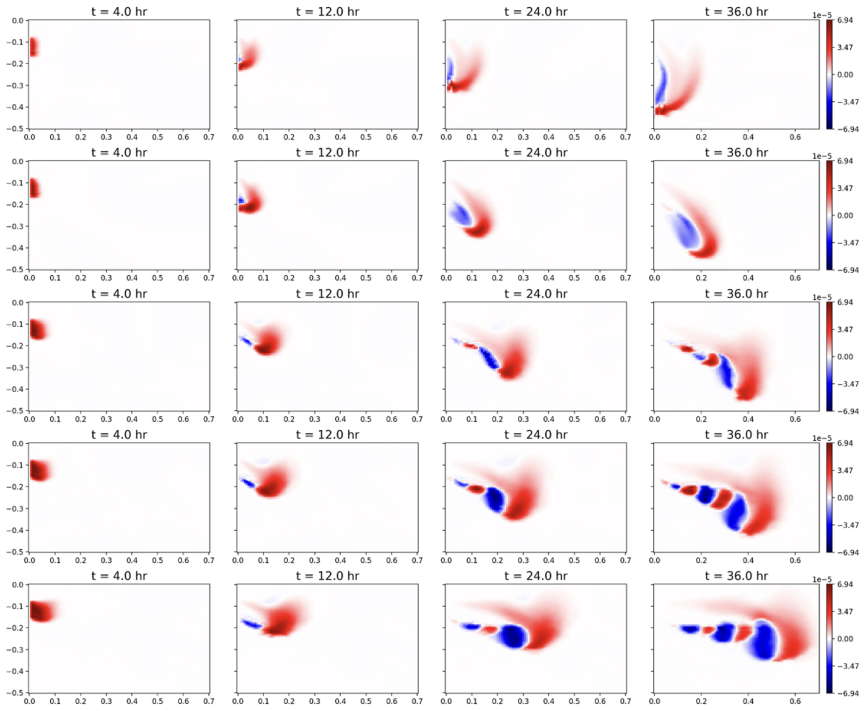
Conclusions 313 In this study, we have presented a new Enriched-DeepONet architecture, STONet, for314 emulating density-driven flow and solute transport in micro-cracked reservoirs. Our ap-315 15 Figure 8: STONet predictions of the concentration field for five samples from the test (unseen) dataset, corresponding to each sample in fig. 4. proach effective...
- [6]
- [7]
-
[8]
K. Azizzadenesheli, N. Kovachki, Z. Li, M. Liu-Schiaffini, J. Kossaifi, and 360 A. Anandkumar. Neural operators for accelerating scientific simulations and design.361 Nature Reviews Physics, 6(5):320–328, 2024. 362
work page 2024
Show all 62 references
-
[9]
S. Cai, Z. Mao, Z. Wang, M. Yin, and G. E. Karniadakis. Physics-informed neural363 networks (pinns) for fluid mechanics: A review. Acta Mechanica Sinica, 37(12): 364 1727–1738, 2021. 365
2021
-
[10]
Cuomo, V
S. Cuomo, V. S. Di Cola, F. Giampaolo, G. Rozza, M. Raissi, and F. Piccialli. 366 Scientific machine learning through physics–informed neural networks: Where we 367 are and what’s next.Journal of Scientific Computing, 92(3):88, 2022. 368
2022
-
[11]
Dentz, D
M. Dentz, D. Tartakovsky, E. Abarca, A. Guadagnini, X. Sanchez-Vila, and J. Car-369 rera. Variable-density flow in porous media.Journal of fluid mechanics, 561:209–235, 370
-
[12]
Diersch and O
H.-J. Diersch and O. Kolditz. Variable-density flow and transport in porous media:372 approaches and challenges.Advances in water resources, 25(8-12):899–944, 2002. 373
2002
-
[13]
H.-J. G. Diersch.FEFLOW: finite element modeling of flow, mass and heat transport374 in porous and fractured media. Springer Science & Business Media, 2013. 375
2013
-
[14]
Do Kim and L
Y. Do Kim and L. J. Durlofsky. Neural network surrogate for flow prediction and376 robust optimization in fractured reservoir systems.Fuel, 351:128756, 2023. 377
2023
-
[15]
Faulkner, C
D. Faulkner, C. Jackson, R. Lunn, R. Schlische, Z. Shipton, C. Wibberley, and 378 M. Withjack. A review of recent developments concerning the structure, mechanics379 and fluid flow properties of fault zones.Journal of Structural Geology, 32(11):1557– 380 1575, 2010. 381
2010
-
[16]
Fuks and H
O. Fuks and H. A. Tchelepi. Limitations of physics informed machine learning for382 nonlinear two-phase transport in porous media. Journal of Machine Learning for 383 Modeling and Computing, 1(1), 2020. 384
2020
-
[17]
Goswami, M
S. Goswami, M. Yin, Y. Yu, and G. E. Karniadakis. A physics-informed variational385 deeponet for predicting crack path in quasi-brittle materials.Computer Methods in 386 Applied Mechanics and Engineering, 391:114587, 2022. 387
2022
-
[18]
Goswami, A
S. Goswami, A. Bora, Y. Yu, and G. E. Karniadakis. Physics-informed deep neural388 operator networks. In Machine learning in modeling and simulation: methods and389 applications, pages 219–254. Springer, 2023. 390 20
2023
-
[19]
Haghighat, M
E. Haghighat, M. Raissi, A. Moure, H. Gomez, and R. Juanes. A physics-informed391 deep learning framework for inversion and surrogate modeling in solid mechanics.392 Computer Methods in Applied Mechanics and Engineering, 379:113741, 2021. 393
2021
-
[20]
Haghighat, D
E. Haghighat, D. Amini, and R. Juanes. Physics-informed neural network simulation394 of multiphase poroelasticity using stress-split sequential training.Computer Methods 395 in Applied Mechanics and Engineering, 397:115141, 2022. 396
2022
-
[21]
Haghighat, U
E. Haghighat, U. bin Waheed, and G. Karniadakis. En-deeponet: An enrichment 397 approach for enhancing the expressivity of neural operators with applications to 398 seismology. Computer Methods in Applied Mechanics and Engineering, 420:116681, 399
-
[22]
Y. Han, F. P. Hamon, S. Jiang, and L. J. Durlofsky. Surrogate model for geological401 co2 storage and its use in hierarchical mcmc history matching.Advances in Water 402 Resources, 187:104678, 2024. 403
2024
-
[23]
K. He, X. Zhang, S. Ren, and J. Sun. Deep residual learning for image recognition.404 In Proceedings of the IEEE conference on computer vision and pattern recognition, 405 pages 770–778, 2016. 406
2016
-
[24]
Hosseini, Z
N. Hosseini, Z. Bajalan, and A. Khoei. Numerical modeling of density-driven solute407 transport in fractured porous media with the extended finite element method.Ad- 408 vances in Water Resources, 136:103453, 2020. 409
2020
-
[25]
A. D. Jagtap, E. Kharazmi, and G. E. Karniadakis. Conservative physics-informed410 neural networks on discrete domains for conservation laws: Applications to forward411 and inverse problems. Computer Methods in Applied Mechanics and Engineering, 412 365:113028, 2020. 413
2020
-
[26]
Jiménez-Martínez, A
J. Jiménez-Martínez, A. Alcolea, J. A. Straubhaar, and P. Renard. Impact of phases414 distributiononmixingandreactionsinunsaturatedporousmedia. Advances in Water415 Resources, 144:103697, 2020. 416
2020
-
[27]
Ageneralandefficientformulationoffractures 417 and boundary conditions in the finite element method
R.Juanes, J.Samper, andJ.Molinero. Ageneralandefficientformulationoffractures 417 and boundary conditions in the finite element method. International Journal for 418 Numerical Methods in Engineering, 54(12):1751–1774, 2002. 419
2002
-
[28]
G. E. Karniadakis, I. G. Kevrekidis, L. Lu, P. Perdikaris, S. Wang, and L. Yang.420 Physics-informed machine learning.Nature Reviews Physics, 3(6):422–440, 2021. 421
2021
-
[29]
Kharazmi, Z
E. Kharazmi, Z. Zhang, and G. E. Karniadakis. hp-vpinns: Variational physics- 422 informed neural networks with domain decomposition.Computer Methods in Applied423 Mechanics and Engineering, 374:113547, 2021. 424 21
2021
-
[30]
Khoei, N
A. Khoei, N. Hosseini, and T. Mohammadnejad. Numerical modeling of two-phase425 fluid flow in deformable fractured porous media using the extended finite element426 method and an equivalent continuum model.Advances in water resources, 94:510– 427 528, 2016. 428
2016
-
[31]
Khoei, S
A. Khoei, S. Mousavi, and N. Hosseini. Modeling density-driven flow and solute 429 transport in heterogeneous reservoirs with micro/macro fractures.Advances in Water430 Resources, 182:104571, 2023. 431
2023
-
[32]
A. R. Khoei and M. Taghvaei. A computational dual-porosity approach for the 432 coupled hydro-mechanical analysis of fractured porous media.International Journal 433 for Numerical and Analytical Methods in Geomechanics, 2024. 434
2024
-
[33]
D. P. Kingma. Adam: A method for stochastic optimization. arXiv preprint 435 arXiv:1412.6980, 2014. 436
2014 arXiv
-
[34]
Kovachki, Z
N. Kovachki, Z. Li, B. Liu, K. Azizzadenesheli, K. Bhattacharya, A. Stuart, and437 A. Anandkumar. Neural operator: Learning maps between function spaces with 438 applications to pdes.Journal of Machine Learning Research, 24(89):1–97, 2023. 439
2023
-
[35]
N. B. Kovachki, S. Lanthaler, and A. M. Stuart. Operator learning: Algorithms and440 analysis. arXiv preprint arXiv:2402.15715, 2024. 441
2024 arXiv
-
[36]
LeCun, Y
Y. LeCun, Y. Bengio, and G. Hinton. Deep learning. nature, 521(7553):436–444, 442
-
[37]
Z. Li, N. Kovachki, K. Azizzadenesheli, B. Liu, K. Bhattacharya, A. Stuart, and444 A. Anandkumar. Neural operator: Graph kernel network for partial differential 445 equations. arXiv preprint arXiv:2003.03485, 2020. 446
2003 arXiv
-
[38]
Learningnonlinearoperators 447 via deeponet based on the universal approximation theorem of operators.Nature 448 machine intelligence, 3(3):218–229, 2021
L.Lu, P.Jin, G.Pang, Z.Zhang, andG.E.Karniadakis. Learningnonlinearoperators 447 via deeponet based on the universal approximation theorem of operators.Nature 448 machine intelligence, 3(3):218–229, 2021. 449
2021
-
[39]
Molinero, J
J. Molinero, J. Samper, and R. Juanes. Numerical modeling of the transient hydro-450 geological response produced by tunnel construction in fractured bedrocks.Engin- 451 eering Geology, 64(4):369–386, 2002. 452
2002
-
[40]
N. J. Moore, J. Cherry, S.-H. Chiu, and B. D. Quaife. How fluid-mechanical erosion453 creates anisotropic porous media. Physica D: Nonlinear Phenomena, 445:133634, 454
-
[41]
J. L. Musuuza, S. Attinger, and F. A. Radu. An extended stability criterion for 456 density-driven flows in homogeneous porous media.Advances in water resources, 32 457 (6):796–808, 2009. 458 22
2009
-
[42]
S. A. Niaki, E. Haghighat, T. Campbell, A. Poursartip, and R. Vaziri. Physics- 459 informed neural network for modelling the thermochemical curing process of 460 composite-tool systems during manufacture. Computer Methods in Applied Mech- 461 anics and Engineering, 384:113959,...
2021
-
[43]
M. Oda. An equivalent continuum model for coupled stress and fluid flow analysis463 in jointed rock masses.Water resources research, 22(13):1845–1856, 1986. 464
1986
-
[44]
B. D. Quaife and M. N. J. Moore. A boundary-integral framework to simulate viscous465 erosion of a porous medium.Journal of Computational Physics, 375:1–21, 2018. 466
2018
-
[45]
Raissi, P
M. Raissi, P. Perdikaris, and G. E. Karniadakis. Physics-informed neural networks: A467 deep learning framework for solving forward and inverse problems involving nonlinear468 partial differential equations.Journal of Computational physics, 378:686–707, 2019. 469
2019
-
[46]
Saeedmonir, M
S. Saeedmonir, M. Adeli, and A. Khoei. A multiscale approach in modeling of chem-470 ically reactive porous media.Computers and Geotechnics, 165:105818, 2024. 471
2024
-
[47]
Saeibehrouzi, R
A. Saeibehrouzi, R. Holtzman, P. Denissenko, and S. Abolfathi. Solute transport 472 in unsaturated porous media with spatially correlated disorder.Advances in Water 473 Resources, 191:104773, 2024. 474
2024
-
[48]
Saeibehrouzi, S
A. Saeibehrouzi, S. Abolfathi, P. Denissenko, and R. Holtzman. Non-monotonic 475 impact of erosion on solute dispersion in porous media.Geophysical Research Letters, 476 52(4):e2024GL114312, 2025. 477
2025
-
[49]
M. Sahimi. Flow and transport in porous media and fractured rock: from classical478 methods to modern approaches. John Wiley & Sons, 2011. 479
2011
-
[50]
R. A. Schincariol, F. W. Schwartz, and C. A. Mendoza. Instabilities in variable 480 density flows: Stability and sensitivity analyses for homogeneous and heterogeneous481 media. Water resources research, 33(1):31–41, 1997. 482
1997
-
[51]
M. L. Sebben, A. D. Werner, and T. Graf. Seawater intrusion in fractured coastal483 aquifers: A preliminary numerical investigation using a fractured henry problem. 484 Advances in water resources, 85:93–108, 2015. 485
2015
-
[52]
A. Vaswani. Attention is all you need.Advances in Neural Information Processing486 Systems, 2017. 487
2017
-
[53]
N. Wang, H. Chang, and D. Zhang. Inverse modeling for subsurface flow based on488 deep learning surrogates and active learning strategies.Water Resources Research, 489 59(7):e2022WR033644, 2023. 490
2023
-
[54]
S. Wang, H. Wang, and P. Perdikaris. Learning the solution operator of parametric491 partial differential equations with physics-informed deeponets.Science advances, 7 492 (40):eabi8605, 2021. 493 23
2021
-
[55]
G. Wen, Z. Li, K. Azizzadenesheli, A. Anandkumar, and S. M. Benson. U-fno—an494 enhanced fourier neural operator-based deep-learning model for multiphase flow.Ad- 495 vances in Water Resources, 163:104180, 2022. 496
2022
-
[56]
Real- 497 time high-resolution co 2 geological storage prediction using nested fourier neural 498 operators
G.Wen, Z.Li, Q.Long, K.Azizzadenesheli, A.Anandkumar, andS.M.Benson. Real- 497 time high-resolution co 2 geological storage prediction using nested fourier neural 498 operators. Energy & Environmental Science, 16(4):1732–1741, 2023. 499
2023
-
[57]
J. Xu, H. Wei, and H. Bao. Physics-informed neural networks for studying heat 500 transfer in porous media. International Journal of Heat and Mass Transfer, 217: 501 124671, 2023. 502
2023
-
[58]
X. Yan, J. Lin, S. Wang, Z. Zhang, P. Liu, S. Sun, J. Yao, and K. Zhang. Physics-503 informed neural network simulation of two-phase flow in heterogeneous and fractured504 porous media. Advances in Water Resources, 189:104731, 2024. 505
2024
-
[59]
R. K. Zeytounian. Joseph boussinesq and his approximation: a contemporary view.506 Comptes Rendus Mecanique, 331(8):575–586, 2003. 507
2003
-
[60]
Zhang, X
Z. Zhang, X. Yan, P. Liu, K. Zhang, R. Han, and S. Wang. A physics-informed 508 convolutional neural network for the simulation and prediction of two-phase darcy509 flows in heterogeneous porous media.Journal of Computational Physics, 477:111919, 510
-
[61]
C. B. Zhou, R. S. Sharma, Y. F. Chen, and G. Rong. Flow–stress coupled per- 512 meability tensor for fractured rock masses.International Journal for Numerical and513 Analytical Methods in Geomechanics, 32(11):1289–1309, 2008. 514
2008
-
[62]
Zhuang, A
L. Zhuang, A. Raoof, M. G. Mahmoodlu, S. Biekart, R. de Witte, L. Badi, M. T.515 van Genuchten, and K. Lin. Unsaturated flow effects on solute transport in porous516 media. Journal of Hydrology, 598:126301, 2021. 517 24
2021
Reviewed August 11, 2026 · model on record in the stance chip above.
Discussion (0). Continue with ORCID to comment.