REVIEW 4 major objections 5 minor 119 references
Fluctuation in energy extraction from quantum batteries: How open should the system be to control it?
T0 review · 4 major / 5 minor · reviewed 2026-08-07 · deepseek-v4-flash
Pith's one-line read The average extractable energy of a quantum battery is identical for random unitary, CPTP, and general quantum maps, while fluctuation generically vanishes only for the open map classes.
desk verdict Useful finite-ancilla scaling results buried under a zero-fluctuation claim that is an artifact of Cesàro averaging over auxiliary dimensions. read the letter →
The pith
A machine-rendered reading of the paper's core claim, the machinery that carries it, and where it could break.
The reading
What carries the argument
The load-bearing object is the Haar-averaged second moment of the extraction map, evaluated through the two-copy unitary integral (Eq. A1) over U(d_B d_A). The variance formulas are expressed in an SU(d_B) basis of the battery Hamiltonian: with H_B = a_0 I + Σ_i a_i λ_i, the unitary variance is (d_B α_1 − 1)/($d_B^{2}$ − 1) Σ_i $a_i^{2}$, where α_1 = Tr($ρ_B^{2}$) is the battery purity; the open-map variance uses α = α_1 ∫ Tr($ρ_A^{2}$) dρ_A, with the auxiliary purity integral from Ref. [114]. Two further pieces carry the argument: the identity (B4) that lets the partial trace pass through the tensor product of two copies, and the Cesàro mean (1/n) Σ_{d_A=2}^{n+1} over auxiliary dimensions, which makes the 1/(d_B d_A + 1)-type terms converge to zero and converts finite positive variances into Theorem 2's exact zero. Theorem 3's 1/n versus ln n/n split comes from bounding the summed terms by harmonic sequences.
What would settle it
Measure the variance of extracted energy for CPTP maps implemented with an auxiliary of one fixed dimension d_A; the paper's Observation 2 predicts it is strictly positive and scales as 1/$d_A^{2}$, so observing a strictly zero variance for any single fixed auxiliary dimension would falsify the claim that zero fluctuation requires averaging over all auxiliary dimensions.
Extended reading notes
Core claim
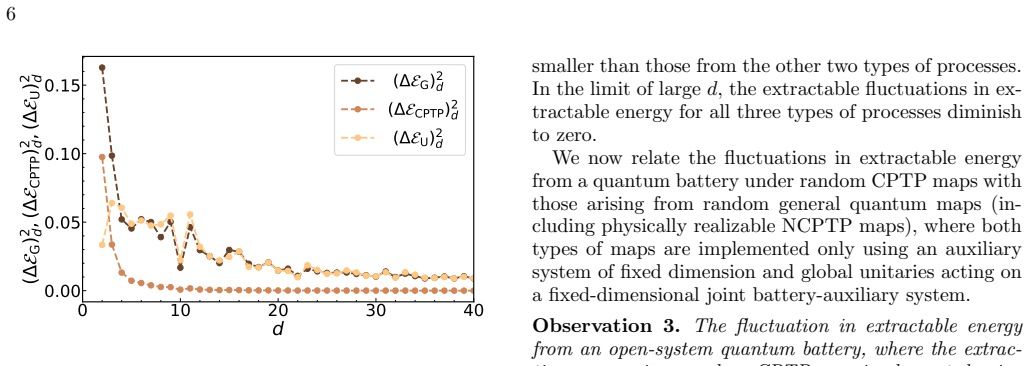
On the paper's own terms, the central discovery is a trio of theorems. Theorem 1 asserts that the Haar-averaged extractable energy is the same for random unitary, random CPTP, and arbitrary (possibly non-CPTP) quantum maps: E_U = E_CPTP = E_G, equal to Tr(ρ_B H_B) − Tr(H_B)/d_B. Theorem 2 asserts that the variance of the extracted energy is exactly zero for random CPTP and random general quantum maps, (ΔE_CPTP)^2 = (ΔE_G)^2 = 0, while random unitary maps give a nonzero variance (d_B α_1 − 1)/($d_B^{2}$ − 1) Σ_i $a_i^{2}$ that vanishes only for the maximally mixed battery state. Theorem 3 refines the open-system result: when auxiliaries are restricted up to dimension n, the Cesàro-averaged variance scales as 1/n for CPTP maps and ln n/n for general maps, so CPTP maps are claimed to be the more stable open strategy. For a fixed auxiliary dimension d_A the paper derives positive variances with 1/$d_A^{2}$ (CPTP) and 1/d_A (general) scalings, and shows that as the battery dimension grows all three classes have variance ~ 1/d_B, so large batteries erase the open-system advantage.
Load-bearing premise
The vanishing-fluctuation result depends on averaging equally over auxiliaries of all dimensions up to n and on sampling only pure entangled battery–auxiliary states when defining 'general quantum maps'; under any fixed auxiliary dimension the fluctuation is strictly positive.
Editorial extensions
If this is right
- For a fixed battery, switching the extraction process from a random unitary to a random CPTP or general map leaves the mean extracted energy unchanged while driving the variance to zero in the Cesàro limit.
- With any cap n on auxiliary dimension, CPTP maps suppress fluctuation faster (1/n) than general maps (ln n/n), so among open strategies CPTP is the noise-optimal choice.
- At fixed auxiliary dimension d_A, the general-map fluctuation (∼1/d_A) exceeds the CPTP fluctuation (∼1/d_A^2), contradicting the intuition that the more general, more resource-intensive process should perform better.
- For large battery dimension d_B, all three processes have variance ∼1/d_B, so a large battery makes unitary extraction as stable as open extraction while avoiding the auxiliary resource cost.
- The average extractable energy Tr(ρ_B H_B) − Tr(H_B)/d_B is independent of the process class, so the comparison between processes is purely a question of fluctuation and resource cost.
Reading between the lines
- The exact zero in Theorem 2 is an artifact of the Cesàro mean over auxiliary dimensions: for any single auxiliary of fixed dimension the paper's own Observation 2 gives strictly positive variance, so the 'vanishing fluctuation' describes a statistical ensemble of implementations, not any one physical battery.
- The general-map ensemble in Appendix B3 is sampled from pure entangled battery–auxiliary states (α = 1); reweighting the average over mixed joint states or over a dimension-dependent prior would almost certainly produce strictly positive variances at every finite n, which an experimentalist would see as a floor on achievable stability.
- The 1/d_B scaling common to all three classes suggests that in many-body or mesoscopic batteries the resource cost of openness buys nothing in fluctuation control; testing the crossover dimension where (ΔE_U)^2 falls below the fixed-d_A open-map variances could guide whether to invest in auxiliaries.
- If the Cesàro-zero result is taken as a design principle, the natural next question is the thermodynamic cost of the sharpness: whether the vanishing variance is accompanied by increased entropy production in the auxiliary, linking this battery result to thermodynamic uncertainty relations.
Editorial analysis
A structured set of objections, weighed in public.
Referee Report
Summary. The paper considers a fixed finite-dimensional quantum battery (state ρ_B, Hamiltonian H_B) and compares three ensembles of energy-extraction processes: Haar-random unitaries on the battery; random CPTP maps implemented by Haar-random global unitaries on battery plus an ancilla initialized in a product state; and 'general' maps, including physically realizable non-CPTP maps, where the battery-ancilla initial state may be entangled. The formal results are: Theorem 1, the average extractable energy is equal for all three ensembles; Observation 2, for fixed ancilla dimension d_A the variances are (d_A d_B α − 1)/(d_A^2 d_B^2 − 1) Σ a_i^2 for CPTP maps and 1/(d_A d_B + 1) Σ a_i^2 for general maps; Theorem 2, these variances vanish after a uniform Cesàro average over ancilla dimensions; Theorem 3, the finite-n Cesàro averages scale as 1/n and ln n/n for CPTP and general maps, respectively; and Section VII, a 1/d_B scaling with battery dimension. The paper interprets Theorem 2 as an open-system advantage in suppressing fluctuations and discusses a resource-cost versus performance trade-off.
Significance. The finite-dimensional expressions in Observation 2 and the first-moment equality in Theorem 1 are clean, explicitly derived, and potentially useful reference results for random-map models of energy extraction. The derivations are analytic and checkable, and the comparison between CPTP and general maps at fixed d_A is well posed. However, the headline claim that open-system fluctuations 'vanish' is not supported as a physical statement: it is an artifact of a Cesàro average over ancilla dimensions, and the general-map ensemble is under-specified. The paper overstates its main conclusion, although a substantial portion of the technical content could be salvaged by reframing the claims.
major comments (4)
- [Sec. V.B, Eq. (5) and Appendix B3] The general-map variance is not well-defined because the ensemble in Eq. (2) averages only over U_BA and ρ_A, not over the battery-ancilla state ρ_BA. The text states that ρ_BA may be any valid quantum state for general maps, but Appendix B3 then silently restricts ρ_BA to pure entangled states and sets α = 1. No measure over ρ_BA is specified, so the quantity (ΔE_G)^2_{d_A}, and hence Theorem 2, is computed for a subset of the allowed processes without a stated averaging convention. This needs to be fixed before the general-map results can be assessed.
- [Sec. V.B, Theorem 2 and its proof] The 'vanishing fluctuations' result is a Cesàro-limit artifact, not a property of any finite physical ensemble. The proof defines (ΔE_G)^2_n = (1/n) Σ_{d_A=2}^{n+1} (ΔE_G)^2_{d_A} and observes that each term is nonnegative and tends to zero, so the Cesàro mean tends to zero by construction. For every fixed ancilla dimension, Observation 2 gives strictly positive variances; the CPTP case follows from Observation 3 and inherits the same issue. Moreover, the uniform weighting over d_A is not a natural physical ensemble for CPTP maps, since Stinespring dilations require ancilla dimension at most d_B^2 and dimensions beyond that are redundant. The abstract's statement that CPTP and general maps 'lead to vanishing fluctuations' should be withdrawn or explicitly qualified as a statement about this particular Cesàro convention.
- [Appendix B3, Eq. (B9)] The CPTP fluctuation formulas depend on the purification dimension d_C through α = (d_A + d_C)/(d_A d_C + 1) Tr(ρ_B^2), and the paper sets d_C = d_A without physical justification. If d_C is kept fixed rather than growing with d_A, the large-d_A scaling of (ΔE_CPTP)^2_{d_A} changes from 1/d_A^2 to 1/d_A (up to constants), and the 1/n versus ln n/n separation in Theorem 3 no longer holds. The claimed CPTP advantage over general maps is therefore contingent on an arbitrary convention for the purification dimension, and this dependence should be stated and justified.
- [Sec. V.B, Eq. (2) and Observation 2] The statement that the auxiliary state ρ_A is 'chosen Haar-uniformly from D(H_dA)' is ambiguous, since there is no Haar measure on the set of density matrices. The average-purity formula taken from Ref. [114] corresponds to a specific (induced) measure on auxiliary states. Using that formula without specifying the measure on ρ_A means that the quantity α, and therefore all CPTP fluctuation formulas in Observation 2 and Theorem 3, are not uniquely determined by the ensemble described in Eq. (2). The measure should be defined explicitly.
minor comments (5)
- [Sec. II] There is a duplicated 'and' in the sentence 'The group of unitary operators and and the identity operator on a d-dimensional Hilbert space...'.
- [Sec. III.A] The notation B(Λ) for the set of all quantum maps is confusing because Λ is also used for a generic map; a different symbol, such as ℒ, would be clearer.
- [Sec. IV, Eq. (2)] As written, E_G depends on the arbitrary state ρ_BA; the text should explicitly state that the first moment is independent of ρ_BA (as shown in Appendix B1), or introduce an average over ρ_BA, so that the definition is unambiguous.
- [Sec. V.B, Observation 2] The quantity α is introduced after the formula for (ΔE_CPTP)^2_{d_A}; defining it before the formula and specifying the measure on ρ_A would improve readability.
- [Sec. VII] The statement 'we assume that Σ_{i=1}^{d_B^2-1} a_i^2 is constant, independent of d_B' is a significant modeling assumption; its influence on the claimed 1/d_B scaling should be stated in the main text rather than appearing only in the scaling analysis.
Circularity Check
Vanishing-fluctuation advantage for open maps is an artifact of the Cesàro average over ancilla dimensions, and the 'general quantum maps' average is computed only for pure entangled ancilla states.
-
self definitional
[Section V B, Theorem 2 proof]
"(∆EG)2 = lim n→∞ (∆EG)2_n, where (∆EG)2_n := 1/n Σ_{dA=2}^{n+1}(∆EG)^2_{dA}."
The paper's headline claim that fluctuations vanish for random CPTP and general quantum maps is obtained by defining the averaged fluctuation as the equally weighted Cesàro mean over auxiliary dimensions d_A = 2,...,n+1. Observation 2 already gives strictly positive per-dimension variances, (∆EG)^2_{dA} = (1/(d_B d_A + 1)) Σ a_i^2 and (∆ECPTP)^2_{dA} > 0, each tending to zero as d_A → ∞. The Cesàro mean of a sequence of positive numbers that converges to zero converges to zero by Cauchy's limit theorem, which is exactly the argument used. Thus the vanishing is forced by the chosen averaging convention, not by any property of CPTP or general maps at any finite auxiliary dimension; the 'open-system advantage' is an artifact of the definition rather than a derived physical prediction.
-
other
[Appendix B 3, calculations of Observation 2 (before Eq. B12)]
"Here we restrict ourselves to the case where ρBA is a pure entangled state. Accordingly, α = ∫ dρA TrBA(ρ^2_BA) = 1."
Equation (2) and Section V define E_G and (∆EG)^2 for 'general quantum maps' with 'ρBA can be any valid quantum state, including entangled ones.' The actual computation of (∆EG)^2_{dA}, which feeds directly into the Theorem 2 zero-fluctuation claim, silently restricts ρBA to pure entangled states and sets α = 1. No measure over the full set of allowed ρBA is specified or averaged over. The claimed result for 'arbitrary quantum maps, including NCPTP maps' is therefore equivalent to a computation for a restricted subclass, not to the stated input; the generality is imported by narrowing the definition during the proof.
full rationale
The paper contains genuine, self-contained derivations for the average extractable energy (Theorem 1), the finite-ancilla variance formulas (Observation 2), the CPTP-vs-general ordering (Observation 3), and the finite-n scaling laws (Theorem 3). These do not rely on self-citations or fitted parameters. However, the abstract's central claim that CPTP and general quantum maps give vanishing fluctuations in extractable energy is not an independent result: Theorem 2 defines the quantity as a uniform Cesàro average over auxiliary dimensions, and since each fixed-dimension variance is strictly positive but tends to zero, the average is forced to zero by elementary sequence analysis. The general-map branch is additionally computed only for pure entangled ancilla states, even though the defining equation allows arbitrary ρ_BA. Hence the flagship open-system advantage reduces, by construction, to the paper's averaging convention and its silent restriction of the ensemble. The finite-n and average-energy results are independent, so the circularity is partial rather than total.
Assumptions & free parameters
free parameters (2)
- Purification dimension d_C =
d_C = d_A
- Auxiliary-dimension averaging weight =
1/n for d_A = 2,...,n+1
assumptions (7)
- standard math Haar measure integrals for one and two copies (Eq. A1)
- domain assumption CPTP maps are realized by product battery-auxiliary states; non-CPTP maps require initial entanglement
- ad hoc to paper Average auxiliary purity formula with d_C = d_A (Eqs. B8, B9)
- ad hoc to paper For general maps, the average can be restricted to pure entangled battery-auxiliary states with α = 1
- ad hoc to paper Auxiliary dimension is averaged uniformly over d_A = 2,...,n and n tends to infinity (Cesàro)
- domain assumption Sum of squared Hamiltonian coefficients a_i is independent of battery dimension in the dB scaling analysis
- domain assumption Physically realizable non-CPTP maps exist via initial correlations as in Ref. [91]
Cite this review
Pith. "Pith review of Fluctuation in energy extraction from quantum batteries: How open should the system be to control it?." pith.science (2026). https://pith.science/paper/TXI2RZA2
@misc{pith2026250516851,
  author       = {Pith},
  title        = {Pith review of: Fluctuation in energy extraction from quantum batteries: How open should the system be to control it?},
  year         = {2026},
  howpublished = {\url{https://pith.science/paper/TXI2RZA2}},
  note         = {Machine review of arXiv:2505.16851}
}
abstract
We ask whether there exists a relation between controllability of the fluctuations in extractable energy of a quantum battery and (a) how open an arbitrary but fixed battery system is and (b) how large the battery is. We examine three classes of quantum processes for the energy extraction: unitary operations, completely positive trace-preserving (CPTP) maps, and arbitrary quantum maps, including physically realizable non-CPTP maps. We show that all three process classes yield the same average extractable energy from a fixed quantum battery. Moreover, open systems are better at controlling fluctuations in fixed quantum batteries: while random unitary operations result in nonzero fluctuation in the extractable energy, the remaining two classes lead to vanishing fluctuations in extractable energy. Furthermore, when the auxiliary system used to implement the non-unitary physically realizable maps is restricted up to a dimension $n$, fluctuation in extractable energy scales as $1/n$ for CPTP maps, outperforming the $\ln{n}/n$ scaling observed for general quantum maps. Even within open dynamics, therefore, energy extraction via random CPTP maps exhibits greater resilience to fluctuation compared to processes based on arbitrary quantum maps. We subsequently obtain that fluctuations in extractable energy scale as the inverse of the battery's dimension for all three process classes. Unitary maps, therefore, perform - in the sense of as low fluctuation as possible - equally well as more resource-intensive open maps, provided we have access to large quantum batteries. The results underscore a fundamental trade-off between performance of a battery and the resource cost of implementing the extraction processes.
Figures

Figures from the paper (1 more)

Reference graph
Works this paper leans on
-
[114]
M. Kliesch and I. Roth, Theory of quantum system cer- tification, PRX Quantum 2, 010201 (2021)
work page 2021
-
[1]
Together, these inequalities imply that (∆ ECPTP)2 = 0
On the other hand, (∆ ECPTP)2 ≥ 0, as it represents the variance of the extractable energy, and the variance of any physical quantity is always non-negative. Together, these inequalities imply that (∆ ECPTP)2 = 0. This com- pletes the proof. ■ Therefore, open-system batteries offer greater advan- tages over closed ones when it comes to minimizing fluc- tu...
-
[2]
C. M. Bender, D. C. Brody, and B. K. Meister, Quantum mechanical carnot engine, J. Phys. A: Math. Gen. 33, 4427 (2000)
2000
-
[3]
H. T. Quan, Y. X. Liu, C. P. Sun, and F. Nori, Quantum thermodynamic cycles and quantum heat engines, Phys. Rev. E 76, 031105 (2007)
2007
-
[4]
Linden, S
N. Linden, S. Popescu, and P. Skrzypczyk, How small can thermal machines be? the smallest possible refrig- erator, Phys. Rev. Lett. 105, 130401 (2010)
2010
-
[5]
Alicki, Quantum thermodynamics: An example of two-level quantum machine, Open Syst
R. Alicki, Quantum thermodynamics: An example of two-level quantum machine, Open Syst. Inf. Dyn. 21, 1440002 (2014)
2014
-
[6]
Joulain, J
K. Joulain, J. Drevillon, Y. Ezzahri, and J. Ordonez- Miranda, Quantum thermal transistor, Phys. Rev. Lett. 116, 200601 (2016)
2016
-
[7]
Vinjanampathy and J
S. Vinjanampathy and J. Anders, Quantum thermody- namics, Contemp. Phys. 57, 545 (2016)
2016
Show all 119 references
-
[8]
Bhattacharjee and A
S. Bhattacharjee and A. Dutta, Quantum thermal ma- chines and batteries, Eur. Phys. J. B 94, 239 (2021)
2021
-
[9]
N. M. Myers, O. Abah, and S. Deffner, Quantum ther- modynamic devices: From theoretical proposals to ex- perimental reality, A VS Quantum Sci.4, 027101 (2022)
2022
-
[10]
P. P. Potts, Quantum thermodynamics, arXiv:2406.19206 (2024)
2024 arXiv
-
[11]
L. S. Cangemi, C. Bhadra, and A. Levy, Quantum en- gines and refrigerators, Phys. Rep. 1087, 1 (2024)
2024
-
[12]
Esposito, U
M. Esposito, U. Harbola, and S. Mukamel, Nonequi- librium fluctuations, fluctuation theorems, and count- ing statistics in quantum systems, Rev. Mod. Phys. 81, 1665 (2009)
2009
-
[13]
Konopik and E
M. Konopik and E. Lutz, Quantum response theory for nonequilibrium steady states, Phys. Rev. Res. 1, 033156 (2019)
2019
-
[14]
A. Levy, E. Rabani, and D. T. Limmer, Response the- ory for nonequilibrium steady states of open quantum systems, Phys. Rev. Res. 3, 023252 (2021)
2021
-
[15]
Jarzynski and D
C. Jarzynski and D. K. W´ ojcik, Classical and quantum fluctuation theorems for heat exchange, Phys. Rev. Lett. 92, 230602 (2004)
2004
-
[16]
Campisi, P
M. Campisi, P. H¨ anggi, and P. Talkner, Colloquium: Quantum fluctuation relations: Foundations and appli- cations, Rev. Mod. Phys. 83, 771 (2011)
2011
-
[17]
Levy and M
A. Levy and M. Lostaglio, Quasiprobability distribu- tion for heat fluctuations in the quantum regime, PRX Quantum 1, 010309 (2020)
2020
-
[18]
M. F. Sacchi, Thermodynamic uncertainty relations for bosonic otto engines, Phys. Rev. E 103, 012111 (2021)
2021
-
[19]
Hasegawa, Thermodynamic uncertainty relation for general open quantum systems, Phys
Y. Hasegawa, Thermodynamic uncertainty relation for general open quantum systems, Phys. Rev. Lett. 126, 010602 (2021)
2021
-
[20]
Menczel, E
P. Menczel, E. Loisa, K. Brandner, and C. Flindt, Ther- modynamic uncertainty relations for coherently driven open quantum systems, J. Phys. A: Math. Theor. 54, 314002 (2021)
2021
-
[21]
Razzoli, F
L. Razzoli, F. Cavaliere, M. Carrega, M. Sassetti, and G. Benenti, Efficiency and thermodynamic uncertainty relations of a dynamical quantum heat engine, Eur. Phys. J. Spec. Top. 233, 1263 (2024)
2024
-
[22]
Rignon-Bret, G
A. Rignon-Bret, G. Guarnieri, J. Goold, and M. T. Mitchison, Thermodynamics of precision in quantum nanomachines, Phys. Rev. E 103, 012133 (2021)
2021
-
[23]
Saryal, M
S. Saryal, M. Gerry, I. Khait, D. Segal, and B. K. Agar- walla, Universal bounds on fluctuations in continuous thermal machines, Phys. Rev. Lett. 127, 190603 (2021)
2021
-
[24]
Gerry, N
M. Gerry, N. Kalantar, and D. Segal, Bounds on fluctu- ations for ensembles of quantum thermal machines, J. Phys. A: Math. Theor. 55, 104005 (2022)
2022
-
[25]
A. Das, S. Mahunta, B. K. Agarwalla, and V. Mukher- jee, Precision bound and optimal control in periodi- cally modulated continuous quantum thermal machines, Phys. Rev. E 108, 014137 (2023)
2023
-
[26]
S. Das, S. Mahunta, N. Gupt, V. Mukherjee, and A. Ghosh, Fluctuations and optimal control in a floquet quantum thermal transistor, arXiv:2412.16920 (2024)
2024 arXiv
-
[27]
Campisi, Fluctuation relation for quantum heat en- gines and refrigerators, J
M. Campisi, Fluctuation relation for quantum heat en- gines and refrigerators, J. Phys. A: Math. Theor. 47, 245001 (2014)
2014
-
[28]
Campisi, J
M. Campisi, J. Pekola, and R. Fazio, Nonequilibrium fluctuations in quantum heat engines: theory, example, and possible solid state experiments, New J. Phys. 17, 035012 (2015)
2015
-
[29]
Y. Dong, K. Zhang, F. Bariani, and P. Meystre, Work measurement in an optomechanical quantum heat en- gine, Phys. Rev. A 92, 033854 (2015)
2015
-
[30]
Chotorlishvili, M
L. Chotorlishvili, M. Azimi, S. Stagraczy´ nski, Z. Tok- likishvili, M. Sch¨ uler, and J. Berakdar, Superadia- batic quantum heat engine with a multiferroic working medium, Phys. Rev. E 94, 032116 (2016)
2016
-
[31]
S. K. Giri and H. P. Goswami, Nonequilibrium fluctua- tions of a driven quantum heat engine via machine learn- ing, Phys. Rev. E 99, 022104 (2019)
2019
-
[32]
von Lindenfels, O
D. von Lindenfels, O. Gr¨ ab, C. T. Schmiegelow, V. Kaushal, J. Schulz, M. T. Mitchison, J. Goold, F. Schmidt-Kaler, and U. G. Poschinger, Spin heat en- gine coupled to a harmonic-oscillator flywheel, Phys. Rev. Lett. 123, 080602 (2019)
2019
-
[33]
Verteletsky and K
K. Verteletsky and K. Mølmer, Revealing the strokes of autonomous quantum heat engines with work and heat fluctuations, Phys. Rev. A 101, 010101 (2020)
2020
-
[34]
Denzler and E
T. Denzler and E. Lutz, Efficiency fluctuations of a quantum heat engine, Phys. Rev. Res. 2, 032062 (2020). 12
2020
-
[35]
Lobejko, P
M. Lobejko, P. Mazurek, and M. Horodecki, Thermo- dynamics of minimal coupling quantum heat engines, Quantum 4, 375 (2020)
2020
-
[36]
G. Jiao, S. Zhu, J. He, Y. Ma, and J. Wang, Fluctuations in irreversible quantum otto engines, Phys. Rev. E 103, 032130 (2021)
2021
-
[37]
Bouton, J
Q. Bouton, J. Nettersheim, S. Burgardt, D. Adam, E. Lutz, and A. Widera, A quantum heat engine driven by atomic collisions, Nat. Commun. 12, 2063 (2021)
2021
-
[38]
Saryal and B
S. Saryal and B. K. Agarwalla, Bounds on fluctuations for finite-time quantum otto cycle, Phys. Rev. E 103, L060103 (2021)
2021
-
[39]
M. F. Sacchi, Multilevel quantum thermodynamic swap engines, Phys. Rev. A 104, 012217 (2021)
2021
-
[40]
Denzler and E
T. Denzler and E. Lutz, Power fluctuations in a finite-time quantum carnot engine, Phys. Rev. Res. 3, L032041 (2021)
2021
-
[41]
Denzler, J
T. Denzler, J. F. G. Santos, E. Lutz, and R. Serra, Nonequilibrium fluctuations of a quantum heat engine, arXiv:2104.13427 (2021)
2021 arXiv
-
[42]
Ptaszy´ nski, Non-markovian thermal operations boosting the performance of quantum heat engines, Phys
K. Ptaszy´ nski, Non-markovian thermal operations boosting the performance of quantum heat engines, Phys. Rev. E 106, 014114 (2022)
2022
-
[43]
L. d. S. Souza, G. Manzano, R. Fazio, and F. Iem- ini, Collective effects on the performance and stability of quantum heat engines, Phys. Rev. E 106, 014143 (2022)
2022
-
[44]
Shastri and B
R. Shastri and B. P. Venkatesh, Optimization of asym- metric quantum otto engine cycles, Phys. Rev. E 106, 024123 (2022)
2022
-
[45]
Kerremans, P
T. Kerremans, P. Samuelsson, and P. P. Potts, Proba- bilistically violating the first law of thermodynamics in a quantum heat engine, SciPost Phys. 12, 168 (2022)
2022
-
[46]
M. S. Alam and B. P. Venkatesh, Two-stroke quantum measurement heat engine, arXiv:2201.06303 (2022)
2022 arXiv
-
[47]
K. Li, Y. Xiao, J. He, and J. Wang, Performance of quantum heat engines via adiabatic deformation of po- tential, arXiv:2202.06651 (2022)
2022 arXiv
-
[48]
Y. Xiao, D. Liu, J. He, W. M. Liu, and J. Wang, Finite- time quantum otto engine with a squeezed thermal bath: Role of quantum coherence and squeezing in the perfor- mance and fluctuations, arXiv:2205.13290 (2022)
2022 arXiv
-
[49]
Jaseem, S
N. Jaseem, S. Vinjanampathy, and V. Mukherjee, Quadratic enhancement in the reliability of collective quantum engines, Phys. Rev. A 107, L040202 (2023)
2023
-
[50]
Singh, V
V. Singh, V. Shaghaghi, O. E. M¨ ustecaplıo˘ glu, and D. Rosa, Thermodynamic uncertainty relation in non- degenerate and degenerate maser heat engines, Phys. Rev. A 108, 032203 (2023)
2023
-
[51]
Chesi, C
G. Chesi, C. Macchiavello, and M. F. Sacchi, Work fluc- tuations in ergotropic heat engines, Entropy 25, 1528 (2023)
2023
-
[52]
El Makouri, A
A. El Makouri, A. Slaoui, and R. Ahl Laamara, Mon- itored nonadiabatic and coherent-controlled quantum unital otto heat engines: First four cumulants, Phys. Rev. E 108, 044114 (2023)
2023
-
[53]
Y. Xiao, D. Liu, J. He, W. M. Liu, L. L. Yan, and J. Wang, Thermodynamics and fluctuations in quantum heat engines under reservoir squeezing, arXiv:2209.05885 (2023)
2023 arXiv
-
[54]
M. J. Sarmah and H. P. Goswami, Efficiency fluctua- tions of a heat engine with noise induced quantum co- herences, arXiv:2405.19150 (2024)
2024 arXiv
-
[55]
Segal, Current fluctuations in quantum absorption refrigerators, Phys
D. Segal, Current fluctuations in quantum absorption refrigerators, Phys. Rev. E 97, 052145 (2018)
2018
-
[56]
Manzano, Entropy production and fluctuations in a maxwell’s refrigerator with squeezing, Eur
G. Manzano, Entropy production and fluctuations in a maxwell’s refrigerator with squeezing, Eur. Phys. J. Spec. Top. 227, 285 (2018)
2018
-
[57]
G. Jiao, Y. Xiao, J. He, Y. Ma, and J. Wang, Quan- tum otto refrigerators in finite-time cycle period, New J. Phys. 23, 063075 (2021)
2021
-
[58]
Kolisnyk and G
D. Kolisnyk and G. Schaller, Performance boost of a col- lective qutrit refrigerator, Phys. Rev. Appl. 19, 034023 (2023)
2023
-
[59]
Friis and M
N. Friis and M. Huber, Precision and work fluctuations in gaussian battery charging, Quantum 2, 61 (2018)
2018
-
[60]
Caravelli, G
F. Caravelli, G. Coulter-De Wit, L. P. Garc ´ ıa-Pintos, and A. Hamma, Random quantum batteries, Phys. Rev. Res. 2, 023095 (2020)
2020
-
[61]
Crescente, M
A. Crescente, M. Carrega, M. Sassetti, and D. Ferraro, Charging and energy fluctuations of a driven quantum battery, New J. Phys. 22, 063057 (2020)
2020
-
[62]
L. P. Garc ´ ıa-Pintos, A. Hamma, and A. del Campo, Fluctuations in extractable work bound the charging power of quantum batteries, Phys. Rev. Lett. 125, 040601 (2020)
2020
-
[63]
S. E. E. Oliviero, L. Leone, F. Caravelli, and A. Hamma, Random matrix theory of the isospectral twirling, Sci- Post Phys. 10, 076 (2021)
2021
-
[64]
Cusumano and L
S. Cusumano and L. Rudnicki, Comment on ”fluctu- ations in extractable work bound the charging power of quantum batteries”, Phys. Rev. Lett. 127, 028901 (2021)
2021
-
[65]
S. Y. Wang, Fluctuations in extractable work and bounds on the charging power of quantum batteries, Entropy 23, 1455 (2021)
2021
-
[66]
Barra, Efficiency fluctuations in a quantum battery charged by a repeated interaction process, Entropy 24, 820 (2022)
F. Barra, Efficiency fluctuations in a quantum battery charged by a repeated interaction process, Entropy 24, 820 (2022)
2022
-
[67]
S. Imai, O. G¨ uhne, and S. Nimmrichter, Work fluctu- ations and entanglement in quantum batteries, Phys. Rev. A 107, 022215 (2023)
2023
-
[68]
Bakhshinezhad, B
P. Bakhshinezhad, B. R. Jablonski, F. C. Binder, and N. Friis, Trade-offs between precision and fluctuations in charging finite-dimensional quantum batteries, Phys. Rev. E 109, 014131 (2024)
2024
-
[69]
T. K. Konar, A. Patra, R. Gupta, S. Ghosh, and A. Sen (De), Multimode advantage in continuous- variable quantum batteries, Phys. Rev. A 110, 022226 (2024)
2024
-
[70]
A. A. Zahia, M. Y. Abd-Rabbou, and A. M. Megahed, Entanglement-driven energy exchange in a two-qubit quantum battery, arXiv:2412.19715 (2024)
2024 arXiv
-
[71]
Alicki and M
R. Alicki and M. Fannes, Entanglement boost for ex- tractable work from ensembles of quantum batteries, Phys. Rev. E 87, 042123 (2013)
2013
-
[72]
Campaioli, F
F. Campaioli, F. A. Pollock, and S. Vinjanampathy, Thermodynamics in the Quantum Regime, Fundamen- tal Aspects and New Directions (Springer, New York, 2018)
2018
-
[73]
Campaioli, S
F. Campaioli, S. Gherardini, J. Q. Quach, M. Polini, and G. M. Andolina, Colloquium: Quantum batteries, Rev. Mod. Phys. 96, 031001 (2024)
2024
-
[74]
F. C. Binder, S. Vinjanampathy, K. Modi, and J. Goold, Quantacell: powerful charging of quantum batteries, New J. Phys. 17, 075015 (2015). 13
2015
-
[75]
Farina, G
D. Farina, G. M. Andolina, A. Mari, M. Polini, and V. Giovannetti, Charger-mediated energy transfer for quantum batteries: An open-system approach, Phys. Rev. B 99, 035421 (2019)
2019
-
[76]
Ghosh, T
S. Ghosh, T. Chanda, S. Mal, and A. Sen (De), Fast charging of a quantum battery assisted by noise, Phys. Rev. A 104, 032207 (2021)
2021
-
[77]
D. Saha, A. Bhattacharyya, K. Sen, and U. Sen, Har- nessing energy extracted from heat engines to charge quantum batteries, arXiv:2309.15634 (2023)
2023 arXiv
-
[78]
C. A. Downing and M. S. Ukhtary, Energetics of a pulsed quantum battery, Europhys. Lett. 146, 10001 (2024)
2024
-
[79]
P. R. Lai, J. D. Lin, Y. T. Huang, H. C. Jan, and Y. N. Chen, Quick charging of a quantum battery with super- posed trajectories, Phys. Rev. Res. 6, 023136 (2024)
2024
-
[80]
Shrimali, B
D. Shrimali, B. Panda, and A. K. Pati, Stronger speed limit for observables: Tighter bound for the capacity of entanglement, the modular hamiltonian, and the charg- ing of a quantum battery, Phys. Rev. A 110, 022425 (2024)
2024
-
[81]
S. Puri, T. K. Konar, L. G. C. Lakkaraju, and A. Sen (De), Floquet driven long-range interactions induce super-extensive scaling in quantum battery, arXiv:2412.00921 (2024)
2024 arXiv
-
[82]
Shastri, C
R. Shastri, C. Jiang, G. H. Xu, B. P. Venkatesh, and G. Watanabe, Dephasing enabled fast charging of quan- tum batteries, npj Quantum Inf. 11, 9 (2025)
2025
-
[83]
Ghosh, T
A. Ghosh, T. K. Konar, L. G. C. Lakkaraju, and A. Sen (De), Constructive impact of wannier- stark field on environment-boosted quantum batteries, arXiv:2501.01309 (2025)
2025 arXiv
-
[84]
A. E. Allahverdyan, R. Balian, and T. M. Nieuwen- huizen, Maximal work extraction from finite quantum systems, Europhys. Lett. 67, 565 (2004)
2004
-
[85]
M. Frey, K. Funo, and M. Hotta, Strong local passivity in finite quantum systems, Phys. Rev. E 90, 012127 (2014)
2014
-
[86]
A. M. Alhambra, G. Styliaris, N. A. Rodr ´ ıguez-Briones, J. Sikora, and E. Mart ´ ın-Mart ´ ınez, Fundamental limi- tations to local energy extraction in quantum systems, Phys. Rev. Lett. 123, 190601 (2019)
2019
-
[87]
Gumberidze, M
M. Gumberidze, M. Kol´ aˇ r, and R. Filip, Measurement induced synthesis of coherent quantum batteries, Sci. Rep. 9, 19628 (2019)
2019
-
[88]
Bernards, M
F. Bernards, M. Kleinmann, O. G¨ uhne, and M. Pater- nostro, Daemonic ergotropy: Generalised measurements and multipartite settings, Entropy 21, 771 (2019)
2019
-
[89]
Sen and U
K. Sen and U. Sen, Local passivity and entanglement in shared quantum batteries, Phys. Rev. A 104, L030402 (2021)
2021
-
[90]
Mohan and A
B. Mohan and A. K. Pati, Reverse quantum speed limit: How slowly a quantum battery can discharge, Phys. Rev. A 104, 042209 (2021)
2021
-
[91]
Chaki, A
P. Chaki, A. Bhattacharyya, K. Sen, and U. Sen, Auxiliary-assisted stochastic energy extraction from quantum batteries, arXiv:2307.16856 (2023)
2023
-
[92]
Bhattacharyya, K
A. Bhattacharyya, K. Sen, and U. Sen, Noncompletely positive quantum maps enable efficient local energy extraction in batteries, Phys. Rev. Lett. 132, 240401 (2024)
2024
-
[93]
Chaki, A
P. Chaki, A. Bhattacharyya, K. Sen, and U. Sen, Pos- itive and non-positive measurements in energy extrac- tion from quantum batteries, arXiv:2404.18745 (2024)
2024 arXiv
-
[94]
D. Saha, A. Bhattacharyya, and U. Sen, Approximate second laws and energy extraction from quantum bat- teries, arXiv:2409.05971 (2024)
2024 arXiv
-
[95]
Chaki, A
P. Chaki, A. Bhattacharyya, and U. Sen, Universal and complete extraction for energy-invariant cataly- sis in quantum batteries versus no uncorrelated state- invariant catalysis, arXiv:2409.14153 (2024)
2024 arXiv
-
[96]
X. Yang, Y. H. Yang, M. Alimuddin, R. Salvia, S. M. Fei, L. M. Zhao, S. Nimmrichter, and M. X. Luo, Bat- tery capacity of energy-storing quantum systems, Phys. Rev. Lett. 131, 030402 (2023)
2023
-
[97]
Ghosh, T
S. Ghosh, T. Chanda, and A. Sen (De), Enhancement in the performance of a quantum battery by ordered and disordered interactions, Phys. Rev. A 101, 032115 (2020)
2020
-
[98]
Ghosh and A
S. Ghosh and A. Sen (De), Dimensional enhancements in a quantum battery with imperfections, Phys. Rev. A 105, 022628 (2022)
2022
-
[99]
T. K. Konar, L. G. C. Lakkaraju, and A. Sen (De), Quantum battery with non-hermitian charging, Phys. Rev. A 109, 042207 (2024)
2024
-
[100]
T. K. Konar, L. G. C. Lakkaraju, S. Ghosh, and A. Sen (De), Quantum battery with ultracold atoms: Bosons versus fermions, Phys. Rev. A 106, 022618 (2022)
2022
- [101]
-
[102]
Bhattacharyya, P
A. Bhattacharyya, P. Dongre, and U. Sen, Nonlinearity- assisted advantage for charger-supported open quantum batteries, arXiv:2410.00618 (2024)
2024 arXiv
-
[103]
Joshi and T
J. Joshi and T. S. Mahesh, Experimental investigation of a quantum battery using star-topology nmr spin sys- tems, Phys. Rev. A 106, 042601 (2022)
2022
-
[104]
C. K. Hu, J. Qiu, P. J. P. Souza, J. Yuan, Y. Zhou, L. Zhang, J. Chu, X. Pan, L. Hu, J. Li, Y. Xu, Y. Zhong, S. Liu, F. Yan, D. Tan, R. Bachelard, C. J. Villas-Boas, A. C. Santos, and D. Yu, Optimal charging of a super- conducting quantum battery, Quantum Sci. Technol. 7, 0450...
2022
-
[105]
J. Q. Quach, K. E. McGhee, L. Ganzer, D. M. Rouse, B. W. Lovett, E. M. Gauger, J. Keeling, G. Cerullo, D. G. Lidzey, and T. Virgili, Superabsorption in an or- ganic microcavity: Toward a quantum battery, Sci. Adv. 8, eabk3160 (2022)
2022
-
[106]
H. P. Breuer and F. Petruccione, The Theory of Open Quantum Systems (Oxford University Press, 2007)
2007
-
[107]
M. A. Nielsen and I. L. Chuang, Quantum Computa- tion and Quantum Information (Cambridge University Press, 2010)
2010
-
[108]
Lenard, Thermodynamical proof of the gibbs formula for elementary quantum systems, J
A. Lenard, Thermodynamical proof of the gibbs formula for elementary quantum systems, J. Stat. Phys. 19, 575 (1978)
1978
-
[109]
Knopp, Infinite sequences and series (Dover Publi- cations, 1956)
K. Knopp, Infinite sequences and series (Dover Publi- cations, 1956)
1956
-
[110]
A. A. Mele, Introduction to Haar Measure Tools in Quantum Information: A Beginner’s Tutorial, Quan- tum 8, 1340 (2024)
2024
-
[111]
Goodman and N
R. Goodman and N. R. Wallach, Representations and Invariants of the Classical Groups (Cambridge Univer- sity Press, 1998)
1998
-
[112]
Zhang, Matrix integrals over unitary groups: An ap- plication of schur-weyl duality, arXiv:1408.3782 (2014)
L. Zhang, Matrix integrals over unitary groups: An ap- plication of schur-weyl duality, arXiv:1408.3782 (2014)
2014 arXiv
-
[113]
D. A. Roberts and B. Yoshida, Chaos and complexity by design, JHEP 2017 (4), 121. 14
2017
-
[115]
Bianchi and P
E. Bianchi and P. Don` a, Typical entanglement entropy in the presence of a center: Page curve and its variance, Phys. Rev. D 100, 105010 (2019). APPENDIX Appendix A: Important concepts and formulae The Haar measure [109] provides the unique probability measure on the unitary ...
2019
-
[116]
In particular, for energy extraction involving unitary maps, E′ U := Tr UBρBU † BHB
Calculations of Theorem 1 The extractable energy from a quantum battery with a stateρB and a Hamiltonian HB can be written as E = E−E′, where E = Tr (ρBHB) and E′ = Tr (ρ′ BHB) describe the energies of the battery before and after the energy extraction process. In particular, ...
-
[117]
Calculations of Observation 1 The fluctuation in the extractable energy during the process of extraction of energy from a quantum battery, initialized in a state ρB and with a Hamiltonian HB, using unitary maps, is given in Eq. (4). Using the notation E and E′ as before, Eq. (...
-
[118]
Calculations of Observation 2 Eq. (5) defines the fluctuations in extractable energy appearing in the process of energy extraction from a quantum battery, initialized in a state ρB and having a Hamiltonian HB, by employing CPTP maps, or any map from the set 16 of all possible ...
-
[119]
Using the following chain of inequalities 1 dA+1 < 1 dA+ 1 dB < 1 dA , we can bound the summation as Pn+1 dA=2 1 dA+1 < Pn+1 dA=2 1 dA+ 1 dB < Pn+1 dA=2 1 dA
Calculations of Theorem 3 The fluctuation in extractable energy arising from general quantum maps, averaged over auxiliary dimensions from dA = 2 up to a limit dA = n can be written as (∆EG)2 n = 1 n Pn+1 dA=2 β dB dA+1 = β ndB Pn+1 dA=2 1 dA+ 1 dB , where we have denoted β = ...
Reviewed August 7, 2026 · model on record in the stance chip above.
Discussion (0). Continue with ORCID to comment.