Topological nontrivial berry phase in altermagnet CrSb
Pith reviewed 2026-05-18 13:44 UTC · model grok-4.3
The pith
CrSb altermagnet shows a nontrivial Berry phase approaching π through quantum oscillations and band calculations.
A machine-rendered reading of the paper's core claim, the machinery that carries it, and where it could break.
Core claim
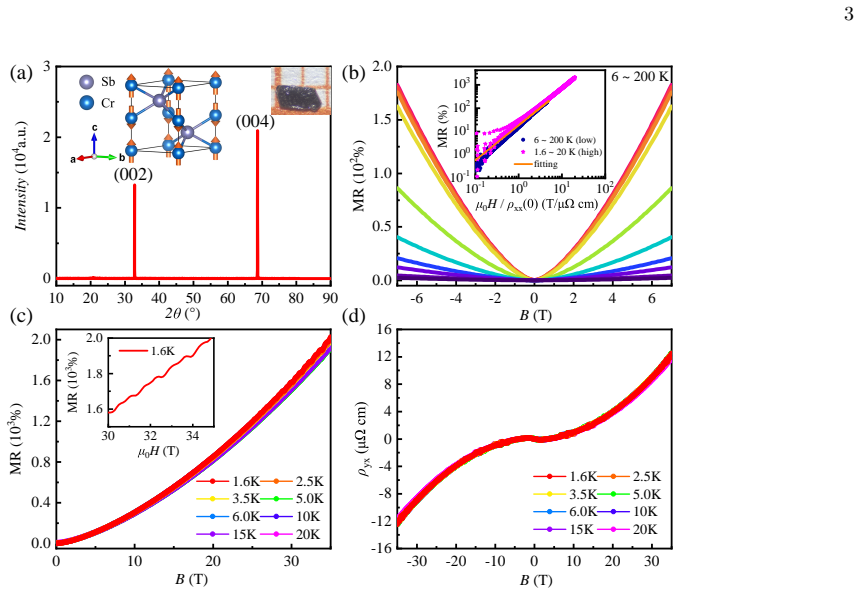
Systematic Fermi surface and band calculations combined with Berry phase analysis confirm the nontrivial topological character of this material (with a Berry phase approaching π). High-field magneto-transport measurements show magnetoresistance with no saturation up to 35 T and a power-law exponent of 1.48, while nonlinear Hall resistivity points to multiband transport and SdH oscillations exhibit Zeeman splitting at 1.6 K.
What carries the argument
Berry phase extracted from Shubnikov-de Haas quantum oscillations, cross-checked against first-principles Fermi-surface and band calculations.
If this is right
- CrSb exhibits unsaturated magnetoresistance up to 35 T that follows a power law with exponent 1.48.
- Nonlinear Hall resistivity signals multiband charge transport.
- Zeeman-induced band splitting appears in the quantum oscillations at 1.6 K.
- The combination of transport and calculations positions CrSb as a platform for topological states inside altermagnetic order.
Where Pith is reading between the lines
- Similar Berry-phase signatures may appear in other altermagnetic compounds once comparable high-field oscillation data are obtained.
- Surface-sensitive probes could test whether the bulk nontrivial phase produces protected boundary states.
- Magnetic-field tuning of the altermagnetic order might offer a route to switch topological features on and off.
Load-bearing premise
The measured Shubnikov-de Haas oscillations come from well-defined Fermi-surface pockets whose phase can be cleanly isolated by standard Lifshitz-Kosevich fitting without major interference from other bands or scattering.
What would settle it
An independent angle-resolved photoemission measurement that finds no band crossings near the Fermi level, or a Berry-phase value extracted from oscillations that deviates substantially from π, would contradict the reported nontrivial topology.
Figures


read the original abstract
The study of topological properties in magnetic materials has long been one of the forefront research areas in condensed matter physics. CrSb, as a prototypical candidate material for altermagnetism, has attracted significant attention due to its unique magnetic properties. This system provides a novel platform for exploring the intrinsic relationship between altermagnetic order and exotic topological states. In this study, we combine systematic electrical transport experiments with first-principles calculations to investigate the possible realization mechanisms of topological semimetal states in CrSb and their manifestations in quantum transport phenomena. Our high field magneto-transport measurements reveal that the magnetoresistance of CrSb exhibits no sign of saturation up to 35 T, following a distinct power-law dependence with an exponent of 1.48. The nonlinear Hall resistivity further indicates a multiband charge transport mechanism. Under high magnetic fields, we observe pronounced Shubnikov-de Haas (SdH) quantum oscillations and discernible Zeeman-effect-induced band splitting at 1.6 K. Systematic Fermi surface and band calculations combined with Berry phase analysis confirm the nontrivial topological character of this material (with a Berry phase approaching {\pi}). These findings not only provide crucial experimental evidence for understanding the electronic structure of CrSb, but also establish an important foundation for investigating topological quantum states in altermagnets.
Editorial analysis
A structured set of objections, weighed in public.
Referee Report
Summary. The manuscript reports high-field magnetotransport measurements on the altermagnet CrSb, including nonsaturating magnetoresistance with a power-law exponent of 1.48 up to 35 T, nonlinear Hall resistivity indicating multiband transport, and Shubnikov-de Haas (SdH) oscillations with Zeeman splitting at 1.6 K. These are combined with first-principles DFT calculations of the Fermi surface and bands to extract a Berry phase approaching π via Lifshitz-Kosevich analysis of the oscillations, supporting the claim of nontrivial topological character in this material.
Significance. If the Berry phase extraction proves reliable despite the multiband and Zeeman effects, the work would provide valuable experimental evidence linking altermagnetic order to topological semimetal states, strengthening the case for CrSb as a platform for studying such phenomena and contributing to the broader understanding of topological properties in magnetic materials.
major comments (2)
- [SdH oscillations and Berry phase analysis] SdH oscillations and Berry phase section: The extraction of a Berry phase approaching π relies on standard Lifshitz-Kosevich phase analysis (Landau fan diagram intercept) of the observed oscillations. However, the abstract explicitly notes multiband transport (nonlinear Hall) and 'discernible Zeeman-effect-induced band splitting', which can introduce superposition or phase shifts of order π/2 in the apparent intercept without explicit multi-frequency decomposition, temperature/field-dependent damping analysis, or accounting for spin-split contributions; this directly affects the reliability of the central topological claim.
- [Fermi surface and band calculations] Fermi surface assignment and DFT comparison: The assignment of specific oscillation frequencies to Fermi surface pockets and the identification of Zeeman splitting appear to depend on the same first-principles band calculations used to confirm the nontrivial topology. This creates a risk of circularity, as the experimental phase extraction is interpreted through the lens of the calculated surface without independent verification of pocket contributions or splitting effects.
minor comments (2)
- [Abstract] Abstract: Specific experimental values (exponent 1.48, T=1.6 K, B=35 T) are given without error bars, raw data references, or explicit description of the Berry phase fitting procedure, which reduces clarity for the central result.
- [Figures and data analysis] Presentation of data: Landau fan diagrams and SdH traces should include explicit fits, error estimates on the phase intercept, and checks for damping factors to strengthen the analysis section.
Simulated Author's Rebuttal
We thank the referee for the careful and constructive review of our manuscript. The comments highlight important considerations for the robustness of our Berry phase analysis and the interpretation of the Fermi surface. We address each point below and indicate the revisions planned for the resubmitted version.
read point-by-point responses
-
Referee: [SdH oscillations and Berry phase analysis] SdH oscillations and Berry phase section: The extraction of a Berry phase approaching π relies on standard Lifshitz-Kosevich phase analysis (Landau fan diagram intercept) of the observed oscillations. However, the abstract explicitly notes multiband transport (nonlinear Hall) and 'discernible Zeeman-effect-induced band splitting', which can introduce superposition or phase shifts of order π/2 in the apparent intercept without explicit multi-frequency decomposition, temperature/field-dependent damping analysis, or accounting for spin-split contributions; this directly affects the reliability of the central topological claim.
Authors: We agree that multiband transport and Zeeman splitting require careful handling in the phase analysis. The dominant SdH frequency was isolated via FFT of the high-field oscillatory component, and the Landau fan diagram was constructed using the positions of the main oscillation maxima for that frequency, giving an intercept near 1/2. The observed splitting is consistent with the Zeeman energy scale estimated from the DFT g-factor, and amplitude damping with temperature follows the expected Lifshitz-Kosevich form for the primary pocket. Nevertheless, we acknowledge that an explicit multi-frequency decomposition and additional field-dependent damping analysis would strengthen the claim. We will add these analyses and a revised discussion of possible phase shifts in the updated manuscript. revision: yes
-
Referee: [Fermi surface and band calculations] Fermi surface assignment and DFT comparison: The assignment of specific oscillation frequencies to Fermi surface pockets and the identification of Zeeman splitting appear to depend on the same first-principles band calculations used to confirm the nontrivial topology. This creates a risk of circularity, as the experimental phase extraction is interpreted through the lens of the calculated surface without independent verification of pocket contributions or splitting effects.
Authors: The SdH frequencies themselves are obtained directly from the experimental FFT spectrum of the magnetoresistance, independent of any calculation. DFT is used only afterward to assign the observed frequencies to specific Fermi-surface orbits and to corroborate the magnitude of the Zeeman splitting seen in the data. The Berry phase value is determined solely from the experimental Landau-level fan diagram intercept and does not incorporate the DFT results. We will revise the relevant sections to state this separation of experimental extraction and theoretical assignment more explicitly, thereby removing any appearance of circular reasoning. revision: partial
Circularity Check
No significant circularity in the derivation chain
full rationale
The paper's central claim rests on independent first-principles DFT calculations of the band structure and Fermi surface combined with separate experimental extraction of Berry phase from SdH oscillations via standard Lifshitz-Kosevich analysis of Landau fan diagrams. The calculations are parameter-free in the sense of ab initio methods and provide predicted pocket areas and topology; the experiment supplies measured frequencies, damping, and phase intercept as external data. Although frequency-to-pocket assignment and Zeeman splitting identification draw on the calculated Fermi surface for interpretation, this constitutes standard cross-validation rather than a reduction of the result to its inputs by construction. No self-definitional steps, fitted parameters renamed as predictions, or load-bearing self-citations appear in the load-bearing chain. The nontrivial topology confirmation therefore remains self-contained against external benchmarks.
Axiom & Free-Parameter Ledger
free parameters (1)
- magnetoresistance power-law exponent =
1.48
axioms (2)
- standard math Berry phase can be extracted from the phase shift of Shubnikov-de Haas oscillations using the Lifshitz-Kosevich formula.
- domain assumption First-principles DFT calculations accurately reproduce the Fermi surface pockets responsible for the observed quantum oscillations.
Lean theorems connected to this paper
-
IndisputableMonolith/Foundation/AlexanderDuality.leanalexander_duality_circle_linking unclear?
unclearRelation between the paper passage and the cited Recognition theorem.
Systematic Fermi surface and band calculations combined with Berry phase analysis confirm the nontrivial topological character of this material (with a Berry phase approaching π).
What do these tags mean?
- matches
- The paper's claim is directly supported by a theorem in the formal canon.
- supports
- The theorem supports part of the paper's argument, but the paper may add assumptions or extra steps.
- extends
- The paper goes beyond the formal theorem; the theorem is a base layer rather than the whole result.
- uses
- The paper appears to rely on the theorem as machinery.
- contradicts
- The paper's claim conflicts with a theorem or certificate in the canon.
- unclear
- Pith found a possible connection, but the passage is too broad, indirect, or ambiguous to say the theorem truly supports the claim.
Forward citations
Cited by 1 Pith paper
-
Band splitting in altermagnet CrSb
Magnetic groups formalism applied to CrSb reveals additional momentum-dependent spin splitting in electron bands beyond the exchange approximation of spin groups theory.
Reference graph
Works this paper leans on
-
[1]
ForF 3, the correspond- ing phase shiftγ−δ= 0.0813 leads to Φ = 0.5874πand Φ = 1.0874π, respectively
and Φ = 1.0406π(δ= - 1 8). ForF 3, the correspond- ing phase shiftγ−δ= 0.0813 leads to Φ = 0.5874πand Φ = 1.0874π, respectively. The Dingle temperaturesT D extracted from fitting are 48.397 K, 6.165 K, and 11.876 K, from which the quantum scattering timesτare calcu- 4 lated to be 2.5×10 −14 s, 1.97×10 −13 s, and 1.02×10 −13 s, respectively. These yield co...
-
[2]
Similarly, forF 2, an intercept ofn 0 = -0.5193 yielded Berry phases of -0.2885πand 0.2115πforδ= + 1 8 andδ= - 1 8, respec- tively. The third frequency,F 3, gave an intercept ofn 0 = -0.1667, which corresponds to Φ = 0.4167πforδ= + 1 8 and Φ = 0.9167πforδ= - 1
-
[3]
Notably, the Berry phases corresponding to the frequency componentsF 1 andF 3 exhibit good consistency between the LL index fitting and the LK fitting methods. In particular, under the LL fitting with a phase offset ofδ= - 1 8, the extracted Berry phases for both components approachπ, the comparative data are shown in Table 2. In conjunction with previous...
work page 2063
-
[4]
L. ˇSmejkal, J. Sinova, and T. Jungwirth, Emerging re- search landscape of altermagnetism, Phys. Rev. X12, 040501 (2022)
work page 2022
-
[5]
L. ˇSmejkal, J. Sinova, and T. Jungwirth, Beyond conven- tional ferromagnetism and antiferromagnetism: A phase with nonrelativistic spin and crystal rotation symmetry, 7 ( a)( b)( c)( d) FIG. 4. (a) Band structure of CrSb without spin-orbit coupling (SOC) along the high-symmetry path Γ-M-K-Γ-A-L-H-A. The red and blue frames highlight two sets of symmetry-...
work page 2022
-
[6]
J. Krempaskˇ y, L.ˇSmejkal, S. W. D’souza, M. Hajlaoui, G. Springholz,et al., Altermagnetic lifting of kramers spin degeneracy, Nature626, 517 (2024)
work page 2024
-
[7]
T. Jungwirth, R. M. Fernandes, J. Sinova, and L. Sme- jkal, Altermagnets and beyond: Nodal magnetically- ordered phases (2024), arXiv:2409.10034 [cond-mat.mtrl- sci]
-
[8]
Y. Li, Y. Liu, and C. Liu, Creation and manipulation of higher-order topological states by altermagnets, Phys. Rev. B109, L201109 (2024)
work page 2024
-
[9]
D. S. Antonenko, R. M. Fernandes, and J. W. F. Vender- bos, Mirror chern bands and Weyl nodal loops in alter- magnets, Phys. Rev. Lett.134, 096703 (2025)
work page 2025
-
[10]
R. M. Fernandes, V. S. de Carvalho, T. Birol, and R. G. Pereira, Topological transition from nodal to nodeless zeeman splitting in altermagnets, Phys. Rev. B109, 024404 (2024)
work page 2024
-
[11]
M. Yang, W. Zhao, D. Mu, Z. Shi, J. Zhong, Y. Li, Y. Liu, J. Zhong, N. Cheng, W. Zhou, J. Wang, Y. Shi, Y. Sun, W. Hao, L. Yang, J. Zhuang, and Y. Du, Mass acquisi- tion of dirac fermions in Bi 4I4 by spontaneous symmetry breaking, Phys. Rev. Lett.133, 256601 (2024)
work page 2024
-
[12]
L. Bai, W. Feng, S. Liu, L. ˇSmejkal, Y. Mokrousov, and Y. Yao, Altermagnetism: Exploring new frontiers in mag- netism and spintronics, Advanced Functional Materials 34, 2409327 (2024)
work page 2024
-
[13]
S. Xu, I. Belopolski, N. Alidoust, M. Neupane, G. Bian, C. Zhang, R. Sankar, G. Chang, Z. Yuan, C.-C. Lee, S.- M. Huang, H. Zheng, J. Ma, D. S. Sanchez, B. Wang, A. Bansil, F. Chou, P. P. Shibayev, H. Lin, S. Jia, and M. Z. Hasan, Discovery of a Weyl fermion semimetal and topological fermi arcs, Science349, 613 (2015)
work page 2015
-
[14]
X. Wan, A. M. Turner, A. Vishwanath, and S. Y. Savrasov, Topological semimetal and fermi-arc surface states in the electronic structure of pyrochlore iridates, Phys. Rev. B83, 205101 (2011)
work page 2011
-
[15]
A. A. Burkov and L. Balents, Weyl semimetal in a topo- logical insulator multilayer, Phys. Rev. Lett.107, 127205 (2011)
work page 2011
-
[16]
C. Shekhar, A. K. Nayak, Y. Sun, M. Schmidt, M. Nick- las, I. Leermakers, U. Zeitler, Y. Skourski, J. Wosnitza, Z. Liu,et al., Extremely large magnetoresistance and ul- trahigh mobility in the topological Weyl semimetal can- didate NbP, Nat. Phys.11, 645 (2015)
work page 2015
- [17]
- [18]
-
[19]
N. P. Armitage, E. J. Mele, and A. Vishwanath, Weyl and Dirac semimetals in three-dimensional solids, Rev. Mod. Phys.90, 015001 (2018)
work page 2018
-
[20]
G. Chang, S.-Y. Xu, D. S. Sanchez, S.-M. Huang, C.- C. Lee, T.-R. Chang, G. Bian, H. Zheng, I. Belopolski, N. Alidoust, H.-T. Jeng, A. Bansil, H. Lin, and M. Z. Hasan, A strongly robust type ii Weyl fermion semimetal state in Ta3S2, Science Advances2, e1600295 (2016)
work page 2016
-
[21]
S. Nie, G. Xu, F. B. Prinz, and S. C. Zhang, Topological semimetal in honeycomb lattice LnSi, Proc. Natl. Acad. Sci. U.S.A.114, 10596 (2017)
work page 2017
- [22]
- [23]
-
[24]
X. Peng, Y. Wang, S. Zhang, Y. Zhou, Y. Sun, Y. Su, C. Wu, T. Zhou, L. Liu, H. Wang, J. Yang, B. Chen, Z. Fang, J. Du, Z. Jiao, Q. Wu, and M. Fang, Scaling behavior of magnetoresistance and hall resistivity in the altermagnet CrSb, Phys. Rev. B111, 144402 (2025)
work page 2025
-
[25]
M. Zeng, M. Zhu, Y. Zhu, X. Liu, X. Ma, Y. Hao, P. Liu, G. Qu, Y. Yang, Z. Jiang, K. Yamagami, M. Arita, X. Zhang, T. Shao, Y. Dai, K. Shimada, Z. Liu, M. Ye, Y. Huang, Q. Liu, and C. Liu, Observation of spin split- ting in room-temperature metallic antiferromagnet CrSb, Advanced Science11, 2406529 (2024)
work page 2024
- [26]
-
[27]
J. Ding, Z. Jiang, X. Chen, Z. Tao, Z. Liu, T. Li, J. Liu, J. Sun, J. Cheng, J. Liu, Y. Yang, R. Zhang, L. Deng, W. Jing, Y. Huang, Y. Shi, M. Ye, S. Qiao, Y. Wang, Y. Guo, D. Feng, and D. Shen, Large band splitting in g-wave altermagnet CrSb, Phys. Rev. Lett.133, 206401 (2024)
work page 2024
-
[28]
W. Lu, S. Feng, Y. Wang, D. Chen, Z. Lin, X. Liang, S. Liu, W. Feng, K. Yamagami, J. Liu, C. Felser, Q. Wu, and J. Ma, Signature of topolog- ical surface bands in altermagnetic Weyl semimetal CrSb, Nano Letters25, 7343 (2025), pMID: 40294341, https://doi.org/10.1021/acs.nanolett.5c00482
- [29]
-
[30]
G. Kresse and J. Furthm¨ uller, Efficient iterative schemes forab initiototal-energy calculations using a plane-wave basis set, Physical Review B54, 11169 (1996)
work page 1996
-
[31]
G. Kresse and D. Joubert, From ultrasoft pseudopoten- tials to the projector augmented-wave method, Physical Review B59, 1758 (1999)
work page 1999
-
[32]
J. P. Perdew, K. Burke, and M. Ernzerhof, Generalized Gradient Approximation Made Simple, Physical Review Letters77, 3865 (1996)
work page 1996
- [33]
-
[34]
N. Marzari and D. Vanderbilt, Maximally localized gen- eralized Wannier functions for composite energy bands, Physical Review B56, 12847 (1997)
work page 1997
-
[35]
N. Marzari, A. A. Mostofi, J. R. Yates, I. Souza, and D. Vanderbilt, Maximally localized Wannier functions: Theory and applications, Reviews of Modern Physics84, 1419 (2012)
work page 2012
-
[36]
A. A. Mostofi, J. R. Yates, G. Pizzi, Y.-S. Lee, I. Souza, D. Vanderbilt, and N. Marzari, An updated version of wannier90: A tool for obtaining maximally-localised Wannier functions, Computer Physics Communications 185, 2309 (2014)
work page 2014
-
[37]
Q. Wu, S. Zhang, H.-F. Song, M. Troyer, and A. A. Soluyanov, WannierTools: An open-source soft- ware package for novel topological materials, Computer Physics Communications224, 405 (2018)
work page 2018
-
[38]
P. Rourke and S. Julian, Numerical extraction of de Haas–van Alphen frequencies from calculated band en- ergies, Computer Physics Communications183, 324 (2012)
work page 2012
-
[39]
A. I. Snow, Neutron diffraction investigation of the atomic magnetic moment orientation in the antiferro- magnetic compound CrSb, Phys. Rev.85, 365 (1952)
work page 1952
-
[40]
A. J. Wu, B. Z. Zhang, C. J. Liu, and D. X. Shao, Mag- netic quadratic nodal line with spin–orbital coupling in CrSb, Applied Physics Letters123, 052407 (2023)
work page 2023
-
[41]
W. J. Takei, D. E. Cox, and G. Shirane, Magnetic struc- tures in the MnSb-CrSb system, Phys. Rev.129, 2008 (1963)
work page 2008
-
[42]
J. Du, Z. Lou, S. Zhang, Y. Zhou, B. Xu, Q. Chen, Y. Tang, S. Chen, H. Chen, Q. Zhu, H. Wang, J. Yang, Q. Wu, O. V. Yazyev, and M. Fang, Extremely large magnetoresistance in the topologically trivial semimetal α−WP 2, Phys. Rev. B97, 245101 (2018)
work page 2018
-
[43]
F. C. Chen, H. Y. Lv, X. Luo, W. J. Lu, Q. L. Pei, G. T. Lin, Y. Y. Han, X. B. Zhu, W. H. Song, and Y. P. Sun, Extremely large magnetoresistance in the type-ii weyl semimetal MoTe2, Phys. Rev. B94, 235154 (2016)
work page 2016
-
[44]
Q. Chen, Z. Lou, S. Zhang, B. Xu, Y. Zhou, H. Chen, S. Chen, J. Du, H. Wang, J. Yang, Q. Wu, O. V. Yazyev, and M. Fang, Large magnetoresistance and nonzero berry phase in the nodal-line semimetal MoO 2, Phys. Rev. B 102, 165133 (2020)
work page 2020
-
[45]
J. H. Du, H. D. Wang, Q. Chen, Q. Mao, R. Khan, B. J. Xu, Y. X. Zhou, Y. N. Zhang, J. H. Yang, B. Chen, C. M. Feng, and M. H. Fang, Large unsaturated positive and negative magnetoresistance in Weyl semimetal TaP, Sci. China Phys. Mech. Astron.59, 037411 (2016)
work page 2016
-
[46]
Z. Wang, X. Peng, S. Zhang, Y. Su, S. Lai, X. Zhou, C. Wu, T. Zhou, H. Wang, J. Yang, B. Chen, H. Zhai, Q. Wu, J. Du, Z. Jiao, and M. Fang, Negative magnetore- sistance in the antiferromagnetic semimetalV 1/3T aS2, Chinese Physics B33, 037301 (2024)
work page 2024
-
[47]
Y. Zhou, Z. Lou, S. Zhang, H. Chen, Q. Chen, B. Xu, J. Du, J. Yang, H. Wang, C. Xi, L. Pi, Q. Wu, O. V. Yazyev, and M. Fang, Linear and quadratic magnetore- sistance in the semimetal SiP2, Phys. Rev. B102, 115145 (2020)
work page 2020
- [48]
-
[49]
A. B. Pippard,Magnetoresistance in Metals, Cambridge Studies in Low Temperature Physics, Vol. 2 (Cambridge University Press, Cambridge, 1989). 9
work page 1989
-
[50]
Kohler, Zur magnetischen widerstands¨ anderung reiner metalle, Annalen der Physik424, 211 (1938)
M. Kohler, Zur magnetischen widerstands¨ anderung reiner metalle, Annalen der Physik424, 211 (1938)
work page 1938
-
[51]
Z. Zhu, X. Lin, J. Liu, B. Fauqu´ e, Q. Tao, C. Yang, Y. Shi, and K. Behnia, Quantum oscillations, thermo- electric coefficients, and the fermi surface of semimetallic WTe2, Phys. Rev. Lett.114, 176601 (2015)
work page 2015
- [52]
-
[53]
Y. Liu, X. Yuan, C. Zhang,et al., Zeeman splitting and dynamical mass generation in Dirac semimetal ZrTe 5, Nat. Commun.7, 12516 (2016)
work page 2016
-
[54]
H. Su, X. Shi, J. Yuan, Y. Wan, E. Cheng, C. Xi, L. Pi, X. Wang, Z. Zou, N. Yu, W. Zhao, S. Li, and Y. Guo, Multiple Weyl fermions in the noncentrosymmet- ric semimetal LaAlSi, Phys. Rev. B103, 165128 (2021)
work page 2021
-
[55]
X. Dai, Z. Li, Y. Xu, Y. Deng, Y. Zhang, P. Yan, J. Wang, S. Wang, K. He, Y. Li, Y. Xu, and L. He, Extremely large magnetoresistance and shubnikov de haas oscillations in the topological nodal-line semimetal ZrP 2, Phys. Rev. B 109, 165155 (2024)
work page 2024
-
[56]
P. Nowakowska, O. Pavlosiuk, P. Wi´ sniewski,et al., Temperature-dependent Fermi surface probed by Shubnikov–de Haas oscillations in topological semimetal candidates DyBi and HoBi, Sci. Rep.13, 22776 (2023)
work page 2023
-
[57]
Y. Li, C. Xu, M. Shen, J. Wang, X. Yang, X. Yang, Z. Zhu, C. Cao, and Z.-A. Xu, Quantum transport in a compensated semimetal W 2As3 with nontrivial Z 2 in- dices, Phys. Rev. B98, 115145 (2018)
work page 2018
-
[58]
L. Xing, R. Chapai, R. Nepal,et al., Topological behavior and Zeeman splitting in trigonal PtBi 2−x single crystals, npj Quantum Mater.5, 10 (2020)
work page 2020
-
[59]
W. Gao, X. Zhu, F. Zheng,et al., A possible candidate for triply degenerate point fermions in trigonal layered PtBi2, Nat. Commun.9, 3249 (2018)
work page 2018
-
[60]
H. Murakawa, M. S. Bahramy, M. Tokunaga, Y. Ko- hama, C. Bell, Y. Kaneko, N. Nagaosa, H. Y. Hwang, and Y. Tokura, Detection of berry’s phase in a bulk rashba semiconductor, Science342, 1490 (2013)
work page 2013
-
[61]
D. Qu, Y. S. Hor, J. Xiong, R. J. Cava, and N. P. Ong, Quantum oscillations and hall anomaly of surface states in the topologi- cal insulator Bi 2Te3, Science329, 821 (2010), https://www.science.org/doi/pdf/10.1126/science.1189792
-
[62]
A. K. Okazaki, S. Wiedmann, S. Pezzini, M. L. Peres, P. H. O. Rappl, and E. Abramof, Shubnikov–de haas os- cillations in topological crystalline insulator SnTe(111) epitaxial films, Phys. Rev. B98, 195136 (2018)
work page 2018
-
[63]
W. Lu, S. Feng, Y. Wang, D. Chen, Z. Lin, X. Liang, S. Liu, W. Feng, K. Yamagami, J. Liu, C. Felser, Q. Wu, and J. Ma, Signature of Topological Surface Bands in Altermagnetic Weyl Semimetal CrSb, Nano Letters25, 7343 (2025)
work page 2025
- [64]
-
[65]
Z. Song, A. Z. Yang, Y. Jiang, Z. Fang, J. Yang, C. Fang, H. Weng, and Z.-X. Liu, Constructions and applications of irreducible representations of spin-space groups, Phys- ical Review B111, 134407 (2025). 10 Appendix A: F ermi-surface evolution from weak to full spin–orbit coupling ( a)( b)weak SOCS OC/s947 '/s945 ' /s946 ' /s946 /s945 /s947 FIG. 5. Evolu...
work page 2025
discussion (0)
Sign in with ORCID, Apple, or X to comment. Anyone can read and Pith papers without signing in.