REVIEW 5 major objections 5 minor 12 references
Information Theoretic Analysis of a Dual-Band MIMO Cellphone Antenna with ANSYS HFSS SBR+
T0 review · 5 major / 5 minor · reviewed 2026-08-06 · deepseek-v4-flash
Pith's one-line read The paper claims that an information-theoretic outage analysis of a dual-band cellphone MIMO array yields a diversity gain of about 1.4, substantially below the maximum of 2 predicted by conventional correlation-based antenna metrics.
desk verdict A promising cautionary case study undercut by a nonstandard diversity-gain metric (Eq. 14) and unverifiable rate equations; the 1.4 vs 2 comparison is an artifact of the metric, not a property of the antenna. read the letter →
The pith
A machine-rendered reading of the paper's core claim, the machinery that carries it, and where it could break.
The reading
What carries the argument
The carrying object is the outage-probability diversity gain, extracted by comparing the throughput cumulative distribution of a 2x1 receive-diversity/maximal-ratio-combining link against a 1x1 single-antenna baseline at the same SNR. The channel matrices fed into those distributions come from HFSS SBR+ ray-tracing for 140 user positions, interpreted through multiport communication theory, in which the MIMO channel matrix $H$ is built from transmit, receive, and propagation scattering matrices rather than from idealized independent fading coefficients. The comparison metric is $d = \log_{10}(p_{2\times 1}^{\mathrm{outage}})/\log_{10}(p_{1\times 1}^{\mathrm{outage}})$, and the reference curves for $d=2$ and for optimal multiplexing are obtained from the same simulated data using optimal MMSE-SIC processing.
What would settle it
Reproduce the outage analysis with the same antenna but a second city geometry (different buildings, roads, or base-station placement) and compare the resulting $d$; if $d$ moves to about 2, the $d \approx 1.4$ result is an artifact of the chosen scene. Independently, rederive Eqs. (11) and (13) with consistent power normalizations and rerun the simulation code; if the corrected $d$ departs materially from 1.4, the discrepancy is partly a code-level issue.
Extended reading notes
Core claim
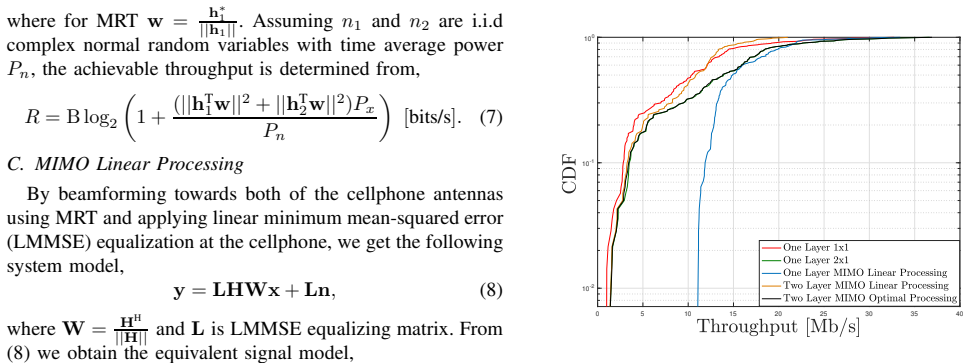
The central result is that the two-antenna cellphone array, despite excellent conventional metrics (isolation $|S_{21}| = -22$ dB and ECC $= 0.04$), achieves an outage-based diversity gain of only $d \approx 1.4$ when measured against a single-antenna baseline at $3.16$ GHz and about $10$ dB average SNR. The diversity gain is defined as the log-ratio of outage probabilities, $d = \log_{10}(p_{2\times 1}^{\mathrm{outage}})/\log_{10}(p_{1\times 1}^{\mathrm{outage}})$, so the maximum for two independent branches would be $2$. The beam-coupling matrix method predicts approximately $2$ for this same antenna, leading the authors to report substantial differences between the methodologies. At high SNR (around $30$ dB), the multiplexing gain of the array becomes significant and optimal MMSE-SIC processing approaches the two-layer limit, whereas linear LMMSE processing is interference-limited by the correlation in the channel. At low SNR (around $-10$ dB), MIMO transmission provides no benefit over a single beamformed layer. The paper interprets these curves as evidence that power imbalance between the two antennas—one is well matched, the other has $|S_{11}| \approx 0.79$ at $3.16$ GHz—and the actual channel statistics, not the isolated antenna metrics, determine diversity.
Load-bearing premise
The whole comparison rests on the assumption that 140 simulated user channels in one Cupertino scene, with concrete material properties and a single base station, represent real urban fading statistics well enough, and that the rate formulas actually implemented match the printed equations.
Editorial extensions
If this is right
- A better-matched or power-balanced dual-band design could recover roughly 10 Mb/s (about 20%) at 10 dB SNR, since the gap between $d \approx 1.4$ and $d = 2$ is that large.
- At low SNR around $-10$ dB, the best strategy is single-layer transmission with base-station beamforming; splitting power into two MIMO layers wastes energy.
- At high SNR around $30$ dB, multiplexing gain becomes the dominant design target, and optimal MMSE-SIC processing nearly reaches the maximum of 2 while linear LMMSE remains interference-limited.
- Envelope correlation coefficient and beam-coupling matrix methods overestimate diversity performance for this dual-band array, so they should not be used alone as acceptance metrics.
Reading between the lines
- A natural stress test is to repeat the analysis in two or three different city scenes with different building heights and user distributions; if the diversity gain varies with the scene, then single-number claims about antenna diversity should be replaced by a distribution over environments.
- The likely physical cause of $d \approx 1.4$ is the strong power imbalance at $3.16$ GHz ($|S_{11}| \approx 0.79$ for the mismatched antenna), which conventional metrics hide; if that is right, equalizing branch gains through a matching network should push the outage curves toward $d = 2$ even without changing the array geometry.
- Because linear detectors are interference-limited in this channel, the outage analysis implies that polarization decorrelation—not just low isolation—should be a primary design goal; a dual-band matching network that equalizes the two branches could improve both linear and optimal processing gains.
- Before using the absolute numbers in another context, the printed rate equations need to be reconciled with the implemented simulation, as Eqs. (11) and (13) contain apparent power-normalization inconsistencies; this is a code-verification step, not a change to the qualitative conclusion.
Editorial analysis
A structured set of objections, weighed in public.
Referee Report
Summary. The paper proposes an information-theoretic evaluation of a dual-band, dual-polarized MIMO cellphone antenna. Channel matrices are generated with ANSYS HFSS (full-wave antenna model) and HFSS SBR+ (ray-tracing over a Cupertino scene with 140 user positions). From the resulting throughput CDFs at three SNR regimes, the authors estimate a diversity gain d≈1.4 at moderate SNR using their Eq. (14), and a multiplexing gain at high SNR, and compare these with conventional metrics (ECC, beam-coupling matrix) that predict diversity gain ≈2. They conclude that the conventional metrics substantially overestimate the antenna's diversity performance and that a more thorough information-theoretic analysis is valuable.
Significance. If the analysis were sound, this would be a useful demonstration of how physics-based EM simulation can be combined with Shannon-theoretic outage analysis to evaluate antenna arrays in realistic deployments. The use of the multiport channel model of Eq. (2), full-wave antenna simulation, and ray-traced user channels is appealing and goes beyond simple i.i.d. Rayleigh assumptions. However, the central quantitative claim depends on a nonstandard diversity metric and on rate equations that contain apparent errors; no code or data are provided to verify the simulation. As a result, the paper's headline comparison (d≈1.4 vs d≈2) is not substantiated.
major comments (5)
- [Section V, Eq. (14)] The diversity gain is defined as d = log10(p2x1_outage)/log10(p1x1_outage) at a single operating point. This is not the standard diversity order, which is the asymptotic slope of log P_out vs log SNR at fixed target rate. For two independent Rayleigh branches, P1 ≈ γ/SNR and P2 ≈ γ^2/(2 SNR^2), so Eq. (14) gives (2 log SNR − log(γ^2/2))/(log SNR − log γ), which depends on the target rate γ and the chosen SNR, equaling 2 only in the infinite-SNR limit. The paper neither specifies the outage threshold nor the SNR point at which the ratio is evaluated, so the reported d≈1.4 cannot be compared with the diversity order d=2 predicted by the ECC/beam-coupling methods. This undermines the paper's central claim of substantial differences.
- [Section IV.D, Eq. (13)] The expression R = B log2 det(I + H H^H W W^H H) is not a valid mutual information formula. If H is Nr×Nt and W = H^H/||H||, the product H H^H W W^H H is not conformable, and no SNR factor (Px/Pn) appears. The mutual information for a MIMO channel with precoding W should include an SNR scaling, e.g., B log2 det(I + (Px/Pn) H W W^H H^H) with appropriate normalization. As printed, Eq. (13) cannot be the quantity whose CDF is plotted in Fig. 6. The authors must correct this equation and clarify the matrix dimensions and norm used.
- [Section IV.C, Eq. (11)] The single-layer throughput formula contains apparent typos. The numerator is (|~h1|^2 + |~h2|^2)^2 Px, which squares the combined SNR, and the denominator has |~h1|^2 Pe1 + |~h2| Pe2, where the second term is missing its square. If these are not typos, the formula is dimensionally inconsistent. Since the outage probabilities and thus d≈1.4 are computed from these rates, the printed equation must be corrected before the numerical results can be assessed.
- [Section II and Section V] The outage CDFs are based on 140 user positions in a single OSM-imported Cupertino scene. No confidence intervals, bootstrap intervals, or sensitivity analyses are reported, and the low-throughput tail of the CDF—the region used to define outage—is estimated from very few samples. The difference between d≈1.4 and d=2 could plausibly be within the sampling uncertainty of a 140-sample CDF. The authors should provide confidence intervals on the outage probabilities and, ideally, results over multiple scenes or user distributions.
- [Section V] The comparison with ECC and beam-coupling metrics is not a like-for-like comparison. The ECC/beam-coupling diversity gain of approximately 2 is derived under assumptions of isotropic or rich-scattering propagation and ideal combining, whereas the HFSS SBR+ simulation uses a specific urban scene, a single base station geometry, MRT toward one or both UE antennas, and MMSE-SIC reception. The observed difference between d≈1.4 and d=2 may reflect these different scenarios and processing assumptions rather than a failure of the conventional metrics to predict diversity. To support the paper's conclusion, the authors should compute a common diversity measure (e.g., the standard diversity order from the outage curves) and compare it with the ECC/beam-coupling prediction under the same scattering assumptions.
minor comments (5)
- [Section II] The concrete conductivity is stated as σ ≈ 1.7e−5 S/m, which is far below typical values for concrete (around 10^-2 S/m). This may substantially affect the propagation results; the authors should justify or test the sensitivity of the outage curves to this parameter.
- [Section III] The paper states the 3.16 GHz antenna is mismatched with |S11|≈0.7860, but it is not explained whether this mismatch is included in the channel matrix H through Eq. (2) and in the noise model. This matters for interpreting the diversity gain.
- [Section IV.C] The notation W = HH/||H|| is ambiguous; it should state the dimensions (e.g., W = H^H/||H||_F for a Nr×Nt H) and define the norm used. Also, the LMMSE matrix L is not defined.
- [Figures 4–6] The axes are not labeled, and the curves are referred to only by color; a legend and axis labels (e.g., throughput in Mb/s and CDF value) should be added.
- [Throughout] There are several typos, e.g., 'Cellpho ne' in the title, 'receieve' in Section IV, and 'configured' in Section II. A careful proofread is needed.
Circularity Check
No circularity: the outage-based diversity estimate is computed from independent HFSS SBR+ channel matrices, not fitted to the ECC/beam-coupling target.
full rationale
The paper's central numerical result, d≈1.4 in Eq. (14), is read directly from outage CDFs that are generated from channel matrices produced by ANSYS HFSS SBR+ for 140 user positions in a Cupertino scene. The derivation chain is: HFSS SBR+ channel matrices -> rate expressions (11)-(13) -> outage CDFs in Figs. 4-6 -> diversity gain via Eq. (14). At no point is a parameter fitted to the ECC or beam-coupling prediction of d=2, and the reported d is not inserted as an input. The self-citation [5] supplies the multiport channel formula Eq. (2), but the numerical pipeline does not depend on that formula: Section II explicitly states that HFSS SBR+ was used to obtain the channel matrices, and the actual computations use those simulated channels. Thus the self-citation is background material, not load-bearing evidence for the discrepancy claim. The definition in Eq. (14) is nonstandard - it is a log-ratio of outage probabilities at an unspecified operating point rather than an outage-probability slope - and the dimensional inconsistencies in Eqs. (11) and (13) are real concerns, but these are correctness or metric-validity issues, not circularity. Nothing in the paper reduces the prediction to its own inputs by construction, and the comparison with conventional metrics is externally sourced rather than derived from the same fitted values.
Assumptions & free parameters
free parameters (1)
- Outage threshold (target rate) for computing p_outage =
not stated
assumptions (7)
- standard math Shannon capacity and AWGN MIMO mutual information formulas are valid for the simulated channels
- domain assumption Multiport channel formula Eq. (2) from prior work [5] correctly models the antenna, source, and load networks
- domain assumption HFSS full-wave simulation accurately represents the cellphone antenna impedances and radiation patterns
- domain assumption HFSS SBR+ ray tracing produces channel matrices representative of a real urban macrocell
- domain assumption Source and load terminations are 50 ohms (SS=0, SL=0)
- domain assumption Additive noise at the cellphone is i.i.d. complex Gaussian with equal power on both ports
- ad hoc to paper User locations and count (140 UEs at 90-200 m from one base station) are representative
Cite this review
Pith. "Pith review of Information Theoretic Analysis of a Dual-Band MIMO Cellphone Antenna with ANSYS HFSS SBR+." pith.science (2026). https://pith.science/paper/TYDPCRIH
@misc{pith2026250714704,
  author       = {Pith},
  title        = {Pith review of: Information Theoretic Analysis of a Dual-Band MIMO Cellphone Antenna with ANSYS HFSS SBR+},
  year         = {2026},
  howpublished = {\url{https://pith.science/paper/TYDPCRIH}},
  note         = {Machine review of arXiv:2507.14704}
}
read the original abstract
Historically, the design of antenna arrays has evolved separately from Shannon theory. Shannon theory adopts a probabilistic approach in the design of communication systems, while antenna design approaches have relied on the deterministic Maxwell theory alone. In this paper, we investigate an information-theoretic analysis approach which we apply to evaluate the design of a dual-band, dual-polarized multiple-input multiple-output (MIMO) array on a cellphone. To this end, we use ANSYS HFSS, a commercial electromagnetic (EM) simulation software suitable for the numerical optimization of antenna systems. HFSS is used to obtain an accurate model of the cellphone MIMO antenna array and HFSS SBR+ is utilized to obtain channel matrices for a large number of users. Taking advantage of linear and optimal processing at the cellphone, we estimate the outage probability curves. The curves are then used to determine the diversity gain in a moderate signal-to-noise ratio (SNR) regime and the multiplexing gain at a high SNR regime. This approach is then compared with the method of estimating the diversity gain from the envelope correlation coefficients or the beam-coupling matrix showing substantial differences in the two methodologies.
Figures


Figures from the paper (3 more)


Reference graph
Works this paper leans on
- [1]
-
[2]
R. W. Heath Jr and A. Lozano, F oundations of MIMO communication. Cambridge University Press, 2018
work page 2018
-
[3]
Mutual coupling in mimo wi reless systems: A rigorous network theory analysis,
J. W. Wallace and M. A. Jensen, “Mutual coupling in mimo wi reless systems: A rigorous network theory analysis,” IEEE transactions on wireless communications, vol. 3, no. 4, pp. 1317–1325, 2004
work page 2004
-
[4]
Toward a circuit theory of communi- cation,
M. T. Ivrlaˇ c and J. A. Nossek, “Toward a circuit theory of communi- cation,” IEEE Transactions on Circuits and Systems I: Regular Papers , vol. 57, no. 7, pp. 1663–1683, 2010
work page 2010
-
[5]
Cha nnel estima- tion with tightly-coupled antenna arrays,
B. Tadele, V . Shyianov, F. Bellili, and A. Mezghani, “Cha nnel estima- tion with tightly-coupled antenna arrays,” in ICASSP 2023-2023 IEEE International Conference on Acoustics, Speech and Signal P rocessing (ICASSP). IEEE, 2023, pp. 1–5
work page 2023
-
[6]
Achievable rate with antenna size constraint: Shannon mee ts chu and bode,
V . Shyianov, M. Akrout, F. Bellili, A. Mezghani, and R. W. Heath, “Achievable rate with antenna size constraint: Shannon mee ts chu and bode,” IEEE Transactions on Communications , 2021
work page 2021
-
[7]
S. Saab, A. Mezghani, and R. W. Heath, “Optimizing the mut ual information of frequency-selective multi-port antenna ar rays in the presence of mutual coupling,” IEEE Transactions on Communications , 2021
work page 2021
-
[8]
Theoretical limitations on the broadband ma tching of arbitrary impedances,
R. M. Fano, “Theoretical limitations on the broadband ma tching of arbitrary impedances,” Journal of the Franklin Institute , vol. 249, no. 1, pp. 57–83, 1950
work page 1950
Show all 12 references
-
[9]
Connected array antennas: Analysis and des ign,
D. Cavallo, “Connected array antennas: Analysis and des ign,” 2011
2011
-
[10]
Achievable rate of near-field communications based on phys ically consistent models,
M. Akrout, V . Shyianov, F. Bellili, A. Mezghani, and R. W . Heath, “Achievable rate of near-field communications based on phys ically consistent models,” arXiv preprint arXiv:2111.08928 , 2021
2021 arXiv
-
[11]
Diversity order and measure of mimo antennas in si ngle- user, multiuser, and massive mimo wireless communications ,
R. S. Kshetrimayum, M. Mishra, S. A¨ ıssa, S. K. Koul, and M. S. Sharawi, “Diversity order and measure of mimo antennas in si ngle- user, multiuser, and massive mimo wireless communications ,” IEEE Antennas and Wireless Propagation Letters , vol. 22, no. 1, pp. 19–23, 2022
2022
-
[12]
Quantifying diversity and cor relation in rayleigh fading mimo communication systems,
M. Ivrlac and J. Nossek, “Quantifying diversity and cor relation in rayleigh fading mimo communication systems,” in Proceedings of the 3rd IEEE International Symposium on Signal Processing a nd Information Technology (IEEE Cat. No. 03EX795) . IEEE, 2003, pp. 158–161
2003
Reviewed August 6, 2026 · model on record in the stance chip above.
Discussion (0). Continue with ORCID to comment.